
| Content |  German German |
About |
The spiritual message of the Norse Edda
Welcome to the mystical realm of the Norse Edda! Welcome to the realm of the gods Odin, Loki, Thor, Baldr, Freyr, and others, to the realm of the goddesses Frigg, Freyja, Gerda, Sigyn, and many more! Welcome to the realm of dwarves, humans, and giants, to Asgard, Midgard, and Niflheim, the World of Mist! Welcome to the realm between Odin's two eyes!
Having already discussed Norse mysticism quite extensively in the World of the Nibelungs (sorry, in German only), we now wish to examine the figures, songs, and stories of the Edda in greater detail. The word “Edda” can be interpreted as “great-grandmother”, who can tell us many tales full of wisdom from long ago. Much has already been written and interpreted about it from the perspectives of history, science, and nature. Therefore, we would like to approach the topic from a different angle and, above all, search for the spiritual depth and meaning of the transmitted text. So don't be surprised if we don't always write what has already been written a hundred times before!
These web pages are still under construction, so everything is in progress and nothing is set in stone. For further suggestions, constructive criticism, or questions, please feel free to contact us via the email addresses listed at the bottom of this page. We wish you patience, enjoyment, and inspiration while reading!
With best wishes,
Undine & Jens
Content
- The Nature of Odin
- Mimir's Well
- Heimdall
- Mimirs Head
- The Story of Kvasir
- Odin's Throne
- Odin's Eight-Legged Horse
- Odin's Runes Song
- Odin as the Host-Father in Valhalla
- Valkyries
- Example of a Near-Death Experience
- Story of Högni and Hedin
- Odin's Wives
- Song of Grimnir (Grímnismál)
- The Nature of Loki
- The Story of Thjasi and Skadi
- Loki`s Family
- The Story of the Otter Penance
- The Story of Baldr`s Death
- Draupnir, the Ring of Renewal
- Baldrs Dreams (Vegtam‘s Song)
- Loki is bound
- The Nature of Thor
- The Nine Worlds
- The nine sisters as nine waves
- Thor’s Family
- The Story of Thor in the Land of the Giants
- The Story of Thor's Fishing Trip
- The Meaning of Thor's Hammer Mjölnir
- The Lay of Thrym and the Recovery of the Hammer
- The Story of Thor and Hrungnir’s Fight
- The Song of Groa's Awakening (Gróugaldr)
- The Song of Fjölswid (Much-Smart)
- The Story of Thor and Geirröd
- To be continued...
- List of Sources
Processing status:
The Worldview of the Edda — Summary
From a spiritual perspective, the Edda reveals a truly remarkable, comprehensive, and fascinating worldview—one that once again challenges the common stereotype of the “Dark Ages” as a time of ignorance. The tales of the gods, in particular, centre around the symbolism of a world tree that—as a tree of life—strives and grows upward toward celestial light. Nine worlds are found within its crown and trunk, and three wells at its roots:
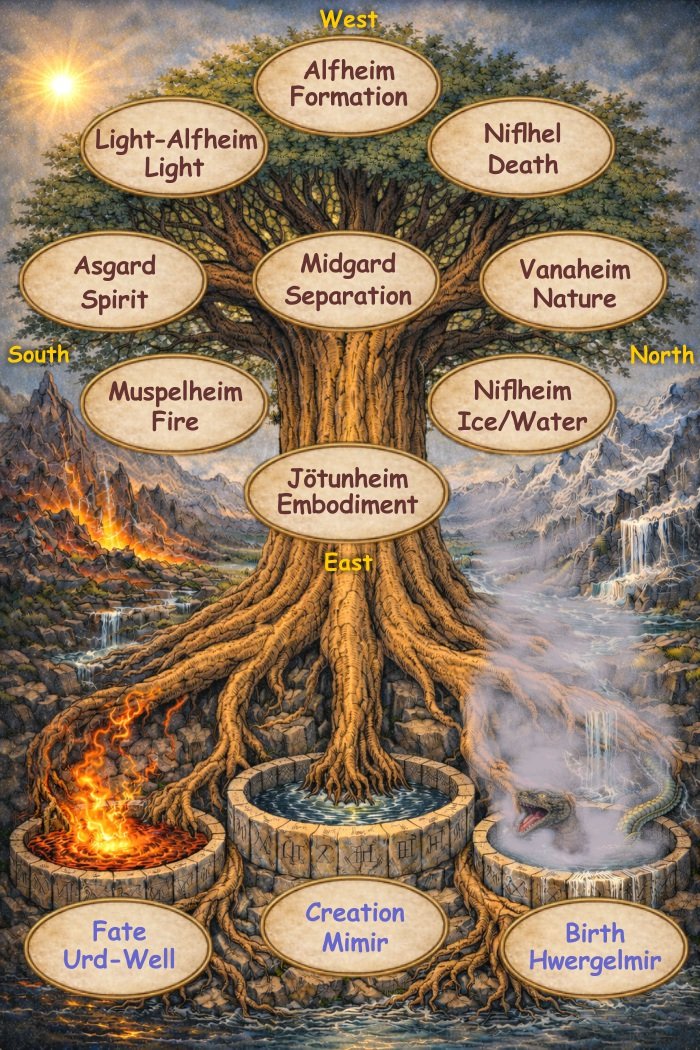
At the centre of the nine worlds, where the tree’s mighty branches fork and divide, lies Midgard—the world of humanity. From this point, we can turn and evolve in any direction. Amidst the interplay of fire and water, one can discern both a spiritual side and a natural side within this tree. High up among the leaves appears the microcosm, inhabited by the dwarfish nature spirits of form-giving; down by the trunk lies the macrocosm, with the titanic embodiments of material solidification.
The central well essentially represents one of Odin’s eyes—a source from which the spirit of Mimir draws forth the creation as a whole, while Odin observes it with his other eye. This is why he is known as the Creator God and the All-Father. On the spiritual side lies the Well of Fate, where the gods gather daily to pass judgment on fateful events. On the natural side, one can envision physical beings emerging from a well of birth in Niflheim—the misty realm of nature—and journeying toward Niflhel, the realm of death.
Alongside Odin, the All-Father, many other gods and goddesses are described—figures who can be viewed as various aspects of the indescribable Divine and who dwell primarily in Asgard. Like the dwarves and giants, they are depicted with human-like traits, making it easier for human beings to recognize themselves in them; therein, perhaps, lies the ultimate goal.
Thus, humanity plays a central role not only within the World Tree but also in the tales of gods and heroes. These stories seek, above all, to explain the human psyche and place it within the greater scheme of things. Of particular interest in this context are the two fundamental paths: that of the Einherjar and that of the solitary warrior. The path of the solitary warrior—marked by separation and isolation—leads to death in Niflhel, appearing as a dark dead end and a final stop. In contrast, the path of the Einherjar—the “host of unity”—leads to Valhalla, Odin’s hall; this is a path of constant renewal and regeneration, serving as a training ground for the battles of the world. This principle of renewal can be observed on both small and large scales, extending even to the cyclical renewal of all creation, when every aspect of the Divine passes away in space and time, only to emerge anew from the eternal light of Gimle.
These heroic tales draw upon many ancient legends familiar to the German-speaking region. Here, too, one finds profound insights into human psychology. Masculine and feminine forces within the individual move like playing figures across the world stage, participating in the grand interplay between spirit and nature. Using modern terminology, we can distinguish between the inner soul and the outer body in relation to nature, and between the divisive ego, the thinking intellect, and holistic reason in relation to the spirit. As with the World Tree, the human intellect stands at the centre; it may incline toward the ego or toward reason, toward the holistic soul or the separated body. Ultimately, however, the goal is to unite all these forces peacefully and harmoniously within the greater whole, thereby walking the path of the Einherjar.
It is therefore well worth studying these wonderfully profound texts of the Old Norse Edda. Thanks!

