
| Content | Next | About |
The Nature of Loki
Loki is considered one of the most enigmatic figures in Norse mythology. Yet he is not so enigmatic as he seems, merely highly contradictory. And this is where we see his essence: as a spirit of contradiction, and even a divine spirit of contradiction, for he is explicitly referred to as an Aesir in the Edda and thus counted among the gods. What does this mean? Well, as soon as the divine beings actively intervene in creation, there must, of course, be a counter-effect to this action. This is worldly logic, and we can imagine it personified as Loki.
The precise meaning of his name is, as usual, disputed. The English Wikipedia currently favours the Germanic root “luk”, which refers to anything related to loop, knot, or closure. This fits relatively well, because Loki, so to speak, closes off all the effects of the gods and neutralizes them on the whole. This must be the case if we consider the pantheon as a holistic entity, for the whole must remain largely neutral. The only thing the gods can do is delay the counteraction in time and space. To illustrate this, we would like to look at some stories that clarify the nature of Loki.
The Story of Thjasi and Skadi
First, the aforementioned story of Aegir, Thjasi, and Skadi, with which the book of skaldic poems begins:
A man was called Aegir or Hler (two names for “sea”). He lived on the island now called Hlesey (“Island of Hler,” today probably Læsø). He was exceptionally skilled in magic. He undertook a journey to Asgard (“Garden of the Gods”), but the Aesir knew of his voyage. He was received hospitably, but many things were played for him with illusions. And in the evening, when they were about to drink, Odin had swords brought into the hall. They shone so brightly that they illuminated the room, and there was no other light while they sat drinking. Then the Aesir proceeded to their feast, and the twelve who were to be judges sat upon their high seats. These were their names: Thor, Njördr, Freyr, Tyr, Heimdall, Bragi, Vidar, Vali, Ullr, Hönir, Forseti, and Loki. The goddesses were also there: Frigg, Freyja, Gefjun, Idun, Gerda, Sigyn, Fulla, and Nanna. Aegir found what he saw there magnificent. The entire wall panelling was covered with splendid shields. Mead was poured, and much was drunk.
Aegir, also known as Gymir, was introduced in the “Song of Grimnir” as the “thawed” frost giant Ymir, who became a friend and host of the gods. He is, in a sense, a sea giant, a holistic aquatic being in whom we can see the epitome of a living being. He thus embodies the dynamic, changeable, and creative nature of life, making him a natural friend of the gods. When this being becomes “magically skilled” and recognizes the magic of spirit and nature, he also comes to Asgard, to the “Garden of the Gods”, which here primarily refers to Valhalla.
There, “many things were played for him with sensory illusions”. Are the gods deceiving him? No, because he is still a living being. While no longer completely hardened or frozen matter, he is also not yet pure consciousness, but rather a “fluid being” between light and darkness in the flow of creation. Here, the world can only be perceived indirectly through the senses, and these, of course, deceive us.
This “space of consciousness” is illuminated by swords that Odin had brought into the hall. We have encountered the spiritual symbolism of the sword in many ways in the Nibelung saga. The edge serves separation and distinction, and the point, unity and wisdom. In Zen Buddhism, one also speaks of the “sword that kills and gives life”. This is the weapon of our intellect, with which we perceive the world and fight within it. That Odin brings these swords into the hall is yet another wonderful symbolism. For these swords, too, are pure consciousness, pure light, as reflected between Odin's eyes. This is also alluded to by the “drink” in Valhalla, the mead of the gods, representing wholeness, which, depending on one's perspective, can also be a wine of “illusion and creative power” or a beer for intoxication and drowsiness.
In this “light of swords”, Aegir now recognizes the court of the twelve gods, each with their own distinct attributes and roles. Interestingly, Odin himself is absent from this circle, though he can be seen either as the “president” in Forseti or as the entire circle. Eight goddesses are also mentioned. Just as the number twelve suggests spiritual wholeness, this eight could represent the natural diversity reuniting as gods and goddesses.
Finally, the shield-like walls of this hall of consciousness are mentioned, the symbolism of which we have already considered in the description of Valhalla.
Bragi (the god of poets and writers) sat closest to Aegir, and the two drank and conversed together. Bragi told Aegir about the many adventures the Aesir had experienced. He began with a story about three Aesir who set out from their home: Odin, Loki, and Hönir. They travelled over mountains and through wilderness, and food was scarce. But when they came down into a valley, they saw a herd of oxen, took one, and prepared it in a cooking pit. And when they thought it must be cooked, they opened the pit, but it was still not done. The second time they opened the pit, some time had passed, and it was still not cooked. They discussed among themselves how this could be. Then they heard words from the oak tree above them, saying that the one who sat there was preventing the pit from boiling. They looked up, and there perched an eagle, which was not a small one. He said: “If you'll give me my share of the ox, it will be cooked in the pit.” They agreed.
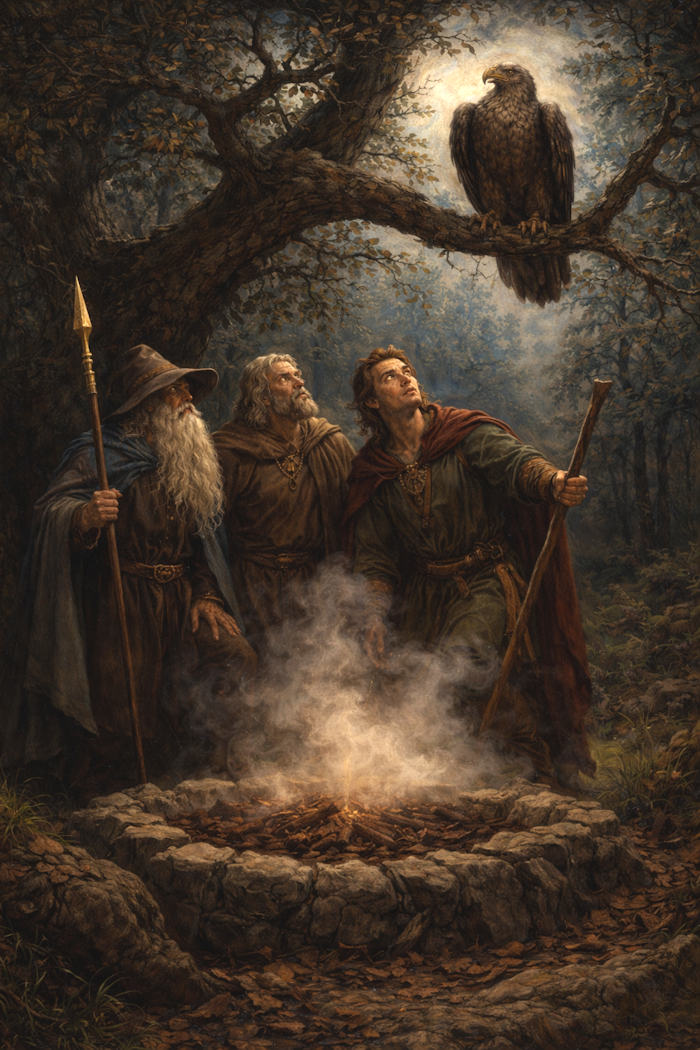
Then he slid down from the tree, sat down on the pit, and immediately took two ox shanks and the two shoulder pieces. This enraged Loki, and he grabbed a large pole. He swung it with all his might and struck at the eagle's body. The eagle dodged the blow and took flight. But the pole stuck in the eagle's rump, and Loki clung to the other end. The eagle flew so high that Loki's feet dragged scree, stones, and trees along with it. He thought his arms would be torn from his shoulders. He cried out and begged the eagle for peace, but the eagle said that Loki would never be freed unless he promised to bring Idun (the “Renewer and Rejuvenator”) and her (golden) apples out of Asgard. And Loki promised. Thereupon he was freed and returned to his companions.
Thus, the gods now tell the “living being” the stories of life, with all the symbolic circumstances in which the living being can recognize itself. The great story begins when Odin, Loki, and Hönir “set out from home into the world”. That is, they “set out” from the holistic deity into action, reaction, and reason as a healing spirit.
But what can this threefold spirit feed on in the physical world? For this, physical food must be cooked, much like the boar Sährimnir in Valhalla, or what we call digestion in the body or decay in the earth. It must therefore be transformed back into energy and ultimately into consciousness so that the spirit can act in nature. And who tries to prevent this process? There, once again, sits an eagle, a bird of prey and symbol of desire, in the Tree of Life, seeking to hold onto physicality. Interestingly, it is described as an oak. Thus, scholars have long debated whether Yggdrasil is an ash, an oak, or a yew. And in the Nibelung saga, we find the linden tree above all as a symbol of the tree of life. It is, in fact, a holistic tree, a symbol for all trees and, in the broadest sense, for all living beings.
The greedy eagle naturally wants the best and biggest pieces. Therefore, Loki has to act as a counterforce. And the story becomes so absurd that one can only really think of a symbolic interpretation. For desire, of course, doesn't let go of its counterforce, because it still wants more, and here even the goddess Idun of youth and immortality with her golden apples as true and imperishable fruits. Yes, even today many people still think about being able to make their bodies eternally young and even immortal, and this seems to them to be the way out of suffering, to avoid death and all fear.
Now, reason might tell us: “It's Loki who suffers, not the greedy eagle.” Yes, one can ponder this wonderful symbolism deeply. Ultimately, it is of course the deity who carries everything, including all states of consciousness involving suffering as “collision with physical matter, like scree, stones, and trees”. But here we mustn't forget the “large pole” with which everything is connected. Thus, desire cannot be free from its holistic or divine counter-effect. And so, the story continues:
Nothing more can be told of their journey until their return home. But at the appointed time, Loki lured Idun from Asgard into a forest. He said he had found apples that she would surely value, and asked her to bring her own apples and compare them. There, the giant Thjasi (“Icy One”) appeared in the form of an eagle, seized Idun, and flew away with her to Thrymheim (“Home of Battle Noise”) and his court.
Thus, the eagle is revealed to be the frost giant Thjasi, who seeks with his desire immortality in the world. But what happens when, in our world of battle noise through desire and hatred, a physical form becomes immortal? Then, of course, the truth is lost, and with it, the awareness of the true essence of the immortal gods.
But the Aesir suffered greatly because of Idun's disappearance; they soon grew grey and old. So, they held a Thing (a meeting), and each asked the others what they had last known of her. The last time she had been seen, however, was when she left Asgard with Loki. Thereupon, Loki was seized and dragged before the assembly. He was threatened with death and torture. After he became frightened, he promised to search for Idun in Jotunheim if Freyja would lend him the falcon cloak she possessed. And when he had it, he flew north to Jotunheim and one day came to the giant Thjasi. Thjasi was out rowing (fishing) on the sea, but Idun was at home. Loki transformed her into a nut, took her in his talons, and flew away as fast as he could.
What does it mean when Loki is threatened with death and torture by the gods and becomes afraid? Here, too, we can see the interplay of action and reaction. For suffering, death, and fear are perhaps the greatest countermeasures in our world against the desire to hold on and possess. Some even say they are the greatest blessing of the gods: “Whom God loves, he makes suffer.” And thus, here too, the world is set right again.
But when Thjasi returned home and missed Idun, he took the form of an eagle, flew after Loki, and soared like one. And when the Aesir saw the falcon flying with the nut, and the eagle following suit, they ran out from Asgard and brought armfuls of wood shavings. When the falcon flew over the castle, it landed behind the rampart. The Aesir, however, lit a fire in the shavings, and the eagle could no longer stop its flight once the falcon had vanished. The flames engulfed its feathers, and it was forced to land. Then the Aesir were there and slew the giant Thjasi behind the Aesir gate. This was a widely famous slaying.
Thus, what is meant to happen, unfolds, much like in the story of Suttung. Desire rises to the gods in pursuit of immortality. There, of course, it is consumed, for no desire can exist within wholeness. And the essence of the greedy frost giant cannot survive here either, but encounters its antidote as fire death; that is, it melts and dissolves, only to flow again. It is crucial that this message becomes known and “famous” throughout the world, otherwise, no learning would be possible.
But Skadi (“damage” or “loss”), the daughter of Thjasi, seized her helmet, mail, and all her weapons of war and went to Asgard to avenge her father's death. The Aesir offered her peace and penance. First, she was to choose a husband from among them, based on his feet, without seeing anything else. She beheld the very beautiful feet of a man and said: “I choose him; only Balder could have so little ugliness.” But it was Njördr of Noatun. In their peace treaty, they had also agreed that the Aesir should accomplish something she thought they couldn't: making her laugh. So, Loki did this: He tied one end of a rope around a goat's beard and the other end around his testicles. They took turns pulling on it, and both cried out loudly. Then Loki fell into Skadi's lap, and she laughed. Thus, peace was made between her and the Aesir. It is said that Odin made amends by taking Thjasis's eyes, throwing them into the sky, and turning them into two stars.
(Skáldskaparmál §1 after Arnulf Krause and Karl Simrock)
Now, death is of course not a true solution, for it leaves behind “damage and loss”. Accordingly, Skadi, the daughter of the mountain and frost giant, appears, in whom we can once again see, from a spiritual perspective, the soul of nature as the principle of causation. For she remains when the physical body dissolves. And as long as there are causes, there will also be a struggle for effects. But the gods, of course, do not fight against this soul of nature; rather, they ally and unite with her, for it is the gods' desire that the causes, on the whole, have their effect. Therefore, death is also not a true solution.
Now, the soul of nature desires nothing more than the pure and divine light of consciousness, namely Baldr as the god of light. But, of course, she only sees the feet of the gods, with which they can move in the external world. Accordingly, she also chooses a nature god of the Vanir, and that is Njördr, the god of the sea, wind, and fire. Thus, the causative soul remarries with the active spirit of nature.
And how does she rediscover her joy in life? Here, too, a wondrous and enigmatic, yet profound symbolism is described for Loki's nature: The goat reminds us of Heidrun from the roof of Valhalla, the “secret of the pastureland”, who bestows the sweet mead as the divine drink of wholeness. And Loki's testicle recalls the seed of conception from the sea of causes for the manifold living beings that strive to come into being. Thus, just as the gods generally work towards wholeness and spiritual unity, so Loki, conversely, works towards natural diversity within unity. Accordingly, he then allows himself to “fall into Skadi's lap”, and this is, of course, a great joy for the soul, to give birth to diversity.
But “all good things come in threes”: Odin ultimately ensures that the eyes of the frost giant, as a symbol of consciousness, are affixed to the sky as stars, which comes very close to immortality. At least we know today that some stars are almost as old as the entire universe.
Thus, in the three gifts to Skadi, we also find the three gods from the beginning of the story: The first gift of marriage to Njördr would then come from Hönir as reason and healing spirit. The second gift of joy in the vibrant diversity of nature came from Loki. And the third gift of the immortality of the eyes of consciousness was bestowed by Odin. A wonderful story! But it continues, though in another book, namely in “Gylfi’s Illusion”, section 23, in the description of Njördr:
A third Aesir is the one called Njördr. He lives in the sky at a place called Noatun (Ship Place, Sea). He controls the course of the winds and governs the sea and fire. He is invoked for seafaring and fishing. He is so rich and blessed with success that he can give to humankind from his abundance of land and wealth. That is why he is called upon. Njördr is not of the Aesir lineage. He grew up in Vanaheim, but the Vanir gave him to the gods as a hostage and took Hönir in exchange. He was part of the peace agreement between the gods and the Vanir. Njördr has a wife named Skadi, the daughter of the giant Thjasi. But Skadi wants to live the dwelling that belonged to her father. It lies in the mountains at a place called Thrymheim (“Home of Battle Noise”). Njördr, however, wants to live near the sea. They agreed to spend nine days in Thrymheim and then the other nine in Noatun. But when Njördr returned from the mountains to Noatun, he said:
“I am tired of the mountains; I was not there long, only nine days. The (loud) howling of the wolves seemed unpleasant to me compared to the song of the swans.”
Skadi replied:
“And I couldn’t sleep on the seashore because of the birds’ cries. The seagull woke me every morning when it came in from the sea.”
Then she travelled up into the mountains and lived in Thrymheim. She often travels on snowshoes with her bow and hunts animals. She is called the Snowshoe Goddess or Ski-Diese (Woman of Destiny), as it is called here:
Thrymheim is where Thjasi, the all-powerful giant, lived. But now Skadi, the radiant bride of the gods, inhabits her father’s old court.
Njördr of Noatun later had two children: one named Freyr (as the god of summer) and his daughter Freyja (as the goddess of love and fertility). They were beautiful and powerful. Freyr is the most distinguished of the Aesir. He controls rain and sunshine and thus the fertility of the earth. It is auspicious to call upon him for a good harvest and peace. Moreover, he determines people's wealth. Freyja is the most esteemed of the goddesses… She enjoys love songs, and it is beneficial to invoke her in matters of love.
(Gylfaginning §23/24 after Arnulf Krause and Karl Simrock)
Thus, Skadi, as the daughter of the mountain and frost giant, becomes the winter goddess and still prefers to inhabit the icy mountains where wolves howl with hunger. Her marriage to Njördr becomes a play of waves between winter and summer, seemingly living separately yet united. A play of waves of life's waters emerges, oscillating between freezing and flowing, a theme echoed by the number nine as the number of renewal. As the winter goddess and the soul of natural creation, she ensures that life is preserved throughout the frosty winter and becomes the mother of Freyr and Freyja, the summer god and goddess of sensual love and fertility. Here, too, we find the interplay of action and reaction, suggesting that Loki's divine fall into Skadi's womb was not without consequence. For, logically, Loki, as a god, is holistically and omnipresent, ultimately acting in accordance with the holistic nature of the deity.
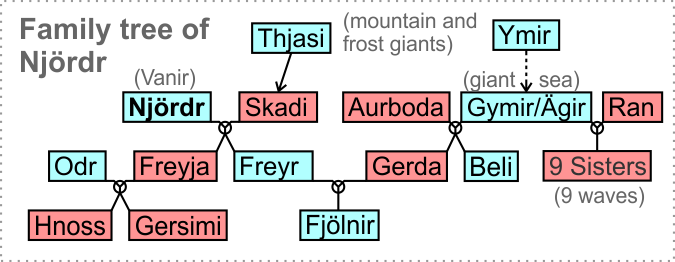
(see also family tree Edda PDF)
Loki`s Family
In “Gylfi's Illusion,” starting at §33, the following is reported about Loki:
Among the Aesir is also counted the one whom some of the Aesir call the slanderer and instigator of treachery and the shame of all gods and humans. Thus, Loki (the “rascal” or “intertwined one”) or Loptr (the “airy” or “incomprehensible one”), the son of the giant Farbauti (“hostile thug”), is called. His mother is named Laufey (“leaf”) or Nal (“needle”). His brothers are Byleist (“wave-slash”) and Helblindi (he who “does not see Hel”, also a name of Odin). Loki is handsome and of pleasing appearance, but has a bad character and is unpredictable in his behaviour. He surpasses all others in cunning, but also in all kinds of deception. He constantly caused the Aesir difficulties, but often resolved them with trickery. His wife is named Sigyn (“bringer of victory”), and their son is named Nari or Narfi (the “one who constricts and limits”).
How can one describe the divine spirit of contradiction without turning it into a villain, a devil, or a demon? Every effect, by and large, requires a counter-effect; otherwise, everything would immediately collapse, and nothing could endure. Every river needs two banks; otherwise, it cannot flow. Therefore, in creation, there could be no arising without passing away, no light without darkness, no life without death, no good without evil, no day without night. This lies in the nature of creation, the Mimir-intellect. As Hermann Hesse writes in his book “Siddhartha”:
“The opposite of every truth is equally true! Namely, like this: A truth can only be expressed and clothed in words if it is one-sided. Everything that can be thought with thoughts and said with words is one-sided; everything is one-sided, everything is incomplete, everything lacks wholeness, completeness, and unity.”
Thus, Loki, too, as a being shaped by our intellect, was born from the macrocosm at the dawn of the world, the son of a giant and a giantess, much like Odin. His father's name already hints at his hostile nature as a counterpoint, and his mother evokes the foliage of transience and the pain of the needle, whose suffering Loki also embodies as a god. His brother Helblindi suggests a close kinship with Odin, the active creator god. This is also reflected in “Loki's Mocking Speech” (verse 9):
Loki said: “Do you remember, Odin, that in ancient times we mixed blood together? You vowed never to partake of ale unless it was brought to both of us.”
His wife Sigyn, as “bringer of victory”, recalls the Valkyrie Sigrdrifa as “driver of victory”, who, much like Loki, defied Odin's will yet ultimately brought about the god's triumph. Their son Nari, or Narfi, as the “Constrictor and Limiter”, also seems to work against the divine light of wholeness, yet this is necessary for physical life in creation. For without limitation, there would be no physical life. In this respect, he already hints at the nature of Loki's other three children:
But Loki had more children. Angrboda (“messenger of sorrow, source of fear”) was the name of a giantess in Jotunheim, and with her Loki had three children: one was the Fenris wolf, the second Jörmungand (“giant serpent”), the Midgard Serpent, and the third Hel (the goddess of death). But the gods knew that these three siblings were growing up in Jotunheim. And they learned through prophecies that great misfortune would befall them from the siblings, and it seemed to everyone that only the worst could be expected from them, first because of their mother's traits, but even more so because of their father's. So All-Father sent the gods to seize these children and bring them back. When they came to him, he threw the serpent into the deep sea that stretches around the entire land (Midgard). But the serpent grew so much that it lies in the middle of the sea, encircling all the lands and biting its own tail.
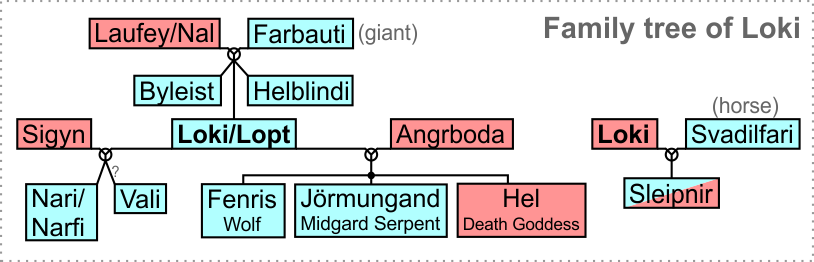
(see also family tree Edda PDF)
Like Odin, Loki also had several wives, at least two, with whom he fathered children. He could even transform himself into a mare and bore to the stallion Svadilfari the eight-legged horse Sleipnir, the “gliding one”. Sleipnir was a gift to Odin, and one can even see in it the living, flowing essence of creation, upon which Odin then rides. However, the text above recounts that he fathered three children with a giantess, who cause the gods great concern. This is especially true for Odin, the creator god, because all three children work against the emerging creation, acting as a counterforce to dissolution. Thus, one can recognize in them the three principles of transience, separation, and death.
Perhaps the most difficult to understand is the Midgard Serpent, which encircles our human world as Midgard, or Middle Garden, and separates it from all other worlds. This serpent principle of separation encompasses our world and permeates all beings born within it. And within this lies a great poison, difficult to recognize. This is above all egoism as a divisive consciousness that separates us from others and thus also from wholeness and divinity, so that we become transient beings who begin with birth in Midgard and end with death. In this respect, the Midgard Serpent also recalls the biblical serpent in the Garden of Eden, from which the demonic devil later emerged. This poisonous essence of separation could be considered the fundamental problem of all creation. And so, perhaps, all of creation exists only to solve this fundamental problem, for which the Einherjar also fight in Valhalla. In the Nibelung saga, we often find this serpentine being of separation as a dragon, and the final battle in the Beowulf saga, in particular, strongly recalls the nature of the Midgard Serpent.
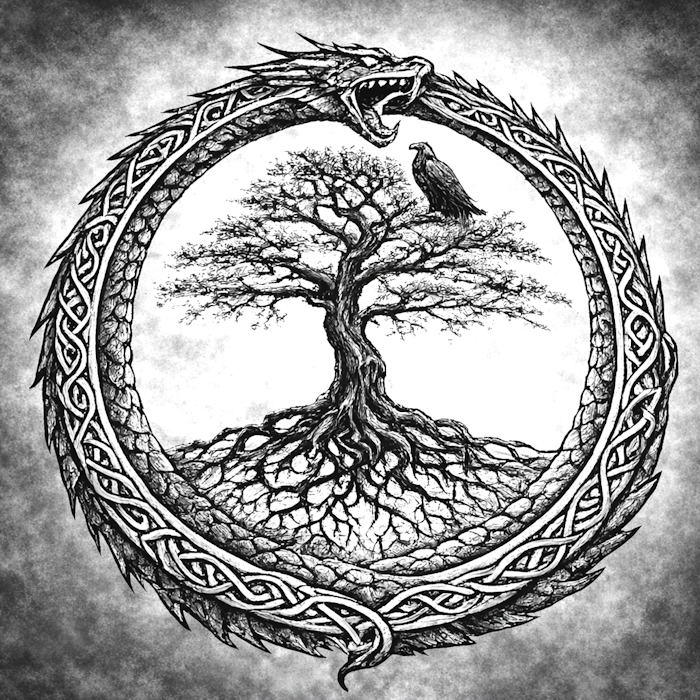
The “Self-Devourer”
The symbolism of a snake biting its own tail, known as the Ouroboros, is very ancient and actually suggests a self-sustaining being, a perpetuum mobile, so to speak, as one might view the entire universe or the divine. However, this divine wholeness is clearly not the point here, otherwise it wouldn't be a misfortune for the gods. Instead, it primarily concerns the ego, which encloses itself and views itself as separate and independent. Jacob Boehme similarly uses this symbol as a “fire wheel of one's own being in the form of a snake” in his 1624 work “Conversation of an Enlightened and Unenlightened Soul” (in German).
Thus, Loki ensures that this problem of separation is embodied in creation, for only in this way can it manifest and be resolved. And Odin ensures that this poisonous being is restrained in space and time and driven back into the “deep sea” of life, or rather, of its causes, and does not immediately overwhelm all of creation. Presumably, this also alludes to the natural characteristic of snakes as cold-blooded animals, so that they become increasingly sluggish in the cold water of the “deep sea”.
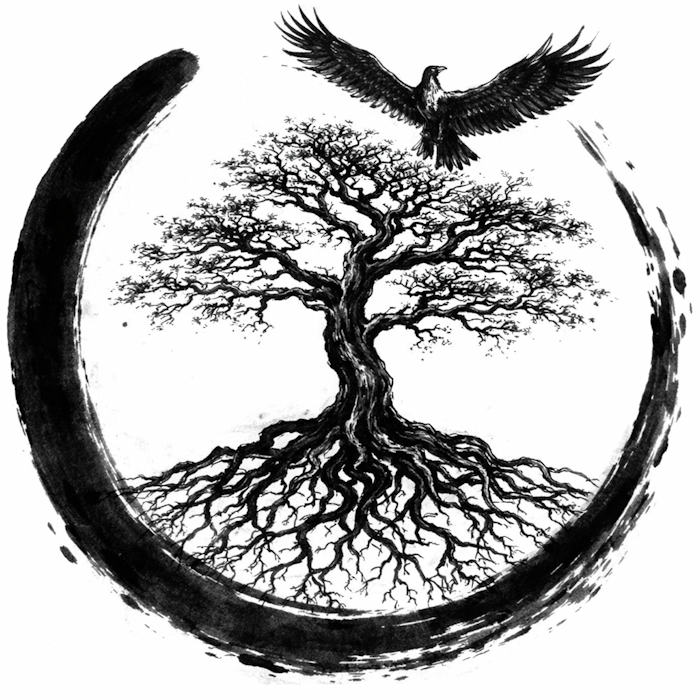
If one eventually succeeds in cutting off the voracious head of the serpent-dragon, then the direction of view reverses back to the source, so to speak, counter-clockwise in time. Then the famous Zen circle emerges, open, so that even the eagle can rise to the divine and the holistic when wilful desire transforms into holistic love. Then, so to speak, the “self-devourer” becomes a “self-bearer,” the lone fighter becomes an Einherjar. And thus, this circle is reminiscent of the ring Draupnir, the “Dripper”, which we will later examine in more detail as a symbol of cyclical renewal.
The “Self-Bearer”
Hel (“the Concealer” or “Cave”) was banished to Niflheim (into the “Misty World”) and Odin gave her from there dominion over the nine worlds (of creation). For she was to share all dwellings with those sent to her, namely those who die of illness and old age. She possesses a large court there, and its fences are exceptionally high, with large iron gates. Her hall is called Eljudnir (Misery, Freezing Cold), her bowl is called hunger, her knife desire, Ganglati (Lethargy) her servant, Ganglöt (Laziness) her maidservant, the threshold of entry is called Trapdoor, the bed is called Sickbed, and Sparkling Damage her bed-curtain. She is half black, but half flesh-coloured; therefore, she is easily recognizable and tends to look rather gloomy and grim.
The same applies to death, when the severed bubble of consciousness narrows and limits itself even further. Therefore, Odin banishes death to a misty realm, like a dream world, so that it cannot overwhelm all life in divine creation. In this respect, Odin is also called Helblindi, who “does not see death or Hel”, for he sees only his own eye of eternal consciousness as eternal life. Therefore, only a consciousness is “sent” to death, to Hel, that does not fall into Odin's sight as an Einherjar in the struggle for wholeness or divinity, but rather dies as a solitary fighter, dying within itself, within its own severed body with which it had completely identified in life. And when this body then dissolves, the consciousness that only wanted to live within this body naturally disappears as if into a dark misty realm, into a seeming dead end of death with no return. It believes, “I am dead now “, and cannot imagine escaping it, and perhaps, in its lethargy, does not even want to. And it is precisely this will that then becomes the “fence and gate” of the death cave.
Yes, consciousness can assume this form too, just as it can assume any form. And that might even be good and beautiful as eternal peace, if there were no more unresolved problems demanding to be solved, problems under which consciousness must suffer in “hunger and desire”. And the greatest problem, of course, is still the separation, formerly called “mortal sin”, the separation from the divine. One could at least consider Hel this way, who is herself only half-dead, half dead darkness and half living light, and who only appears grim and gloomy to egos.
The wolf (Fenris, meaning “swampier”) was kept by the Aesir, and only Tyr (the “god of just victory”) had the courage to go to him and feed him. But when the gods saw how much he grew each day, and when all the prophecies said he would bring them ruin, the Aesir decided to make an exceedingly strong fetter, which they called Leyding (“Growth”). They brought it to the wolf and invited him to test his strength against it. But this seemed no difficult task for him, and he let them do as they pleased. And the first time he tried to resist it, the fetter broke. Thus, he freed himself from Leyding. Next, the Aesir created a second fetter of twice the strength, which they called Dromi (“Indolence”). Again, they asked the wolf to try his hand at it, explaining that he would become very famous for his strength if such a thick piece of metalwork couldn't hold him. The wolf considered that these bonds were indeed very strong, but he also remembered that his strength had grown since he had broken Leyding. It occurred to him that he had to take this risk if he wanted to become famous. So, he allowed them to put the fetter on him. When the Aesir declared they were finished, the wolf shook himself and struck the fetter on the ground. He strained mightily, bracing himself against it, and the chain broke, sending its pieces flying far and wide. Thus, he freed himself from Dromi. Since then, it has been customary to say one frees oneself from Leyding or tears oneself free from Dromi when someone is pursuing something vigorously.
After that, the Aesir feared they could not bind the wolf. Therefore, All-Father sent a messenger from Freyr named Skirnir (“the Radiant”) down to Svartalfheim to the dwarves and had them forge the fetter called Gleipnir (“Causation”). It was made from six different things: the noise of a cat's paws and the woman's beard, the roots of the rock and the sinews of the bear, the breath of the fish and the saliva of the bird. And if you don't yet know this tale, you can find here a true example that you are not being lied to. You will have noticed that the woman has no beard, that a cat's gait makes no noise, and that there are no roots under the rock. But truly, everything I have told you is equally true, even if there are some things among them that you cannot verify.
Another powerful counterforce in the nine worlds of creation is transience. For everything that comes into being must, of course, also pass away. We already encountered the hungry wolf as a symbol of this in Odin's description; it is restrained by the gods so that creation is not immediately devoured, but rather a learning process is possible. Incidentally, our modern science also grapples with this problem, asking: Why didn't all particles and antiparticles immediately annihilate each other in the Big Bang? Why did some remain, which we now know as the matter of our universe? What holds back their antiparticles? What binds and restrains them for as long as the universe exists? (see also Wikipedia: CP violation)
A similar question likely arose in earlier times: How can one tame the process of decay and bind the hungry wolf? The epitome of these wolves is Fenrir, or Fenris Wolf, the all-devouring wolf who will ultimately devour even Odin at Ragnarök—at least, our understanding of Odin. His name, Fenrir, can be derived from “fen”, meaning swamp, thus an eternal swamp in which everything can sink again.
How can one tame and bind this wolf? One could first try to intensify the vital growth of life. But with growth, of course, comes increased decay, making the wolf even stronger. Another attempt is to use inertia to slow down decay, as the mountain and frost giants attempt with their solidified matter. This presents a greater challenge for the wolf. The third attempt is the most ingenious: to create a bond from things that do not yet exist, from causes, so to speak. For this power intensifies itself the more one rejects it. And only when nothing new can arise this bond loses its force, for then this creation, too, has outlived its usefulness and come to an end. Thus, one could say: Causation makes creation permanent because it stretches time without stopping it. And Ragnarök, as the end of creation, would then be a kind of collapse of causation.
Wow, that's something to ponder for a long time, and behind it all lies the soul of nature as the principle of causation, and essentially formless consciousness, which can assume any form. This is also the imperishable, which can be rediscovered in transience, the meaning and purpose of all creation, truth itself, which existed before anything came into being.
The symbolism of how the gods get this fetter is also ingenious: Skirnir, the “Radiant One”, goes as the light of consciousness and messenger of Freyr, the god of summer and life, into the microcosm to the nature spirits of the dwarves, that is, into the dark world of matter. Our modern natural scientists have also gone there and found a wonderful source of everything in nuclear physics. Ulrich Warnke speaks of the “sea of possibilities” in this regard, Hans-Peter Dürr says “matter is congealed spirit that can think of nothing more”, Anton Zeilinger says “information is the primordial substance of the universe - reality and information are the same”, and we like to speak in this respect of the “sea of causes” and of the “formless consciousness that can assume any form”.
Gangleri (“the Wanderer”) answered: “I can certainly see that this is true. I can see what you used as an example. But how was the fetter forged?”
The High One replied: “I can tell you. It was made smooth and supple like a silk ribbon, but as strong and durable as you will soon hear. When the fetter was brought to the Aesir, they thanked the messenger for his efforts. Then they sailed out onto the body of water called Amsvartnir (“the dark sea” of causes) and onto the island called Lyngvi (“heathland” meaning pasture for living beings). They summoned the wolf, showed him the silk ribbon, and challenged him to tear it. They said it was stronger than one would expect for something of that thickness, because each passed it to another, and each tried with their strength, but it did not break. And then they said the wolf would tear it. He replied: “With this band, it seems to me that I cannot gain any glory from it, even if I tear it to pieces. But if it was made with skill and cunning, so that it only appears so thin, then this band will not touch my legs.” The Aesir said: “You will quickly tear this narrow silken ribbon to pieces, for you broke the strong iron chain before. But if you fail to break this ribbon, then you will no longer be able to inspire fear in us gods, and we will untie you.” The wolf said: “If you bind me in such a way that I cannot free myself, then you are acting in a manner that will hardly grant me your help. Therefore, I am not eager to have this ribbon tied around me. But before you accuse me of lacking courage, let one of you place his hand in my mouth as a pledge, so that this will be done honestly.” But each of the Aesir looked at the other, and there seemed to be two problems now. No one wanted to extend his hand, until finally Tyr (the “god of just victory”) stretched out his right hand and placed it in the wolf’s mouth. And when the wolf pulled, the ribbon became tighter and even tighter. For the more he tried to free himself, the tighter the ribbon became. Everyone laughed except Tyr, for he lost his hand.
Thus, the wolf of transience was bound with the fetter Gleipnir, the power of causation. And for this, the “god of just victory” sacrificed a hand. What does this mean? On the one hand, one can see in this loss a “divine asymmetry”, necessary for the permanence of creation, as modern physics also recognizes. For in perfect symmetry, everything would immediately cancel itself out, and nothing could exist in time and space. A slight asymmetry is necessary for this, as is also assumed to exist in the Big Bang. On the other hand, he also loses his “right hand” as a symbol of justice because the gods did not keep their promise to untie the wolf, and in principle, could not keep it at all. For who could release this fetter of causation once it has been applied? How just and true, then, is this creation? Here, one can again reflect on the wine of “illusion and creative power”, which Odin, as the creator god, drinks. For a god, as a holistic being, can in truth lose nothing, not even his hand. In this sense, both asymmetry and the constraints of transience can only be an illusion, but one that is necessary in the interplay of action and reaction to bring about the experience of physical creation in time and space, on an island in the sea of causes, where living beings are to find their pasture.
One could also say: The gods act as if they were limited, so that a limited world can come into being. This limitation is thus a voluntary self-concealment of divinity and wholeness. For every form that consciousness assumes is a limitation.
Also interesting is the wolf's pride, to which the gods appeal, so that he will “voluntarily” or wilfully put on the fetter. This alludes to the ego-driven nature of the Midgard Serpent, for all three of Loki's children are, of course, closely related and connected as transience, separation, and death.
When the Aesir saw that the wolf was completely bound, they took the rope attached to the fetter, called Gelgja (“pole” as a connection). They threaded it through a thick stone slab called Gjöll (like the river of the dead of the same name) and secured it deep in the earth. They also took a large stone called Thwiti (“sling stone”), threw it even deeper into the ground, and used it as a peg for the rope. The wolf opened his mouth wide, thrashed about violently, and tried to bite them. So, they put a sword in his mouth, the hilt touching the lower palate and the point the upper. This is his palate lock. He howled terribly, and saliva poured from his mouth. This is the river called Van (“expectation, hope,” or hunger). There the wolf will remain until Ragnarök.
Finally, the question remains: What can the Gleipnir fetter be bound to? The description sounds very complicated and can only be meant symbolically. We can think of the famous Philosopher's Stone, considered the imperishable foundation of everything. It covers the River of Death, and everything is built upon it and connected to it. This can again be seen as a symbol for formless consciousness, which can assume all transient forms but is itself imperishable.
Finally, another solution to the problem of transience is suggested: the Sword of Wisdom, which we have already discussed. Its point symbolizes “unity”, and the hilt (in German: Griff) would then be a “concept of unity” (in German: Begriff). With these two, one can, of course, also block the wolf's hungry maw, because in unity, there can logically be no transience. Where would anything perish to? And yet, this does not satiate the wolf`s hunger, for everything that arises in the diversity of forms must eventually pass away. This too is part of the whole, and is also Ragnarök, the “fate of the gods”.
Gangleri (“the Wanderer”) meant: Loki had exceptionally wicked children, but all these siblings are of great importance. But why didn't the Aesir kill the wolf, since they expected only harm from him?
The High One replied: So highly did the gods value their sanctuary and place of peace that they did not want to defile it with the wolf's blood, even though the prophecies foretold that he would kill Odin.
(Gylfaginning §33/34 after Arnulf Krause and Karl Simrock)
Of course, the “desire to kill” cannot be a divine or holistic solution for any of the three siblings, because killing is a separation from life, and thus one would only further reinforce the principles of transience, separation, and death. Such an attempt would rob the gods of their sacred, peace-loving, and holistic nature, and they would no longer be gods.
The Story of the Otter Penance
This story is told twice in the Edda. One version is found in the “Reginsmal” of the heroic songs. Here, we would like to consider the other, shorter version from the Skaldic Book, section 39:
It is told that the Aesir Odin, Loki, and Hönir set out to explore the world. They came to a river and followed it to a waterfall. There was an otter there, and it had caught a salmon in the waterfall, which it ate with its eyes almost closed. Then Loki picked up a stone, threw it at the otter, and hit it on the head. Loki boasted of his prey, for he had caught both an otter and a salmon in one fell swoop. They then took the salmon and the otter with them. They came to a farmstead and went inside. The farmer who lived there was called Hreidmar (“Nest-Fame”). He was very strong and extremely skilled in magic. The Aesir asked for a place for the night, saying they had brought plenty of food, and they showed the farmer their spoils. But when Hreidmar saw the otter, he called his sons, Fafnir (“Grasp/Griffin”) and Regin (“Adviser”), and said that their brother Otter (“Inspiration/Life Spirit”) had been slain, and also who had done it. Then father and sons immediately attacked the Aesir, seized them, bound them (taking Odin's spear and Loki's shoes), and told them that this otter was Hreidmar's son. The Aesir offered a ransom, as much as Hreidmar himself wanted. And so, it was agreed with him, and the oaths were sworn. Then the otter was skinned. Hreidmar took its pelt and told them to fill it with red gold and completely cover it. That was to be their reconciliation.
This story, too, begins with the three gods Odin, Loki, and Hönir, representing action, reaction, and healing through reason, who “set out” from the deity. For movement can only exist in apparent separation. Similarly, in Indian mythology, we find the three gods Brahma, Shiva, and Vishnu, representing creation, dissolution, and preservation. And it is said that they “set out to explore the world”. What do gods want to explore in the world? Themselves? Well, gods are holistic beings and, of course, omnipresent. Thus, they also help us in this world to explore the essence, “what holds the world together at its core”. And so, they come to the river of life and walk with us “along it to the waterfall”. For every river must have a gradient, and the creatures that swim in it are the “fallen” in Valhalla, the “Hall of the Fallen” in the world of creation. Thus, Odin, as the creator god, is also called “Val-Father”, “Father of the Fallen”.
Interestingly, Hönir seems to play no role in this story either. But perhaps this is deceptive, and he is the story itself, or at least the setting in which the story unfolds? It begins with Loki smashing the head of an otter that had caught a salmon in a waterfall and was about to carelessly devour it. The otter is called “Otr” in Old Norse, a name reminiscent of “Óðr”, meaning inspiration and life force, from which the name “Odin”, meaning “life force of creation,” can also be derived. Thus, Loki appears once again as the counteraction of Odin, seemingly killing the very otter to whom Odin gave life. And yet, it is not actually something dead, but rather the food of the gods. Just as the salmon, with its red flesh, already evokes red gold as a symbol of living truth. Furthermore, it is a classic symbol of the return to the source, for at the end of its life in the sea, the salmon tirelessly swims upstream to its birthplace, to the source where it was born, to mate and reproduce. Then it usually dies, sacrificing its body as food for further growth.
In his “farmstead”, the farmer Hreidmar reminds us of physicality, and with his “magic”, of the associated illusion of consciousness identifying with a body. Thus, the gods, who provide “plenty of food”, also request “a place for the night” with him in the earthly night of ignorance. In his three sons, Fafnir, Regin and Otter, we can recognize the essence of the three gods Loki, Odin and Hönir. However, they have fallen from wholeness into separation, becoming human ego, intellect and reason, which are present, to a greater or lesser degree, in every human being and, in principle, in every creature.
Through the death of human reason due to unmindfulness in nutrition, what was hinted at in the last chapter regarding Gangleri's question now occurs: The gods are “seized and bound” and must buy their freedom within humanity. The “ransom” for their lives is, of course, the gold of truth, which compensates for the death of reason. What else could revive reason? Therefore, it is also about “red gold”, whose colour is reminiscent of blood as the lifeblood, and thus about “living truth”. Where can this red gold be found?
Then Odin sent Loki to Svartalfheim, and he came to the dwarf named Andvari (“Presence/Mindfulness”). He was in the form of a fish in the water, and Loki seized him. He demanded as ransom all the gold he had in his rock. And when they entered the stone, the dwarf brought out all the gold he possessed. It was a very great treasure. But he quickly hid a small gold ring in his hand. Loki saw it, and he demanded that he hand over the ring at once. The dwarf begged him not to take the ring, for he could increase his gold again with it if he were allowed to keep it. But Loki replied that he should not keep a penny, took the ring, and went out. Thereupon, the dwarf declared that the ring would bring death to anyone who possessed it. Loki said this seemed good to him, and stated that this prophecy would hold true, provided he himself brought it to the attention of the one who possessed the ring.
Where can this red gold, this living truth, be found? Just as Skirnir, the “Radiant One”, was sent in the last story as the light of consciousness and Freyr's messenger into the microcosm to the nature spirits of the dwarves, so here Loki is sent to Svartalfheim, the dark world of matter, where living truth can be found as the source and foundation of all creation. The nature spirit here is called Andvari, meaning “presence and mindfulness”, who swims like a fish in the water of life and can bring forth the red gold from the “stone of matter” or “philosopher's stone.”
Student: Who preaches the wisdom of the Buddha?
Nanyang: Walls and stones.
Student: How can they teach us anything? They don't live or feel.
Nanyang: That doesn't mean no one hears them.
Student: Who hears them?
Nanyang: All the wise hear them.
(Zen Buddhism)
Andvari gladly gave the gold, but wanted to keep a small ring in his hand with which he could increase the gold again. This ring reminds us once more of the meaning of Draupnir, the “Dripper”, from which eight rings of equal weight drip every ninth night. As long as it belongs to wholeness and divinity, we can see in it the ring of renewal of the “Self-Bearer”, the essence of the Einherjar as an imperishable consciousness directed toward the source from which everything is constantly reborn, in every moment. But if it is selfishly “possessed” then it becomes the “Self-Devourer”, as we learned above about the Midgard Serpent: namely, a transient consciousness of a lone warrior, eagerly directed toward the flow of transience in order to hold onto the ephemeral. And Loki now ensures that this “comes to our attention” and can become conscious:
He went away, came to Hreidmar, and showed Odin the gold. When Odin saw the ring, it seemed beautiful to him, and he took it from the hoard. He offered the remaining gold to Hreidmar. Hreidmar filled the otter skin as full as he could and stood it up when it was full. Then Odin came to cover the skin with gold and asked Hreidmar to check if it was completely covered. But Hreidmar looked at it very closely and saw a single whisker hair still visible. He demanded that it be covered, otherwise the peace would not be valid. Then Odin took out the ring, covered the whisker hair with it, and said that now they were freed from the otter's penance. But when Odin had seized his spear and Loki his shoes, and they no longer had to fear, Loki said that what Andvari had spoken would be true: that this ring and the gold would bring death to their owner, and that this would take effect from now on. That is why gold is called Otter's Penance and the Aesir's Ransom.
Why does Odin take this ring? Yes, this ring of perpetual renewal actually belongs only to Odin as the All-Father and creator god, who should wear it. Then this story would likely have had a happy ending, and even Andvari would have received the ring back in its entirety, since he serves as a nature spirit in the microcosm of the deity. But Hreidmar demands from Odin the perfection of a form that a separate, existing body can never possess. And Odin even grants it to him, but with it comes death, which, of course, is an inherent part of physicality. Thus, the whisker hair reminds us, on the one hand, of the minute asymmetry or imperfection necessary in physical creation for its temporary existence. For only imperfection can exist in time and space. On the other hand, the whisker hair symbolically recalls an expressed thought or feeling about the outside world, which is meant to be gilded, to become true, something that even reason cannot achieve. For a word, thought, or feeling is a form and thus an experience that can point to the truth, but is not truth itself. Thus, although the otter, representing reason, is weighed against the red gold of living truth, it cannot come back to life in Hreidmar's family or body. With that, his “nest fame” was over, and his two other sons, Ego and Intellect, ensured its demise, as we shall read.
But the gods were absolved of their guilt. Odin receives his spear back as the soul of creation, and Loki his shoes for mobility in the outer world. Loki then reveals himself as a counterforce to physical creation and gives Hreidmar the effective knowledge of his death. This is a wonderful symbolism, for knowledge is naturally a foundation of all creation. As the Bible says: “In the beginning was the Word.” Or as modern science states: “Information is the fundamental substance of the universe.” And so, one can also understand “consciousness” as “moving knowledge in being”, the foundation of creation and the “philosopher's stone”.
After Hreidmar received the gold as penance for his son, Fafnir and Regin demanded their share as fraternal penance. But Hreidmar refused them a single penny of the gold. Then the brothers made the wicked decision to kill their father for the gold. When this was done, Regin demanded that Fafnir divide the gold with him in two. But Fafnir replied that it was hardly to be expected that he would share the gold with his brother, since he had killed their father for its sake. And he ordered Regin to leave, or he would suffer the same fate as Hreidmar. Fafnir took the helmet that Hreidmar had possessed and placed it on his own head. Thus, it became known as the “Helmet of Terror”, because all living beings who saw it were terrified. And he took the sword called Hrotti (“Wicked Man”). Regin, on the other hand, possessed the sword called Refil (“Wall Hanging/Weave”). He fled, but Fafnir went up to Gnita Heath (“Rocky Heath”, presumably in the mountains) and made camp there. He took the form of a serpent and lay down on the gold. Regin, however, went to King Hjalprek (“helping power”) in Thjod (“people”) and became his smith. There he took over the care of Sigurd (Old Norse “victory-protector”), the son of Sigmund (Old High German “victory-protector”)…
(Skáldskaparmál §39/40 according to Arnulf Krause and Karl Simrock)
To whom does living truth belong when holistic reason is dead? To the physical body, the ego, or the intellect? First, the body lays claim to the whole truth, and because of this claim, it must also die, killed by its own ego. But the ego does not die with the body; instead, it now claims all the gold of truth for itself, even independently of the intellect. To this end, it retreats into matter and seeks to hold onto the gold of truth there, so to speak, in the “rocky heath” where the stones grow. And the stronger this desire to hold onto it becomes, the more it transforms into a mountain and frost giant, like those we have already encountered in Ymir or Thjasi. For matter still seems to be the most enduring thing in our world. Thus, modern science also knows that some atoms are as old as the entire universe.
The ego, as “I am,” is also a very peculiar story: On the one hand, it can be the greatest living truth, as Christ says: “I am the way and the truth and the life. No one comes to the Father except through me.” (John 14:6) And with that, it also has a claim to all the red gold of living truth. On the other hand, the “I” can be the greatest deadly lie when, in separation, it becomes a serpent, a dragon, a devil, or a demon. It is therefore only a question of whether the “I am” looks, acts, and judges toward wholeness or separation. In separation, the hissing “I” then appears with its poisonous fiery breath of death and destruction, for it must destroy and kill everything that appears threatening to it. And these are the “other I’s” and, above all, the holistic consciousness of reason.
There is an ego that wants to cling to the living truth, or even the truth of life. But what one tries to cling to, one must logically lose again. As Christ says, in essence: “Whoever tries to hold on to their life will lose it. But whoever loses their life for my sake (as the whole) will find it and keep it in eternal life.” Therefore, one cannot cling to the truth, but only be it, which is also the way of the Einherjar.
Do not seek the truth,
Just have no opinion.
(Seng-Ts'an, Zen wisdom)
And how does the ego story continue? The ego-serpent Fafnir, much like the Midgard Serpent, becomes the inner essence of the human world of Midgard. And everything embodied in matter here automatically contains the ego-serpent within it. Hidden within every atom is the fire-breathing dragon, which should not be awakened without reason, as modern science has clearly demonstrated with nuclear energy. And the Regin-intellect, as a smith, enters the human world, where Hjalprek, the benevolent force of creation, reigns as king, and forges the conceptual armour, helmets, and jewellery. We can find this smith under other names, such as Mimer or Wieland, in many sagas. And finally, it is said that he takes over the care of Sigurd there, in whom we can recognize divine reason, which, of course, can never truly die.
What is still missing in this version of the story is the feminine or natural aspect. In the other version of the “Regin Song”, we also find two daughters of Hreidmar named Lyngheid and Lofnheid, referred to as “Herb-Heath” and “Favour- or Permission-Heath”, in whom one can see the outer nature and the inner soul of nature. They are only briefly mentioned there, when Hreidmar dies and calls his two daughters:
10. “Lyngheid and Lofnheid, know that my life has been taken from me! Many things are now forced upon us by necessity (fate).”
Lyngheid replied: “Rarely will a sister, even if she loses her father, avenge her grief on her brother.”
11. Hreidmar spoke: “If you cannot have a son with a prince, then bear a daughter, wolf-hearted Dis (woman of fate). Give the maiden a husband in her great need! Then her son can avenge your grief.” And died…
(Reginsmál after Arnulf Krause, Karl Simrock, and Edward Pettit)
These two “living heathens” thus stand in contrast to the “rocky heath” of Fafnir and, as beings of fate responsible for causation, fulfil their task. Odin's spear is also symbolically reflected in this, representing, so to speak, the causative soul of nature, which struggles to operate and resolve all the problems it has caused. This, of course, always occurs in the interplay of spirit and nature as masculine and feminine, and can extend over many generations. The final verse hints at two paths for continuing the course of the story.
The first Path: Lyngheid gives birth to a son as an avenger. This constellation reminds us of the traditional Beowulf saga, which ends with a dragon fight that fits this story very well because the gold from the dragon's cave in a mountain is recovered there. The son would then be Beowulf, the diligent “bee-wolf” as a soul force, born of the “wolf-hearted Fate Woman”, and her brothers would be Herebeald (“warrior”), Haethkyn (“fiery king”), and Hygelac (“game of reason”), in whom one can also find reason, ego, and intellect (see also the family tree and interpretation of the Beowulf saga in Chapter 33 -in German). Thus, in this first path, one can see the causation or birth of the solution, such as the births of Krishna, Buddha, or Jesus, and it is said of Jesus: “Just as the Son of Man did not come to be served, but to serve, and to give his life as a ransom for many.” (Matthew 20:28) Similarly, the Beowulf saga describes how the common hall of warriors, which strongly reminds us of Valhalla, is restored to working order by Beowulf, and how he ultimately defeats the dragon of deadly destruction, bringing forth the red gold as living truth and revealing it, thereby fulfilling the purpose of his physical birth. The story ends with the gold treasure being hidden once again in the rock tomb with Beowulf, in order to then move on to the second path of impact in the flow of life:
The second Path: Lyngheid gives birth to Grimhild, whose daughter Gudrun then marries Sigurd, and in their son Sigmund, one can see the reincarnation of Sigurd's namesake father. This is then recounted in the Norse Edda version of the widespread Nibelung saga. The path begins with Sigurd as the “protector of victory” and great-great-grandson of Odin, who defeats Fafnir and Regin to avenge his father's murder and wins the gold treasure. He then marries Gudrun as the “god-rune” and divine secret of nature, so that the problem can take effect. In the Nibelung saga, she is called Kriemhild. Sigurd can be found there again in Siegfried, and Högni and Gunnar in Hagen and Gunther, who play the roles of ego and reason, respectively, and in turn bring about the death of reason as Siegfried and “victorious peace”, sinking the gold treasure of living truth in the Rhine, the river of life, where it still lies today. Siegfried and Kriemhild's son is named Gunther here and survives as “reasonable mind”. In comparison, Gudrun's path in the river of consequences in the Edda version is considerably more convoluted, but perhaps this will become clearer eventually.
These two paths of cause and effect naturally form an eternal cycle, and this cycle, perhaps not coincidentally, also encompasses our mystical journey through the Nibelung saga, in which we, too, have attempted to examine the ancient legends primarily from a spiritual perspective (in German).
Yes, there is much more to ponder regarding these paths. But we now wish to return to the divine spirit of Loki, who, as a creative counterforce, once again set much in motion in this story, allowing the repressed problems to emerge from the sea of causes and resolve themselves, like waves in the wind of the spirit.

