
| Content | Next | About |
The Story of Baldr`s Death
In “Gylfi's Illusion”, beginning in section 49, the following story about the strange death of Baldr, the god of light, is recounted, in which Loki, of course, also played a part:
Then Gangleri asked: Have there been any other adventures involving the Aesir?
The High One replied: The incident that seemed very bad to the Aesir must also be told. The beginning of this story is that Baldr, the Good, had violent dreams that threatened his life. When he told the Aesir about these dreams, they held council together, and it was decided to demand a guarantee of peace for Baldr, protecting him from all kinds of danger. So, Frigg made all things and living beings swear oaths. Fire and water should spare Baldr, as well as iron and all metals, stones, the earth, trees, all diseases, animals, birds, poison, and snakes. When this was decided and announced, it happened, for the amusement of Baldr and the Aesir, that he was to stand before the assembly. And of all the others, some were supposed to shoot at him, others to hit him, and still others to throw stones. Whatever was done, nothing harmed him, and that seemed a great advantage to everyone.
What does it mean when a god dreams of his death? A god is a holistic being, and so his death can only be a dream in the sense of an illusion. And of course, only a form of him that appears in this dream can die.
Now, this story of dreaming and dying certainly revolves around Balder, the god of light, for good reason. Light is an extremely wondrous phenomenon in our world. Modern science has also gained astonishing insights into it: not only that light can be frozen and transformed into matter, but also that the speed of light is the fastest movement in the universe. Light itself is even infinitely fast and thus everywhere at once. Only through observation does a finite speed appear. In this respect, light also possesses a certain eternity, as long as it is not bound in space and time by an observer, which again reminds us of Odin's two eyes. Thus, as soon as light is seen, it becomes transient, and yet it merely transforms.
People have likely always contemplated the eternity of light, which logically implies the existence of eternal darkness as well. For if neither were eternal, they would have already passed away in the course of endless time. And between these two extremes of light and darkness, we can see this world and all forms that appear in the light and seemingly disappear again. For in pure light, one could see nothing, just as in pure darkness.
Yes, this has been pondered much, and from this has likely arisen such wonderful stories, intended to stimulate further reflection. So: What happens when light, as a form, desires to be immortal, as a photon in the realm of action? Then one would have to tell everything in the world that it must not harm the photon, lest it dies. In this story, this task falls to Frigg, Odin's wife, in whom we can see the soul of nature, ensuring the necessary “oaths” in the realm of causation. And the form of light, in the divine or holistic sense, would then be all of creation, which has likely reached a culmination in its development and is beginning to dream of its demise. The gods' desire, of course, is to keep creation alive, which they seem to be succeeding in doing. But to this effect of Odin, there is, of course, the counter-effect of Loki, who is directly challenged by the gods' demands:
Loki, Laufey’s son, saw this and was displeased that Balder was invulnerable. He went to Fensalir (the “swamp hall” or “water hall”) to Frigg and took the form of a woman. Frigg asked if this woman knew what the Aesir were doing at the assembly. She said that everyone was shooting at Balder and that nothing could harm him. To this, Frigg replied: “Neither weapons nor trees will harm him. I have taken oaths from them all.” The woman asked: “Have all things sworn to spare Balder?” Frigg answered: “West of Valhalla grows a tree sapling called a mistletoe. It seemed too young to demand an oath from.” Immediately, the woman set off. And Loki seized the mistletoe, tore it off, and went to the assembly. There, Hödur stood far outside the assembly circle, for he was blind. Loki asked him: “Why don't you shoot at Balder?” He replied: “Because I cannot see where he stands, and secondly, because I have no weapon.” Loki said: “Do as the others do, and show Balder the honour they do. I will show you where he stands. Throw this branch at him!” Hödur took the mistletoe branch and, following Loki's instructions, shot it at Balder. The projectile pierced him, and he fell dead to the ground. Thus, the greatest suffering arose among gods and men alike.
As the soul of nature and the principle of causation, we now find Frigg in the hall Fensalir, which can be interpreted as a “water hall” in the sense of the sea of causes. Of course, it can also be seen as a “swamp hall”, just as the Fenris wolf can be translated as “swamp wolf”. For in this water of life, every physical creature eventually sinks to be reborn, even if the “swamp” as a hall for such a high goddess doesn't seem particularly worthy. Naturally, Loki, as a male spirit, also had to transform into a female soul in order to find in this sea of causes both: the cause of Baldr's invulnerability and the cause of his vulnerability. Then he returns from there and transforms again into the male spirit of effect.
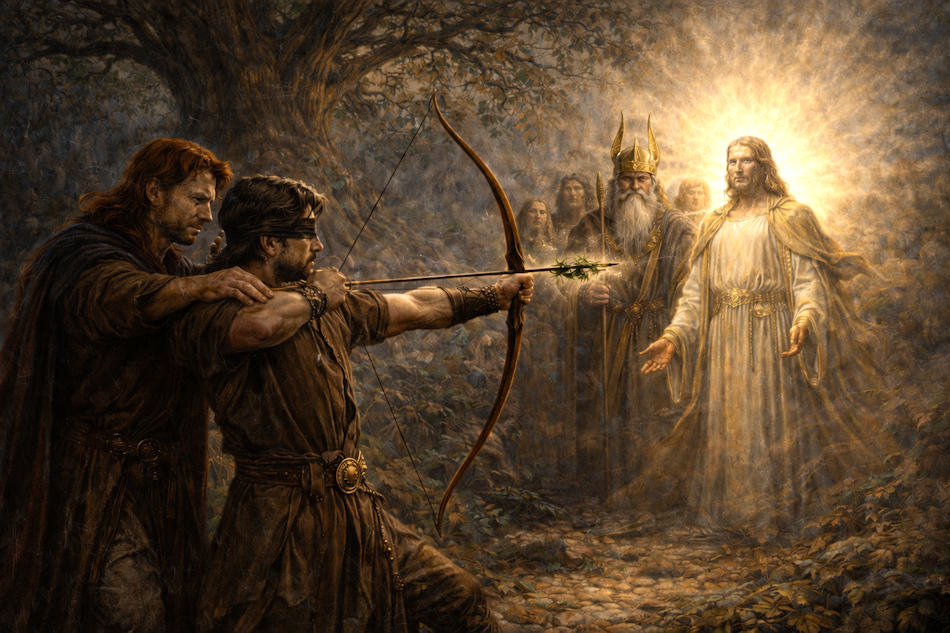
The tool for this is a mistletoe, which “grows west of Valhalla”, where the sun sets, that is, in our transient world, in the Tree of Life. Mistletoe is an ancient and deeply mystical symbol, for its roots are not in the earth, but rather it grows, so to speak, in the Tree of Life between heaven and earth, as between spirit and nature. Thus, it is relatively “unbound”, also with regard to oaths and responsibilities, and this was perhaps the reason why it seemed too young, immature, and weak to Frigg. Yet it is precisely in this unbound state that the greatest strength often lies, and also the prerequisite for a vibrant world. For a completely bound world would be dead.
The actor is Hödur. Baldr, Hermodr, and Hödur are considered the three sons of Odin and Frigg. In them, one can also find reflections of Odin, Hönir, and Loki. Baldr is the radiant god of light, while Hödur is the blind god of darkness. Between them lies our visible world, in which Hermodr reigns as the fighting intellect and messenger of the gods, and Hönir represents reason and wisdom. In this respect, Odin and Baldr form a pair, and Loki and Hödur their counterparts—that is, the effect of light and the counter-effect of darkness. Between them, reason and intellect were meant to mediate, heal, and govern within creation. But divine reason apparently began to freeze when it fired upon forms for “entertainment”, and so Baldr, the divine light, fell first.
When Balder fell, all the Aesir were speechless, unable to raise their hands to touch him, and they gazed at one another. They all agreed who had done it, but no one could avenge him, for there was a great place of peace. And when the Aesir tried to speak, they were more likely to burst into tears. Therefore, no one could put their grief into words. But Odin suffered this loss most terribly among them, for he knew best the great harm and loss that Baldr's death had caused the Aesir.
How can divine reason become rigid? For even the aforementioned “great peace” in the Thing assembly is evidently more rigid than vibrant. Well, divine reason is holistic reason and must, of course, be embraced by all beings in creation, including us humans. Therefore, everyone can first ask themselves to what extent reason, as holistic consciousness, is alive or rigid within them. We encountered the greatest power of rigidity in the last story as the ego-serpent of separation and its desire to cling. Yes, the desire to cling is a curious game: for truth cannot be grasped, but one can only be truth. Therefore, it doesn't need to be grasped, because it cannot be lost. Only the constructed forms of truth, which arise and pass away as in a dream, can be lost. These can be held for a while in time and space, but they should not be allowed to freeze as illusions, like the frost giants and mountain giants. And the greatest counterforce against this stagnation is arguably painful suffering, as embodied by Loki as a counterforce in creation and experienced here by the other gods.
But how can we, with reason and intellect, reawaken this pure light of consciousness?
When the gods regained their senses, Frigg spoke and asked which of the Aesir would win all their affection and favour by riding along the Hel`s path and attempting to find Baldr and offer Hel a ransom if she would allow him to return to Asgard. And it was the one named Hermodr (“Host Courage” as messenger of the gods), the Brave, a son of Odin, who volunteered for this journey. They took Sleipnir (“the Gliding One”), Odin's horse, and brought it before them. Hermodr mounted it and set off.
Here, the third pair of spirits, Hönir and Hermodr, enters the story between the other two pairs. Hönir remains unnamed in this tale as well, but is certainly still present as holistic reason, even if he is slowly becoming rigid. Hermodr, as divine intellect and messenger of the gods, now becomes active and is tasked with trying to redeem Baldr from death in Hel and from Hel herself. And this wish came once again from Frigg, the soul of nature. But can intellect achieve this? What could the ransom be?
Meanwhile, the gods attempt to “bury” Baldr's body, or rather, his form, in the Sea of Causes.
But the Aesir took Baldr's body and brought it to the sea. His ship was called Hringhorni (“Ring-Horn” with a “circle at the bow/rudder”), and it was the largest of all ships. The gods wanted to launch it and burn Baldr on it, but the ship wouldn't budge. Then they sent to the realm of the giants for the giantess Hyrrokkin (“Fire-Wrath”). When she arrived, she rode a wolf with a poisonous snake for reins. She dismounted, and Odin called for four berserkers (fearful heroes) to guard it. But they couldn't stop it until they threw it down. Meanwhile, Hyrrokkin went to the bow of the ship and, with the first jerk, pushed it so hard that fire shot from the ship's wheels and the whole land trembled. This enraged Thor. He grabbed his hammer and would have smashed her skull had all the gods not pleaded for her peace. Afterward, Baldr's body was carried onto the ship. But when his wife Nanna (“Mother/Daring One”), Nep's daughter, saw this, her heart broke with grief, and she died. She too was placed on the funeral pyre, which was then lit. Thor stood before it and consecrated it with Mjölnir (his hammer “Crusher”). But a dwarf named Lit (“Coloured Design”) ran in front of him. Thor kicked him and pushed him into the fire, where he burned.
Baldr's ship, Hringhorni, as “Ring-Horn”, is reminiscent of the Ring of Renewal, so that everything that perishes in the sea of causes can also be reborn. But the gods could no longer move this ship. This is a wonderful symbolism that invites much contemplation. Here, too, one can recognize the ossification of divine reason and how the gods lose their power, so that now even a giantess is stronger, and they beg for her help. She comes riding as “Fire-Wrath” on the wolf of transience, which she tames with the fire-breathing ego-serpent, in order to suppress transience with it’s wrath. But even this tamed wolf can only be controlled for a short time by the gods with the greatest difficulty, by also “throwing it down” and suppressing it. This giantess can move the ship with a short, powerful jerk, so fiercely and powerfully that it was a great disgrace to the gods, and the whole world trembled. This particularly angered Thor, considered the strongest of the Aesir, who wanted to take revenge with his hammer. But even this freedom was no longer available to him, so he had to vent his anger on a dwarf. That he then consecrates Baldr's corpse and the ship of renewal with his hammer makes sense, for with it he crushes solidified forms so that they can be renewed.
In Nanna, Baldr's wife, we could see Mother Nature. Just as Frigg represents the soul of nature, Nanna could stand for outer nature, which, with the apparent death of the light, also becomes dead. For when the light of the spirit is dead, then the light of nature is also dead. Nanna and Baldr's son is named Forseti, the “president”, the god of justice, in whom one can see the meaning of all creation. However, he is not mentioned in this story, though he certainly also plays a role in the narrative, much like Loki. Instead, her father Nep is mentioned, whose name, through the Old Norse “napr”, evokes “cold”, and thus the frost giant Ymir, who was “thawed” back into living nature. But now the general stagnation sets in once more, against which a “cremation” in the waters of life is initially meant to help.
People from many tribes came to this cremation: First, it is said of Odin, that with him came Frigg and the Valkyries, as well as his ravens. Freyr came in his chariot with the boar called Gullinbursti (“Golden Mane”) or Slidrugtanni (“Sharp Tooth/Terror-Tooth”). Heimdall (“The one, who illuminates Home”) rode on the horse called Gulltop (“Golden-Crested”), and Freyja drove with her cat-drawn chariot. Many frost and mountain giants also came. Odin placed the golden ring called Draupnir (“Dripper”) on the funeral pyre. It had the property that every ninth night, eight equally heavy gold rings dripped from it. Baldr's horse, with all its harness, was also led onto the woodpile.
Who participates in this “cremation”? First and foremost, of course, is Odin as the All-Father, whose essence is most closely related to Baldr's. With him come Frigg, the soul of nature, and the Valkyries, his servants meant to aid the fallen creatures, among whom is now Baldr's body. Also present are his two ravens, Huginn and Muninn, representing thought and memory, for this entire story is, of course, a play on thought and memory. Freyr, the god of summer, and Freyja, the goddess of love, who have perhaps lost the most with Baldr's passing, join them. Interestingly, the frost and mountain giants from the macrocosm also arrive, their natural instinct being to hold onto the forms of light, which is why they deeply mourn their loss. Fortunately, Heimdall, as divine consciousness, also comes to illuminate Baldr's path home from the darkness that killed him.
What's missing are the dwarves from the microcosm, whom Thor banished, and of course Hönir as divine reason, as well as Loki as Odin's antagonist. Blind Hödur is also no longer mentioned; he has presumably disappeared by now, but we'll consider that later.
It's highly interesting that Odin throws the ring Draupnir into the fire, a crucial symbol of renewal. On the one hand, he relinquishes the power of renewal from his divine hand. On the other hand, he could be trying to give this ring to Balder to take with him on his journey, in order to renew himself. But that would again be a renewal in separation, rather than in the wholeness of the creator god, which apparently cannot work, as we will see.
Finally, it is mentioned that Baldr's horse, complete with all its harness, was led onto the funeral pyre, which serves as a strong reminder that this is about the death and burial of a physically bound form of the god of light.
But it is said of Hermodr that he rode for nine nights through dark and deep valleys, seeing nothing, until he came to the river Gjöll (the River of the Dead “Echo”) and rode onto the Gjöll Bridge. It is covered with gleaming gold. Modgud (“Goddess of Courage”) is the name given to the maiden who guards the bridge. She asked him his name and his origin, saying: “The day before, five troops of dead men rode across this bridge. But beneath you alone, the bridge resounds even more, and you do not have the appearance of dead men. Why are you riding here on the Hel Road?” He answered: “I am riding to Hel to seek Baldr. Or perhaps you have seen him on the Hel Road?” She said: “He rode here across the Gjöll Bridge, and down to the north runs the Hel Road.”
The name Gjöll, chosen to describe the river of the dead, is quite surprising. Gjöll also means battle noise and shouting, whereas here one would expect dead silence, where the dead men or spirits ride across the bridge. However, since the “nine nights” after the darkness already hint at renewal, it is perhaps more fitting to call the river “Echo”. Thus, it flows between the two banks of life and death and does not necessarily have to end in Hel, the dark cavern of consciousness, but can also return. The crucial question is whether one has the courage to return to life. Therefore, the bridge between life and death is guarded by the “Goddess of Courage”. And this “courage” is possessed above all by the Einherjar, who fight for the deity in the army of unity, so that their lives, by and large, cannot be lost and must not end in Hel with the goddess of the dead. In this respect, a wonderful symbolism is once again described.
Hermodr, as “host courage” and messenger of the gods, naturally possesses this same courage. Thus, as a holistic being, he rides the Hel way with Sleipnir, Odin's horse, naturally intending to return. This is likely why the bridge resounded so loudly, as if all of creation were riding across it.
Hermodr rode until he came to Hel's gate. Then he dismounted, tightened the girth, remounted, and spurred the horse. The horse leaped so powerfully over the gate that it never came close. Hermodr then rode to the hall, dismounted, and entered. There he saw Baldr, his brother, sitting in a place of honour, and he stayed with him all night. But at dawn, Hermodr asked Hel to let Balder ride home with him, and he told her how great the grief was among the Aesir. Hel replied: “Let's see if Baldr was truly as beloved as they say. If all things, living and dead, in the world weep for him, then let him return to the Aesir. However, he will remain with Hel as soon as anyone objects or refuses to mourn him.” Then Hermodr rose, and Balder led him out of the hall. He took the ring Draupnir and sent it to Odin as a memento. So, Nanna also sent Frigg a dress and other gifts, and Fulla a gold ring. Afterwards, Hermodr rode back his way, arrived in Asgard, and recounted all the events he had seen and heard.
Here, the story beautifully recounts how the horse of creation, full of strength, can even leap over the Hel gate. But the mind must tighten its girth to avoid being thrown. There, he meets his brother Baldr again and stays all night. At dawn, he intended to ride home with him. This gives one much to ponder: How can night end and dawn break in the dark realm of Hel? This likely only happens in Hermodr's mind, so that he can return to the world. For Hel itself, it is probably only possible at the end of creation, when everything is transformed back into pure light. And then Balder, too, can return to the gods, when no being desires or longs for darkness. Only then can there be a god of light, a holistic light. And this is also the condition set by the goddess of death.
So, Hermodr must initially return without Baldr. Baldr returns the Ring of Renewal to Odin as a memento, for it is of no use to him here in the darkness, since nothing can be renewed here as long as the night continues. But for Odin, as the All-Father of Creation, it is useful in the world. One can think similarly about Nanna's gifts: in the dark cavern of consciousness, neither a garment nor any gifts or jewellery are useful. But in the world between light and darkness, they are. And so, dead nature sends a dead garment for the soul of nature, just as we today consider external nature to be something dead. At least, that's what our physicists (e.g., Harald Lesch) believe, that this universe is 99.99999…999% dead. And Fulla, Frigg's maid of “abundance” in nature, receives a golden finger ring from her, presumably to preserve and protect the abundance and diversity in nature with holistic truth.
Immediately, the Aesir sent messengers throughout the world, asking them to weep Baldr out of Hel (to free the god of light from the realm of the dead with their tears). All humans and other living beings, as well as the earth, stones, trees, and every metal, did so, just as you will have seen these things weep when they come from frost into warmth.
Thus, we encounter here once again a claim to absolute perfection in external forms—a phenomenon that likely arises when one is no longer able to perceive inner perfection as a holistic truth in all things. In principle, this mirrors — on the grand scale of Creation — the earlier tale of Hreidmar and the otter penance, wherein we had already recognized that a perfection based solely on form can no longer be truly alive.
The “weeping” of all beings serves as another marvellous symbol. On the one hand, it surely appeared as a miracle in those days that warm air would condense upon cool objects and dewdrops resemble tears. On the other hand, this calls to mind the concept that every form is essentially “frozen light” — light that, within the spiritual warmth of love, can thaw once more to become “living water”, or indeed, even pure and formless consciousness. And were all forms to undergo this transformation, an eternal God of Lightness would once again prevail; yet, by the same token, there would no longer be any life existing within the realms of space and time, suspended between darkness and light. And for this very purpose, Loki must now step in and take action once again:
But when the messengers returned home, having successfully fulfilled their missions, they discovered yet another cave, wherein sat a giantess. She called herself Thökk (“Thanks” / “Darkness”). They implored her, too, to weep Balder back from Hel. But she replied:
“Thökk shall weep dry tears for Baldr's funeral journey. Neither from the living nor from the dead son of the Old One have I ever derived any benefit. Thus, let Hel keep what she holds.”
It is believed that this was Loki, son of Laufey, who had played the Aesir the cruellest trick of all.
(Gylfaginning §49, after Arnulf Krause and Karl Simrock)
Thus concludes this tale of the death of Baldr. The name Thökk represents an intriguing play on words, hovering between “gratitude” and the Old Norse “Døkkr”, meaning “darkness”. Indeed, we ought to be grateful to the darkness, for it is only through its existence that our life between light and darkness becomes possible, offering us the opportunity to recognize ourselves anew as perfection in all its forms. In this giantess, therefore, we may once again discern the pairing of Hödur and Loki—with Loki having transformed himself into a woman once more—thereby manifesting as a quintessential union of Spirit and Nature.
Thökk’s pronouncement is also noteworthy. For an eternal being, naturally, derives no benefit whatsoever, as it undergoes no change, because eternity is beyond time and space. To such a being, everything is perfect exactly as it is. Hence, there are arguably only two entities incapable of “thawing” and weeping tears of living water into the river of creation: eternal Light and eternal Darkness. Between these two eternal shores, living creation flows onward through time and space. Yet what happens when these shores cease to be eternal—when they appear to dissolve? At that moment, creation has probably reached its zenith—the “full moon”, so to speak, following a waxing phase of ever-increasing light, whereupon begins the darkening descent toward the new moon. For when the shores of creation symbolically dissolve, order is naturally lost; the entire river slowly disintegrates, ceasing to flow, and reverts once more to a shoreless ocean—a boundless sea of causes. Which, of course, is ultimately merely a matter of consciousness—specifically, the extent to which one is aware of eternity.
However, one problem remains unresolved: If Baldr, as the god of light, dies, then—logically—Hödur, as the god of darkness, must also die; otherwise, the entire world would immediately be overwhelmed by darkness. This is also alluded to by Thökk in her guise as a “giantess” as a natural force of overwhelming power within the macrocosm. Thus, the story here lacks an essential continuation: namely, the death of Hödur at the hands of Vali, the son of Odin. Corresponding references to this can be found in other sources within the Edda. One such source is the Prophecy of the Seeress (Völuspá), in which it is stated:
31. I saw Balder, the bleeding god—Odin’s child—whose fate is sealed: High above the fields, slender and passing fair, the mistletoe had grown.
32. From this wood, which seemed so slight, was fashioned the dangerous shaft of harm; and Hödur shot it. But Odin’s son, Baldr’s half-brother Vali, was swiftly born, and, but one night old, began to slay.
33. He washed not his hands, nor combed his hair, ere he bore Baldr’s slayer (Hödur) to the funeral pyre. Yet Frigg wept in Fensalir for the woe of Valhalla. Do you know how to interpret this?
And in the lay of “Baldr’s Dreams”, which we shall examine in greater detail later, it is written:
10. Odin spoke: “Speak on, Seeress! I shall question you until all is revealed. I wish to know yet more: Who shall avenge the heinous deed committed by Hödur, and bear Baldr’s slayer to the funeral pyre?”
11. The Seeress spoke: “Rinda (the Protectress) shall bear Vali in the Western Halls; and this son of Odin shall fight when but one night old. He shall not wash his hands, nor comb his hair, ere he bears Baldr’s foe, Hödur, to the funeral pyre. Under duress I spoke; but now I shall fall silent.”
Why Snorri Sturluson omitted this significant story here remains unclear. Perhaps a passage has been lost. At the very least, there is no account of the deed itself; one might conceive symbolically that Hödur’s death could, naturally, occur only within the indescribable darkness—never in the light of reason. This is simply due to the fact that Vali was begotten by Odin, the All-Father, and born of Rinda, the Protectress of Creation. Thus, we may view Vali as the true principle of life, one that ultimately survives even Ragnarök. As such, it constitutes an eternal principle of life; consequently, both Light and Darkness are preserved eternally. Indeed, Snorri himself writes regarding the conclusion of Ragnarök and the subsequent re-creation in “Gylfaginning” Section 53:
Vidar and Vali live on, for neither the sea nor Surt’s flames have harmed them... Then Baldr and Hödur emerge from the realm of Hel. They all gather together and converse. They recall their secret knowledge and speak of the events of times past—of the Midgard Serpent and the Fenris Wolf.
Thus, in the wake of Ragnarök, a new, vibrant creation begins once more—established in divine order between the two eternal shores of Light and Darkness—embodied by Baldr and Hödur, in whom one may also recognize the two eyes of Odin. Of particular interest here is the interplay of the names Val, Vali, and Vala —representing, respectively, a creature, a life principle, and a seeress. We will later turn our attention to “Baldr’s Dreams”, a tale in which a seeress also makes an appearance. But first, let us take a closer look at the Ring of Renewal.
Draupnir, the Ring of Renewal
The text above states:
Odin placed the golden ring called Draupnir on the funeral pyre. It possessed the property that every ninth night, eight equally heavy gold rings dripped from it.
The name Draupnir means “dripper” and is a wonderful symbol for the cyclical renewal and regeneration in creation. Night recalls the night-consciousness of illusion in creation, nine the symbolic number of renewal, and eight (German: acht) the consciousness of mindfulness (German: Achtsamkeit) as the gold of truth that existed before anything came into being.
How might we imagine this “drip”? Initially, a linear renewal is conceivable, similar to the circle of a clock, which primarily recalls the temporal flow in creation, the cyclical process of arising and passing away. Then each ring would be “equally heavy and large”, and the first ring sacrifices itself for eight more rings. Thus, the beginning sacrifices itself for the end, and the end, in turn, for the beginning.
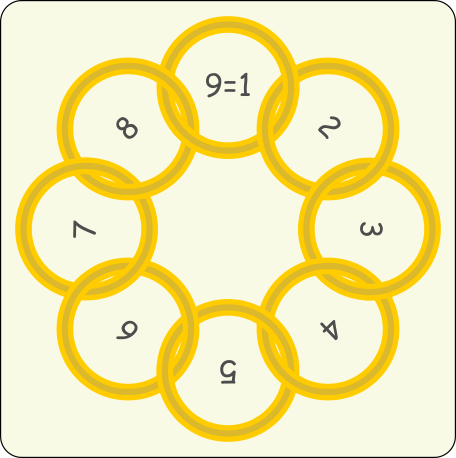
However, if one interprets “equally heavy” as “equally important”, then one could also let the ninth ring “drip” into eight smaller rings. Similar to how the ice giant Ymir thaws and the “frozen light” drips down as the water of life. And each drop is a gold ring of truth bound into a form. Then the following image would emerge:
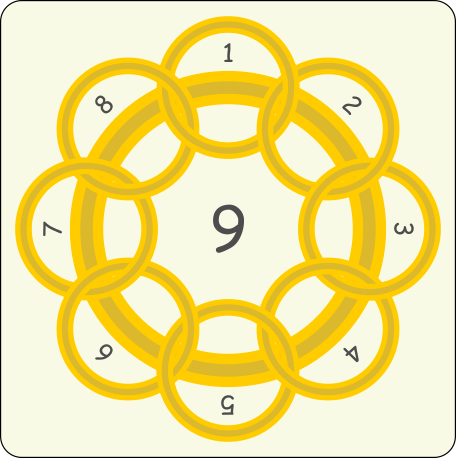
If you continue this process with each ring, a kind of fractal emerges, so that the whole is repeated in every ring. This, too, is a wonderful symbol for creation and is particularly reminiscent of its expansion in space. In this process, the whole sacrifices itself for the parts, and each part, in turn, sacrifices itself for the whole. In this way, an infinite number of beings can come into being, and each being has the power of renewal and can also find itself again in the whole.
Only when you take this ring of renewal away from a being does the concept of death, in the sense of an end, appear. A similar thing happened in the story of the “otter's penance”, when Loki took this ring from the dwarf Andvari (“presence/mindfulness”), thus also bringing the “curse of death” into the world. The “Ring of the Nibelung” could also play a similar role in the long story of Sigurd, Brynhild, and Gudrun.
Regarding the fractal concept, these rings are naturally also closely connected to the dwarves as nature spirits in the microcosm, who are essential for renewal and regeneration in the natural creation of diversity. For the gradual division into ever smaller beings is also a fundamental principle of nature. Consider the levels of the universe, galaxies, stars, planets, ecosystems, bodies, organs, cells, molecules, atoms, and elementary particles. Accordingly, the living, physical growth in our bodies is also based primarily on cell division and reproduction, like in a complex molecular factory in the microcosm, where countless tiny dwarves work. Therefore, it is certainly no coincidence that the dwarf Ivaldi is considered the father of Idun, the goddess of renewal and rejuvenation. And in the long list of many dwarves, there is even one named “Draupnir”. Furthermore, the gold ring was also created by dwarves. And the following story tells about this in the Skaldic Book §35:
Loki, Laufey's son, had maliciously cut off all of Sif's (Thor's wife) hair. When Thor learned of this, he seized Loki and threatened to break every bone in his body until he vowed to persuade the Dark Elves (the dwarves of earth) to make Sif's hair of gold. This hair would grow like any other. Afterward, Loki went to the dwarves known as Ivaldi's sons. They forged the hair, the ship Skidbladnir, and the spear that later belonged to Odin and was called Gungnir.
We have often encountered hair as a symbol of thoughts, which grow from our heads in a more or less orderly or wild fashion. In relation to Sif, Thor's wife, we can see in it the creative thoughts of Mother Nature, which should actually belong to the spirit. Perhaps this was also the reason why Loki cut her hair off, and he again plays a crucial role in this story. Under the pressure of suffering, he then ensures that the little nature spirits create a living replacement, even from the gold of truth. And thus, not only are golden hairs created, which can grow alive as creative thoughts, but also two further symbols of natural growth in creation, which we already encountered in the chapter on “the nature of Odin”: the ship Skidbladnir, whose name means “joined together from thin planks”, and which reminds us of the living physicality that floats on the sea of causes and sails on the wind of the spirit. This organism was assembled by the dwarves in the microcosm from countless small and “thin-skinned” particles. Of course, the spear Gungnir, the “wavering and rocking one”, is also necessary, reminding us of the “waves” of effects on the sea of causes, and thus also of the will of the All-Father Odin. In summary, one could say of this triad: Word of creation - creatures - Creator's will.
At least Loki found this creation of the dwarves excellent, for now the spiritual essence of the nature spirits was also behind it. And Loki was so convinced of their work that he even wagered his life that the nature spirits could produce nothing better.
Loki wagered his head with the dwarf Brokk (“fragment, part”) that his brother Sindri (“sinter, hardening” or embodiment) could not forge three treasures as fine as these. When they arrived at the smithy, Sindri placed a pigskin in the forge and ordered Brokk to work the bellows. He was not to stop until he could take out what he had put in. But as soon as he left the smithy, where Sindri was still working, a fly landed on his hand and tickled him. Nevertheless, he continued working the bellows until the smith took it from the forge. It was a boar with golden bristles (named Gullinbursti).
Next, he placed gold in the forge and asked him to operate the bellows and not to stop until he returned. He left, but the fly came, landed on his neck, and tickled him twice as hard as before. He continued blowing, however, until the smith took the gold ring, called Draupnir, from the forge.
Then he placed iron in the forge, told him to keep blowing, and said that nothing usable would result if he stopped. At that moment, the fly landed between his eyes and stung his eyelids. But when the blood dripped into his eye, so that he could no longer see, he reached out as quickly as he could and wiped the fly away while putting down the bellows. Then the smith came and said that almost everything in the forge had been ruined and rendered unusable. Then he took a hammer from the fire (called Mjölnir, “Crusher”). He handed all the items over to his brother Brokk and told him to go to Asgard and fulfil the bet.

The dwarf Brokk, as a “fragment/part”, reminds us once again of the fractal principle of nature. And Loki apparently doubts that even a single part can create such holistic works as the entire band of dwarves that comprise Ivaldi's sons. The small “nature spirit” is further divided: Brokk, as the spirit that provides the wind of action, and his brother Sindri, as nature itself, who, as a smith, attends to the hardening and embodiment in the fire kindled by the spirit. It is crucial that the spirit works attentively and purposefully, without distraction. However, Loki likely provides this distraction again in the form of a small, troublesome fly, appearing as a minor disturbance in creation—a disturbance that is, of course, fundamentally necessary for creation to exist and flow. In this respect, we find Loki once more as the embodiment of suffering on various levels. This distraction also prevented Thor's hammer from becoming perfect, failing to completely shatter the overwhelming stagnation within creation. In contrast, the golden ring Draupnir, the ring of renewal and regeneration, can be considered perfect, just like the boar Gullinbursti, which can be interpreted as a symbol of light and free movement within creation. These three works could be summarized as: beings of light - renewal - transformation.
The process is also superbly described: Nature provides the material as the catalyst for the forge's fire. The spirit works with the wind of effect. And nature takes the product from the fire and gives birth to it. Thus, this smith also reminds us of the intellectual smith of concepts, as described above as Regin, and as we find him again as Mimer or Wieland in many other sagas, or even as Mimir, who draws creation from Odin's eye. In this sense, the foundation of feminine nature in the macrocosm is also a masculine spirit in the microcosm.
When Brokk and Loki presented these items, the Aesir sat down on their judgment seats. And what Odin, Thor, and Freyr said was to be considered the verdict. Loki gave Odin the spear Gungnir, Thor the hair that Sif was to receive, and Freyr (the ship) Skidbladnir. He explained that the spear would never end when thrust; the hair would grow instantly upon being placed on Sif's head; and Skidbladnir would immediately have wind when its sail was unfurled, wherever it might go. But it could be folded up like a cloth and carried in a pocket if desired.
Then Brokk displayed his treasures: He gave Odin the ring (Draupnir) and explained that every ninth night, eight rings of equal weight would drip from it. To Freyr he gave the boar (Gullinbursti) and said it could run faster than any horse, day and night, through air and water. And never would it be so dark at night or in the Dark Abode that there wasn't sufficient light where it was, for its bristles glowed. Then he gave Thor the hammer (Mjölnir) and said that he could strike with it as hard as he liked, whatever was before him, the hammer would not fail. And if he threw it at something, it would never miss its target. But it would never fly so far that it couldn't find its way back to his hand. If he wished, it was so small that he could tuck it under his shirt. One flaw, however, was that the handle was a bit short.
Odin receives the spear Gungnir and the ring Draupnir, for he is the All-Father, embodying the will, spirit, and law of creation and its cyclical renewal. Thor receives golden hair for his wife Sif, symbolizing creative growth in nature, as well as the hammer Mjölnir to combat stagnation in nature and protect Midgard. Freyr receives the ship Skidbladnir, representing physicality, and the boar Gullinbursti, a being of light, to make the light of consciousness fertile, vibrant, and dynamic within physical creation as the god of fertile spring and summer.
Their verdict was that the hammer was the best of all the items and offered the greatest protection against the frost giants. They decided that the dwarf had won the bet.
Miraculously, the gods recognize the imperfect hammer as the dwarves' finest creation. Its slightly short handle might indicate its limited reach. This explains why Thor uses the hammer so frequently to defeat the overwhelming mountain and frost giants. And so, perhaps, even this small imperfection is the most perfect and best aspect of all creation. For it is only through imperfection that something can develop and move with vitality, precisely because it is not yet perfect. And only through this can we rediscover perfection in imperfection, the eternal in transience, unity in diversity, and the whole in the part.
Thus, Loki lost his bet, yet simultaneously, as a small, troublesome fly, he himself contributed the necessary imperfection to creation. In doing so, he also makes himself imperfect, despite being a divine and holistic being, and through this bet, he loses his whole head to the dwarf Brokk as a “part and fragment”. So, the whole thing is sacrificed for the sake of the part that reminds us again of the Draupnir fractal. Oh yes, there's a lot to think about.
Loki then offered to ransom his head. But the dwarf said he couldn't count on that. “Then take me!” cried Loki. But when he tried to seize him, Loki was already far away. For Loki wore shoes that allowed him to walk through air and water. Then the dwarf asked Thor to seize Loki, which he did. Now the dwarf wanted to cut off Loki's head, but Loki said he could have the head, but not the neck. Then he took a shoelace (strong thread) and a knife and tried to pierce a hole through Loki's lips and sew his mouth shut. But the knife wouldn't go in. He thought a needle (shoemaker's awl) belonging to his brother would be better. As quickly as he spoke, the needle appeared and pierced Loki's lips. So, he sewed them together, but Loki tore the holes open. The band with which Loki's mouth had been bound is called Wartari (“strap, binding”).
(Skáldskaparmál §35 after Arnulf Krause and Karl Simrock)
Thus, the small fragment, as a part of the whole, now gains power over the greater whole, including the divine. Wonderful! Loki initially offers to buy his freedom. With what? Perhaps again with the red gold of living truth, as in “The Otter's Penance”. But the dwarf doesn't accept this; instead, he wants to “seize” him, thereby taking away his life and his mobility. But how can one seize a god as a whole being? Here we find once again the symbol of the shoes for Loki's mobility in the external world, which was already mentioned in the story of “The Otter's Penance”. And the great question is then answered with the message: Only a god can seize a whole being. And Thor, as protector of the divine order, ensures this, in accordance with the concept of justice in Midgard between the world of the dwarves and the giants.
But now the dwarf wants to cut off Loki's head. This is symbolism at its finest: How can one separate a part from a god as a whole? Here Loki argues perfectly correctly, even if it is often interpreted as trickery or even deception: “The head belongs to you, but not the neck as the transition to the body.” That is to say: “The part belongs to you, but not the connection to the whole.” And this is divine wisdom that Loki speaks to the dwarf Brokk as “part and fragment”, just as he now speaks to us as human beings. For one cannot grasp the whole in order to rule “over” it, but only be. One can, however, rule over a part within the whole if consciousness formally identifies with it.
Well, apparently the dwarf has understood this and is now trying to rule over Loki's head. Interestingly, he's using the same tools with which the “shoes” of physical mobility are made, namely “shoelace and knife” as principles of binding and separation. Indeed, only through these physical mobility is possible. But the knife of separation, of course, doesn't work on Loki as a holistic, spiritual being, not even to pierce a hole. For that, Brokk, as part of the spirit, must turn to his brother, as part of nature. For only in nature do stitches and binding work, because here the laws of cause and effect apply. This then also works on Loki, because as a holistic being he also embodies nature. And yet, nature is only a concept of the spiritual mind and the spoken word of creation, as it so beautifully goes: “As quickly as he spoke it, the needle was there.”
This leads to the question: Why does he want to sew Loki's mouth shut? On the one hand, we can consider that he wants to “prevent” Loki from speaking the word of creation, so that Loki can no longer “interfere” with creation, just as he can't interfere with the work of the dwarves. On the other hand, he could simply let him starve to death to eliminate the problem of the counterforce. But of course, neither of these methods works for long, because in nature there is nothing so firm and durable that a bond could be permanent and reliable. And it doesn't work on Loki either, because he himself is the counterforce and cannot be bound by a part of creation. He can only be bound by the whole itself, that is, by God, just as in this story he could only be “seized” by a god. Loki will finally be overtaken by this divine bond, which we will discuss in detail later.
Thus, this symbolic story begins with the separation of Sif's hair and ends with the binding, which also came into the world through Loki, as the last sentence affirms. This brings us back to the concept of Draupnir as a fractal, in which separation and binding play a crucial role: separation as the dripping, and binding as the rings themselves. But as soon as one can see wholeness within it again, separation, parts, and binding disappear, and Draupnir exists once more as a whole and as a divine entity. And that is surely the ultimate goal, for separation and binding are, of course, fundamental causes of suffering in the world, just as Loki's very nature is closely intertwined with suffering.
But now let us turn again to Baldr and his dreams of death, just as perhaps binding and separation are merely dreams.
Baldrs Dreams (Vegtam‘s Song)
Now we might ask ourselves: How can the divine light dream? How do information and knowledge emerge within the light? From a scientific perspective, light acts as a carrier of information. Information is difference, and difference presupposes a relative frame of reference. Thus, information is that which “forms” and shapes everything and giving it structure. Knowledge, then, would be the connecting of information, and the synthesis of all information could be described as holistic wisdom. In the German language, the etymological link between *Weiß* (white) and *Weisheit* (wisdom) serves as a reminder of this—just as the sum of all light colours yields white light.
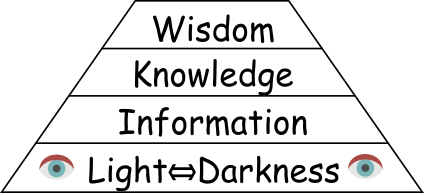
It is important to recognize that information can only ever exist relatively; thus, there is no such thing as absolute information. And in this sense, information is also free—much like pure consciousness, which can assume any form. Indeed, our dreams are far freer than our perception of the external world. Yet even here, the distinction is merely relative, which is why some compare the reality of our world to a dream.
In this regard, one can now conceive how Baldr, as the god of light, and brother of Hödur, as the god of darkness, is capable of dreaming, provided one views both deities together within the context of the Godhead or the Whole. For only when light encounters darkness can relative images, forms, and concepts, and the entire creation, come into being. Thus, standing between these brothers is Hermodr—the third brother and divine messenger—serving to imbue creation with both meaning and direction.
In this way, light can come into being, such as the Bible begins: “Let there be light! And there was light. And God saw that the light was good. And God separated the light from the darkness… (Genesis 1:3)”
But why is it that Balder, as a god, no longer experiences good dreams, but rather “evil” ones, even dreaming of his own death, such that the entire creation begins to die, thereby bringing Ragnarök ever closer? It is with this very question that the “Vegtam’s Song”—the lay of Baldr’s dreams—now begins:
1. Quickly, all the Aesir were gathered at the Thing, and all the Aesir women were discussing, and the mighty gods deliberated about why Baldr was having nightmares.
... (He slept so poorly, as if bound by chains. The refreshment of sleep turned to torment. The powerful then consulted soothsayers and inquired whether it foretold something terrible. The consulted replied: “To die young is the lot of the dearest of Ullr's (the winter god's) favourites.” Fear gripped Frigg and Svafnir (the “Lord of Sleep,” Odin) and the other Aesir. They agreed to send messengers to all beings with the plea not to harm Baldr. And each one vowed not to harm him, and Odin's wife swore them all to an oath. But the All-Father considered the pledge insufficient: the protective Norns seemed to him to leave. So, he summoned the Aesir and demanded counsel. But from their inconclusive discussions, no resolution was reached.)
The verses in brackets are drawn from the translations by Wilhelm Jordan and Karl Simrock, which rely on a more recent source wherein these verses were inserted to serve as a reminder of the story of Baldr’s death. It is noteworthy that Odin is here referred to as Svafnir, the “Lord of Sleep”, and, by extension, the “Lord of Dreams”. Equally significant is the fact that the gods can no longer reach a consensus in their deliberations, a circumstance that already foreshadows the rupture of their unity and the ossification of holistic reason. Thus, Odin himself now ventures into the realm of dreams, to the Foggy Realm:
2. Then Odin arose—the Lineage Gaut (“Sustainer of the People”), and saddled Sleipnir. Then he rode down from there to Niflhel (“Mist-Cave”), and encountered a hound (Garm, “the Barker”) that came forth from Hel.
3. It was bloody across its chest and barked long at the Father of Magic. Odin rode onward; the earth-road thundered beneath him, and he came to the high house of Hel.
Why does the watchdog of the Realm of the Dead bark at him? In the “Song of Grimnir”, it was a sign of Odin that Geirröd’s watchdog did not attack him. Yet here, one might consider that Garm is the watchdog of the Realm of the Dead and attacks all who still bear the blood of life within them. In contrast, Geirröd’s watchdog was meant to guard life—just as Odin guards life: as “Gaut of the Lineages”, the “Preserver of the People”, but also as the “Father of Illusion and Creative Power”. This latter title can also be interpreted as the “Father of Magic Song”, in the sense of creation arising from the Word, or from information. Thus, Odin remains a god of living creation, which is why he rides to the “Eastern Gate”, where the sun rises:
4. Then Odin rode to the eastern gate, where he knew lay the grave of the seeress (Völva/Vala). There he began to chant spells of the dead to the sorceress, until, under compulsion, she rose and spoke words like a corpse:
5. Vala: What kind of being is this—unknown to me—that has imposed upon me this arduous journey? I was covered in snow, beaten by rain, and drenched in dew: Long have I been dead.
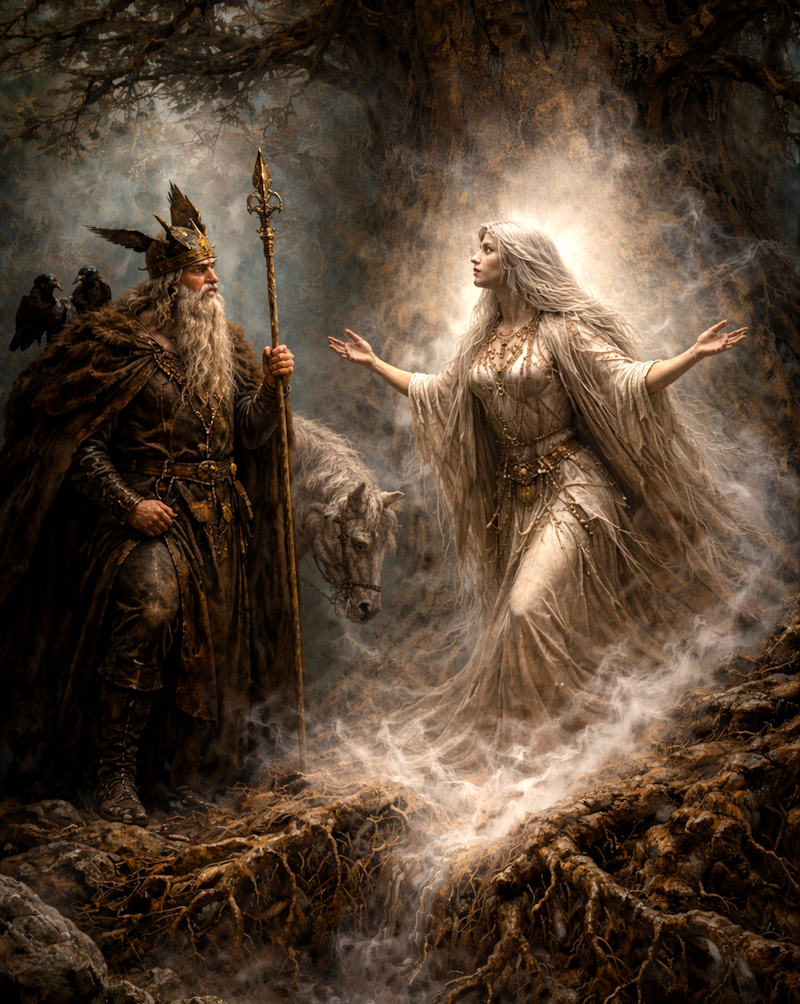
From where does the sun of life rise? The final sentence once again calls to mind the frost giant Ymir, from whom the living world was created or rather, thawed into existence. This is, perhaps, precisely what we call “grave and death”—the moment when life freezes rigid. Who, then, compels it back into life, even when this often appears arduous and toilsome? Who awakens memory from the frozen sea of causes? Who rouses the future from the Well of Fate? Is not everyone entitled to dream their own dream? Who tames the paths? Who tames the creatures?
6. Odin: Vegtam (“Tamer of Ways”) is my name; I am the son of Valtam (“Tamer of the Fallen”). Speak to me from Hel (the Underworld), and I shall remember in Heim (the Upperworld): For whom are the benches draped with rings, and the floor so magnificently gilded?
Yes, that is surely the very purpose of this entire creation: to awaken consciousness from the dream of separation and to recognize itself within the Whole. To this end, there exists a certain order within creation—such as the laws of nature—ensuring that in this “reality”, individuals cannot each live out their own separate dreams, but only exist in communion. This is the spiritual unity within natural diversity, a unity one can “remember”. And what can the ossified life of physicality remember? Itself? To this end, the eye of Odin’s consciousness gazes into the Hall of the Dead; yet he sees no dead, but rather rings of holistic connection and, by extension, of cyclical renewal. Thus, he asks: “For whom are the seats upon these benches reserved? For whom is the floor of this hall gilded, such that it appears to rest upon the very bedrock of Truth?”
7. Vala: Here stands the mead brewed for Balder—a pure draught—yet a shield lies over it, for the Sons of the Aesir dwell in uncertainty. Under duress I spoke; now I shall be silent.
Wow! She recalls the God of Light, who drinks the pure mead of Wholeness. Yet it is veiled by a shield. We have already encountered this shield in Valhalla as a symbol for the limitation of spaces of consciousness. Now, that space has been further restricted—to such an extent that even dead matter can manifest. And with this, the very consciousness of the Gods is reduced to “uncertainty” and discord, thereby threatening the order of creation. Yet this, too, is meant to be recognized and brought into conscious awareness:
8. Odin: Do not be silent, Seeress; I will question you until all is revealed. I wish to know yet more: Who shall become Baldr’s slayer, and rob Odin’s son of his life?
9. Vala: Hödur brings the highly renowned one hither. He shall become Baldr’s slayer, and rob Odin’s son of his life. Under duress I spoke; now I shall be silent.
10. Odin: Do not be silent, Seeress; I will question you until all is revealed. I wish to know yet more: Who shall exact vengeance upon Hödur for this deed of horror, and bring Baldr’s slayer to the funeral pyre?
11. Vala: Rinda (“Protectress”) bears Vali in the Western Halls; and this son of Odin shall fight when but one night old. He shall not wash his hands, nor comb his hair, until he carries Baldr’s foe—the archer Hödur—to the funeral pyre. Under duress I spoke; but now I shall be silent.
Thus, Wala is now compelled to recall her own past in order to deduce the future from it. And she remembers how darkness slew the light, yet how a counterforce was born of the “Protectress”, namely, Vali in the “Western Halls”, where the sun sets. He was, of course, begotten by Odin; and in him, we may recognize the very principle of the life force. For evidently, his birth alone suffices, indeed, even in the dawn of his very first day, he slays the slayer of the light.
Yet clearly, Wala does not like to remember. Here, in the dark realm of Niflhel, she would sooner remain dead and at peace. But against this inertia, Odin continues to strive:
12. Odin: Do not remain silent, Seeress; I shall question you until all is revealed. I wish to know one thing more: Who are the women who will weep (for their beloveds) and cast their scarves toward the heavens?
Much thought has already been devoted to this final question, and it has been interpreted and reinterpreted in countless ways. For it is this question that determines the subsequent course of the dialogue. Karl Simrock writes: “What is the name of the woman who refuses to weep, and refuses to cast her head-veil heavenward?” Evidently, Vala feels caught in the act here. Her true nature was laid bare, revealing that she, in truth, desires to remain dead, and neither mourns nor weeps for the divine light. She clearly has no wish to grieve, nor to open herself—in her sorrow—to the heavens or the Divine, nor to lift the veil of illusion that shrouds her. Thus, through this question, she is indirectly challenged by Vegtam to assume responsibility within the entirety of creation—a challenge that, in turn, reminds us of the very essence of the Einherjar.
13. Vala: You are not Vegtam, as I thought, but you are Odin, the ancient Gaut.
Odin: You are not a seeress (Vala), nor a wise (knowing) woman, but you are the mother of three giants.
14. Vala: Now ride home, Odin, and be glorious (and victorious)! May no creature ever return to me (or: May no man ever regain his senses) until Loki breaks free from his bonds and Ragnarök appears, bringing destruction.
(Vegtam's Song after Arnulf Krause, Karl Simrock, and Edward Pettit)
What, then, happens at the end of the lay? The conventional interpretation is that Vala is now offended, sullen like a small child and refuses to speak any further. Odin is told to vanish from this place and not to return until the end of the world.
However, we wish to attempt a somewhat deeper interpretation from a spiritual perspective, asking: Is it possible that Odin and Vala did not merely recognize one another, but also recognized themselves within the other? In Vegtam, the “Tamer of Ways”, Vala recognizes the All-Father Odin. And in Vala, the seeress of worldly knowledge, Odin recognizes the All-Mother and Soul of Nature: a universal principle of causation that has not yet manifested as active knowledge. Here, one might initially think of Angrboda, the “Messenger of Sorrows”, Loki’s consort, who gave birth to the Fenris Wolf, the Midgard Serpent, and Hel. But one might also think of Frigg, Odin’s wife, who bore Hödur, Hermodr, and Baldr. In his translation, Wilhelm Jordan even suggests a connection here to the three Norns at the Well of Fate. Indeed, all these offspring may be regarded as “Giants” within creation, as beings of immense, holistic power. And from a divine perspective, their mothers collectively represent the holistic Soul of Nature, the All-Mother.
Mother | Three Giants | ||
Giant Daughters | Odin/effect | Hönir/healing | Loki/counteraction |
Frigg/goddess of life | Baldr/god of light | Hermodr/Messenger of the gods | Hödur/god of darkness |
Vala/karma | Urd/fate | Verdandi/becoming | Skuld/debt |
Angrboda/ Messenger of Sorrows | Hel/goddess of death | Midgard Serpent/self-devourer | Fenris Wolf/all-devourer |
Thus, All-Father and All-Mother recognize one another and merge once again into the holistic deity of spirit and nature, seer and seen, subject and object, perception and perceived—a state that may also be termed “self-knowledge”. At that moment, too, the conversation would abruptly cease, for there would no longer be any separate beings to conduct a dialogue. Accordingly, Odin declares: “I shall question you until all is revealed.” And this ensuing silence is not a dead silence amidst the darkness, but rather a living silence within the light, within that eternal victory-peace evoking the figure of Odin’s son, Vidar, the God of Silence, who vanquishes the Fenris Wolf and survives Ragnarök.
One could also say: Odin’s two eyes then become once again a single eye of “insight”—or of pure consciousness—which is no longer divided or separated within itself. The miraculous nature of this “self-knowledge” or “enlightenment” is that, as a culmination, it occurs only once for as long as creation endures; specifically, it happens entirely independently, freely, and beyond creation, yet without being separated from it. And this can occur only for a holistic or divine being such as Odin, who unites all of creation within himself. Thus, the final verse “Svá komit manna meirr aptr á vit” could also be translated as: “May no man (spirit) ever return to (holistic or divine) reason again.” Indeed, this is something our intellect—which is capable of thinking only in terms of opposites—cannot conceive. Yet it is not without reason that one might view this as the ultimate goal of all creation: namely, to discover the imperishable within the perishable, and to find unity and divinity amidst diversity. Perhaps this is also what is meant by “Odin’s ride home”, the “homecoming ride of the Creator God on the horse of creation”. At the very least, this would constitute a worthy conclusion to this profound song.
From the perspective of creation, one might now ask whether this union of All-Father and All-Mother remained barren. In response, we can readily imagine that, through this union, Vali, the God of Life, was born following Baldr’s death, and Vidar, the God of Silence, following Hödur’s death. Thus, after the demise of two eternal principles, two new eternal principles would have been born once again at the very summit of creation—principles that would, moreover, survive Ragnarök. In this regard, one might recognize Vala in the figures of the mothers, Rinda and Grid.
With this, the summit of creation has been reached, the full moon of the cycle, so to speak, and creation now begins to recede through time and space, leading up to Ragnarök. Correspondingly, the apparent discord among the gods intensifies—particularly in relation to Loki—as they now seem to swap their roles. Loki now strives to cling to life at the very zenith of creation, while the other gods press onward toward its end. Indeed, to our human minds this may seem irrational; yet, it is likely a form of holistic and divine reason. For everything that comes into being must, naturally, also pass away. And yet, life must be preserved.
Born to die,
Destined to live.
Thus, in the following chapter, let us reflect upon the binding of Loki—upon how and why he was bound.
Loki is bound
As long as creation was still in the making, the gods—acting as a force—and Loki—acting as a counterforce—were able to coexist relatively harmoniously in their interactions; indeed, Loki himself was, by and large, accepted. For he is, after all, an integral part of the divine pantheon, and evidently, all were aware that every action requires a corresponding reaction if a living creation is to function. It was only his children whose far-reaching influence they sought to curb, ensuring that creation could endure within the bounds of time and space.
Yet now, it seems, creation has passed its zenith, and the processes of aging and dissolution have begun. In a similar vein, human beings experience this very same reality in their own lives: there is a season of youth characterized by growth, followed by a time of aging and decay. In the days of youth, aging is a welcome prospect; later, however, it becomes an adversary—for typically, suffering increases as well. And just as humans struggle for their very lives against this aging process, one might imagine that Loki, too, is now once again battling against the current of creation—and must, in consequence, endure the attendant suffering. The following tale regarding this matter is recounted in “Gylfi’s Illusion”, Section 50:
Then Gangleri spoke: “Loki has wrought a great deal of mischief—first by causing Baldr’s death, and subsequently by ensuring that he was not released from Hel. Was this in any way avenged upon him?”
The High One replied: “He was made to pay such a price for it that he will feel the consequences for a long time to come. When the gods had grown as furious with him as was to be expected, he fled and hid himself upon a mountain. There he built a house with four doorways, so that he might look out in every direction. By day, he often assumed the form of a salmon and concealed himself in the place known as the Franangr Waterfall ('Foaming Gorge').”
Thus, we first read how all anger leads to division and discord. This is followed once again by concentrated symbolism: the foaming waterfall calls to mind the river of creation—now plunging with ever-increasing power and already nearing the sea, where it once again vanishes into the ocean of causes. The mountain reminds us of the summit of creation, where Loki builds himself a house with four doors, through which he can look out and venture forth in every direction. This likely signifies his desire to maintain a comprehensive “overview” and to remain open to all things—or, at the very least, to retain the ability to flee in any direction so as to avoid being bound. That is to say: either back toward the source, forward into the sea, or toward one of the riverbanks—which may be symbolically interpreted as Life and Death, Light and Darkness, or even Spirit and Nature.
Even more potent is the symbol of the salmon form, which he assumes “by day” in the worldly light. We have already encountered the salmon in the tale of the “Otter-Ransom”, when Loki slew the otter, who, having caught a salmon in a waterfall, was about to devour it heedlessly. Its red flesh reminded us of “red gold” as a symbol of living truth. Moreover, it serves as a classic symbol of the return to the source; for at the end of its life in the sea, the salmon swims tirelessly upstream—ascending its natal river all the way to the very source of its birth—there to mate and reproduce. It then dies, sacrificing its body to serve as sustenance for further growth. Thus, in this, we may also discern the true essence of living creation: an entity that strives to return to its source, there to offer up its body for the sake of new creation.
Thus, while Loki indeed strives back toward the source “by day,” he does not go to the source himself; instead, he builds a house for himself above the waterfall, a place to “spend the night”—in order to limit himself and anchor himself physically. And so, he now dwells precisely where the gradient of the River of Creation is steepest—the very place where, as the ultimate counterforce, he intends to remain, refusing to let himself be bound.
Then he pondered what cunning the Aesir might devise to catch him in the waterfall. And as he sat in the house, he took linen yarn and tied the knots in the manner in which nets have been made ever since. A fire burned before him. Then he saw that the Aesir were not far off, for Odin had spotted his whereabouts from Hlidskjalf (the “High Seat of Far-Sight”). He sprang up instantly and ran out into the river, but he cast the net into the fire.
Now things become even more tricky: Loki devises the very net with which he himself—in the guise of a salmon—could be caught and bound. Behind this lies a profound question: How can a divine man or spirit—one who embodies freedom itself—be bound? In truth, binding exists only within the natural world, governed by the laws of cause and effect. The spirit must be free, and the divine, holistic spirit above all—for otherwise, freedom itself would cease to exist. The only way, therefore, is for the spirit to bind itself—this freedom it naturally also possesses. Thus, he himself assumes the forms of water, river, salmon, and net. With this, nature once again comes into play. Indeed, this constitutes the wondrous essence of Loki: that he is capable of assuming feminine, or rather, natural forms, such that his reactive force is transformed back into a generative cause. From this, one can clearly discern that Loki represents not merely a destructive counterforce within creation, but also one that is profoundly constructive.
Thus, the net serves as a powerful symbol of the bonds within nature—composed of countless knotted threads or “strands”, wherein one may also discern the interwoven soul of nature. Perhaps, too, this net exists solely to recapture the spirit that has lost itself in illusion—a notion that, in turn, reminds us of the “self-realization” of consciousness. In this vein, the name of Loki is also interpreted along these lines, being derived from the Germanic root *luk*—a term encompassing everything associated with snares, knots, loops, and fastenings. In this regard, the symbol of the net also serves as a reminder that, depending on the size of its mesh, only certain beings are ensnared within the fabric of space and time.
Yet it is the Spirit, in turn, that conceives the thought of such a net; and it was likely by this very sign, that Odin, seated upon his throne of foresight, realized it could be none other than Loki who, as a divine spirit, was devising the very means of his own binding. For naturally, all thoughts are borne by his two ravens Huginn and Muninn back to him, the Creator God, who then ensures their realization. And so, just as he rises to seize Loki, Loki simultaneously springs up to flee into the river of creation. Thus, once again, action and reaction.
The fire burning before Loki could also be a symbol of the spirit. Thus, Odin would rise as the spirit within the fire, while Loki, in turn, leaps into the water—serving, as it were, as the counterplay of fire and water, which together form the very foundation of physical life. But why does he cast the net he has devised into the fire? One might initially assume that he intended to burn it there so as to avoid being ensnared by it himself. Yet, within the fire of the spirit, nothing is ever consumed without consequence; indeed, even every single thought has some effect. We might, therefore, examine this symbolism more deeply and consider the possibility that Loki sought to use the net to bind the spirit within the fire. And this appears to be precisely what happens; for it is not Odin himself who appears at Loki’s dwelling, but rather Kvasir, accompanied by the other Aesir. We have already come to recognize Kvasir as the embodiment of divine intellect and worldly wisdom—a figure in whom one may discern a bound form of divine reason.
When the Aesir arrived at the house, the first to enter was the wisest of them all—he who is named Kvasir. When he saw the ashes in the fire where the net had been burned, he realized that this must have been a device for catching fish, and he told the Aesir. Immediately, they set to work and wove a net modelled after the one they had seen in the ashes, the one Loki had made. And when the net was finished, the Aesir went down to the river and cast it into the waterfall. Thor held one end of the net, while all the other Aesir held the other, and they dragged the net. But Loki slipped away and hid himself between two stones. They dragged the net over him, yet noticed that something living was moving ahead of it. Therefore, they went back up to the waterfall a second time and cast the net out again. They attached something so heavy to it that no one could possibly slip underneath. Then Loki swam ahead of it; and when he saw how close the sea was, he leaped over the net-rope and up the waterfall.
Thus, the wise Kvasir, acting as divine intellect, now retrieves the concept of the binding net from the “ashes of the fire”, that is, from that which remains unconsumed within the spiritual flame—much as Mimir draws forth creation from the waters of the Sea of Causes. And the gods gave form to this concept and wove the net, to which they then bound themselves, in order to wield it within the flow of creation. On one bank of the river stood Thor, and on the other, the other gods. What, then, are the two banks of the River of Creation? Life and death, light and darkness, or indeed: Spirit and Nature.
Here, one may now reflect upon the transformation of Thor—he who, until now, had wielded his hammer against the mountain and frost giants to prevent creation from freezing solid. Yet, following the death of Baldr and his slaying of the dwarf Lit as “colourful formation”, he now appears to be battling, from the shores of death, against physical life within the river of creation; and he does so no longer with his hammer, but rather with a net of binding. Thus, interestingly enough, the gods do not cast their net from the sea upstream—against the current, toward the source and the waterfall—as one might expect; instead, they cast it downstream, with the current, toward the sea and the river's end. For they are no longer fighting to preserve living creation, but rather fighting against Loki, who is swimming against the current.
One can therefore visualize the following: Source → Waterfall → Net → Loki/Fish → Sea.
Consequently, only two possibilities remain for the fish—or rather, the living beings—within the river of creation: Either they flee back into the Sea of Causes, where the river of creation ultimately ends; or they allow themselves to be ensnared in the net of bondage. For the path back to the source is now sealed off. This is a truly profound point!
Loki attempts to escape twice: once passively, beneath the net; and once actively, over the net. Yet both attempts are detected and thwarted by the gods. Thus comes the third attempt:
Now the Aesir spotted where he was; they ran back upstream and positioned their ranks along both banks of the river. Thor, however, waded right down the middle of the stream, and in this manner, they proceeded out toward the sea. Yet Loki saw two options: moving toward the open sea was fraught with mortal peril, but the alternative was to leap back over the net. And that is precisely what he did. As swiftly as possible, he sprang over the line. Thor reached out and seized him, but he slipped through his hands, so that in the end, Thor managed to catch him only by the tail. For this reason, the salmon is narrow at the rear.
Thus, the destiny of the gods now takes its course. Thor himself steps into the river of creation, thereby becoming a mortal being, much as Loki had assumed the form of a salmon. The other gods are separated and dispersed along the two banks. Loki, recognizing the peril facing physical life within the sea of causes, attempts once again to leap over the net in order to escape his bonds. Yet Thor now blocks the upward path of escape toward the heavens and seizes Loki in his salmon form. However, it was only with great difficulty that he managed to grasp the slippery creature by the tail—seizing it, as it were, at its end and main drive. For how, indeed, can one hold fast to life? Especially at the very point where it seeks to move—and, naturally, at the very point where it meets its end. Hence, physical life inevitably wanes as it approaches its conclusion. Yet this very decline constitutes its primary driving force—much like the tail fin of a fish—which is, in all likelihood, what the final sentence implies.
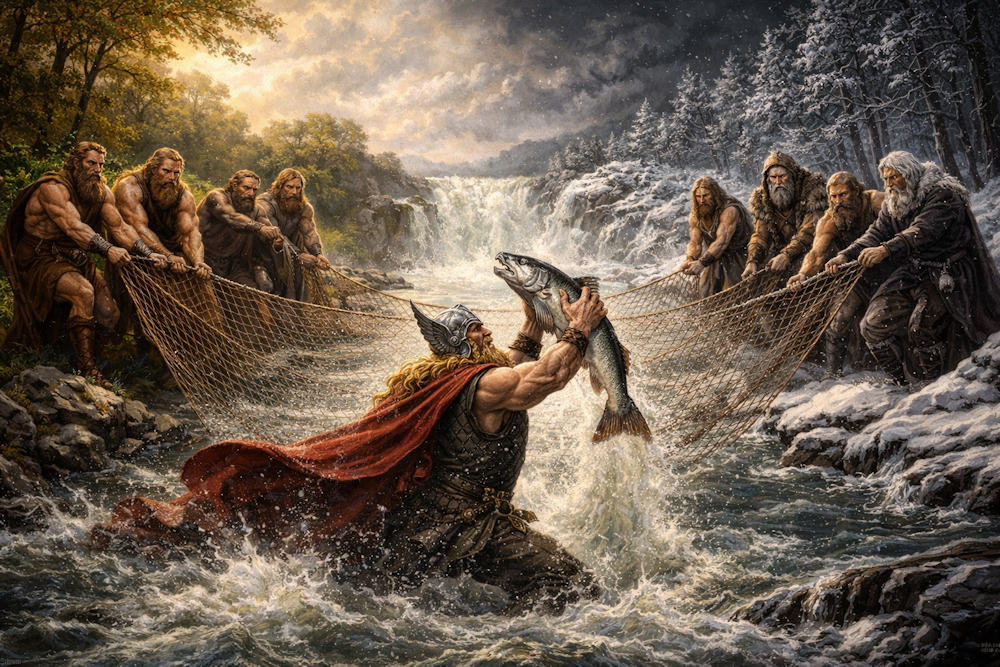
Now Loki was imprisoned without any guarantee of his safety, and they took him to a cave. There they took three flat stones, placed them on their edges, and made a hole in each stone. Then Loki's sons, Vali and Nari or Narfi (the “Constrictor and Limiter”), were captured. The Aesir transformed Vali into a wolf, and he tore his brother Narfi to pieces. Then they took Narfi's intestines and bound Loki to the three sharp stones. One was placed under his shoulders, the second under his loins, the third under his knees, and the intestine bonds turned into iron. Then Skadi (the “Harassment” or “Loss,” as winter goddess) took a poisonous snake and fastened it above him so that the venom dripped from the snake onto his face. But Sigyn, his wife, stood by him, holding a bowl beneath the drops of venom. When the bowl is full, she steps away and pours out the venom. Meanwhile, however, it continues to drip onto his face. He contracts so violently that the whole earth shakes. They call this an earthquake. There Loki lies in chains until Ragnarök.
(Gylfaginning §50 after Arnulf Krause and Karl Simrock)
And the symbolism intensifies: Loki is now trapped in the river of creation and bound in a dark cave, reminiscent of the underworld of Midgard, the unconscious of matter, and the water creature is transformed into a stone being. His son Vali is then transformed into a wolf who tears his brother Narfi apart. This is particularly noteworthy: Up to this point, we have encountered a Vali as the son of Odin, born from Rinda as the “protector”, whose birth avenged the death of Baldr on Hödur, the god of darkness. Now, suddenly, a second Vali appears, a son of Loki and Sigyn, the “bringer of victory”. One can consider whether this refers to the same life principle or two distinct ones. At the very least, the Aesir transform this Vali into a wolf of transience, which is, of course, an inherent part of the life principle, at least in the way we understand physical life as becoming and passing away. With this wolf, they then kill another son of Loki and Sigyn, namely Nari or Narfi, the “Constrictor and Limiter”. In doing so, they essentially kill the principle of physical life, which can only exist for a time through the limitation and narrowing of consciousness. What then remains is the life principle itself, the eternal and boundless life of pure consciousness, which is formless in its essence.
But Loki works precisely against this, seeking to hold onto physical life. Indeed, this is the wondrous interplay of opposites, of action and reaction, within the totality of creation. When creation, as physical life, sought to grow, the rascal Loki fathered the three mighty children Hel, Jörmungandr, and Fenrir with Angrboda, the “bringer of sorrow and suffering”. These children then appear as the Cave of the Dead (or Death's Noose), the Midgard Serpent (or Self-Devourer), and the wolf Fenrir (or All-Devourer). But now, as physical creation sought to dissolve once more, he must, of course, fight against it, swim against the current, and seek to hold onto the limited physical realm.
In this respect, we can easily imagine that Vali, the son of Loki, actually refers to Odin's son of the same name. As far as we know, he is only mentioned in this one instance in the entire Edda (see also the Wikipedia entry: Vali). Thus, the gods, with the help of Vali as a life principle, bring about the dissolution of the physical limitations of creation. This is an ingenious symbolism: for the dissolution of creation apparently means nothing other than the dissolution of physical limitations.
Thus, Loki is now bound by his own children through Narfi, namely in the death cave of Hel beneath the Midgard Serpent, which drips the poison of self-destruction as the saliva of the hungry Fenris wolf. We also know this poison of separation and isolation from the venom- and fire-breathing dragons in other legends. This likely also refers to the three flat stones that previously lay at the bottom of the river of creation. They are now perforated in their solidity and erected for divine judgment. The fact that they stand as sharp stones beneath Loki's shoulders, loins, and knees reminds us of the binding of his effective power, fertility, and mobility. And this binding is effected by his son Narfi as a “constriction and limitation”, whose intestines, as the physical source of strength, now solidify into iron chains.
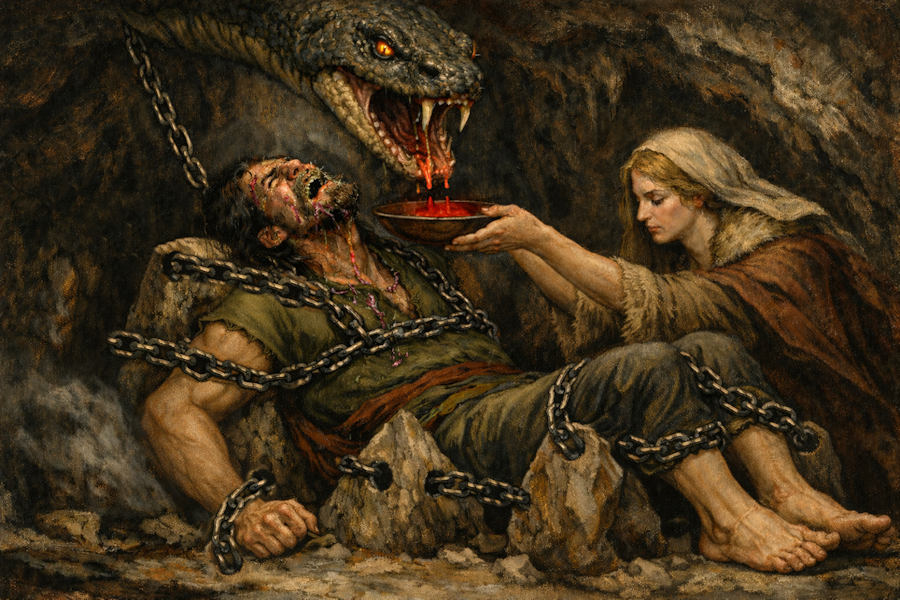
Loki as “counterwave”
Thus, the image of the cave of painful suffering, formerly also called “hell”, emerges. And indeed, Loki has been the embodiment of painful suffering in creation from the very beginning, for every counteraction is naturally suffering if one cannot be content with what is. Nevertheless, Loki is still an Aesir god, a holistic being, so that with Loki, all of creation suffers. His wife Sigyn apparently ensures this, collecting the painful poison in a bowl and, when the vessel is full, emptying it. Where does it flow? It can only flow back into the river of creation, so that now all other creatures suffer with Loki, especially the elderly, who are approaching physical death in the winter of their lives. This is likely where Skadi, the winter goddess with whom we began our chapter on Loki, comes into play.
Every drop of this poison is a physical death, the suffering of which shakes the entire earthly world in its apparent permanence, in the small and the great. It is remarkable that never before in the entire Edda has such painful and agonizing suffering in the realm of Hel been described as that now befalls Loki. It is therefore above all a divine suffering, which has its divine purpose in creation, which is why Sigyn also means “bringer of victory”, in contrast to Angrboda as “bringer of suffering”. For in the end, of course, there is divine victory in creation, as the saying goes: “In the end, everything will be alright, and if it is not alright, then it is not yet the end.”
In summary, we can imagine the following image of the “wave of creation”, to which Loki forms a kind of “counter-wave”. This is also suggested in the image above, if one considers the three pointed stones as turning points of the wave, creating a valley-peak-valley sequence, or beginning-middle-end:
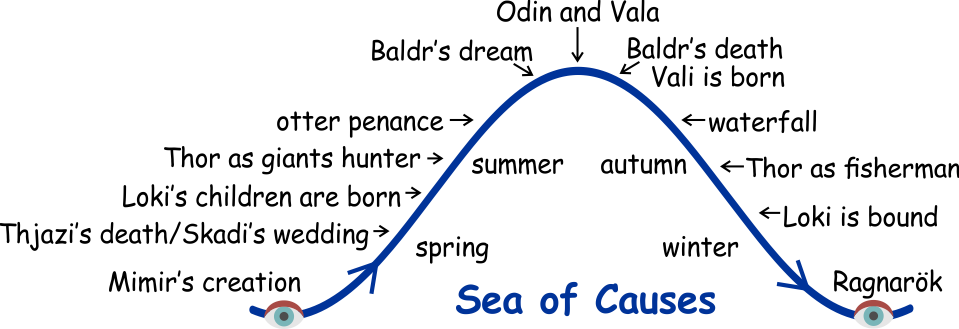
Thus, creation flows from one eye of Odin to the other. And one might say: Until his meeting with Vala, Odin himself could be seen riding the wave of creation. But now it is Hermodr who rides Sleipnir, the “Gliding One”, to spread the message. For here one should be careful not to become a “cunning fox”, as a famous story from Zen Buddhism illustrates:
A fox turned to Master Pai-Chang and said: “I was once a Zen master, and when a student asked me whether an enlightened being is still subject to the law of cause and effect, I replied: 'The enlightened one rides the waves of cause and effect.' For this error, I had to live five hundred lifetimes as a fox. Please help me to gain insight.” Pai-Chang replied: “For the enlightened one, there is only the wave of cause and effect.” These words helped the visitor to enlightenment, and his fox existence came to an end. (Wisdom of Zen, Timothy Freke)
The culmination of creation would then be the “self-knowledge” or “enlightenment” of Odin and Vala. And the dissolution of creation begins with the death of Baldr and Hödur, when the awareness of the eternal boundaries between light and darkness disappears. Therefore, all physical limitations dissolve, and the worldly opposites are balanced in conflict. Accordingly, the Prose Edda of “Gylfi's Illusion” continues in the next chapter with a description of Ragnarök. However, we want to wait a little longer before discussing the end of the world and first take a closer look at the mystical being of Thor and the associated stories.

