
| Content | Next | About |
The Gods’ Songs of Mockery
It is surely not conducive to healing when we humans mock the gods, thereby blocking our own path to wholeness and fulfilment. But what does it mean when gods mock gods? The Edda contains two songs of this kind, often regarded as comic tales or parodies. Some scholars also see in them the decline of the old myths, which had become objects of ridicule. Others think of the art of verbal contest.
From a spiritual perspective, we would again like to reflect above all on the role of the intellect. In three long chapters, we have ourselves attempted to make the nature of Odin, Loki, Thor, and other gods and goddesses more graspable to our intellect. Naturally, this, too, has given rise to images and particular conceptions, as it did for many scholars before us. Some saw divine beings primarily as natural phenomena; others found Germanic heroic ideals for warriors, while still others discovered their occultism in runic magic. Such diversity is also important within a living culture. Our intellect, too, needs this diversity, for only within diversity can it recognize unity and thus transcend itself. Problems arise when such conceptions become rigid and are misused to serve a particular purpose—in the worst case, even political ends. This danger exists in all worldviews that claim absolute and exclusive validity. We need only recall the medieval Inquisition, one of the darkest chapters in Christianity…
How, then, can we prevent a worldview from becoming rigid within the human intellect? The Buddha is said to have declared: ‘Monks, I shall show you the teaching as a raft, suitable for crossing over, not for holding on to.’ It is in this spirit that we would now like to reflect on the Edda’s songs of mockery.
The Lay of Harbard the Ferryman
Thor was returning from a journey in the East when he came to a sound (a sea strait). On the other side of the sound stood the ferryman with his boat.
1. Thor called: Who is that lad among lads standing beyond the sound?
2. The ferryman answered: Who is that fellow among fellows calling across the bay?
3. Thor: Ferry me across the sound, and I shall feed you tomorrow morning! I have a basket on my back; no food could be better. I ate at leisure before setting out from home: herrings and oat porridge. I am full enough from that for today.

Here, we may first imagine Thor returning from Jötunheim, the realm of the mountain and frost giants, to Asgard—from the realm of nature, as it were, back into the spiritual and divine realm. Having heard so many stories of Thor fighting in Jötunheim, even carrying half a whetstone in his head, our intellect finds it far from easy to bring him back into the realm of the gods. What ferryman could carry him across this apparent boundary?
Thor himself calls for such a ferryman, although until now he has been able to wade through every body of water: all the rivers, and even the vast sea after he caught the Midgard Serpent and overthrew Hymir. Yet now he presents himself as a poor man living on herrings and oat porridge—the food of the poor—and eating only once a day, after having consumed an entire ox and eight salmon at Thrym’s. He also carries a basket on his back, apparently containing all his worldly possessions. Is that much or little? Perhaps he carries within it the brave Aurwandill, whom we met at the end of the story of Hrungnir’s fight: the ‘Wanderer in the Rising Light’, Groa’s husband, whom Mother Nature awaits as the spirit of life? Is this the nourishment on which the Einherjar, too, feed each morning? And where should he carry him?
4. Ferryman: Too soon you praise tomorrow’s meal. Little do you foresee: sorrow lies upon your household, for I believe your mother is dead.
5. Thor: You tell me plainly what strikes every man a bitter blow: that my mother is dead.
6. Ferryman: You do not look as though you owned three tolerable farms. Bare-legged you stand, dressed like a vagabond. You do not even wear trousers of your own.
Thus, the ferryman asks: How am I to bring you into the world of the gods? You look like a mortal man and do not know whether you will still be able to eat your breakfast tomorrow. Perhaps even your mortal mother is already dead! You do not even look as though you led a fruitful family life with children, parents, and grandparents, or possessed decent clothing. How can a ‘vagabond’ enter the spiritual realm of the gods?
To this, we ask: What form does a god have? What nourishes him? What ancestors and descendants does he have? What does he possess?
7. Thor: Steer the boat over here! I shall show you the landing place. Or who owns the boat you keep by the shore?
8. Ferryman: Hildolf (‘Battle-Wolf’) is the name of the man who asked me to keep it, the wise counsellor who lives by the sound of Radseyjar (the ‘Island of Counsel’). He decreed that I should ferry over no robbers or horse thieves, only good people and those I know well. Tell me your name if you wish to cross the sound!
Who owns a boat floating upon the water of life? Above all, it belongs to the bodily intellect, which fights the wolf of transience for its body, yet often appears as greedy as a hungry wolf itself. And this ‘wise-counselling’ intellect guards its island of knowledge, and thus also the boundary to Asgard. For it decides who belongs among the gods and who does not. Names, too, are therefore of the utmost importance to it.
9. Thor: I would tell you my name even if I and all my kin were outlaws: I am Odin’s son, Meili’s (‘Love’s’?) brother, and Magni’s (‘Might’s’) father, the mighty lord of the gods. It is Thor with whom you may speak here. Now let me ask your name.
10. Ferryman: Harbard (‘Greybeard’) is my name, and I seldom conceal it.
11. Thor: Why should you conceal your name unless you bore some guilt?
12. Harbard: But even if I bore some guilt, I would defend my life against one such as you, unless I were doomed to die.
Thus, each gladly gives his name, which belongs to his identity. Thor reveals himself as a Son of God and speaks rather of his nature as the power of the gods, brother of divine love, and father of divine might in Thrudvang, his ‘Field of Strength’ within nature.
The ferryman calls himself Harbard. His name can be interpreted as ‘Greybeard’ and is listed as one of Odin’s names in the Lay of Grimnir (verse 49). The grey beard evokes the wisdom of old age, and behind it stands, of course, the deity himself: Odin as the All-Father, or pure consciousness reflected in outward forms within Odin’s eyes.
Yet Thor seems not to recognize him in the ferryman’s form. He feels mocked and asks about guilt. What guilt could a god bear? And yet the intellect can imagine even this—which is probably also the chief source of karmic guilt in our world. Thus, Harbard allows for this possibility while revealing his purpose in the world: to protect life as far as possible.
13. Thor: It seems a grievous labour to wade across the bay to you and wet my basket. I would repay your mockery, you swaddled infant, if I could cross the sound.
14. Harbard: Here I shall stand and await you. You would meet no tougher man since Hrungnir’s death.
Who or what could be harder and more enduring than matter? Odin as man—or spirit?
The play of possibilities continues. Indeed, we may regard this entire world as a play of possibilities capable of emerging from the Sea of Causes. Similarly, Ulrich Warnke speaks of a sea of possibilities from the perspective of modern quantum physics. Naturally, it is arduous to wade through it and endure all its possible effects. The intellect also fears that our basket, containing all our possessions, might dissolve within this sea. Accordingly, in the following verses, it begins to reflect on all that it has done and achieved on its journey through the world—and might lose again:
15. Thor: So now you wish to recall how I fought Hrungnir, that hard-hearted giant whose head was made of stone. Yet I brought him down and made him sink. What were you doing meanwhile, Harbard?
It seems Thor was not wearing his divine protective helmet in that fight, allowing the petrified notion of deeds of his own to enter his head. What could Thor have done without his father, his mother, and all creation? Why does he see a division between my deeds and yours? And his father appears to join in this game:
16. Harbard: I was with Fjölvar (‘Much-Caution’) for five whole years, on the island called Algrön (‘All-Green’, the earth). We fought and felled the warriors there, tried all manner of things, and pursued the maidens.
17. Thor: How did things go with your women?
18. Harbard: Lively women we had, had they been more yielding to us. Clever women we had, had they been kinder to us. They twisted ropes from sand and dug the earth out of a deep valley. I alone surpassed them all in cleverness. I slept with the seven sisters and enjoyed all their pleasure and delight in love. What were you doing meanwhile, Thor?
Just as Thor tells of his struggle against the rigidity of the mountain and frost giants to preserve a living creation, Harbard tells of his long struggle within the realm of space and time. In doing so, Greybeard shifts from ‘I’ to ‘we’, reminding us of the Einherjar, who fight under the guidance of providence within the host of unity amidst the diversity of flourishing nature. The maidens and women evoke the soul of nature, whom Svipdag, too, sought in order to reunite spirit and nature. Naturally, the obstacles are difficult to overcome, especially the material and earthly ones. Only a holistic spirit can reach this goal, and ultimately this is again Odin as the All-Father and deity, who accomplishes everything because he is everything. The sisters evoke the nine sisters as the sea’s wave-daughters, with whom Odin fathered Heimdall: the ‘Consciousness Shining Homeward’, through which Thor, too, now seeks his way home.
19. Thor: I slew Thjasi (the ‘Icy One’), the arrogant giant, and hurled the eyes of Allvaldi’s son into the bright heavens (‘All-Ruler’, or, in the Skaldic Book, Ölvaldi, ‘Ale- or Beer-Ruler’). They are the greatest signs of my deeds, visible to all people ever since. What were you doing meanwhile, Harbard?
20. Harbard: Many arts of seduction I practised upon the night-riding women when I lured them away from their men. Hlebard (‘Protective Beard’?) was a hard giant, I believe; he gave me his magic staff, and I robbed him of his intellect.
21. Thor: Poorly you repaid good gifts there.
22. Harbard: What breaks off one oak is gained by another (in light). Each looks to himself in such matters. What were you doing meanwhile, Thor?
Here, one might think of Odin winning the love of many giantesses, luring them away from the wilful, rigidifying spirit of the mountain and frost giants—from night-consciousness toward the divinely enlivening spirit of day-consciousness. Thus, the mountain and frost giant Hlebard, too, may have been transformed when he surrendered his magic staff for fulfilling wilful desires to the deity, thereby losing his selfish, bodily intellect. This again recalls the nature of the Einherjar, who relinquish their egotism as lone warriors to fight for the entire Tree of Life in the deity’s service. Indeed, each can decide this for himself. And who is the ‘other’?
Thor appears to deal differently with the giants and their women, who follow the mountain-path toward rigidity, although he, too, acts only out of divine love:
23. Thor: I was in the East, slaying giants (Jötuns) and harmful women who went to the mountain. Overwhelming would be the race of giants if all remained alive. It would be the end of humans in Midgard. What were you doing meanwhile, Harbard?
24. Harbard: I was in Valland (‘Land of the Fallen’), seeking battles. I stirred up princes but never reconciled them. Odin has the princes who fall in battle, while Thor has the race of thralls.
Here, Harbard seems even to shatter our intellectual concept of divine love. For struggle, too, naturally has its place in creation, and fundamentally all creatures in the ‘Land of the Fallen’ struggle for existence, having fallen from divinity and wholeness. Accordingly, they must also rediscover their divine peace for themselves. It would surely miss the point entirely if an overpowering god were to impose peace upon all creatures within creation.
What is divine love? And what is it not?
Odin’s princes evoke the free lords of the Einherjar, while Thor’s thralls recall Thjalfi and Röskva, who serve him. Is there a division between them? What is true freedom?
25. Thor: Unequally would you divide the host among the Aesir if you had such power.
26. Harbard: Thor has power enough, but no courage. In fear and cowardice you hid in the mitten and seemed no longer to be Thor. In your fright, you dared neither sneeze nor fart, lest Fjalar hear it (the ‘Deceiver’, also Skrymir or Utgard-Loki).
This apparent division now brings us to the great theme of illusion. Naturally, Thor had to enter this realm of illusion if he wished to act and fight within nature, especially since Thjalfi, as the human intellect, also accompanied him on this journey to Utgard. But how does he now emerge from illusion into divine consciousness again? For he has evidently entered deeply into this illusion if he allows himself to be provoked by this accusation, no longer recognizes his father, and even wishes to send him into the realm of dark death:
27. Thor: Harbard, you unmanly fellow, I would strike you down to Hel if I could cross the sound.
28. Harbard: Why should you cross the sound, where there is no quarrel at all? What did you do then, Thor?
Yet his father attempts to help him. How can a god, as a holistic being, be separate? How can any place be beyond his reach when there is no quarrel, no separation at all? Thus, he continues to ask his son about his deeds, presumably hoping that he will recognize within them the unity of Father and Son.
29. Thor: I was in the East, defending the river when Svarang’s (the ‘Sluggish One’s’) sons attacked me. They hurled stones at me, yet had little joy of victory, for they first had to ask me for peace. What were you doing meanwhile, Harbard?
30. Harbard: I was in the East, conversing with a certain woman. I jested with the linen-white one and held a secret meeting. I gladdened the golden-shining one, and the maiden cherished the pleasures of love.
31. Thor: Pleasant company you had with maidens there.
32. Harbard: I could have used your help there, Thor, to keep the linen-white maiden.
33. Thor: I would have given it, had I been able.
34. Harbard: I would trust you in that, unless you betrayed my trust.
35. Thor: I am no heel-biter, like an old leather shoe in spring (which harms what it ought to protect).
Once again, this concerns the realm of embodiment in the East: defending life within the river of embodiment. The Father presumably speaks of love for the pure soul of nature and asks his son to help in this direction, too, preserving the pure soul for the pure spirit. And it seems that understanding is slowly dawning upon Thor.
36. Harbard: What were you doing meanwhile, Thor?
37. Thor: I slew the berserkers’ women on Hlesey (‘Island in the Sea’). They had done the worst of deeds, deceiving the entire people.
38. Harbard: A shameful deed you committed there, Thor, when you slew women.
39. Thor: She-wolves they were, scarcely women. They smashed my ship, which I had set upon supports, threatened me with iron clubs, and drove Thjalfi away. What were you doing meanwhile, Harbard?
40. Harbard: I was with the host preparing to come this way, to raise the battle-banner and redden the spear.
Thor, too, sees in feminine nature a kind of soul of the overpowering frost and mountain giants—their inner essence—which he wishes to shatter in order to break the giants’ dominance as well. To this end, he struck the poor sister at Thrym’s and broke Geirröd’s daughters Gjalp and Greip. Yet his father reproaches him, saying that striking women was a shameful deed. Surely feminine nature exists for healing. Or not always?
The question of what we should fight against in this world, and how, is evidently very old. Similarly, the ancient Indian Ramayana already contains a story about the death of the giantess Tadaka…
What kind of ship does a god set upon supports on land, so that it does not float upon the water? Was it perhaps good that they smashed it? Was it good that they sought to drive Thjalfi, as the human intellect, away from him? Was it good to threaten him with iron clubs as long as transient form still clung to a god?
A similar ship upon supports recalls Baldr’s sea burial, when the gods had to fetch a giantess named Hyrrokkin (‘Fire-Wrath’) to push the ship into the water. She did so with fiery giant-strength, putting the gods to shame, and Thor would gladly have slain her with his hammer.
Yet the Father said: Do you not recognize that I am everywhere within creation, holding the battle-banner high?
41. Thor: So you mean to say that you set out to bring us harm.
42. Harbard: You shall receive compensation for that in the form of an arm-ring, as granted by the arbitrators who wish to reconcile us.
No, Thor does not yet recognize his own father, but still sees good and evil within creation as things affecting him personally. In response, the Father offers the arm-ring as a symbol of unity and wholeness in action, seeking reconciliation with his son. Yet instead of reconciliation, he hears only ridicule:
43. Thor: Where do you get these mocking words, more mocking than any I have ever heard?
44. Harbard: I took them from those old men who dwell in homely woods.
45. Thor: A fine name you give to stone-heaps (burial mounds), calling them homely woods.
46. Harbard: That is how I think and speak of such things.
Here, one may reflect on the silent forest hermits who revere Vidar, the god of silence and silent warrior within the forest of conceptions. For divine intuition arises from this stillness, rather than from the clamour of thoughts. Yet our ordinary intellect sees death in such stillness, just as Thor sees only stone-heaps or burial mounds there. Accordingly, he also feels attacked by this wisdom:
47. Thor: Your eloquence will serve you ill if I decide to wade across the sound. Louder than a wolf, I believe, you will howl when the hammer strikes you.
48. Harbard: Sif has a lover (a paramour) at home. You should wish to meet him, for it would be more fitting for you to face that trial of strength.
We find a similar allusion to Sif’s infidelity in Loki’s flyting, which we shall examine shortly. Tradition tells us that Sif is also Ullr’s mother, while Thor is named as his stepfather. In our account of Thor’s family, we considered Njördr as a possible father, before he was admitted to the rank of the gods. Yet this is presumably not the infidelity meant here. We can readily imagine that Thor himself is the paramour, since he is evidently no longer conscious of his divine nature. He thus seems no longer to be the Son of God who married Sif. In a higher sense, this presumably concerns recognizing oneself, overcoming the ego, thereby becoming free of separation and rediscovering one’s divine nature. Yet Thor does not wish to hear this:
49. Thor: You speak as your mouth commands, so as to wound me, cowardly man. Yet I believe you lie.
50. Harbard: I believe I speak the truth. Late you are upon your journey. Far would you have travelled by now, Thor, had you continued on your way.
51. Thor: Cowardly Harbard, it is you who have delayed me most.
52. Harbard: I never thought Aesir-Thor’s journeys would be hindered by a herdsman.
53. Thor: Now I shall give you counsel: Row the boat over here! Let us end this quarrel; fetch Magni’s father!
Indeed, as a holistic being, Thor could have been delayed nowhere. Who could stop a god? Only the intellect can really imagine this happening to a creature within space and time. Yet Thor feels delayed by a ferryman whom he cannot recognize as his father—and thus, fundamentally, as himself.
The herdsman recalls the Christian shepherd tending his lost sheep and is probably not intended disparagingly. Thor now also offers to end the quarrel if the ferryman acts according to his will. Yet the ferryman does not, because this is no divine will:
54. Harbard: Go away from the sound! You are denied the crossing.
55. Thor: Show me the way, then, since you will not ferry me across the bay.
56. Harbard: It is little to refuse, yet long is the way. A while to the tree-stump, another to the stone. Keep to the left-hand path until you reach Verland (‘Land of Men’). There Fjörgyn (Earth, Jörd) will meet Thor, her son, and show him the paths of his kin to Odin’s land.
Thus, Thor now asks to be shown the way. What does this path, which his father shows him, mean? It leads into the human world, and we can readily imagine Thor first becoming a Son of Man in order to become a Son of God again. Here, we may recall the Son of Man’s path described in the Songs of Groa and Fjölswid. The first stage, as far as the tree-stump—a symbol of separation from the Tree of Life—recalls the mother’s grave, where Thor, too, must now awaken her again upon the threshold of death. Once Mother Earth is alive again, the second stage leads to Fjölswid’s stone wall, where he must overcome and dissolve the petrified intellect that he has carried in his head as half a whetstone since his fight with Hrungnir. The ‘left-hand path’ recalls the nature-side of the World Tree. There he must restore his mother to life, and will then rediscover Sif as his faithful wife, just as Svipdag rediscovered his Menglöd on Healing-Mount as the pure soul of nature. Living Mother Nature will thus show him the paths of his divine kin into Odin’s spiritual realm, the realm of his All-Father. A wondrous path!
57. Thor: Shall I reach it today?
58. Harbard: You will arrive with toil and hardship while the sun stands high. Yet I expect a thaw.
The day beneath the sun of living consciousness recalls our day of life, and, in Thor’s case, the entire day of creation. And this path is surely worth the effort. The Father also expects a ‘thaw’, recalling the frost giants from whom the water of life is thawed again. This actually happens quite of its own accord through the spiritual fire from Muspelheim, the divine spark of love—or, in Christian terms, through the Holy Spirit. Yet here, too, Thor hears only mocking words, because he still believes he performs this work himself and fails to recognize the All-Father within all creation:
59. Thor: Brief shall our conversation now be, since you answer me with mockery alone. I shall repay you for refusing me passage when we meet another time.
60. Harbard: Go now where fiends will seize you [or: where harm will befall you]!
(Harbarðsljóð, based on Arnulf Krause, Karl Simrock, and Edward Pettit)
Thus, the path leads to Midgard, into the world of separation, where we consequently encounter the harm that seeks healing. In this song, we may therefore find a wonderful vision: the Son of God is to become a Son of Man so that the Son of Man may become a Son of God again. Similarly, St Augustine is said to have declared: ‘God became man so that man might become God.’ Thus, the human being lives within a living nature to fulfil the ferryman’s task: dissolving the petrified intellect and bringing everything back into the divine that is fundamentally already divine. Wonderful!
The Lay of Hymir and His Cauldron
This story prepares the way for the second song of mockery: Loki’s flyting at the drinking feast that Ägir prepared for the gods:
1. Once, the gods of the fallen took hunting spoils and wished to drink before eating their fill. They cast the rune-staves and examined the lot. Then they found that Ägir (the sea-giant) possessed an ample store of cauldrons.
2. He sat upon a mountain, cheerful as a child, resembling a son of Miskorblindi (‘Mister Blindi’ or ‘Mash-Blind’?). Odin’s son (Thor) looked challengingly into his eyes and said: ‘You shall prepare abundant drink for the Aesir (the gods)!’
3. The man’s demanding words troubled the giant greatly, and he quickly devised revenge (an excuse) against the god. He asked Sif’s husband (Thor): ‘Bring me a cauldron in which I can brew beer for you all!’
The gods of the fallen are the gods of all creatures that have fallen into time and space. Their hunting spoils would then be the entire creation from Mimir’s Well, intended for their divine wholeness, perfection, and the satisfaction of every desire. Naturally, a drink to aid digestion is still missing—preferably mead, the divine drink of wholeness. Where can they find it within creation? To this end, they interpret creation’s runic signs at the Well of Destiny and behold the lot of fate. It points toward Ägir, the Sea of Life, who has embodied himself as a sea-giant like a child, appearing happy yet remaining blind. The gods now challenge him, and Thor in particular becomes active within the realm of embodiment. Yet Ägir—in whom we may symbolically recognize growing living beings, and above all humanity—begins to think and tries to talk his way out of his responsibility. For where in this world could there be a cauldron large enough to brew mead for all the gods as the divine whole? Moreover, in his blindness, he seems not yet to know the gods’ mead at all, thinking only of intoxicating beer.
4. Even the renowned gods and high counsellors could find such a cauldron nowhere, until Tyr (the god of righteous victory) privately gave Hlorridi (Thor as the ‘Rider of Clamour’) alone some great and friendly counsel:
5. ‘East of Elivagar (the “Ice-River” of embodiment), at the edge of heaven, dwells the hound-wise (precociously clever) Hymir (the “Darkened One”?). My mighty father owns a cauldron, a spacious cauldron a mile deep.’
6. Thor asked: ‘Do you know whether we can obtain this drink-boiler?’ And Tyr answered: ‘With cunning, my friend, it is possible.’
7. Thus, they set out that very day, away from Asgard, until they came to Egill (the wicked giant). There he lodged the goats (of his chariot), those with the most magnificent horns. And they went to Hymir’s hall.
8. The young man (Tyr) encountered his grandmother, who seemed most repulsive to him, for she had nine hundred heads. But another woman came toward him (his mother), all golden and with white brows, to bring the son a draught of beer:
9. ‘Kinsman of giants, I shall place you both, two brave men, beneath the cauldrons. For my beloved (Hymir) is often miserly toward guests and full of ill intent.’
First, Hymir’s nature is described in somewhat greater detail. He appears to dwell in Jötunheim, at the ‘edge of heaven’, presumably meaning the boundary of rigid matter. He is called ‘hound-wise’: a precociously clever, or one-hundred-per-cent clever, intellect embodied as a frost and mountain giant and defended as though by greedy dogs, recalling the Song of Fjölswid (‘Much-Smart’). Accordingly, he is often miserly, while his ill intent evokes the giants’ desire for wilful dominance, especially through physicality.
What cauldron could such a giant possess in which the divine drink might be brewed? Presumably, it signifies the principle of embodiment itself, brought to Ägir, who embodies himself out of the Sea of Life. Thus, the Skaldic Book §1 also tells how Ägir even journeyed from his island of growing embodiment to Asgard. There, he received, as it were, the divine drink of the entire Skaldic Book. Afterwards, he is challenged to invite all the gods into his embodiment to drink in turn.
Here, Tyr, too, as the god of righteous victory, makes his greatest appearance in the Edda. On the one hand, he is a son of Odin; on the other, a son of Hymir. His mother has no name in the Edda, although some scholars call her Hrod, meaning ‘Glory’. His grandmother, presumably on his mother’s side, evokes through her ‘nine hundred heads’ the diversity of outward nature (100) and its ring of cyclical renewal (9). That she appears ‘repulsive’ to Tyr might suggest the ever-present struggle of opposites within outward nature. In this regard, we might recognize in Tyr’s mother—the ‘golden mother with natural wisdom’—the holistic soul of nature, who also unites Odin and Hymir and makes righteous victory within creation possible: the victory of peace, healing, and perfection, which is also the highest glory in this struggle. She is also the beloved and the loving one, embodying great love for both divine spirit and embodied nature. Here, we may already reflect on the role embodiment plays in righteous, divine, and holistic victory within creation. The cauldron they seek is presumably also a symbol of this: preparing the divine drink within living embodiment.
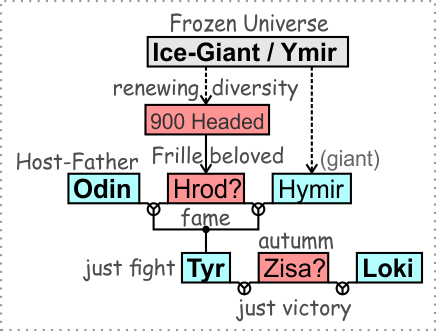
(see also the Edda Family Tree PDF)
Thus, in Tyr’s family tree, we rediscover a wonderful circle of kinship and influence revolving around Hrod as the soul and glory of victory, directed toward creation’s righteous divine goal.
The name of Tyr’s wife has likewise not been preserved in the Edda, but some scholars (such as Jacob Grimm) suggest Zisa, a goddess of autumn. This also makes sense, for autumn evokes the third stage of life, in which a human being should attain glorious victory before frosty winter arrives. Naturally, Loki also plays his part here, which we shall encounter in the following song of Loki’s flyting. In this respect, we may see in Tyr the great goal of creation: righteous and divine victory in life, which the Einherjar also embody.
10. Late (in the evening), the ill-intentioned one returned: hard-hearted Hymir, home from the hunt. He entered the hall. The man’s beard was frozen, clinking like icicles.
11. His wife said: ‘Hail to you, Hymir, in a kindly spirit! Your son has come into your hall, the one we awaited from his long journey. Following him came the foe of Hrod (of the giants’ glory?), the friend of humankind called Veorr (Thor).
12. You see where they sit beneath the hall’s gable. Thus they shelter themselves, with a pillar standing before them.’ The pillar shattered beneath the giant’s gaze, and then the beam, too, broke in two.
13. Eight (cauldrons) fell, but only one of them, a hard-hammered cauldron, fell intact from the beam. They emerged, and the old giant followed his enemy (Thor) with his eyes.
Here, once again, we find concentrated symbolism. The giant’s frozen beard recalls the rigid thoughts of his intellect. His beloved rejoices that her long-awaited son has returned to the hall as the world, or space of consciousness, of embodiment, bringing righteous divine victory into view. The eight cauldrons upon his hall’s roof-beam may evoke the eight worlds above the pillar, or trunk, of the World Tree. The pillar would then symbolize the ninth world, Jötunheim, the world of the giants. Yet now the giant recognizes his own divine son behind this pillar. We might thus imagine his world of embodiment within the World Tree’s trunk collapsing, and all the other worlds resting upon it shattering as well—except one, presumably Asgard as the world of the gods.
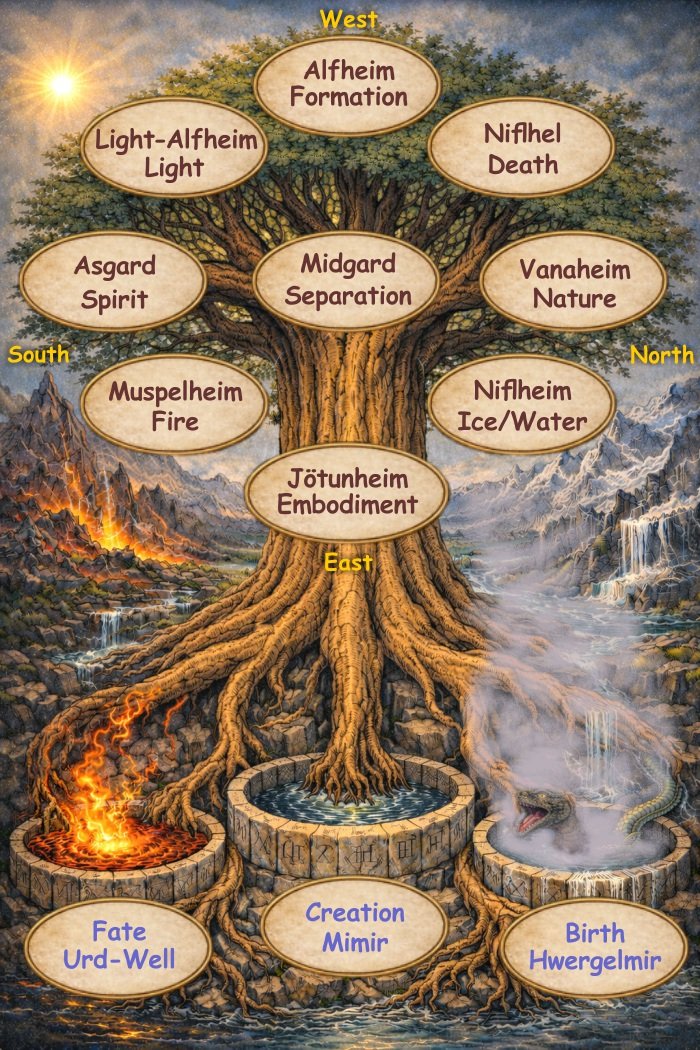
This again reveals how closely embodiment and intellect are connected, and how the world we see is merely a question of our direction of gaze or perspective. Yet as much as the mountain and frost giant rejoices in his divine son, who promises victory, he simultaneously fears the effect following him in Thor’s form: the threat to his material physicality, and thus also to his notion of permanence. Accordingly, Thor is called an enemy of the mountain and frost giants’ victorious glory and a friend of growing human beings.
14. His foreboding promised nothing good when he saw the thorn of sorrow for giantesses (who lose their husbands through Thor) enter the forehall. Three bulls were brought there, and the giant ordered them cooked at once.
15. They beheaded each one and brought them to the fire. And before Sif’s husband (Thor) went to sleep, he alone ate two of Hymir’s entire oxen.
16. To Hrungnir’s greying friend (a giant as a ‘Clamourer’), Hlorridi’s (Thor’s, the ‘Rider of Clamour’s’) meal seemed very large indeed, and he said: ‘Tomorrow evening, we three shall have to live on what we catch fishing.’
After the giant’s hall had at least partly collapsed, all those involved withdrew into the ‘forehall’, where the great cauldron stands and the intellect nourishes itself for the world of embodiment. In terms of the World Tree, we move toward the root. There, three bulls are to be cooked over the fire of spirit. In these three bulls, we might symbolically recognize the World Tree’s three springs, or the three fundamental principles of desire, hatred, and ignorance, of which we have already spoken at length. The two gods struck off the bulls’ heads, recalling the seat of the intellect with the horns of battling opposites and distinctions. For only without these heads can embodiment become changeable again, and even turn into holistic nourishment for the gods. Thus, Thor alone could consume two of them—perhaps the Wells of Birth and Destiny, or desire and hatred, once they had lost their opposition. Tyr, his mother, and the giant then feed upon the third ox: Mimir’s Well of Creation, or the intellect’s ignorance and illusion. Thus, the age-grey giant remains a friend of the intellect with its clamorous, battling thoughts—and naturally remains unfulfilled and hungry.
17. Veorr (Thor) said (the following morning) that he wished to row out to sea with him if the bold giant would provide bait. Hymir said: ‘Go to the wild herd if you trust your courage, destroyer of mountain-Danes (mountain giants), and seek some bait!
18. Surely it should be easy for you to obtain bait from an ox.’ The lad (Thor, compared with the giant) hurried to the forest, where an entirely black ox stood.
19. The giants’ enemy tore from the bull the lofty seat of its two horns (its head). In the boat, Hymir said: ‘Your work (at rowing) seems far worse to the boat’s master than when you sit still.’
20. The lord of goats (Thor) asked the descendant of apes (Hymir) to take the wave-horse farther out. Yet the giant showed little desire to row farther.
21. Renowned Hymir, the bold one, alone hauled up two mighty whales at once upon his hook. But behind him in the stern, Veorr (Thor), Odin’s offspring, skilfully prepared a fishing line.
22. The protector of humankind, who alone strikes the serpent dead (at Ragnarök), fastened the ox’s head to the hook. And she (the Midgard Serpent), the gods’ hatred, who encircles all lands below, snapped at the hook.
23. Bravely, strong Thor hauled the poison-gleaming serpent up to the ship’s side. From above, he struck the hammer upon the mountain-high, armoured head, the most terrible head of the (Fenrir-) wolf’s birth-brother.
24. Wolves howled, the rocky foundations cracked, and all the ancient earth trembled. Then the catch sank back into the sea.
We have already explored this symbolism in detail in the story of Thor’s fishing trip in ‘Gylfi’s Delusion’ §48 of the Prose Edda. After the grandmother’s nine hundred heads and the three heads of the oxen used for food, one further head is mentioned: that of a black ox. This recalls the ‘darkening’ of ignorance, which the name ‘Hymir’ presumably also suggests. Hymir catches two whales from the Sea of Life, evoking the ‘fallen’ creatures—the German words Wal, ‘whale’, and Wal, ‘the battle-slain’, echo one another—who exist in separation, even if they grow to gigantic size. Yet with the ox-head of ignorance, for only this will make it bite, Thor catches the serpent as the fundamental principle of separation upon which all Midgard, and the entire world of creation, rests. Even this fundamental principle can be shaken by Thor’s power, and at Ragnarök he also shatters this serpent, as he intimates to the giant here. Thus, he shakes the giant’s enduring world still further: matter’s rocky foundations break, the ancient earth trembles, and the hungry wolves of transience howl.
This demonstration of their powers now begins a trial of strength between Hymir and Thor: between physicality and divinity, or nature and spirit.
25. The giant was troubled as they rowed back, and Hymir said nothing for a long time. At last, he laid down the oars and spoke:
26. ‘We should divide the work. Take the whales home to the farmstead, or pull our water-goat (our boat) ashore!’
27. Hlorridi (Thor) went, seized the stem, and lifted the sea-horse out without bailing it. With oars and bailing vessels, he alone carried the giant’s boat through the mountain gorge to the farmstead.
28. Yet the giant, ever full of defiant craving, continued to contest bodily strength with Thor. He said no man was truly strong, however powerfully he might row, unless he could break this goblet.
29. Once Hlorridi (Thor) held it in his hands, he at once shattered the hard stone with the crystal goblet. Still seated, he hurled it through the pillars. Yet afterwards, it returned intact to Hymir.
30. At last, the excellent beloved (of Hymir) gave him some great and friendly counsel that she knew: ‘Strike it against Hymir’s skull, the skull of the giant made sluggish by food, for it is harder than any goblet.’
31. The bold one, the lord of goats, half rose and filled himself entirely with Aesir-strength. The man’s helmet-seat (skull) remained intact above, but the round beer-bringer shattered against it.
The boat, too, symbolically recalls the body floating upon the Sea of Life, moved and supported above all by divine power. Like the cauldron, the goblet is also an embodied ‘vessel’, with which the intellect can ‘grasp’ and comprehend something. And what the intellect has once grasped can only shatter against the intellect itself. This is presumably precisely what these songs of the gods’ mockery concern: breaking the physically rigid conceptions of worldly things. Only thus can we ultimately discover spiritual unity within natural diversity and recognize that everything consists of transient forms which formless consciousness can assume. Yet until this insight dawns, we shall repeatedly believe that we can lose something precious:
32. And Hymir said: ‘Much that is precious I know I have lost, seeing the goblet broken at my feet.’ The old man continued: ‘Never again shall I be able to say: “You are prepared with beer.”
33. Now you may try whether you can also carry the beer-ship (the brewing cauldron) out into our yard!’ Tyr twice attempted to move it. Yet both times, the cauldron remained immovable.
34. Modi’s (‘Courage’s’) father (Thor) grasped its rim and strode across the floor out of the hall. Sif’s husband had lifted the cauldron onto his head, and its rings (handles) clattered against his heels.
Here, the cunning of which Tyr spoke at the beginning reveals itself. For Hymir would never surrender this cauldron willingly. Yet in their contest of strength, he eventually challenges the gods to do precisely this. And just as Thor carried the giant’s boat, he now carries his cauldron. It seems as though he himself has become this cauldron, now able to move with life again. This is wonderful symbolism, offering much food for thought…
And yet the giant still regards the cauldron as his property. He wishes to defend it, but thereby only destroys himself, together with his entire family of petrified conceptions:
35. They had walked a while when Odin’s son looked back. Then he saw a many-headed host of giants coming from the mountains in the East with Hymir.
36. He lifted the great cauldron from his shoulders, hurled the ready-striking (hammer) Mjölnir toward them, and shattered all the lava-whales (mountain giants).
37. Then they had not travelled far before one of Hlorridi’s goats (from Thor’s chariot) lay half-dead. The draught animal of the shaft was lame in one leg, and cunning Loki was to blame.
38. But you have heard—for anyone versed in the gods can give a fuller account—what compensation he received from the lava-dweller when he gave his two children in return.
39. Thus, the mighty one came to the Thing (the assembly) of the gods, bringing the cauldron Hymir had owned. And the holy gods will surely drink the beer seasoned with poison at Ägir’s.
(Hymiskviða, based on Arnulf Krause, Karl Simrock, and Edward Pettit)
Lava, as liquid rock, is also a fitting symbol for the water of life, which can embody itself, cool, and become rigid. On the return journey, one further obstacle arose for which Loki was held responsible. For every effect of the gods must naturally have a divine counter-effect. Through this ‘divine mistake’, the human being enters the picture again: the ‘lava-dweller’ of a mobile body, whose intellect has not yet hardened into the stone of a mountain and frost giant—a ‘materialist’. Here, the story of Thor in the Land of the Giants in ‘Gylfi’s Delusion’ §44 is alluded to, which we have already treated in detail. The two children who now help bring the cauldron to the assembly of the gods at the Well of Destiny would then be Thjalfi and his sister Röskva. We have interpreted them symbolically as the intellect and soul of an awakening human being who serves the gods and thereby develops into an Einherji. Presumably, we, too, are called to do this as we read such wondrous stories. At the very least, we may reflect on whether we, too, have been given such a cauldron of body and intellect by the father of righteous and divine victory, in order to brew within it the divine drink of wholeness, invite the divine into ourselves, and overcome all separation.
Thus, the great cauldron finally reaches Ägir, the Sea of Life. For the gods’ goal is a living creation, and Thor above all ensures this within the human world. The ‘beer seasoned with poison’ recalls the old tradition of adding intoxicating substances such as henbane to alcoholic drinks. Presumably, this was intended not merely to make the beer filling and sleep-inducing, but also to expand consciousness in ritual use. For, as we know, whether a poison heals or harms is often simply a question of dosage. Thus, intoxication with beer also becomes a symbol of our intellect, which can make us sluggish, addicted, and ill, but can also awaken, help, and heal us. In this regard, the poison in the beer presumably also evokes Loki, who plays his part in the following song, attacking the bodily, discriminating intellect amidst the intoxication of beer.
Thus, we have again found a wonderfully profound song whose distinctive character also finds expression in its composition. Clearly recognizable is the developing art of the skalds, which Snorri describes and praises in his Skaldic Book. Edward Pettit writes in his introduction to the song:
The poem’s style is remarkable, for of all the Eddic poems, Hymiskviða has the most in common with Old Norse skaldic poetry: it contains numerous kennings and variations, together with some unusual syntactic features. The poet also uses many unique words. Taken together, these features might suggest the work of a skald reworking Eddic verse, or simply that of an original poet familiar with both poetic traditions.
There was evidently a time when skaldic poets sought ever more perfect expression for their divine inspiration. First, naturally, through the harmonious sound of words, but also through artistic composition, so that the text increasingly became a framework for listeners or readers to fill with meaning themselves: recalling the old stories, reflecting, becoming creative, finding connections, and helping shape the narrative’s flow in order to fathom its depths. For ‘perfection’ naturally cannot exist in outward form alone. Perfection must unite all participants into a harmonious whole: the listener and what is heard, the reader and what is read, perception and form, spirit and nature. To this end, the so-called ‘kennings’, artistic circumlocutions for familiar concepts, were presumably also used to break through the habits of the conceptual mind, which tends to become rigid and cling to names and forms. And this is probably also precisely what the following song concerns:
Loki’s Flyting (Lokasenna)
Of Ägir and the Gods
Ägir, who was also called Gymir, had prepared beer for the Aesir after receiving the great cauldron, as just recounted. Odin came to this feast with his wife Frigg. Thor did not come, for he was travelling in the East. Sif, Thor’s wife, was there, as was Bragi (‘Divine Inspiration’, god of poets) with his wife Idun (the ‘Renewing and Rejuvenating One’, goddess of youth and immortality with the golden apples). Tyr (god of righteous victory), the one-handed, was also there, for the Fenris Wolf had bitten off his hand when being bound. Njördr (god of sea, wind, and fire) was there with his wife Skadi (‘Harm, Loss’, goddess of winter), (and their children) Freyr and Freyja (the goddess of love and the god of summer), as well as Odin’s son Vidar (god of silence and silent warrior within the forest of conceptions). Loki was there, and Freyr’s servant Byggvir with his wife Beyla (the nature spirits ‘Barley’ and ‘Manure’). Thus, many of the Aesir and Elves were present.
Here, Ägir receives another name. Gymir recalls the thawed frost giant Ymir, whom the gods have made liquid, flowing, and alive again through their spiritual fire. Thus, the water of life could flow from the ‘Big Freeze’ back into the source of the ‘Big Bang’, into ‘Mimir’s’ Well. A great circle thus closes around Mimir, who, as the intellect, draws creation from Odin’s eye—from consciousness itself. Within this great circle, we may see Ägir as a holistic living being: all humanity, and also the individual human being, insofar as he rediscovers himself within the greater whole. In this way, every human being can be a sea-giant in the Sea of Life. And this wonderful story revolves around the important role played here by the intellect, with its conceptions and formations.
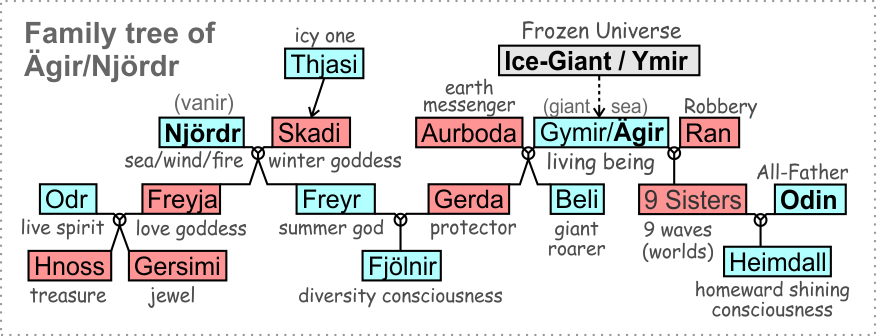
The structure of Ägir’s family tree is also interesting. In Aurboda, we may recognize inward nature as a messenger, and in protective Gerda, the soul of nature. Her brother, the embodied giant Beli as the ‘Roarer’, had already been defeated by Freyr, freeing Ägir of him and allowing him to be silent. His wife Ran would then, as ‘Robbery and Lack’, be a driving force of life and a fundamental principle of outward nature, of the waves and worlds upon the Sea of Life. With them, Odin as the All-Father and Father of the Fallen begets the divine son Heimdall, a consciousness capable of leading all living beings back to their true home: holistic consciousness, the gold of truth.
As the human being develops toward this wholeness, all the conceptual mind’s separations and distinctions begin to dissolve. Thus, the entire world of the gods appears within Ägir himself, and he is challenged to nourish these beings accordingly, so that they remain alive. Within himself, he recognizes Odin as the All-Father and creator together with the soul of creation, as well as Bragi as divine inspiration and Idun as the goddess of renewal and eternal youth. Hence, in the preceding song, Ägir was also called ‘cheerful as a child’. Yet he recognizes within himself not only the spiritual side but also the whole of nature: Njördr with Skadi and their children, from whom nature’s diversity arises. From this, the barley for beer also grows, naturally needing nourishment and fertilization within the earth. Particularly important is Tyr, the god of righteous and divine victory, as the great goal, as well as Vidar, the god of silence, for naturally the conceptual mind must grow quiet and the clamour of thoughts disappear. Only Thor was still travelling in the outward realm of embodiment, for wholeness was not yet perfect, and physical rigidity therefore still threatened. And to reach this great divine goal, Loki, too, is naturally present—perhaps even the most important of the gods in this process of development:
Ägir had two servants, Fimafeng and Eldir (‘Quick-Grasper’ and ‘Fire-Stoker’). Shining gold served there in place of firelight. The beer served itself. And the place was a sacred sanctuary of peace. Those present greatly praised the excellence of Ägir’s servants. Yet Loki could not bear to hear this and slew Fimafeng (‘Quick-Grasper’). Thereupon, the Aesir shook their shields and shouted at Loki. They drove him out into the forest and themselves went on drinking.
At first, a world made whole thus appears within Ägir. The shining gold recalls the eternal light of truth, replacing the firelight of transient flames. Everything happens before the gods as if of its own accord, and victorious peace seems attained: the healing of all battling opposites. Everyone praises Ägir’s servants, who have brewed the divine drink. What is still lacking for perfection and supreme fulfilment?
Well, what happens when someone scratches the surface of this state—not even from outside, but from within? This is evidently possible because it remains a transient state of the conceptual mind, which all too quickly wishes to grasp and hold on to it. Loki is there for precisely this reason and slays this ‘Quick-Grasper’. And this is truly a great divine blessing, freeing the intellect from its desire to cling. Yet the conceptual images of the gods defend themselves with their protective shields of separation and drive Loki himself out like an enemy into the forest of conceptions of an external world. This means that the cauldron of the intellect—and thus also the world of Asgard—has still not shattered, as suggested in the preceding song, and appears to be an enduring vessel. This is probably one of the greatest challenges along the path. What names and forms do gods have, what weapons, powers, and abilities? What separation and distinction can there be for a holistic being?
It is therefore good that Loki returns and meets Ägir’s other servant at the hall’s entrance, treating him more amicably. Accordingly, Eldir, the ‘Fire-Stoker’, recalls a healing spirit who works symbolically as Ägir’s cook, tending to the cooking and preparation of digestible food.
Yet Loki soon returned, encountered Eldir (‘Fire-Stoker’) outside, and said to him:
1. ‘Tell me, Eldir, before you take another step: What are the sons of the victory-gods saying over their beer in there?’
2. Eldir: ‘The sons of the victory-gods speak of their weapons, their fighting strength, and their prowess. Yet none of the Aesir and Elves within is your friend in speech.’
3. Loki: ‘I shall enter Ägir’s hall to look upon the feast. Insult and disgrace I bring to the sons of the Aesir. Thus, I mix poison into their mead.’
4. Eldir: ‘Know that if you enter Ägir’s halls to look upon the feast and pour insult and disgrace upon the healing counsellors, they will wipe it off on you.’
5. Loki: ‘Know, Eldir, if we contend together with sharp words, I shall have answers in abundance, however much you say.’
The ‘sons of the gods’ already suggest that born, formed, and therefore also transient beings are meant. Yet within this play of separation, Loki still sees mead as the divine drink of wholeness where the others drink intoxicating beer. Into it, he mixes, as it were, himself as an antidote, turning it back into pure mead. Yet this antidote is surely intended to help, rather than harm—for otherwise Loki would not be divine—and to expand Ägir’s consciousness. Naturally, this depends upon dosage, and Eldir warns of still greater separation and counter-reaction, for as a cook he knows this secret. The final verse already points toward wholeness, for Eldir appears to stand for Ägir’s entire hall and all those present. In this respect, he also recalls Andhrimnir, Valhalla’s cook as ‘Anti-Embodiment’, who prepares the Einherjar’s nourishment there each day.
Then Loki entered the hall. Yet when those present saw who had come in, they all fell silent.
6. Loki: ‘Thirsty I came, Loptr (the “Airy One”, difficult to grasp), a long way to this hall, to ask the Aesir to give me an excellent draught of mead.
7. Why are you so silent, arrogant gods, unwilling to speak? Show me a seat and place at the drinking feast, or send me away from here!’
8. Bragi: ‘Never will the Aesir show you a seat and place at the feast. For the Aesir know which beings they should welcome to a friendly feast.’
9. Loki: ‘Do you remember, Odin, how in ancient days we mixed our blood together? You vowed never to drink beer unless it were offered to us both.’
The first to deny Loki the pure mead of wholeness is Bragi. This makes sense, for he is the divine poet and narrator of the gods’ stories, thereby also creating the images of the gods with all their distinctions. Thus, he now speaks in the gods’ name and knows Loki’s contrary nature, to which he himself has given form. Ägir, too, heard the gods’ stories from Bragi when he visited Asgard, as we read at the beginning of the Skaldic Book:
Ägir undertook a journey to Asgard, but the Aesir knew of his coming. He was indeed received hospitably, yet many things were presented to him through sensory illusions… Mead was poured, and much was drunk. Bragi sat nearest to Ägir, and the two drank together and conversed. Bragi told Ägir of the many events the Aesir had experienced…
Such stories of the gods are surely very healing, but how does one finally get all these different figures out of one’s head again?
To entice the blind, the Buddha released words from his golden mouth, merely at play. Ever since, heaven and earth have been filled with entangling thorn-thickets.
(Daiō Kokushi, Zen master around 1300)
To this end, Loki now turns to Odin himself, the All-Father, who should restore wholeness. For all creatures are originally drawn from Odin’s eye and thus consist of the same blood as the water of life. The final sentence is particularly powerful. For Odin himself actually drinks only wine, in the sense of the pure power of illusion and creation, of which he is fully conscious. When Odin drinks beer, he enters the intoxication of unconsciousness, and Loki must counteract this, as now happens.
10. Odin: ‘Rise now, Vidar, and let the (Fenris-) wolf’s father sit at the feast, lest Loki speak words of abuse to us in Ägir’s hall.’
Then Vidar rose and poured a drink for Loki. Yet before drinking, Loki addressed the Aesir:
11. ‘Hail to the Aesir, hail to the goddesses, and to all the most holy gods! Except that one Ase sitting in here upon the bench: Bragi.’
12. Bragi: ‘A horse and sword I give you from my possessions, and Bragi will also compensate you with a ring, so that you show the Aesir no hostility. Do not make the gods angry with you!’
13. Loki: ‘Horse and arm-rings—you will always lack both, Bragi. Of the Aesir and Elves within, you are the most cowardly in battle and the most fearful of missiles.’
14. Bragi: ‘I know that if I were outside, just as I came into Ägir’s hall, I would carry your head in my hand. That would be my gift to you for this lie.’
15. Loki: ‘Bold you are in your seat, yet you will not do so, Bragi, bench-adornment. Go and fight if you are angry! The brave man does not hesitate.’
Thus, Odin now calls upon Vidar to reconcile Loki with everyone present and invite him to the drinking feast. As the god of silence, he is probably also the only one who could accomplish this. For only when the discriminating intellect falls silent can this divine peace be preserved. Loki, too, is willing and wishes healing to all those present, except Bragi, who himself refused reconciliation with him. What does this mean? Is Bragi now himself challenged to establish the peace of wholeness?
At least he attempts it, though not through silence. We should also note that Loki does not call upon him to be silent, as he does all subsequent speakers. Yet Bragi wishes to give him a horse and sword from his possessions. This presumably signifies bodily formation and distinction, over which, as a storyteller, he believes he has power. He adds an arm-ring as compensation, to justify his deeds within the ring of divine wholeness. Yet Loki answers that he has no power over these things, being merely a storyteller upon the bench where people gather to drink mead and beer. Is this a lie on Loki’s part? Who possesses this power? Does the narrator possess it, or above all the listener?
16. Idun: ‘I beg you, Bragi: kinship among children and all wish-sons requires that you speak no words of abuse to Loki in Ägir’s hall.’
17. Loki: ‘Be silent, Idun! Of all women, I call you the most man-mad, since you laid your arms, washed shining-white, around your brother’s slayer.’
18. Idun: ‘I speak no words of abuse to Loki in Ägir’s hall. I am calming Bragi, stirred up by beer. I do not wish you to fight each other in anger.’
19. Gefjun (the ‘Giving One’): ‘Why should you two Aesir quarrel here with wicked words? Lopt (Loki, the “Airy One”, difficult to grasp) knows that he is jesting and that all the gods love him.’
20. Loki: ‘Be silent, Gefjun! Now I shall mention the one who seduced you into love’s delight: the white lad who gave you jewellery, and you wrapped your thighs around him.’
Loki now repeatedly demands silence. Vidar is therefore also the only one he does not attack here, for ‘speech is silver, silence is golden’. At first, the feminine beings of nature cannot hold their tongues. This is also what nature is there for: to express itself and work out its effects, yet always with peace as its great goal.
Loki responds by accusing them of infidelity through allusions to obscure and questionable stories which they cannot reject either. This, too, scratches the intellect’s surface. For what is truth within the gods’ stories? And yet they always point toward truth. This may therefore concern the more fundamental question: What is the meaning of fidelity in marriage between man and woman, or spirit and nature? Why is it not conducive to healing to jump from one partner to another? Here, too, the aim is naturally to rediscover wholeness: the holistic spirit and the holistic soul of manifold nature. For only thus can the two unite in perfection and supreme fulfilment. Yet how could this fidelity exist as long as one regards oneself as a separate being? Consciousness will then always ‘stray’…
21. Odin: ‘Mad you are, Loki, and out of your senses if you anger Gefjun. For I believe she knows all the world’s destinies as precisely as I do.’
22. Loki: ‘Be silent, Odin! You could never decide the battle among men. Often you gave victory to the worse man, although you should not have done so.’
23. Odin: ‘Know that if I gave victory to the worse man, although I should not have done so, you spent eight winters beneath the earth. You were a milk-cow and a woman, and there you gave birth; and that I consider an unmanly way.’
24. Loki: ‘But you, they say, practised magic on Samsey and worked witchcraft like the seeresses. In a sorcerer’s guise you travelled among humankind, and that I consider an unmanly way.’
Now even Odin joins this quarrel and cannot remain silent. Indeed, the intellect can imagine even this in its beer-intoxication, losing every concept of wholeness and divinity. And evidently this, too, is important at this stage of development.
Thus, Odin accuses him of being ‘mad and out of his senses’, presumably meaning that Loki, too, no longer perceives through the senses and has lost his intellect. Can this incur the wrath of the soul of nature, who, as the principle of causation, knows destiny?
Thus, Odin and Loki now seem to quarrel beyond all intellect over whether they are man or woman, spirit or nature. Where is this to lead?
25. Frigg: ‘Never should you tell humans of your destinies, of what you two Aesir did in ancient days. Living beings should always avoid these old stories.’
Indeed, Frigg is probably right, for one should always be cautious with such creation stories. They often establish a foundation of illusion upon which our world is then supposed to stand. And no one may scratch it, for the entire world would then threaten to collapse. This also makes it so difficult for our intellect to recognize wholeness again, since it builds upon the principle of separation—an intellectual construction, as it were, a Tower of Babel seeking to grow into heaven toward God.
But who says this? Again, merely the intellect? Be silent!
26. Loki: ‘Be silent, Frigg! You are Fjörgyn’s (a giant’s) daughter and have always been man-mad, since you became Odin’s wife and took both Ve and Vili into your arms.’
27. Frigg: ‘Know that if I had a son like Baldr here in Ägir’s hall, you would not escape the sons of the Aesir. He would strike you down in your fury.’
28. Loki: ‘Still you wish, Frigg, that I tell more of my harmful deeds: I brought it about that you will never again see Baldr riding to the halls.’
Loki’s accusation refers to Odin’s two brothers, Ve and Vili as ‘Consecration’ and ‘Will’, who naturally always accompany a god when he is embraced. Here, too, we can really only think of the holistic soul of nature as capable of embracing a god at all.
Regarding Frigg’s answer, we may again agree with her. She addresses the central problem of the whole story. For if Baldr, as the god of brightness, were consciously present here, everyone would drink the mead of divine wholeness in the pure light of consciousness. We have already spoken at length about Baldr’s descent into the dark realm of the dead. Here, too, Loki merely provided the antidote when the gods began reaching for immortal forms. Thus, the gods became transient figures of the creative intellect. Ragnarök approached, and we can readily imagine the gods, now taking fixed form, thereby also becoming beer-drinkers. Accordingly, Loki’s ‘harmful deed’ appears harmful only when regarded in isolation.
29. Freyja: ‘Mad you are, Loki, to recount your wicked, harmful deeds. I believe Frigg knows all destinies, even though she does not speak of them herself.’
30. Loki: ‘Be silent, Freyja! I know you very well; you lack no vice. Of the Aesir and Elves within, every one has been your lover.’
31. Freyja: ‘False is your tongue. I believe it will conjure up no good for you in days to come. The gods and goddesses are angry with you; sorrowful you will go home.’
32. Loki: ‘Be silent, Freyja! You are a witch, deeply mingled with harm, since the healing counsellors surprised you with your brother (Freyr), and then, Freyja, you had to fart.’
33. Njördr: ‘There is little wrong if women take a husband, a lover, or both. Yet it is a wonder that this unmanly Ase, who has even borne children, was able to enter here.’
34. Loki: ‘Be silent, Njördr! From the East you were sent as a hostage to the gods. Hymir’s (the giants’) daughters used you as a chamber pot and urinated into your mouth.’
35. Njördr: ‘This is my comfort: that long ago I was sent as a hostage to the gods. Then I begot a son (Freyr, god of summer and fertility) whom no one hates and who is regarded as the Aesir’s protector.’
36. Loki: ‘Stop now, Njördr, and restrain yourself! I shall conceal it no longer: with your sister you begot such a (praiseworthy) son, and that is nevertheless no worse than expectation [and yet that was better than expecting something].’
Njördr is the Vanir god of sea, wind, and fire. As a god of nature, he naturally sees no great problem in the diversity of relationships. Yet he still clings to the distinction between man and woman, spirit and nature. Like Odin, he therefore criticizes Loki for being able even to assume women’s roles and bear children, such as the eight-legged horse Sleipnir, upon whom Odin rides.
Loki defends himself and accuses Njördr of precisely this separation, allowing the giant-daughters to use him as a chamber pot. This presumably means that all feminine, or natural, embodiments flow back into the masculine spirit of the elements. In primordial times, the great war between Aesir and Vanir was fought over this separation between spirit and nature, and could not be decided. Thus, peace was concluded, with nature and spirit recognizing one another as gods within wholeness. ‘Hostages’ were exchanged to this end, and Njördr was raised to the rank of the gods. We have already reflected more closely in the section on Thor’s family upon the sister he had as his wife while a Vanir. Accordingly, this first son would be Ullr, the god of winter, whom Loki praises more than the summer god, for he protects the gods through winter’s time of rigidity. The final verse also addresses expectation. What does a god expect from nature’s summer? Fittingly, Tyr, as the god of righteous victory, now speaks:
37. Tyr: ‘Freyr is the best of all bold riders in the courts of the Aesir. He grieves no maiden, nor any man’s wife, and frees everyone from fetters.’
38. Loki: ‘Be silent, Tyr! You could never create good between two (peace between opposites). I shall mention your right hand, which the Fenris Wolf bit off.’
39. Tyr: ‘I am deprived of my hand, but you of Hrodvitnir (the Fenris Wolf). Thus, the loss brings painful suffering to us both. Nor does the wolf fare well, bound in fetters awaiting Ragnarök.’
40. Loki: ‘Be silent, Tyr! This befell your wife: she bore a son by me. Neither ell nor penny (forearm nor the smallest gain) did you ever receive for this loss, you wretched one.’
This now concerns victory and gain within creation. To this end, Tyr praises the summer god as the liberator from winter’s bondage and is also often symbolically married to Zisa, the goddess of autumn, who symbolizes the harvest following summer.
What kind of righteous victory does Tyr embody? He sacrificed his right hand to the wolf of transience to bind it for a time, so that creation does not immediately perish again and learning becomes possible. Loki accuses him of being able to fight and act only one-sidedly with one hand, so that he never succeeds in balancing opposites, as Loki attempts here. Yet Tyr answers well, for he already sees himself in connection with Loki, who has become, as it were, his right hand for victory, just as his right hand has entered the Fenris Wolf. And Loki confirms this connection, for he, too, begot with Tyr’s wife, as it were, a counter-son or counter-gain at autumn’s harvest time. This balancing of opposites is what the entire story concerns, and probably all creation as well. Only this can be a righteous, divine, and holistic victory. Hence, this victory is nothing tangible or possessing form.
41. Freyr: ‘I see the wolf lying before the river-mouth until the counsellors (gods) perish. Soon you, too, will be bound, unless you fall silent now, smith of harm.’
42. Loki: ‘You had Gymir’s daughter (your wife Gerda as the “Protectress”) purchased with gold, and gave away your sword in doing so. Yet when Muspel’s sons (from the fire of Muspelheim) ride through Myrkvid (the “Dark Forest” of Niflheim), you will not know how to fight, you wretched one.’
Fittingly, the summer god speaks and confirms that the Fenris Wolf was bound to dam the river of creation. In this, we may recognize creation’s fundamental principle: effect and counter-effect are bound within time and space to enable fruitful, living growth and the working out of their consequences. And as long as the effect does not fall silent, Loki logically cannot remain silent either. Thus, he answers and, like Tyr, calls Freyr a ‘wretched one’, still poor in the holistic soul because he regards himself as a separate being. He did indeed marry Gymir’s daughter, and thus also Ägir’s, in whom we may see the soul of nature, yet apparently lost the gold of truth and his sword with which to fight for it.
Thus, following the summer god of fertility, his servant now speaks: the autumn harvest as ‘Barley’:
43. Byggvir: ‘Know that if I had a lineage like Ingunar-Freyr (Yngvi-Freyr as “God-Freyr”) and so rich a seat, I would crush this crow of slander finer than marrow and smash him entirely to pieces.’
44. Loki: ‘What is that little thing I see wagging (swaying upon its stalk), snapping so greedily (craving growth)? Always you will be (a song of praise) in Freyr’s ears, chattering beneath the millstones.’
45. Byggvir: ‘Byggvir (“Barley”) is my name, and all gods and humans call me swift (in growth). Here I take pride in this: that all Hropt’s (Odin’s) sons drink beer together (brewed from barley).’
46. Loki: ‘Be silent, Byggvir! You never knew how to distribute the meal (justly) among men. And no one could find you in the straw beneath the benches while the men were fighting.’
Now the fruit and harvest of summer attempts to defend itself against its own transience. The barley recalls the karmic seed sown in spring, growing in summer, and harvested in autumn. The straw then serves as bedding for animals and humans, while the new seeds provide nourishment throughout winter, and whatever remains undigested is sown again in spring. These karmic seeds can also be used to brew beer, intoxicating worldly beings and now even the sons of the gods. Yet they can also be ground between millstones, consumed as bread, and digested. This recalls the Mill Song of Frodi’s Peace, which we shall examine later.
In the final verse, Loki might suggest that karmic seed can never nourish the spirit holistically. Thus, it was never used to brew the gods’ mead, symbolically obtained from the nectar of blossoms, but rather beer, which intoxicates and induces sleep. The barley thus provides more for the straw bedding than for the struggle of the divine spirit.
47. Heimdall: ‘Drunk you are, Loki, to the point of losing your intellect! Why do you not control yourself, Loki? For excessive drinking makes everyone unable to restrain their chatter.’
48. Loki: ‘Be silent, Heimdall! An ill life was given you in ancient days. Ever must you have a dirty back and keep watch as the gods’ guardian.’
Heimdall, as the ‘Consciousness Shining Homeward’, is naturally always present everywhere, and now also accuses Loki of drunkenness, since he seems no longer able to control his counter-reactions here. In this, he is surely right, for from the perspective of pure consciousness, every reaction is naturally also an illusion within the beer-intoxication into which Loki now ‘mixes himself’. He therefore calls upon Heimdall, too, to be silent, for only then would Heimdall be pure consciousness and able to serve as the all-conscious guardian of the divine. He also reproaches him for the impurity he has, as it were, loaded onto his back within creation. Indeed, there is much to reflect upon here: How can pure consciousness become impure? And how can a god fall into the beer-intoxication of illusion? Both are fundamentally impossible. Now, following spring, summer, and autumn, the goddess of winter speaks:
49. Skadi: ‘Merry you are, Loki. Yet you will not play much longer with a loose tongue. For the gods will bind you upon sharp rock with the entrails of your frost-cold son (the slain Nari as “Limitation”).’
50. Loki: ‘Know that even if the gods bind me upon sharp rock with the entrails of my frost-cold son, I was first and last when we seized (your father) Thjasi (the “Icy One”) and took his life.’
51: Skadi: ‘Know that if you were first and last when you seized Thjasi and took his life, cold counsels shall always come to you from my dwellings and fields.’
52. Loki: ‘Warmer were your words to Laufey’s son (Loki) when you had me invited into your bed. Such things, too, we must mention if we wish to count our faults precisely.’
The future story of Loki’s binding with entrails and his suffering is addressed more fully in the prose passage at the end of this song. Loki himself answers this fateful prediction by pointing to the beginning of this tale of suffering, which we also discussed at the beginning of our chapter on the nature of Loki. There, the frost giant Thjasi, Skadi’s father, set Loki upon his path of suffering in the guise of an eagle. He was then struck down in the fire at Asgard, and his life transformed. Indeed, we should not speak of ‘killing’ here, for gods do not actually kill. Thus, verse 50 also uses ‘fjǫrlag’ in the sense of ‘fate or life’s destiny’. This story of Thjasi is also told to Ägir at the very beginning of the Skaldic Book when he visits Asgard.
Skadi, Thjasi’s daughter and soul, signifies ‘Harm or Loss’, which the gods sought to make good by marrying her to a god of her choice. She chose Njördr and, as the frost giant’s soul, became the goddess of winter. As a goddess, she then bore Freyr as the summer god. This is presumably also what Loki alludes to: as the spirit of counter-effect, he was naturally present at this conception. Indeed, this is creation’s wondrous play of opposites, in which the little ‘faults’ are important, for without them no life would be possible.
Then Sif stepped forward, poured mead into a frost-goblet for Loki, and said:
53. ‘Hail to you now, Loki! Accept this frost-goblet, full of ancient mead, so that at least you leave me alone without fault among the sons of the Aesir.’
He accepted the drinking horn and drank from it:
54. ‘Alone you would be, if you were so: mindful and rejecting any (other) man. One I know—at least I believe I know him—an adulterer even against Hlorridi (Thor as the “Rider of Clamour”), and that was this fault-wise Loki.’
In principle, the same applies to Sif as Thor’s wife. Sif means ‘Kin or Kinship’ and likewise evokes the holistic soul of nature, who, together with Thor, protects life within Midgard’s human world. She is evidently conscious of her wholeness and offers Loki mead rather than beer, yet still in a ‘frost-goblet’ as frozen embodiment. Loki drinks from it, but nevertheless accuses Skadi of infidelity and adultery. In doing so, he presumably alludes to her illegitimate son Ullr. For surely the spirit of counter-effect was also present here when the protectress of life bore a winter god. Where do such opposites within creation come from?
55. Beyla: ‘All the mountains tremble, and I believe Hlorridi (Thor) is on his journey home. He will silence the one who slanders all gods and humans here.’
56. Loki: ‘Be silent, Beyla (“Manure”)! You are Byggvir’s (“Barley’s”) wife, deeply mingled with harm. No greater disgrace came among the sons of the Aesir. Entirely, milkmaid, are you defiled with dung and urine.’
Beyla recalls the fertilization of the earth for the growth of karmic seeds. She consists, as it were, of the undigested remnants that fertilize new growth. In this sense, she is something impure and imperfect when regarded in isolation. Yet within the greater whole, she is the one who now calls Thor, as Midgard’s protector, to heal this play of opposites.
Thus, Thor arrives as if summoned and shakes everything that has become rigid. The narrative circle thus closes with the Lay of Harbard. For there, the ferryman denied him a return to the world of the gods and sent him to Midgard, into the human world, where he was to meet his wife and heal the harm.
Then Thor arrived and spoke:
57. ‘Be silent, quarrelsome wretch! My mighty hammer Mjölnir shall rob you of speech. I shall strike the shoulder-rock (stubborn head) from your neck, and then your life will have departed.’
58. Loki: ‘Jörd’s (Earth’s) son has now come in here. Why do you rage so, Thor? You will not dare this when (at Ragnarök) you must fight the Fenris Wolf, who swallows the Victory-Father (Odin) whole.’
59. Thor: ‘Be silent, quarrelsome wretch! My mighty hammer Mjölnir shall rob you of speech. I shall hurl you up onto the eastern paths; then no one will see you again.’
60. Loki: ‘Never should you tell people of your eastern journeys, since you sat curled up in the mitten’s thumb like a lone warrior, and there you seemed not to be Thor.’
61. Thor: ‘Be silent, quarrelsome wretch! My mighty hammer Mjölnir shall rob you of speech. With my right hand I shall strike you with Hrungnir’s (the “Clamour-Giant’s”) slayer, so that every bone in you breaks.’
62. Loki: ‘I intend to live for a long time yet, even if you threaten me with your hammer. Hard you found Skrymir’s (the “Boaster’s”) straps, and you could not obtain your food, and you were wholly (despite divine perfection) consumed by hunger.’
63. Thor: ‘Be silent, quarrelsome wretch! My mighty hammer Mjölnir shall rob you of speech. Hrungnir’s slayer will bring you to Hel, below the gates of death.’
Thus, the roles now change. Thor demands silence and attempts to silence the counter-effect. Hence, he is also called Hlorridi, the ‘Rider of Clamour’, who is to rein in the intellect’s clamorous thoughts and lead them home toward the divine goal. Yet Loki initially defends himself by attacking the image of Thor that has formed within our intellect through the many stories about him. In particular, he refers to the story of Thor in the Land of the Giants, where the human intellect was also present in the narrative as Thjalfi. Thor counters these accusations with further intellectual arguments, which at first do not sound especially profound. He wishes to behead Loki like Hymir’s oxen. He wishes to hurl him onto the eastern paths of embodiment, where his divine nature disappears and he can shatter him like Hrungnir. And finally, he wishes to send him to Hel, into the realm of the dead. Yet precisely these intellectual arguments are evidently effective: Loki retreats before them and acknowledges Thor’s power.
Why? On the one hand, we learned in the preceding Lay of Hymir that the intellect can shatter only against the intellect itself. On the other, death in dark Hel is an argument beyond which the intellect cannot pass, for there it loses everything to which it wishes to cling. The ‘gates of death’ thus become a boundary and an end to the conceptual mind. Now the intellect’s clamour within Ägir also falls silent, and Loki takes his leave:
64. Loki: ‘Before the Aesir I spoke, before the sons of the Aesir I spoke, what my mind (my heart) prompted. Yet before you alone I shall go out, for I know that you strike.
65. Beer you brewed, Ägir, but never again will you hold a drinking feast. All your possessions here within: may the flame lick over them and burn your back!’
(Lokasenna, based on Arnulf Krause, Karl Simrock, and Edward Pettit)

Ägir as Gymir
Wonderful! An ending like a thunderclap—a stroke of Donar! The clamour of thoughts falls silent, the intellect is calmed, the ‘Quick-Grasper’ defeated, all possessions burned, and the ‘Fire-Stoker’ keeps watch. Ägir himself spoke not a word throughout the story: a silent witness to everything, an eternal sea of consciousness. Where are the nine worlds and waves? Where are walls, fences, and separation? Hymir’s brewing cauldron dissolves within the boundless Sea of Life. Fire and water become one again, the gold of truth. Righteous and divine victory?
The Skaldic Book adds the following concerning this story:
32. How should gold be described? By calling it the fire of the sea and the foliage of Glasir (a grove before Valhalla’s gates, or the World Tree), Sif’s hair, Fulla’s (the ‘Abundant One’s’) headband and Freyja’s tears, the mouth-count, voice, and speech of giants, Draupnir’s drops and Draupnir’s rain or shower, Freyja’s eyes, the otter’s ransom, the Aesir’s compensation, the seed of the Fyris Fields, the roof of Hölgi’s mound, the fire of all waters and of the arm, the stone, skerry, or gleam of the arm.
33. Why is gold called the fire of the sea (Ägir)? The answer is given by the story told earlier: Ägir came to a feast in Asgard. And when he was ready to journey home, he invited Odin and all the Aesir to visit him within three months. Odin was foremost on this journey, followed by Njördr, Freyr, Tyr, Bragi, Vidar, and Loki, as well as the goddesses Frigg, Freyja, Gefjun, Skadi, Idun, and Sif. Thor was not present. He had gone east to strike down giants. Once the gods had settled into their seats, Ägir had shining gold poured onto the floor, illuminating and lighting the hall like fire. It was used for illumination at his feast, just as swords served as fire in Valhalla (when Ägir had been in Asgard).
There (in Ägir’s hall), Loki quarrelled with all the gods and slew one of Ägir’s servants, named Fimafeng (‘Quick-Grasper’). Another servant was called Eldir (‘Fire-Stoker’). Ran is the name of Ägir’s wife, and they have nine daughters, as written earlier. At this feast, everything served itself: food, beer, and everything else needed for a banquet. Then the Aesir noticed that Ran possessed the net with which she caught all humans who perished at sea. Thus, the story explains why gold is called ‘the fire, light, or gleam of Ägir, Ran, or Ägir’s daughters’. In these kennings, the elements are combined so that gold is called ‘the fire of the sea’ and of all its names, just as Ägir and Ran have names derived from the sea. Hence, gold is also called the fire of water or river, and of all names for rivers…
(Skáldskaparmál §32/33, based on Arnulf Krause)
This text also mentions three months between Ägir’s visit to Asgard and the gods’ invitation into his own hall—into himself. In these three lunar, or intellectual, cycles, we may also recognize three stages of life, like spring, summer, and autumn. In spring, Ägir was in Asgard. In summer, his daughter, or soul, Gerda was married to Freyr, the god of summer and fertility. And in autumn, this drinking feast took place as life’s harvest and victory.
Another powerful symbol is the net of Ran, mother of the nine sisters, or worlds. The net recalls the interconnections throughout the universe: through cause and effect, everything is connected, and nothing exists separately. Ran means ‘Robbery’, and this net of interconnections ensures that everything apparently stolen from us within the world of transience does not perish, but remains preserved within the Sea of Life. Wonderful!
Thus, we might ultimately recognize in Ägir a holistic being who has attained the highest in life—a saint, as it were, who has healed and united everything within himself. Thor, too, has thereby fulfilled his task and returns, united with all those present, into the realm of divinity and wholeness, which in truth they had never left. And the brewed beer transforms, as if of its own accord, into pure mead, into the water of eternal life, into pure consciousness beyond time and space.
Now our intellect may ask: ‘What does this mean? Why do I notice nothing of it?’ Well, because you still live within the illusion of separation, separate from Ägir. From your perspective, your world continues, and there Loki must continue fulfilling his task. He returns to the river of creation, which has evidently passed its peak and is moving toward Ragnarök—toward winter again, as it were. Accordingly, this song of Ägir also ends with a short prose passage concerning Loki’s further path of suffering:
Of Loki
Afterwards, Loki hid in the shape of a salmon in Franangr Waterfall (the ‘Foaming Gorge’). There the Aesir caught him. He was bound with the entrails of his son Nari (‘Narrowing, Limitation’). And his other son Narfi was transformed into a wolf (who tore his brother Nari apart). Skadi took a venomous serpent and fastened it above Loki’s face. Poison dripped from it. Sigyn, Loki’s wife, sat there holding a bowl beneath the poison. When the bowl was full, she carried the poison away. Meanwhile, however, the poison dripped onto Loki. He convulsed so violently that the entire earth shook. This is now called an earthquake.
(Lokasenna, based on Arnulf Krause, Karl Simrock, and Edward Pettit)
We have already discussed this story in detail at the end of the chapter on the nature of Loki, in the section ‘Loki Is Bound’.
The Story of Gerda and Freyr (Skirnir’s Journey)
What happened in summer, after Ägir, also called Gymir, had visited the Aesir in Asgard? How did Freyr, the fertile summer god, win Gymir’s daughter, beautiful Gerda, in whom we may recognize Gymir’s soul? There is a longer song about ‘Skirnir’s Journey’, as well as a condensed prose account in ‘Gylfi’s Delusion’, which we would like to examine first:
37. Gymir (Ägir, or ‘Sea’) was the name of a man, and his wife was Aurboda (‘Earth-Messenger’). She descended from the race of mountain giants, and their daughter was Gerda (‘Protectress’), the most beautiful of all women. One day, Freyr (the fertile summer god) had come to Hlidskjalf (Odin’s ‘Throne of Far-Sight’) and looked out over all the worlds. But when he turned north (toward nature), he saw a large and beautiful house upon a farmstead. A woman was walking toward this building. And when she raised her hands to open the door before her, a radiance shone from them across air and water, illuminating all the worlds. Thus, Freyr’s presumption in seating himself upon that one holy seat was avenged: he departed full of sorrow. On returning home, he neither spoke nor slept nor drank. No one dared address him.
Here, we find a wonderful description of Freyr that again challenges our intellect profoundly. How did Freyr come to sit upon Odin’s throne? Had Odin left his throne? Evidently, Freyr is also an aspect of Odin. Only our intellect constructs a separation here, ultimately to seek wholeness again. Where, then, does Freyr look from Asgard’s divine Throne of Far-Sight? He looks north into the realm of Vanir-nature, recalling his roots. And what does he see there?
One glimpse of our pure soul, and we are in love!
It is the pure soul of physicality, of all nature, and thus also his own, whom he beholds there at Gymir’s. He sees her opening the door to the body-house and revealing the light that illuminates all the worlds upon the Sea of Life. Wonderful! And the ‘revenge for this lofty courage’ of vision was love’s natural response. Yet as long as separation remains, this love manifests as desire for a wished-for state, a state as things ought to be. Accordingly, hatred and anger arise within and toward the state as it is, and the gulf between these two states becomes worldly knowledge: the illusion of ignorance, or lack of wisdom. Here, we again find the axis of the Buddhist Wheel of Life as desire, hatred, and ignorance, becoming the motor and driving force of worldly life. And already something begins to move:
Then Njördr (Freyr’s father) summoned Skirnir, Freyr’s servant, and ordered him to go to Freyr. He was to ask for a word with him and enquire why he was so angry that he spoke to no one. Skirnir (the ‘Radiant, Clarifying One’) said he would go, though reluctantly, for he expected an ill response. When he came to Freyr, he asked why he was so sorrowful and spoke to no one. Freyr answered that he had seen a beautiful woman and was so distressed on her account that he could no longer live unless he obtained her. ‘And now you shall go, ask for her hand on my behalf, and bring her here, whether her father wishes it or not. I shall reward you well.’ Skirnir replied that he would undertake this journey on his behalf, but Freyr should give him his sword. It was so good that it fought by itself. And Freyr did not hesitate, but gave him the sword.
How, then, can the pain of separation—the origin of all suffering—be overcome? Here, a wondrous servant enters the scene. Who is this Skirnir, the ‘Radiant and Clarifying One’? The traditional interpretation from a natural perspective sees in him the summer sun’s rays. From a spiritual perspective, we may speak of the pure light of consciousness, which is naturally the servant of everything in the world, for formless consciousness can assume any form and thus fulfil every wish. Yet why is this servant reluctant to go to Freyr? Well, as long as we are angry, we cannot see this pure light of consciousness because we ourselves repel and darken it. Yet our Father sends this servant to us again and again to help us.
Indeed, we can trust him and pour out our hearts to him. We can ask for his help, and he can fulfil every wish. Yet what does he need for this? Our sword, with which we ordinarily fight. Who would willingly surrender that? There is probably only one reason: love for the pure soul. Only for this can we relinquish our ego-intellect, and ultimately even every conceptual intellect of separation. Then, in the servant’s hands, this sword becomes the sword of wisdom, which ‘fights by itself’ because it no longer belongs to an ego. The edge symbolizes distinction, and the point unity. With this, Skirnir now sets out:
Then Skirnir undertook the journey, wooed the woman on his behalf, and obtained her promise of marriage. Nine days later, she wished to come to the place called Barrey (‘Pine Forest, Barley Island, Pasture Island’) and celebrate her wedding with Freyr. Skirnir brought Freyr this news, and he spoke these words:
Long is one night, long are two; how can I endure three?
Often a month seemed shorter to me than half a night before the wedding.
This is why Freyr was unarmed when he fought Beli (the ‘Roarer’, Gerda’s giant-brother) and slew him with the stag’s antler.
Gangleri remarked: It is astonishing that so mighty a man as Freyr would give away his sword without possessing a second one equally good. This put him at a great disadvantage when he fought the one called Beli. I believe he deeply regretted that gift then.
The High One replied: It mattered little when he encountered Beli. Freyr could have struck him down with his hand. Yet the time will come when lacking his sword will seem worse to Freyr, when (at Ragnarök) Muspel’s sons come to lay everything waste.
(Gylfaginning §37, based on Arnulf Krause and Karl Simrock)
Barrey, the place of the wedding, presumably signifies Midgard, the human world of natural growth and diversity. The nine days recall the ring of renewal and regeneration, within which one can find nature’s eternal soul—especially at the new moon, when the reflecting intellect falls silent.
Who is Beli as the soul’s brother? The traditional interpretation sees in him the roaring winter storm defeated by the summer god. We may see in Beli the rigidifying bodily being: the frost giant within Gymir, as it were, defeated as if of its own accord as soon as the soul reunites with a divine, or holistic, spirit.
The unarmed Freyr in battle also recalls this. For a god actually needs no weapon in battle, being himself the weapon, especially as a ‘summer god’. The branching ‘stag’s antler’ would then evoke growth’s living diversity, like the Tree of Life’s branches and twigs fighting against life’s frosty rigidity. Accordingly, the Ynglinga Saga (chapter 10) also tells of a special child named Fjölnir, begotten by Freyr and born to Gerda. The name can be interpreted as ‘Much-Knowing’ or ‘Manifold’. In the Edda, Fjölnir is also mentioned several times as a name of Odin. Thus, nature’s diversity is surely also an aspect of Odin, once again closing a great circle. Similarly, Odin is also called Oski, the ‘Wish-Fulfiller’, recalling Skirnir’s nature.
Fjölnir’s death, described in chapter 11 of the Ynglinga Saga, is also highly symbolic—if we can speak of death at all. For in the palace of King Frodi, who had found great peace and was his friend, he drowns after a drinking feast in an enormous vat of mead, having missed his chamber while drowsy and intoxicated. Thus, this story fundamentally recalls Ägir’s drinking feast once again.
Finally, we may reflect on why Freyr misses his sword at Ragnarök. Indeed, this is probably only an ‘apparent ill’, as the text puts it. For in practice, only a god’s outward form disappears at Ragnarök. And this is probably also important, lest our intellect become too attached to it…
So much for the condensed account. To explore this theme further and better understand Ägir’s nature as Gymir, we would now like to consider the song of Skirnir’s journey:
Skirnir’s Journey
Freyr, Njördr’s son, had seated himself in Hlidskjalf (Odin’s ‘Throne of Far-Sight’) and looked upon all the worlds. He looked toward Giantland and saw a beautiful maiden walking from her father’s dwelling to the storehouse. This brought him great lovesickness.
Skirnir was the name of Freyr’s servant. Njördr ordered him to ask Freyr for a conversation. Then Skadi (Freyr’s mother) spoke:
1. Rise now, Skirnir, and go to ask our son for a conversation, enquiring with whom the wise man is angry.
2. Skirnir: Ill words await me from your son if I go to speak with the man and enquire with whom the wise man is angry.
(Yet he went to Freyr and spoke:)
3. Tell me, Freyr, commander of the gods’ host, what I wish to know: Why do you sit alone, my lord, in spacious halls, day after day?
4. Freyr: Why should I lament my great sorrow to you, young man? For the elf-ray (the sun above Light-Elfheim) shines every day, yet not upon my longing.
5. Skirnir: I do not consider your longing so great that you cannot tell it to me as a man. For we were young together in ancient days; surely we two can trust each other.
Here, Njördr and Skadi together give the servant his command. We may thus imagine how the goddess of winter, too, wishes to awaken the fertile summer god from his withdrawal to fulfil his deepest longing. For this is why she bore him, just as she bore Freyja as the goddess of love.
Skirnir asks ‘why he sits alone in spacious halls’. The word ‘alone’ can be interpreted in different directions. For Freyr, it was presumably not yet the ‘All-One’, but the great sorrow of separation or seclusion within his space of consciousness, for he had not yet fulfilled his task. The elf-ray, which had not served his longing for many days, recalls the light of the nature spirits, and thus also Skirnir’s nature as the light of consciousness. Why did it no longer serve him? The problem is evidently separation, for separation naturally gives rise to countless conflicts of interest. If everyone has a will of their own, whom should it serve, and whom should it not?
Thus, the final sentence makes clear that originally there was no separation: all beings were united within this light of consciousness. Even our modern science recognizes this pure light at the universe’s origin. From a spiritual perspective, it is above all the conceptual mind that creates separation within creation, thereby naturally preventing all wishes from being fulfilled. The great goal is again wholeness and divinity, in which every wish is fulfilled, and for this, trust is needed first of all.
6. Freyr: Upon Gymir’s farmstead I saw a maiden walking whom I desired. Her arms shone, and from them all the air and sea.
7. This maiden is dearer to me than any maiden has been to a young man since ancient days. Of the Aesir and Elves, (apparently) no one wishes us to be together.
8. Skirnir: Give me the horse that carries me through the dark, certain flickering flame (of the fire-wall), and the sword that fights by itself against the race of giants.
9. Freyr: I give you the horse that carries you through the dark, certain flickering flame, and the sword that will fight by itself if the one who holds it is wise.
10. Skirnir spoke to the horse: Dark it is outside. I call it time for us to travel over the wet mountains, through the people of the giants. Either we both succeed, or the overpowering giant catches us both.
Trust is then followed by surrender. Here, Freyr surrenders not only the sword of his intellect but also the horse of his physicality. For physicality and intellect make the light of consciousness effective, a servant capable of action. Similarly, in the preceding song, Bragi also wished to give Loki a horse and sword to gain him as a faithful servant. Yet not every embodiment is capable of every service.
The dark, certain flickering flame symbolically reminds us of this: a fateful decision, like an invisible fire in which all possibilities not corresponding to destiny are burned away. Thus, we may symbolically imagine the path from Asgard to Giantland, or Jötunheim, passing through Muspelheim’s world of fire, where the gods also hold their daily court at the Well of Destiny, determining fateful circumstances. A similar flickering flame as a fire-wall and ‘knowing guardian’ is also described around Brynhild in some legends, penetrable only by Siegfried.
Finally, Skirnir speaks to the horse—that is, the intellect speaks to embodiment. The outward darkness recalls worldly ignorance, and the intellect recognizes that the time has come to overcome it. The great obstacle for both is the fire giant in Muspelheim, as well as the mountain giant in Jötunheim. Ultimately, these become One again as Ägir: fire within water and the gold of truth, as we learned in the preceding song. Yet the way is still long:
Skirnir rode to Giantland, to Gymir’s farmstead. There were vicious dogs, bound to the gate of the wooden fence surrounding Gerda’s hall. He rode to where a herdsman sat upon a mound and spoke to him:
11. Tell me, herdsman, sitting upon the mound and guarding all the paths: How can I speak with the maiden despite Gymir’s dogs?
12. The herdsman said: Are you doomed to die, or have you departed (are you already dead)? Forever shall you be denied speech with Gymir’s good maiden.
13. Skirnir: Determination is better than lamenting for one prepared to go. My lifespan was determined to within half a day, and my entire life laid down.
We have already encountered such vicious watchdogs in the Song of Fjölswid, where they are to guard and defend our body-castle. Thus, everyone presumably defends their space of consciousness until they recognize themselves as consciousness. The herdsman recalls Gymir’s servant Fimafeng, the ‘Quick-Grasper’, who cannot imagine overcoming these dogs—and even death—to speak with the eternally young soul. Skirnir argues with determination and trust in divine destiny. And already Gerda hears him:
14. Gerda: What is that sound of sounds I now hear resounding within our houses? The earth shakes, and all Gymir’s farmstead trembles.
15. The maidservant said: A man is outside, dismounted from his horse. He lets the steed graze upon the meadow.
16. Gerda: Ask him to enter our hall and drink the excellent mead! Yet I sense that my brother’s slayer is outside here.
The soul’s maidservant recalls outward nature, where Skirnir also leaves physicality behind, allowing it to feed upon a green meadow. At the soul’s request, he himself, as the intellect, can enter her hall, her space of consciousness, without further hindrance. There, she even asks him to drink the excellent mead, the divine drink of wholeness, already pointing toward her true nature as nature’s holistic soul. This also includes her presentiment that her brother Beli’s slayer comes with him. The resounding noise and trembling earth presumably reminded her of Thor, who fights all frost giants with his hammer. Thus, she asks the newcomer:
17. Who are you among the Elves, sons of the Aesir, or wise Vanir? Why did you come alone through the blazing fire to behold our dwelling?
18. Skirnir: I am none of the Elves, sons of the Aesir, or wise Vanir. Yet I came alone through the blazing fire to behold your dwelling.
19. Eleven apples I have here, all golden, which I shall give you, Gerda, to win your love, so that you tell Freyr he is dearest to you of all the living.
20. Gerda: Never shall I accept the eleven apples for a man’s affection. Thus, we two, Freyr and I, shall never dwell together as long as our lives endure.
21. Skirnir: Then I shall give you the ring that was burned with Odin’s young son (Baldr). Eight of equal weight drip from it every ninth night.
22. Gerda: I shall not accept the ring, even if it was burned with Odin’s young son. I lack neither gold in Gymir’s farmstead nor a share in my father’s possessions.
Who is Skirnir as the light of consciousness? Nature spirit, Son of God, or spirit-nature? He came through destiny’s fire to behold the ‘dwelling’. Wonderful! Thus, he is naturally an aspect of Odin, if not Odin himself, allowing him also to command Idun’s golden apples of eternal youth and Draupnir, the ring of renewal and regeneration. Yet what would nature’s eternally young soul want with golden apples as imperishable fruits? What would she want with the golden ring of renewal? Surely she herself is their fundamental essence. Such gifts may please our bodily intellect as supposed possessions, but through them we cannot win the pure soul’s love. Gerda already has all these gifts through the gold, or truth, of her father Gymir, who is the Sea of Life.
23. Skirnir: Do you see this sword, maiden, narrow and beautifully adorned, which I hold here in my hand? With it I shall strike your head from your neck unless you promise your consent.
24. Gerda: Never shall I endure coercion for a man’s affection. Yet I believe that if you and Gymir meet, untiring in battle, you will be eager to fight.
25. Skirnir: Do you see this sword, maiden, narrow and beautifully adorned, which I hold here in my hand? Before this edge the old giant will fall; your father will be doomed to die.
Now Skirnir begins to wield the sword of the intellect, threatening to strike off her stubborn head. Yet what can be struck off a holistic soul? She refers the intellect to the struggle with her father: a long and wearisome struggle against the water of life within the Sea of Causes. And indeed, with its discriminating edge, the intellect believes it can kill something within the Sea of Life. Yet how could it kill the entire sea? Thus, it now attempts to argue in a better way, no longer with the edge but with the sword’s point:
26. With the taming staff I strike you, and I shall tame you, maiden, according to my will. There shall you go where the sons of men will never see (or recognize) you again.
27. Upon the eagle-mound you shall sit every morning, turned away from the world, gazing toward Hel (the realm of the dead). Food shall be more hateful to you than the shining (Midgard-) serpent among beings is to a human.
28. A strange sight you shall become when you come out. Hrimnir (the frost giant) shall stare at you; everyone shall stare! Far better known shall you become than the guardian among the gods (Heimdall), gaped at through the bars!
29. Howling rage and revulsion, compulsion and impatience—thus shall tears of sorrow flow for you! Remain seated here, and I shall foretell grievous toil and twofold sorrow for you.
30. Fiends shall torment you all day in the giants’ courtyard. To the frost giants’ hall you shall creep every day without choice, creep and have no other choice. Lamentation instead of joy shall be yours, and with tears you shall accompany your sorrow.
31. With a three-headed giant you shall spend your days forever, or remain without a man. May your longing seize you, your consuming desire consume you! Like a thistle you shall be, finally trampled down at harvest.
Here, the argument reaches its climax, elaborated in the greatest detail: the magical runic spell. Odin himself recognized it when he hung head downward upon the World Tree for nine nights. Hence, Skirnir, too, knows it and shows Gymir’s soul the path she follows in separation if she does not unite with the divine spirit. For this is what the wise can read and recognize in the world’s runic signs.
32. To the forest I went, and to the sap-filled (living) tree, to obtain the magic twig; and the magic twig I obtained.
33. Angry with you is Odin, angry with you is the best of the Aesir. Freyr shall hate you, wicked, impious maiden, for you have received the gods’ magical wrath.
34. Let the mountain and frost giants hear it, Suttung’s (the ‘Heavy One’s’) sons, and the host of the Aesir themselves: how I forbid the maiden, how I deny the maiden men’s joy, men’s delight.
35. Hrimgrimnir (‘Frost-Masked’) is the name of the giant who shall have you below the gates of death. There, servants at the tree’s roots give you goats’ urine! Never shall you obtain a better drink, maiden, according to your wish, maiden, according to my wish.
36. A Thurs (a giant-rune) I carve for you, and three staves: lust, madness, and impatience. And I shall scrape them off again, just as I carved them, if it is to be so.
The Thurs-rune points toward the destiny of bodily giants, above all their rigidity as mountain and frost giants—the ‘soul stared into rigidity’, as it were. The three staves evoke desire, ignorance, and hatred as the fundamental principles of separation: transience, suffering, and death. This is presumably also the meaning of the ‘three-headed giant’ threatened earlier. The wonderful thing is that the intellect can carve these signs into the wood of the Tree of Life, into Jötunheim’s trunk, but also erase and balance them again when it finds divine love. Here, too, the intellect’s creative role within creation is suggested. In this regard, it carves the magical runes with the sword’s point to attain spiritual unity in love and rediscover its true nature.
Hence, such a runic spell is also often called a love-spell, although it sounds far from lovely, evoking instead painful sorrow and suffering. Yet precisely here probably lies creation’s greatest power, moving us to rise up and seek love and healing:
37. Gerda: Hail to you now, dear lad, and accept the frost-goblet full of ancient mead. Although I had thought I would never love one of the Vanir’s race.
38. Skirnir: I wish to know the full outcome of my errand before riding home from here: when will you agree to meet Njördr’s mighty son?
39. Gerda: Barri is the name of a wood with a windless place, known to us both. And there, after nine nights, Gerda will grant Njördr’s son her love.
Then Skirnir rode home. Freyr stood outside, greeted him, and asked for news:
40. Tell me, Skirnir, before you remove the saddle from the horse and take another step: What have you accomplished in Giantland of your wish or mine?
41. Skirnir: Barri is the name of a wood with a windless place, known to us both. And there, after nine nights, Gerda will grant Njördr’s son her love.
42. Freyr: Long is one night, long are two; how can I endure three? Often a month seemed shorter to me than half a night before the wedding.
(Skírnismál, based on Arnulf Krause, Karl Simrock, and Edward Pettit)
Thus, with the sword of wisdom, Skirnir reaches his great goal, and the soul offers the intellect mead as the divine drink of wholeness in a frost-goblet: spiritual unity within bodily diversity. Accordingly, she also recognizes that only her thoughts stood in the way of pure love between nature’s soul and spirit. For she thought she was merely the soul of the embodied frost and mountain giants and must always remain so.
Hence, the two meet in the forest of conceptions at a windless place where thoughts fall silent—where Vidar, as it were, is present, the god of silence and silent warrior within the forest. They both know this place, for where the discriminating intellect falls silent, everything naturally meets as if of its own accord. Thus, we, too, know deep within ourselves this place of living stillness, of pure consciousness. Symbolically, it recalls a new-moon night when the reflecting intellect falls silent: the ninth night in the cycle of renewal, and the last night before the eternal wedding day. This is probably also why the Edda contains no further conceptual story of this magnificent wedding between divine spirit and nature’s holistic soul.
Most important, however, is that God created the human being and gave him a soul that shall live and never die, even though the body decays into earth or burns to ashes… (Gylfaginning §3, based on Arnulf Krause and Karl Simrock)
Barri, the wood’s name, etymologically recalls a ‘barley-field’, as does Barrey. Here, barley now grows during summer, from which Gymir can brew beer in the autumn of his life and invite the gods to the great drinking feast. Thus, this wood also points toward Midgard, our human world, where all this can happen, be understood, and be experienced. For here, the seeds of accumulated karma germinate and grow within nature’s diversity, working out their effects in the different directions of the most varied worlds. We would now like to examine in the next text how these seeds can be ground between millstones and healing peace attained.
The Mill Song of Frodi’s Peace
42. Why is gold called ‘Frodi’s Flour’? A story tells that one of Odin’s sons was named Skjöld (‘Shield’), from whom the Skjöldungs descend. He had his seat and ruled in the lands now called Denmark, but then known as Gotland. Skjöld had a son named Fridleif (‘Inherited Peace’), who ruled the lands after him. Fridleif’s son was named Frodi (the ‘Wise One’). He inherited the kingship from his father at the time when Emperor Augustus established peace for the whole world. Christ was born then. But because Frodi was the mightiest of all kings in the North, the peace was named after him throughout the Norse-speaking world and called ‘Frodi’s Peace’. No man harmed another, even if he encountered his father’s killer, or over the settling or binding claims of a brother’s murder. Nor was there any thief or robber, so that a golden ring lay for a long time upon Jalang Heath (in the open). King Frodi received an invitation to Sweden from the ruler called Fjölnir (‘Diversity’). There he acquired two maidservants named Fenja and Menja. They were tall and strong. For at that time, there were two millstones in Denmark so large that no one was strong enough to move them. These millstones, however, had the property that the mill ground whatever it was told to grind. This mill was called Grotti (‘Grinding’). Hengikjöpt (‘Hanging Lower Jaw’, a byname of Odin) was the name of the one who gave King Frodi the millstones. Frodi had the maidservants led to the mill and ordered them to grind gold. And they did so. First they ground gold, then Frodi’s peace and happiness. He allowed them no longer rest or sleep than the cuckoo was silent (until the cock crowed early in the morning), or the time it took to recite a poem. It is said that they sang the song called Grotti’s Song (the ‘Mill Song’):
In this story from the Skaldic Book, we can clearly recognize how the style of symbolism changed. Where previously relatively abstract divine figures had been central, worldly kings now increasingly assume the symbolic roles. These can be imagined historically, and often there are even historical connections. This, too, is a play of the conceptual mind, making the symbolism still more tangible and connecting the stories more closely to the outwardly experienced world. Whether this serves the spiritual message is difficult to say. At least the style now resembles more closely legends such as the Ynglinga, Beowulf, or Nibelung traditions. Thus, in the Beowulf legend, we have also encountered Skjöld as Scyld, Halfdan as Healfdene, and Yrsa as Yrse, of whom we shall hear more.
The present story begins with a golden age of peace, recalling Ägir’s golden autumn. Historically, it evokes the Roman Empire’s long period of peace, which began with Emperor Augustus and Christ’s birth. Thus, Christ also says in the Bible: ‘Peace I leave with you; my peace I give you. I do not give to you as the world gives…’ (John 14:27). Accordingly, emperor and Christ already evoke a holistic consciousness as the foundation of peace.
In the Beowulf legend, too, we encountered the kingdom of Denmark as a realm of the sons of the gods. Here, we might again think of the Einherjar, who serve the divine holistically within the host of unity. And in this realm, Frodi reigns as wisdom. Sweden, by contrast, stands more for the realm of lone warriors, where Fjölnir rules as king: the manifold knowledge of discrimination, and thus also nature’s diversity.
The two millstones in Denmark, which the All-Father gave to wisdom, recall two mighty principles already very close to wholeness. Here, we might think of spirit and nature, the World Tree’s two great sides. Between them, all karmic seeds are ground, as it were, as in a ‘problem-solving mill’ of worldly creation. Yet what forces can move this mill?
To this end, Frodi brings two giant-forces from the realm of diversity and separation. The names Fenja and Menja are difficult to interpret. Fenja might evoke ‘Marsh’, or the Fenris Wolf of transience. Her opposite would then be Menja as arising, which one might derive from Old Norse ‘menna’, meaning ‘education’. These two giant-forces thus recall arising and passing away within creation, which naturally move everything.
And what does this mill grind? We are told: ‘Whatever it was told to grind.’ Here, too, the intellect’s great role within creation is alluded to. For wisdom, which has passed beyond the conceptual mind and become holistic reason, ‘Frodi’s Flour’ is the gold of truth, capable of fulfilling all wishes and granting true happiness.
And when does this mill grind? When consciousness neither sleeps nor composes and tells stories of its own. Then wisdom listens only to the mill’s song. And this listening, without personally entangling oneself in the world through the conceptual mind, is probably the greatest peace attainable here.

We have already encountered a similarly symbolic story about King Gylfi in Sweden at the beginning of the Prose Edda. There, it was the goddess Gefjun, the ‘Giver of Wealth’, who, with the help of four oxen from Giantland, drew Gylfi’s heart from Sweden to Denmark, where it became the island of ‘Zealand’. Thereupon, Gylfi travelled to Asgard and heard the sacred stories of the gods from Bragi in Valhalla.
Thus, we, too, would now like to hear what the great mill sings of arising and passing away:
1. Now two foresighted ones have come to the king’s court, Fenja and Menja. They serve Frodi (the ‘Wise One’), Fridleif’s (‘Inherited Peace’s’) son: strong maidens, kept as servants.
2. They were brought to the millstone and made to set the stones grinding. He allowed neither rest nor joy until he heard the maidservants’ song.
3. And they sang the restless mill’s song: ‘We set the grinding gear in order; we drive the stones.’ He ordered the maidservants to keep on grinding.
4. They made the busily turning stone resound and run, while most of Frodi’s (other) maidservants fell asleep. Then Menja sang these words, arising from the grinding:
5. We grind Frodi’s wealth, we grind his blessing, we grind abundance for him in the mill of happiness. May he sit upon riches, sleep upon down, and wake as he wishes; then the grinding has been good.
6. Here may no one harm another, neither bring misfortune nor cause a killing, nor wield the sharp sword, even if he finds his brother’s slayer bound.
7. Yet Frodi says only: ‘You shall not sleep when cuckoos call beside the house (after the cocks have crowed there early in the morning), and no longer than it takes me to recite a poem.’
8. You were not very wise, Frodi, trusted friend of men, when you acquired the maidservants. You chose for strength and appearance and did not ask about their lineage.
So far, so good. Until now, it is chiefly Menja who sings and grinds as the force of arising within creation. Yet she soon complains that they must both continually grind and serve as maids: Why do you not ask about our lineage? Why do you not revere us and fall in love with us, as with your soul? Surely we are your soul as the principle of causation determining your future, are we not? Thus, Menja now explains her giant lineage and power:
9. Strong were Hrungnir (‘Clamour-Giant’) and his father, yet Thjasi (the ‘Icy One’) was stronger than they. Idi (‘Activity’) and Aurnir (‘Clay, Inertia’) are our kinsmen (fathers?), the mountain giants’ brothers, and from them we descend.
10. Grotti would not have come from the grey rock, the hard stone would not have come from the earth, the mountain giants’ maid would not grind, had we (not) known this.
11. For nine winters we sisters, strong of arm, were beneath the earth. Then the maidens faced the great work: we ourselves moved the rock from its place.
The nine winters recall the time of the ice giant Ymir, when the universe was frozen and rigid. Afterwards, a new cycle of creation began, and the maidservants became active, moving matter. The names of their kinsmen, or fathers, as ‘Inertia’ and ‘Activity’ likewise point toward their nature. Knowledge, too, is emphasized as the essential foundation of all creation. Yet they believe they did it themselves, and herein lies their illusion, so that they are not divine, holistic beings, but resemble Sweden’s lone warriors.
12. We rolled rubble through the giants’ realm, making the earth tremble. Then we hurled the turning stone (millstone), the heavy round stone, so that humans found it.
13. Then we two, wise in the future, strode through Sweden toward the warrior-host. We challenged bears and broke shields. We advanced against the grey-clad host (of soldiers).
14. We overthrew one prince and supported the other (his opponent). We brought good fortune to good Gothorm (‘God-Serpent’) and were not content until Knui (‘Fist’) fell.
15. Thus we acted for many winters, becoming known for our lust for battle. With sharp spears we drew blood from wounds and reddened the blade.
16. Now we have come to the king’s court, without mercy, kept as maidservants. Sand gnaws at our soles and cold from above; we turn the pacifier of battle. Sorrowful it is at Frodi’s.
Thus, they fought above all in Sweden, in the realm of lone warriors, the realm of separation and opposites—naturally on both sides. The ‘God-Serpent’ recalls the principle of separation within wholeness, like the symbolism of the dragon or devil. And the ‘Fist’ suggests the clenched ego in battle. Yet now, in Denmark, both must work for peace. This seems contrary to their opposing natures. Herein we may recognize the decisive difference from nature’s pure soul.
Thus, it is now chiefly Fenja, as inertia and transience, who begins to sing:
17. Let the arms rest, let the stone stand still! Enough have I ground; I cease my labour. Otherwise, there will be no rest for the arms until Frodi thinks enough has been ground.
18. Hands must hold hard mill-handles (instead of) blood-soaked weapons. Awaken, Frodi, awaken, Frodi, if you wish to hear our song and ancient stories.
19. A fire I see burning east of the stronghold; the tidings of war awaken, and it is called a beacon. An army advances irresistibly this way, and the king’s court will burn.
20. You will not keep Lejre’s seat (your royal court), neither red golden rings nor the mighty (mill-) stone. Let us grip the stone’s shaft more firmly, maids; we are not yet in the blood of the fallen.
21. The (giant-) father’s maid grinds mightily, seeing the fall of many men. Great iron-bound supports fall from the millstone’s casing, yet we grind on.
22. We grind on: Yrsa’s (the ‘Wild Bear-Power’s’) son, Halfdan’s (‘Half-Dane’s’) kinsman, will avenge Frodi. He will be called her son and brother. We both know it.
The Half-Dane recalls a Son of God who has half become a creature. And we may imagine how this creature begot a son with Yrsa, his own daughter, or soul, thereby also making him the soul’s brother. This son and brother is above all one’s own body with its ego-intellect, whom we shall yet encounter as Mysing. Indeed, herein, too, lies Menja and Fenja’s knowledge of arising and passing away. We have already reflected more fully on this theme in our interpretation of the original text of the Beowulf legend.
23. The maidservants ground, using all their strength; the young ones were filled with giant-rage. The shaft-poles swayed, the millstone’s casing collapsed, and the mighty (mill-) stone split in two.
24. And the mountain giants’ bride spoke these words: ‘We have ground, Frodi, but now we cease. The maid has ground long enough.’
Thus, Frodi as wisdom now listens to the mill’s song within this creation, within the eternal play of arising and passing away. And he listens even as his own form passes away:
And before they ended the song, they ground an army against Frodi, so that in the night the sea-king called Mysing (‘Mouse-Man’) came there. He killed Frodi and took great booty. Thus, Frodi’s Peace ended (subsided). Mysing took Grotti (the mill), together with Fenja and Menja, and ordered them to grind salt. At midnight, they asked whether Mysing had not had enough salt. Yet he ordered them to keep grinding. They ground a little longer, until the ship sank. A whirlpool formed in the sea where the water flowed through the millstone’s hole. Thus, the sea became salty in those days.
(Mill Song, Skaldic Book §42, based on Arnulf Krause, Karl Simrock, and Arthur Gilchrist Brodeur)
Thus, Mysing now appears in the night, when consciousness is no longer fully awake but falls into the dream of illusion. The Old Norse meaning of Mysing is ‘Mouse-Man’ or ‘Little Mouse’, plundering the pantry at night and seeking to feed upon karmic seeds. If Snorri invented this name, as some scholars suppose, it might also evoke the English ‘My Song’, for someone singing his own wilful song. Thus, he naturally falls out of holistic wisdom, kills Frodi’s Peace, and personally appropriates the mill with its giant-forces. Now the mill is to grind salt for him instead of peace.
If we regard salt as a symbol of crystallization, as was also customary in alchemy, we might reflect here on embodiment within the Sea of Life: how this body is carried like a ship for a while, yet cannot keep growing indefinitely, but is ground down again and sinks as though within a whirlpool into the Sea of Causes. There, crystallization, or embodiment, dissolves within wholeness, making the entire sea salty as well. Yet nothing true is lost; the gold remains. And we can readily imagine Ägir and Frodi, as the Sea of Wisdom and pure consciousness, still listening and watching in peace. OM Shanti OM
Most important, however, is that God created the human being and gave him a soul that shall live and never die, even though the body decays into earth or burns to ashes… (Gylfaginning §3, based on Arnulf Krause and Karl Simrock)
Thus, we find a fitting transition to the next chapter on Ragnarök: the great dissolution of creation within divine destiny.

