
| Content | Next | About |
The Nature of Thor
Today is Thursday—a fitting day to begin our chapter on the divine nature of Thor. Described in numerous tales within the Edda, he also enjoyed widespread veneration throughout the Germanic lands under the name Donar. Both names evoke the word “thunder”, and thus, in Thor, we recognize the personified power and strength of the gods. One might also call to mind the “righteous wrath of the gods”—a force directed primarily against the mountain and frost giants, and thus against the forces of stagnation in nature; in this sense, it serves to safeguard the life of all creation. In doing so, Thor aligns himself with the gods' overarching goal in their struggle to preserve a vibrant creation, though his focus lies particularly upon the realm of living physicality. In this regard, Thor might be viewed as the most corporeal among the leading deities, a quality that makes him appear closest of all to us humans. Consequently, his primary role in the Edda is to protect Midgard from the frost giants of Jötunheim, ensuring that our human world is never overwhelmed by the forces of stagnation.
Yet, with this brief characterization, we do not wish to immediately pigeonhole Thor into any specific category, even if, alongside Odin and Loki, he appears significantly more graspable. For he, too, is a god, and thus a holistic being. It is only within the realm of our own mental conception that he assumes a comprehensible form of the otherwise unfathomable divine. For only in this way can such wondrous tales—like those we find in the Edda—be told, helping us to draw closer to that which is Highest, Perfect, and eternally Incomprehensible in life.
Accordingly, in the “Prose Edda”, specifically in the section known as “Gylfi’s Delusion” §21, the nature of Thor is described as follows; and this description is offered, moreover, by “The High One” himself—by Odin:
Then Gangleri (the “Wanderer”) asked: “What are the names of the other Aesir? What are they capable of, and what great deeds have they accomplished?”
The High One replied: “Thor is the most prominent among them. He is also called Aesir-Thor or Öku-Thor ('God-Thor' or 'Chariot-Thor'—or, alternatively, 'God-Thunder' or 'Rolling Thunder'). He is the strongest of all gods and men. He rules over the realm known as Thrudvang ('Field of Strength'), and his hall bears the name Bilskirnir ('Lightning-Strike'). Within this hall are five hundred and forty rooms. It is the largest house known to mankind. Thus, it is stated in the “Lay of Grimnir” (Verse 24):
'Five hundred rooms and forty—such, I reckon, is Bilskirnir (the palace of Thor) in its entirety. Of all the houses I know to be roofed, I recognize my son's as the greatest.'
Thor has two goats, named Tanngnjost and Tanngrisnir (“Teeth-Grinder” and “Teeth-Gnasher”), and a chariot when he goes out; and the goats pull this chariot. He also possesses three treasures: First, the hammer Mjölnir (“Crusher”), which the frost and mountain giants know well when it is swung through the air. And that is no wonder, for it has shattered many a skull of their fathers and relatives. The second outstanding treasure he possesses is a belt of strength. When he puts it on, he gains twice the strength of the Aesir. But he has a third great treasure: Iron gauntlets. He cannot do without them on the hammer handle. No one, however, is wise enough to be able to recount all his heroic deeds. But I could tell you so many stories about him that time would pass before everything I know could be said.”
(Gylfaginning §21 according to Arnulf Krause and Karl Simrock)
Right at the very outset, Thor is here lauded as “the strongest of all gods and men”, thereby emphasizing his connection to humans and their physical world in Midgard. For Midgard is our sphere of existence, a realm where physical strength, too, plays an essential role; it is, so to speak, Thrudvang, the “Field of Strength”, where physical power can grow and flourish fruitfully for all living creation.
Regarding his hall, Bilskirnir—conceived as a space of consciousness—we have already spoken in greater detail in the chapter on the nature of Odin, specifically within the description of Valhalla. Its name signifies “Lightning-Strike” and evokes a divine beam of light descending upon the earth to strike it. In this context, one might call to mind the living beings who, amidst the unimaginably vast span of creation, appear here like a flash of lightning, and vanish just as swiftly. The 540 gates are likewise described in connection with Valhalla; we can readily visualize these gates leading from Valhalla—from Odin’s celestial hall, as it were—into Thor’s earthly hall, passing from the Divine Father to the Son. Thus, as a “roofed house”, it stands as the largest physical hall. As for why there are precisely 540 gates, we have been unable to find a conclusive interpretation. The number 360—representing 12x30 days within the annual cycle—would seem a logical choice; however, 540 corresponds to 18x30, amounting to an additional half-year.
Thor’s chariot reminds us of the earthly physicality required to move about the world. This chariot is drawn by two bucks, often described specifically as he-goats. Here, we may reflect upon the necessary duality of opposites. Their names—Tanngnjost and Tanngrisnir—mean “Teeth-Grinder” and “Teeth-Gnasher”, symbolically evoking the “bite” as the driving force that enables movement within our world. We may also consider the principles of separation and binding, which are likewise essential for physical mobility. The Edda contains a story—which we will examine in greater detail later—in which Thor slaughters these goats and prepares them as food for himself and others. Afterward, he is able to restore them to life with his hammer, provided that their bones remained intact. This mirrors the way in which the bodies of all living beings likewise perish and are reborn, so long as the underlying causes for their existence persist.
This brings us directly to Thor’s hammer, Mjölnir—”the Crusher”—a weapon well known to the Frost and Mountain Giants. For with this weapon, he battles against the overwhelming forces of stagnation and solidification within creation, thereby ensuring its vital dynamism, just as, symbolically, he was able to use this very hammer to restore his two draught animals to life. Thus, it is not a weapon of lethal destruction, but rather a divine instrument for life within creation. It was, therefore, surely no coincidence that this hammer was crafted by the dwarves, spirits of nature, alongside the golden ring of renewal (or regeneration) and the golden boar, a being of light that served as the draft animal for Freyr’s chariot. We have already discussed this in greater detail in the previous chapter on the nature of Loki, specifically in the section concerning Draupnir.
Another of his treasures is his belt of strength. Why would a god need a belt of strength? After all, as a holistic being, he already possesses all powers. Here, we might conceive of it as a means to channel the holistic power of the spirit within nature and focus it upon a specific object. And concentrated powers are, of course, powers that are doubled, indeed, multiplied. Thus, Thor’s influence acquires a specific direction, one that, in the sagas, is typically described as “East”, the direction in which Thor travels to strike down the Frost Giants with his hammer. In the next section, we shall reflect upon the symbolic significance of this “East”.
The third treasure is the iron gloves. Perhaps they are even the most precious of all—if we view them as protective gloves shielding us from the consequences of our own actions. For every action taken within nature produces an effect, and thereby a counter-effect, as well as the cause for further effects. In Indian philosophy, this chain of causality is known as Karma. In the Christian tradition, one speaks of sin, debts, and merits—accumulations that one can amass through one's own deeds.
But can a god accumulate karma or guilt? This is a crucial question, particularly for understanding the true nature of Thor. For in doing so, he would forfeit his divine and holistic essence, becoming instead an ordinary living being—much like you and me—entangled in the affairs of this world. This appears to happen frequently in the many tales of Thor, especially when he acts impulsively in a fit of “righteous divine wrath”, precisely because he seems so close to us humans and acts in ways so similar to our own. Yet, fundamentally, this is not the case after all, for his actions remain firmly within the bounds of the divine order. In a similar vein, it is the ultimate goal of Indian yogis to act without attachment to their own deeds, thereby working through and dissolving accumulated karma, yet without generating any new karma. In this context, the “protective gloves” serve as a powerful symbol of “action without attachment”, a concept that might also be termed “divine action”. Likewise, the “protective helmet”—with which the gods are often depicted—could be interpreted as a symbol of “thought without attachment”, representing, in turn, “divine thought”.
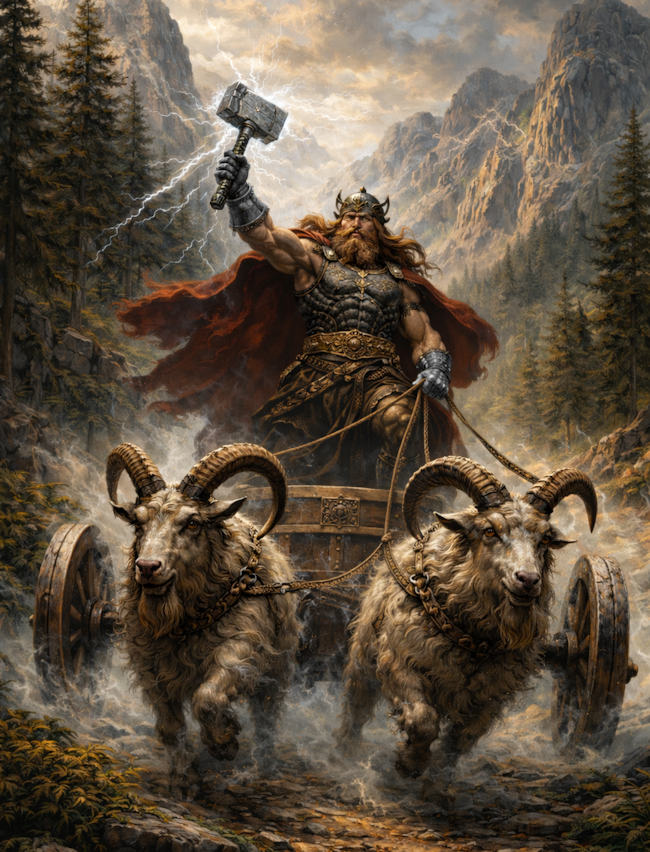
Thus, Thor remains a divine being whom one can never fully comprehend. And the final two sentences serve to confirm this once more: “Yet no one is wise enough to be able to recount all his heroic deeds...”
For within this tension—between proximity and overwhelming power, between impulsive action and divine wholeness—Thor ultimately remains inexhaustible. Precisely where he appears most akin to us, he simultaneously eludes any complete equation with human action. Thus, his precious tools point not merely to external power, but to an inner order—one that finds expression in the god’s deeds, yet can never be fully grasped. The fact that no one is capable of enumerating all his deeds is, therefore, not just a rhetorical flourish, but rather an indication of that depth which reveals itself only through a journey through the individual stories: in the encounters, battles, and trials in which the essence of this god manifests itself anew, time and again.
The Nine Worlds
“I was in the East and struck down giants (Jötnar) and malevolent women who made for the mountains. The race of giants would grow all-powerful if they all lived. It would be the end of mankind in Midgard.” (Song of Harbard, Verse 23, after Arnulf Krause and Karl Simrock)
Similarly, the Edda often describes how Thor travels “to the East”, the realm where the mountain and frost giants dwell in Jötunheim. What does this “East” signify? At first, one might interpret it as a geographical direction, a subject that has, in fact, been the focus of much speculation. For instance, in the text of the “Heimskringla“, the “Circle of the World”, also attributed to Snorri Sturluson, it is stated right at the very beginning of the “Ynglinga Saga”:
Thus it is said: The circle of the Earth inhabited by mankind is deeply intersected by waters; great seas extend from the World Ocean deep into the land. It is well known that a sea stretches from Njörvasund (the Strait of Gibraltar) all the way to the Holy Land (Jerusalem). From this sea (the Mediterranean), a long gulf extends toward the northeast, known as the Black Sea; it separates the three parts of the Earth: the region lying to the east is called Asia, while that lying to the west is named Europa by some, and Enea by others. But to the north of the Black Sea lies Swithjod, the Great, or the Cold (Greater Sweden/Russia/Sarmatia?). Some claim that this Great Swithjod is no smaller than the vast Serkland (“Land of the Serkir”, the Muslims). Others compare it in size to the great Blueland (Africa). The northern reaches of Swithjod lie uncultivated due to frost and cold, just as the southern regions of Blueland lie desolate from the scorching heat of the sun. Within Swithjod lie many vast territories; there, too, dwell many truly wondrous peoples and are spoken many diverse tongues; there are giants and there are dwarves; there are also “Bluemen” (dark-skinned peoples); and there, too, roam creatures of terrifying size and dragons. To the north of the mountain ranges that encircle the entire inhabited world, a great river flows through Swithjod—rightly named the Tanais (the Don); in former times, it was known as Tanaquisl or Vanaquisl, and it empties into the Black Sea. The land situated between the branches of the Vanaquisl was known in those days as Vanaland or Vanaheim; the river serves to demarcate the three parts of the Earth: the region to the east is called Asia, while that to the west is called Europa. The land lying to the east of the Tanaquisl, within Asia, was known as Asaland or Asaheim; and the principal stronghold situated within that land they named Asgard.
(Heimskringla: Sagas of the Kings of Norway, Gottlieb Mohnike, 1837 / Other source: Snorri’s Book of Kings (Heimskringla), Felix Niedner, 1922)
It is difficult today to reconstruct exactly what Snorri envisioned around the year 1230. While the phonetic resemblance between “Asia” and “Aesir” is intriguing, it is likely more a matter of coincidence. Perhaps his placement of the realm of the Aesir or gods in the East also had a biblical basis; after all, it was from the Orient that the Three Wise Men travelled to Bethlehem for the birth of Jesus. One might also imagine the Himalayas, situated east of the Black Sea, as a sky-scraping citadel of the gods, akin to Asgard; this would stand, as it were, in contrast to the Alps lying to the west, the stronghold of the “alp” (elves) or dwarves, with the cold realm of the frost giants situated further north. Such geographical conceptions undoubtedly found their way into the Eddic texts, whether through Snorri himself or other authors. Yet, if this is the case, why then does Thor journey eastward to Jötunheim to battle the mountain and frost giants?
Here, we wish to consider a more spiritual-symbolic perspective—specifically, that of physical hardening and rigidity, wherein the waters of life increasingly freeze into stone-hard ice, transforming into mountain and frost giants. Thus, Jötunheim is also a world toward which one can gaze from Midgard—a direction in which one can set foot. For generally speaking, whichever way one looks is the direction in which one eventually travels.
Accordingly, Jötunheim ranks among the “Nine Worlds” to which the Edda makes frequent reference. Yet nowhere are these nine worlds described with such clarity and precision as to dictate exactly how one ought to envision them. Perhaps this is for the best, for it allows us to give free rein to our imagination. Finnur Magnusson, an Icelandic scholar, is said to have envisioned the following image:
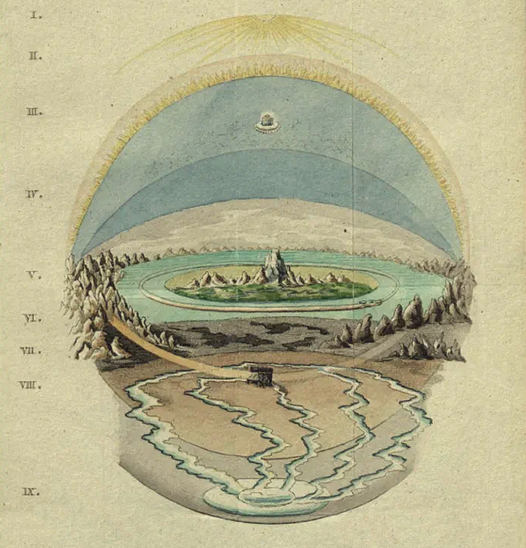
Finnur Magnusson, around 1825
Here lie the nine worlds, layered one above the other: I. Ljosalfheim (Home of the Light Elves/Alfs), II. Muspelheim, III. Asgard/Valhalla, IV. Vanaheim, V. Midgard/Manheim, VI. Jötunheim, VII. Svartalfheim (Home of the Dark Elves/Alfs), VIII. Helheim/Niflhel, IX. Niflheim (Source: www.germanicmythology.com)
Then, around 1853, in his “Handbook of German Mythology“, Karl Simrock drew more upon the words of the seeress in the “Völuspá”, Verse 2:
“Nine worlds I know, nine branches I discern on the mighty trunk amidst the dust of the earth.”
Furthermore, he contemplated the northern realm of Nifl—or the World of Mist—as well as the southern realm of Muspelheim, and envisioned Midgard (or Manheim) situated at the centre of these nine worlds. Accordingly, he arranged the worlds into a matrix of three by three:
1. Above the Earth: Muspelheim, Light-Alfheim, Asaheim/Asgard
2. On the Earth: Jötunheim, Midgard/Manheim, Vanaheim
3. Beneath the Earth: Dark-Alfheim, Niflheim, Niflhel
This also makes more sense in the context of Thor and his physical chariot, allowing one to better visualize how he travels in it across the Earth—passing through the worlds of the Giants, Humans, and Vanir—within the realm of Nature.
If we now take this approach a step further and examine the nature of the various worlds as described in the Edda, we can juxtapose the two worlds of the Giants and Dwarves as Macrocosm and Microcosm, just as we can view the two worlds of the Aesir and Vanir as the realms of Spirit and Nature. Further contrasts are formed by Light and Darkness, as well as Life and Death. If we now position the Giants toward the East, we can visualize the following image:
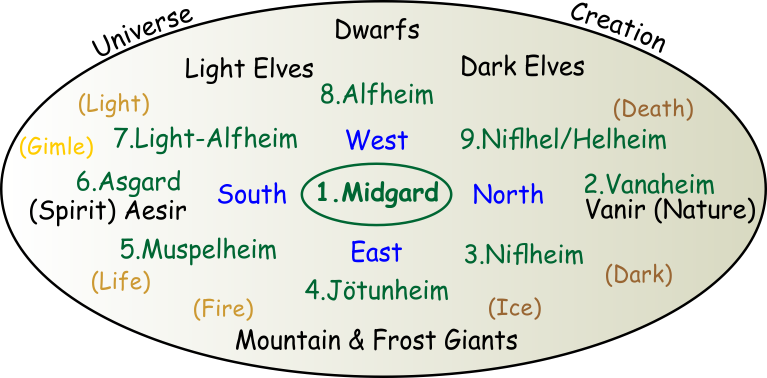
Here, looking northward, one beholds the dark realm of nature—Niflheim, or the Realm of Mist—nourished by the Waters of Life, which “thaw” and emerge from the giant-world of the frozen Frost Giants. And this occurs through the southern influence of the Realm of Spirit, where fire, life, and light are at work. Thus, one can also visualize how, down in the east, the sun “rises”—proceeding from the south to “illuminate and warm” the realm of nature, only to plunge back into the dark night in the west. And to ensure that the sun rises again and again—and that living creation does not freeze rigid—Thor, too, with his hammer, repeatedly journeys eastward to do battle against the Mountain and Frost Giants in Jötunheim.
From a spiritual perspective, we can interpret this cosmic sphere of the “Nine Worlds” primarily as various worldly principles that exert their influence to varying degrees upon all creatures within the living creation. Furthermore, the image above clearly illustrates the interplay of opposites, which serves to enable and sustain this living creation. Moreover, these opposing principles are to be found not only in the outer cosmos but also within every living being that perceives itself as a distinct centre and integral part of the whole. In this sense, the worlds surrounding Midgard appear less as geographical locations and more as spiritual orientations—spiritual lines into which one may gaze and in which one may place one's faith. Their significance depends entirely on the strength of one's belief in the body, the spirit, nature, matter, the gods, birth, death, formation, or light. Thus, they represent spiritual paths of belief rather than mere geographical directions.
In this regard, we would now like to attempt to examine the individual worlds in somewhat greater detail. We begin with Midgard as the first world, for it is here that we are born as humans, and here that we typically dwell. Thereafter, we circle through the wheel of time—clockwise, so to speak—until we reach the ninth world.
1. Midgard - Separation / Connection (Centre)
Just like us humans, every creature actually resides perpetually within Midgard, the “Middle Garden” of the universe. For anyone who looks out in various directions around themselves naturally always stands at the very middle, the absolute centre of their own universe or sphere of experience. In principle, our modern cosmological science acknowledges this very fact: that every observer in the universe always occupies the centre, and that, within the universe as a whole, no absolute centre exists.
Furthermore, Midgard—conceived as a “garden, enclosure, or fortress”—is also a realm defined by boundaries and separation; it is a place where creatures perceive themselves as distinct entities, encased within a physical body and encircled—as if by a fence—by the Midgard Serpent, or Ego-Serpent. Thus, the Midgard Serpent emerges as a symbol of separation, yet simultaneously as a symbol of connection within the fabric of space and time. Consequently, all creatures here are mutually interdependent, for everything exists in a state of constant interaction with everything else. From this “centre”, every living being is able to gaze out toward the various and, in principle, possible worlds, that surround it. It is toward these realms that a being may then orient itself, moving in that direction to pursue its path and undergo its evolution.
2. Vanaheim - Diversity / Divine Nature / Order (North)
In this direction lies the principle of formed, living nature. Here, the “nature gods”, the Vanir hold sway, governed by the natural laws of cause and effect. Natural diversity of creation arises here, unfolding in accordance with the possibilities emerging from the sea of causes. Thus, it becomes the transient realm of opposites, such as coming into being and passing away, abundance and scarcity, summer and winter. Accordingly, Vanaheim appears within the aforementioned cosmic cycle situated between Niflheim and Niflhel, that is, between birth and death. And in contrast to the warm and luminous South, this realm in the North is of a more wintry and sombre nature.
3. Niflheim - Water / Source / Birth (Northeast)
In this direction lies the primordial and primeval “World of Mist”. Situated there, at one of the roots of Yggdrasil, is the dark spring Hvergelmir—the “bubbling and seething spring” of the fighting spirit—where one may also encounter the Ego-Serpent of demarcation. And as the Edda states: from this spring, all rivers take their course. Thus, it is a cold and dark world of mist wherein hot springs bubble forth—a concept that Icelanders, in particular, can readily visualize. In this context, the principle of birth may also be situated here, specifically, how living beings are born amidst the struggle for life, serving, as it were, as the antithesis to death in Niflhel. It is, therefore, a physical birth—facilitated by the serpent of demarcation, whereby a physical shell is formed for the living being within Midgard.
4. Jötunheim - Ice / Embodiment / Matter (East)
In this direction lies the world of the mountain and frost giants—the principle of embodiment, of the hardening and solidification of the Water of Life and the Light of Consciousness. Even modern science recognizes matter as “frozen light”, something that can be thawed once again to transform matter back into light. In this direction, one might also call to mind the ice giant Ymir, of whom the Edda speaks, the being within whom the entire universe lay frozen and solidified. Similarly, cosmological science speaks of the “Big Freeze” as a possible end-time scenario for our universe. Yet, how things might proceed thereafter remains, generally speaking, unclear. The Edda relates symbolically that, at the dawn of creation, Ymir was thawed once more by the spirit of the gods, aided by the fire of Muspelheim. Accordingly, one can also find fire giants—such as Logi—within Jötunheim; these figures incline more toward the south, toward Muspelheim, standing, as it were, in contrast to the mountain and frost giants, whose inclination lies more toward the north: toward the realm of Nature and its snow-capped mountains. A similar distinction is also described regarding the dwarves within the microcosm of Alfheim.
Furthermore, situated in the direction of Jötunheim, lies the Well of Mimir—described as the second root of the World Tree and Tree of Life, Yggdrasil. It was here that Odin sacrificed his second eye, and within this well, one may once again perceive an inspiring source of creation. We have already discussed this Well of Mimir in detail in the chapter dedicated to Odin.
5. Muspelheim - Fire / Destiny / Dissolution (Southeast)
In this direction resides the principle of fire, which acts upon the world of the frost giants and subsequently causes the “thawed ice” to flow in Niflheim as the Water of Life. The name “Muspel” remains relatively obscure. One might surmise a connection to the Old High German poem “Muspilli“, which treats of the Last Judgment and the fiery destruction of the world. Similarly, in the context of Muspelheim, one might call to mind the “righteous wrath of God”—emanating from Asgard—which also manifests in the figure of Thor acting on Jötunheim. Furthermore, Muspelheim is situated on the side of the Spirit; thus, it represents a spiritual fire—one that, within the act of creation, enables physical life in its cyclical process of emergence and dissolution. Correspondingly, situated directly opposite in Niflheim, the “seething spring” of the martial spirit bubbles forth, giving rise to physical birth.
Regarding these paths of living creation, one may view the Well of Urd—situated in the direction of Muspelheim—as the source of destiny and spiritual creation; it is described as the third root of Yggdrasil. Thus, it lies directly adjacent to Asgard, ensuring that the gods need not travel far to assemble there each day to sit in judgment over destiny. What is destiny? One might define it as the visible burning away of causes in their effects. It is also the invisible burning away of all other possibilities that do not align with the established causality and the divine purpose. To this end, the gods establish the conditions and circumstances within creation, centred upon the Tree of Life. Within this realm resides the fire of the divine spirit—much like the fire of the Holy Spirit known in Christianity—serving to heal and remedy misfortune. Accordingly, the Well of Urd is likewise characterized as “most holy”.
In this regard, concerning Muspelheim, Section 4 of “Gylfi’s Illusion” states:
First, however, there was the region in the southern half of the world, known as Muspel. It is radiantly bright and hot. This realm is engulfed in flames and burns ceaselessly, rendering it unbearable for those who are strangers there and do not call it home. Surt (or Surtur) is the name of the one who stands guard at its borders. He wields a flaming sword, and at the end of the world, he will sally forth, wage war, and vanquish all the gods. He will consume the entire world in fire (transforming it into pure light).
6. Asgard - Unity / Divine Spirit / Freedom (South)
In this direction lies the realm of the Aesir—the “spirit gods”, so to speak—standing in contrast to the “nature gods”, yet a contrast that is no longer one of hostility. For following the great Vanir War, they united peacefully and recognized one another as gods. Thus, the spirit gods, too, maintain order within creation—not through the laws of nature, with their principles of cause and effect, but rather through the freedom of the spirit: a freely mobile consciousness capable of assuming any form. Consequently, these gods are not bound by limitations as are the creatures of Midgard; rather, they are holistic beings, so much so that, even within the forms they “voluntarily” assume within creation, they are able to endure throughout the entire cycle of creation. And as holistic beings, they are, by their very nature, immortal.
Interestingly, their world, too, is referred to as a “garden and enclosure”. This already hints at a fundamental shift in perspective. For naturally, Asgard stands at the centre of the universe for them—just as Midgard does for us humans—yet viewed from the opposite angle. In this regard, there is a story—one we have already discussed in the chapter on the nature of Odin—in which the Aesir commissioned the construction of a wall around Asgard. Here, one might ponder what lies “within” this wall and what lies “outside” of it. If the Aesir are holistic beings, then this wall can, in reality, only arise “within” their own realm, thereby encompassing the entirety of creation—much like the outer boundary depicted in the diagram above. Accordingly, this wall was erected by a mountain and frost giant, aided by a horse, a symbol of living corporeality. Thus, this wall can be viewed, on the one hand, as a symbol of Asgard’s protection against the processes of embodiment and solidification—forces represented by the mountain and frost giants—and, on the other hand, as a formidable barrier to entering this realm of the gods, a barrier that is, in essence, nothing other than corporeality itself. In this sense, one might say: The gods, within Asgard, protect themselves against fragmentation and embodiment; conversely, the creatures of Midgard protect themselves against absolute wholeness and dissolution. Ultimately, the shift in perspective lies in the fact that the gods perceive creation “within” themselves, whereas sentient creatures perceive “themselves” within creation. It is, therefore, no longer a matter of saying, “I am not “in” the body”, but rather, “the body is “in” me”—within the “I Am” as the holistic, conscious space of existence itself.
7. Light -Alfheim - Light / Mindfulness / Foundation (Southwest)
In this direction resides the principle of Light. It is not yet the pure light of consciousness, but rather light intertwined with nature. Thus, here it still manifests in the form of nature spirits—as Elves or Dwarves—who may be regarded as the foundational architects of creation within the microcosm, and who, in this world, are particularly inclined toward spiritual light. Similarly, modern science recognizes light as the foundation of the universe and the carrier of all information.
As Jesus, too, declared: “I am the light of the world.” Accordingly, lying in the direction of Light - Alfheim is yet another realm of light: a “Light-Home”, so to speak, which we shall later come to know as “Gimle” and as the gateway to the Kingdom of Heaven.
8. Alfheim - Dwarves / Formation (West)
In this direction lies the principle of creative shaping forces—forces that, throughout the microcosm, operate tirelessly like little dwarves in the service of both Nature and Spirit. Presumably, this is why the Edda distinguishes between “Dark Elves” (“Svartalfar”) and “Light Elves” (“Ljósalfar”)—depending on whether, as nature spirits, they incline more toward Nature or toward Spirit, toward darkness or toward light. For it is between these very poles that all images and forms in our world come into being—arising, so to speak, between “Day-consciousness” and “Night-consciousness”, as “Day-awareness” and “Night-awareness”. In a similar vein, in the section concerning Draupnir, we have already encountered the two dwarves, Brokk and Sindri, as symbolic representations of the realms of Spirit and Nature.
Accordingly, we encounter these nature spirits across a wide spectrum, ranging from light elves and fairies to night elves and the most terrifying nightmares. Yet, fundamentally, the same beings are always being referred to. In Old High German, they were called “Alb”, “Elb”, or “Alp”; in Old Norse, “Alfr”; in Old English, “Älf”; and in Danish, “Elve”. In many legends, they are depicted as dwarves or other diminutive beings—such as the dwarf Alberich from the Nibelungenlied and the Dietrich saga.
9. Niflhel/Helheim — Dark Cave / Night-Awareness / Death (Northwest)
In this direction resides the principle of death within the nocturnal consciousness of obscuration, a state in which consciousness increasingly withdraws and encloses itself, as if within a cave. Thus, we also conceive of death as a form of unconsciousness akin to deep sleep. Accordingly, this is also the “ninth world”—a realm that may be viewed as the end of life, yet also as a number of renewal, depending on where one directs one's faith within the world. For solitary warriors, it signifies primarily the end of their physical life; for the Einherjar, however, it represents the principle of their physical renewal and regeneration.
Regarding the nature of Niflhel as the “ninth world”, the Prose Edda, specifically in “Gylfaginning”, writes the following at the conclusion of Section 3:
Then Gangleri began his questions: Who is the most distinguished and oldest of all the gods?
The High One answered: He is called All-Father in our language, but in ancient Asgard he had twelve names: The first was All-Father, the second was Herran or Herjan (Commander), the third Nikarr or Hnikarr (Awakener), the fourth Nikud or Hnikud (Arouser), the fifth was Fjolnir (All-Knowing, Manifolder), the sixth Oski (Wish-Granter), the seventh Omi (Clever-Hearing), the eighth was Biflidi or Biflindi (He with the Painted Shield), the ninth Svidur (Spear-Thrower), the tenth Svidrir (Spear-Bearer), the eleventh Vidrir (Striker), and the twelfth Jalg or Jalk (Stallion).
Then Gangleri asked: Where is this god, what powers does he possess, and what glorious deeds has he performed?
The High One replied: He lives for all time, rules over his kingdom, and brings about all things, great and small.
Then the Equal One spoke: He created heaven, earth, and air, as well as everything in them.
To this, the Third One said: But the most important thing is that He created humankind and gave them a soul that is to live and never die, even if the body decays to earth or burns to ashes. All people who are of the true faith will live and be with Him in the place called Gimle or Vingolf. But the wicked (enemies) go to Hel and then to Niflhel. That is down in the ninth world.
(Gylfaginning §3 after Arnulf Krause and Karl Simrock)
Here we can reflect once more on the two great paths of consciousness: either as a lone warrior who believes he will die with his body and whose spirit ends in Niflhel, or as an Einherjar who fights in the army of unity and is aware that only the body dies, while his soul lives eternally in wholeness or divinity. For him, the ninth world is not a dead end, a one-way street, but a world of physical renewal and regeneration in the realm of nature. For his spirit is not focused on separation and thus on death in Niflhel, but on the deity in Asgard, where Gimle or Vingolf are also thought to reside. Gimle likely means “protected from fire”, and Vingolf “hall of friends” or “wine hall”, reminiscent of Valhalla. Furthermore, the Edda text explicitly emphasizes that the path one takes and develops in the world is a matter of faith.
At the southern end of the sky stands the hall, the most beautiful of all, brighter than the sun. It is called Gimle, and it will still exist when heaven and earth have passed away. It is inhabited by good and righteous people from all ages. Thus, it is written in the Völuspá, the seeress's prophecy:
I see a hall standing, brighter than the sun, roofed with gold, in Gimle. There, faithful followers will dwell and enjoy joy forever.
Thus, in the diagram above, we can imagine this hall as a realm or heaven beyond Asgard and Light-Alfheim, so that it remains untouched by fire, bathed in pure light. From there, further heavens are described:
Then Gangleri asked: What protects this place when Surtur's fire burns the heavens (or airspace) and the earth?
The High One replied: It is said that there is a heaven south and above this one, called Andlang (“Long-Life”). And yet another heaven is above them, called Vidblain (“Wide-Blue”, sky-blue?). We believe that this place lies within that heaven. And we believe that some Light Elves already inhabit it.
(Gylfaginning §17 after Arnulf Krause and Karl Simrock)
With this, we have attempted to describe the Edda's world circle in more detail. Overall, this ring of nine worlds, as depicted in the diagram above, strongly reminds us of the symbolism of Draupnir as a ring of renewal and regeneration, as we described in the chapter on Loki. One can even imagine the fractal principle here, how the great ring becomes ever more deeply nested, appearing as a whole in each part. Accordingly, Midgard could be viewed on different levels within the universe, such as a galaxy, solar system, Earth, continent, human, organ, cell, molecule, or even atom.
Finally, let us consider how we can symbolically create a world tree from these nine worlds, which then becomes Yggdrasil, the Tree of Life, with branches and roots. We propose the following image for this purpose:
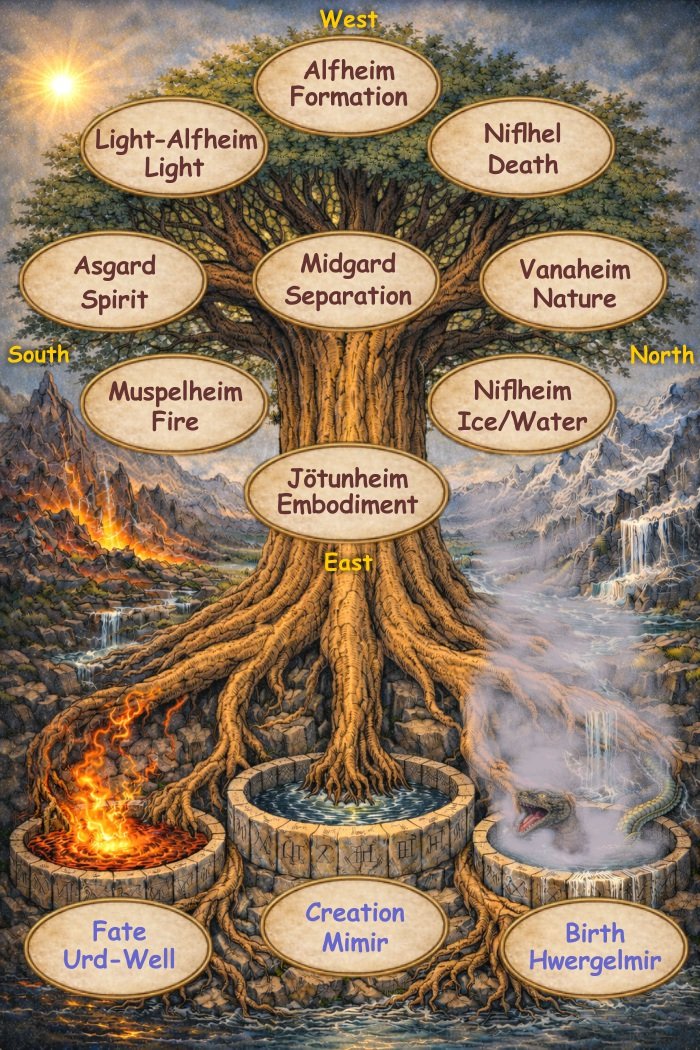
This image shows how the main branches of the tree in Midgard divide and branch out. At the root are the three wells that nourish the entire tree: On the spiritual side lies the Well of Urd, the source of spiritual creation, where the three Norns hold sway and the gods hold their daily judgment. On the natural side lies Hvergelmir, the source of physical creation and the birth of mortal beings. And between them lies Mimir, the source of intellectual creation, which is perhaps the most powerful source of the water of life from the Sea of Causes. For the intellect determines where the rivers from Hvergelmir flow and generates the causes of future destiny.
The four classical elements can also be seen in the four directions: Fire on the right side of the tree, water on the left, earth below, and air above:
West/Air
South/Fire --|-- North/Water
East/Earth
The corresponding shoots or goals within the tree are also clearly visible in this image, appearing vertically above the three lower root sources in the crown: The source of physical birth is directed towards death via the path of water and nature. The source of intellectual creation leads upward to form via the path of embodiment and separation. And the source of destiny is directed towards the light of divine consciousness via the path of fire and spirit. Yes, there is much more to ponder. But in short:
Born to die,
Destined for the light.
The nine sisters as nine waves
In principle, regarding the “Nine Worlds”, we might also call to mind the mystical “Nine Sisters”—generated by Aegir, the “Sea”, as it were, like nine creative waves upon the Sea of Causes: realms of life and motion within creation that come into being and pass away. They were born of Ran—”Plunder” or “Lack”—a principle of “Calamity” that we might trace back to the primordial giant Bölthorn, the “Evil-Thorn”.
Diagram: Solidified Universe, Conciliation, Healing, Spirit, Son, All-Father, Creator, Shining Homeward Consciousness, Waves, Worlds, Plunder, Lack, Evil-Thorn, Calamity, Sea, Nature
Ice-Giant Ymir, Bölthorn, Bestla, Ran, Nine Sisters, Heimdall, Odin, Börr, Aegir, Buri
It is a wonderful and highly symbolic fact that Odin subsequently fathered the god Heimdall with these “nine sisters”, such that, through these waves of the worlds, the “home-shining consciousness” or the “consciousness of the homes”, was also born. This is, of course, essential for illuminating the “homes” of the worlds—such as Muspelheim, Jötunheim, Niflheim, and so forth—and for perceiving them with full awareness.
Thus, it is stated in the “Skáldskaparmál”, Section 25:
How is the sea (Aegir) to be circumscribed? — By calling it Ymir’s blood, the visitor of the gods, the husband of Ran, and the father of Aegir’s daughters, who are named as follows: Himinglava, Dufa, Blodughadda, Hefring, Udr, Hrönn, Bylgja, Bara, and Kolga. Furthermore, it is referred to as the land of Ran, of Aegir’s daughters, and of ships…
The names of Aegir’s daughters could be interpreted—in relation to the Nine Worlds, for instance—in the following manner:
Wave Name | Meaning | Possible World |
Bylgja | Swelling Wave | Jötunheim / Embodiment |
Bara/Dröfn | Spray / Mist-Wave | Niflheim / Birth |
Kolga | Cold Wave | Vanaheim / Nature |
Dufa | Numb Wave / Subsidence | Niflhel / Death |
Hrönn | Surging Wave / Whirl | Midgard / Separation |
Blodughadda | Blood-haired / Red Spray | Muspelheim / Fire |
Hefring | Lifting Wave | Asgard / Fate |
Himinglava | Heavenly Radiance | Light- Alfheim / Light |
Udr/Unnr | Joyful Wave | Alfheim / Formation |
In this regard, one might also consider the symbol of the Aegis or Ögis helmet, whose name “Ægishjálmur” is also derived from “Ägir”. This helmet was part of Fafnir’s dragon hoard. Sigurd later defeated Fafnir and, along with the gold hoard, took possession of the helmet. Symbolically, it could serve to assume a specific physical form of life. In this sense, it is the opposite of Siegfried’s invisibility cap from the Nibelungen saga. Even more interesting is a symbol of the Aegis helmet from a later Icelandic grimoire dating from 1670. It states that a man should wear this symbol on his forehead to always be victorious (like Sigurd as the “protector of victory”):
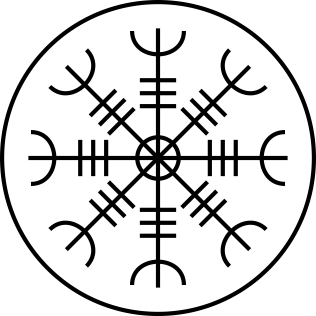
Source: Wikipedia Ægishjálmur
In this symbol, one can essentially recognize the nine waves of Aegir as the nine worlds. At the centre lies Midgard, and the three horizontal lines between the worlds are reminiscent of the bridge of light and the rainbow with its three colours. In this sense, it could be a symbol of the unity of all worlds, which are open in every direction and reunite in wholeness. And the awareness of this wholeness, in which nothing can be lost, is of course also a good prerequisite in the struggle of life for always emerging victorious.
With regard to Ägir and the nine waves as the mothers of Heimdall—the consciousness that illuminates and calls home—one might also think of “Gylfi’s Illusion”, the “illusion of the foaming wave.” And one can easily imagine how, in the Prose Edda—where he appears in the guise of Gangleri, meaning “weary world-wanderer”—these waves are explained to him as worlds, such that the “wanderer” becomes a “wave-rider”. Accordingly, the text of “Gylfi’s Illusion” in the Prose Edda begins as follows:
1. King Gylfi ruled over the lands that are now called Sweden. It is said of him that he gave a wandering woman, as payment for her entertainment, as much arable land in his kingdom as four oxen could plough in a day and a night. But this woman was from the Aesir tribe and was called Gefjun (“the Giver of Wealth”). She took four oxen from the Giant's Home in the north—these were her sons, whom she had with a giant—and harnessed them to a plough. But the plough ploughed so wide and so deep that it tore the land loose. The oxen pulled it out to sea to the west until they stopped in a strait. There Gefjun fastened the land. She gave it a name and called it “Zealand”. And where the land had been torn out, a lake was found, which in Sweden is now called Löger. And the bays are distributed within it, like the headlands on Zealand. Then the skald Bragi the Old spoke:
Joyfully, Gefjun of Gylfi claimed the island as her own. The oxen toiled for the gain of Denmark. Four heads and eight crescent moons (eyes) carried the oxen, and they hauled the spoils to Zealand.
Here we find concentrated symbolism, offering much food for thought. Who is the goddess Gefjun, who, as the “Giver of Wealth”, wanders among the earthly kings of Midgard? Who is the goddess described as the mother of four giant oxen? Why does a goddess need land? Why does she pull a plough with oxen like a farmer? Later in the text, it says: “Gefjun is a virgin, and all who die as virgins serve her.” In this respect, we can again think of the pure soul of nature, the All-Mother and eternal virgin.
In our interpretation of the Beowulf saga (in German), we encountered Sweden as the realm of the ego, reminiscent of Midgard. Denmark, on the other hand, was the realm of the sons of gods, such as Scyld or Skjöld, the “Shield”, a divine protector. There, the communal Hall of the Deer was built, similar to Valhalla, which already strongly evokes Asgard.
This symbolism would also be fitting here, and we can easily imagine the goddess tearing the heart out of the realm of the ego and drawing it into the realm of the gods, using the immense power of embodiment. With this, she bestows “true wealth”—not just the manifold forms of nature, but also the path to unity and wholeness, not just partial wealth, but the entire one. Thus, she takes the king's personal possessions and grants him divine wholeness.
This symbolism, in a broader sense, also reminds us of a story from the Indian Puranas, in which Vishnu incarnated as a dwarf and asked the demon king for three paces of land. The king granted his request, the dwarf transformed into his whole form, and with three steps assumed complete dominion over the kingdom (see, for example, Harivamsha 3.71, in German).
Finally, the four heads of the oxen, as beings of embodiment, can remind us of the four cardinal directions of the nine worlds, and their eight moon-like eyes also of the secondary directions and their interplay of opposites. This also suggests the ultimate goal of this world circle: to draw closer to the divine or holistic realm.
2. King Gylfi was a clever and magically skilled man. He was greatly surprised that the Aesir were so powerful, that everything went according to their will. He wondered whether this stemmed from their own power or from the divine powers to which they offered sacrifices. He secretly set out for Asgard, disguised as an old man, and did not reveal his identity. But the Aesir were wise because they possessed the gift of prophecy. They foresaw his journey before he arrived and projected illusions upon him. When he entered their fortress, he beheld a hall so high that he could scarcely see over it. Its roof was covered like a shingle roof with golden shields.
Thus, “King Gylfi was a clever and magical man.” This likely means that the “foaming wave” on the sea of life was well-versed in the earthly magic of nature. However, not everything went according to his will. Presumably, he was also growing old. And after receiving Gefjun’s wealth and having his heart drawn to the divine, he now turned his mind to Asgard, the spiritual realm of the gods. He came in the form of an old man who “did not reveal himself” because he had not yet recognized himself and was now searching. The gods, of course, knew who he was, but received him with sensory illusions. Why? Well, with his conceptual mind, which can only think in terms of opposites, he could not yet comprehend anything else.
Thus, in the gods fortress of Asgard, he beheld a great hall whose end he could not see. Its roof was covered with “golden shields”, as is also described of Valhalla. The hall is reminiscent of a realm of consciousness, the gold of truth, and the shields of protection, so that the realm of consciousness in this divine world is protected by truth. That is why he could not see the end.
Thjodolf of Hvinir (a famous skald) also said that Valhalla was covered with shields:
On their backs, the battle-hardened (wise) men of Svafnir made their shields shine like shingles, for they were pelted with stones.
This mystical verse is reminiscent of the insightful nature of the Einherjar, who dwell in Valhalla. Throwing their shields over their backs was usually a sign of flight in battle, when warriors turned away from the enemy and protected their backs from arrows and projectiles. But here, it was likely an insightful feat of battle, a way to protect survival against the stones of material stagnation. Why?
Svafnir means “sleep-bringer” or “killer”. It is the name of a venomous serpent that gnaws at the root of the Tree of Life, Yggdrasil. Its scales are reminiscent of dragon scales, which in many legends are considered impenetrably hard against all earthly weapons. On the other hand, Svafnir is also a name of Odin, who, as the All-Father, is naturally embodied throughout creation. Thus, it likely refers to the fundamental question in which direction one bears this protective shield. Accordingly, one fights either as a lone warrior or as a united Einherjar, for partial or total possession. This is probably why the roof of Valhalla is symbolically covered with these golden shields, to protect the whole, and not so that everyone protects their own part with their own shield. This again hints at the great shift in perspective found in the world of Asgard: no longer fighting against something, but for everything.
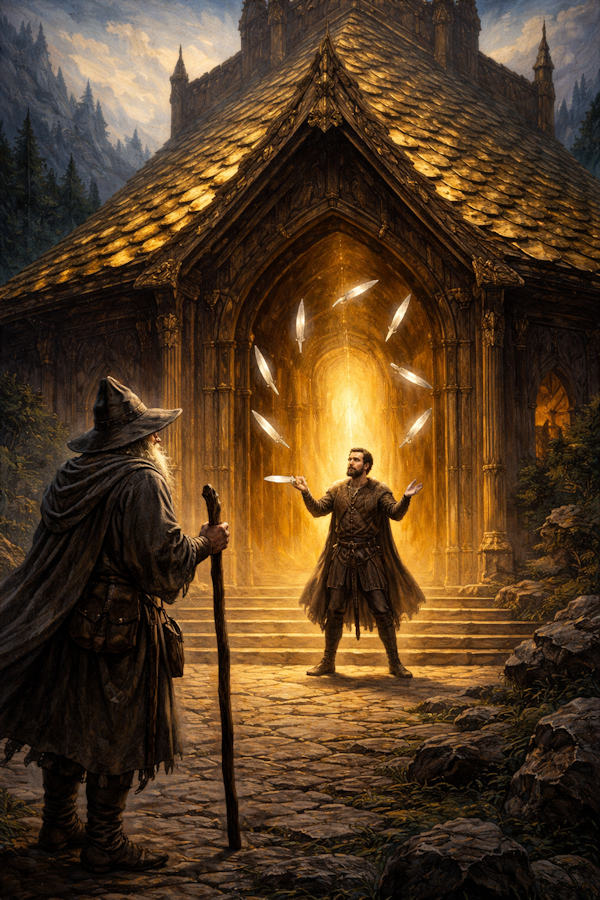
Gylfi saw a man outside the hall door, juggling knives, seven at once in the air. The man asked him his name. He then called himself Gangleri and said he had come by winding paths and was looking for a place to sleep. He also asked who owned the hall. The man replied that it belonged to a king: “I will take you to him. There you can ask him his name yourself.” He then entered the hall, Gangleri followed him, and the doors closed behind his heels. There he saw many rooms and numerous people: some were playing games, others were drinking, and still others were practicing combat with weapons. He looked around, and much of what he saw seemed unbelievable. Then he said:
Behind every door, one should look before going any further.
For it is uncertain whether enemies are sitting on the bench before you.
Whom does Gylfi meet here in Asgard, before the hall's entrance? In this man, or rather, this spirit, we can recognize the conceptual mind, which “juggles” the eight worlds around him—one of the greatest arts. Juggling two or three worlds is already difficult, and seven or eight require divine mastery, as can be clearly seen in the diagram of the world circle above. For each world is like a sharp knife that can sever or at least wound our holistic being, even though it consists only of the light of consciousness.
Therefore, this man of intellect asks the newcomer's name, just as Gylfi asks the king's name, for the conceptual mind naturally needs a name and a concept for everything separate. He calls himself Gangleri, a “weary wanderer” who comes from the day of life, where he found his world in Midgard and established his realm and “camp”. But his day seems to be slowly coming to an end, and he seeks a “night's lodging” in Asgard to “spend the night” in order to preserve life even beyond death.
The divine spirit then led him into the great hall, whose doors immediately closed behind him. What had he left behind? Was he now imprisoned? Had he lost something? What awaited him now? There, he apparently glimpsed an entire world within the hall: many rooms and many people playing games, drinking mead or beer, and practicing combat with weapons. Yet it was again a world full of differences and separate beings, where enemies could lurk anywhere, as he could not comprehend with his intellect. And yet, “it seemed unbelievable to him”, which already hints at the first signs of doubt. Similarly, in the pantheon of Asgard, we too see different gods, goddesses, and other beings who seem to contradict and even fight each other. Our ordinary mind cannot understand it any other way. But it is always good not to let belief in outward forms become rigid, but to question them.
He saw three high seats, each higher than the last, and three men sat upon them. He asked the names of these leaders. The one who had led him in replied that the one in the nearest high seat was a king. He was called “the High One” (“Har”), and the one above him was called “the Equally High One” (“Jafnhar”), but the one at the very top was called “the Third One” (“Tridi”). Then the High One asked the newcomer if he had any further business. Food and drink were available for him, as for everyone in the High One's hall. He (Gangleri) said that first he wished to inquire whether any wise man was within. The High One replied that he would not leave safely unless he were wiser.
Stand while you ask.
Whoever answers should sit down.
He even glimpsed the king of this realm as three different men or spirits on three seats of varying heights, which at that time symbolized the status of rulers. And for this, he was given three names. Presumably, these refer to three manifestations of Odin, whose names are not further explained, but who answer Gangleri's questions on different levels, more or less comprehensively. Yet, “food and drink are available as for everyone in the hall of the High One”, which already suggests a holistic knowledge from which one can draw sustenance here. Nevertheless, Gangleri asks for a particularly “wise man”. To this, “the High One” admonishes him that “he will not leave here safely unless he himself is wiser”. A wonderful answer! “Safely” means healing and wholeness. And the wisdom for this must, of course, come from within, and not from outside—that is, from himself and not from others.
Thus, Gangleri, as a “wave rider” and “world wanderer”, begins to question his world of forms, in dialogue with the forms themselves. This is arguably also the task of our conceptual intellect: to question external forms and fathom the mysteries of the world in order to attain holistic reason and rediscover the divine vision. Gangleri is now on this path.
The final verse once again reminds us of the “intellect” that asks, and wisdom that sits upon the throne and foundation of all things should answer. Similarly, one still finds the traditional debate among monks in Buddhism today: the questioner and challenger stands, and the defenders and answerers sit on the floor.
Then Gangleri's questions begin with section §3, which we discussed earlier:
3. Then Gangleri began his questions: Who is the most distinguished and oldest of all the gods? …
Then followed over 40 more questions about gods and goddesses, as well as about the origin and dissolution of creation with all its worlds. And when the circle of cyclical renewal and re-creation had closed, the long conversation ended with the admonition of the “High One”:
“But if you can still ask more questions now, I don’t know where you got that from. For I have heard no one else speak more of the course of the world. Now use what you have heard!”
54. Next, Gangleri heard a great commotion all around him, and he looked to the side. But when he looked back, he was standing outside in a flat field, and saw neither the hall nor the castle. Thereupon, he went on his way and returned to his realm. There he recounted the events he had seen and heard. And after him, one person told these stories to another.
(Gylfaginning according to Arnulf Krause and Karl Simrock)
Yes, that is a wonderful message: when all circles close for the mind, the opposites dissolve, and the differences disappear. Then what remains is the vision of holistic reason, a divine seeing. In Buddhism, this is referred to as “emptiness”, unity in diversity, when everything harmoniously balances itself and only a “flat field” remains, boundless, without castles or halls. Yet the world remains “as it is”. The king returns from the “overnight”, the night of renewal, to his realm of day, and nothing is lost. No dead end of death, for the sea remains, and there will always be foaming waves, Gylfis and Gangleris. Wonderful! This is how these stories are still told to us today…
Thor’s Family
Thor is, of course, a son of the gods—sired by Odin, the All-Father, and born of Jörd, “Mother Earth”, in whom we can discern an aspect of the All-Mother. The Earth itself was born of Nott—”Night”—the daughter of a dark giant, and sired by Annar, or “Transformation”. This symbolism is profound: while the Earth is indeed a natural realm of night, it is also a place of transformation, growth, and the unfolding of life toward the light.
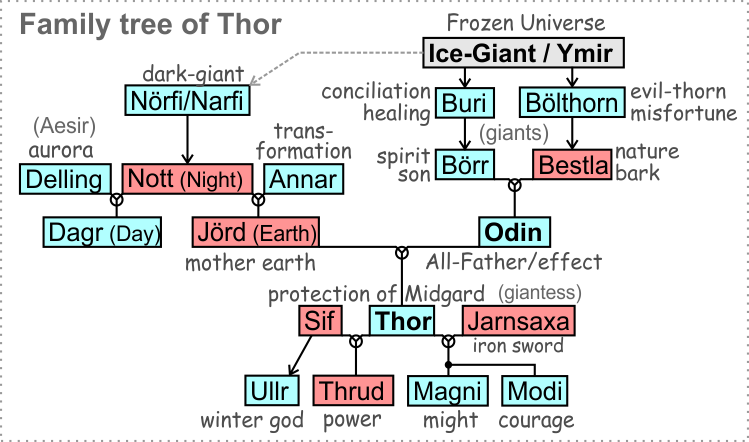
Thor’s principal wife is named Sif. Her name signifies “kin” or “relative”, and she appears as a golden-haired goddess who, alongside her husband, protects Midgard. We have already covered the story of her golden hair in detail in the chapter on Loki. Her hair reminds us of the creative thoughts of Mother Nature. Loki ensured that this hair was also linked to the shaping powers of the dwarves—themselves nature spirits—so as to preserve a living creation through the interplay of spirit and nature.
Their daughter is named Thrud. Her name means “strength” and may evoke the creative, feminine power of nature—particularly in Midgard—such that Thor’s own realm is known as “Thrudvang” or “Thrudheim”. The “Poetic Edda” contains a story about this daughter in the “Alvissmal”, featuring Alviss—the “all-knowing” dwarf—who seeks her hand in marriage. Although she is not explicitly named in the text, it is presumably Thrud. Thor was unenthusiastic about the match, even though a betrothal had already been arranged, because the dwarf evidently belonged to the race of the Dark Elves. This may hint at a problem similar to the one involving Sif’s hair: the creative, feminine power of nature ought not to marry a Dark Elf, for as dark nature spirits are bound to the natural realm. Consequently, the vitalizing spirit is lacking, even though the dwarf considers himself all-knowing regarding all the worlds. Thor resolves the situation by posing a series of conceptual questions until the sun rises over Midgard. The poem then concludes with the verse:
You lost the wager through cunning desires. The day casts its spell on you, dwarf, for the sun shines into the hall. (Alvissmal, The Lay of Alviss, after Karl Simrock)
It is generally believed that this dwarf turned to stone in the sunlight. This was presumably due to his conceptual, intellectual nature—a quality that could just as well have caused him to assume the form of any other petrified natural feature. Whom Thrud eventually married remains an open question in the Edda. Yet she, too, surely found a life-giving spirit.
Thor has a second woman in his life named Jarnsaxa. Her name means “Iron Sword”, yet she is mentioned only briefly in the Edda as a consort and the mother of Magni. She is considered a giantess and is presumably also the mother of Modi. Regarding Magni—whose name signifies “Might”, a giant-like-mighty strength he evidently inherited from his mother—the following story is told: After his father slew the giant Hrungnir (“the Noisy One”), the giant's leg fell upon him, and not even the Aesir could free Thor. Then Magni, a mere three days old, stepped in and freed his father. In gratitude, he received the giant's magnificent horse, Gullfaxi (“Golden-Mane”). We shall examine this story more closely later on. Beyond this, the only other accounts concerning Magni and Modi—representing “Might and Courage”—state that they survive Ragnarök and, in the renewed creation, inherit their father's hammer, Mjölnir (“the Crusher”).
Finally, there is a son of Sif named Ullr. His name may mean “Splendour” or “Glory”, and he is regarded as the god of winter. However, the Edda remains silent about his father. It is evidently not Thor, as he is referred to as Ullr's stepfather. But who else could it be? Considering the structure of the family tree, one might imagine Njördr as the father:
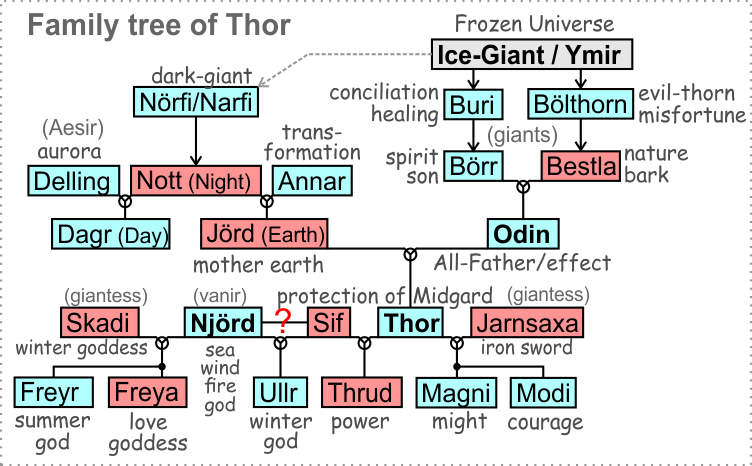
For golden-haired Sif, as the mother of Thrud and Ullr, strongly evokes the nature of the Vanir—beings associated with the natural realm—much as Thor is closely linked to the natural world of Midgard through his earth-mother. Regarding the War of the Vanir, the “Ynglinga Saga” (part of the “Heimskringla“) states—after the Vanir and Aesir had reached a peaceful settlement and Njördr had joined the Aesir: “While Njördr was among the Vanir, he had taken his sister as his wife—for such was lawful there—and their children were named Freyr and Freya. But among the Aesir, marriage between such close kin was forbidden” (see the chapter on Odin / Mimir’s Head). If we were to substitute “Ullr” for “Freyr and Freya” in this text, it would fit seamlessly into the Edda, which suggests that Freyr and Freya were the children of Skadi. In this way, the cycle of gods and goddesses representing summer and winter would be complete, as is clearly illustrated in the family tree above. As a Vanir, Njördr fathered Winter with Sif; as an Aesir, he fathered Summer with Skadi. Thor’s nature also fits into this circle, for Freyr and Freya are likewise described as traveling the world in chariots: Freyr’s chariot is drawn by the golden boar Gullinbursti, and Freya’s by two cats.
The Story of Thor in the Land of the Giants
44. Then Gangleri asked: Did Thor never come to a place where he encountered something so mighty and strong that it surpassed him in strength and magical power?
The High One answered: I believe few can speak of that, though he did find some things very difficult. Yet, if it were the case that something was so mighty and strong that Thor could not triumph over it, then it is not a thing to be spoken of. For there are many such instances, yet everyone ought to believe that Thor is the strongest.
At this, Gangleri said: It seems to me that I have asked you about a subject that no one wishes to speak of.
Then the Equally High One spoke: We have heard of events that seem too incredible to be true. Yet here before you sits one who knows how to speak the truth; and you should not think that he—who has never lied before—would lie now.
Gangleri replied: I shall stand here and listen to see if an answer to this matter can be found. Otherwise, I shall deem you bested if you cannot tell me what I ask.
Thereupon the Third One spoke: It is evident now that he wishes to learn of this event, even though it does not please us to speak of it.
This introduction alone suggests that the story is a very subtle and profound one. It emphasizes once again the importance of belief in the absolute power of the gods for the sake of trust. Yet, this belief should not become rigid within the external world of concepts; for the great question always arises: What is truth? Especially in our external world of physicality. It is therefore fitting that Gangleri questions his own ossified belief. This is precisely the theme of this profound story about “Thor of the Chariot”, who travels through the physical world of humans and—even there—uses his divine nature to combat the stagnation of faith. We would like to set down a few thoughts on this subject, in the hope of prompting further reflection.
The story begins with Öku-Thor (Chariot-Thor) setting out with his goats and his chariot, accompanied by the Aesir named Loki. That evening, they arrived at a farmer’s home and were given lodging for the night. Thor took his goats and slaughtered both of them; afterwards, they were skinned and placed in a cauldron. Once the meat was cooked, Thor and his companion sat down to their evening meal. He also invited the farmer, his wife, and their children to join the feast. The farmer’s son was named Thjalfi (“Bounder/Shaper/Servant”?) and the daughter Röskva (“Capable/Brave”). Thor laid the goatskins out before the fire and instructed the farmer and his household to throw the bones onto them—without damaging them. However, Thjalfi, the farmer’s son, took one of the goats' thigh bones, opened it with his knife, and broke it open to get at the marrow.
Thor spent the night there, but he rose and dressed before daybreak. He took the hammer Mjölnir, raised it aloft, and hallowed the goatskins. The goats then stood up, though one limped on its hind leg. Thor noticed this and said that the farmer—or someone in his household—must not have handled the goat's bones with care. He discovered that the thighbone was broken. There is nothing more to tell of this.
Thus, Thor enters our physical human world. We have already discussed his chariot as a symbol of physicality. All embodied beings sustain themselves on this physicality—specifically on the bodies of “others”, whether in the form of animal flesh or plant matter. The divine spirit then ensures the renewal and regeneration of these bodies. Thor and his hammer symbolize this process, preventing physicality from becoming rigid or stagnant. Logically, Loki always rides in the chariot as well, for every action requires a counter-action. Naturally, regeneration is only possible as long as the necessary underlying conditions exist—a fact that “bone marrow” might serve to remind us of. Modern biology would put it this way: as long as the genes remain intact, the living organism can be reproduced. Experiments to this effect have indeed been conducted. Fortunately, however, humanity has recognized the need to restrain its greedy impulses and to leave physical regeneration to nature—and to God.
In this story, the farmer and his wife could symbolically represent the human being as a union of spirit and nature, with their children representing the intellect and the soul. In this context, it is primarily the intellectual mind that can hinder natural physical regeneration.
Everyone can imagine how terrified the farmer must have been when he saw Thor lower his brows over his eyes. Yet, looking at what little of Thor’s eyes remained visible, he felt as though that gaze alone might kill him. Thor gripped the shaft of his hammer so tightly that his knuckles turned white. The farmer and his family did what was to be expected: they wailed and begged for mercy, offering everything they owned as atonement. Seeing their fear, his anger subsided, and he calmed down. In recompense, he took their children, Thjalfi and Röskva, to serve him. Ever since, they have followed him wherever he goes.
Thus, the “just anger of God” manifests when our intellect hinders physical regeneration. What can we do about this? Ideally, surrender everything that is our own. Then, intellect and soul belong to the Divinity, now drawing Thor’s chariot, as it were.
45. He left his goats behind and continued the journey eastward toward the realm of the giants, all the way to the sea. Then he crossed the deep waters. Upon reaching the coast, he went ashore, accompanied by Loki, Thjalfi, and Röskva. They had walked only a short distance when they came upon a large forest. They made their way through it all day long until nightfall. Thjalfi was the fastest runner among them. He carried Thor’s bag, though provisions for the journey were scarce. Once darkness had fallen, they looked for a place to spend the night and found an extraordinarily large house. The doorway was at one end and spanned the entire width of the building. They chose this as their shelter for the night. But in the middle of the night, a massive earthquake struck; the ground beneath them undulated like waves, and the house swayed. Thor rose and instructed his companions to do the same. Groping their way forward, they found a side chamber on the right-hand side of the hall and entered it. Thor took up a position at the entrance, while the others stayed behind him inside, filled with fear. Thor, however, held his hammer, ready to defend himself. Then they heard a great noise and a thunderous din.
At daybreak, Thor went out and spotted a man lying in the woods not far away. The man was of immense size; he was asleep and snoring loudly. Thor realized then what the noises during the night had been. He strapped on his belt of strength, and the power of the Aesir surged within him. At that moment, the man woke up and sprang quickly to his feet. However, the story goes that, for once, Thor was too taken by surprise to strike him with his hammer. Instead, he asked the man his name, and he identified himself as Skrymir (“Big-talker”). “But as for you,” he said, “I have no need to ask your name. I know that you are Thor of the Aesir. But where have you dragged off my mitten?” Skrymir then reached out and picked up the mitten. Thor saw then that he had mistaken it for a house during the night, and that the side chamber had been the mitten's thumb.
And so, the journey heads eastward once more. The deep sea calls to mind the waters of life and the ocean of causes, while the land represents material embodiment within that ocean. Presumably, this refers to Jötunheim. Thus, the four of them arrived together in the realm of the giants—the macrocosm of nature. The great forest evokes the forest of conceptual ideas, and it is there that our perception is plunged into darkness. Thjalfi—who, as the intellect, can run almost as swiftly as thought—carries the provision sack, which yet never seems quite sufficient. The mitten or glove—within which the four beings, representing action, reaction, intellect, and soul, spend the “night-consciousness” in nature—recalls the bodily shell we inhabit, and with which we struggle and act. In this light, the earthquake represents physical impermanence shaking the house of that bodily shell. Yet, in the macrocosm, this bodily shell is merely part of a far greater organism that has become embodied here, as the part of a giant who perceives it as his own glove, reminiscent of a frost giant.
It is noteworthy that this giant knows Thor’s name and thus has a concept of him, whereas Thor has no concept of this giant, forcing the latter to identify himself. The giant calls himself Skrymir. This name can be interpreted as “Big-Speaker” and is often understood to mean “braggart” or “boaster”. Yet, his character is not actually described in such terms. He is simply a giant, a being of immense size, and thus gives expression to vastness by voicing it, in the sense of the creative word. However, such a giant must not become overpowering or come to dominate, overwhelm, or oppress smaller beings; doing so would threaten living creation. And it is precisely to counter this that Thor travels with his hammer. We have encountered this theme before in the Nibelung legends, for instance, where dwarves (such as Eugel, Elbegast, or Bibung) lament the overwhelming power of giants, and where humans come to their aid by defeating those giants.
Skrymir asked if Thor wished to have him as a traveling companion, and Thor agreed. Skrymir then took his bundle, untied it, and began to eat breakfast. Thor and his companions, however, camped elsewhere. Skrymir suggested they eat together, and Thor consented. Afterward, Skrymir bundled all their provisions together and slung the pack over his shoulder. He walked ahead throughout the day, taking long strides. Late in the evening, Skrymir chose a place for them to camp beneath a large oak tree and said to Thor: “I intend to lie down and sleep. You take the provisions and prepare your evening meal.” Skrymir promptly fell asleep and began to snore loudly. Thor took the bag and tried to untie it. Yet what must be told of this will seem incredible: he could not undo a single knot, nor could he move the end of a strap to loosen it in the slightest.
And so, five set out on their journey together: action, reaction, intellect, soul, and embodiment. The great oak calls to mind the Tree of Life, under whose protection all living beings “spend the night”, while the bundle of provisions represents the karmic bundle of our accumulated causes, upon which all living beings subsist. Indeed, we all partake of it together, more or less, for the separation into individual beings is, in the context of Wholeness or Divinity naturally an illusion. The fact that embodiment within the macrocosm binds this karmic bundle so tightly that one can scarcely access its contents, and preferring instead to sleep, points to physical inertia. Yogis, too, can attest to this, as they strive to let this karma play itself out and exhaust itself. Consequently, we usually feel a ceaseless hunger, a longing that can never be fully satisfied in the external world. At such times, even a god finds it difficult to help, and thus “divine wrath” must come into play.
When he saw that he could not succeed in this task, he grew angry and grasped the hammer Mjölnir with both hands. He walked step by step to where Skrymir lay and struck him on the head. But Skrymir woke up and asked if a leaf had fallen on his head, and whether they had finished eating and were ready to sleep for the night. Thor said they were going to sleep immediately. Thereupon, they moved beneath another oak tree [or: to the other side of the oak]. Yet, in truth, none of them slept without fear. In the middle of the night, Thor heard Skrymir snoring so loudly in his deep sleep that the sound echoed throughout the forest. He rose, went over to him, swung the hammer swiftly and with all his might, and struck him squarely on the crown of the head. He felt the head of the hammer sink deep into the skull. At that moment, Skrymir woke up and asked: “What is it now? Did an acorn fall on my head? And what is the matter with you, Thor?” But Thor quickly stepped back and replied that he had just woken up. The giant said it was the middle of the night and there was still time to sleep. Thor thought to himself that if he got the chance for a third blow, that he was never to see the giant again. But for now, he lay down and waited to see if Skrymir was fast asleep again. Just before dawn, hearing that the giant must have fallen asleep, he rose and ran over to him. He swung the hammer with all his strength and struck the temple that was facing upward. The hammer sank into the head up to the shaft.
Wonderful symbolism! It invites deep reflection: the embodiment within the macrocosm seeks, above all, to sleep and dream. This includes our daydreams, in which our mind snores so loudly that the sound echoes throughout the entire forest of thoughts and concepts. Thor battles against this with his hammer, arguably his divine task within this creation. He struck three times, and the hammer drove ever deeper into the giant’s head. What does this signify? Why could he not kill him? That is evidently the crux of the matter. For surely, a god’s goal is not to kill anyone, but rather to preserve life in the grand scheme of things. Thus, the focus is on the giant’s head, where the hammer must strike to shatter rigid beliefs and the confines of the intellect. Consequently, little appears to be happening in the external world.
Here, we are reminded of Gangleri, whose rigid belief in an external world was ultimately shattered to the point where even the conceptual realm of the gods around him vanished. Yet, the world remained as it is. For the focus here is on an inner awakening rather than the destruction or killing of external forms. Thus, Skrymir, too, survives the third and most powerful blow and withdraws—not with arrogant boasting, but rather with a humility that warns against such boasting.
But Skrymir sat up, brushed his temple, and remarked: “Some birds must be perched in the tree above me. When I woke up, it seemed as though a branch had fallen from the boughs onto my head. Are you awake, Thor? It is time to get up and get dressed. You do not have far to go now to reach the stronghold called Utgard (“Outer Garden or Enclosure”). I heard you whispering among yourselves that I am no small man. But you will see even bigger men when you arrive at Utgard. Let me give you a piece of good advice: do not speak boastfully of yourselves! For Utgard-Loki’s followers would hardly tolerate such big talk from little fellows like you. Otherwise, you had best turn back. That seems the better course for you anyway. But if you are determined to travel on, then head east. I must go north now; toward the mountains you can see over there.” Skrymir picked up his bundle, slung it over his shoulder, and turned away from them into the forest. And it is not said that the Aesir had any desire to see him again.
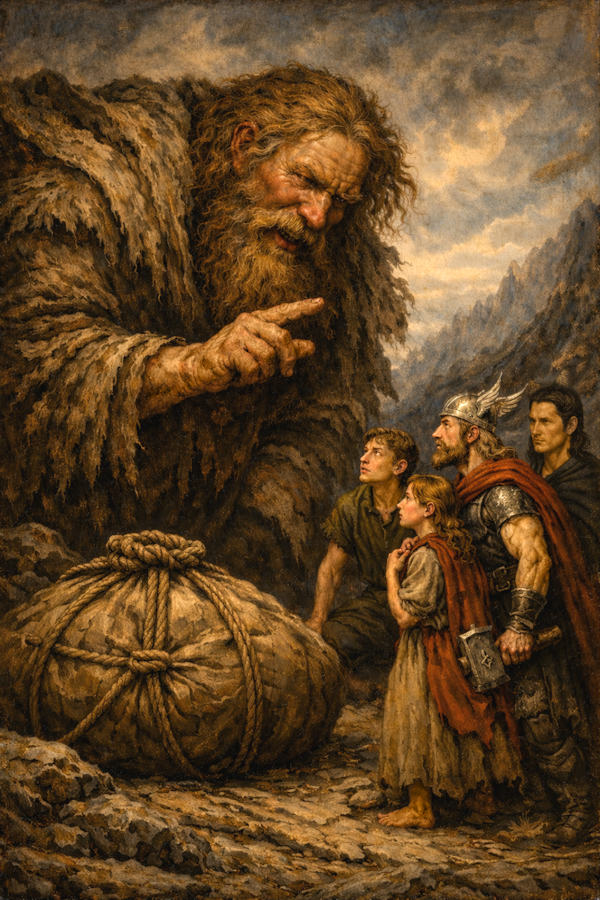
Here, the destination of their journey eastward to Jötunheim is named: Utgard, the royal stronghold of the giants—analogous to Asgard for the gods and Midgard for humans. Skrymir himself, with his mittens, reveals his nature as a mountain and frost giant drawn northward into the realm of nature, toward the snow-capped mountain giants.
The king of Utgard is named Utgard-Loki, a Loki of the outer world, or the giant-world of the macrocosm, so to speak. As king within this “fortress of the body”, he is himself a “trickster”—much like the Loki of the gods—and, through his counter-action, brings about physical creation and binding. Against what does this macrocosmic embodiment act? Against freedom in the microcosm? Against the freedom of the spirit that has lost itself in a dream and now binds itself to avoid becoming even more lost? What is the purpose of embodiment? These are subtle questions to which answers are not easily found. Yet, that is precisely why such profound stories were told.
46. Thor and his companions continued on their way and travelled until midday. Then they saw a castle standing in a field, and they had to tilt their heads far back before they could see over it. Then they approached the castle, but a gate had been lowered. Thor went to the gate, but could not open it. However, they eagerly tried to enter the castle, and squeezed through the bars and thus got in. They saw a large hall and went there. The door was open. They entered and saw many men, most of them very tall, seated on two benches. Next, they came before King Utgard-Loki and greeted him.
Apparently, the four, as deities, human intellect, and soul, were not particularly welcome in the royal castle of embodiment, as Skrymir had advised them against continuing their journey. But they are spiritual beings who can force themselves into any physical form, and then, despite all obstacles, stand before the king of embodiment in the midday light.
But he turned to them slowly, grinning contemptuously, and said: “It makes no sense to ask for news on such a long journey. Isn't this little fellow called Öku-Thor (Chariot-Thor)? Yet you might be more than you seem to me. What skills do your traveling companions claim to possess? No one should be here with us who does not possess some kind of knowledge or skill better than most others.”
Much like Skrymir, Utgard-Loki also recognizes the wandering Thor, and their connection will be revealed later. Then the king doesn't beat about the bush: he's not interested in news from the wider world, but in the core and essence of his rule, namely supremacy. And Loki is the first to confront this claim, always acting last, as a countermeasure.
Then the one who had arrived last, named Loki, said: “I have mastered the art, which I am immediately ready to test, namely, that no one in here can eat their meal faster than I.” Utgard-Loki replied: “That is indeed an art, if you have mastered it. It shall be put to the test!” He called to the back of the bench that the one named Logi (“Fire”) should step forward and compete against Loki. Then they took a trough, placed it on the floor, and filled it with meat. Loki sat at one end, Logi at the other, and each ate as fast as they could until they met in the middle of the trough. Loki had eaten all the meat from the bones. Logi, however, had swallowed all the meat, the bones, and even the trough itself. Therefore, it seemed to everyone that Loki had lost the contest.
At first glance, one might think that Loki was very hungry after his long journey and quickly obtained a large amount of food through this trick. On a deeper level, this speed of consumption is reminiscent of the rapid reaction on every effect. And thus, it also reflects the principle of dissolution inherent in all creation, so that everything that comes into being must also perish more or less quickly. The consumption of the bones recalls the beginning of this story, when Thjalfi broke a bone from Thor's goat and ate the marrow. Loki, however, leaves the bones whole so that life is preserved and the body's flesh can regenerate. In contrast, Logi even consumed the trough. Thus, we will ultimately come to know him as a fire giant and an all-powerful force of destruction. Yet, in the external world, it appears to our minds that Loki was less powerful and had lost the wager.
Therefore, Edda scholarship places great emphasis on clearly distinguishing Loki and Logi, even though their names sound very similar and they are described as being very similar in nature. For our understanding, their difference lies primarily in the fact that Logi, as a fire giant, burns within separation and thus becomes a fire of destruction. Loki, on the other hand, as a divine being, operates within wholeness, where nothing can be lost or destroyed.
Thus, here too in Utgard, the royal fortress of Jötunheim, we find a giant in the form of Logi, whose nature, unlike Skrymir's, does not lean northward into the realm of nature, to the mountain and frost giants, but rather southward toward the sons of Muspelheim in the spiritual realm of fire. Similarly, in the microcosm, the dwarves of Alfheim are also distinguished: some lean more toward the spirit and are called light elves, others more toward nature, who are then called dark elves.
Then Utgard-Loki asked what the other young man could do. Thjalfi replied that he could compete in a race against anyone Utgard-Loki chose. Utgard-Loki thought this was a good skill, and he believed he was indeed very fast when he practiced this art. Immediately, he arranged for it to be tested. Utgard-Loki stood up and went outside. There was a good stretch of flat field to run on. Then he called a boy named Hugi (“Thought”) and ordered him to race Thjalfi. They began the first race. Hugi got so far ahead that at the end of the track (at the turning point) he could turn around and meet Thjalfi. Then Utgard-Loki said: “Thjalfi, you must try harder if you want to win the race. But it is true that no one has come here who seemed faster to me.” Then they ran a second race. But when Hugi reached the finish line and turned around, he was an arrow's length ahead of Thjalfi. Utgard-Loki said: “Thjalfi seems to be running well. But I no longer believe he can win the race. We'll see when they run the third race.” So, they ran once more. And when Hugi crossed the finish line and turned around, Thjalfi hadn't even reached the halfway point. At that, everyone said the competition was over.
Here again we find wonderful symbolism! A race between intellect and thought. Who reaches their goal faster? Who is more powerful? The race is run three times. And each time, intellect slows down. In the first race, thought had only a slight lead until the turning point. Here we can consider what happens when intellect chases after a thought that runs in the same circle, turning around and around, especially when it is constantly urged to try harder. The more intellect tries, the more it fixes itself on a goal, and the more it chases thoughts in circles, the more it loses its light-footed speed. And the more it clings, the more it tenaciously holds on, and the more it believes it can lose, the more it stagnates and gets stuck into its position, which we then call “understanding”.
Finally, the question of the difference between intellect and thought arises here as well. Much like Loki and Logi, Thjalfi and Hugi are essentially alike. Yet thought lives in wilful separation, while intellect seeks connections and even strives for wholeness, the more it serves the divine, like Thjalfi serves Thor. And yet, in the external world of diversity, every wilful thought seems more powerful than an intellect that serves the divine.
Afterward, Utgard-Loki asked Thor what skill he wished to demonstrate to them, noting that there were so many stories told of his great deeds. Thor replied that he would most like to compete against someone in a drinking contest. Utgard-Loki agreed, went into the hall, and summoned his servant. He ordered him to bring the great punishment horn from which the retainers usually drank (whenever they had lost a wager or a fight). Soon after, the servant appeared with the horn and placed it in Thor’s hands. Utgard-Loki said: “To drink well from this horn, one must empty it in a single draught. Some finish it in two, but no one is such a poor drinker that they cannot manage it in three.” Thor examined the horn; it did not look very large, though it was quite long. Being very thirsty, he began to drink. He took deep swallows, believing he would not need to return to the horn many times. Yet, when he paused for breath and lowered the horn, he saw how much he had actually consumed; it seemed to him that there was hardly any difference. It seemed that there was scarcely less in the horn than before. Utgard-Loki remarked: “A good drink, but not a large one. I would not have believed it had I been told that Thor of the Aesir could not drink more. Yet I know you will empty it in the second draught.” Thor made no reply but put the horn to his lips, confident that he would drink more this time. He exerted himself as he drank until he had to catch his breath. He noticed that the tip of the horn still did not point upward as much as he had hoped. And when he took the horn from his mouth and looked inside, the level seemed to have dropped hardly at all compared to the first attempt; at the very least, the rim was clearly visible within the horn. To this, Utgard-Loki said: “What is the matter, Thor? Are you holding back for the next draught, thinking it will stand you in good stead? It seems to me that if you take a third draught from the horn now, it ought to be the mightiest of all. How can you be considered the great man the Aesir call you, if you show no more prowess in other contests than what is visible here?” At this, Thor grew angry; he put the horn to his lips and drank as eagerly as he could. He exerted himself greatly with this draught. And when he looked into the horn, a difference was finally discernible. Then he handed it back, refusing to drink any more.
Certainly, the ability to hold one’s drink during a feast was considered a virtue among great heroes. This likely involved the “punishment horn” or “penance horn” (vítishorn), used to wash away a loser's sorrow and allow him to reassert himself as a victor. Yet, this text surely points to a deeper significance:
What does a god drink? Why does a god drink? And why is this his greatest strength? It is said of Odin that he drinks only wine; the wine of the power of illusion and creation, drawn from the sea of primal causes. Indeed, right at the beginning—in the chapter on Odin’s nature—we encountered the figure of Mimir, who draws forth creation using his horn from the Well of Mimir, located at the root of Yggdrasil.
Accordingly, the Well of Mimir is the source and foundation of Jötunheim—the realm of giants representing embodiment—as can be clearly seen in our image of the World Tree above. In this regard, the “great horn of punishment” reminds us of the horn of creation, which the beings must drink off due to their karmic debt. As the saying goes: “You have made your bed, now you must lie in it.” To bring about the external conditions and circumstances for this, one can picture God drinking from this source and then breathing out the life of creation. In doing so, He holds nothing back but breathes everything out again—yet within wholeness, within Himself, so to speak.
Similarly, we find Thor here drinking from the horn, only to be forced to breathe again. Thus, Thor, Loki, and Thjalfi appear as a trinity of action, counter-action, and intellect: Thor drinks from the sea of causes, Loki consumes the effects, and Thjalfi follows the flow of events.
But why is Thor unable to drain the horn completely? Well, on one hand, it is not his task as a god to empty the horn entirely, for that would bring creation to an end before it had fulfilled its purpose. On the other hand, the horn—appearing finite in the outer world, leading one to believe it can be drained—is naturally an illusion; as is later revealed, the tip of the horn actually rests in the sea. This makes sense, for since Thor is a holistic being—a god—he can only drink from a holistic source. The drinking horn itself serves as a fitting symbol for this: its tip represents inexhaustible unity flowing into the abundance of diversity, much like the concept of the “horn of plenty”. Yet, the harder he struggles and the angrier he becomes while drinking, the greater the danger to all living creation, as the waters of life appear to be vanishing. Thank God, he eventually ceased his efforts. And yet, in our outer world, his inability to completely drain the horn of guilt’s punishment appears to be a divine weakness.
Why don’t we drink it off ourselves? Is it not our guilt and our task? Here, we are quick to say: “That’s impossible!” In this regard, the Indian Mahabharata contains a similarly symbolic story about Agastya, who—at the behest of the gods—drank up the entire ocean because demons had hidden within it. Here, too, the gods were unable to empty the sea, yet the wise and holy Agastya drank it dry. Consequently, the gods were able to defeat the demons, who can also be viewed as overpowering giants. But when the gods later asked Agastya to release the water, he replied that he had already digested it. Thus, the celestial Ganga, the river of the Milky Way, had to descend to replenish the ocean. Marvellous! (See Mahabharata 3.105)
Nevertheless, the physical world regards the spirit as weak; it belittles the spirit and suppresses it wherever it can. We, too, still attempt to solve our problems physically rather than spiritually. Just look at our medical system: how dominant the physical aspect is, and how weak the spiritual! How powerful the natural sciences have become compared to the humanities! How heavily we rely on chemistry and technology, and how little on the power of the spirit! Yes, this is the world of Utgard-Loki:
To this, Utgard-Loki said: “It is now evident that your strength is not as great as we believed. But do you wish to attempt further trials? It has been clear so far that you are achieving nothing here.” Thor replied: “I am willing to face further contests. Yet, back home among the Aesir, it would have seemed strange to call such gulps 'small.' What kind of contest do you wish to offer me now?” Utgard-Loki said: “Young lads here perform a feat considered trivial: lifting my cat off the ground. But I would not speak this way to Thor of the Aesir had I not seen that you are far less significant than I thought.”
Immediately, a large grey cat ran across the hall floor. Thor went over to it, grasped its midsection with his hands, and tried to lift it up. But the cat arched its back as high as Thor could reach. And when he had stretched up as far as he possibly could, the cat lifted just one paw, and Thor could not carry the contest any further. Then Utgard-Loki remarked: “The contest went exactly as I expected. The cat is quite large; Thor, however, is small and insignificant compared to the great men we have here among us.”
What role did cats play in the household back then? They were likely not merely cuddly pets as they are today; rather, their primary task was to protect food stores from mice, rats, and other small creatures. In this respect, cats held sway over smaller beings much as the giants sought to do. It was fundamentally a matter of protecting the home, sustenance, and physical existence. As we shall later discover, for Utgard, this cat symbolized nothing less than the mighty Midgard Serpent, which coils around the human world, defining boundaries to safeguard what is deemed to be humanity's own.
In this context, the giants once again confronted Thor with a fundamental principle of their nature in order to test his strength. And indeed, he once more shook the very foundations of the giants. Yet, even here, it was evidently not his divine mission to completely abolish this fundamental principle of their being. Consequently, he himself came to be viewed as weak. Thus, he ultimately challenged the giants to attack and defeat him personally.
Thor said: “If I am as weak as you say, let someone come here and fight me. I am angry now.” Utgard-Loki looked around the rows of benches and replied: “I see no man here who would not consider it beneath his dignity to fight you.” He continued: “But let us see. Summon my old nurse Elli ('Old Age'), here. Thor may wrestle with her if he wishes. She has brought down men who seemed to me no weaker than Thor.” Then an old woman entered the hall. Utgard-Loki told her to wrestle with Thor of the Aesir. There is nothing more to say about it: the match went in such a way that the harder Thor struggled, the more firmly she stood her ground. Then the old woman began to press the attack, and Thor grew unsteady on his feet. A fierce wrestling match ensued, and it was not long before he sank down onto one knee. Utgard-Loki then stepped forward and told them to stop wrestling. He said that Thor could not afford to challenge any more of his followers to a wrestling match. By this time, night had fallen. Utgard-Loki assigned places to Thor and his companions, and there they spent the night, with good food and service.
Having already contended with guilt and separation as fundamental principles of embodiment, they now face a third great challenge: the principle of aging. This principle is the most feared in the realm of embodiment, just as we humans know the fear of growing old. It is no wonder, then, that even the giants perceive it as the most powerful being of all. The symbol of the “old nurse” is aptly chosen: as an old woman, she embodies the nature of transience; as a nurse, she reminds us that without her, we would never have grown.
Without aging, there is no growth.
Without passing away, there is no coming into being.
Can Thor, as a god, resist aging? Can he defeat it? Here, too, the dynamic is described with profound insight: the harder he struggles and fights against her, the more firmly she holds her ground. This is true of any illusion: the more one fights it, the more it manifests as reality. Yet, Thor was not defeated by her; he merely sank to one knee. This likely refers to the aspect of his form—comprehensible to our minds—which must inevitably age and pass away. His divine and holistic essence, however, remains immortal and imperishable.
And yet, we do not want this divine spirit in our world of embodiment. Why is that? Do we fear losing our ego—and all the possessions attached to it—within the Whole? Why are we so intent on being someone special when we could simply be Everything?
47. At daybreak, Thor and his companions rose, dressed, and prepared to set out. Then Utgard-Loki came to them and had breakfast served. There was no lack of good hospitality, food, and drink. When they had finished eating, they wished to depart. Utgard-Loki accompanied them out and walked a short distance from the stronghold with them. But upon parting, he spoke to Thor and asked how he felt his journey had gone and whether he had met any man more powerful than himself. Thor replied that he would not deny having suffered great humiliation during their encounter: “For I know well that you will call me a weak man, and I am not pleased by that.”
Thus, Thor had fought hard, yet failed to achieve his goal of being acknowledged as the strongest being in the world. Or had he? At the very least, he voiced his dissatisfaction to the King of Utgard. It is noteworthy that he did not use his hammer while inside Utgard, even though he became enraged on several occasions. Perhaps the hammer was already exerting its influence within the fortress of the body? There is also the question of the role played by Röskva on this journey; she is not mentioned again after their arrival in Jötunheim. If we view her as the soul—alongside Thjalfi, representing the human intellect—then, as the principle of causation, she must have significantly influenced the course of the entire story. Perhaps this is why the tale feels so human to us, allowing us to recognize our own weaknesses and strengths regarding divine and spiritual power. And perhaps the entire story actually unfolded within the fortress of a human body.
The overnight stay, accompanied by generous hospitality, reminds us of the nocturnal state of consciousness in which we dream. And when the divine day dawns, we awaken and prepare to “set out” from the fortress of the body and return to our true home. Utgard-Loki, too, now leaves the fortress of the body alongside Thor and his companions. And—what a marvel!—he no longer speaks with arrogance, but utters profound words of truth.
To this, Utgard-Loki said: “Now I will tell you the truth, since you are out of the stronghold. As long as I live and have the power to decide, you shall never enter it again. And I know for certain that you would never have gotten in had I known beforehand how great your strength was. You nearly brought us into grave danger with it. But I deceived you with illusions. I first encountered you in the forest. When you tried to untie the provision bag, I had bound it shut with iron wire, and you could not figure out how to undo it. Next, you struck me three blows with the hammer. The first was the weakest, yet it was powerful enough that it would have killed me had it landed true. But near my hall, you saw a mountain containing three square valleys—one of them especially deep; those were the marks of your three hammer blows. I pushed that mountain in front of your blows, but you did not notice.”
Wow! So Utgard-Loki now reveals himself as Skrymir, as the true “big-speaker”, and utters truly momentous words: had he recognized the power of God earlier, it would never have entered the fortress of his body. And we learn at the end of the story how he can prevent this. He then admits that his arrogance within the bodily fortress stemmed from fear of God’s power; out of that fear, he had conjured sensory illusions to deceive the divine spirit. Of course, he had primarily deceived himself with these illusions, for only in this way was his embodiment possible. This allowed him to safeguard his karmic provision-sack from divine reach and to embody himself as a material mountain giant, thereby protecting himself against the blows of the divine hammer. How wonderful it is for one who can see through these illusions!
Why had Thor not seen through them? On one hand, he was wandering with the human mind. On the other, even God can only become active within the realm of illusions. With what else could He act? Thus, we often speak of the “illusory and creative power” of God—symbolically recognized in the wine that nourishes Odin as the divine All-Father and Creator God. Indeed, the whole of creation appears in this way so that we may recognize God’s power and see through the illusions, just as Utgard-Loki now does. He therefore continues:
“It was the same with the contests you undertook against my followers. Loki competed in the first: he was very hungry and ate rapidly. But the one named Logi was a raging fire; after consuming the slaughtered meat, he swiftly burned the trough as well. When Thjalfi raced against the one named Hugi, he was competing against my thought itself; Thjalfi could not possibly have hoped to match such speed. But when you drank from the horn and the level seemed scarcely to drop, I knew for certain that a miracle had occurred—something I had deemed impossible. For the other end of the horn lay out in the ocean, though you could not see it. Yet when you reach the sea now, you will see how much you drank from it; that receding of the waters is what is now called the ebb tide.”
Thus, he now recognizes that the divine Loki—acting as a counter-force within creation—is superior to the wild fire giant who seeks only to burn and destroy everything. Next, he realizes that the intellect can never outpace thought itself, for as long as it chases after thoughts, it remains bound to the nature of creation as it unfolds within space and time. Only holistic reason moves faster, as we learned from the fairy tale of the Hare and the Hedgehog. Reason is knowing instantly: “I am already here!” Thirdly, he perceives the wondrous power with which God drinks from the ocean of causes and exhales creation. The ebb and flow of the tides serve as powerful symbols of this process—representing how the Divine breathes in and out daily, yet nothing is ever lost.
And he continued: “It seemed to me no small feat when you lifted the cat. And to tell you the truth, everyone was terrified when they saw you lift one of its legs off the ground. For that cat was not what it appeared to be; it was the Midgard Serpent, which encircles all the lands. It was barely long enough for its tail and head to touch the ground, for you stretched your hands so high that they were not far from the heavens. Yet a great marvel also occurred during the wrestling match, when you held your ground for so long and sank to only one knee while grappling with Elli. For no one has ever—nor will anyone ever—encounter Old Age and remain standing without being brought down.”
Utgard-Loki, in the guise of Skrymir, also recognizes the true nature of the Midgard Serpent. and sees how everyone in Utgard is terrified when the serpent threatens to uncoil and rise up from the earth. Deeply alarmed, they ask themselves: “Who am I, if I can no longer be a distinct and individual being, if my earthly bodily shell vanishes?” And finally, he even recognizes the imperishability and immortality of the divine power, which thereby proves superior to all earthly powers. Then Skrymir concludes his magnificent and truthful speech, saying:
“But now, truly, we must part ways. And it will be better for both sides if you do not cross my path again. Next time, I shall conceal my castle with such illusions and others, so that you gain no power over me.”
At these words, one might suddenly begin to doubt again whether Skrymir has spoken the truth. Why does he wish to part from the divine spirit? Why does he no longer wish to encounter it? Why does he speak of “illusion” once more, thereby claiming to be more powerful than God? Well, our human intellect can likely grasp it in no other way; it will never be free of misunderstandings. And since Thor is still accompanied by Thjalfi, he too seems to misunderstand the situation and once again swings his hammer.
But when Thor heard these words, he seized his hammer and swung it through the air. However, as he was about to strike, he could no longer see Utgard-Loki. He turned back to the castle and wanted to smash it. But there he saw only a vast and radiant field, and no castle. Thereupon he turned back and continued his journey until he returned to Thrudvang (“Field of Power”). And it is truly said that he had decided to try to meet the Midgard Serpent, which later happened. Now I believe no one can tell you anything more true about this journey of Thor's.
(Gylfaginning §44-§47 by Arnulf Krause and Karl Simrock)
Here we learn how Skrymir protects himself from divine might: first he vanishes, then his fortress of a body disappears too—and that, too, is an illusion. A brilliant solution! Then there is nothing left to smash and nothing left to defend. Wonderful!
Was this, perhaps, the ultimate goal of Thor’s journey? After all, what kind of god would Thor be if he failed and could not achieve his aims? Was his third hammer blow successful after all, as the text initially suggested: “Thor thought that if he were given the chance for a third blow, he would never see him again”?
Utgard-Loki, too, now lives up to his name, for he is the “Loki of Utgard”—the counter-force to that fortress of a body. Thus, this embodiment exists solely to be overcome. What a magnificent story! It ends much like the account of Gangleri we read earlier, when he awoke from “Gylfi’s Illusion” and even the vision of Asgard vanished. Similarly, Utgard and its king disappear here. And yet, the world remains as it is: a boundless, “vast and radiant field” of consciousness. What a marvel!
To find ourselves in boundless being
Who would not vanish, gladly fleeing…
To take what’s made and then re-make it,
To fight rigidity and break it,
Eternal living action quest…
And all must be annihilated
That existence strives to last.
(“One and All”, Goethe)
Thus, illusion is an important, and often even central theme in the Edda, carrying a profound message: when one looks and travels from Midgard toward Asgard, the “sensory illusions” are generated primarily by the spirit—as stated at the beginning of “Gylfi’s Illusion”: “But the Aesir were wise, for they possessed the gift of foresight. They saw his journey before he arrived and conjured up sensory illusions for him...” Conversely, if we look and travel from Midgard toward Utgard—the realm of external nature—the “sensory illusions” are generated by the king of the fortress of the body, by the giant power of embodiment.
What does “illusion” mean? In German, the term is often translated as deception, which tends to remind us of fraud. Yet, fundamentally, neither spirit nor nature deceives us. It is more an illusion in the sense of self-deception—an “illustration” in the light of consciousness. This strongly evokes the Indian concept of “Maya” as the illusory and creative power of Vishnu, the god of preservation. Maya, too, is not a deception but a vital means of rediscovering the truth within the illusion—the foundation of all things, or, so to speak, that which existed before anything came into being. Therein lies the self-knowledge so often spoken of: the ability to recognize oneself as the truth within all things and to see through every illusion. Through this, the principle of separation, and with it, all egoism dissolves. For it is from this demarcation and separation that the gardens, enclosures, and even the strongholds of Midgard, Asgard, and Utgard arise—realms for which the Midgard Serpent serves as a potent symbol. It is in this direction that Thor continues his struggle, having “decided to meet the Midgard Serpent”—a subject we shall explore in the next section.
Wonderful! We have thus gained a deeper and more comprehensive understanding of the essence of Thor and his hammer.
The Story of Thor's Fishing Trip
48. Then Gangleri said: “Utgard-Loki is very powerful, a master of illusion and sorcery! Yet one can also see that his power stems from having followers who possess great strength. Did Thor not take revenge on them?”
The High One answered: “It is common knowledge—even among the unlearned—that Thor set matters right during the journey just recounted. He did not stay home long but quickly prepared for a new expedition, taking neither chariot, goats, nor companions with him. Disguised as a young lad, he travelled through Midgard, and one evening he arrived at the home of a giant named Hymir. Thor spent the night there. At daybreak, Hymir rose, dressed, and prepared to row out to sea to fish. Thor sprang up, readied himself quickly, and asked Hymir to let him row out to sea with him. Hymir, however, said that Thor would be of little help, being small and still a young man: “And you will freeze if I stay out there as long as I am accustomed to.” But Thor replied that he could row so far from land that it would be uncertain which of them would be the first to urge a return. At this, he grew so angry with the giant that he was ready to strike him dead on the spot with his hammer. Yet he refrained, intending instead to test his strength elsewhere.”
Here, it becomes evident that the separation between the worlds of Midgard and Jötunheim is also an illusion, for the giants live just as readily in Midgard. In principle, Midgard is wherever one happens to be, for one stands at the centre of one’s own world. In this world of illusion, Thor, too, can assume any form; to anyone wishing to see him as a young lad—small and weak—he appears exactly that way. Yet his divine essence remains, and with it, his strength and power.
The sea surrounding Midgard calls to mind the sea of causes, from which the giants fish for their sustenance in the form of effects. Yet, typically, we do not dare to row too far out or venture away from the solid land where we feel secure in our embodiment. For in this sea, one can easily sink. Naturally, we wish to avoid this, fearing the loss of something, namely ourselves, our own bodies, and all the possessions we have fought to acquire throughout our lives; indeed, even our own world.
The etymology of the name Hymir is unclear; it may signify “the eclipsed one”. Yet, much like “Skrymir”, the name contains “Ymir”—the primordial giant who had frozen into ice and from whom this entire world was thawed so that the waters of life might flow once more. Naturally, all giants are descended from him. It seems, however, that Hymir was beginning to freeze over again, which is why the youthful Thor encountered him.
He asked Hymir what they should use for bait, but Hymir told him to get some himself. So, Thor went to where he saw a herd of oxen belonging to Hymir. He grabbed the largest ox, named Himinhrjodr (“Sky-Shatterer”), tore off its head, and carried it to the shore. By then, Hymir had already launched his boat. Thor climbed aboard and sat in the stern. He took two oars and began to row; Hymir, however, believed the boat was moving because of his own rowing, for he was sitting right at the bow and rowing vigorously. Hymir then said they had reached the fishing grounds where he usually sat to catch flounders. But Thor wanted to row further, so they quickly covered a long distance. Eventually, Hymir said they had gone so far out that staying there was dangerous because of the Midgard Serpent. Thor, however, wanted to keep rowing for a while longer and did so. Hymir, meanwhile, was in an extremely bad mood.
The ox-head from the giant’s herd is a powerful symbol. It reminds us of the combative stubbornness of the ego-mind. And indeed, this turns it into a “shatterer of the heavens”, destroying the wholeness of the sky.
The boat or ship, floating like a wave upon the sea of causes, serves as a symbol for the body. There is a profound description of how the giant believes he is rowing and propelling the boat primarily through his own strength. Yet, ultimately, it is always the divine power—usually remaining in the background—that moves everything in this creation. Consequently, we rarely recognize or acknowledge this power. And when we do become aware of it, we are seldom pleased, much like Hymir, who grew ill-tempered. Yet, it is only through this divine power that we reach the true destination of our journey.
However, the giant fears approaching the Midgard Serpent. Why? Is he afraid of overstepping his boundaries, of leaving his familiar realm, his “comfort zone”? He prefers to catch flounders, flatfish that symbolically remind us of shallow, superficial thoughts and effects. And yes, this is likely the case for most people, too. Yet, the divine power urges us toward the goal nonetheless.
After Thor had put aside the oars, he prepared a rather strong fishing line, and the hook was neither small nor weak. He baited it with the ox's head, cast it overboard, and the hook sank to the bottom.
And truly, it must be said that Thor deceived the Midgard Serpent no less than Utgard-Loki had deceived him when he lifted the serpent (in the guise of a cat) with his hands. The Midgard Serpent snapped at the ox head, and the hook pierced its palate. But upon realizing this, the serpent thrashed so violently that both of Thor’s fists slammed against the boat’s side. This enraged him, and his divine strength surged; he braced himself so firmly that he drove both legs through the hull and down to the seabed, then hauled the serpent up to the side of the boat.
Why does the ox head deceive the Midgard Serpent? If one views the ox head as the ego-mind, it is hardly surprising that the ego-serpent of separation bites into it. And the ego-mind can, of course, be regarded as a deception or illusion—much like the illusion of the fortress-body of Utgard-Loki with the cat. Here, we might consider whether this mind serves primarily to entice the ego-serpent to sink its teeth into it and swallow the divine fishhook. In this way, it can be drawn by divine power out of the sea of causes and defeated in its manifestations within our world of reality. Crucially, the divine power no longer stands upon the shaky boat of physicality, but upon the bed of the sea of causes—and thus upon the foundation of All That Is. In this respect, we once again encounter powerful symbolism.
However, it must be said: no one has ever witnessed such a terrifying sight who could not watch Thor stare piercingly at the serpent as it glared up from below, spewing venom. It is said that the giant Hymir changed colour, turned pale, and became terrified when he saw the serpent and the sea rushing in and out of the boat. But the moment Thor seized the hammer and swung it through the air, the giant took the bait knife and cut Thor's fishing line on the side of the boat. The serpent sank back into the sea, and Thor threw the hammer after it. It is said that the hammer smashed its head beneath the waves. However, I believe something else to be true, just to tell you, that the Midgard Serpent is still alive and lying in the sea. But Thor swung his fist and struck Hymir so hard on the ear that he fell overboard, and Thor saw only the soles of his feet. After that, Thor waded ashore.
(Gylfaginning §48 according to Arnulf Krause and Karl Simrock)
What kind of sight is this that no one can bear? Here, one could contemplate the downfall of someone, namely our self-contained, ego-like being. And this happens when divine and holistic power first brings the venom-spewing serpent of boundaries surrounding us into consciousness and then shatters it. Therein lies perhaps our greatest fear: Who am I then? Who am I when the entire ocean flows in and out of my body? Presumably, we would react much like Hymir, cutting the divine fishing line while the god wields his hammer. Probably also with the “bait knife on the side of the boat”, which symbolically reminds us of the knife of discernment on the physical bodyshell. But this is apparently of no use anymore, for Thor never swings his hammer in vain, without achieving his goal. On the contrary, his fist strikes us, and we plunge, like Hymir, headfirst into the dark depths of the sea.
What does the blow to the ear signify? Physically, one might think of the sense of balance behind the ears. Spiritually, this blow reminds us of the Word of Creation, which we were all meant to hear. But Hymir apparently refused to hear it, so his being was overthrown, and thus his course of development was reversed.
Therefore, a master says that the power of hearing is far nobler than the power of seeing, for one learns more wisdom through hearing than through seeing, and thus lives more fully in wisdom. Hearing brings more in, while seeing points more outward, at least the act of seeing itself. And therefore, in eternal life, we will be far more blessed through hearing than through seeing. For the process of hearing the eternal Word is within me, but the act of seeing goes away from me; and hearing I receive, but seeing I accomplish. (Master Eckhart, Sermon 58)
What would have happened if Hymir hadn't cut the fishing line, but had instead watched with trust, or better yet, listened? Then it would have been possible for divine power to draw Hymir's ego-driven head upward to the heaven of wholeness, to Valhalla with the Einherjar, or even into the pure light of heaven. Master Eckhart writes about similar symbolism:
Whoever is caught on this hook is so hooked that foot and hand, mouth, eyes, heart, and everything in a person must always belong to God. And therefore, you can never better overcome this enemy (of physicality) so that it does you no harm than with love… Therefore, look only for this hook, then you will be happily caught, and the more you are caught, the more you are freed. - That we may be thus captured and freed, may He who is Love Himself help us. Amen. (Sermon 59)
But Hymir resisted. So, his nature had to be reversed, and he plunged headfirst into the dark depths. And we can well imagine how two islands in the sea emerged from the soles of his feet, on which new life could once again grow fruitfully.
So, Thor had at least shattered Hymir's Midgard Serpent, causing its own colossal head to dissolve back into the Sea of Causes. But the Midgard Serpent of our human world continues to live in the sea. Are there multiple Midgard Serpents? Yes and no. As long as we perceive separate physical beings, there is, of course, a Midgard for each body, and around it a Midgard Serpent to define its boundaries. It lives in the Sea of Causes and creates the distinct physical fortress that then becomes the centre and Midgard of our world. But this very separation into distinct beings is our greatest illusion. Anyone who sees through this can only perceive one Midgard Serpent as the universal principle of separation, conceived holistically by Loki. And this serpent is then shattered by Thor at Ragnarök, at the end of the creation cycle.
Thus, we come full circle to the opening words:
… He became so enraged by the giant that he was ready to strike him down with his hammer on the spot. But he refrained because he intended to test (or rather, demonstrate) his power elsewhere.
And this whole story can be read as a more detailed description of what happens internally and what is actually meant when Thor strikes down or smashes a giant with his hammer. It is also clearly emphasized again at the end of this text that Thor's hammer is not actually for killing, even though it can smash heads. Thus, it is a very mystical weapon for our ordinary minds. Therefore, in the following section, we would like to examine the nature of this hammer in a more comprehensive way.
The Meaning of Thor's Hammer Mjölnir
Gods wielding symbolic weapons appear in many ancient mythologies. Consider, for instance, the Greek Zeus with his thunderbolt—embodying divine power and order, and serving as a visible sign of his dominion over the heavens and the cosmic order. Or the Greek Poseidon and Roman Neptune with their tridents, symbolizing the power of the sea, the forces of nature, and earthquakes. Looking further afield to India, we find Indra, the king of the gods, with his vajra-thunderbolt, fashioned from the bones of a holy man and symbolizing the invincible power of the gods. There is also Shiva with his trident, representing the three divine forces of creation, preservation, and destruction; or Vishnu—who also appears as Krishna—wielding the chakra (discus), the “wheel rim of time” acting as a ring-shaped weapon of transience and renewal. His brother, Balarama, bears a plough as a weapon, evoking the cultivation and urbanization of the natural world. Clearly, the essence of Thor’s hammer can also be found reflected in all these weapons.
But why does a God need weapons? After all, He is a holistic and omnipotent being. Why does He require means? Can He not act directly? These are profound questions that are difficult to answer. To begin with, we might consider the nature of our intellect, which can grasp only names and forms. Consequently, it envisions the gods as resembling humans and acting in similar ways. How else could we speak of them or tell instructive stories?
Yet God Himself, as a holistic being, is naturally beyond all names and forms. That is why Moses commands that one should worship only a holistic God and make no image of Him. One is also to hallow His name rather than misuse it—that is, not employ it to impose boundaries or limitations upon His wholeness and omnipotence. And indeed, this divine wholeness is surely the ultimate goal, reminding us once again of the pure light of formless consciousness, which is capable of assuming any form.
But how does one get there? To this end, Moses employs a specific approach, describing how the Divinity becomes active—transforming into the Creator God—and brings forth and exhales creation. In this sense, one might view all of creation as God’s most powerful weapon for exerting influence. What is creation made of? Of God? If so, it would be beyond comprehension. Of illusion? Then our minds could grasp it, as a flow of cause and effect, as the stream of life moving through time and space. This brings us back to God’s “power of illusion and creation”, known in India as Maya. Through this, God acts, and only through this can we, too, act within creation. It is likely the substance of God’s weapons, just as it is the substance of all our own weapons, tools, and means in life. Thor’s hammer should be viewed in this light as well.
Its name is Mjölnir; its etymology, like that of many other names, remains relatively obscure. The most plausible meaning is “Crusher”—an instrument capable of crushing and shattering hard objects. It is, above all, a practical tool. It is therefore not surprising that this hammer was forged by the dwarves, nature spirits. We encountered the story behind this in the previous chapter on the nature of Loki, within the section discussing Draupnir. There, the hammer was created by two dwarves, alongside the golden ring of renewal and the golden boar (a being of light and the draft animal for Freyr’s chariot):

This came about because of a wager made by Loki, who bet that the dwarves could create nothing better than Sif’s golden hair, the ship Skidbladnir, and Odin’s spear Gungnir. However, he lost the wager, for they went on to create Odin’s ring Draupnir, Freyr’s boar Gullinbursti, and Thor’s hammer Mjölnir—of which the text says:
Then he gave Thor the hammer and told him he could strike as hard as he pleased with it. Whatever lay before him, the hammer would not fail. And if he threw it at something, it would never miss its target. Yet it would never fly so far that it could not find its way back to his hand. If he wished, it could become small enough to tuck under his shirt. There was one flaw, however: the handle had turned out a bit too short.
It is stated right from the start that the hammer never fails or misses its target. In this regard, we should not doubt its effectiveness within the stories—neither the blow struck against Skrymir’s head nor the one against the Midgard Serpent. The flaw of the short handle might relate to the hammer’s range, which naturally must be limited if it is to function within Creation. This is likely why Thor travels so extensively with this hammer. And this is important, for without a flaw, this Creation could not exist, move dynamically, or evolve. Thus, the gods made their decision—despite the flaw, or perhaps precisely because of it:
Their verdict was that the hammer was the best of all objects and offered the greatest protection against the frost giants. They decided that the dwarf had won the bet.
(Skáldskaparmál §35 after Arnulf Krause and Karl Simrock)
This struggle against the frost giants runs through many stories of the Edda and is virtually omnipresent. This is understandable, for after the gods had ensured that the ice giant Ymir thawed and a living creation emerged, they naturally had to fight—throughout the entire cycle of creation—against life freezing over once more. One could also say they fought to prevent the spirit from being overwhelmed by nature and solidifying into mere matter. For a living creation requires a swinging balance between spirit and nature, between freedom and constraint, between light and darkness. And it is the flaws that sustain this oscillation.
Thus, the goal of the hammer is not to completely exterminate the frost and mountain giants or to shatter all embodied forms so that spirit might overwhelm nature. Rather, it is primarily about a living balance between coming into being and passing away. Consequently, this hammer is not a weapon of lethal destruction, but a divine instrument for life within Creation. For this reason, it was created—alongside the golden ring of renewal and regeneration and the golden boar—as a living being of light. It is, above all, a divine tool for the dynamic shaping and reshaping of existence. It was crafted by the dwarves, who, as nature spirits within the microcosm, ensure the shaping of things throughout Creation. For the very essence of “nature spirits” is a living balance between nature and spirit. Viewed individually, some may lean more toward nature and others more toward spirit—much like the two dwarves working on the hammer in the image above—yet together, they ensure the harmonious shaping of living Creation as a whole.
At their own will: Formation, Transformation,
The Eternal Mind's eternal recreation,
Forms of all creatures, there are floating free.
They'll see thee not; for only wraiths they see.
(Goethe, Faust II)
In this respect, we can view Thor’s hammer as a divine instrument for maintaining the necessary balance within living creation. Naturally, this requires it to be capable of acting in various ways. This includes the power of consecration: Thor used his hammer to consecrate the funeral pyre for Baldr when the god was destined to journey to Hel. Similarly, he consecrated the bones of the two goats that had been eaten, bringing them back to life. Thus, with this hammer, he consecrates both death and life—a function that calls to mind Draupnir, the ring of renewal and regeneration, which is indispensable to a living creation. We will also read how the hammer was placed in the lap of Thrym’s bride to consecrate the marriage and ensure its fruitfulness; it therefore serves as a blessing of fertility for creation.
It is no wonder, then, that the hammer Mjölnir, along with Thor’s sons, “Courage” and “Might”, survives even Ragnarök and once again fulfils its vital role in the next cycle of creation:
Vidar and Vali (Odin’s sons) tend the sanctuary of the gods after Surtr’s flame has died out. Modi and Magni (Thor’s sons) are to wield Mjölnir to carry on Vignir’s (Thor’s) battle.
(Gylfaginning §53, according to Arnulf Krause and Karl Simrock)
In this regard, Thor’s hammer can be understood as embodying a very comprehensive significance, much like Shiva’s trident, which represents the powers of creation, preservation, and destruction. The trident of Neptune and Poseidon—symbolizing the power of the sea, the forces of nature, and earthquakes—evokes a similar concept. People also perceived this “force of nature”—essential for the preservation of creation—in the thunder and lightning that appeared in the sky, seemingly sent by higher powers, inspiring a deep sense of awe for the divine.
This profound and significant meaning is further confirmed by archaeological finds of various amulets dating from the 9th and 10th centuries; they were often even placed in graves. Clearly, people placed great faith in the power of this hammer, likely associating it with the renewal and regeneration of life following physical death. A prime example is the gold and silver “Thor’s hammer of Ödeshög”, discovered in Sweden:
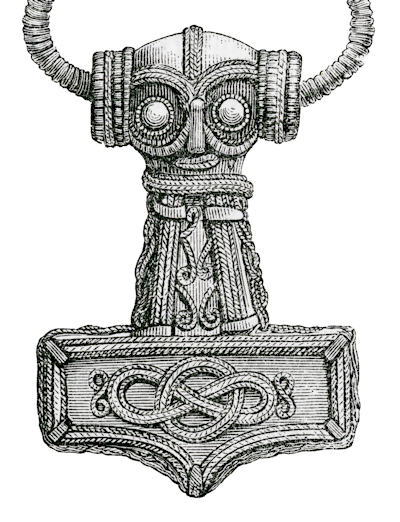
(Source: Wikipedia)
At the top of the handle, one can discern a face with large eyes; some even perceive a beard beneath the mouth. It is easy to imagine Thor and the hammer merging here into a living being, where the large eyes symbolize divine vigilance, or perhaps even the two eyes of Odin. On the hammerhead, an interwoven endless knot appears—a sign of infinity (∞)—reminding us of the cycle of renewal and regeneration as an eternal bond of the soul. A circle is also intertwined with this symbol; it might represent the Midgard Serpent, acting as a boundary within the eternal infinite from which transient finitude emerges. Powerful symbolism! Furthermore, a central point at the bottom end evokes the image of a trident.
In some archaeological finds, this hammer appears to blend with the Christian cross. This is quite conceivable, as the hammer can certainly serve as a symbol of suffering. After all, who would willingly have their body crushed and shattered, or the life they have painstakingly built and come to cherish? Yet, one must acknowledge that this process is essential for a living creation; it prevents things from becoming rigidly stagnant and allows for the emergence of the new.

