
| Content | Next | About |
The Lay of Thrym and the Recovery of the Hammer
This wonderful poem is often interpreted as a humorous comedy. There is value in this perspective, too, as it underscores the genius of such works—showing that they can be understood on multiple levels. We recommend reading the relatively short text in its entirety first.
1. Wing-Thor was furious when he awoke and found his hammer missing. He shook his beard, tore at his hair, and Jörd’s son (son of the Earth) searched everywhere.
2. Then, first of all, he spoke these words: “Listen, Loki, to what I say now, something neither man on earth nor god in heaven knows: the Aesir (god) has been robbed of his hammer!”
3. So they went to the beautiful dwelling of Freyja (to Folkvangr, the “Field of the Folk”). And Thor immediately spoke these words: “Will you lend me your feather cloak, Freyja, so that I might find my hammer again?”
4. Freyja replied: “I would gladly give it to you, even if it were made of gold; you shall have it, even if it were made of silver.”
5. So Loki flew, his feathered cloak rustling, until he left Asgard and reached the land of the giants.
6. Thrym (“Clamour”), lord of the giants, sat upon a mountain, adorning his dogs with golden collars and grooming his horses' manes.
7. Then Thrym asked: “How fare the Aesir (gods)? How fare the Elves (dwarfs)? Why have you come alone to Jötunheim (the land of the giants)?”
Loki answered: “Ill fare the Aesir. Badly fare the Elves. Have you hidden the hammer of Hlorridi (Thor, the 'Rider of Clamour')?”
8. Thrym spoke: “I have hidden Thor's hammer eight leagues beneath the earth. No one shall retrieve it unless Freyja is brought to me as my wife.”
9. Then Loki flew, his feathered cloak rustling, until he left the land of the giants and reached Asgard (Ása garða). There he met Thor in the midst of the stronghold (miðra garða), and Thor immediately spoke these words:
10. “Do you bring news of your mission? Let me hear a full account from on high! For often the one who sits forgets the message, and the one who lies down utters falsehoods.”
11. Loki answered: “I bring news of my mission: Thrym, lord of the giants, has your hammer. And no one shall retrieve it unless Freyja is brought to him as his wife.”
12. Then they went to meet the beautiful Freyja, and Thor immediately spoke the words: “Freyja, put on a bride’s dress! We both must go to Jötunheim.”
13. But Freyja became furious and hissed so loudly that the entire hall of the Aesir trembled. Her radiant Brising necklace fell to the ground, and she cried: “Do you call me man-crazy, that I would go to Jötunheim with you?”
14. Quickly, all the Aesir gathered for the thing, and all the Aesir women for discussion. The mighty gods deliberated on how they could get Thor’s hammer back.
15. Then Heimdall, the wisest of the Aesir, who knew not less than the Vanir, spoke: “Let us dress Thor in the bride’s robe. And let him wear the great Brising necklace!
16. Let the keys jingle at his belt and let women’s garments fall over his knees. Let magnificent jewels gleam on his chest, and let us skilfully arrange his headgear (and bridal veil)!”
17. Then Thor, the mighty Aesir, spoke: “The Aesir will call me unmanly if I allow myself to be dressed in the bridal robe.”
18. But Loki, the son of Laufey (“of the leaves”), replied: “Be silent, Thor, with such words! Soon the giants will inhabit Asgard if you do not return your hammer.”
19. Then they dressed Thor in the bridal gown and the great Brising necklace. They made the keys jingle at his belt and let women's garments fall over his knees. Magnificent jewels gleamed on his breast, and skilfully they arranged his headdress (and bridal veil).
20. Then Loki, son of Laufey, said: “I, too, shall go with you as a handmaiden. Thus, shall we both journey to the home of the giants.”
21. Quickly the goats were driven home and harnessed to the shafts. They had to run so fast that rocks shattered and the earth burst into flames as Odin's son journeyed to Jötunheim.
22. Then Thrym, lord of the giants, spoke: “Rise up, you giants, and deck the benches! Then bring me Freyja, Njördr’s daughter from Noatun, to be my wife!”
23. “Gold-horned cows shall roam this courtyard, and oxen black as night, to the giant's delight! I have many treasures, much jewellery; only Freyja do I lack, methinks.”
24. Soon evening fell, and ale was brought before the giants. Thor, Sif’s husband, ate an ox all by himself, along with eight salmon and all the delicacies meant for the women, and drank three casks of mead.
25. Then spoke Thrym, lord of the giants: “Where have brides been seen to gorge so greedily? Never have I seen a bride eat more, nor a maiden drink more mead.”
26. But the clever handmaiden sat beside him and answered the giant’s words: “For eight nights Freyja fasted, so great was her longing for the home of the giants.”
27. Then the giant peered beneath the bridal veil, lusting for a kiss. But he sprang back the length of the hall: “How terribly Freyja’s eyes glow! It seems to me that fire blazes from her eyes.”
28. But the clever handmaiden sat beside him and answered the giant’s words: “For eight nights Freyja did not sleep, so great was her longing for the home of the giants.”
29. In came the giants' wretched sister, who dared to demand a bridal gift: “Give me the red [golden] rings from your hands, if you wish to win my love, my dear, and all my favour.”
30. Then spoke Thrym, lord of the giants: “Bring in the hammer to hallow the bride! Lay Mjölnir in the maiden’s lap, and consecrate us together by the hand of War [goddess of marriage]!”
31. Hlorridi’s [Thor’s] heart laughed within his breast when the hard-hearted (hard-bolded) one beheld the hammer. First, he struck down Thrym, lord of the giants, and crushed the giant’s entire family [gathered there].
32. Then he struck the giant's old sister, who had demanded a bridal gift. She received blows instead of the shillings (of gold) and hammer-strokes instead of the many rings.
Thus, Odin's son regained the hammer.
(Thrymskvida, based on Arnulf Krause, Karl Simrock, and Edward Pettit)
We would now like to revisit this wonderful text from a spiritual perspective, to interpret its many symbols and explore the depths of the story. Let's begin.
1. Wing-Thor was furious when he awoke and found his hammer missing. He shook his beard, tore at his hair, and Jörd’s son (son of the Earth) searched everywhere.
2. Then, first of all, he spoke these words: “Listen, Loki, to what I say now, something neither man on earth nor god in heaven knows: the Aesir [god] has been robbed of his hammer!”
The name Wing can be interpreted as “swinging” in the sense of hammer swinging, but also as “consecration” (according to E. Pettit), as the hammer is used in both directions at the end of this song. However, right at the beginning, we find a striking contrast to the amulet described in the last section. For here, Thor appears neither particularly vigilant nor inextricably linked to the hammer. And this is good and instructive, because a god can, of course, assume any form, even if our minds try to force him into a specific one. But what kind of God would that be, one who is subject to the constraints of our intellect? A rigid god, overwhelmed by frost giants?
3. So they went to the beautiful dwelling of Freyja (to Folkvangr, the “Field of the Folk”). And Thor immediately spoke these words: “Will you lend me your feather cloak, Freyja, so that I might find my hammer again?”
4. Freyja replied: “I would gladly give it to you, even if it were made of gold; you shall have it, even if it were made of silver.”
Freyja is the daughter of the Vanir god Njördr and thus a child of divine nature. In nature, she primarily embodies divine beauty and love. Her feather cloak is likely the falcon's mantle that she often lends to Loki in the stories so that he can fly to Jötunheim, the physical realm of the giants. Symbolically, one could see this as nature giving the spirit a physical form so that it can act in the material world and counteract its power as Loki. The feathers evoke something very light, something not yet stiff and heavy, much like our dream of flying, of rising into the heavens. Freyja gladly lends this garment, even if it were made of gold and silver. The gold symbolizes truth, and the silver, intellect, much like the sun and moon. Indeed, this is probably what all garments in nature are made of, just as the Mimir intellect draws creation from Odin's eye. And with this plumage, Loki flies to Jötunheim.
5. So Loki flew, his feathered cloak rustling, until he left Asgard and reached the land of the giants.
6. Thrym (“Clamour”), lord of the giants, sat upon a mountain, adorning his dogs with golden collars and grooming his horses' manes.
We have already encountered Thrym's realm as Thrymheim. Its name evokes “roar, noise, or battle clamour”, thus referencing the noisy realm of the intellect in its physical embodiment. Skadi, the winter goddess and wife of Njördr, also lives in Thrymheim, and Njördr complained about the noise of the wolves there. Similarly, our world is filled with the noise of battle: loud machines, cars, and airplanes, as well as the noise of thoughts in our minds, which then usually erupt into raging storms in the autumn of life. This realm of Thrym stands in contrast to the realm of Vidar, Odin's son, the god of silence and silent warrior in the forest of imagination.
Accordingly, Thrym, too, sits as a mountain giant atop the mountain of petrified matter. His dogs are reminiscent of the guard and hunting dogs of thought as tamed wolves, that he seeks to bind and adorn with the gold of truth. And his horses are a reminder of the physicality he cultivates, loves, and wants to enhance.
7. Then Thrym asked: “How fare the Aesir (gods)? How fare the Elves (dwarfs)? Why have you come alone to Jötunheim (the land of the giants)?”
Loki answered: “Ill fare the Aesir. Badly fare the Elves. Have you hidden the hammer of Hlorridi (Thor, the 'Rider of Clamour')?”
Here we find an interesting connection: with the loss of the hammer, not only the Aesir are threatened with stagnation in their spiritual power, but also the Elves, as nature spirits, in their function of creative, vibrant shaping.
And why did Loki come to the home of the giants alone? In this story, too, Thor and Loki are closely connected and united in a divine sense. For every action naturally has a reaction. But the giant sees only Loki and not that Thor is also approaching him to avenge the theft of the hammer. Accordingly, Thor is called Hlorridi, the “Rider of Noise”, by Loki, thus foreshadowing his arrival.
8. Thrym spoke: “I have hidden Thor's hammer eight leagues beneath the earth. No one shall retrieve it unless Freyja is brought to me as my wife.”
Here the giant reveals the reason he stole the hammer: he wants to win Freyja's hand. A similar story is told in the tale of the castle's construction in Asgard, when the master builder demanded Freyja as payment. What does the giant hope to gain from this? Doesn't he fear Thor's wrath? We can easily imagine that the giant believed he would become immortal by marrying a goddess, thus freeing him from the fear of Thor's hammer. Just as the gods became mortal incarnations by marrying giantesses, thereby embodying a living cycle of creation, so does the giant now attempt to become an immortal incarnation by marrying a goddess's daughter.
To this end, he hides the hammer of shaping and transforming deep in the earth, where he believes it to be safe from the gods. He thus attempts to protect himself with material physicality, like an armour against the hammer blow, much like Skrymir held the petrified mountain over his head. This creates the material protective walls of physicality around the head, serving as the seat of the corporeal-sensual intellect. Similarly, matter often appears far more reliable to us than the mind, which then becomes our “gigantic intellect”.
In this respect, this “gigantic intellect”, which then transforms into “gigantic desire”, is reminiscent of the story of the frost giant Thjasi, who demanded the goddess Idun from the gods, the goddess of youth and immortality, with her golden apples of truth. There, too, Loki borrowed Freyja's falcon cloak and flies to the home of the giants, northward into the realm of nature, to retrieve Idun for the gods. With this story of Thjasi and Skadi, we began the chapter on the nature of Loki. Similarly, he now provides a solution here as well.
9. Then Loki flew, his feathered cloak rustling, until he left the land of the giants and reached Asgard (Ása garða). There he met Thor in the midst of the stronghold (miðra garða), and Thor immediately spoke these words:
10. “Do you bring news of your mission? Let me hear a full account from on high! For often the one who sits forgets the message, and the one who lies down utters falsehoods.”
11. Loki answered: “I bring news of my mission: Thrym, lord of the giants, has your hammer. And no one shall retrieve it unless Freyja is brought to him as his wife.”
This, too, offers interesting symbolism: initially, the fortress wall—referred to as “garða”—stands between Asgard and the realm of the giants, a barrier Loki can fly over. In practical terms, this represents the material substance separating spirit from nature. Indeed, our intellect can rise above this—shedding its sluggish heaviness—to survey the world from on high and convey a true message. Yet, the moment it sits in the world again, it forgets that vision; and when it lies down, it sinks even deeper into the realm of dreams. Here, we are reminded of the various levels of consciousness one can experience in the world.
Likewise, we know the effort required to understand this world and to perceive the many interconnections between events. This is the world of beautiful Freyja, of beautiful Nature, whose grace and love we all desire, to a greater or lesser extent. Yet, will she yield herself to us? According to “Gylfaginning” (The Deluding of Gylfi), section 35, she already has a husband, though he has abandoned her:
Freyja is wedded to a man named Odr (“spirit of life”, “inspiration”). Their daughter is named Hnoss (“treasure”): she is so beautiful that anything beautiful and precious is named after her. Odr departed on distant journeys; Freyja weeps for him, and her tears are red gold.
Thus, Nature is wedded to the inspiring spirit that brings life. Yet why does he seem to abandon her, leaving Nature threatened by a kind of material stagnation? Can she ever find this spirit in a form that is not impermanent? It is said that she has wandered the world ever since, searching for him. As she does so, she sheds tears of the red gold of true love. It is a wonderful vision: the beauty and love of the external world of nature exist to rediscover the imperishable spirit of life. Will she be able to find him in the land of the giants?
12. Then they went to meet the beautiful Freyja, and Thor immediately spoke the words: “Freyja, put on a bride’s dress! We both must go to Jötunheim.”
13. But Freyja became furious and hissed so loudly that the entire hall of the Aesir trembled. Her radiant Brising necklace fell to the ground, and she cried: “Do you call me man-crazy, that I would go to Jötunheim with you?”
Well, evidently, she does not seek her husband in the land of giants; instead, she flies into a rage, losing her beauty and love in the process. The “radiant Brising necklace”—positioned between head and body, bridging spirit and nature—serves as a beautiful symbol of this. Known as Brisingamen, this piece of jewellery evokes the fiery lustre of natural beauty that instantly catches the eye. Legend has it that it was crafted by four dwarves, spirits of nature. This story is recounted in a later 14th-century work titled “Sörla þáttr”:
The goddess Freyja observed four dwarves—Álfrigg, Dvalin, Berlingr, and Grérr—inside a rock face as they forged a golden necklace. Freyja offered the dwarves gold and silver in exchange for the piece, but they were uninterested. They declared that each would transfer his share of the necklace to Freyja if she agreed to share her bed with him for a night. Freyja consented and thus acquired the precious necklace. (Source: Wikipedia)
Symbolically, these four dwarves remind us of the four elements of nature and their beauty. Freyja had to unite with them to attain her outwardly seductive beauty. Yet, in this instance, she neither intends nor is permitted to use that beauty to aid the gods. What now?
14. Quickly, all the Aesir gathered for the thing, and all the Aesir women for discussion. The mighty gods deliberated on how they could get Thor’s hammer back.
15. Then Heimdall, the wisest of the Aesir, who knew not less than the Vanir, spoke: “Let us dress Thor in the bride’s robe. And let him wear the great Brising necklace!
16. Let the keys jingle at his belt and let women’s garments fall over his knees. Let magnificent jewels gleam on his chest, and let us skilfully arrange his headgear (and bridal veil)!”
Here, Heimdall makes his appearance as a far-seeing consciousness capable of surveying both the realm of spirit and that of nature in the light of all colours. He clearly perceives how the story must unfold if Freyja refuses to surrender herself as the giant’s bride: the Spirit must then assume the role of Nature, for he is capable of taking on any form. Freyja makes it plain that while she is willing to lend the garment, it is the Spirit—indeed, the divine Spirit itself—that must wear it. She knows that this garment is composed solely of “gold and silver”—of the spirit of truth and understanding. Thus, Thor is to wear the bridal gown of feminine nature and the adornment of natural beauty. A powerful message!
In those times, the keys at one’s belt were regarded as insignia of noblewomen; yet, symbolically, they also remind us of the keys of nature that can unlock the gates to the divine Spirit for us. The headdress and bridal veil are likewise potent symbols of external nature, a means of veiling one’s spiritual essence, and above all, one’s divine and holistic nature: the spiritual unity within natural diversity. Indeed, the “skill” of the gods lies within this very act of veiling.
17. Then Thor, the mighty Aesir, spoke: “The Aesir will call me unmanly if I allow myself to be dressed in the bridal robe.”
18. But Loki, the son of Laufey (“of the leaves”), replied: “Be silent, Thor, with such words! Soon the giants will inhabit Asgard if you do not return your hammer.”
Does Thor thereby lose the masculine essence of spirit if he allows himself to be clad in the feminine garb of nature? Here, too, Loki is right, for these are words and concepts belonging to our intellect, which can only think in terms of opposites. It is difficult for it to conceive how spirit and nature—unity and multiplicity, formlessness and form, subject and object—can unite and transform. Yet it was to this state that he was meant to rise—from the divisive intellect to holistic reason—so that the spirit would not stagnate and the mountain and frost giants come to inhabit Asgard in the absence of the power of transformation and metamorphosis.
jingle at his belt and let women's garments fall over his knees. Magnificent jewels gleamed on his breast, and skilfully they arranged his headdress (and bridal veil).
20. Then Loki, son of Laufey, said: “I, too, shall go with you as a handmaiden. Thus, shall we both journey to the home of the giants.”
21. Quickly the goats were driven home and harnessed to the shafts. They had to run so fast that rocks shattered and the earth burst into flames as Odin's son journeyed to Jötunheim.
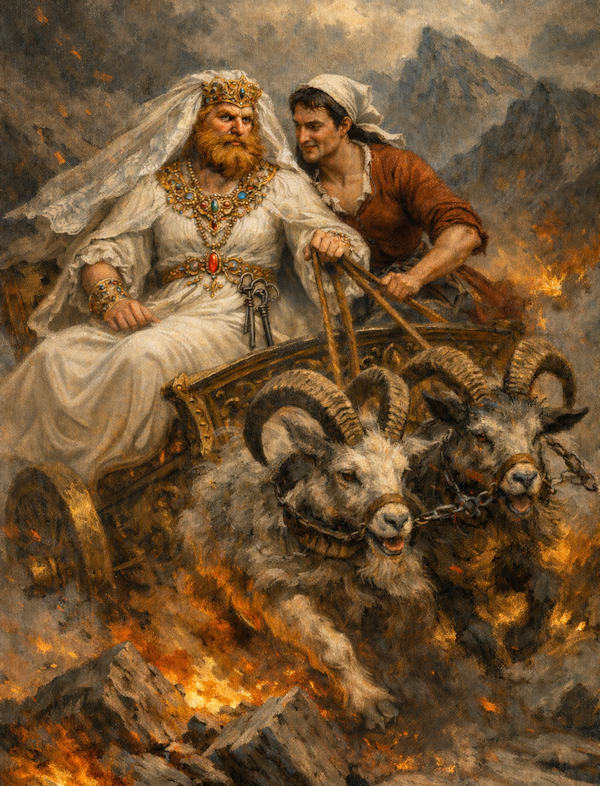
This serves to further clarify the purpose of the journey: the shattering of the rocks calls to mind the destruction of the frost and mountain giants, while the flames rising from the earth evoke the divine spirit destined to be reawakened from inert matter. Thor himself is, after all, the spiritual and divine son of Mother Earth—begotten by Odin upon Jörd.
22. Then Thrym, lord of the giants, spoke: “Rise up, you giants, and deck the benches! Then bring me Freyja, Njördr’s daughter from Noatun, to be my wife!”
23. “Gold-horned cows shall roam this courtyard, and oxen black as night, to the giant's delight! I have many treasures, much jewellery; only Freyja do I lack, methinks.”
The cows and oxen serve as a symbolic reminder of the nature of these physical giants: their spirit is dark, castrated, and barren. Yet they adorn their natural bodies with gilded horns intended to create the illusion of truth and serve their struggle. They gather treasures and ornaments from the natural world and adorn their courtyards with living creatures, but the imperishable, divine essence of nature eludes them. Or so they think…
24. Soon evening fell, and ale was brought before the giants. Thor, Sif’s husband, ate an ox all by himself, along with eight salmon and all the delicacies meant for the women, and drank three casks of mead.
Here we encounter once again the symbolism of beverages that we have often discussed: the benighted, embodied beings drink the water of life as an intoxicating, sleep-inducing beer. The sons of the gods drink it as sweet mead—the divine elixir of wholeness. And we know that Odin, the All-Father, drinks the water of life only as the noble wine of “illusory and creative power”. The foods Thor consumes with such ease are surely symbolic as well: the ox calls to mind the stubborn spirit of embodied beings. We already encountered the salmon in the previous chapter on Loki as a classic symbol of the return to the source and of renewal; for at the end of its life in the sea, it swims tirelessly up its native river to the very source where it was born, there to mate and reproduce. It then dies, sacrificing its body as nourishment for further growth. Similarly, the number eight evokes the ring of cyclical renewal, for the number nine—the number of renewal, which in turn becomes one again—follows the eight. Thus, everything a god consumes is renewed—even the sweet treats intended for the female beings of nature.
25. Then spoke Thrym, lord of the giants: “Where have brides been seen to gorge so greedily? Never have I seen a bride eat more, nor a maiden drink more mead.”
26. But the clever handmaiden sat beside him and answered the giant’s words: “For eight nights Freyja fasted, so great was her longing for the home of the giants.”
27. Then the giant peered beneath the bridal veil, lusting for a kiss. But he sprang back the length of the hall: “How terribly Freyja’s eyes glow! It seems to me that fire blazes from her eyes.”
28. But the clever handmaiden sat beside him and answered the giant’s words: “For eight nights Freyja did not sleep, so great was her longing for the home of the giants.”
Yet, as corporeal beings, we rarely perceive this constantly renewing essence of nature—least of all within ourselves. For we habitually seek gain in nature and fear loss—above all, the loss of our own bodies. What kind of being, then, does the giant expect from the divine Freyja? Here, too, Loki does not lie; instead, he speaks of the “eight nights” during which divine nature sacrificed herself for the sake of embodiment. Yet now, she yearns for the “ninth night” of renewal. And behind this, of course, stands the divine spirit that sustains all creation and keeps it alive.
29. In came the giants' poor sister, who dared to demand a bridal gift: “Give me the red [golden] rings from your hands, if you wish to win my love, my dear, and all my favour.”
Who is the poor sister of the wealthy giants? From a spiritual perspective, we might think of the impoverished souls of the physically wealthy, those who, despite all outward riches, suffer from an inner poverty because their wealth is transient and they lack that which is eternal.
What does this soul of the giants demand? It demands that nature yield, and only then is she willing to love and respect nature. And what does she understand by the red or golden rings? The truth of individual rings, capable of being independent and enduring? Or the bond of love that transforms into desire?
Just as the inner soul yearns for this, so too does the outward giant crave possession of nature. Thus, he has the hammer retrieved from the depths of the earth, a hammer intended solely to bless his property, not to destroy anything further. And in return, Freyja, as the embodiment of divine nature, is to pledge herself to him in marriage:
30. Then spoke Thrym, lord of the giants: “Bring in the hammer to hallow the bride! Lay Mjölnir in the maiden’s lap, and consecrate us together by the hand of Wár [goddess of marriage]!”
Why does he place the hammer in the maiden’s lap? Perhaps it was an ancient rite for marital fertility, a symbol of renewal, whose true meaning the giant no longer grasped. At the very least, in “Gylfaginning” (Section 35), Wár is identified as the ninth goddess:
The ninth is Wár. She listens to the oaths and agreements that men and women make with one another. For this reason, such pledges are called “várar” (vows of troth). She punishes those who break them.
Indeed, this connection and union of man and woman—as spirit and nature—is surely vital for a living creation. Yet how can there be living fertility without transience? How can there be becoming without passing away? The giant was likely unaware of who stands behind the veil of nature, or that Mjölnir also signifies “Crusher”.
31. Hlorridi’s [Thor’s] heart laughed within his breast when the hard-hearted (hard-bolded) one beheld the hammer. First, he struck down Thrym, lord of the giants, and crushed the giant’s entire family [gathered there].
32. Then he struck the giant's old sister, who had demanded a bridal gift. She received blows instead of the shillings (of gold) and hammer-strokes instead of the many rings.
Thus, Odin's son regained the hammer.
(Thrymskvida, based on Arnulf Krause, Karl Simrock, and Edward Pettit)
In this way, Hlorridi now rides upon the “clamour” of the giant intellect, and the ninth night becomes a night of renewal and transformation. Thus, the divine spirit reveals itself behind the outward forms of nature:
For all must crumble into nothingness,
If it would persist in being.
(“One and All”, Goethe)
It is important, of course, that he not only shatters the outward forms of the giants but also strikes the old soul of the giants from within. In doing so, she, too, receives its “bridal gift.”
Yes, this sounds hard-hearted and merciless for a god. And yet his heart laughs—his inner, steadfast, and imperishable essence, which refuses to be defined or dominated by outward forms. Only in this way does the power of the hammer return to divine hands, where it surely serves all of creation best.
God takes nothing
Without giving something better.
In summary, this story allows us to envision how the mountain and frost giant was able to grow to colossal proportions within the natural world and amass great possessions. Now, only the eternal and the enduring were lacking. To achieve this, he sought to bind the hammer of shaping and transformation into solid, structured matter, thereby preserving his embodiment for all time. Thus, he did not wish to move within the cycle of worlds or the ring of renewal, but rather to remain eternally in Jötunheim. Yet, he also desired to live, grow, and be fruitful, just as he observed in his own realm of nature:
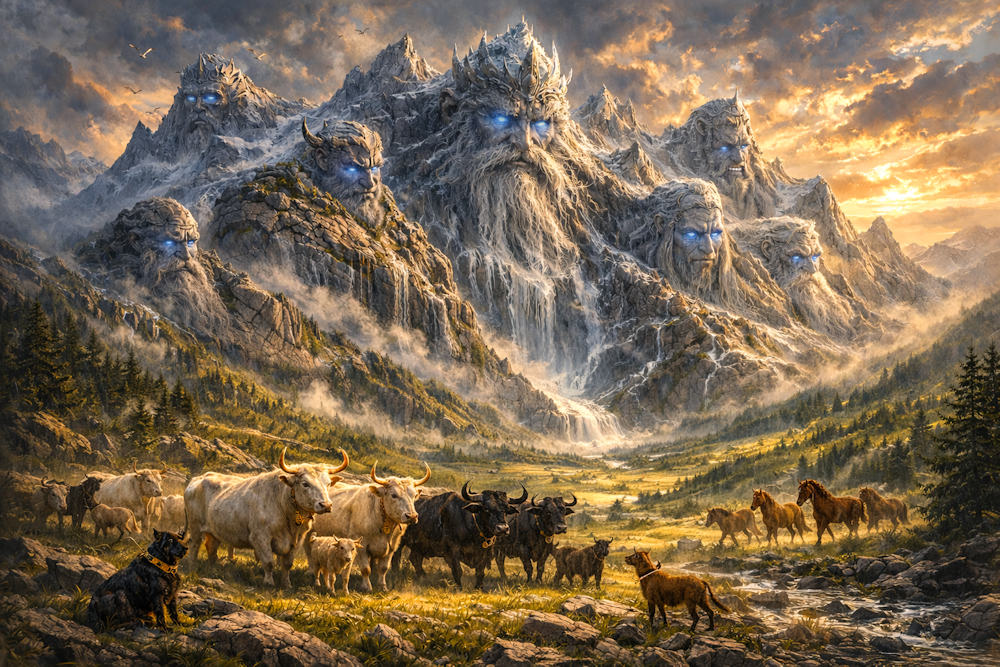
This means he must unite with nature; he cannot suppress this hammer forever. Consequently, he attempts to bind himself to divine nature—embodied by the goddess Freyja—through a vow of marriage, ensuring she swears eternal fidelity and never abandons him. Upon this pledge, he intends to place the hammer in her lap so that she, as nature, remains fertile and sustains life, yet never uses the weapon to shatter him, her lord. However, his plan fails, for Freyja does not yield to him in exchange for this eternal marital vow. Moreover, the apparent separation of Thor from his hammer was merely an illusion of space and time, much like the divine carelessness that had allowed him to steal the weapon in the first place. Thus, what he had perceived as divine nature revealed itself to be divine spirit the moment, he released the hammer.
For between spirit and nature there is already a vow of marriage, to keep each other alive as long as creation exists. And this includes, of course, physical formation and transformation, becoming and passing away, birth and death. - A truly wonderful comedy of life and an instructive story for reflecting deeply on the divine nature of spirit and nature, as well as for meditating on clinging to one's own body.
And as long as you lack this:
Die and Become!
You are but a dreary guest
On the dark earth.
(Goethe “Blessed Longing”)
The Story of Thor and Hrungnir’s Fight
Another story illustrating Thor's profound nature can be found in the Book of Skalds, §17:
Thor had travelled eastward (in his chariot) to slay monsters (giants). Odin, however, rode Sleipnir to the land of the giants and came upon the giant named Hrungnir (“Noise-maker”). Hrungnir wondered who this man with the golden helmet was who rode through air and water. He told him that he had a wonderful horse. Odin then said he would wager his head that there was no steed in the realm of the giants that could rival it. Hrungnir replied that while it was indeed a good horse, he claimed to have a much faster one named Gullfaxi (“Golden Mane”). Enraged, he leaped onto his horse and galloped after Odin to repay his boast. But Odin rode so fast that he was already on a wide hilltop. And Hrungnir was so incredibly angry that he didn't realize he had already gotten behind the Aesir wall.
Here Thor is once again traveling eastward to smash the frost and mountain giants. Odin, too, rides in a similar direction on his eight-legged horse, in which we can symbolically see all of physical creation. And with this, he is naturally also traveling through Jötunheim. Here, the giant Hrungnir recognizes him, whose name again evokes “noise” and thus has a similar meaning to Thrym. His horse “Golden Mane” is presumably another symbol of his physicality, which he adorns with golden hair. This hair is meant to represent thoughts that correspond to the truth. And with this body, the giant believes himself to be superior to all of creation. This is remarkable, for in this way he competes with all of creation, measures himself against the creator god, and doesn't even realize how he crosses the barrier of matter and enters the spiritual and even divine realm of Asgard and Valhalla. Was this perhaps Odin's intention, his challenge, and the meaning of all creation? Did he pledge his eye for this and now even offer his head in return?
This is a magnificent vision of how Odin and Thor complement each other in their struggle for a living creation, and how the ultimate goal lies primarily in a spiritual solution. Will the giant Hrungnir now become an Einherjar in Valhalla?
When he arrived at the hall's entrance, the Aesir invited him to drink. He entered the hall and asked for a drink. The bowls from which Thor usually drank were brought out, and Hrungnir emptied each one. But as he grew drunk, he was not sparing with his boastful words. He claimed he would lift up Valhalla and carry it to Jötunheim, but he would sink Asgard and slay all the gods. Only Freyja and Sif would he take with him. Freyja alone dared to pour him a drink, and he intended to drink all the Aesir's beer.
Well, he wasn't quite ready for that. He did receive the divine drink from the same vessels from which Thor drank, but for him it became not the mead of the Einherjar, but rather intoxicating beer. Thus, he remains in his delusion as a lone warrior, arrogantly believing he must rise above all others to be victorious. Accordingly, he, like Thrym, also desires the goddess Freyja and even wants to possess Sif, Thor's wife. Behind this likely lies the desire to rule all the worlds as a giant. This is the “giant noise” of the arrogant thoughts of a selfish lone warrior. And yet, it is Freyja, the divine nature of names and forms, who pours him this beer. Who else? Even if the divine spirit stands behind her:
When the Aesir grew tired of his boasting, they summoned Thor. He immediately entered the hall, brandishing his hammer in the air and was furiously angry. He demanded who had decided that smart-aleck giants should be allowed to drink there, who granted Hrungnir peace in Valhalla, and why Freyja was serving him as if at an Aesir feast. Hrungnir answered, glaring at Thor with unkind eyes. He said that Odin had invited him to drink and granted him peace. Thor replied that Hrungnir would regret this invitation before he even left. Hrungnir retorted that it would be of little use for the Aesir to slay him unarmed. It would be a greater test of courage if he dared to fight him at the border in Grjotunagardar (the “Garden of Stones and Rocks”). He added: “It was a great mistake to leave my shield and whetstone at home. If I had my weapons here, we could have fought a duel immediately. Otherwise, I accuse you of envy and cowardice if you intend to kill me unarmed.”
So now the giant, because of his haughty and arrogant nature, must meet Thor, who cannot comprehend how such a being could have gained entry to Valhalla, the hall of the gods. And why will the giant regret this invitation? Precisely because he clings to his selfish arrogance. He refuses to let this rigid spirit be shattered here in Valhalla. Therefore, he longs to return to his giant's incarnate home, the “Garden of Stones and Rocks”, for there he believes he will find the weapons to protect and defend himself against Thor's hammer.
Thor had no intention of avoiding the duel to which he had been challenged; for never before had anyone—and certainly no giant—offered him such a contest. Hrungnir then made his way back, hastening to reach the land of the giants. News of his journey and the agreed-upon duel with Thor spread quickly among the giants. Much seemed to be at stake, depending on who emerged victorious; they feared the worst from Thor should Hrungnir lose, as he was the strongest among them. So, at Grjotunagardar, the giants fashioned a man out of clay; he stood nine leagues tall and was three leagues wide across the chest. However, they could not find a heart large enough to suit him until they took one from a mare, but it failed to hold firm when Thor arrived. Hrungnir, as is well known, possessed a heart of hard stone, triangular in shape, much like the carved symbols known ever since as “Hrungnir’s Heart”. His head was made of stone, as was his broad, thick shield. He held this shield before him as he stood at Grjotunagardar (the “Garden of Stones and Rocks”) awaiting Thor. He carried a whetstone slung over his shoulder as a weapon and presented a terrifying appearance. Beside him stood the clay giant Mökkurkalfi (“Mist-Calf”), who was utterly terrified; it is even said that he wet himself upon seeing Thor.
Once again, the symbols come thick and fast: Hrungnir returns to his realm of embodiment, and to defend themselves, the giants fashion a huge human-like figure out of clay, much as we possess earthly bodies. It is even endowed with a living horse’s heart. Its height of nine leagues might signify its capacity for living renewal, mirroring the nine worlds it inhabits. Its width of three leagues evokes the three wells—or the three eras of past, present, and future—from which it draws its life.
Yet how can the mountain and frost giants create such a being? Indeed, this is simply the nature of their embodiment. In Jötunheim flows the Well of Mimir, where Mimir draws forth creation from Odin’s eye. The one thing they cannot create is a living heart to serve as the symbol of the soul; that, they must take from another living creature. This is represented by the symbol of the mist-calf, born of the mother from the waters of life, a calf that transforms into the physically obscuring mist found in nature, which in turn calls to mind Niflheim.
All these are symbols of an earthly physicality that is either more or less vital or else petrified. Hrungnir’s heart and head of stone point to his physical petrification as a “materialist”, which is why he could not become a living Einherjar in Valhalla. Shattering them seems to be the only remedy.
The whetstone or grindstone he carries as a weapon is difficult to interpret. In the chapter on the nature of Odin, we already discussed the story of Suttung and the mead of poetry. There, Odin himself drew a whetstone from his belt to sharpen the scythes of nine thralls, who subsequently killed one another with their sharp scythes while fighting over the stone. This reminded us, at the time, of worldly intellectual forces—forces that must naturally fall silent so that the divine mead of holistic inspiration can be obtained.
This whetstone still exists in the world today. In this story, it reminds us of the physical intellect, the faculty we use to sharpen our senses and thoughts so that they may distinguish between all things. This is certainly useful and meaningful for physical life. Hence, here is also the location of Mimir’s well; since Mimir, too, is a figure associated with the intellect. Thus, the entire story evidently revolves around the intellect within physical creation. Yet this intellect must not become excessively rigid, as seems to have happened to Hrungnir, causing both his head and heart to turn to stone.
The triangular mark on his stone heart calls to mind the downward-pointing triangle symbol (▽) representing the alchemical element of Earth, like a frozen heart (♡) resting upon a shield, unable to penetrate the inner depths. In contrast, the upward-pointing triangle (△) of the Fire element exerts its influence. And this fire emerges from the earth as divine spirit, for Thor is also a son of the Earth (Jörd).
He came with Thjalfi to the combat. Thjalfi hurried to where Hrungnir stood and said to him: “There you stand, unwary giant, holding your shield before you, but Thor has spotted you. He is coming through the earth below, and he will reach you from beneath.” Hrungnir then slid his shield under his feet and stood upon it, while grasping the whetstone with both hands.
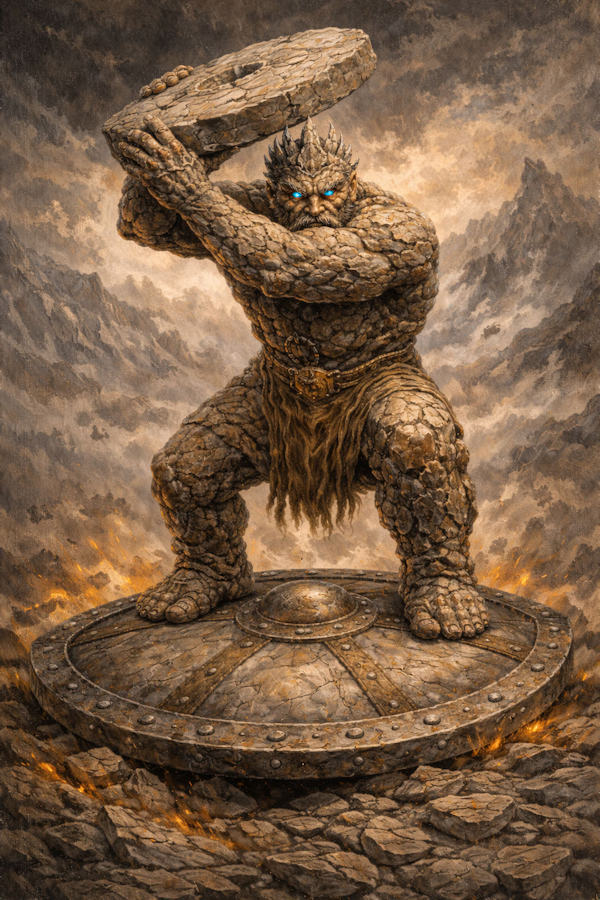
Hrungnir as “materialist”
Next, he saw flashes of lightning and heard loud claps of thunder. Then he beheld Thor in the fury of the Aesir. Thor charged forward, swung his hammer, and hurled it a great distance at Hrungnir. The giant raised his whetstone with both hands and flung it back; it struck the hammer in mid-air and shattered in two. One fragment fell to the earth, giving rise to all the mountains of whetstone. The other lodged in Thor’s head, causing him to crash to the ground. Yet the hammer Mjölnir struck Hrungnir square in the skull, smashing it into countless small pieces. The giant fell forward onto Thor, pinning the god’s neck beneath his leg. At the same time, Thjalfi attacked Mökkurkalfi, who fell in a most inglorious manner.
Here, Thjalfi—the farmer’s son who had broken a bone from one of Thor’s goats and eaten the marrow—comes back into the picture. In him, too, we can see the intellect, specifically the human intellect, which has nonetheless committed itself to divine service, becoming, along with his sister Röskva, a servant of Thor. Fittingly, he is swift of movement; he rushes forward to reveal a higher wisdom to the giant: namely, that his destruction does not come from the heavens but from the earth—from the very physicality he seeks to cling to and defend. Yet Hrungnir could not grasp this in a way that would rouse him from his delusion; he could only perceive it physically, and he reacted accordingly. Otherwise, he might well have realized that destruction arises from the body itself, for by nature, all that has come into being must eventually pass away.
Thus, the giant hurled his entire intellect against the hammer of transformation; they met in mid-air. The hammer split the intellect in two. One part remained in the realm of embodiment, giving rise to many more whetstones there, while the other returned to the divine. This serves as a wonderful symbol of how the physical intellect can penetrate even the mind of a god—a matter we shall examine more closely later. Moreover, Thor’s hammer did not miss its mark; instead, it shattered the giant’s stone head into countless small fragments capable of becoming living and fertile once more, much as fertile soil is composed of tiny pebbles and the remains of living creatures.
Just as Thor battles the mountain and frost giants, shattering the principle of physical rigidity, Thjalfi, representing the human intellect, now contends with the human body of clay fashioned by the giants. Yet, because he already serves the divine, this struggle is relatively simple and swift, leading to the inevitable fall of this “calf from the home of mist”. However, this victory was achieved, so the story goes, with little glory. This likely serves to remind us that such a notion of triumph, or even of killing, represents no true gain for the human intellect.
Then Thjalfi ran to Thor and tried to lift Hrungnir’s leg off him, but he did not succeed. All the Aesir came over when they learned that Thor had fallen. They tried to remove the leg but could not manage it. Then Magni (“Might”) stepped forward, the son of Thor and Jarnsaxa (“Iron-sword”). Though only three days old at the time, he threw Hrungnir’s leg off Thor and said: “Father suffered great distress because I arrived so late. I believe I would have sent this giant to Hel with my fist, had I encountered him.” Thor then rose from the ground, rejoiced in his son, and said: “You are destined for greatness. As a reward, I shall give you the horse Gullfaxi (‘Gold-mane’), which belonged to Hrungnir.”
Something truly remarkable occurs during this struggle: the giant falls upon Thor, and his leg comes to rest across Thor’s neck. Our intellect tells us that when Thor battles physicality, he must necessarily be bound to it—much like action and reaction—for otherwise, he could not exert influence upon it. Consequently, Thor himself becomes tethered to physicality. Who can free him from this? Clearly, the human intellect cannot do so on its own. Nor do the various Aesir, the gods -whom we distinguish intellectually and often perceive as physical beings—manage to achieve it. Yet Magni could; he was the divine “might” of the father, born of the giantess Jarnsaxa, the “Iron Sword” for the physical battle, which, united with the divine spirit, transforms into the renowned “Sword of Wisdom”. And why was he able to do this? He was merely three days old. This implies that he possessed no worldly intellect to draw a distinction between spirit and nature. Thus, he could easily liberate his father from physicality and, with a single blow, dissolve the petrified giant into nothingness. Christ speaks similarly: “Unless you turn and become like children, you will never enter the kingdom of heaven” (Matthew 18:3). In this sense, Magni may well be a being who grows ever younger, drawing closer to his source, which explains why he even survives Ragnarök.
This, in turn, is a wonderful vision, the son liberating the father, for children are born into creation precisely to resolve the problems of their forebears. Thor rejoiced that his son had freed him from the bonds of physicality and, in gratitude, gifted him the giant’s horse—which is, after all, itself a symbol of physicality. Similarly, Loki gifted the horse Sleipnir to the All-Father, Odin. And just as Odin was worthy of this gift—in which we can perceive the entirety of physical creation—so surely was Magni, who will ensure a living creation in the next cycle of existence. Or perhaps he is not yet meant to ride upon physical creation?
At this, Odin spoke, suggesting that Thor was acting wrongly by giving this noble horse to the son of a giantess rather than to his father (Odin as All-Father?).
This is, once again, a curious statement. Can a god act wrongly? Here, too, the issue is surely that of the material intellect, which had now penetrated Thor’s head. For only in this state could he hear such words from Odin, words that sever father from son, and ultimately even the All-Father from his material creation, the spirit from nature. Yet father and son are truly one, as Christ also declared. How, then, is Thor to rid his head of this worldly, material intellect?
Thor travelled home to Thrudvang (“Field of Strength”), with the stone still lodged in his head. He went to the seeress named Groa (“Growth”), the wife of the brave Aurvandill (“Aurora-Wanderer”). She chanted her magic spells over Thor to loosen the stone. But when he realized this and felt hopeful that she would succeed in removing it, he wanted to reward and delight her for the healing. He told her how he had waded through the Elivagar (“Ice Rivers”) in the north. He had carried Aurvandill on his back in a basket, bringing him from Jötunheim in the north. As proof, he mentioned that one of Aurvandill's toes had been sticking out and had frozen; Thor had snapped it off and tossed it up into the sky. It became the star known as Aurvandillsta (“Aurvandill's Toe”). He said it would not be long before Aurvandill returned home. Groa was so overjoyed at this news that she could no longer recall her magic spells; consequently, the whetstone did not come loose and remained in Thor's head.
Now that Thjalfi has made his appearance in this story, his sister Röskva is naturally also present, whom we can symbolically recognize here in Groa as the soul of nature. Her name signifies “growing, turning green, and flourishing”, and through this, she ensures the flow of cause and effect within nature. And to what end? To rediscover her husband, the wandering spirit as the awakening light of consciousness. Similarly, we have read of Freya seeking her husband Odr, the spirit of life, in hopes of finding him again. In much the same way, we too seek our spirit within nature, in the realm of names and forms, to rediscover ourselves as a holistic source and to come home. Thus, the soul of nature also acts as a healer, mending and making whole all that is severed and broken. Her “magic spells” within the play of natural illusions serve this purpose, spells we have already encountered through Odin as runes incantations for healing.
The great goal of healing can be seen, above all, in the wholeness of spirit and nature. Thus, Nature now serves Thor as well, helping to dissolve the mind within his head that had turned to stone. Thor is so delighted by this that he reveals to her how her long-sought husband will soon return home. After all, he himself sustains life within creation, tirelessly bringing the spirit of life back from the frosty realm of nature—where it threatens to freeze—into our human world: to Midgard, the midpoint between spirit and nature, between south and north. The fact that he carries this “wanderer in the rising light” in a basket calls to mind a small child—much like Magni. And that is wonderful. For just as nature grows old and flows, with her stream of forms, back into the sea of causes, so too should the spirit become young again and return to his source, where both are reunited and all separation is overcome.
The stream passes,
The source remains.
The frostbitten toe calls to mind that final, tiny remnant of frozen physicality, which Thor snapped off and set in the heavens as an eternal light. Thus, it became a visible sign of the invisible spirit. One might think here of the Morning Star, heralding the rising sun of the spirit, thereby living up to the name “Aurora Wanderer”. Indeed, the Morning Star is regarded as a powerful symbol of hope, renewal, and spiritual awakening. And when Thor revealed that the wait would not be much longer, the soul of nature saw her deepest desires fulfilled. Why, then, sing healing incantations?
That is a good thing! For what reason would there be to heal a god? That, too, can only be a construct of the mind. Perhaps it is actually highly beneficial for only half of the mind to reside within our body, tending to its physical well-being, while the other half remains in God, tending to spiritual well-being. Only in this way can our mind rise toward the divine and transform into the holistic reason of an Einherjar. In reality, these two parts of the mind are not separate at all, a fact confirmed by the final sentence of this story:
Therefore, it is not advisable to throw a whetstone across the floor, because then the stone will move inside Thor's head.
(Skáldskaparmál §17 after Arnulf Krause and Karl Simrock)
This could imply that we ought to bring our physical mind to a state of peaceful, vital stillness, rather than thrashing about in anger across the very ground on which we stand. For such agitation destabilizes our holistic reason, that faculty meant to become the “Philosopher’s Stone”, the immovable and imperishable foundation of all things. Groa’s silence serves as a reminder of this, much like Vidar, the god of silence and a silent warrior within the forest of conceptions, who, alongside Magni, survives Ragnarök.
The intellect is thus a major theme—one we have already pondered deeply in our interpretations of fairy tales and even more so within the Nibelung saga cycle. The intellect recognizes and connects causes and effects; it links and organizes our thoughts, feelings, and experiences, working in tandem with our memory to shape it. It serves as the conscious space for our conceptual world, our beliefs, our worldview, and our identity. In doing so, it operates on various levels; to distinguish between them, we have spoken of a creative, physical, egoistic, wise, or reasonablel intellect. Added to this are the various states in which it can be experienced: it may be petrified, frozen, or seemingly dead, or conversely, alive and fluid. It can be agitated and angry, or calm and peaceful. Given this diversity, the intellect stands as a fundamental principle of all creation and the most vital tool for living beings. Through the power of imagination, it can incline itself toward any conceivable realm—such as the nine worlds of the Edda. Accordingly, the intellect may lean toward separation or wholeness, serving either to bind or to liberate us. Yet, what it cannot do is grasp the Absolute and the Independent, for its mode of cognition is inherently relative and dependent. To attain this highest realization, it must fall silent and still—not with the rigid stillness of death, but with the fluid stillness of life, as free and still as light itself. Indeed, even this complex description is, of course, a construct of the discriminating intellect. Holistic reason would simply say: Everything is and remains pure consciousness.
The Song of Groa's Awakening (Gróugaldr)
We would like to dwell a little longer on this theme—how spirit and nature seek and find one another, and the role the human mind plays in this process. There are two songs associated with Groa. The first begins with Groa’s son awakening his dead mother and asking for help.
1. Son: Awaken, Groa (“Growth”)! Awaken, good woman! I rouse you before the gates of the dead. If you recall that you bade your son come to the burial mound.
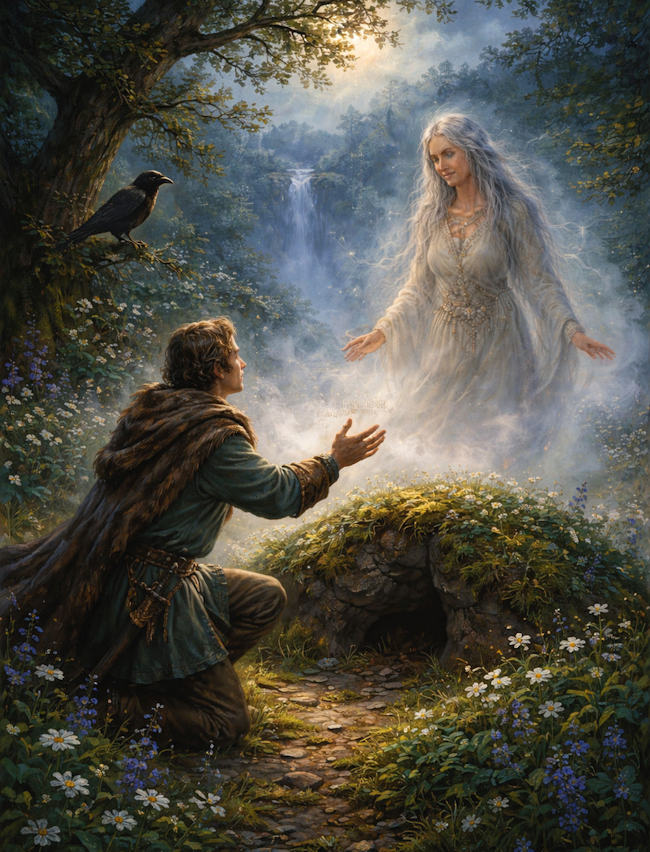
2. Groa: What troubles my only son now? Into what misfortune have you stumbled, that you call upon the mother who has gone into the earth and departed from the homes of men?
3. Son: A cruel game was thrust upon me by the woman—wise in malice—who embraced my father (his stepmother). She commands me to reach Menglöd (“Jewel-Joy”), a feat known to be impossible.
The designation “only son” already suggests that the aim here is to recognize oneself in wholeness, as a spiritual unity amidst the diversity of nature. Thus, in this son, we can also see all of humanity, born of Spirit and Nature in Midgard. Yet Mother Nature appears to have died, just as many people witness the passing of their own biological mothers. Similarly, our natural science perceives primarily a dead universe in which life is but a marginal phenomenon, so minuscule as to be almost inexpressible in figures. Consequently, the Spirit has created a world of the intellect—akin to the home of the giants—intended to be at least partially alive, and is embraced by Nature, acting, as it were, as a “stepmother”. She commands us to seek fulfilment in life, specifically, the beautiful and desirable Menglöd, the “Joy of Jewels”. She is often likened to the beautiful Freyja and her Brisingamen necklace, treasures so ardently coveted by the mountain and frost giants.
Yet, in time, the son of man ceases to trust this stepmother, realizing that she demands the unattainable. Fearing ruin under her guidance, he looks toward Niflhel, the realm of mist and death, and remembers the true Mother Nature, who seems to be dying there, just as his stepmother herself compels him to follow this path of death. And then the miracle occurs: she awakens at that gateway to death and speaks to him.
4. Groa: Long is the journey, long are the paths, long is man’s yearning. Should it come to pass that your wish is granted, then Skuld (the Norn of destiny governing karmic debt) allows good fortune to take its course.
5. Son: Sing me spells that are good (and healing)! Protect your son, Mother! I fear perishing on the journey. I deem myself too young a man.
Yes, our journey in this world is indeed long, and we have all traversed great distances. Human beings have existed for millions of years, and our universe for billions. For all that time, humanity has been seeking to fulfil its desires. What a long, enduring yearning. Yet my stepmother tells me I am a lone fighter, alive for only a few decades and destined to die in a few more, only to vanish forever into the darkness of death. Thus, I regard myself as a “young man” lacking in experience and ability, and I fear perishing along the way. Yet Mother Nature herself helps me when I ask, using healing incantations—for all of nature is magical, a magic of consciousness.
6. Groa: I sing the first one for you. The spell deemed highly useful (and healing). Rinda (“Protection”) sang it to Ran (“Deprivation/Want”): Cast aside, over your shoulder, whatever seems ill to you. Let yourself be guided by yourself! (Trust in yourself!)
As “Protection”, Rinda is the wife of Odin, the All-Father, and bore him Vali, the principle of life. As “Want”, Ran is the wife of Aegir, the sea of life, and bore him the nine waves as daughters, which also remind us of the nine worlds. Now, under the protection of the life principle, the task is to remedy this lack of fulfilment within the sea of life. To this end, we must leave all that is evil and unwholesome behind us and place our trust in ourselves—as living beings, trusting in life itself rather than in the stepmother.
7. I sing this second one for you when you must wander joylessly along life’s paths: May Urd’s bond—the circumstances of fate—protect you on every path when you are beset by hardship.
At the Well of Urd, the gods hold court and, based on underlying causes, determine the circumstances and conditions we encounter in life. In this sense, one can place one’s trust in them. This brings to mind the words of the Christian mystic Master Eckhart regarding the divine will:
“It is the same for the person who delights in God’s will: whatever God assigns to him—be it sickness, poverty, or anything else—he prefers it above all else, precisely because God wills it. That is why it is sweeter to him than anything else. You might well ask: ‘How, then, do I know if it is God’s will?’ I answer: If it were not God’s will, it would not exist for even a single moment; it must (indeed) always be His will…” (Sermon 46)
8. I sing this third one for you when mighty rivers threaten you: Horn and Rud (the worldly rivers Hrönn and Hrid?), which turn toward Hel (toward death), may they forever recede from you.
In the Song of Grimnir, starting at verse 26, two types of worldly rivers are described that flow from the spring Hvergelmir, the source of birth beneath Niflheim. Some flow around the abode of the gods, recalling the rivers of life of the Einherjar. Others plunge down toward Hel, recalling the paths of solitary warriors. The text likely refers here to Hrönn and Hrid, which plunge into dark or spiritual death.
9. I sing this fourth one for you when armed enemies beset you on the path to the gallows (or the path of death): May their mood turn toward you, and may your mind turn toward them in reconciliation.
This incantation reminds us of Christ’s commandment: “Love your enemies! Bless those who curse you. Do good to those who hate you. Pray for those who insult and persecute you, so that you may be children of your Father in heaven. For he makes his sun rise on the evil and the good, and sends rain on the just and the unjust.” (Matt. 5:44) Yes, nature itself can teach us such healing magic, if we observe it attentively.
10. I sing this fifth one for you when shackles are placed upon your limbs: I shall speak Leifnir’s fire over your thighs, and thus the bond will spring from your limbs.
“Leifnir’s fire” could be a kenning for gold. Leifnir is regarded as a sea-king, and in the Skáldskaparmál (§33), Snorri teaches that gold is called the “fire of the sea” or the “fire of the sea-kings”. And if we view gold as a symbol of truth, the spell makes sense: truth liberates, whereas illusion binds us, especially physically. Thus, truth burns away every illusion of bondage and grants freedom. Mother Nature can teach us this, too.
11. I sing this sixth one for you for when you venture onto the sea, a sea more tempestuous than any known to humankind: may wind and water unite in your boat and grant you a journey of constant peace.
Symbolically, the wind reminds us of the active spirit, which can become so turbulent upon the sea of life that it surpasses all our conceptions. From a symbolic perspective, the water represents consciousness, the eternal water of life. Thus, Mother Nature teaches us to reunite spirit and consciousness with her within the boat of our physical body, so that we may find true peace: the perfect peace of wholeness, the eternal peace of the Divine.
12. I sing this seventh one for you. Should frost beset you in the high mountains, may the chill of death not kill your flesh, and may your body and limbs remain ever unharmed.
Here, the focus is on the freezing of the waters of life within the realm of the frost giants and mountain giants. This, too, can be learned from Mother Nature: as long as the spirit is alive, the physical form will also remain alive and constantly renew itself. Thus, within divine wholeness, there can be no such thing as loss.
13. I sing this eighth one for you, for when night overtakes you out on the misty path: that a dead Christian woman can do you no harm.
Many scholars have puzzled over this verse. Some suspect religious hate propaganda regarding the dead Christian woman, while others suggest a scribal error. In practical terms, it concerns the misty path out in the outer realm of Niflheim, where nocturnal consciousness overtakes us and clouds our senses as in a dream. In this respect, the “dead woman” once again calls to mind a dead nature. Does a true death that can harm us even exist in nature? And all the more so from a Christian perspective? After all, Christ said: “I am the way and the truth and the life.” Mother Nature, too, can teach us this: that within nature, all forms merely transform, and her aim is not to harm us, but to offer healing aid.
14. I sing this ninth one for you, for when you exchange words with the giant renowned for his weaponry: may you be granted sufficient eloquence and wisdom for both mouth and heart!
This final incantation once again speaks directly to our intellect, addressing how to meet our physical embodiment with inner wisdom and outward eloquence. The subsequent song by Fjölswid deals with this very theme—how to find fulfilment in life when the outer self is once again in harmony with the inner, and spirit and nature are united.
Thus, there are ultimately nine spells from Mother Nature, reminding us of her cycle of renewal and regeneration: “Behold, I make all things new!”
15. Now, never go where ruin looms! Let no calamity stand in the way of your desires! I stood upon solid rock in the gateway (on the threshold) as I chanted the magic spells for you.
There are various paths our minds can take. The most healing path leads to divine wholeness. For there, no calamity obstructs our longing for ultimate fulfilment, since separation—which would require healing—no longer exists. There, too, Mother Nature stands upon solid rock, upon the “Philosopher’s Stone”, as it were: eternal consciousness. And there she stands to this day, whenever we awaken her on the threshold between life and death, consult her, and listen to her magic spells. Marvellous!
16. Take with you, son, your mother’s words and keep them in your heart: you shall always possess sufficient healing so long as you remember my words.
(Gróugaldr, based on Arnulf Krause, Karl Simrock, and Edward Pettit)
Ultimately, we might ask: How does Mother Nature know this? Why is she referred to as a seeress (Völva)? Well, nature consists of knowledge, and thus of consciousness. Indeed, even modern scientists like Anton Zeilinger state: “Information is the primordial substance of the universe—reality and information are one and the same.” And through the principle of causation in nature—which we also like to call the “soul of nature”—she can even look from the past into the future, earning the title of “seeress”. It is a wonderful vision: that nature is not merely the visible, but also the seeing—just as she is drawn from Odin’s eye and consists, at her core, of consciousness.
Yet, formed and manifested nature tends toward stagnation and cooling; modern science, too, knows that since the Big Bang, our universe has cooled to -270°C, placing it a mere 2.7 degrees above absolute zero—the point of total stasis. A gigantic frost giant, in effect! Counteracting this is the spirit, with its fire from Muspelheim. For it is the spirit that brings life. This spirit also works within us humans, enabling us to awaken nature and ensoul embodiment. Therein, perhaps, lies our task and responsibility in life. And so, as sons of nature, we embark upon the great quest for life’s true wealth—the “jewel-joy” of supreme fulfilment:
The Song of Fjölswid (Much-Smart)
Here, too, we recommend reading this wonderfully profound song in its entirety before we will dissect it with our own thoughts.
1. Outside his courtyard, he saw someone approaching the abode of the giant-folk.
Fjölswid: Turn back from damp (misty and watery) paths! You shall find no refuge here, seeker of shelter [or: no lodging, starving wretch]!
2. Son: What manner of giant is this who stands in the outer courts and prowls around the perilous fire?
Fjölswid: Whom do you seek, or for whom are you searching? Or what do you wish to know, friendless one?
3. Son: What manner of giant is this who stands in the outer court and denies hospitality to wayfarers?
Fjölswid: You have lived your life as a human without honest (and truthful) words. So go home from here!
4. Fjölswid (“Much-Smart”) is my name, and I possess a keen mind. Yet I am not generous with my food. You shall never enter this courtyard. Now go your way, (voracious) wolf!
5. Son: A man is drawn back to feast his eyes where he sees things he loves. The fences seem to me to gleam like golden halls. Here I would be content to make my home.
6. Fjölswid: Tell me: to whom were you born, lad, and which son of man are you?
Son: Windkald (“Wind-cold”) is my name; Warkald (“Spring-cold”) was my father’s name; his father was Fjölkald (“Much-cold”).
7. Tell me this, Fjölswid, what I shall ask and wish to know: Who rules here and holds sway over these possessions and golden halls?
8. Fjölswid: Menglöd (“Jewel-joy”) is her name; her mother bore her to the son of Svafrthorinn (“Sleep-brave”). She rules here and holds sway over these possessions and golden halls.
9. Son: Tell me this, Fjölswid, what I shall ask and wish to know: What is the name of this lattice? Never have men seen a more perilous danger among the gods.
10. Fjölswid: Thrymgjöll (“Din-echo”) is its name; the three sons of Solblindi (“Sun-blind”) fashioned it. It becomes a firm fetter for any wanderer who lifts it from the gate.
11. Son: Tell me this, Fjölswid, what I shall ask and wish to know: What is the rampart called? Never have men seen a more perilous danger among the gods.
12. Fjölswid: Gastropnir (“Guest-Caller”) is its name, and I fashioned it from the limbs of Leirbrimir (the “Clay Giant”). I propped it up so that it shall stand forever, as long as the world endures.
13. Son: Tell me this, Fjölswid, what I shall ask and wish to know: What are the dogs called? Never have men seen a more perilous danger among the gods.
14. Fjölswid: Gif (“Greed”) is the name of one, and Geri (“Voracious”) the other, if you wish to know. They must keep eleven watches until the Counsellors (gods) meet their doom.
15. Son: Tell me this, Fjölswid, what I shall ask and wish to know: Is there any man who can enter while the battle-bold ones (dogs) are asleep?
16. Fjölswid: They were strictly ordered to take turns sleeping since the watch was assigned to them. One sleeps by night, and the other by day. And no one can get inside when he comes.
17. Son: Tell me this, Fjölswid, what I shall ask and wish to know: Is there any food given to them that one can slip in with while they are eating?
18. Fjölswid: Two wing-roasts lie upon the limbs of Widofnir (the cock “Far-Caller”), if you wish to know. That is the food given to them, and one can slip in while they are eating.
19. Son: Tell me this, Fjölswid, what I shall ask and wish to know: What is the name of the tree that spreads its branches over all lands?
20. Fjölswid: It is called Mimameid (“Mimir’s Tree”, Yggdrasil). But no one knows from what roots it grows. Nor does anyone know how it falls, for neither fire nor iron fells it.
21. Son: Tell me this, Fjölswid, what I shall ask and wish to know: For what purpose does this famous tree grow, if neither fire nor iron can fell it?
22. Fjölswid: Its fruit is used to make a fire for women ailing from the cold; it expels whatever lies within. That is the virtue it holds for mankind.
23. Son: Tell me this, Fjölswid, what I shall ask and wish to know: What is the name of the rooster that sits in the high tree, gleaming all over with gold?
24. Fjölswid: Widofnir (“Far-Caller”) is his name, and he sits—gleaming in the wind—upon the branches of Mimameid (the “Mimir-tree” Yggdrasil). He afflicts Surt and Sinmara with terrible suffering. [Or: He is afflicted with terrible suffering by Surt and Sinmara (“Fire Giant” and “Great Nightmare”).]
25. Son: Tell me this, Fjölswid, what I shall ask and wish to know: Is there no weapon that could bring Widofnir down to Hel’s abode?
26. Fjölswid: Läwateinn (“Branch of Harm”) is its name; Loptu (Loki) cunningly broke it before the gate of the dead. It now lies in an iron chest with Sinmara, secured by nine Njard-locks.
27. Son: Tell me this, Fjölswid, what I shall to ask and wish to know: Will he return, the one who sets out to fetch the branch?
28. Fjölswid: He will return—the one who sets out to fetch the branch—if he brings back what few possess: the secret of the water-gleam.
29. Son: Tell me this, Fjölswid, what I shall to ask and wish to know: Is there truly something so precious that humans can possess it, and which delights the pale giantess (Sinmara)?
30. Fjölswid: You must carry the shining sickle (a tail feather from the rooster—the one set in Widofnir’s tail—to the chest. Give it to Sinmara, and she will agree to lend the weapon for the battle.
31. Son: Tell me this, Fjölswid, what I shall ask you and what I wish to know: What is the name of the hall surrounded by the unfailing wall of fire?
32. Fjölswid: It is called Lyr (“Fire-House”?), and long shall it move as if upon the tip of a spear. Of this house of riches, men throughout the ages shall know only by hearsay.
33. Son: Tell me this, Fjölswid, what I shall ask you and what I wish to know: Which of the sons of the Aesir created what I saw within the courtyard?
34. Fjölswid: Uni and Iri, Ori and Bari, Warr and Wegdrasill, Darri and Uri, Delling, Atward, Lidskjalf, and Loki.
35. Son: Tell me this, Fjölswid, what I shall ask you and what I wish to know: What is the name of the mountain where I see the bride (Menglöd)—the highly renowned one—abiding?
36. Fjölswid: It is called Lyfjaberg (“Healing-Mount”), and for a long time it has brought comfort to the sick and wounded. Any woman, even one suffering from a severe illness, regains her health if she climbs it.
37. Son: Tell me this, Fjölswid, what I shall ask and wish to know: What are the names of the maidens who sit (or sing) peacefully together before Menglöd’s knees?
38. Fjölswid: One is named Hlif, another Hlifthrasa, the third Thjodwarta; then there are Björt and Bleik, Blid and Frid, Eir and Aurboda.
39. Son: Tell me this, Fjölswid, what I shall ask and wish to know: Do they protect those who offer sacrifices to them, when the need arises?
40. Fjölswid: They bring aid when offerings are made to them at the holy altar-site. No danger, however great, befalls the sons of men; they rescue everyone from distress.
41. Son: Tell me this, Fjölswid, what I shall ask and wish to know: Is there any man who may sleep in Menglöd’s cherished embrace?
42. Fjölswid: There is no man among them who may sleep in Menglöd’s cherished embrace, save Svipdag alone: to him was the sun-bright bride promised as his wife.
43. Son: Open the doors, throw wide the gates: here you may see Svipdag! Go and find out if Menglöd will accept my love!
44. Fjölswid: Hear me, Menglöd: a man has arrived here—go and see the guest! The dogs rejoice, the house opens wide: I believe it is Svipdag.
45. Menglöd: Wise ravens shall tear out your eyes upon the high gallows if you lie, claiming that the youth has come from afar to my hall!
46. Where do you come from? Where have you been all this time? What does your family call you? I must know your lineage and name as a mark, if I was promised to you as wife.
47. Son: Svipdag (“Current Day”) is my name; Solbjart (“Sun-gleam”) was my father’s name. From there, I journeyed along wind-cold paths. No man defies the word of Urd (Fate), even if it seems fraught with hardship.
48. Menglöd: Welcome! My wish has been fulfilled: a kiss shall follow this greeting! The sight of a beloved brings joy to anyone who holds love for another.
49. Long did I sit upon Lyfjaberg (“Healing-Mount”) and wait for you, day after day; now that for which I waited has come to pass—you have arrived, young man, in my courtyard.
50. Svipdag: I longed for your love, and you for the memory of mine; now it is true that we shall spend our lives and our old age together.
(Fjǫlsvinnsmál, based on versions by Arnulf Krause, Karl Simrock, and Edward Pettit)
Wonderful! The song possesses remarkable depth, and we are well aware that we, too, can only set down a few thoughts on it—perhaps to inspire further reflection and meditation. Here goes!
Having heard the revelation of his true mother-nature, Groa’s son now sets out as the Son of Man on the great quest for life’s true wealth—the “jewel-joy” of supreme fulfilment. And Fjölswid, a giant of vast knowledge, sees him arriving in his realm.
1. Outside his courtyard, he saw someone approaching the abode of the giant-folk.
Fjölswid: Turn back from damp (misty and watery) paths! You shall find no refuge here, seeker of shelter [or: no lodging, starving wretch]!
2. Son: What manner of giant is this who stands in the outer courts and prowls around the perilous fire?
Fjölswid: Whom do you seek, or for whom are you searching? Or what do you wish to know, friendless one?
3. Son: What manner of giant is this who stands in the outer court and denies hospitality to wayfarers?
Fjölswid: You have lived your life as a human without honest (and truthful) words. So go home from here!
4. Fjölswid (“Much-Smart”) is my name, and I possess a keen mind. Yet I am not generous with my food. You shall never enter this courtyard. Now go your way, (voracious) wolf!
What is the “abode of the giant-folk”? Here, we might think of embodiment. The guardian, then, would be the physical intellect—defending the body with its vast knowledge and barring entry to any threatening spirit. Yet, right there—within the realm of physicality—lies precisely what the human being seeks while traversing the misty paths in the river of life: the soul of nature, the deep longing of our love to rediscover our fulfilment and wholeness. To emerge from separation and return to the unity of spirit and nature. To find ourselves in pure love and overcome the fear of losing anything. But one cannot reach this state by acting like a voracious wolf. Here, the only help comes from the reasonable mind grounded in honesty and truthfulness—above all, truthfulness with oneself:
5. Son: A man is drawn back to feast his eyes where he sees things he loves. The fences seem to me to gleam like golden halls. Here I would be content to make my home.
The golden halls remind us of realms of truth within consciousness that are to be found beyond the walls and fences of our physical shells. And it is surely good to seek contentment in this direction.
6. Fjölswid: Tell me: to whom were you born, lad, and which son of man are you?
Son: Windkald (“Wind-cold”) is my name; Warkald (“Spring-cold”) was my father’s name; his father was Fjölkald (“Much-cold”).
Here, the reasonable mind within the human body honestly recognizes and reveals itself as a cooled spirit—a frozen light of consciousness that has been steadily cooling since the Big Bang. Indeed, such honesty with oneself is surely necessary to reverse this path of embodying the cold wind—moving from the bitter cold of winter, through a cold spring, toward the warm light of summer. Thus, the reasonable mind begins to “question its way through” the dialogue with the bodily intellect:
7. Tell me this, Fjölswid, what I shall ask and wish to know: Who rules here and holds sway over these possessions and golden halls?
8. Fjölswid: Menglöd (“Jewel-joy”) is her name; her mother bore her to the son of Svafrthorinn (“Sleep-brave”). She rules here and holds sway over these possessions and golden halls.
If, in the figure of Menglöd, we consider the soul of nature—which holds sway over the physical realm through the principle of causation—then it is only natural that she should possess a divine lineage. Can Odin be discerned in the name Svafrthorinn? After all, Svafnir—meaning “Lord of Sleep”—is one of Odin’s epithets. Furthermore, Wilhelm Jordan notes that while the meaning of “svafr” is uncertain, it has been interpreted as “one who brandishes or swings”, while “svaf” signifies “spear”. Thus, the name could be interpreted as “the bold brandisher” or “the bold spear-swinger”—referring, presumably, to Odin as the wielder of the spear Gungnir.
9. Son: Tell me this, Fjölswid, what I shall ask and wish to know: What is the name of this lattice? Never have men seen a more perilous danger among the gods.
The final sentence suggests that the Son of Man is looking—here, within the confines of corporeality—for a divine realm where the gods dwell. In this context, the lattice of the bodily shell appears to him as a source of perilous danger, a form of separation that ought to be healed.
10. Fjölswid: Thrymgjöll (“Din-echo”) is its name; the three sons of Solblindi (“Sun-blind”) fashioned it. It becomes a firm fetter for any wanderer who lifts it from the gate.
What is this lattice that binds every wandering being whenever it struggles against it? Here, we can once again reflect on the nature of illusion that tightens its hold the more one fights it; for every clamour of the mind’s struggle echoes back, amplified. Thus, the lattice resembles a sticky spiderweb in which one becomes increasingly entangled with every movement. This applies above all to the “ego-lattice” of “mine and thine”— a barrier, with which a person seeks to cut themselves off and defend themselves at the gates of their physical walls.
Who created this echoing grid? Solblindi might stand in opposition to Helblindi, an epithet of Odin. And this counter-force to Odin brings to mind Loki, who also has three sons deeply involved with this lattice: the Midgard Serpent (the self-devourer), the Fenris Wolf (the all-devourer), and Nari (the limiter). In principle, then, the lattice consists of intertwined serpents of limitation sired by the “Trickster”. In this regard, Loki also played a role in erecting the fortress wall around Asgard, a structure that holds a significance similar to that of the lattice and the rampart discussed here:
11. Son: Tell me this, Fjölswid, what I shall ask and wish to know: What is the rampart called? Never have men seen a more perilous danger among the gods.
12. Fjölswid: Gastropnir (“Guest-Caller”) is its name, and I fashioned it from the limbs of Leirbrimir (the “Clay Giant”). I propped it up so that it shall stand forever, as long as the world endures.
The rampart (“garð”) evokes the wall of matter, which summons the spirit as a guest to bring it to life. And this matter can appear remarkably enduring; after all, we know that some atoms are nearly as old as the universe itself. Naturally, this matter is solidified and sustained by the physical mind itself—a fact that Fjölswid now admits. This is possible because “information is the primal substance of matter”. Yet, the mind usually resists—often stubbornly—the insight that it can dismantle and revitalize the very wall it has built and hardened, thereby becoming its own greatest obstacle.
It thus becomes increasingly clear that the issue here is the separation between the physical and divine realms, between nature and spirit, and that this boundary wall exists, in reality, primarily around the Son of Man. Accordingly, the giant Fjölswid—representing the physical mind and its vast knowledge—acts to prevent departure from the fortress of the body, thereby barring entry into the divine realm of wholeness.
This highlights the fact that it is the mind itself that cannot leave this bodily fortress, as it becomes entangled in the lattice of the gates, recalling the bodily gates of the senses. A second reason is that the mind itself has rendered the wall of matter permanent, a wall destined to endure as long as the world exists. This suggests a hopeless situation for our mind, a plight compounded by the watchdogs of the bodily fortress:
13. Son: Tell me this, Fjölswid, what I shall ask and wish to know: What are the dogs called? Never have men seen a more perilous danger among the gods.
14. Fjölswid: Gif (“Greed”) is the name of one, and Geri (“Voracious”) the other, if you wish to know. They must keep eleven watches until the Counsellors (gods) meet their doom.
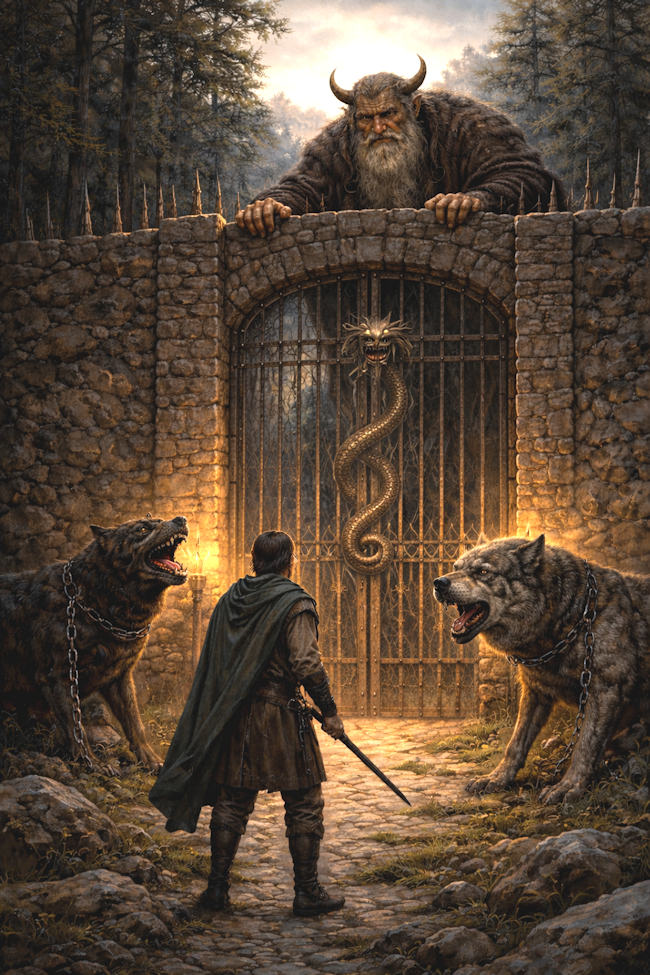
The two dogs call to mind Odin’s two wolves. Regarding them, it is said: Odin gives the food from his table to his two wolves, named Geri and Freki (“Greed” and “Voracity”); he himself requires no sustenance. Thus, these wolves symbolically represent worldly transience—a force Odin has tamed just enough to prevent them from instantly devouring everything that comes into being in creation, as the Fenris Wolf desires to do. For without this restraint, learning would be impossible.
Through our intellect, we have wondrously “domesticated” and transformed these wolves to the point where they serve us as guard dogs and hunting dogs within the fortress of the body. This is possible because these wolves and dogs are, at their core, creations of the intellect born of Mimir’s Well. The guard dog Garm, who stands watch over the realm of the dead, can be understood in a similar light.
Thus, the two dogs, with their natural greed and voracity, stand guard over the physical realm within the cycle of creation. In this context, the “eleven watches” evoke the twelve-hour cycle of the clock or the twelve-month cycle of the year—where the number twelve signifies the end and the number one a new beginning, much like the number nine in the Draupnir ring of renewal. In other words, these domesticated dogs keep watch until, at Ragnarök, they reveal their wild nature once more and devour all creatures in their voracious greed.
From a modern scientific perspective, one might, in principle, associate this greed with the fundamental forces—nuclear forces, electromagnetism, and gravity—that hold all matter together.
15. Son: Tell me this, Fjölswid, what I shall ask and wish to know: Is there any man who can enter while the battle-bold ones (dogs) are asleep?
16. Fjölswid: They were strictly ordered to take turns sleeping since the watch was assigned to them. One sleeps by night, and the other by day. And no one can get inside when he comes.
We cannot bypass this ravenous greed, whether we are aware of it or not, indeed, not even in our dreams at night—if we are to re-enter wholeness and find true fulfilment. Yet the reasonable mind does not give up just yet. There simply must be a solution:
17. Son: Tell me this, Fjölswid, what I shall ask and wish to know: Is there any food given to them that one can slip in with while they are eating?
18. Fjölswid: Two wing-roasts lie upon the limbs of Widofnir (the cock “Far-Caller”), if you wish to know. That is the food given to them, and one can slip in while they are eating.
With what might one sate this ravenous greed—if only for a moment—so as to pass from a state of bodily separateness back into wholeness and divinity? The crowing rooster serves as a symbolic reminder of the eagle perched atop the World Tree, the very place where the forces of outward manifestation are at work. We have already encountered this eagle as a symbol of a yearning desire, a desire that nonetheless holds a purpose. For as the king of birds, this desire is meant to “call” us into the divine realm, there to find fulfilment. Such was the case for the giant Suttung when Odin transformed into an eagle, soared to Asgard with the mead of poetry, and was pursued by Suttung, who had also taken the form of an eagle.
And this pair of wings is then to be given to the two dogs as a roast. One can thus picture greed devouring greed, finding a moment’s respite. At this stage, the human mind does not yet perceive the dangerous treachery lurking beneath; instead, it simply wonders how to get its hands on that roast.
19. Son: Tell me this, Fjölswid, what I shall ask and wish to know: What is the name of the tree that spreads its branches over all lands?
20. Fjölswid: It is called Mimameid (“Mimir’s Tree”, Yggdrasil). But no one knows from what roots it grows. Nor does anyone know how it falls, for neither fire nor iron fells it.
The first and most comprehensive solution would be to fell the entire World Tree. Yet the intellect cannot reach the roots; it cannot fell the trunk with brute force, nor consume its substance with its fire. But perhaps it can destroy its meaning? Thus, it asks itself: What is the tree for?
21. Son: Tell me this, Fjölswid, what I shall ask and wish to know: For what purpose does this famous tree grow, if neither fire nor iron can fell it?
22. Fjölswid: Its fruit is used to make a fire for women ailing from the cold; it expels whatever lies within. That is the virtue it holds for mankind.
The fruits of the World Tree of Life are, in all likelihood, the living beings. And the women afflicted by frost-sickness call to mind the wives and daughters of the frost giants, representing a nature grown cold and prone to freezing into rigidity, which the fire of life is meant to heal. Viewed in this light, one can also understand the symbolism found in the Edda, where the gods and their sons marry the daughters of the frost and mountain giants to bring about healing. And why? To drive out the accumulated inner causes, manifest them outwardly, and burn away karma. This is the significance the World Tree of Life holds for us humans. That is why it must not be felled, for doing so would cause us to lose all meaning in life. In this sense, it is also a “Mimir tree”—a tree of creation representing the intellect, destined to turn toward reason and serve the Divine.
23. Son: Tell me this, Fjölswid, what I shall ask and wish to know: What is the name of the rooster that sits in the high tree, gleaming all over with gold?
24. Fjölswid: Widofnir (“Far-Caller”) is his name, and he sits—gleaming in the wind—upon the branches of Mimameid (the “Mimir-tree” Yggdrasil). He afflicts Surt and Sinmara with terrible suffering. [Or: He is afflicted with terrible suffering by Surt and Sinmara (“Fire Giant” and “Great Nightmare”).]
Having grasped the meaning of the World Tree, the mind now seems to doubt whether the rooster perched high in the tree is truly the right one—especially now that it gleams in the wind, adorned with the gold of truth. This wind evokes the wind of the Spirit, which draws us upward to the tree’s crown—specifically toward the spiritual realm of Light-Alfheim, home to Gimle, the radiant gateway to heaven. Each morning, the rooster sounds his wake-up call, summoning us to rouse ourselves from the dream of our nocturnal consciousness.
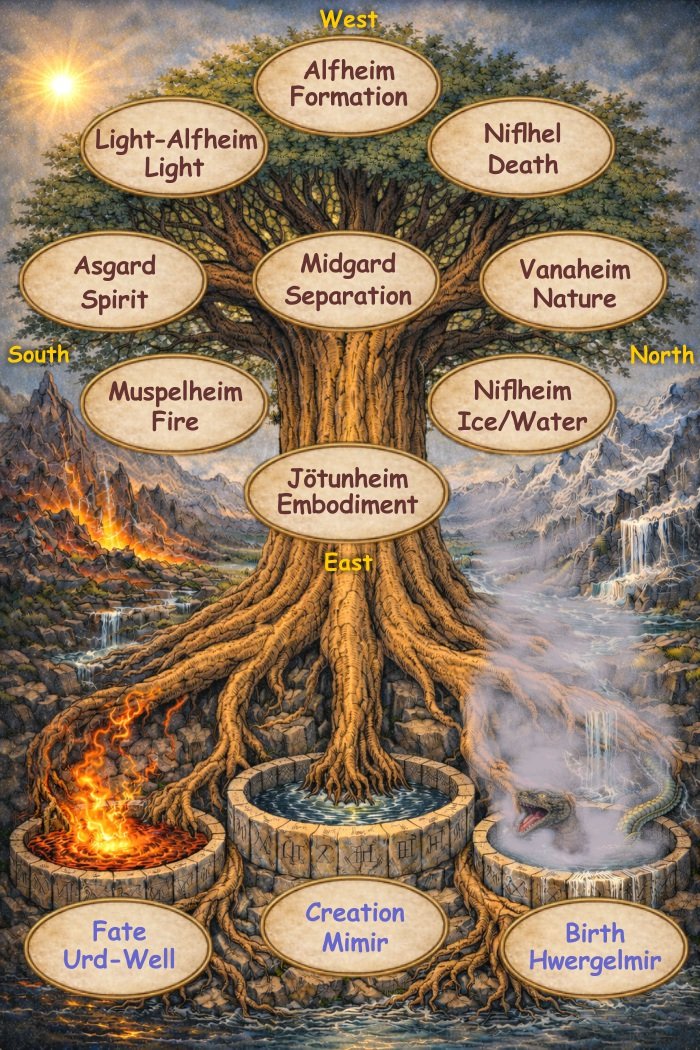
For the final line of the verse, we prefer the reading in square brackets. Surtr is presumably the fire giant described in Gylfaginning §4: Surtr is the name given to the one who stands guard at the border of the land (facing Muspelheim). He wields a flaming sword, and at the end of the world, he will march forth, wage war, and defeat all the gods. He will consume the entire world with fire. Sinmara might signify “great nightmare”—in the sense of the mind's worldly illusion—whereby the desire of the rooster (or eagle) can turn into a terrible suffering that threatens even the entire tree. It is likely because of this suffering that the Son of Man still sees a reason to kill this far-calling rooster and feed it to the greedy dogs, in order to find the great goal of his love and fulfilment.
25. Son: Tell me this, Fjölswid, what I shall ask and wish to know: Is there no weapon that could bring Widofnir down to Hel’s abode?
26. Fjölswid: Läwateinn (“Branch of Harm”) is its name; Loptu (Loki) cunningly broke it before the gate of the dead. It now lies in an iron chest with Sinmara, secured by nine Njard-locks.
This branch of harm calls to mind the mistletoe branch that Loki broke off west of Valhalla, where the sun sets. He gave it to the blind Hödur—the god of darkness—to send Baldr, the god of light, into the darkness of Hel. Ever since, this cunning weapon has haunted the human mind, leading us to believe that divine light can be obscured or even extinguished. It is truly a “great nightmare”—one that, fortunately, remains secured and locked away in an iron chest with nine locks. The name Njard here evokes Njördur, the god of nature. In the microcosm, the shaping dwarves forged the golden ring Draupnir; similar to nine locks—which in nature cannot all be opened simultaneously—it thus preserves the divine light of life within the world.
Does the human mind truly wish to kill the golden light in order to conquer ravenous greed and find fulfilment? Or does it merely destroy itself in the process?
27. Son: Tell me this, Fjölswid, what I shall to ask and wish to know: Will he return, the one who sets out to fetch the branch?
28. Fjölswid: He will return—the one who sets out to fetch the branch—if he brings back what few possess: the secret of the water-gleam.
Who can return from this “great nightmare” of Sinmara? Indeed, doing so requires the secret of the light of consciousness within the water of life. For this light does not perish and knows no death. Yet, in practice, few are aware of this.
29. Son: Tell me this, Fjölswid, what I shall to ask and wish to know: Is there truly something so precious that humans can possess it, and which delights the pale giantess (Sinmara)?
30. Fjölswid: You must carry the shining sickle (a tail feather from the rooster—the one set in Widofnir’s tail—to the chest. Give it to Sinmara, and she will agree to lend the weapon for the battle.
This verse is generally interpreted as a case of the “cat chasing its own tail”—an insoluble vicious circle, so to speak, of the all-knowing intellect. For anyone capable of tearing the tail feather from the rooster must have already overpowered it. Thus, the Son of Man ceases to pursue this line of questioning in his quest to conquer desire. And that is a good thing—thank God! For now, the reasonable mind reasserts itself; it increasingly recognizes the nature of the corporeal intellect, seeing that the latter merely spins in circles, unable to find a true solution to worldly problems.
Symbolically, we can also discern Heimdall’s rainbow bridge—which connects the realm of the gods with the realm of humans—within the gleaming, iridescent curve of the rooster’s tail feather. To surrender this bridge of consciousness to Sinmara’s “great nightmare” would surely be the height of folly, even though the light of consciousness can, of course, unlock any chest. For then, the bridge would no longer lead to the realm of the gods, and the human world would be completely cut off by the Midgard Serpent—a scenario that is, in essence, an impossibility.
Thus, through this interpretation of the rooster's feather, we once again find a symbolic connection between the rooster and the eagle—allowing the latter to serve as a bridge to Asgard in the stories of Suttung and Thjasi. Moreover, the feather itself is a beautiful symbol of consciousness: it fans out into visible colours and forms, yet is utterly weightless, enabling flight through the realm of air and wind—much like the feathered cloak Freya lends, which allows one to fly across the worlds.
In brief summary: The Son of Man has thus far recognized three fundamental principles of corporeality: the lattice of entanglement, in which one becomes ever more ensnared the more one attempts to undo it; the wall of matter—created by the corporeal mind itself—which persists until the very end of creation and the mind, dissolving only when the fire giant Surtr consumes all things; and, thirdly, the dogs of ravenous greed—a force that sustains itself and cannot be slain by mere desire. These three principles recall the concepts of hatred, ignorance, and desire—which we previously identified symbolically as the serpent, the squirrel, and the eagle in the description of Yggdrasil, and which also form the axis of the Wheel of Life in Buddhism, around which all worlds revolve. In that tradition, they are symbolized by the serpent, the pig, and the rooster. And here, we find the rooster once again. Wonderful!
Interestingly, desire appears to be the greatest challenge among these—the one around which the mind circles most extensively. For it is precisely in desire that one can also discern a higher purpose: the rediscovery of holistic love and fulfilment. Consequently, hatred and ignorance must also exist, as desire logically cannot exist without them. Thus, these three fundamental principles drive the wheel of the worlds, enabling beings to learn.
In this way, the reasonable human mind learns that there is no sense in fighting hatred with hatred, ignorance with ignorance, or desire with desire. Likewise, it makes no sense to preserve life through killing, tranquillity through noise, or peace through war. But what then? How does one attain fulfilment? To this end, the Son of Man turns away from the struggle within the external realm of nature and looks once more toward the divine world, beyond the confines of the physical:
31. Son: Tell me this, Fjölswid, what I shall ask you and what I wish to know: What is the name of the hall surrounded by the unfailing wall of fire?
32. Fjölswid: It is called Lyr (“Fire-House”?), and long shall it move as if upon the tip of a spear. Of this house of riches, men throughout the ages shall know only by hearsay.
What kind of hall is this, surrounded by an unmistakable wall of fire? Here, too, we can only have an inkling of it and think of the Hall of the Consciousness of Truth. To enter it, naturally, all that is transient and illusory must be burned away. This includes space and time, so that it exists in a state of timelessness and spacelessness within unity—and the spearhead serves as a fitting symbol for this. Here, we might also think of Odin’s spear, Gungnir—the “Swaying” or “Waving” one—which sets everything in motion. From a spiritual perspective, we often speak of pure, formless consciousness—which can assume any form and thus bestow every kind of abundance, yet can only be perceived or sensed indirectly. This, then, is the Truth: that which existed before anything came to be.
Thus, we can readily picture the Son of Man gazing from this place—past Asgard and Light-Alfheim—toward Gimle, toward the pure celestial light that shines like a sun above the World Tree of Life.
33. Son: Tell me this, Fjölswid, what I shall ask you and what I wish to know: Which of the sons of the Aesir created what I saw within the courtyard?
34. Fjölswid: Uni and Iri, Ori and Bari, Warr and Wegdrasill, Darri and Uri, Delling, Atward, Lidskjalf, and Loki.
The “courtyard” of this hall of consciousness evokes the world of forms that can be seen and experienced across the nine worlds. Who created these forms? Who are these sons of the gods? There follows a list of twelve peculiar names, pointedly concluding with Loki. Some of these names recall the dwarves—nature spirits who shape the natural world within the microcosm. Yet their names are difficult to interpret, and we shall not attempt to do so here. For the focus may well be on the number twelve as a symbol of wholeness—much as the Eddic texts often speak of a circle of twelve gods to represent the Divine. In this light, the first eleven symbolically recall the aforementioned eleven guardians of creation, with Loki—representing a counter-force—standing as the twelfth.
The message of the verse, then, would be this: The wholeness—or divinity—of the gods of spirit and nature brings forth visible forms within the courtyard of pure consciousness, manifesting, as it were, across all nine worlds of the World Tree. All distinctions based on names and concepts are, above all, fabrications of the rational mind—constructs that should not be mistaken for truth. Thus, this song attempts something truly profound and healing: to liberate us from the rigid concepts of the rational mind. This likely explains why so few familiar names are used—names upon which the mind might otherwise fixate or cling to. The Buddha is said to have spoken in a similar vein: “Monks, I shall teach you the Dharma as a raft—meant for crossing over, not for clinging to.”
35. Son: Tell me this, Fjölswid, what I shall ask you and what I wish to know: What is the name of the mountain where I see the bride (Menglöd)—the highly renowned one—abiding?
36. Fjölswid: It is called Lyfjaberg (“Healing-Mount”), and for a long time it has brought comfort to the sick and wounded. Any woman, even one suffering from a severe illness, regains her health if she climbs it.
Now the Son of Man seems to turn his gaze toward Vanaheim—the realm of material nature—and there, upon the summit, beholds the goal of his love and fulfilment. What is the purpose of this mountain of matter? Here, once again, we encounter a powerful vision: it is a mountain of healing remedies intended to heal feminine—or natural—beings. What is the nature of their long-standing illness and wounding? Here we may reflect upon karma and, above all, the sin of separation—the separation of man and woman as spirit and nature, and consequently the separation from the Divine. The mountain’s summit thus symbolizes healing through spiritual unity—a unity that can be rediscovered within natural diversity. This unity also embodies the soul of nature as a holistic principle of causation—and thus as the source of all beauty and abundance—representing the “joy of jewels” associated with Menglöd, which the Son of Man loves and seeks in the very depths of his being.
37. Son: Tell me this, Fjölswid, what I shall ask and wish to know: What are the names of the maidens who sit (or sing) peacefully together before Menglöd’s knees?
38. Fjölswid: One is named Hlif, another Hlifthrasa, the third Thjodwarta; then there are Björt and Bleik, Blid and Frid, Eir and Aurboda.
Who are the maidens of the soul who, peacefully united with her, sing the song of natural diversity? Their names might be interpreted as Protection, Giant-Protection, Guardianship of the People, Radiant Brightness, Shining/Gracious, Cheerfulness/Joy, Beauty/Charm, Compassion, and Earth-Message. The last of these, Aurboda, bears the same name as the consort of Gymir—the sea giant—who became the mother of Gerda, the “Protectress”. Gerda subsequently marries Freyr, the god of summer, and bears him Fjolnir, representing the “diversity” of nature.
In this context, nine names are cited once again, evoking the golden ring of nature’s renewal. One might therefore surmise that, regarding the concept of wholeness, the number twelve relates more to spiritual unity, whereas the number nine pertains to natural diversity.
39. Son: Tell me this, Fjölswid, what I shall ask and wish to know: Do they protect those who offer sacrifices to them, when the need arises?
40. Fjölswid: They bring aid when offerings are made to them at the holy altar-site. No danger, however great, befalls the sons of men; they rescue everyone from distress.
What kind of sacrifice do they demand? This, too, is a major theme, and this requirement for sacrifice has taken on the most bizarre forms when its deeper meaning is no longer consciously understood. From a spiritual perspective, we think above all of the sacrifice that is hardest for us to make: sacrificing our own wilful egoism. And where? Naturally, at a place of healing where wholeness is revered as the Divine. Then, nature will no longer harm us; instead, it will protect us on the path to wholeness and help us, in a healing way, out of any distress.
41. Son: Tell me this, Fjölswid, what I shall ask and wish to know: Is there any man who may sleep in Menglöd’s cherished embrace?
42. Fjölswid: There is no man among them who may sleep in Menglöd’s cherished embrace, save Svipdag alone: to him was the sun-bright bride promised as his wife.
That makes a total of eighteen questions in the dialogue—surely a symbolic number. Through this, various paths were explored for our intellect to understand how the Son of Man can reach the goal and fulfilment of his love. Indeed, one can gather instructive experiences along all these paths. Yet the greatest experience comes at the very end: that no man—or spirit—can reach the goal, “save Svipdag alone”. It is wonderful that the intellect can lead us to this conclusion! Thus, the point here is certainly not some personal name—such as when parents of old betrothed their sons and daughters to one another—but rather a much deeper message.
What is the meaning of the name Svipdag? “Dag” can be translated quite clearly as “day”—in the sense of light and consciousness within the world. However, the element “Swip” invites considerable reflection—and indeed, it has been analysed at length. Wilhelm Jordan writes: To explain the name Svipdagr, scholars have proposed the Old High German terms suep and swëb—denoting the uppermost air, the ether, or empty, boundless space. These terms also describe the open waters of the sea far from the shore, or the centre of a river or lake; in this latter sense, the dialect word “Schweb” is still used today to refer to the middle of Lake Constance. This suggests two possible interpretations: a day of ether-like clarity and perfect transparency, or a day marking the midpoint—specifically, midsummer. One arrives at the same meaning via the dialect word “schwippen”, which signifies being overflowing or brimming; thus, “Schwipp-day” would be the day of greatest abundance—the longest day of the year.
This interpretation creates a cohesive link with the names Much-Cold, Spring-Cold, and Wind-Cold in the context of natural phenomena, illustrating how the cold winds of winter and spring transform at the onset of summer.
Regarding Old Norse etymology, one might consider the word svipr, denoting a sudden movement, a reversal, or an instant. Rudolf Simek, for instance, speaks in his lexicon of a “day that breaks in suddenly”. From a spiritual perspective, we can envision here the pure light of consciousness spontaneously breaking through all forms, causing everything to appear within this supreme light or eternal day. As Christ says: “I am the light of the world. Whoever follows me will not walk in darkness, but will have the light of life.” (John 8:12)
In this sense, Svipdag is not an ordinary name or something one can become, but an “I am”—existence itself. Thus, the focus returns to the famous question of self-knowledge: Who am I? Fundamentally, this requires no action, no changing the world, no traveling anywhere, no acquiring anything. All the mental constructs discussed earlier in this dialogue become superfluous in the light of this profound realization: I myself am the pure light of consciousness, the eternal day within every moment. And I am this “al(l)-one” within the wholeness of being.
Wow! Suddenly, a great miracle occurs. All the obstacles that previously seemed insurmountable to the mind dissolve as if by themselves:
43. Son: Open the doors, throw wide the gates: here you may see Svipdag! Go and find out if Menglöd will accept my love!
44. Fjölswid: Hear me, Menglöd: a man has arrived here—go and see the guest! The dogs rejoice, the house opens wide: I believe it is Svipdag.
45. Menglöd: Wise ravens shall tear out your eyes upon the high gallows if you lie, claiming that the youth has come from afar to my hall!
Wonderful! In wholeness, there can be no separation, no ravenous greed; all gates open, and the spirit remains eternally young. Through wisdom, the walls of the intellect vanish; through insight, the bars of the ego-sensual serpents dissolve; and through love, the greedy watchdogs of opposites fall away. Thus, Fjölswid—the all-knowing intellect of physicality—withdraws, clearing the path for the rational mind. Correspondingly, the intellectual “stepmother-nature” fades away, and Menglöd—as “Jewel-Joy” and the holistic soul of nature—takes up the conversation. Who was this Fjölswid? This all-knowing intellect, having now wondrously fulfilled his task, was naturally a divine spirit of wisdom; indeed, we find his name appearing as one of Odin’s names in the Song of Grimnir (verse 47).
But beware! Whoever merely deceives themselves here and clings to a fixed notion will meet death through the noose of attachment, and the wise ravens of the discursive mind will strip them of their deluded vision. For that state is not yet pure and true consciousness.
Yet, even within the Godhead, the world remains as it is—with all the names and forms of nature in space and time—for nothing is lost in wholeness. And this is precisely what the soul of nature asks about now:
46. Where do you come from? Where have you been all this time? What does your family call you? I must know your lineage and name as a mark, if I was promised to you as wife.
47. Son: Svipdag (“Current Day”) is my name; Solbjart (“Sun-gleam”) was my father’s name. From there, I journeyed along wind-cold paths. No man defies the word of Urd (Fate), even if it seems fraught with hardship.
Thus, to nature, the Son of Man now reveals himself as the son of the sun and of light—whence he had journeyed forth, becoming, as a cold wind, the son of dark winter and cool spring. Yet this path, too, was determined by the destiny of causation and the judgment of the gods, who gather for this purpose at the Well of Urd. Thus, naturally, it leads to the divine goal:
48. Menglöd: Welcome! My wish has been fulfilled: a kiss shall follow this greeting! The sight of a beloved brings joy to anyone who holds love for another.
49. Long did I sit upon Lyfjaberg (“Healing-Mount”) and wait for you, day after day; now that for which I waited has come to pass—you have arrived, young man, in my courtyard.
Thus, one becomes the spiritual husband of the natural soul in the great mystical marriage—not by virtue of having “become” so, but by recognizing that one always was and will be so. The soul of nature awaits this self-realization; it is for this purpose that the natural stepmother and the embodiment of the all-knowing intellect appear, and toward this end that all agencies in nature work to heal the painful separation. Indeed, only in this way—by recognizing oneself as the truth of pure consciousness within all things—can the wholeness of spirit and nature be rediscovered in the Godhead. Then, desire within the intellectual realm of conceptual opposites transforms back into pure love within the eternal realm of the Godhead:
50. Svipdag: I longed for your love, and you for the memory of mine; now it is true that we shall spend our lives and our old age together.
(Fjǫlsvinnsmál, based on versions by Arnulf Krause, Karl Simrock, and Edward Pettit)
Wonderful! Truth is rediscovered, love triumphs, spirit and nature are reunited, and yet the world remains as it is. The forms of nature arise, age, and pass away within the golden cycle of renewal and regeneration. Thus, spiritual reason can now “sleep in Menglöd’s loving embrace”—in the arms of the natural soul—just as the Son of Man desired. And we surely sense that he means not merely deep sleep, but also the fertile dream of a living creation. Yet, in doing so, he remains ever conscious of his own imperishable truth. Thus, the soul of manifold nature remains eternally young, as does the divine spirit of unity. The two belong together eternally. Only our intellect can separate them, transforming love into desire, thereby giving rise to hatred and ignorance. We must turn back from these “wind-cold paths” to rediscover wholeness. In this way, the Son of Man becomes a Son of God. Wonderful!
In this regard, we can once again recall the great ideal of the Einherjar: that the goal is not to flee from this creation—neither into the cave of darkness nor into the heaven of light—but rather to serve within the host of the Divine’s unity. This vision can also be found in Buddhism; for instance, in this text:
With folded hands, I beseech all those who intend to enter Nirvana and depart from the world to remain here for as many aeons as there are particles in the worlds, in order to help all those wandering in the cycle of existence and to bring them happiness. (Seven Branches of Good Conduct, Tsongkhapa, 1357-1419)
The Story of Thor and Geirröd
We would now like to return to Thor and, to conclude this chapter, consider the following story from the Skaldskaparmal (§18).
Bragi said: It is also worth recounting how Thor journeyed to Geirrödsgard (to “Geirröd’s Castle”). At that time, he possessed neither his hammer Mjölnir, nor his belt of strength, nor his iron glove, and Loki, who was traveling with him, was to blame for this.
It so happened that Loki, while flying about for pleasure in Frigg’s (or Freyja’s) falcon cloak, flew out of curiosity to Geirröd’s castle. There he spotted a large hall, alighted upon it, and peered in through a skylight. But Geirröd (“blood-reddened spear”?) caught sight of him and ordered that the bird be captured and brought to him. The messenger struggled to climb the wall, for it was very high. Loki was pleased that the man could reach him only with difficulty, and he did not bother to fly off before the man had completed the arduous climb. Yet when the man drew near, Loki spread his wings and tried to push off with his feet, but they were stuck fast. Thus, Loki was captured and brought to the giant Geirröd. Upon seeing the creature’s eyes, Geirröd suspected it must be a man and ordered Loki to speak. But Loki remained silent. Geirröd then locked Loki in a chest and left him to starve there for three months. When he finally took him out and demanded him to speak, Loki revealed his identity. To be spared, he was forced to swear an oath to Geirröd that he would bring Thor to the castle without his hammer or his belt of strength.
Here we find Loki once again in falcon’s guise, borrowing an outer shell from the soul of nature—a shell composed of light feathers, representing forms of consciousness that fan out in a play of colourful light. In this form, he flies joyfully through the world as a divine being, peering curiously into the “body-castles” to see if he can bring about some effect within them. He thus calls to mind the eagle—or the rooster with colourful plumage—that perches high in the World Tree, calling out to us and issuing a challenge. Similarly, he now sits upon the roof of Geirröd’s body-castle, gazing through the skylight. Symbolically, the windows of the body-castle represent the senses through which corporeal beings look out into the world; the skylight, in particular, looks upward toward the celestial realm of the gods. Yet Geirröd evidently has no desire to rise up; instead, he attempts to bring down to his own level what he sees. To this end, he dispatches his messenger—presumably his conceptual intellect—to seize the bird. It is a difficult task, naturally, but he succeeds.
Why do Loki’s feet get stuck? Here, one might once again reflect on the relationship between action and reaction. Naturally, the desire to seize something must trigger a counter-reaction—and this is precisely Loki’s role. The trajectory is clear: the desire to grasp is inevitably followed by the risk of losing. And so, the story unfolds: Geirröd senses the divine spirit and desires to subdue it, wishing to see himself as a victor—a lone warrior rather than an Einherjar in the service of the deity. As for Loki, this victory initially seems within reach, yet he harbours a greater fear of Thor, who poses a general threat to the mountain and frost giants. It appears, however, that he fears not so much Thor himself as his weapons. Loki says: “Fine, then I will bring you Thor—without his hammer and belt of strength!”
We have already encountered the name Geirröd in the Lay of Grimnir as the king who sought to vanquish the “Masked One”. Failing to recognize the deity in Grimnir, he ultimately threw himself upon his own sword. A similar fate befalls Geirröd here. The etymology of his name is unclear; one might associate it with a “blood-reddened spear”. Symbolically, we can view him as the wilful, solitary warrior who, as an isolated ego-entity, ultimately destroys himself.
Just how Loki persuades Thor to travel with him unarmed is left to our imagination. In the poetic verses composed after this story—which follow in the Skaldic Book—Loki speaks of “green paths leading to Geirröd’s castle”. This may imply that the conflict is destined to sprout and flourish naturally within the landscape—as indeed it does—rendering advance preparation unnecessary for Thor. These verses also mention Thjalfi, who accompanies Thor and Loki; just as, naturally, human reason must always be present when we read such tales.
On his way there, Thor sought lodging with the giantess named Grid (“home, reconciliation, peace”). She was the mother of the silent Vidar (“warrior of the forest”, god of silence). She told him the truth about Geirröd—that he was a very clever giant but kept bad company. In return, she gave him the belt of strength and iron gloves she owned, as well as her staff, known as Gridarvol (“Grid's staff”).
Thus, Thor journeys from the spiritual realm—“along verdant paths”—into the realm of nature. There, he first encounters the giantess Grid—Odin’s consort—who bore him Vidar, the god of silence and the silent warrior within the forest of conceptions. This is a magnificent vision of how divine peace in nature gives birth to the living stillness of the mind. Fundamentally, this represents the greatest power for overcoming all the obstacles erected by the mind—obstacles alluded to in the preceding Song of Fjölswid. Fittingly, the Edda calls Vidar “the strongest after Thor”. Therein lies the sacred power of silent ascetics, Zen monks, the stillness of monastic life, and forest hermits.
Thus, Grid is also the mother of true intuition, which reveals the true nature of Geirröd. And as Mother Nature, she provides the divine spirit with the necessary means. We have already encountered the belt of strength as a symbol used to harness and concentrate the holistic powers of the divine spirit so they may take effect within nature. The iron gloves serve as a reminder of the divine spirit’s protection against the consequences of his own actions—for a god cannot, of course, accumulate karma in the sense of guilt or merit. And in place of the hammer, she gives him her staff of peace. There is something wonderful in the vision that these instruments originate from nature herself—a force that fundamentally seeks peace, reconciliation, and healing. In this sense, they are healing agents of nature that also belong to the gods as weapons; for the separation between spirit and nature is merely a construct of the mind, as we learned from Fjölswid.
This implies that as soon as Thor appears within nature, all of nature’s resources are at his disposal. Indeed, we shall eventually read how he comes to possess his hammer as well.
Afterward, Thor journeyed to the river named Wimur (“Surging” or “Swelling”), a mighty torrent indeed. He fastened on his belt of strength and braced Grid’s staff against the current, while Loki held fast to the belt. When Thor reached the middle of the river, the water swelled so high that it rose to his shoulders. Then he spoke:
“Do not swell now, Wimur, while I must wade through you to the realm of the giants! Know this: if you rise, my divine strength shall rise as high as the heavens.”
Then, looking up high between the rocky banks, he saw Gjalp (“The Noisy One”), Geirröd’s daughter, standing astride the river, causing it to swell. Thor picked up a large stone from the river, hurled it at her, and said: “A river should be dammed at its source.” His aim was true. At that moment, he neared the bank and grasped a rowan branch, pulling himself out of the river. From this comes the saying that the rowan is Thor’s salvation.
The swelling river Wimur reminds us once again of the river of embodiment. We find a similar interpretation in the Song of Grimnir, where verse 29 states that Thor “must wade through rivers daily when he goes to pass judgment at the ash tree Yggdrasil”. For a god must naturally be able to transcend physicality—rather than be overwhelmed by it—in order to truly pass judgment and administer justice. To this end, he dons his belt of strength to cross the river and braces his staff of peace against the current. It is thus a peaceful form of struggle, devoid of noise and violence, that Vidar, as the god of silence, also embodies. Yet it is an immensely powerful force, a divine power capable of rising to the silent heavens. Marvellous! And naturally, Loki, acting as a counter-force, also clings to this potent power.
Yet Gjalp—in who we can recognize the clamorous intellect—fears this divine power and attempts to drown it within the river of embodiment. For our intellect finds no use for silence; instead, it perceives silence as its own end and death amidst the darkness. Herein lies another reason why the intellect erects physical walls within this river: to dam the flow and halt its transience. We encountered this wall of the intellect as “matter” in the Song of Fjölsvid. Thor now beholds a similar wall “up high between rocky banks”. Why “up high”? Naturally, this river of embodiment is not ordinary water flowing downward; rather, within creation, it flows upward—just as, in our imagery of Yggdrasil, we find Jötunheim (the realm of embodiment) situated within the trunk of the World Tree, which draws the waters of life upward from Mimir’s Well.
Thor then shatters this wall within the river using the very material that arises in the stream, casting a large stone that strikes true, and declares: “One should dam a river at its source.” This implies that it is futile to strive for imperishability within the river's flow, for transience is the very essence of a river; only the source can be imperishable. In the Edda, it is Mimir’s Well, the source of creation, for which Odin pledged his eye. Indeed, through this divine vision of wisdom, one can transcend the walls and boundaries of the intellect, and thereby the river of embodiment itself.
Thus, Thor also emerged from this river with the help of a rowan tree (also mountain ash, in German Eberesche). This serves as a wonderful symbol—particularly in the German translation of the Old Norse “reynir”. The ash element of the name (Esche) evokes Yggdrasil, the World Tree of Life. The Lay of Grimnir states that he “must wade through rivers daily when he goes to pass judgment at the ash tree Yggdrasil”. Meanwhile, the boar element (Eber) calls to mind the luminous being of life—such as Gullinborsti, the boar that draws Freyr’s chariot, or Sährimnir, who is cooked daily in Valhalla to feed the Einherjar. Thus, it is said: “The rowan tree is Thor’s salvation.” But does a god need saving? The implication here is likely that Thor saves the rowan tree, ensuring a living creation that does not become rigid—or “turn to wood”—in its physicality.
When he arrived at Geirröd’s, the companions were first shown into the guest hall. There stood a (throne-like) chair, and Thor sat down on it. Then he noticed the chair rising beneath him toward the ceiling. He thrust Grid’s staff against the roof beams and braced himself firmly against the chair. There was a loud crash, followed by piercing screams. Geirröd’s daughters, Gjalp and Greip (“Clamour” and “Grip”), had been beneath the chair; he had broken both their backs. Then Thor spoke:
“I exerted Aesir-strength in the giant’s stronghold when Gjalp and Greip, Geirröd’s daughters, lifted me toward the heavens.”
Thus, Thor and Loki—as divine figures—enter the fortress of the body, and Thor seats himself upon the throne he finds there. How do we react? We can view the daughters symbolically as representing Geirröd’s natural essence, even though their names are more evocative of male or spiritual entities—specifically, the clamorous intellect and the desire to grasp. In this sense, they likely embody the very messenger who captured Loki at the story’s outset. They also constitute the foundation for the throne where, within the fortress of the body, the ego typically sits as a wilful king. Yet now, Thor takes his seat upon that throne. What is to be done?
The symbolism of being lifted up can be interpreted in various ways: One might first surmise that Thor was meant to be crushed against the ceiling—just as he himself uses his hammer to crush physicality. One could also imagine an attempt to topple Thor from his throne in order to break his claim to power. A third way to get rid of a god is to lift him far away from this world and up into the heavens, where he can be revered as an ideal without the need to actually live alongside him. This occurs frequently across various religions and reflects the habitual nature of the human mind.
Yet Thor refuses to be driven from his throne; instead, using the Staff of Peace, he presses himself even more firmly into his seat. In doing so, he simultaneously shatters the inner essence of the physical giant. In effect, that essence shatters itself, for it refuses to acknowledge divine sovereignty and seeks instead to rule with overwhelming force. This is a crucial point, for it is the inner essence that is shattered first; only then does Thor also destroy the outer form of the giant who had sought to assert such overpowering dominance.
Then Geirröd had Thor summoned to the hall for a contest. Great fires blazed the length of the hall. But when Thor stood face to face with Geirröd, the latter seized a glowing block of iron with tongs and hurled it at Thor. Thor, however, caught it with his iron gloves and swung it through the air. Geirröd sprang behind an iron pillar for protection. Thor hurled the block back; it pierced the pillar, Geirröd, and the wall, and buried itself in the earth outside.
(Skáldskaparmál §18, based on Arnulf Krause and Karl Simrock)
The fires lining the hall evoke the spiritual fires of passion and desire. It was in these fires that Geirröd had forged the hammer with which he now intended to slay Thor, perceiving him as a threat. Yet, naturally, no guilt attaches to a god. Thus, he shields himself with his iron gauntlet; the hammer returns as if of its own accord, striking its target unerringly. It shatters Geirröd and his bodily fortress, then returns to the earth—to the realm of nature from which it had come to bring healing. This represents the natural interplay of cause, effect, and counter-effect; for Loki was ever-present here, as is the human intellect capable of grasping this wondrous tale. May we, with God’s help, understand it in a way that brings healing!
Thus, we have endeavoured to gain a profound and comprehensive understanding of the essence of Thor and his hammer from a spiritual perspective—insofar as a divine being can ever be truly understood or known. Since the divine knows no limits, our intellect can never fully grasp every aspect to the point of feeling entirely secure. Indeed, Thor himself ensures this, repeatedly shattering our intellect whenever it threatens to become rigid within conceptual or physical forms. Only in this way can creation remain alive. Thank God!

