
| Content | Next | About |
Example of a Near-Death Experience
Everyone can experience such spaces, worlds, and levels of consciousness. We are usually familiar with waking consciousness during the day and with the consciousness experienced during sleep and dreams, extending to deep sleep. Extraordinary experiences are reported from meditations, drug trips, and, even more intensely, from so-called near-death experiences, which demonstrate how consciousness can completely change in a very short time. We would like to give an example of this:
“For example, (cardiologist and near-death researcher) Pim van Lommel reports on a young mother who suffered a life-threatening bowel perforation after a cesarean section, as a result of which she initially had a near-death experience imbued with profound love and expanding her horizons. Back in her artificially kept-alive body, however, she no longer felt at ease in the intensive care unit, even though she had consciously decided to return to the earthly world during her near-death experience. She therefore began to bite through the breathing tube (connected to the endotracheal tube), thus attempting suicide. But now she experienced the previously gentle current that had carried her as a steel-hard, cold funnel. In a panic, she realized that this time she was in a different 'layer' and that she herself had erected a wall. The patient described the terrifying fear during this second near-death experience of having been abandoned by God - not as a consequence of her past life, but as a consequence of her own rebellion against her current suffering, as a consequence of the loveless state of mind that had driven her to attempt suicide.” (Source: Werner Huemer)
The woman describes these two near-death experiences in detail, as far as she was able to put them into words, in Pim van Lommel's book “Consciousness Beyond Life”. There, for example, she writes about the first experience:
Picking up speed, I saw every single room in the hospital, including patients and staff, as well as the past, present, and future of everything that whizzed past me. I knew it! I had often thought to myself: What if life is like a dream, and just as you can wake from a dream you can wake from life? At that point I didn’t know yet what lay ahead of me and that I was to see that life is a cycle, just like sleep is a cycle in life. What’s more: that this in turn is a cycle in a dimension that would be well beyond my comprehension… Gradually a sense of sight developed around me, like a sphere that I myself was a part of. I seemed to have ended up in the omniverse, as another image formed below me; in fact, it formed around and through me. I continued to feel protected, by somebody rather than something… I appeared to be ascending through a spectrum of light, and I recognized colors not by sight but by sense. The colors became lighter, warmer, and brighter and then intermingled, as if to form one big umbilical cord… I seemed to be experiencing birth at different levels and in different dimensions. Ascending, descending, entering or exiting places—I could no longer tell the difference, nor did it matter… I sensed a hierarchy of the regions or atmospheres I literally and figuratively went through. Every “layer” had its own atmosphere with distinct boundaries and restrictions. “Aha,” it flashed through me, “atmosphere,” and I understood that every “level” I moved through contained parts of both myself and others… I was hoping to arrive at the essence, the purest form of consciousness… Be together with this all-encompassing consciousness. This is where I belonged! This was no longer the dimension of earth or other spheres, this was more! This was the beginning and the end, this was the source… And I would know and understand everything as soon as I had become one with this whole. Everything!
We can find much of this in previous descriptions of Norse mysticism, even Heimdall's colourful rainbow bridge. But then came the second experience:
With a violent and painful jolt, I returned to an immobile body. It was full of tubes and hooked up to machines that were keeping it alive... The loving smile and the tranquillity of where I came from were obviously gone too. Nor was I grateful; what a sluggish, harsh reality this was. I didn’t know how many hours or days I had been lying there, feeling frustrated in the body that I couldn’t get going again, when I decided that it was pointless. I didn’t realize that it was my “I” making this rash decision instead of trusting the experience I’d had within the oneness of that beautiful consciousness. I became angry and felt betrayed… I wanted to return to this heaven and didn’t realize that a single loving thought would let me be part of the whole again. I thought that the only way back was via death… But it wasn’t good; it was neither a good thought nor a good deed, not loving toward nature, God, Allah, Jahweh, the Source, toward anyone on earth doing their best for me, and most of all not loving toward myself.
This time I saw nothing: no colors, no warmth. The soft vortex now looked like a hard, cold funnel. I was confused; where was I supposed to go, what was happening? Contact with all earthly things vanished abruptly, and this was by no means a smooth transition. A sense of panic came over me. I didn’t understand what was happening and what had to be done except that this was damn serious and that I was now at a different “layer” in the atmosphere than last time. In the distance, very far away, I saw a pinprick of light. The end of the darkness? Was I supposed to go there? Did I want to go there? I looked around me; everything was black—black, quiet, cold, and lonely. I was completely alone. Alone with my thoughts and feelings. The expression “godforsaken” made sense to me now, or whatever name you want to give the all-embracing. It wasn’t as if the all-embracing wasn’t there, but I had obstructed it, as it were. I had built a wall between myself and my heart, between myself and trust, between myself and gratitude. And above all between myself and love. The love of the heart that enables a clear consciousness, peace, health—in one word, everything. My wall cast a shadow over me so I couldn’t see the light. Love and the higher consciousness are in the light; they are the light. And in order to see this, I had to break down this wall. Fear—I was full of fear. I think there’s no bigger wall than fear except perhaps anger, which was still there too. How could I escape this misery?
This second experience describes what happens when consciousness identifies with a body and separates from the holistic light. It then falls into darkness because it loses awareness, limits itself, and thus erects a wall around itself. All-encompassing love becomes a game of opposites, of desire and hatred, between states of consciousness that we either want to possess or wish to be rid of. The Einherjar, who fights for God's will in the army of unity, becomes a wilful lone fighter, which we then call ego. Thus, fear also becomes a fundamental experience in the detached ego-bubble of consciousness, for only in separation one can gain and lose—an experience that the Einherjar learn to overcome. Who can help now? Who can tear down this wall? What spirit can cut through this mail, this breastplate around the heart of love?
Why did nobody help me? I got more anxious and felt nothing but pain, anguish, grief, and loneliness. The regret intensified, and I understood that I had made a huge mistake. Why had I not had any faith and patience? I felt deeply ashamed before all the light of which I was part of and from which I had isolated myself… I was of no use to anything or anyone by isolating myself like this, and I encountered immediate pain… All of a sudden my father [who had previously died] drifted around the corner, like a huge shadow. He didn’t look up at all. He moved solemnly. I sensed that he knew his way around this darkness. His feet never touched the ground as if he was walking or floating in slow motion, and yet he walked ahead of me at quite a steady pace… He had only come to clarify everything for me. It felt like his final duty as a parent before he could proceed to the light. I had to understand everything now. And again, the decision would be mine… Right before my eyes he entered the overwhelming light. Such power! Such love! One more step and I’d be with him. With him and with many others. He had arrived; he had finally found peace. Now I knew that part of him, part of his energy that had been with me all those years after his death, was gone. Because of him I could move on, and vice versa… I had no time to weigh up the two options. I felt like I was suffocating; I had to decide. I had reached the hardest part of both of my NDEs, and the decision this time to return to my body on earth was actually the only time that felt like I was “dying”. The decision to walk backward and return as quickly as possible seemed inexplicable to me. It was the more painful of the two options, and I knew I would be suffering a lot of pain. Ahead of me everything was good, full of love, warmth, honesty, knowledge, everything I had always wanted here on earth. Then why return to that hell when I knew for sure that what I saw in front of me I would never have on earth? Actually, it wasn’t about having but about being. I myself should be full of love, honesty, warmth, and awareness without wanting or having it from someone or something else.
Herein lies the task of our lives as physical beings: to work through and heal the spirit of separation, so that in every form of consciousness the pure light of holistic and divine consciousness may be rediscovered. This is, so to speak, “reality” as the messenger of “causality”.
Suddenly I was back in my body, rudderless, and this time with a mask over my mouth and nose. Somebody leaned over me, manually respirating me. I was in pain and longed to be back, but I also knew that I needn’t feel alone as long as I kept the connection with the love and gratitude. Strangely enough, this painful decision was also motivated by conscious love. Love for creation, the nature of everything, and consciousness as well as love for myself, because the decision to give up ran counter to nature and creation; in other words, it ran counter to me.
Everything remained dark for days, and during the moments when I was aware of my comatose state, I knew that my first experience was a natural one and that my so-called negative experience was an unnatural one that sprang from lovelessness. However, the latter NDE taught me most about love and conscious choices because I had to feel right down to my toes what free will, faith, and love can achieve and that I’m always only one thought removed from the source, irrespective of the horrible state I’m in. At no point during my NDE did I feel that somebody other than myself forced me to do anything. I made all the decisions. That’s what made the crucial choice of staying or going back so intensely difficult. I will never be able to let anyone see or feel what I perceived or where I was during my NDE. I can only describe what I felt, what I pictured, imagined, and what it signified to me. In other words: what I experienced…
And during my pure perception within the source, I had no opinion either. I didn’t even have an “I”. An opinion is tied to the ego, and the ego to the body. Without any of this, there was only objective consciousness…
When I left the hospital after my NDEs, the search began. What I had perceived must surely be known here on earth… Where was I to look, who could I turn to? Where did science and spirituality meet? What is matter and what is reality? I practically lived at the library and in bookstores; I recognized all kinds of things, but none of it felt like real “life”. The greatest reality for me was there! There where I awoke again and again with a speed far greater than the speed of light. A pure life at spirit level, an energy that surges on and through the earth, through everything! … Every day I’m happy that I chose the difficult route and that I’ve been through this heaven and hell. On a wall in my living room I calligraphied “What you think matters; in fact, it forms matter” as a daily reminder of the opportunities offered by life. Whether the experiences will feel positive or negative depends on the intention of my heart.
(Source: Pim van Lommel “Consciousness Beyond Life”, 2010, from chapter 10 “A Comprehensive NDE: Monique Hennequin”)
Story of Högni and Hedin
The struggle between the spirit of separation and the spirit of wholeness, between ego and reason, between demon and god, between hell and heaven, or in the broadest sense between darkness and light, likely reflects the fundamental struggle in Valhalla and thus also in Midgard, our human world. We can find this struggle everywhere in creation, and it will probably continue as long as creation exists, that is, until the problem of separation is solved and the great victory is achieved. This is also how it is described in the following story from the Edda, a book of skaldic poetry:
A king named Högni had a daughter named Hilde (“warrior”). She was abducted by a king named Hedin, son of Hjarrandi. At that time, King Högni had gone to a meeting with other rulers. But when he learned that raids had been carried out in his kingdom and that his daughter had been kidnapped, he set out with his army to find Hedin. He heard that Hedin had sailed north along the coast. However, when King Högni came to Norway, he learned that Hedin had sailed west across the sea. So, he sailed after him as far as the Orkney Islands and came to the island called Haey (“high or outstanding island”, today Hoy). There Hedin was anchored with his army.
Hilde met with her father and, on Hedin's behalf, offered him a torc as a gesture of reconciliation. But she also said that he was ready to fight and Högni shouldn't expect him to back down. Högni answered his daughter sharply. When she came to Hedin, she told him that Högni wanted no understanding and advised him to prepare for battle. Both sides did so; they went to the island and formed their battle lines. Then Hedin summoned his father-in-law, Högni, and offered him peace and much gold as penance. To this, Högni replied: “You offer it too late if you wish to reach a settlement. For now, I have drawn my sword Dainsleif (“Heir of Death”), which the dwarves forged and which will bring death to men every time it is drawn. Never does a blow miss, and no wound it inflicts will heal.” Hedin said: “You boast of a sword, but not of victory. Only the sword that is loyal to its master I consider good.”
Then they fought the battle called the “Battle of the Hjadninge” (or Heodenings, presumably “Battle of the Fallen or Transient Creatures”), and they fought all day. In the evening, the kings went to the ships. But Hilde went to the battlefield that night and, with magic, resurrected all those who had fallen. And the next day, the kings went to the battlefield and fought among themselves, and with them all those who had been killed the day before. Thus, the battle continued day after day: all who fell, and all weapons lying on the battlefield, as well as shields, turned to stone. But when day broke, all the fallen men rose and fought, and all weapons were made new. Thus, the poems say that the Hjadninge must endure this until Ragnarök.
(Skáldskaparmál §49 after Arnulf Krause)
This story about the kings Högni and Hedin reminds us of the Hageling legend about the kings Hagen and Hettel. In our interpretation of that legend, we have come to know Hagen as the wilful ego and Hettel as growing reason. Similarly, one could see Högni as the typical lone fighter and Hedin as the practicing Einherjar, a spirit of separation and a spirit on the path to wholeness.
In the Hageling legend, Hagen was married to a woman named Hilde, whom he had found on an island, like a mermaid or a norn of fate, after being abducted there as a child by an all-powerful griffin. Hilde bore him a beautiful daughter, also named Hilde, the “Fighter”, whom we interpreted as his physical soul, which an ego naturally never wants to relinquish. Therefore, he would only give her in marriage to a man who could defeat him in battle. But who can defeat an ego? Many suitors died in battle, and soon no one dared to woo Hilde. King Hettel finally had her abducted by three of his followers, in whom we could recognize fate, reason, and wisdom. Hagen pursued the abductors, and a great battle ensued. But unlike in the story above, reconciliation ultimately followed, for Hilde was able to soothe her father with her love, as well as King Hettel. Thus, Hilde and Hettel were wed as soul and reason. But even here, the fundamental problem remained unresolved and was passed on to the next generation. Hilde gave birth to a daughter named Gudrun, whose fate can be read in the Gudrun saga. In this, we can essentially find the essence of the Valkyrie as a trinity of mother, daughter, and granddaughter—Brunhild, Kriemhild, and Gudrun, or rather, nature, soul, and the god-rune—which, from a masculine-spiritual perspective, also reminds us of the Trinity of Father, Son, and Holy Spirit.
Accordingly, in the story above, Hedin and Hilde also marry as the holistic reason and holistic soul of nature. However, the struggle with the ego, which claims the soul for itself, lasts not just three generations, but until the end of creation or universal redemption. The ego fights with the sword “Heir of Death”, in which we can also recognize the “original sin” or “mortal sin” of separation from God and eternal life. Reason cannot see true victory in this and instead praises the sword that “is faithful to its master”. This is reminiscent of the “Heir of God” as holistic reason, the god-rune, or even the Holy Spirit. Thus, the kings, as creatures on their island in Midgard, fight “all day long”, are born in the morning, and return in the evening to their “ship” as a wave on the sea of causes. All those who fell in this battle will be brought back to life by the soul of nature from their dead or hardened physical bodies, as will all their weapons and shields, in a long cycle of renewal over many generations, until the problem is solved and the great victory and peace is achieved.
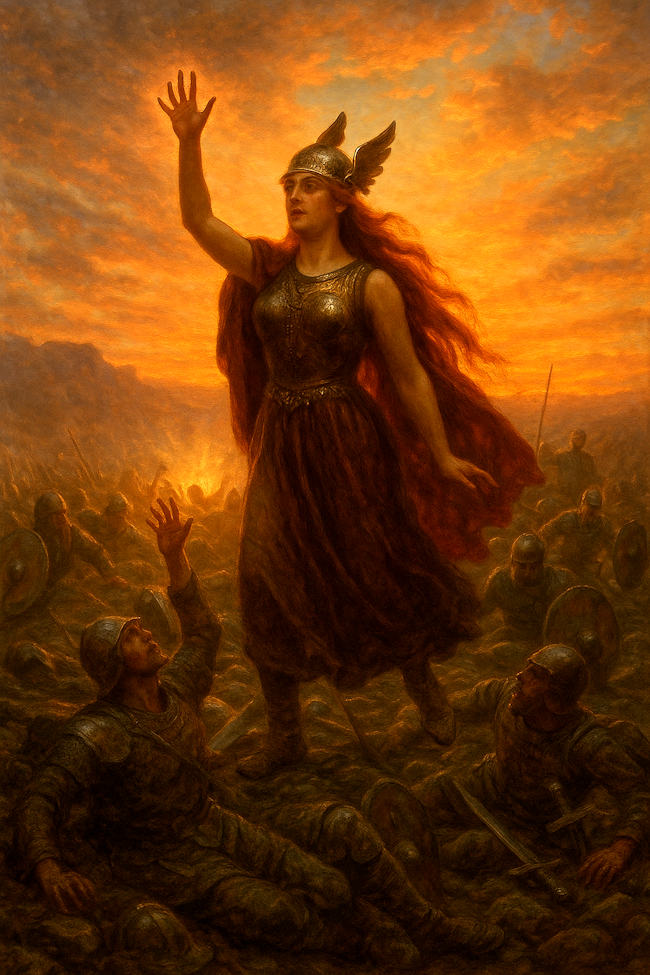
This wonderfully and profoundly describes the essence of the Valkyries, not only as circumstances and conditions in nature, but also as the animating soul of nature. For just as the Valkyrie, as the “victory-bringer”, was awakened from hardened and petrified matter by Sigurd's reason, so now the Valkyrie, as “fighter” and “soul of nature”, awakens petrified matter to life in the light of dawn. For everything is consciousness on different levels, more or less narrowly confined and enclosed, more or less obscured and veiled, more or less freely moving and alive. That is to say: what we call “life” is the love between soul and reason. And thus, life drives us toward the victory of reason.
Odin's Wives
As the all-encompassing father of the gods and, in essence, of all creation, Odin naturally has many wives, in whom we can symbolically recognize the diversity of nature. Thus, spirit and nature unite as one and diversity into a living world. These women are primarily known as the daughters of the giants, who, as mountain and frost giants, remind us of the hardening and materialization of consciousness. And just as Sigurd and Sigrdrifa, representing reason and the soul of nature, are united in love, so too does Odin marry the daughters of the giants in order to revive the frozen nature with divine spirit, to conceive and give birth to a living creation, conceived by spirit and born of nature.
Through their marriage to Odin, the father of the gods, the giantesses are also called “goddesses”. In the symbolic stories, Frigg is particularly emphasized as Queen of Heaven and patron goddess of marriage, life, motherhood, the hearth, and domesticity, which likely refers in the broadest sense to living physicality. It is said that she bore Odin three sons: the gods Baldr, Hödur, and Hermodr, who can be seen as the gods of light, darkness, and message. As gods, they are holistic, spiritual beings, and as Odin's sons, they form an inseparable unity, offering much food for thought. For between light and darkness, all of creation appears with its divine message. It is also said that the Valkyries are named as daughters of Odin and Frigg in some myths, which would make sense in principle. However, we could find nothing of the sort in the Edda. There, they are referred to as “Odin's maidens” (Óðins meyjar).
Two other wives were mentioned earlier: Jörd, representing “Earth”, who became the mother of Thor, who battles the mighty giants, including the mountain and frost giants, to ensure that Mother Earth does not freeze but remains alive and fertile. Rinda was also mentioned, the mother of Vali, who fights against the darkening of the sky and avenges the death of Baldr, whom we will discuss later. Thus, Jörd and Rinda are also interpreted as “fertile, summery Earth” and “frosty, wintery Earth”, which plays a significant role in life, especially in the Norse lands.
Another wife mentioned is the giantess Grid, who kindly aided Thor in his battle when the frost giant Geirröd tried to kill him. With her, Odin fathered a son, Vidar, the “silent Aesir” or “God of Silence”, whose name can also be interpreted as “Warrior of the Forest”. Along with Hödur, Baldr and Vali, he is one of the four sons of Odin who survive Ragnarök, the end of the world, because he defeats the all-devouring Fenris wolf:
The wolf devours Odin, which is his death. But immediately afterward, Vidar rushes at the wolf and places his foot in its lower jaw. On this foot, he wears the shoe for which people have always collected donations—namely, the strips of leather that people cut from their shoes where the toes and heels are. Therefore, everyone who wishes to come to the aid of the Aesir should throw these strips away. With his hand, Vidar then grasps the wolf's upper jaw and tears its throat open. This brings death to the wolf. (Gylfaginning §51 after Arnulf Krause and Karl Simrock)
Other women are only hinted at, such as the nine sisters who are the mothers of Heimdall or Gunnlöd in the story of Suttungr and the poet's mead, when Odin disguised himself as Bölverkr. One might assume that Bragi, the god of poetry and intuitive wisdom, was born from this marriage, as we have also assumed in our family tree. But the Edda is silent on this point. The lineage of Tyr, the god of just victory, is also unclear. On the one hand, he is described as Odin's son, and on the other, as the son of the giant Hymir. There are only conjectures about their common mother. She is referred to as “Frille”, meaning concubine or secondary wife. Later, she was also called “Hrod” or “Hrodr”, meaning “fame”. Morally, one might think of “adultery” here, which is probably why this topic is only cautiously alluded to in the Edda. But from a spiritual perspective, Odin is “marriage” itself. For as a divine spirit, he is holistically present everywhere. Thus, betrothed and married, all parts are united and connected, especially the separation of spirit and nature, so that Tyr too is a “just victory”.
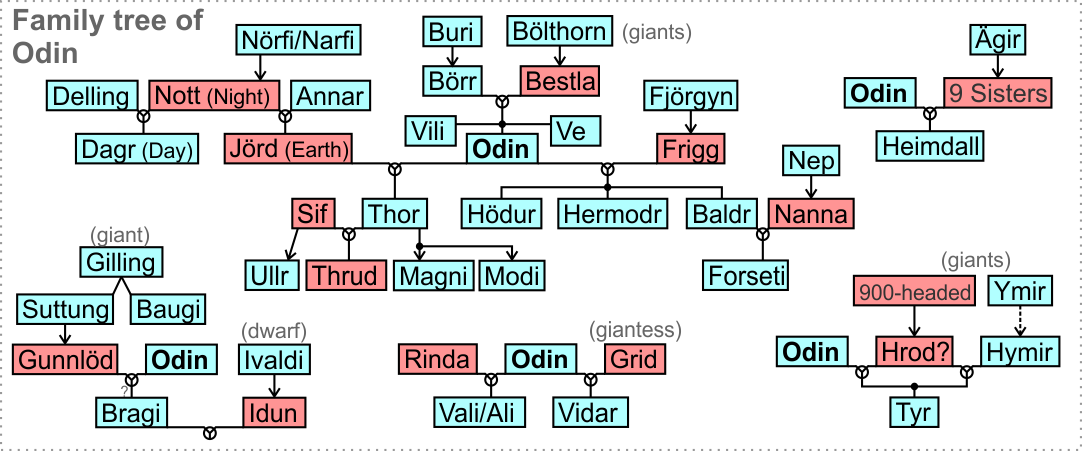
see also Family-Tree Edda PDF
There is a profound story about Odin and Frigg, essentially the All-Father and All-Mother, which we will examine further. With a little imagination, we can recognize Högni and Hedin from the story above as Geirröd and Agnarr, and even the sword that is not loyal to its master. For at the end of the story, King Geirröd falls on his own sword and dies.
Song of Grimnir (Grímnismál)
King Hraudung (“Transience”) had two sons: one named Agnarr, the other Geirröd. Agnarr was ten years old, Geirröd eight. They both rowed in a boat with their fishing lines to catch small fish. The wind carried them out to sea. In the darkness of night, they were shipwrecked on a shore, went ashore, and met a cottager (a poor farmer without much property) with whom they spent the winter. The old woman raised Agnarr, and the old man raised Geirröd. In the spring, the old man gave them a ship. When he and the woman accompanied them to the beach, the old man spoke with Geirröd alone. They had fair wind and came to their father's ship's resting place. Geirröd was at the bow of the ship. He jumped ashore, pushed the ship out, and said: “Go where the monsters have you!” The ship drifted away. Geirröd went up to the court. He was greeted with joy. His father had already died. Then Geirröd was made king, and he became a famous man.
Odin and Frigg sat in Hlidskjalf (“High Seat of Far-Looking”) and gazed out over the entire world. Odin said: “Do you see Agnarr, your foster son, fathering children with a giantess in the cave? But Geirröd, my foster son, is king and now rules the land.” Frigg replied: “He is so stingy with food that he torments his guests if he thinks there are too many.” Odin said that this was the biggest lie. So, they made a wager.
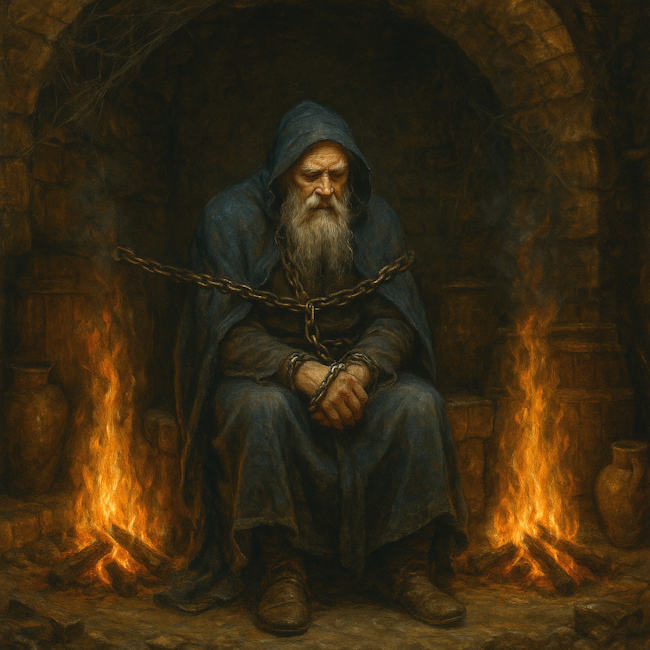
Frigg sent her servant Fulla (“Abundance”) to Geirröd. She begged the king to be careful that a sorcerer who had come to the land would not bewitch him. She cited as a sign that no dog was so vicious as to attack him. But it was a very big lie that Geirröd was so stingy with food. Nevertheless, he had the man seized, the man whom the dogs refused to attack. He wore a blue cloak and called himself Grimnir (“Masked One”). He said nothing more about himself, even when asked. So, the king had him tortured to make him talk, and sat him between two fires. There he sat for eight nights.
King Geirröd had a son, ten years old, who was named after his brother Agnarr. Agnarr went to Grimnir and gave him a full horn to drink. He said that the king was acting wickedly by letting him be tortured unjustly. Grimnir drank from it.
This is a typical “tale of the gods”, in which our usual concepts of space and time dissolve. Years of life, day and night, summer and winter have almost exclusively symbolic meaning. Even the differences between the characters blur, and one ultimately senses, that there is only one being, who, like Grimnir, wears different masks, and only one time as the eternal present. Thus, Geirröd surely does not bear the name of the frost giant who wanted to kill Thor by chance. The etymology of his name is unclear, and one might think of a “blood-stained spear”. Symbolically, we can see Högni, also known as Hagen, as a wilful lone wolf or ego, who, as a separate being, must ultimately die. Similarly, Agnarr bears the same name as the Agnarr whom Sigrdrifa chose as Einherjar. He would then also be the Einherjar in the service of wholeness, who is reborn again and again. Both are brothers as creatures and sons of “transience”, of the king who rules over all beings. First, they try to “catch small fish” in the sea of causes to feed themselves. In doing so, they fall into the night and wintertime of incarnation. The ancient foster parents in this “land” of physicality can be recognized as spirit and nature, and thus also as Odin and Frigg. The term “cottager” is therefore very fitting for Odin, because as the creator god, he naturally builds and inhabits all the cottages or bodies of creatures, without, however, considering them his property, because he is always aware of his two eyes, between which creation arises—a state also known as “God-consciousness”.
Why Odin chose Geirröd and Frigg Agnarr as his foster sons is a question that invites much contemplation. One interpretation is that the lone warrior must first cultivate the spirit of unity in order to become an Einherjar. In contrast, the Einherjar practice their way through the diversity of nature in order to realize the spirit of unity within it, so that spirit and nature may once again become one. We could also imagine that when the Old One spoke alone with Geirröd, he encouraged him to become king in the human realm. By this, he meant, of course, the holistic reason that should reign there as king. But the ego didn't understand this and believed that if he was to be king, then there could be no other king. So, he tried to kill his older brother. This is the typical struggle in the ego-world of separation and contradictions. And therefore, he became king in the “Land of Transience”. But deep down, he probably regretted his deed and named his son “Agnarr”, in memory of his brother.
Thus, Odin, as the spirit of unity, now looks out over the world and sees how Geirröd has seized power in the “Land of Transience” and how Agnarr fathered children with a giantess in the giant's cave. Odin, too, fathered his children with giantesses and even survives Ragnarök through them. Similarly, one could see Agnarr here, too, conceiving and giving birth to himself as an Einherjar in the giant's cave of the macrocosm, and thus also as Geirröd's son, within the eternal cycle of renewal.
When Spirit and Nature looked upon the two, Geirröd was rebuked by Frigg as an egoist. But Odin said that “this is the greatest lie”. What does this mean? From the perspective of natural diversity, Nature is certainly right to see Geirröd pursuing his self-willed, egoistic path. But from the spiritual perspective of unity, it is the greatest lie if one cannot see pure consciousness everywhere, beyond any separation by different forms. For everything is consciousness, even the greatest ego. Who is right now? This is a typical problem that every ego must grapple with. Thus, they both come to him: Nature as the abundance of forms, and Spirit as the magician who can make everything vanish back into nothingness. Naturally, the dogs, who are meant to guard the possession of abundance, do not bark at this magician. For the dogs are the tamed wolves of transience, tamed by Odin himself, which is why they acknowledge him as their master. Furthermore, the magician's blue or dark cloak is often interpreted as a symbol of death and transience.
Then the king asks him who hides behind the name “Grimnir” as the “Masked One”. Similarly, we would ask today who hides behind someone who calls themselves a “person”. For “person” comes from the Latin “persona” and simply means “the mask of an actor”. But he receives no answer to his question. Why not? Odin would surely have liked to answer him. But how could an ego, as a consciousness of separation, understand the divine spirit of unity? The ego then tries to force this spirit into his world of separation and opposites, placing the spirit between two fires. In this, one could recognize the passionate fires of desire and hatred, as well as all other opposites such as birth and death, winning and losing, or mine and yours, which burn threateningly and tormentingly in an ego-consciousness.
There now sits this divine spirit, as it resides in all creatures, for “eight nights”, which symbolically remind us of the clouded consciousness and the limited length of physical life. Then comes the ninth night, the number of renewal. Thus, at the beginning of the story, Geirröd was assigned the number eight and Agnarr the number ten, so to speak, below and above the spirit of cyclical renewal. Accordingly, Agnarr, as Geirröd's son, is now ten years old. This is a number in which, symbolically, everything and nothing unite as one and zero into wholeness. Therefore, Agnarr can walk between the two fires, reuniting desire and hatred into holistic love, and offer the imprisoned spirit the “full horn” of life's water, the famous horn pf plenty, which is also a symbol of eternal renewal. Then the cloak of Grimnir, the veiling of the divine spirit, began to burn, and the outer mask fell away. For Geirröd, this was physical death, and for Agnarr, spiritual rebirth, so that he could now recognize the divine essence in all of creation. And this is now described in a wonderful way below:
The fire had grown so fierce that Grimnir's cloak was ablaze. And he said:
1. Hot you are, swift flame, and far too great, go away from me, fire! The fur burns even when I lift it; the cloak is consumed.
2. For eight nights I sat here among the fires, so that no one offered me food, except Agnarr, son of Geirröd, who alone shall rule the land of the Goths.
3. Hail to you, Agnarr, for the god of men commands your salvation: For a drink you will never receive a better reward.
4. The land is holy that I see lying near the Aesir and the Elves: In Thrudheim (Power Home) shall Thor be, until the Gods are destroyed.
Thus, Agnarr is promised the land of the Gothic, or heroic, people, a wholesome land close to the gods and elves, who are depicted as dwarves or nature spirits assisting the gods in the microcosm. Thor is to reside there throughout all of creation, repelling the mountain and frost giants and thereby preserving the living creation. This also brings us full circle to the story of the frost giant Geirröd, who was defeated by Thor, just as Geirröd's ego is not to rule in this world, but rather Agnarr's reason.
The following section describes the courtyards and halls of Asgard, the “garden of the gods” or spiritual realm of the gods, as it was imagined at that time and as Agnarr can now, in broad terms, perceive it from Midgard. We have already encountered them as realms of consciousness that flow into one another and are essentially just a space between Odin's eyes.
5. Ydalir (Valley of the Yews) is where Ullr (the god of winter) built his hall.
Alfheim (Realm of the Nature Spirits) was given to Freyr (the god of summer) by the gods in ancient times as a tooth offering (a gift for a child on the occasion of its first tooth).
6. The Court is the third, where the benevolent advisors (gods) roofed the halls with silver; it is called Valaskjalf (Seat or Realm of the Slain), which the Aesir (Odin) built for himself in ancient times.
7. Sökkvabekkr (bank of the Sunken) is the fourth, where cooling waves rush over it. There, Odin and Saga (Frigg? or the sagas of the gods) drink merrily from golden goblets every day.
8. Gladsheimr (Gleaming Home) is the fifth, where Valhalla (Hall of the Slain) stretches far and wide, gleaming with gold. There, Hropt (Odin) chooses men killed by weapons every day.
Here, too, one can imagine the halls flowing into one another, from the spiritual macrocosm to the microcosm, from Valhalla down to the valley of the yew trees of the winter god Ullr, who is also considered the god of the hunt. It is said that bows and arrows, deadly weapons, were made from the wood of the yew tree, a highly poisonous tree often even called the “tree of death”. Yet it is also evergreen, very long-lived, and can sprout anew time and again, so it was also revered as a sacred tree of eternity and rebirth. Some even see a yew tree in the world tree Yggdrasil.
The fallen and the sunken are reminiscent of the creatures who, from the pure light of consciousness, as “frozen light” under the influence of the frost giants, fell and sank into creation, all the way down to the realm of death. But through divine or holistic wisdom and awareness, they can rise again to eternal life. The following section describes Valhalla in more detail, as we already learned about this hall earlier in the text and how it is easily recognizable to Einherjar.
9. The estate is easily recognizable to anyone who comes to Odin as soon as they see it: The roof is constructed with spears, the hall is covered with shields, and the benches are strewn with mail (or populated by armoured warriors).
10. The estate is easily recognizable to anyone who comes to Odin as soon as they see it: A wolf hangs before the western gate, and an eagle soars above it.
The spears that join the roof remind us of Odin's spear, which we learned about as a symbol of the waves acting on the sea of causes, and thus also of the prevailing natural laws of cause and effect that shape and form everything in the realm of consciousness within creation. The shields form the roof and the boundaries of this hall as a space of consciousness, thus recalling a symbol of the warrior's mindfulness and presence within creation.
Before the western gate, where the sun sets, the hungry wolf of transience waits. Specifically, in the earthly world, where transience is restrained so that anything can come into being in space and time. The eagle hovering above the wolf reminds us of Odin's eagle, which we encountered as a symbol in the story of Kvasir and Suttungr. There, it symbolizes that the ego can rise above physical transience and perhaps even attain spiritual immortality in the divine, as we also hope for Geirröd.
This description of Valhalla now mentions further courtyards and halls, presumably in front of the western gate in the natural realm of the giants and Vanir.
11. Thrymheim (Home of Battle Noise) is the name of the sixth, where the mighty giant Thjazi (Icy One) lived. But now Skadi (Dark One, Winter Goddess) as the radiant bride of the god (Njördr) inhabits her father's old court.
This myth is recounted in detail in the Skaldic Book of the Edda, §1. The central story is the conflict between the frost giant Thjazi and the gods. After Thjazi abducted the goddess Idun (the “Renewing and Rejuvenating”), he was ultimately slain by the Aesir after rising to them in eagle form (similar to Suttungr). Skadi, Thjazi's daughter, was allowed to choose a husband from among the gods as penance for killing her father, but she could only see their feet. She chose the most beautiful and hoped for Baldr, the god of light, but instead chose the Vanir Njördr. Gylfi's Illusion, §23, continues the story: They could not live together in one place (in nature) for long, as Skadi loved the mountains and Njördr the sea. So, they agreed to spend nine nights each in one location, but this solution also proved unsuccessful. Skadi was bothered by the cries of the seabirds, and Njördr by the howling of the wolves. So Skadi returned to Thrymheim. We will discuss this story in more detail later in the chapter on Loki, for it aptly illustrates how, in nature, the struggle of opposites gives rise to the interplay of separation through the desire to cling to what is transient.
12. Breidablik (Broad and Wide Splendour) is the seventh. There Balder (the god of light) has built himself a hall, in the land where I know of the fewest curse runes.
13. Himinbjörg (Heavenly Citadel) is the eighth. There, Heimdall (the Shining One), so it is said, rules the sacred courts. There, this guardian of the gods merrily drinks the good mead in his peaceful house.
14. Folkvangr (People's Field) is the ninth, and there Freyja (goddess of love and fertility) decides the seats in the hall. She chooses half of the fallen each day; the other half belongs to Odin.
The translator Wilhelm Jordan also points out that it is not about half the number of fallen, but rather half of each individual. One could imagine it this way: the spiritual essence belongs to Odin in Valhalla, and Freyja chooses the physical aspect in the realm of nature.
15. Glitnir (Shining One) is the tenth. It is supported by gold and also covered with silver. Forseti (president) resides there most of the time and settles all disputes.
The gold reminds us of truth, and the silver of reason. In Gylfi's Illusion §32, it says:
Forseti is the son of Baldr and Nanna, the daughter of Nep. He dwells in heaven in the hall of Glitnir. All who turn to him in legal disputes go home reconciled. This is the best court of justice among gods and men.
16. Noatun (Ship Place, Sea) is the eleventh, and there Njördr (god of the sea, wind, and fire) has built himself a hall. The Prince of Men, the Immaculate One, presides over a lofty temple.
17. Bushes grow, tall grass, and also forest in Vidar's land (the god of silence and warrior of the forest). There, the boy speaks from the back of the horse, boldly seeking to avenge his father.
The nature of Vidar, as the son of Odin and Grid, is difficult to grasp. Along with Hödur, Baldr and Vali, he is one of Odin's four sons who survive Ragnarök, the end of the world, because he defeats the all-devouring Fenris wolf. Thus, we could see in him the true principle of life: peaceful existence as a victory over all hostile opposites, which is also what the ascetic hermits in the silent forest seek to soothe the “noise of battle in Thrymheim”. This peaceful reconciliation of opposites is likely also the great goal of Agnarr's spiritual rebirth and the divine realization of the realms of consciousness.
If one compares the two lists symbolically, one can see that the descriptions of Breidablik and Himinbjörg somehow don't fit into the flow. However, if one moves them to the end of the list and constructs a table from bottom to top, the following structure emerges:
👁️ Deity - Unity 👁️ | |||
12 | Himinbjörg (Heavenly Castle) / Heimdall (Home-Bright One) Guardian of the Gods | Breidablik (broad and wide splendor) pure and holy land / Balder (god of light) | 11 |
5 | Gladsheimr (Gleaming Home) / Valhall (Hall of the Fallen) / Odin as host father | Vidar's Land (God of Silence and Warrior of the Forest) | 10 |
4 | Sökkvabekkr (Bank of the Sunken), where cooling waves rush / Odin and Saga (Frigg? or myths of the gods) | Noatun (ship's place, sea) / Njördr (god of the sea, wind and fire) and Skadi (natural stories of diversity) | 9 |
3 | Valaskjalf (Seat/Realm of the Slain) covered with silver / friendly advising gods / Aesir (Odin) | Glitnir (Shining One) covered with silver / best court of justice among gods and men / Forseti (president) | 8 |
2 | Alfheim (home of the nature spirits) / Freyr (summer god) | Folkvangr (People's Field) / Freyja (Goddess of Love and Fertility) | 7 |
1 | Ydalir (Valley of the Yew Trees) / Ullr (Winter God) | Thrymheim (Home of the Noise of Battle) / Skadi (Dark, Winter Goddess) | 6 |
Aesir 👁️ Spirit | Vanir 👁️ Nature | ||
Then the two lists make considerably more sense, both individually and in comparison to each other. One can clearly see the developmental process of knowledge from the lower to the higher, how the consciousness of an Einherjar expands from the realm of separation to wholeness, from the wintery, frosty darkness to vibrant light, from the separation of spirit and nature as male and female to spiritual unity and divinity within natural diversity. Then one can also find the symbolic eight of Geirröd as the place of judgment, where he is judged by his own sword. And the symbolic ten of Agnarr refers to the land of Vidar as a peace-loving ruler, enabling him to calm the passionate fire of opposites, between which the holistic, or divine, spirit was enclosed. Above this, Baldr and Heimdall, as eleven and twelve, complete the great circle between nature and spirit, the physical and spiritual worlds, diversity and unity, transience and eternity, leading to the highest deity.
And the description of Valhalla continues:
18. Andhrimnir (the cook as the “counter-hardening or embodiment”) has Sährimnir (the boar as the “sea or water embodiment”) cook the finest meat in Eldhrimnir (the cauldron as the “fire embodiment”), but few know what the Einherjar (who fight in the Army of Unity) eat.
In creation, consciousness feeds on embodiment, but for this to happen, embodiment must transform back into consciousness. This is accomplished by the cook of knowledge, and ideally even of self-knowledge, within our cauldron, or vessel, of the living body, which the fire-spirit animates to enable this cooking process. This is, so to speak, our body heat for the “chemical kitchen” in all our body cells. We know how important water is for this, and we also know that hydrogen is a fundamental element of all matter in the universe. For this cooking process, the all-powerful frost giants must, of course, be restrained, but they too have their role in creation, in the endless cycle of becoming and passing away, in eternal renewal. For, as it says in “Gylfi's Illusion”, the boar is cooked every day, nourishes all the Einherjar in Valhalla, and is reincarnated and unharmed again in the evening. Thus, only a few know what those eat who do not feed on “others”.
19. Geri and Freki (Odin's wolves, “greed and gluttony”) are fed by the battle-hardened, glorious Host-Father, but the battle-renowned Odin lives solely on wine.
This interplay of embodiment is primarily a battle of habit. Odin, as the Host-Father of all warriors, is aware of this and knows that all physical nourishment is a perishable sustenance of habitual “greed and gluttony”. Accordingly, we have come to know the wolves as a symbol of insatiable transience. And as the battle-renowned All-Father of the gods and all creation, he is also aware that he himself lives only on “spiritual wine”, which we have interpreted as a symbol of the power of illusion and creation. He lives, therefore, on consciousness itself, symbolized by his two eyes, between which all of creation unfolds as spirit and nature.
20. Huginn and Muninn (Odin's ravens, “Thought” and “Memory”) fly over the vast Earth every day. I worry about Huginn (Thought), that he won't return. But I fear even more for Muninn (Memory).
Thus, between these two eyes, the black ravens of Thought and Memory fly as the obscured consciousness of ordinary reason “over the vast Earth”, or rather, the “power of embodiment”. And this is what we try to cling to, and even Odin himself, to restrain the wolves of transience, so that they don't devour everything that comes into being. This surely has its purpose, for otherwise we would have no time or space to learn anything from it, to rediscover the imperishable in the transient, and ultimately perhaps even to recognize ourselves in everything.
21. The Thund roars (“Thunder,” also a name of Odin), the fish of Thjodvitnir (the people's wolf or the people's knower) rejoices in the flood. The current seems too strong for the band of fallen (Einherjar) to wade through.
Here we can think of the flow of creation and life through space and time. In it, the wolf rejoices in transience, or perhaps in the knowledge of the people, as “vitnir” can be translated as “wolf” or “knower”. This essentially means the same thing, for our intellectual knowledge, to which we so readily cling, is also transient, arising and passing away in the flow of creation. The only thing that is truly imperishable is perhaps the source of this river. Thus, the Einherjar, as creatures, cannot wade through the current, that is, leave the river, but follow it, with the holistic understanding that it must, of course, eventually return to its source.
22. Valgrind (Gate of the Fallen) is the name of the gate that stands in the field, the holiest of the holy gates. This gate is ancient, but few know how it is closed.
Every river has a gradient and two banks; otherwise, it could not flow. So too does the river of life fall from its source, and whoever flows with it becomes a falling creature in the current of creation and transformation between the banks of spirit and nature. This is also clearly visible in the table of courtyards and halls above. And one can easily imagine how the river becomes ever wider and its current ever stronger the further it flows from its source. The gate of the river would then be the source, and the holiest of the holy sources is the holistic source of creation and life, the Godhead itself. But how can one prevent oneself from flowing out of this source, from falling out, and becoming a “fallen one”? Yes, for that one must sacrifice an eye in order to consciously allow creation to flow and to consciously remain the source, the eternal source as pure consciousness.
23. Five hundred and forty gates are—as I believe—in Valhalla. Eight hundred Einherjar pass through each gate simultaneously when they go forth to fight the wolf.
In the diversity of nature, the one gate then becomes many gates, and also many rivers, as we shall read. Above, in the detailed description of Valhalla, we interpreted this as the earthly days in which the earthly, or natural, sun rises to fight for life against the wolf of transience in the physical world, in the flow of creation. We could not find a conclusive interpretation for the number 540. The number 360 would make sense as 12 x 30 days in the cycle of the year, but 540 is 18 x 30, thus half a year more. The 8 x 10 x 10 Einherjar remind us here of Geirröd and the two Agnarrs, to whom the numbers 8 and 10 were assigned.
24. Five hundred and forty rooms, that's how I imagine Bilskirnir (“Lightning Flash”, Thor's Court) in its entirety. Of the houses I know to be roofed, I recognize my son's as the largest.
Thus, these 540 gates lead from Valhalla into 540 rooms of the world of Thor, son of the All-Father Odin and the earth Jörd. It is therefore a physical world of fleeting splendour or light. For every physical light of life is, from a divine perspective, only a brief flash between birth and death. In this world, Thor primarily battles the overwhelming mountain and frost giants to preserve the vitality of creation. And the Einherjar fight united in the army of spiritual unity against the wolf of transience to maintain the constant renewal of creation.
25. Heidrun is the name of the goat that stands on the hall of the All-Father and feeds on the branches of Laerad. She is said to fill the vessels with pure mead, and this drink can never run dry.
The “Rune of the Heath (German: Heide)” or the “Secret of the Pastureland” of all creatures stands as a “Light Rune” on the roof of Valhalla and is a reminder of the field of consciousness from which all creatures draw sustenance. From a spiritual-symbolic perspective, one should imagine this goat facing inwards. For there she feeds on the branches of the Tree of Life, which, as “Laerad”, is also a tree of learning, if one considers the Old Norse “læra”, which can be translated as “to learn and to teach”. Accordingly, she also provides the Einherjar in Valhalla with pure mead as the inexhaustible divine drink of wholeness. This verse could then be interpreted as follows: On Valhalla, the hall of the All-Father, is founded the secret or invisible field of consciousness from which the Einherjar as a whole feed.
26. Eikthyrnir (“Oak-Thorn”) is the name of the stag that stands in the hall of the All-Father and feeds on the branches of Laerad. From its antlers drips water into Hvergelmir (“Bubbling, Boiling Spring, Cauldron-Roarer”), and from there all rivers flow.
The antlers, with their thorny tines, remind us of a symbol of the worldly struggle of opposites, and the oak tree of steadfastness and endurance in this struggle. The struggle itself, of course, draws its sustenance from the Tree of Life and Learning, and from its thorny tines, so to speak, the “masculine fighting spirit” drips down into the water of life to the wellspring, which then becomes the source of birth for all fighting creatures. From this spring the rivers of the world and of life—that is, everything that flows, changes, moves, and transforms. Thus, many river names, difficult to interpret, are listed below. In principle, they are reminiscent of the diversity of natural qualities in the interplay of opposites, such as slow, broad, wild, swift, furious, cold, combative, roaring, aging, swelling, dwindling, undulating, raging, and so on. A comprehensive list with interpretations (in German) can be found on Wikipedia under “List of rivers in the song Grímnismál”. (A few are mentioned in the English Wiki here.)
27. Sid and Wid, Sökin and Eikin, Swöl and Gunnthro, Fjörm and Fimbulthul, Rin and Rennandi, Gipul and Göpul, Gömul and Geirwimul—these flow around the abode of the gods, as do Thyn and Win, Töll and Höll, Grad and Gunnthorin.
28. One is called Wina, the second Wegswinn, the third Thjodnuma, Nyt and Nöt, Nönn and Hrönn, Slid and Hrid, Sylg and Ylg, Wid and Wan, Wönd and Strönd, Gjöll and Leipt—these flow near humankind, but from there they plunge to Hel (Hell).
Similar to the two types of courtyards and halls of consciousness spaces, Agnarr also recognizes rivers here that flow more in the spiritual realm of the gods and simply return to their source, as well as others that flow more in the natural world of humans and fall into the underworld of hell or Hel, often referred to as the “goddess of death”.
But how does a river return to its source? Here, one can think about the sea of causes, in which all flows of effects end and from which they also arise again, like waves on a sea. Some causes linger longer in this sea and remain invisible because their effects are not seen. Here, one can speak of the subconscious, or even of the underworld of hell or the dark cave of consciousness. However, one should always be aware that this is a human view of the world, which, like Agnarr, one can generally perceive quite directly, but which is difficult to put into words because it transcends the usually limited intellect, which can only think in terms of opposites. We also know from near-death experiences that such intense experiences can only be described superficially and imperfectly in a symbolic way.
29. Thor must wade through Körmt, Örmt, and the two Kerlaugar rivers every day when he goes to judge at the ash tree Yggdrasil, because the Aesir Bridge (the rainbow bridge between Asgard and Midgard) is ablaze and the sacred waters are boiling.
If one considers the “two Kerlaugar” as one river, then there would be a total of 2 x 20 rivers: 20 flow more in the spiritual realm of the gods, and the other 20 more in the physical realm of nature, where Thor also has his court. There, every day of the year, he holds court at the World Tree with the other gods to maintain the world order. To do so, he must wade through the rivers Körmt, Örmt, and Kerlaug. Their etymological meaning is also unclear. Körmt could be derived from “karmr” in the sense of confinement or limitation, and thus it is reminiscent of the flow of limited consciousness. Örmt can be derived from “ormr” for “serpent” and is reminiscent of the flow of the wilful ego. Kerlaug means “kettle bath”, reminiscent of the dammed-up pools in the River of Living Incarnations, where consciousness, as a bridge between all worlds, is softened once more, much like the boar Sährimnir. Thor must, of course, wade through and leave all three rivers to fulfil his duty as a divine judge alongside all the other gods. For only those who are free and independent can judge justly.
But why are there two Kerlaugar rivers? One might consider that not all rivers of embodiment lead to Hel. Some “also flow around the abode of the gods”, as mentioned above, which the Einherjar and, of course, the gods themselves follow when they enter the physical world. Thus, Kerlaug could practically be just one river, appearing as two, depending on which direction one looks in this river of embodiment—whether toward the eternal source or toward transience, which then leads into darkness. Accordingly, the flames of the Rainbow Bridge are either a fire of healing love or a fire of passionate desire. In this respect, the circle of rivers closes again, returning to the divine, much like the circle of courts and halls.
Similarly, the “water” from which all rivers are made is sacred, healing, and holistic, for it is the water of life that flows between Odin's eyes in creation and is, in essence, formless consciousness capable of assuming any form. And for those who become aware of this, no river flows into unconscious darkness anymore.
30. Glad and Gyllir, Glär and Skeidbrimir, Silfrintopp and Sinir, Gisl and Falhofnir, Gulltopp and Lettfeti—these are the horses the Aesir ride every day when they go to judge at the ash tree Yggdrasil.
While Thor walks, the Aesir ride on horseback to the day of judgment, which in Norse is also called the “thing”. This term became the meaning of an object, or a matter, which already points to our physical world. Thus, one can also see symbols of physicality in the horses, on which the gods then ride in the physical world. Their ten names are again difficult to interpret and evoke images like Shining, Radiant, Glossy, Lightning-Swift, Silver-Mane, Golden-Haired, or Light-Footed. Together with Thor, there would then be eleven Aesir, whose names will not be mentioned here. But there should actually be twelve to complete the circle of judges, as we still know today as the “Twelve Jurors” in the legal system. The twelfth would then have to be Odin, whose horse Sleipnir is missing from the list of horse names. Instead, the tree Yggdrasil appears here, whose name can also be interpreted as “Yggr's horse”. And “Yggr” is a name for Odin, as he himself explains later in the text. Thus, the world tree Yggdrasil would symbolically be Odin's horse, which is why he is also present here. This, of course, makes sense if one considers Odin as the All-Father and creator god of everything that appears before his eyes.
Now the big question is: What do the gods judge each day on the Tree of Life and the World Tree? The simplest way to put it is that they maintain order throughout the entire world, constantly, every single day, as long as creation exists as a cosmic organism. This likely includes the prevailing laws of nature, how cause and effect are interconnected. In the microcosm, it is symbolically the dwarves of nature spirits who serve the gods to enliven the macrocosm. Thus, the gods' “thing” provides for all things and therefore for the conditions in nature, which we have also encountered as Valkyries. In this way, the Tree of Life and the World Tree, as a cosmic organism and “Odin's horse”, can become a tree of learning. The “every day” is a reminder of our ordinary waking consciousness in the external world. For, as we know from experience, we can also create our own laws of nature in our nightly dream consciousness.
Why does this happen? Why can't we live according to our own natural laws even in our everyday consciousness? Perhaps therein lies the very meaning of all creation: to overcome self-will and transform from the egoistic individualist into a holistic, unified being, to emerge from separation back into wholeness, from desire into love, from bondage into freedom. Friedrich Schiller aptly wrote:
The strict fetter of the law binds
Only the slavish mind that spurns it,
With human resistance vanishes
Even God's majesty.
31. Three roots extend in three directions beneath the ash tree Yggdrasil: Hel dwells beneath one, the Frost Giants beneath the second, and human beings beneath the third.
Now, the world and life tree Yggdrasil will be described in more detail, beginning with its threefold root. Three is a typical number for forces in nature, which, like a river, have two opposing boundaries and a direction of action. This gives rise to the characteristic triangular symbol. If there were only two opposing forces, the force would oscillate endlessly, and nothing could come into being. Thus, at the root, we also find the opposing forces between Hel and the Frost Giants, and, as a direction of action, human beings and other living creatures. In this way, embodiment oscillates between the natural hardening of matter and spiritual annihilation as unconsciousness, between arising and passing away, while life strives upward toward the divine light.
These are the three main roots of the World Tree and the Tree of Life, from which it draws strength and lifeblood. In Buddhism, these would be described as desire, hatred, and ignorance, forming the axis of the Wheel of Life. The desire to cling to the Frost Giants manifests as physical hardening, the hatred of wanting to get rid of them as repression into the subconscious, and ignorance as separation from the divine. But where does the water that these three roots absorb come from? Here we can again think of the ocean of causes with the water of life, from which everything arises and into which everything returns. A more detailed description of the sources for these fundamental roots can be found in the Edda text “Gylfi's Illusion” §15:
The ash tree is the largest and finest of all trees. Its branches spread across the entire world and reach out to the heavens. Three roots support the tree, extending far and wide: one to the Aesir, the second to the Frost Giants, where Ginnungagap (the yawning chasm) once stood. The third extends to Niflheim (the realm of mist and darkness), and beneath this root lies Hvergelmir (the boiling spring, cauldron-roarer), and Nidhogg (the Hate-slayer/Hate-serpent) gnaws at it from below. But beneath the root that reaches toward the Frost Giants is Mimir's spring, where wisdom and understanding are hidden. Mimir is the one to whom it belongs. He is full of wisdom, for he drinks from this spring with the horn Gjallarhorn (the horn of Heimdall). There, All-Father came and begged for a drink from it. But he received nothing until he gave his eye as a pledge… The third (or first-mentioned) root of the ash tree reaches towards the sky, and beneath it is a very holy spring. It is called Urd's Well (Fountain of Fate). There the gods hold their judgment. Every day the Aesir ride across Bifröst (Bridge of Light) to that place. That is why it is also called the Aesir's Bridge. The horses of the Aesir have these names: Sleipnir is the best; it belongs to Odin and has eight legs. The others are Glad, Gyllir, Gien, Skeidbrímir, Silfrintop, Sinir, Gísl, Falhofnir, Gulltop, and Lettfêti. Baldr's horse was burned with him, and Thor goes to the judgment place on foot, fording (three or four) rivers.
Here, the conceptual understanding of the “Gylfi Illusion” becomes apparent once again, which, in addition to three roots, naturally requires three sources. This immediately complicates Agnarr's relatively simple view, but the mind can work, and one could imagine the three sources as follows:
The source of Mimir would be the source of intellectual creation, which primarily nourishes the essence of the Frost Giants for their embodiment. This is essentially our “mind”, which seeks to grasp and comprehend everything. Thus, our “standpoints”, which, with the power of desire, resist the flow of change.
The boiling spring of Hvergelmir, the battle-spirit, which drips from the antlers of the Valhalla stag, is connected here to Niflheim and Hel. It would therefore be the source for the fighting beings, who are physically born here and die in Hel, so to speak, the source of physical birth. At least, it is stated above, starting in verse 26, that half of the rivers from this spring flow to Hel, and the other half around the seat of the gods. Here, one can consider the fundamental separation between nature and spirit. And depending on which direction the fighting spirit follows, the paths of the individual warriors or the Einherjar in the service of the gods emerge. One path leads into the dark unconsciousness of death, and the other to the divine or holistic awareness of eternal life.
The third source would then be the Well of Urd, the “Fountain of Destiny”. In it, we can see the wellspring of causes that seek to manifest themselves within us humans and other living beings. One could also speak of the “soul of living beings” and therefore of a source of spiritual creation. Here, the gods hold their judgment and connect causes with effects, which we then call “destiny”—what is sent to us or where we are sent. Similar to the Latin “fatum”, a divine pronouncement for healing, this spring is also described in the text as “very holy”. This refers primarily to the conditions and circumstances we encounter in the flow of life. However, our spirit always retains a certain degree of freedom in how we react to and deal with them. The more we cling to our own physicality, the less freedom we possess. The more spiritually and holistically we live, the greater this freedom becomes. And the greatest freedom lies in being able to lovingly accept everything “sent”. Then every struggle ends in a great, triumphant peace. But a wilful ego cannot understand this, because it confuses freedom with self-indulgence, love with lust, and struggle with hatred. Similarly, the Christian mystic Meister Eckhart explains the divine will as follows:
“So, it is with him who is pleased by God’s will: everything that God allots to him, be it sickness or poverty or whatever it may be, he prefers to anything else, precisely because God wills it. That is why it tastes better to him than anything else. Now you like to say: How do I know if it is God’s will? I answer: If it were not God’s will, it would not exist for a single moment; it must (rather) always be his will… (Sermon 46)”
32. Ratatosk (gnawing tooth) is the name of the squirrel that leaps (up and down) on the ash tree Yggdrasil. It carries the eagle's words down from above and speaks them below to Nidhogg (hate-slayer/hate-serpent).
Here we again find three living forces as symbols: The eagle could be seen as a being from the root of the frost giants, so to speak, desire as a bird of prey high in the crown, embodying and solidifying the tree. The serpent Nidhogg would then be a being from the Hel root (of physical birth) and stands for hatred as the “killer” and “poisonous serpent” of opposites that fight and kill each other in hatred. Thus, this serpent is also often referred to as a dragon, reminiscent of the ego-dragon, which must kill everything that threatens it. And the squirrel would then be our worldly knowledge, which can only think in opposites and thus also jumps back and forth between desire and hatred.
This is a wonderful symbolism, one that invites much reflection. It also bears a strong resemblance to the Buddhist symbolism of the axis of the Wheel of Life. There, desire is symbolized by a rooster, hatred by a snake, and ignorance by a pig. Around this axis revolves the great Wheel of Life, and within it flows all of living creation.
Panta rhei - Everything flows
(Teaching of Heraclitus)
Accordingly, beginning in verse 26, the two twenty rivers of Hvergelmir were first described. Then we find the two Kerlaugar as the river of embodiment, which Thor must wade through. And now the squirrel, as it leaps back and forth between desire and hatred as the river of worldly knowledge, or as the river of life and the “gnawing tooth” of time, flowing back and forth between arising and passing away, between birth and death. Or the river finds eternal life around the divine source.
The eagle, as the bird of prey of desire, which brings forth creation from Mimir's spring before Odin's eyes, was also presented as a form of Odin himself in the story of Suttungr. Thus, desire can elevate us to the gods and even to the source of eternal life, the more it transforms into love. Likewise, worldly knowledge, the more it becomes reasonable wisdom, and conflict, the less it is waged with hatred. In this way, our consciousness increasingly finds its centre and balance, the triumphant peace of wholeness and divinity.
33. Four stags, too, gnaw at the shoots (of the tree) with bent necks: Dainn and Dvalinn, Duneyrr and Durathror.
Thus, together with Eikthyrnir, the “Oak-Thorned One”, a total of five stags have been described as “battle spirits” or “consuming life forces”, which initially remind us of the five senses that feed on the tree's outward shoots, leaves, buds, blossoms, and fruits, and from which our physical experiences flow. The names of the four other stags are again difficult to interpret and symbolically evoke states of consciousness, such as the “Killing One”, the “Stunning One”, the “Noisy One”, and the “Sleep-Boar”, which rouses us from sleep and dreams. Within this, one can find two directions: either into the darkness of death or into the light of life, into the cave of Hel, the goddess of death, or into the wholeness of Odin, the god of life—in other words, into the subconscious or the superconscious. In terms of nature, one could also think of the four seasons with their winter and summer halves, or the four winds from the four cardinal directions.
Thus, these deer have an essential function in the cycle of nature. They consume what has grown and, through their digestion, ensure new growth. What they take is not lost, but returns transformed.
34. More snakes lie beneath the ash tree Yggdrasil than any foolish person could ever imagine: Goin and Moin (in the earth and the swamp), they are the sons of Grafwitnir (Grave-Wolf), Grabak and Grafwöllud (Grayback or Old Wolf, and Field-Graver), Ofnir and Swafnir (Exaggerator and Sleep-Bringer or Slayer). I believe they are always gnawing at the tree's shoots.
In the external world, one might first think of the many worms, bacteria, and fungi that decompose organic matter everywhere in the earth, such as the leaves that fall from trees in autumn or the bodies of dead plants and animals. But even “foolish people” can see these worms, for this is the obvious cycle in the external world. What they don't see, and what is therefore a matter of faith, are the inner, more spiritual worms and serpents that bring about decay and death in every living being. These are primarily the serpentine forces emanating from the root of Hel, the goddess of death, which gnaw at the shoots of the Tree of Life from within. They are, so to speak, the sons of the wolf of decay, who age, gnaw, kill, and bury living beings—things that do not happen to the gods.
On the contrary, it is the gods who generate these serpents as a river, cord, or even band of effects from the sea of causes, from which the circumstances and conditions of living beings arise, by which they are then guided or seduced in life. And therein lies the spiritual freedom of all living beings, where they orient themselves in this river: toward the eternal wholeness of the deity as Einherjar, or toward transience in the hell of Hel as solitary warriors. In the latter case, the serpent becomes the famous dragon, demon, or devil, who seduces consciousness into a world of separation, into good and evil, mine and yours, life and death, gain and loss.
Such symbolic serpents exist in many cultures, like the biblical serpent at the Tree of Good and Evil, the lindworm of Germanic legends, or the Nagas in Asian mythology. From this also arises the famous ego-dragon, which in many ancient legends is fought by brave knights to free the maiden as a pure soul. In our interpretations of the Nibelung saga, we have found many examples of this and have already given it a lot of thought.
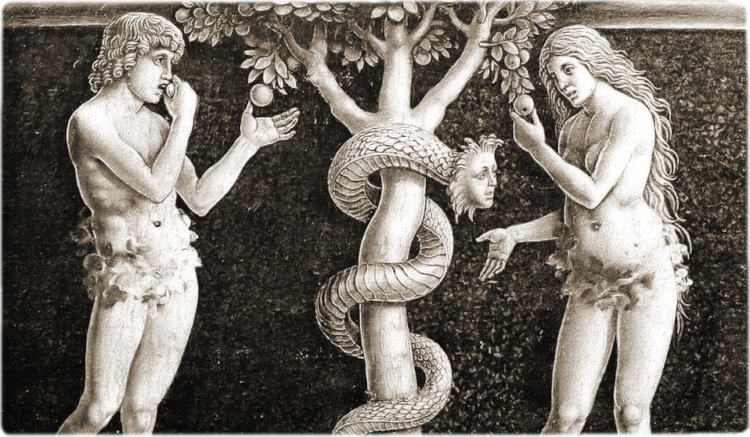
Bild: Adam and Eve, 15th century, Paris, Louvre
Thus, the flow of our life experience can transform into a venomous snake, a fire-breathing dragon, or even a gnawing squirrel and helper on the path to the eternal spring, to wholeness and divinity. Indian myths also contain wonderful stories of Nagas who help people on their journey, such as the story of Hritadhwaja in the Markandeya Purana from chapter 20 onwards (in German).
35. The ash tree Yggdrasil endures hardship, more than people know: The stag grazes above, all around it rots, and below Nidhogg gnaws.
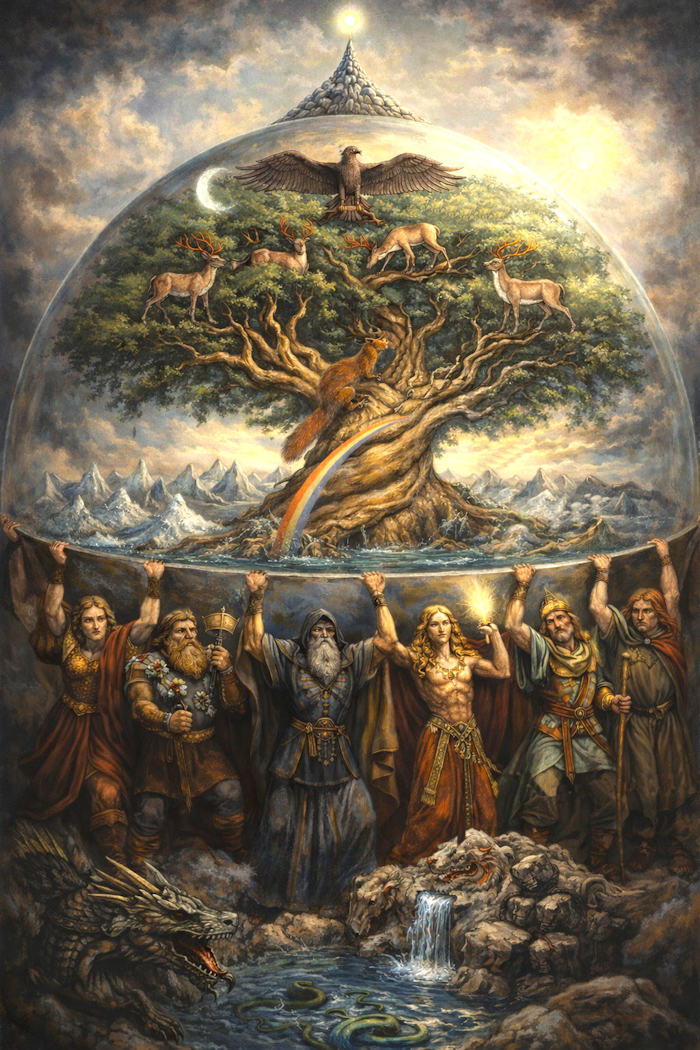
Yes, very few people are aware of all the problems in the Tree of Life. At least we know about external and internal transience, so to speak, in the crown and at the root, as well as the general process of “decomposition” of all “living beings”. Physically and materially, we can easily recognize the eternal cycle of becoming and passing away in nature, but spiritually we struggle with it and readily believe in the annihilation of life and the fall from the light of life into the darkness of death. To illustrate this cycle of spiritual renewal, the following verse mentions the Valkyries, who choose the fallen from death to return to life, the Sigrdrifas, so to speak, as “victory-bringers”:
36. May Hrist and Mist bring me (Grimnir, or Odin) the horn; Skeggjöld and Skögul, Hild and Thrud, Hlökk and Herfjötur, Göll and Geirölul, Randgrid and Radgrid and Reginleif—they bring beer to the Einherjar.
Their names, as usual, are difficult to translate. They could be interpreted as Shaking/Raffling, Cloud/Mist, Age of the Axe, Rattling, Battle, Power, Noise, Army-Shackle, Tumult, Spear-Clang, Shield-Protection, Council-Protection, and Divine Heritage. We have already encountered them as natural conditions that serve the gods, and especially Odin, in Valhalla, the world hall of warriors. And depending on how our consciousness reacts to these natural conditions and circumstances, it either follows the flow “around the seat of the gods” toward wholeness and light, or the flow toward Hel, toward separation and darkness.
In this sense, the Valkyries Hrist and Mist, representing becoming and passing away, also offer the creator god the creator horn of Mimir, laden with the wine of illusion and creative power. And as circumstances in creation at the Tree of Life, they bring the Einherjar the invigorating, yet bitter, intoxicating, and soporific beer of worldly wisdom. This only transforms into the sweet mead, the drink of the gods, in the presence of Odin himself, when they realize that they are fighting in Valhalla in the “Army of Unity”.
37. Arvak and Alsvid (the two horses “Early Awakening” and “All-Swift”) were to pull the sun from here, exhausted. But beneath their shoulders, the benevolent counsellors, the Aesir, hid cooling iron.
The sun chariot is familiar to virtually all ancient cultures. It is a wonderful symbol for the movement of consciousness as the light of the world, seemingly rising and setting in eternal becoming and passing away. Here, the sun is drawn by two horses: the awakening or becoming, and the ever-swift, representing eternal movement, which together grow weary and tired. For everything that awakens must, of course, also fall asleep again, just as everything that comes into being must pass away. This is the fire of transience, a fire of decay and dissolution. And just as Odin restrained the hungry wolves of transience, so too did the benevolent gods devise a way to tame this fire, allowing the sun to seemingly move through time and space without standing still or traveling at an infinite speed—so that, in effect, the pair of horses might tire but not burn up. In this respect, the “cooling iron” reminds us again of “frozen light” as an essence of inert matter.
38. Svalinn (Cooler) is the name of the shield that stands before the sun, before the radiant goddess. Mountains and surf, I know, will burn if it falls from there.
Our modern science has also discovered such “protective shields”, such as the ozone layer in the stratosphere against harmful UV radiation or the heliosphere in the solar system against cosmic radiation. However, this verse, from a spiritual perspective, likely revolves more around the interplay of light, fire, and darkness. It refers either to the fire of destruction and annihilation, leading to death and darkness, or to the fire of purification and the healing spirit, leading to life and light. Similarly, the fire of the sun can either destroy or promote life. And here, too, the gods, through the laws of nature, provide the necessary conditions to protect and promote life on Earth in Midgard.
39. Sköll (trail) is the name of the wolf who pursues the radiant goddess (the sun) to the safety of the forest. But the other is called Hati (Hatred), he is a son of Hrodvitnir (the Fenris wolf) and hunts before the radiant woman of the sky.
Here we find two wolves: one pursues the sun, and the other races ahead of it. From a natural perspective, one could think of solar and lunar eclipses: one wolf devours the sun, and the other, following the same path, the moon. A similar symbolism exists in Vedic astrology with Rahu and Ketu. This is also explained in §12 of the prose text of “Gylfi's Illusion”:
These are two wolves: the one who pursues the sun is called Sköll. She fears him, and he wants to seize her. The other is called Hati, Hrodvitnir's son, who runs ahead of her and wants to seize the moon, which will happen.
From a spiritual perspective, we can recognize desire and hatred here. Desire is reminiscent of the tamed wolf, which then became a hunting and guard dog for humans. With it, it pursues the earthly light, seeking to seize and hold onto it. But this sun flees into the forest, where the transient trees of conceptual ideas grow, and where it then sets. The other wolf is hatred, the natural opposite of desire, which causes the sun to set. Thus, it is a typical offspring of Fenris, the wolf who, as the principle of transience, devours all that is transient, leading to the end of the world. In this respect, desire and hatred suggest another principle of movement in the earthly world, from which the experience of time and space arises. Perhaps one could also say: Desire makes the earthly sun rise, and hatred makes it set. Desire is the wanting to possess the light of consciousness, and hatred is the wanting to get rid of it, thus causing the darkening. Thus, man lives with desire and hatred in Midgard, between light and darkness.
When desire and hatred become ever more powerful, all-encompassing, and ultimately overwhelming, so that everything desired is held captive, nothing can flow or change, and everything hated is banished into darkness, then one can imagine the nature of the mountain and frost giants. Then even time is suspended, and living creation freezes like a mountain of frozen light or consciousness. But even this frost giant cannot last forever; it must eventually melt again, and so a new creation from Ymir was envisioned:
40. From Ymir's flesh the earth was created, and from his blood the sea, the rocks from his bones, the trees from his hair, and from his skull the sky.
41. But from his eyelashes the benevolent counsellors (gods) created Midgard for the sons of men, and from his brain all the exceedingly violent clouds were created.
Here again it is the benevolent gods as a holistic spirit who bring forth creation and, with the stormy clouds of our thoughts, set it in motion and make it alive once more. It is a “kind counsel” to our consciousness. For what purpose? Perhaps to recognize ourselves as eternal life within all of creation, just as Odin, as the All-Father, recognizes himself in his own eye.
In this context, our human world of Midgard is merely a small part of creation, like an eyelash or a blink. Others translate the Norse word “brá” here as eyebrow or eyelid. The eyelid would also be an interesting symbol, representing how Midgard arises above the eye of consciousness when it closes, but disappears and is no longer seen when it opens.
Similar to the frost giant Ymir, we also find the giant demon Madhu in ancient Indian creation myths as the embodiment of natural inertia, as explained, for example, in chapter 3.13 of the Harivamsha Purana (in German). He is transformed by the gods, and especially by Vishnu, the god of preservation, to bring forth living creation. Thus, in the Mahabharata, it says:
O destroyer of Madhu, the firmament is your head, the sun and moon are your eyes, the winds are your breath, and fire is your energy. The cardinal directions are your arms, the great ocean is your belly, the mountains and hills are your legs, and the sky is your hip. The earth represents your feet, and all plants are like the hair on your body. (Mahabharata 3.201 in German)
The name Ymir can be translated as “hermaphrodite” and evokes both a dual being of man and woman, or desire and hatred, and a homogeneous entity like a cosmic frost giant. Modern science has a similar concept known as the “Big Freeze”, the “great freezing” of the universe: The temperature would eventually reach a value that is exactly the same everywhere, so that no further thermodynamic work is possible, resulting in the heat death (or cold death) of the universe… What might happen after that is purely speculative… (from German Wikipedia)
Where, then, do the benevolent gods come from who bring the frost giant back to life and give rise to a new creation, a new “Big Bang”? One could imagine that gods are holistic beings, and that wholeness, logically, cannot perish. Only in separation can energy seemingly burn and dissipate, but in wholeness, nothing is lost. This is the “favour” of the gods, divine love, which can overcome even the greatest power of desire and hatred:
42. Ullr's (the Winter God's) favour, and that of all the gods, belongs to whoever first reaches into the fire. For the worlds become visible to the sons of the Aesir when the cauldrons are lifted.
Thus, the favour of the Winter God can remind us that he preserves life even in the deepest frost. And this divine favour of life is won by whoever grasps fire instead of frost, that is, the fire of the spirit instead of the forms of nature. This verse also reminds us of the symbolism of verse 18 above, how the boar is cooked in Valhalla: The frost giant Ymir would then be Sährimnir, the sea-incarnation of the water of life. The gods would be the cook Andhrimnir, to soften and make the frost giant supple again in the fire of the divine spirit. And the form-giving mind, or our physical body, could be considered the cauldron Eldhrimnir, the fire-incarnation of the spirit. Whoever can lift and remove this cauldron surrounding the divine spirit can, as a Son of God, see into all worlds, because consciousness is no longer separate and limited. Similarly, the Bible says: “Do not hide your light under a bushel.”
This is likely what happened to Agnarr, who now sees through the “mask” of Grimnir in the fire and recognizes the entire world within the divine.
43. Ivaldi's sons (the dwarves) came in ancient times to create Skidbladnir, the finest ship, for the radiant Freyr (summer god), Njördr’s worthy son (god of the sea, wind, and fire).
Just as the list of divine courts and halls begins with Ullr as the winter god in verse 5 and continues with Freyr as the summer god, so too does Freyr follow here, as every winter is followed by summer. Here we can think of the summer of life, a time of growth, activity, and fertility, after the water of life has been freed from the grasp of the frost giant. The ship that floats on this water reminds us of the bodies of living beings that sail on the waves of cause and effect in the wind of the spirit. Thus, they too are a true dwarven creation from ancient times, for in every cell of the body, countless tiny nature spirits are at work in the microcosm. The name Skidbladnir literally means “made of thin planks”. This could be an allusion to the fragility of living bodies, or to the delicate work of art that is the body's cells. In “Gylfi's Illusion” §43, it says:
Gangleri (the “Wanderer”) asked: “What can be said of Skidbladnir, the best of all ships? Isn't any ship just as good?” The High One replied: “Skidbladnir is the best ship and built with the highest skill. Naglfar (“Nail-ship”, a ship of death), however, is the largest ship and belongs to Muspell (the fire giant at Ragnarök). Many dwarves, sons of Ivaldi (“Ale- or Beer-Power”), built Skidbladnir and gave the ship to Freyr. It is so large that all the Aesir, along with their weapons and armour, can fit inside. As soon as the sail is set, it has fair wind wherever one wishes to go. But when one is not to be at sea with it, it is made of so many pieces and with such great skill that he (Freyr) can fold it up like a cloth and carry it in his pocket.”
Here, the ship of the living is compared to the ship of the dead. It is said that the ship of the living is the best, but that of the dead is the greatest. Apparently, even back then, there were many who, at the end of their physical lives, wanted to hold onto death and the dead (symbolically, their nails), thus unable to let go of their physical bodies. Accordingly, in “Gylfi's Illusion”, §10, the essence of Naglfari is married to the night. This reminds us again of the path into darkness to the goddess of death, Hel, in contrast to the Einherjar's path to the divine light of the All-Father Odin. It is also said that in this best ship of the living, all gods with all their divine powers find their place, and their respective wills determine the course of travel in the winds of the spirit.
The next and final sentence is very mystical and is usually translated as follows: “If one doesn't want to be at sea with this ship, one can fold it up like a folding boat and put it in one's pocket.” However, in the original Norse text, “want” is replaced by “skal”, which actually means “should” in the sense of fate and thus alludes to the passage of physical lifespan. And the second part of the sentence refers to a “he” in the original text, which certainly means the owner of the ship, namely Freyr. But what is Freyr's pocket? Where can he fold the bodies of living beings like a cloth woven from long threads? Here, one can think of the threads of fate of the soul, which can be folded into a seed that the sower then puts in his pocket to sow later so that it can unfold again. In a modern sense, one can even imagine the long threads of genes from which the living body is woven, which then floats again in the water of life on the sea of causes. It is also suspected that the etymology of “Seele” (soul) leads to the Proto-Germanic word “saiwalo”, which originally meant “that which belongs to the sea”, since the Germanic peoples saw water as the dwelling place of souls before birth and after death. In this respect, one could also consider the sea as “Freyr's pocket”, the water of life, which also recalls his father Njördr as the god of the sea, wind, and fire. This would at least be a fitting “pocket” for a nature god as a holistic being, in which something can seemingly disappear and reappear.
Gangleri said, “Skidbladnir is a fine ship, but a great deal of magic must have gone into its construction.”
Yes, this ship is certainly a good and useful ship when used appropriately. But fundamentally, it consists of “magic” in the sense of the All-Father’s power of illusion and creation. And perhaps the greatest magic lies in the fact that the one ship appears as many ships, the one soul as many souls.
We can also find such a holistic ship at the beginning of this story, which Odin, as an old cottager, gave to Agnarr and Geirröd in the “springtime” of life. But Geirröd, as ego, pushed his way to the front of the ship and, together with Agnarr, as reason, pushed it back into the sea of causes. For as king, he wanted his own ship on the physical island.
44. The ash tree Yggdrasil is the first (highest and best) of trees, Skidbladnir of ships, Odin of the Aesir, Sleipnir of horses, Bifröst of bridges, Bragi (“god of poets and lyricists”) of skalds, Habrok of hawks, and Garm of dogs.
We have already encountered Bifröst as the Rainbow Bridge and the Light of Consciousness, which is, of course, the first, highest, and best bridge between everything that can be perceived. New here is Habrok, the “Highest Robe”, which can be seen as a holistic garment, perhaps the best thing that “birds of prey” can grasp. And Garm, presumably the “Barking One” or “Snarling One”, is the best guard dog, a tamed and trained wolf, for he guards the realm of the dead, Hel. And this is likely what the dead desire, who wish to keep death and the dead within them, so that no one can take anything from them. This also makes him the most reliable guard dog, fulfilling his duty until Ragnarök.
45. I have now unveiled my face before the sons of the victorious gods, and with it, the desired liberation will be revealed. May this befall all the Aesir (divine beings) on Aegir's benches, at Aegir's drink.
So, Grimnir now lays down his mask and reveals his divine essence. Why are gods always victorious? They are holistic beings, and wholeness, of course, can never be defeated. Their sons likely refer to beings like Agnarr, who were born of wholeness and fight for wholeness, like all Einherjar in Valhalla. This, then, is the liberation and redemption they desire: to see through the mask of outward forms and recognize the imperishable essence of all things. For then they will no longer be bound by transient forms.
The second sentence is likely a play on words between Æsir and Ægir, the gods and the sea. Aegir means “sea” and is a giant of the sea, a good friend of the gods who entertains them. The story is described in the “Song of Hymir” and the subsequent “Aegir's Feast”, where he is also called Gymir. Gymir's daughter was the beautiful Gerda, who became Freyr's wife, thus completing the circle back to Freyr.
Thus, we could find in Aegir, also known as “Gymir”, the thawed frost giant “Ymir”, whom the benevolent gods defeated and made liquid, flowing, and alive once more. This allowed the water of life to flow from the “Big Freeze” back to the source of the “Big Bang”, into the well of Mimir. In this way, the “frozen light” was at least once again transformed into the liquid water of life. This also changes the names, and this play on names is what the following is about:
46. I (Odin) was called Grimr (the Masked One), I was called Gangleri (the Wanderer), Herjan (the Commander) and Hjalmberi (the Helmet-Bearer), Thekk (the Beloved) and Thridi (the Third), Thund (the Mighty) and Ud (the Patron), Helblindi (the One who does not see Hel) and Har (the High One).
47. Sadr (the True) and Svipall (the Changeable) and Sanngetall (the Truth-Finder), Herteit (the One who is delighted in the Army) and Hnikarr (the Awakener), Bileyg (the One-Eyed), Baleyg (the Fire-Eyed), Bölverkr (the Evil-Doer), Fjolnir (the Much-Knowing, the Manifolder), Grimr and Grimnir (the Masked), Glapswid (the Wise Seducer) and Fjolsvid (the Most Wise).
48. Sidhott (Long Hat), Sidskegg (Long Beard), Victory-Father, Hnikud (Exciter), All-Father, Host-Father, Atridi (Attacker), and Farmatyr (the all-bearing god). I have never called myself by only one name since I went among the peoples.
49. Grimnir (Masked One) they called me at Geirröd (the blood-red spear), but Jalk (Stallion) at Asmund (God's Hand/Protection), and Kjalarr (Sled-Driver) when I pulled a sled; Thror (Prosperous One) at the Thing, Vidur (Forest) in battles, Oski (Wish-Fulfiller) and Omi (Keen-Hearing One), Jafnhar (the Equal One) and Biflindi (the one with the painted shield), Göndlir (Wizard) and Harbard (Greybeard) among the gods.
Many of the names are difficult to translate. We have included the most fitting ones from a spiritual perspective in brackets. Names of God have always posed a significant challenge to the conceptual mind. How can one give a name to the deity in its entirety? For every name seems to negate all others. It was also the custom in ancient India of giving the highest gods many names, such as the 108 or even 1008 names of Shiva, Vishnu, or Krishna (e.g. Mahabharata 12.285 in German). Maybe this is likely also the meaning of the Christian Lord's Prayer with “hallowed be thy name”—a whole, healing, and holistic name to recognize the deity in all its forms and all its names.
50. Svidurr (spear thrower) and Svidrir (spear bearer) was my name at Sökkmimir (the giant “sunk in Mimir”), and I hid from the ancient giant that I alone had become the manslayer of the famous son of Midvidnir (forest dweller).
The giant Sökkmimir, who was “sunk in creation”, reminds us of the frost giant Ymir, whom Odin, as the divine All-Father, defeated “alone” and transformed back into the water of life. The word “manslayer” should not be misunderstood, for he actually slew death and brought creation back to life. In this process, the divine All-Father himself is concealed within the diversity of creation, and the ultimate goal is surely to recognize him everywhere. This is, of course, difficult because, as “forest dwellers”, we usually “can't see the forest for the trees”.
51. You are drunk, Geirröd! You have drunk too much. You are deprived of much (Or: You have fallen deep), for you are against my retinue, against all the Einherjar, and against Odin's favour.
Where does Geirröd suddenly come from in this revelation? Was he present and watching as Agnarr offered the tormented Grimnir the refreshing drinking horn? Agnarr, as the son of King Geirröd, would hardly have dared to do so. Thus, we can remember that this is a divine-mystical story. The three beings of Geirröd, Agnarr, and Grimnir are likely always present within every human being. The only question is which one becomes aware of. Thus, the veiled deity always speaks to both, to the lone warrior and to the Einherjar, but they hear different things.
52. I told you much, but you remember little. Your friends betray you (deceive you). I see my friend's sword lying completely dipped in blood.
Here, Geirröd is contrasted with the Einherjar, as a lone warrior, so to speak, intoxicated and overwhelmed by worldly illusion, having lost his wholeness and fallen deep down. For whoever lives in separation naturally loses wholeness, and with it not only much, but ultimately everything. Above all, he lacks the memory to recognize himself as a spiritual unity within natural diversity. And for this, he has apparently chosen the wrong friends. His true friend is the deity itself, as the last sentence suggests. But through his turning away, his own sword will kill him. Here the circle closes with the previous story of Högni and Hedin, in which Hedin said: “You boast of a sword, but not of victory. Only the sword that is faithful to its master do I call good.”
53. Ygg (“the Terrible”) will now claim the fallen (Geirröd), weary of arms (battle-weakened). I know your life is lost. The Disir (goddesses of fate) are hostile: Now you can see Odin; come to me if you can!
Here we find the name Ygg again for the terrible aspect of Odin. But for whom is the deity terrible? Naturally, for those who fight alone and choose to live in separation, for them wholeness is a hostile threat to their entire existence. Interestingly, the entire Tree of Life and World is also called Yggdrasil, the “Horse of Ygg”, Odin's horse. Perhaps this entire Tree of Life exists only to frighten those who fight alone, so that they may awaken from their delusional state. In this, too, one can see the great love of God and the meaning of all creation. As it is also said: “Whom God loves, He makes suffer.”
54. Now I am called Odin, formerly I was called Ygg (“the Terrible”), before that Thund (“the Mighty”), Vak (“the Watcher”) and Skilfing (“the Protector”), Vafud (“the Waver”) and Hroptatyr (“the Calling God”), Gaut (“the Goth or Divine One”) and Jalk (“Stallion”) among the gods, Ofnir and Swafnir (the two serpents “Exaggerator and Sleep-bringer or Slayer” at the bottom of Yggdrasil): I know them all, born of myself alone.
King Geirröd sat with his sword on his knees, drawn halfway. But when he heard that Odin had come, he rose and wanted to take Odin out of the fires. However, the sword slipped from his hand, and the hilt pointed downwards. The king stumbled and fell forward, the sword pierced him, and he died. Then Odin vanished. But Agnarr remained king there for a long time. (Grímnismál after Arnulf Krause, Karl Simrock, and Edward Pettit)
Thus, the two fundamental paths are also hinted at here: One leads to death and to the goddess of death, Hel, because the selfish lone warrior kills himself with his sword of death, even if he wants to worship God, but he does not recognize Him. Whom does he worship then? Similarly, in the story of Högni and Hedin above, when Högni spoke: “For now I have drawn my sword Dainsleif (“Heir of Death”), which the dwarves made and which will bring death to men every time it is drawn. Never does a blow miss, and no wound it inflicts heals.” The other path leads to the holistic understanding of the divine essence of all creation. And this is the true king, whom we can also call “Reason”, who can reign for a “long time”, perhaps even for the long time of creation itself.
And if we still see two distinct beings here, then we are, of course, still trapped in the egoistic mindset of separation. For the deity, these are not distinct beings who tread these paths, because nobody can fall out of wholeness. This is likely why Odin is also called “Helblindi”, who “does not see Hel”, at least not as the blind end of death.
Thus, with this “Song of Grimnir”, our understanding of the nature of the Einherjar also expands; we can now recognize them as “warriors in the army of spiritual unity and natural diversity”. Therefore, no spiritual lone warriors like Geirröd, and no natural monotony like the frost giant Ymir.

