
| Content | Next | About |
The Nature of Odin
Lend silent devotion to the song, you higher and lower offspring of Heimdall.
I will proclaim the works of All-Father, the oldest sagas I can recall.
(Vala's Prophecy, Voluspá 1, after Wilhelm Jordan and Edward Pettit)
On our spiritual journey, we would first like to turn to Odin, one of the most central figures in Norse mysticism, as it is primarily recounted in the Edda. The name Odin, or Wodan, etymologically suggests “to blow on” or “to inspire”. He is considered the highest of the Aesir, or gods, and is also known as the “god of the living spirit”. As a being formed from our intellect, he was born as the son of Börr and Bestla at the dawn of the world. Thus, he is also mortal and will be devoured by Fenrir at the end of the world, the wolf, that we will encounter later as a symbol of all transience.
How was Odin born? According to traditional cosmology, we can simplify it from a spiritual perspective as follows: The entire universe was frozen solid like a giant block of ice. As it slowly began to thaw, two giant forces emerged: Bölthorn (means evil-thorn), representing evil and misfortune, and Buri, representing reconciliation and healing. From Buri arose the giant's son, Börr, as the masculine principle of spirit, and from Bölthorn, the giant's daughter, Bestla, as the feminine principle of nature. Through the union of spirit and nature, Odin was born as a divine, or holistic, being, who then became the All-Father of creation, thus qualifying him as a creator god.
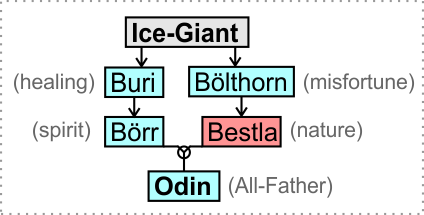
As a formless being, Odin can therefore be seen as the deity itself, beyond all forms in time and space—a holistic and imperishable being. He can also be described as truth, or wholeness, that was before anything came into being, and always is and always will be.
To gain a more comprehensive understanding of this profound essence of Odin from a spiritual perspective, we will now turn to the symbolism of some stories from the Edda.
Mimir's Well
First, let's explore how Odin became a creator god. The Völuspá, the “prophecy of an ancient seeress”, offers a brilliant parable to illustrate this:
27. She (the seeress, or intuition) knows of Heimdall's horn, hidden beneath the sacred, light-accustomed tree. She sees a foaming river flowing from Val-Father's pledge. Do you understand this?
28. She sat alone outside when the ancient one, the wisest of the Aesir, came and looked into her eyes. (Then she spoke:) “What do you seek? What do you wish to know? I know everything, Odin, even where you have hidden your eye is revealed to me. You concealed it in Mimir's pure well. And Mimir drinks mead every morning from Val-Father's pledge.” Do you understand this?
(Völuspá, after Wilhelm Jordan and Edward Pettit)
This parable can be interpreted very profoundly from a spiritual perspective, far beyond our ordinary intellect. If we consider the eye as a symbol of consciousness, then the All-Father Odin would have given half of his consciousness as a “pledge” for creation, to redeem it at the end of creation. Thus, divine or holistic consciousness confronts itself within creation, contemplates itself, and sees what kind of forms the formless consciousness can bring forth. The pure well would then be the well of destiny or the sea of causes, in which, so to speak, all possibilities for creation are available.
Who draws from this source “every morning” when the earthly sun rises? The Old Norse name Mimir is derived from “memory” or “remembrance”, thus recalling the principle of conceptual understanding. Similarly, in the Nibelung saga, the smith Mimer is described as forging the forms and concepts of consciousness in the fire of the mind. The following image shows Mimir drawing water from the well, or sea of causes, at the root of the world tree with Heimdall's horn. On his shoulder sits Odin's raven, presumably Muninn, whose name also evokes “memory.” Accordingly, his long hair is often interpreted as a symbol of thoughts growing from the head. The image also beautifully depicts how intellect itself rises from the well, like a wave on the sea of causes, and becomes the root of the tree of life, the “sacred, light-accustomed tree.”
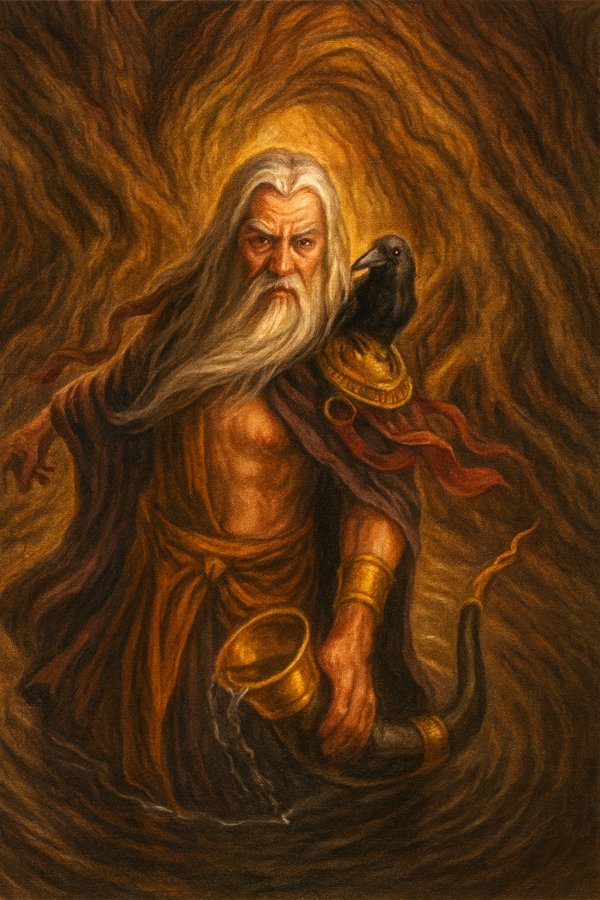
Thus, Odin became the “creator god” by sacrificing an eye as a pledge, allowing the intellect to draw creation from the universal well of memory or sea of causes of consciousness. Accordingly, Odin is often depicted with one eye, and with this eye of “insight,” he gazes upon creation. This ensures he is always aware that he is merely looking at himself. This metaphor of “looking at oneself” also points to “self-knowledge,” to “divine consciousness,” as the gods' ultimate goal in their struggle for wholeness. And in this, one could essentially see the meaning of all creation.
Heimdall
The name Heimdall can be interpreted as “he who illuminates the homeland or world” or “he who shines homeward”. He thus belongs to the divine or holistic beings. In the myths, it is said that he can hear the grass growing and the wool on the sheep. He sees and hears everything; he is all-seeing, all-hearing, and all-knowing. Day and night he keeps watch, is considered the guardian of the gods, the father of humankind, and the protector of the rainbow or light bridge between Asgard and Midgard—that is, between the world of the gods and the world of humans, or even between Odin's two eyes. In all of this, one can recognize an image of fundamental consciousness, the principle from which all creatures arise and in which everything exists. Thus, the light of consciousness can be seen as a bridge between all worlds, all forms, and all experiences.
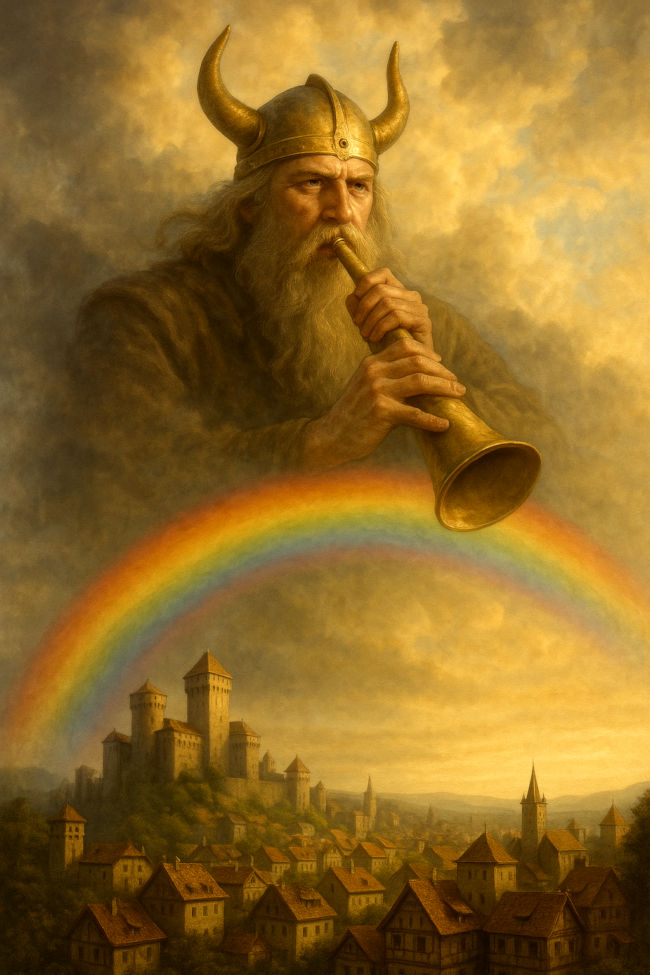
Accordingly, in the first verse of the prophecy (see above), all “higher and lower offspring of Heimdall” are addressed, that is, all human beings and, in a broader sense, all creatures on higher and lower levels of consciousness, from the all-conscious deity to the almost unconscious matter. Thus, the aforementioned “Horn of Heimdall beneath the Tree of Life” is also a wonderful symbol: the tip of the horn signifies the unity from which diversity flows, and from this flow all beings drink the sweet mead. Mead itself is also a frequently used symbol, reminding us of the divine drink of wholeness, which Mimir drinks in the growing daylight. When the light of consciousness then fades again, it is also referred to as ale or beer, which intoxicates and makes one sleepy.
Thus, in the Edda text of “Gylfi's Illusion,” the “Illusion of the Foaming Wave”, it says:
27. Heimdall is the name of one who is also called the white god. He is powerful and holy, and was born of nine maidens who were sisters. He is also called Hallinskidi (“Horned One”) and Gullintanni (“Golden Tooth”) because his teeth are made of gold. His horse is called Gulltoppr (“Golden Mane”). He lives on Himinbjörg (the “Sky Fortress”) near Bifröst (“Bridge of Light or Rainbow Bridge”). He is the guardian of the gods and sits at the edge of the sky to protect the bridge from the frost and mountain giants. He needs less sleep than a bird and can see a hundred miles both by night and by day. He can also hear the grass on the earth and the wool on the sheep growing, in fact, everything that can be heard. He has a trumpet called the Gjallarhorn (“Calling Horn”), and when he blows it, it is heard in all the worlds. Heimdall's sword is called Hofund (Hǫfuð, “head or man's head”). It is further said: “Himinbjörg is the name given to the place where Heimdall, so it is said, rules the sacred site. There, in his peaceful home, the guardian of the gods blissfully drinks the sweet mead.” He himself also says in Heimdall's song: “I am the son of nine mothers, born of nine sisters.” (Gylfaginnîng after Arnulf Krause and Karl Simrock)
And in the “Hynda song”, it says of Heimdall:
35. Born at the beginning of days was One, a miracle of strength, of divine origin. Nine of the giantesses bore the weapon-renowned (or merciful) man at the edge of the earth.
36. Much we tell you, and will tell you more, for it seems good to me to know of it. Do you want more?
37. He was borne by Gjalp, Greip, Eistla, and Eyrgjafa. He was borne by Ulfrun, Angeyja, Imd, Atla, and Jarnsaxa.
38. He was made strong by the power of the earth, the cool sea, and the (fiery) boar's blood. (Hyndluljóð after Arnulf Krause, Edward Pettit, and Karl Simrock)
How can consciousness be born? Consciousness itself is formless, yet it can assume any form. Nine giantesses are mentioned here as personified creative forces of nature, whose names, however, are difficult to interpret. Possible interpretations include: calling or summoning, seizing, storming and silting up or embodiment, as well as Wolf-rune as the wolf's secret, distress or affliction, darkened power or mist, terrible or quarrelsome, and iron sword as distinction and separation. The birth or embodiment of Heimdall is strengthened by the natural elements of earth, water, and fire. One could also imagine that Heimdall, as pure consciousness, embodies all nine worlds through the nine sisters, with Midgard, the human world, at their centre. In this sense, he would then also be the protector of the nine worlds and the bridge between everything.
Mimirs Head
Thus, the separation of Odin's two eyes creates a world of opposites, which then clash in a struggle to find balance. This is why Odin is also called Val- Father or Host-Father, the Father of the warriors. Among the greatest contrasts is the distinction between spirit and nature, which we find in the Edda as the battle between the Aesir and the Vanir, the gods of spirit and nature. The name Vanir can be derived from “externally shining”, referring to the radiance of forms, but also from the German word “Wahn”, meaning delusion or illusion. One can imagine the following world:
Giants/Macrocosm
Nature👁️Vanir - Humans/Midgard - Aesir👁️Spirit
Dwarfs/Microcosm
Thus, humankind stands between all these opposing forces, in the “middle garden” of creation, and naturally at the heart of such symbolic sagas, striving to find its place and purpose within creation and to understand itself. The Völuspá recounts the following about this first great battle between the Aesir and Vanir, immediately before the story of Mimir's Well:
21. The first battle in the world was fought when the (fateful) fairy of gold was strengthened in fire. In the hall of the High One, she was heated to the point of melting. Thrice fired, thrice reborn from the embers. Again and again she comes to life, at any time and in any place.
22. Bright radiance was what she was called wherever she entered a house, promising blessings, working magic. She practiced the art of refining, promising treasures, a constant favourite of wicked (greedy) people.
23. Then the holy gods gathered on high seats and deliberated whether they should avenge the heinous sin or all accept atonement.
24. Then Odin hurled his spear into the host, and the first battle in the world began. The stronghold of the Aesir fortress was broken, and the mighty Vanir trampled the battlefield.
25. Then the holy gods gathered on high seats and deliberated over who had corrupted the airy realm with deceit and delivered Odin's bride to the giants.
26. Thor alone was seized with the fiercest anger, for he rarely hesitates when he learns of such things. And so, the oaths, promises, and pacts that had hitherto been sacredly made between them vanished into thin air.
(Völuspá, after Wilhelm Jordan and Edward Pettit)
The opening verses evoke nature, which fatefully arises from the “gold” of truth and comes alive in creation. The “thrice” is found throughout nature, where, in the interplay of opposites, a directed effect is meant to occur as a third force. The “bright radiance” would then be the outward brilliance of the magical and seductive forms in nature, which beings, and especially humans, reach for. This gives rise to desire and hatred, and from this, the sin of separation from wholeness or divinity. This also includes the separation between spirit and nature, as well as between creator and creature. Odin and his bride, who was seized by overwhelming giants in order to take possession of nature, can be seen as symbol of this. We will consider Thor's role as a fighter against the giants' overwhelming power in more detail later.
A continuation of the description of this first great war between the Aesir and Vanir can be found in the Ynglinga Saga, where it says:
Odin marched with an army against the Vanir, but they were well-equipped and defended their land, and so first one, then the other, was victorious. Both ravaged each other's lands and inflicted damage on one another. But when their strife grew too much, they agreed to a meeting for reconciliation. They concluded a peace contract and gave each other hostages. The Vanir gave their most distinguished men, Njördr the Rich and his son Freyr, while the Aesir gave a man named Hönir. They said he was very well suited to be chieftain. He was a tall and very handsome man. With him, the Aesir sent Mimir, a very wise man, and the Vanir gave in return the wisest of their men, named Kvasir. When Hönir arrived in Vanaheimr, he was immediately made chieftain there, and Mimir advised him in all matters. But whenever Hönir was at a Thing or assembly, and Mimir was not nearby, he always answered difficult cases in the same way: “Let others decide.” he would say. Then the Vanir suspected that the Aesir had deceived them in the exchange of men. They seized Mimir, cut off his head, and sent the head to the Aesir. Odin took the head, coated it with herbs so that it would not rot, cast spells over it, and thereby gave it such power that it spoke to him and revealed many hidden things.
Aesir 👁️ spirit | nature 👁️ Vanir |
Hönir | Njördr with Freyr and Freyja |
Mimir | Kvasir |
Odin made Njördr and Freyr temple priests, and they became “Diar” (“high priests”) among the Aesir. Njördr's daughter was named Freyja. She was a temple priestess. She was the first to teach the Aesir magic, as it was practiced among the Vanir. While Njördr was with the Vanir, he had married his sister, for this was lawful there, and their children were named Freyr and Freyja. But among the Aesir, it was forbidden to marry within such close kinship.
(Ynglinga saga, Chapter 4, after Felix Niedner, 1922)
What at first glance seems like a simple story, reveals itself upon closer examination to be a tough nut to crack, one that requires a long toil before the kernel can be tasted. Let's try: The struggle between spirit and nature will always ebb and flow, and neither side can be victorious, for it is a battle against itself. Thus, a peace contract is perhaps the best solution for reaching an agreement. Instead of “mutual hostages,” perhaps it would be better to speak of “mutual guarantors” to overcome the contradictions between spirit and nature—that is, nature beings who are allowed to rule in the spirit realm, and spirit beings who are allowed to rule in the nature realm. For this, the Vanir gave Njördr with his children Freyr and Freyja, as well as Kvasir. Njördr is the ruler of the sea, the wind, and fire, and with his children, also of fertility, beauty, love, and the magic of nature. They were made priests by the Aesir, who, in a certain sense, can rule over the gods. They also received Kvasir. He originated when the Aesir and Vanir spat together into a jug at the end of their battle and probably symbolizes the natural or worldly wisdom from which the mead of the skalds, bards and poets later emerged.
Even more symbolic are Hönir and Mimir, who were given to the Vanir by the Aesir as rulers. We have already encountered Mimir as an instrument of creation in the sense of the creative intellect. Hönir, then, must be divine reason, which should reign holistically as king in nature. His wise advisor would then be Mimir, serving reason with his power of judgment and discernment. And reason, of course, needs this willing intellect to rule as king in worldly affairs. For pure reason is an immortal, holistic, and therefore non-dualistic consciousness that perceives but does not judge or distinguish, as in good and evil or right and wrong. Thus, Hönir, too, is immortal, survives Ragnarök, the end of the world, and then establishes a newly emerging world. Similarly, in Indian mythology, one can also find Vishnu as an immortal principle of divine reason, who survives the end of the world of the creator god Brahma.
But now something strange happens: The Vanir realize that their king, Hönir, cannot make decisions or judgments without Mimir present. Consequently, they capture Mimir and behead him. They keep his dead body and send his head back to the Aesir. While this prevents Mimir from running away, it also renders him a dead, or rather, physical mind, so that reason can no longer reign. And they don't want the spiritual, or living, head of reason. Does this sound familiar? We experience this in our world today more clearly than ever before, because a dead mind only produces dead things, what we call the “technological revolution”, an age of dead machines that have now conquered almost every aspect of human life. And even our natural scientists don't want the mind as the head of the living intellect, relegating it to spirituality or religion. What motivates this? Here one can reflect on the act of grasping, the desire to hold on, and the yearning for ever more power and possession, as it says above: “They therefore seized Mimir...” This already shows the influence of the nature of giants in their striving for overwhelming dominion in nature.
So, we can now ask: What is our problem if the mind can detach itself from our internal council? Why don't we want a freely moving and vibrant mind? This is precisely what yogis work on in meditation: to make the mind vibrant and free again, so that it can also detach itself and be silent in order to hear divine reason.
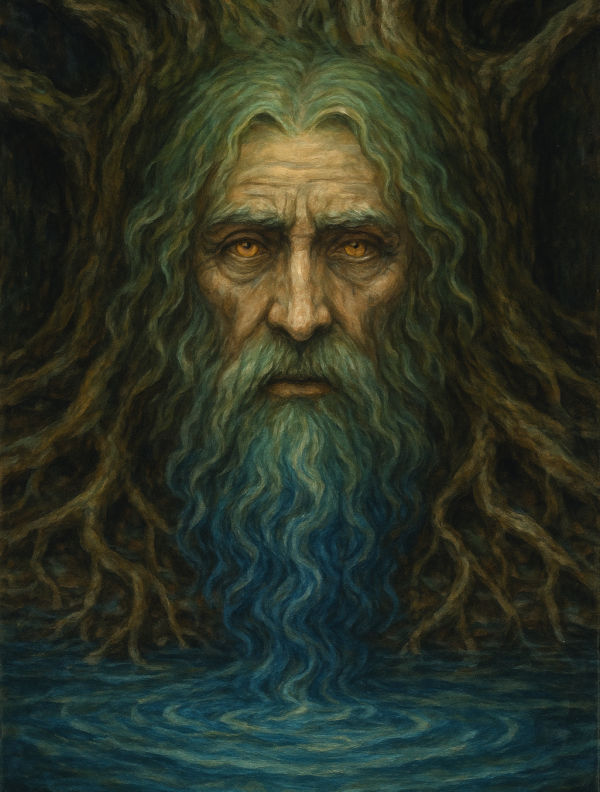
Similarly, Odin also revived Mimir's head through the power of spells and herbs, or rather, through the power of spirit and nature. Thus, he preserves the living mind of the creative intellect at the root of the world tree and the tree of life, as long as creation exists.
The Story of Kvasir
Much can be pondered about the kinship between Mimir as creative intellect and Kvasir as inspiring wisdom, and their connection to mead as the drink of the gods. A similar meaning to that described above for Mimir can also be found in the ingenious story of Kvasir, who is likewise killed in nature and resurrected by Odin in the spiritual realm. This means that wisdom must take shape and transform itself in order to become effective and helpful. As it is written in the Book of Skalds, §1:
“Where does the art you call poetry come from?” Bragi replied: “It began when the gods had a war with the Vanir. But they negotiated peace and made it by each of them going to a vessel and spitting into it. When they parted, the gods took it. They didn't want to lose this symbol of peace, so they created a man from it. He was called Kvasir, and he was so clever that no one asked him questions he couldn't answer. He travelled far and wide, teaching people his knowledge. When he came to the dwarves Fjalar and Galar (presumably “the Concealer” and “the Singer”) at their invitation, they invited him to a secret conversation and killed him. They let his blood flow into two vessels and a cauldron, the cauldron being called Óðrerir (“Inspiration-bringer”), and the vessels Són (“Reconciliation” or “Atonement”) and Boðn (“Sacrifice”). They mixed honey with the blood, and from this came the mead that makes anyone who drinks it a poet and a sage. The dwarves told the Aesir that Kvasir had choked on his own wisdom; for no one was wise enough to bear all his knowledge.
Then the dwarves invited the giant named Gilling (“the Screaming, Roaring, or Commanding”) and his wife. They asked the giant to row out to sea with them (to fish). But as they rowed along the shore, the dwarves hit a cliff and capsized the boat. Gilling couldn't swim and drowned, but the dwarves righted the boat and rowed ashore. They told his wife about the incident. She grieved and wept loudly. Then Fjalar asked her if she wouldn't feel any comfort if she looked out to sea, to where he had drowned. She agreed. He told his brother Galar to go up through the doorway and, when she came out, to drop a millstone on her head. He said he was sick of her wailing (or screaming). And so, he did.
The name Kvasir is reminiscent of “kvass,” the fermented juice that represents the essence of the shared being of the Aesir and Vanir, or spirit and nature. Within this mutual essence lies the inspiring wisdom that can manifest as worldly intelligence and answer all conceivable questions. However, as long as it remains merely a thought experiment, it is nothing more than the clamour of the intellect, which strives to be grand and powerful, like an all-powerful giant, or like an elaborate theory lacking practical application. Thus, we might imagine that the dwarves, as nature spirits in the microcosm, see their role as transact this wisdom into reality. Therefore, the dwarves may not act as maliciously and cunningly as they are often portrayed, but rather ensure that this inspiring wisdom can have a creative impact and does not suffocate under its own weight. Thus, they can unleash great powers from this wisdom to defeat the overwhelming giants, the clamour of the intellectual giants, as man and woman in relation to spirit and nature. The intellectual mind sinks once more into the sea of causes, and physical matter is ground and crushed. But these two have a son who is difficult to defeat:
When the giant Suttungr (“the Heavy”), Gilling's son, heard of this, he came and seized the dwarves. He took them out to sea and set them adrift on a small rocky island, which was submerged at high tide. They begged Suttungr for their lives and offered him, as atonement for his father, the precious mead, which he accepted. Suttungr brought the mead home and hid it in the place called Hnitbjörg (“firm rock”). He appointed his daughter Gunnlöd (“challenge to fight”) to guard it. Therefore, we call the skaldic poem Kvasir's Blood, Drink of the Dwarves, Strength of the Dwarves, a kind of drink from Óðrerir, Són, or Boðn, the ship (as salvation) of the dwarves, because this mead saved their lives from the rocky island, Suttungr's Mead, or the drink from Hnitbjörg.” - Ägir said: “It seems to me difficult to understand how to name skaldic poetry with these names.”
Regarding Suttungr, we can think of the egoism that makes life so difficult for us, both mentally and physically, and which, as experience shows, is so hard to overcome. Here we also find the “seizing” with which egoism grasps for possessions, hardens, and becomes embodied. Suttungr seizes the dwarves as nature spirits, separating them on the “Sea of Life” from the wholeness of creation on an island, and is prepared to let them drown because they appear threatening to him. The inspiring poet's mead counteracts this and allows them to continue living. But the mead, too, is then seized by egoism and locked away and hidden as possession within material physicality. In this, one can recognize the principle of egoistic embodiment. His daughter is reminiscent of the soul he traps in order to guard this possession. But precisely as the soul of nature, she is also the principle of causation and “challenges” him to a struggle for liberation and spiritual awakening.
Finally, the list of names beautifully describes how the wisdom of poetry interacts with the dwarves and egoism to subtly work within people, preserving life and opening the depths of inspiration and intuition. For this purpose, there is the cauldron of inspiration and the two vessels of reconciliation, to overcome sin, and of surrender as a sacrifice to egoistic possession. In this way, even egoism can find itself within wholeness. But for this to happen, the mead, as the divine drink of wholeness, must be freed from embodied and solidified matter and become effective.
And Aegir (“the sea” as “water of life”) continued: “But how did you Aesir obtained Suttungr’s mead?” Bragi (“god of poets and writers”) replied: “A story tells how Odin left home and came to where nine servants were mowing grass. He said that if they wished, he would sharpen their scythes. They agreed. So, he took a whetstone from his belt and sharpened the scythes. But the scythes seemed to cut much sharper to them, and they wanted to buy the stone. He, however, valued it so highly that whoever wanted to buy it would have to pay a suitable sum. They all declared their intentions and demanded the stone should be handed over to them. But he threw the stone high into the air. And when they all tried to catch it, they became so confused that each one cut the other’s throat with the sharp scythe.
Odin sought lodging for the night at the home of the giant Baugi (“the Inclined”), Suttungr's brother. Baugi said his farm was in bad shape, and that his nine servants had killed each other, but he had little hope of finding new workers. Odin called himself Bölverkr (“Wicked One”) before him. He offered Baugi the labour of nine men, but demanded a sip of Suttungr's mead as payment. Baugi explained that he could not have the mead, for Suttungr wanted it for himself. However, he agreed to go with Bölverkr and try to get the mead. Bölverkr performed the labour of nine men for Baugi throughout the summer, and as winter approached, he asked him for his payment. Then they both went to Suttungr. Baugi told his brother about the agreement with Bölverkr, but Suttungr refused every drop of the mead. So Bölverkr suggested to Baugi that they try to get the mead by trickery, and Baugi agreed. Bölverkr then produced a drill, which was called Rati (“the Driller”), and told Baugi to drill into the rock until the drill would bite in. Baugi did so. Then Baugi said the rock had been drilled through. But Bölverkr blew into the hole, and shavings flew out. From this, he realized that Baugi was trying to deceive him. He ordered him to continue drilling, and Baugi drilled again. And when Bölverkr blew into it a second time, the shavings flew inwards. Then he took on the form of a snake and crawled into the borehole. Baugi stabbed at him with the drill but missed him.
Bölverkr went to where Gunnlöd was and lay with her for three nights. She promised him he could drink three sips of the mead. With the first sip, he drank all of Óðrerir, with the second he emptied Boðn, with the third Són, and thus he had all the mead. He transformed himself into an eagle and flew away as fast as he could. But when Suttungr saw the eagle flying, he too took on the form of an eagle and flew after him. When the Aesir saw where Odin was flying, they placed their vessels outside in the courtyard. And when he came to Asgard, he spat the mead into these vessels. But Suttungr had nearly come close enough to grasp him, so he let some mead go unnoticed. Anyone who wanted it could have it, and we call it the poets' share. Odin gave Suttungr's mead to the Aesir and to those who can write poetry. For this reason, we call skaldic poetry Odin's booty, Odin's find, Odin's drink, Odin's gift, or drink of the Aesir.”
(Skáldskaparmál §1 after Arnulf Krause and Rasmus Anderson)
Here we learn more about the nature of Odin. The nine servants are reminiscent of nine masculine or spiritual beings that serve the ego, such as the five senses, memory, thought, intellect, and will. But when they are “sharpened” by the divine, their natural desire for ever more ultimately leads to their mutual destruction; that is, they annihilate each other as separate beings in the whole. Then it becomes clear that, in essence, only Odin himself, as the creator god, serves all creatures with his “nine-man strength” through his two eyes of pure consciousness.
But he introduces himself to the giant as “Bölverkr,” which means “the wicked one”, because he had also been responsible for the giant's servants killing each other. Based on such stories, it is often claimed that the Norse gods are cunning liars and deceivers. But one should be careful here, because people usually feel quickly cheated and lied to when the gods don't do what they expect. This happens when we project our human moral expectations onto superhuman beings. This is especially true for selfish people who, as separate individuals, naturally have very different interests than a holistic divine being. So, it is not surprising that they feel cheated and lied to by the gods. Many have even left the Christian church because they no longer wanted to worship a god who allows so much injustice and evil in the world, a problem known as the “problem of theodicy”. From there, it is a short step to also calling them “wicked”.
Thus, Odin now serves the “inclined” Baugi and finally requests his reward when winter arrives, which could also refer to the final stage of physical life. Then it would be good to recognize the deity, to overcome the greedy desire to grasp and hold on, and to relinquish personal attachments to possessions. Baugi seems inclined to do so, but his selfish brother Suttungr is not. Here, Odin's cunning trick comes into play once again. Indeed, one could even consider this entire creation as a trick, so that consciousness can rediscover and recognize itself. For this purpose, the wondrous symbolism of a divine drill is described here as a kind of “consciousness drill for spiritual breakthrough”, which is entrusted to the immense power in the macrocosm to bore through the hardened matter to the very foundation of creation. Sometimes our intellect tries to do this too, but it is reluctant to bore to the bottom and prefers to deceive itself in the process. As long as any shavings or particles still fly back at us when the wind of the mind blows into the hole, we have of course not yet reached the bottom, but are still in a world of reflections from the opposing intellect. But when the hole is drilled, the divine slips in, because as pure consciousness it is not bound to any form, while the external embodiment cannot follow inwards.
There, the divine, or holistic, spirit rediscovers the pure soul of nature and unites with her in the great mystical marriage of spirit and nature, unity and diversity, freedom and connection. The three nights can remind us of the three forms of time: past, present, and future, for this union naturally transcends time and space. This is also the true and pure love of God, with which, in essence, the original conflict between the Aesir and Vanir finds its end. As a result, inspiring wisdom returns to the divine, or wholeness, as “whole mead” or “divine drink of wholeness”. Then Odin, as the eagle and king of birds, flies back to his realm of the gods, and what was meant to happen occurs: the egotistical Suttungr follows him on this path and also raises his consciousness to the holistic realm of the gods. While the eagle still acts as a “bird of prey”, this desire to grasp and comprehend the mead of wisdom then returns to Earth and the human world as “Suttungr's mead” and divine inspiration for poets. A wonderfully profound symbolism that invites long contemplation, for it depicts nothing less than the path of wisdom from the dark depths of matter back into the divine light!
This story is also addressed in another text of the Edda, the Hávamál, also known as “The Sayings of the High One”, in which Odin offers sound advice to mortals:
104. I visited the old giant, now I am back: I gained little there through silence. I spoke many a word to my advantage in Suttungr's Hall.
105. Gunnlöd, seated on a golden throne, offered me a sip of the precious mead. I gave her only a small reward for her sacred feelings, for her fervent spirit.
106. I let Rati's Mouth (the “Consciousness Drill”) carve a path for me, gnawing through the rocks. The paths of the giants ran around me, but for this I risked my life.
107. I have made good use of the form I assumed. The wise man lacks nothing. For Óðrerir (“Inspiration-Generator”) has now become a sanctuary for humankind.
108. I doubt I would have returned from the realm of the giants if Gunnlöd, the good maiden, had not helped me by putting her arm around me.
109. The following day, the frost giants hurried to the hall of the High One (Odin) to hear High Council. They inquired about Bölverkr, whether he had returned to the gods, or whether Suttungr had killed him.
110. Afterward, they spoke: Odin had sworn a ring oath (as a marriage vow). How can one trust his promises? He cheated Suttungr out of the potion, and he left Gunnlöd (“she who challenges to battle”) suffering (in the human world).
(Hávamál after Karl Simrock and Edward Pettit)
“Oh wonder of wonders, what noble suffering it is when the soul’s being can suffer nothing other than the pure unity of God!” (Meister Eckhart, Sermon 42)
In summary, it can be said that every person can experience this story in their life. For even our parents, who for a long time were our guides and “commanders”, eventually die, usually through the dwarfish power of the microcosm. Spiritually, they sink back into the sea of causes, or the water of life, and physically, they dissolve. We remain as individuals. And when we examine our own being, we can find the screaming intellectual giant who wants to command us, along with his physical wife. Perhaps we also recognize the dwarfs as inner forces of nature, trying to transform divine wisdom into reality. Then we will likely also find the ego giant and our soul, enclosed in the material body, preserving the mead of wisdom. Perhaps we will even become aware of his giant brother, who is inclined towards the divine and whom the nine servants serve. Then we could help him to bore through consciousness to the very foundations of the world, thus clearing the way for the divine to reunite with our soul in wholeness.
Thus, in this story of Kvasir, one finds a brilliant description of how humankind, through intuitively inspiring wisdom, can recognize and understand its “environment” in the broadest sense: the gods as holistic beings of spirit and nature, the giants of the macrocosm and the dwarfs of the microcosm. Through this understanding, one can recognize oneself within this larger whole and become an inspired poet, expressing this profound insight, incomprehensible to the ordinary mind, in brilliant words and symbols. It is likely that many ancient myths, legends, and fairy tales originated in this way, passed down through centuries, perhaps even millennia, across all cultures. Thank God!
Odin's Throne
We continue with the nature of Odin. In the Edda text “Gylfi's Illusion” (“Illusion of the Foaming Wave”) it says:
The food that lies on Odin's table he gives to his two wolves, who are called Geri and Freki (“Greed and Glutton”). He himself needs no food. Wine is both drink and food to him. Thus it says:
The battle-hardened, glorious Host- Father feeds Geri and Freki,
But the battle-famous Odin lives only on wine.
Two ravens sit on his shoulders and whisper into his ear everything they see and hear. They are called Huginn and Muninn (“Thought and Memory”). At daybreak, he sends them out to fly over the whole world, and they return for the day's meal (between morning and noon). From them he learns many news. That is why he is called the Raven God. Of this it is said:
Huginn and Muninn fly over the vast earth every day;
I worry about Huginn (“Thought”), that he won't return;
But I fear even more for Muninn (“Memory”).
(Gylfaginning after Arnulf Krause and Karl Simrock)
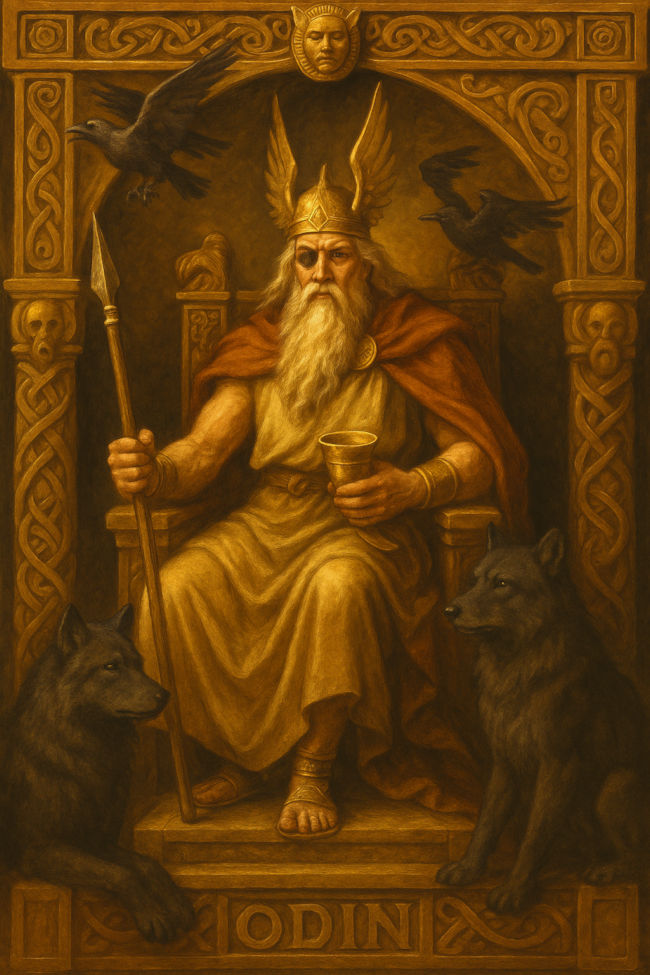
Thus, Odin, as the All-Father and creator god, sits upon the golden throne of omnipotence. At his feet sit two tamed wolves, which are in their nature hungry predators, and are called “Greed and Glutton”. Just as humankind has tamed dogs as domestic animals, so too is the symbolism of the black wolves employed here. From a spiritual perspective, we can see in them a symbol of voracious transience, which always desires that everything that arises in the light should also perish in darkness, that everything that is created should also flow back into the sea of causes. In the image of Mimir above, one can clearly see how he draws the water of life from the sea of causes at the root of the Tree of Life with his horn. But why does it not flow back immediately? What holds it back so that we can experience the transience of time? In this, we could see the symbol of the “tamed wolves” as “restrained transience”, so that living beings in creation can learn something within the temporal interplay of cause and effect. If everything happened simultaneously, as one might imagine eternity, then this learning would not be possible, because everything that comes into being immediately passes away. This also expresses the principle of desire, as a wish to hold onto certain forms in consciousness. The shadow side of this is the potential for loss.
Thus, Odin, as the All-Father and creator god, ensures a restrained transience in the creation of this world through his tamed wolves. And therein lies a great blessing of the deity, for through this we can seek the imperishable within transience and find it beyond time and space, as well as beyond all names and forms.
The two ravens, considered particularly wise animals, are also wonderful symbols. Here, they represent thoughts and memory. Their dark colour reminds us that these are darkened forms of the pure light of consciousness, arising as thoughts in the interplay of light and darkness, like images on a cinema screen, and preserved as a film that can be revisited in memory. In the dawn of creation, they fly into the world, yet always return to the creator god, who, as a holistic being, is also “omniscient”. But these images of mental knowledge are essentially only illusions, like the images on a cinema screen. This justifies the concern that these illusions could dissolve and that all of creation might one day perish. And yet, even the creator god, as the “raven god”, lives from this illusion, for it is from this illusion that Mimir, as intellect, creates this entire world. Perhaps we should speak more accurately of a “power of illusion and creation”, which, interestingly, must also be imperishable and eternal—a typical divine power. For if it were to cease to exist, there could be no more creation.
This could also be suggested by the symbolism of wine, on which Odin alone feeds, for he gives everything else to the wolves of transience. For creatures like us humans, this “power of illusion and creation” can be an intoxicating beer that makes us sluggish and sleepy, or mead as the divine drink of wholeness, from which we can awaken from the dream of illusion. In the latter, one could see the great purpose of all creation. But why doesn't Odin drink mead? Well, Odin is already awake, for as the All-Father, he is aware that all of creation is merely his second eye. Therefore, he consciously drinks the noble wine of illusion so that creation may appear, to help our consciousness awaken as well and recognize ourselves in everything. Who can understand this? Indeed, here our ordinary understanding quickly reaches its limits. But perhaps the symbolism of such ancient myths can help us to transcend these boundaries and expand and elevate our consciousness, like Suttungr in his greed for the poet's mead.
Finally, we can ponder on the spear that Odin holds in his right hand. It is said that it never misses its target and always returns to its owner. It was forged by the dwarves as a magical weapon for the All-Father of creation. Its name is Gungnir, the “wavering” or “rocking”, reminding us of the waves of action on the sea of causes. This, too, embodies the essence of the “power of illusion and creation”, representing the law of cause and effect in creation. Here, we can think of the laws of nature, created by the microcosm, to which every creature must submit. This “wave” is also the “will” of the creator god as the creator of all creation. And with this spear, Odin began the battle between the Aesir and Vanir, or between spirit and nature. Thus, this spear of the creator god could also symbolize the soul's power of causation in nature, directed toward the great goal of all creation.
Odin's Eight-Legged Horse
The Edda text continues with “Gylfi's Illusion”, the “Illusion of the Foaming Wave”, concerning the construction of the gods' fortress Asgard and the birth of the horse Sleipnir:
42. Gangleri (“the Wanderer”) asked: “To whom does the horse Sleipnir (“the Gliding One”) belong? And what can be said of him?” - The High One replied: “You do not know Sleipnir’s qualities, nor the circumstances of his creation. Yet this will make the stories seem worthwhile to you. The gods’ settlement was still in the beginning when they had established Midgard and Valhalla. At that time, a master builder came to them and offered to construct a fortress so good within three years that it would be reliable and secure against the mountain and frost giants, even if they were to invade Midgard. But as payment, he demanded that Freyja should belong to him, and he wanted the sun and moon. Thereupon, the Aesir gathered and held council. This agreement was made with the master builder, according to which he would only receive what he demanded if he completed the fortress in one winter. But if any part of the structure was not finished on the first day of summer, then he would break the contract. And no one was to assist him in his work. When they told him these conditions, he demanded that they grant him the help of his horse Svadilfari (“unhappy or in the mud wandering”). And because Loki advised it, this was agreed upon with him.
He began building the castle on the first day of winter, and even at night he hauled stones on his horse. The Aesir were astonished at the sheer size of the rocks the horse pulled. It did twice as much work as the builder. But an unbreakable testimonial and many oaths bound them to their agreement, because the giants felt it unsafe to be among the Aesir without such a pact when Thor returned home. At that time, however, he had gone east to fight against fiends. As winter passed, the castle construction progressed rapidly, and the fortification was already so high and strong that no one could attack it. When there were only three days left until the beginning of summer, it was finished except for the castle gate. Then the gods sat down on their judgment seats and deliberated. Each asked the others who had advised marrying Freyja off to the land of the giants and corrupting the air and the sky by taking the sun and moon and giving them to the giants. And everyone agreed that this must have been recommended by the one who gave the worst advice of all, namely Loki, Laufey's son. They said he would meet a terrible death if he had no advice on how the builder would break the contract, and they attacked Loki. In his fear, he swore oaths that he would act in such a way as to make the builder break the contract, no matter how hard he tried.
And that same evening, when he went out with his horse Svadilfari to fetch stones, a mare came running out of the forest. She ran to the stallion and neighed. But when the stallion realized what kind of mare this was, he became wild, broke his ropes, and ran towards her. She galloped off into the forest, and the builder ran after her, trying to catch the stallion. However, the horses ran on all night, and that night the work was left unfinished. The next day, too, work was not carried out as before. But when the builder saw that his work could not be completed, he was seized with giant rage. Then the Aesir knew for certain that a mountain giant had come to them, which meant the oaths did not have to be kept. They called for Thor, who came immediately, and in the next instant, the hammer Mjölnir flew through the air. He paid the worker's wages, and these were not the sun and moon; rather, he even refused to let him live in the Giant's Realm. For the first blow struck so hard that the skull shattered into many pieces. He sent him down to Niflheim. But Loki had such a memorable encounter with Svadilfari that he later gave birth to a foal. It was grey and had eight legs. This horse is the best of both gods and men.”
(Gylfaginning after Karl Simrock and Arnulf Krause)
The gods' fortress serves as a symbol for all of creation. The menacing mountain and frost giants represent the personified forces of material embodiment, but also of stagnation, which, of course, must not be allowed to completely conquer the spiritual realm, as otherwise life would cease. This raises the crucial question: How can living creation be protected from the material stagnation brought about by the mountain and frost giants? A giant as architect seems the obvious choice, but he demands dominion over the light of the world and the goddess Freyja, the embodiment of love and the beauty of nature. In other words, he demands the key forces of life. Thor, with his hammer, which we will examine in detail later, is the primary opponent of this overwhelming power of the giants. We will also consider Loki's role later; he ensures that the giant is allowed to use the horse Svadilfari for the project. This horse reminds us of the living physicality of physical beings in general, whose labour and willingness to serve are enslaved and exploited by the all-powerful giant. This is how the gods also recognize that the master builder himself was a mountain and frost giant.
Loki then uses sexual desire to ensure that the horse leaves his “unhappy path”. To this end, he transforms himself into the female counterpart to the male horse, which now embarks on a “happy path”, namely, protecting living creation through living reproduction. The point is not to serve the frost giants, to imprison divine life in a material fortress behind thick stone walls where it can only stagnate, but rather to serve life itself as a flow of birth and death. Thus, the gods find better protection from the frost giants than any material walls can offer: the rainbow or light bridge Bifröst, which Heimdall, as consciousness itself, guards. For consciousness is, of course, the best protection against stagnation; the more conscious, the more fluid; the more expansive, the more holistic and divine.
On the path of the union of masculine and feminine as spirit and nature, Loki gives birth to the gray, eight-legged horse Sleipnir, the “gliding one”, which rises from the earthly mud and can effortlessly ride over earth and water through the air. Its gray coat reminds of a creature between light and darkness, like all of creation. And why does it have eight legs? Firstly, it was born of a god, so it is also a holistic being, possessing the four legs of both the male and female horse. In this, one can see the unity of the forces of spirit and nature, which, like eight legs or pillars, support physical creation. On this horse, which also became long-lived through its wholeness, rides not a frost giant, but Odin himself, the All-Father of creation—a wonderful symbolism.
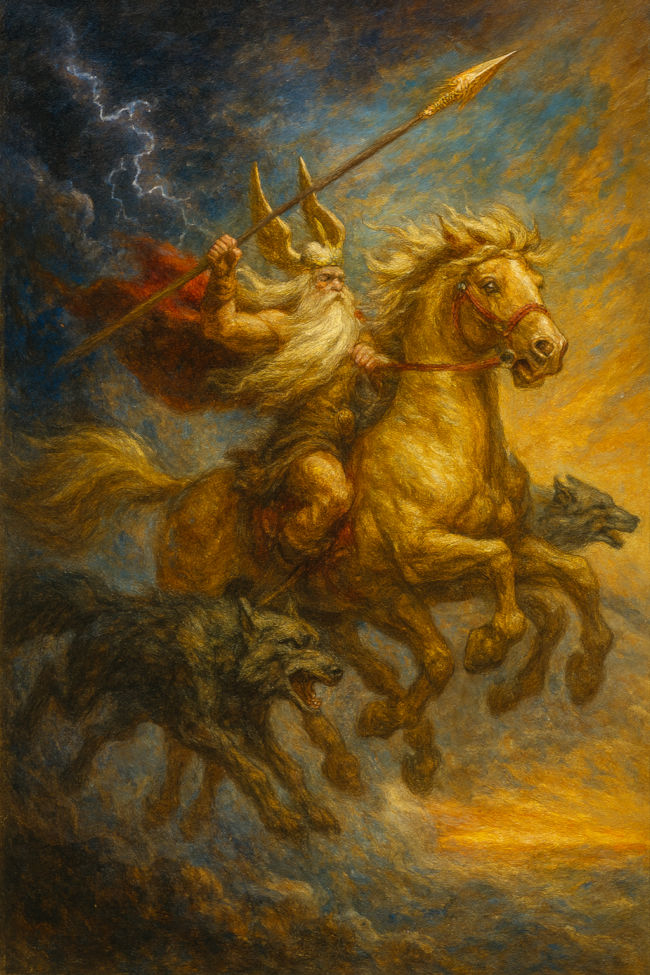
Odin, as both rider and divine will, would then be the “ninth” force, in the sense of the constant “renewal” of creation (nine = renewal). He could also be considered the first force, as the “unity” and origin of everything (one = unity). Such nine fundamental forces or principles of divine creation are also symbolically addressed in other stories, such as the nine mothers of Heimdall or the nine servants of Baugi. We could not find a detailed explanation of what these forces mean in detail in the Edda. However, other ancient writings also mention such forces in varying numbers as a vivid explanation of creation. For example, the 14th-century Christian mystic Master Eckhart speaks not of nine, but of six forces: desire, anger, discernment or intellect, memory, reason, and will.
…If we wish to be renewed in spirit, then the six forces of the soul, the highest and the lowest, must each have a golden ring, gilded with the gold of divine love. Now look at the lowest force, of which there are three. The first is called discernment; rationale, on this you shall wear a golden ring: this is “enlightenment”, so that your discernment may always be timelessly illuminated by the divine light. The second force is called anger; irascibilis, on this you shall wear a ring: this is “your peace”. Why? Well: so far in peace, so far in God; so far outside of peace, so far outside of God! The third force is called desire; concupiscibilis, on this you shall wear a ring: this is “sufficiency”, so that you may be content with all creatures that are under God. But God shall never be enough for you! For you can never have enough of God: the more you have of God, the more you desire him; for if you could have enough of God, so that there could be a sufficiency in relation to God, then God would not be God.
You must also wear a golden ring on each of the high powers. There are three high powers: The first is called the power of retention, memoria. This power is compared to the Father in the Trinity. On this power you shall wear a golden ring: it is a “retention”, so that you may retain all eternal things within yourself. The second is called reason, intellectus. This power is compared to the Son. On this power you shall also wear a golden ring: it is “insight”, so that you may know God at all times. And how? You shall know him without image, directly and without comparison. But if I am to know God directly in such a way, then I must become him, and he must become me. More precisely, I say: God must become absolutely me, and I absolutely God, so completely one, that this “he” and this “I” is one, become and are one, and in this unity of being eternally work one thing. For as long as this “He” and this “I”, that is, God and the soul, are not a single Here and a single Now, this “I” could never work with the “He” or become one. The third power is called will, voluntas. This power is compared to the Holy Spirit. On this you shall wear a golden ring: this is “love”, so that you may love God. You shall love God regardless of his lovableness, that is, not because he is lovable; for God is not lovable: he is beyond all love and lovableness. “How then shall I love God?” - You shall love God without mind (or without understanding), that is, your soul should be without mind and devoid of all intellectuality; for as long as your soul is mindful (or understanding), it has images. But as long as it has images, it has mediation; as long as it has mediation, it lacks unity and simplicity. As long as it lacks simplicity, it has never truly loved God; for true love depends on unanimity. Therefore, your soul should be devoid of all mind, should stand mindless (or without understanding). For if you love God as He is God, as He is Mind, as He is Person, and as He is Image—all of that must go. “But how then shall I love Him?”—You shall love Him as He is a non-God, a non-Mind, a non-Person, a non-Image, and even more: as He is a pure, clear, and distinct One, set apart from all duality.
And in this One we shall eternally sink from Something to Nothingness. May God help us in this. Amen. (Master Eckhart, Sermon 42)
Odin's Runes Song
To further explore the mystical nature of Odin, let's now turn to the “Runes Song” in the Edda text “The Sayings of the High One”:
I know that for nine long nights I hung on the Wind Tree, wounded by the spear, dedicated to Odin, myself to me, on the tree, from which one cannot see from which root it grows. I received neither food nor drink. Then I looked down, contemplating runes. I listened attentively, sighing as I learned them: At last, I fell to the earth.
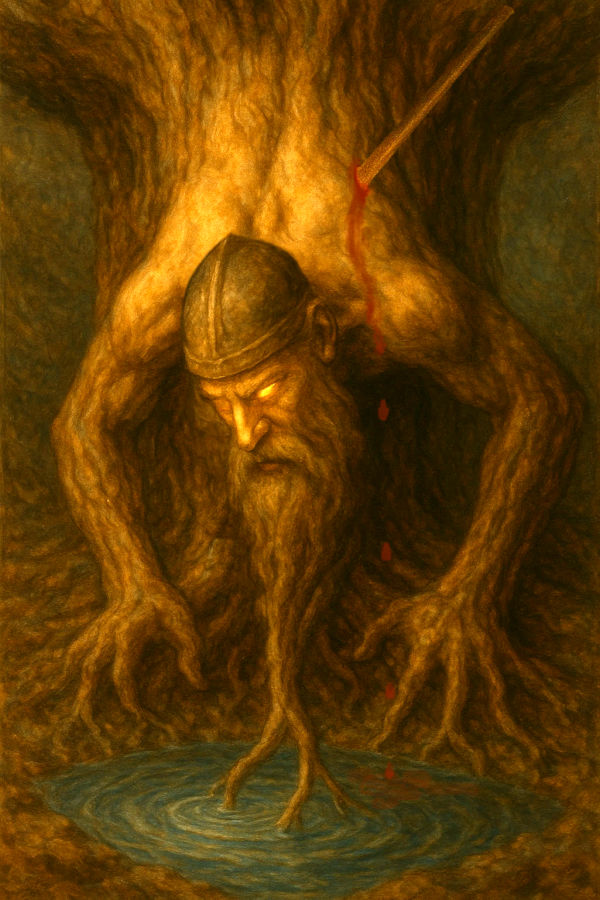
Here we can find another aspect of Odin, namely the mystical “I”. We usually experience ourself as a selfish ego, living in a personal and separate body, and thus mortal and transient. But beyond this small self, there is a higher, holistic, or divine self, of which Christ also says: “I am the light of the world.” Or: “I am the way, the truth, and the life.” Thus, in Odin's “rune knowledge”, we can also find so-called “self-knowledge”, when one recognizes oneself in everything, oneself as the source of life, and oneself as the root and trunk of the Tree of Life. For this, of course, one must look downwards, into the deep ground of everything, and the selfishly separate self must be surrendered and sacrificed.
The “nine long nights” can remind us of the long period of creation, during which the originally perfect light was obscured. Here, too, we find the number nine as a sacred number, reminding us of the cycle of development, testing, and renewal. The “wind tree” would then be a “spirit tree”, the world and life tree Yggdrasil, whose branches and leaves are the creatures. Here, Odin sacrifices himself, wounded by his own spear as the creative will in the interplay of cause and effect, and his sacrificial blood flows into the Well of Fate. He does not sacrifice himself to any foreign god or another creation, but to himself within himself, so that the sacrificer and the sacrifice become one again, just as self and God, the human and the divine self, are reunited. In this, one could see the goal of all creation as a path to self-knowledge.
Thus, I learned nine of the powerful runic spells from the wise son of Bölthorn (“evil-thorn”), father of Bestla (presumably Mimir). Then I was given the finest mead to drink, drawn from the well of Óðrerir (“Inspiration-bringer”). This gave me prosperity, wisdom, and memory. I grew, and I felt well. Word sought word from my word, deed sought deed from my deed. Runes (“secrets”) you will find and interpretable staffs, very meaningful staffs, very powerful staffs, which the wise Odin coloured, which the high council (of gods) created, and which Odin himself engraved as a prophetic advisor. Odin (“Power of Movement or Life”) engraved them for the Aesir, but Dainn (“Power of the Dead or Ancestors”) for the Elves, Dvalinn (“Power of the Sleeping or Dreaming”) for the Dwarves, Alsvidr (“Power of the Too Swift or Unrestrained”) for the Giants, and I also engraved some.
The “runes” are a central theme in Norse mythology, which also refers to itself as runic script. The name “rune” can be translated as “secret” or “trusted counsel”, a meaning still echoed in the old verb “to round”. More comprehensively, one could speak of the hidden meaning behind the outward symbols, for it is fundamentally about recognizing the source, the root, and the purpose of creation in all beings. The word “staff” can also mean “letter”. The staffs would thus be the symbols that can be found everywhere in creation, read, and coloured with emotional feelings—our “concepts”, so to speak. From this arises our world of good and evil, wanting and not wanting, desire and hate. The engraving or carving of the rune staffs would then be the creative power of Odin and I as “advisor” or “advise”. We have preferred the verb “engrave” here because “carve” sounds like injuring, and that is not what we are talking about. Engraving reminds us, on the one hand, of the inscription of spirit into matter, and on the other hand, of gravity, which, so to speak, embodies the symbols and their meanings through the attraction of mass. It is primarily the intellect, as Mimir, that gives them weight and importance, but also likes to complain about it (to complain = sich beschweren in German = to make oneself heavy). Accordingly, the runes were symbolically engraved into the wood of the Tree of Life, so that their respective meanings could flourish and grow as power in the branches of the tree, along the branching paths of the world.
Thus, the self can recognize that it is primarily the conceptual mind that gives meaning to forms and shapes. And once this secret has been recognized, what can the self do with it? In which direction can the self use this knowledge of the runes? Continue towards separation, obscuration, and bondage? Or towards wholeness and freedom in the divine light?
Do you know how to engrave and advise? Do you know how to colour and test? Do you know how to ask and offer? Do you know what to give and forsake? Better to ask for nothing than to neglect the sacrifice, for the offering is determined by the return offering. Better to give nothing than to neglect forsaking. Thus, the Thunderer (a name of Odin) engraved before the fate of humankind. There he departed, to where he returned.
I know runic spells unknown to everyone, not even the wife of the highest ruler or his son. The first is called the “Spell of Help”, for it aids in battles and troubles, in every worry and sickness. A second, I know, which humankind needs is indispensable for healing and the healer's work. A third I know, which can bind and chain spiteful opponents. It blunts the point of the enemy's spear, so that his weapons and runic staffs cannot wound me. A fourth I know: When enemies bind my limbs, I speak so that I can walk and move. Then the chain immediately falls from my feet, and the bond loosens from my hands. A fifth I know: If an enemy arrow comes flying menacingly in battle, however fast it may fly, I stop it with a glance of my eye. A sixth I know: If a warrior tries to wound me with the root strengthened by runes, the hatred intended to injure me will harm him more than me. A seventh I know: If the hall is ablaze around the benches of assembled guests, the blazing fire will never burn so far that I cannot save them with my runic spell. Learning the eighth spell would also be of great benefit to everyone: If hatred flares up among heroes' sons, it quickly settles it and makes peace. As for the ninth, I know how to save my ship in the flood when I am threatened with peril. I calm the raging storm on the waves and soothe the entire sea.
I know a tenth: When I see fence riders (witches) flying through the air, I cause them (the lost ones) to vanish back to where their form and spirit came from. I know an eleventh: When I am to lead my faithful into battle, I let the incantation resound from behind my shield. With glory they go safely into battle and return safely as victors. I know a twelfth: When I see the corpse of a hanged man dangling from a tree, I engrave and colour the runes so that this man comes to me and speaks with me. I know a thirteenth: When I consecrate a young man with water, he will not fall from swords even in the greatest melee of battle. As for the fourteenth, I know how to recite the gods before the assembly of the people. I know all the Aesir and Elves with their attributes, something no ignorant person can do. I know a fifteenth, sung by the dwarf Thjodrörir (“stone-hill dweller”) before Delling's Gate (“at daybreak”): He sang strength to the Aesir, benefit to the elves, and wisdom to Hroptatyr (the “holy god”, a name of Odin). I know a sixteenth: If I wish to win all the love and pleasure of an able maiden, then I will turn the senses and feelings of the white-armed maiden to myself. I know a seventeenth, so that the young woman will find it hard to leave me again. You, dear listener, will long miss these spells. But it is good for you to know them, useful to learn them, and helpful to accept them. I know yet an eighteenth, which I will never reveal to a maiden or wife. It is far better if only one knows it, someone who embraces me or is like my sister, for it is the conclusion of my sayings.
Thus are the sayings of the High One spoken in the hall of the High One, very useful to the children of men, but useless to the children of giants. Hail to him who spoke them! Hail to him who knows them and learns to use them! Hail to those who heard them!
(Hávamál, verses 138-164, after Arnulf Krause, Wilhelm Jordan, and Edward Pettit)
Once the holistic self has recognized and understood the spiritual essence of the forms and designs of this world, we now find essential runic spells for creatively and constructively influencing them. For the self has now found its unity with the Creator God. With this, everything can be healed, and even death loses its power. It is interesting that there are eighteen spells, although previously only “nine of the powerful runic spells” were mentioned, which the self had learned from Mimir. Perhaps the other nine spells do not originate from Mimir as conceptual intellect, but rather as a reflection of himself as holistic reason. Thus, one can also find certain complementary pairs within the spells, such as spells 1 and 2 as help and healing, or spells 3 and 4 as bonding and salvation. After the two spells 16 and 17 concerning love spells, the “conclusion of all spells” follows, which remains unnamed but could form a pair with spell 15. One should perhaps ponder this final and highest secret of the runes for oneself. It is said that one only experiences it when worldly love becomes true love, and man and woman, as spirit and nature, become whole again, just as self and God do. This likely refers to the height of self-knowledge in self-awareness.
All things transitory
But as symbols are sent;
Earth's insufficiency
Here grows to Event;
The Indescribable,
Here it is done;
The Woman-Soul leadeth us
Upward and on!
(End of Faust II, Goethe)
The Christian mystic Master Eckhart also speaks about the power of the creative word:
Saint Paul writes: “Speak the word, speak it forth, bring it forth, and give birth to the word” (2 Timothy 4:2). It is a wondrous thing that something flows out and yet remains within. That the word flows out and yet remains within is truly wondrous. That all creatures flow out and yet remain within is truly wondrous. What God has given and what God promised to give is truly wondrous, incomprehensible, and unbelievable. And rightly so; for if it were comprehensible and believable, it would not be right. God is in all things. The more he is in things, the more he is outside of things; the more he is within, the more he is outside. I have said before that God creates this entire world completely in this very moment. Everything that God ever created six thousand years ago and more, when he made the world, God is creating now in its entirety. God is in all things; but insofar as God is divine and insofar as God is reasonable, God is nowhere more truly present than in the soul and in the angels, if you will: in the innermost depths of the soul and in the highest realm of the soul. And when I say “the innermost depths”, I mean the highest realm; and when I say “the highest realm”, I mean the innermost depths of the soul. In the innermost depths and in the highest realm of the soul: I mean both of them as one. There, where time never penetrated, where no image ever shone: in the innermost and in the highest realm of the soul, God creates the whole world…
“Speak it out!” What is spoken from the outside is something crude; but that word is spoken within. “Speak it out!” means that you should become aware of what is within you… (Master Eckhart, Sermon 43)
Odin as the Host-Father in Valhalla
Thus, Odin is also called Val-Father or Host-Father. Val means “one who falls in battle”. Host-Father (Val-Father) would then be “the father of those who fall in battle” and therefore also the “father of all warriors”, because, as we will read, Valhalla is not about the dead, but about warriors who practice fighting. This reminds us again of the father of creation. For there is probably no creature that does not fight in some way and must eventually fall in battle.
Born to die,
Destined to live.
The Val-Ground would then be “the place of the warriors”, the arena of combat or the battlefield. And Valhalla is the “hall of warriors”. In the Edda text of “Gylfi's Illusion”, Valhalla is described as follows:
38. Then Gangleri (“the Wanderer”) asked: “You say that all the men who have fallen in battle since the beginning of the world have now come to Odin in Valhalla. What food does he offer them? I mean, there must be a great multitude there.” - To this, the High One replied: “What you say is true. A vast multitude of people is there, and many more will come. And yet, it will seem as if they are too few when the wolf comes.”
First of all, it is stated that “all the men who have fallen in battle since the beginning of the world come to Odin in Valhalla”. In contrast, in the Song of Grímnir, verse 14, it says:
In Folkvangr (“People’s Field”) is the ninth hall, and there Freyja decides the seats in the hall. She chooses half of the fallen each day; the other half belongs to Odin.
Here, right at the beginning, we encounter a central question in the understanding of Valhalla: Who comes to Valhalla? Why do many translations only refer to men? While the Old Norse word can simply mean “people”, the general image is clearly masculine and warlike. One could symbolically say that the other half are the women who enter Freyja's hall. From a spiritual perspective, this isn't entirely unreasonable if one considers men and women as representing spirit and nature, since Freyja, as a goddess of love, belongs to the Vanir and thus to the realm of nature gods.
However, a deeper search reveals many other halls of deities in Grímnismál, such as Breidablik (“Broad and Broad Splendour”) as the hall of Baldr, the god of light; Himinbjörg (“Heavenly Castle”) as the hall of Heimdall; or Noatun (“Ship's Place”) as the hall of Njördr. From a spiritual perspective, these symbolic halls could also be interpreted as realms of consciousness for the respective deities. Similarly, the term “hall” evokes in German the reverberation and reflection of consciousness within itself, as between Odin's eyes, creating a kind of space like a hall. These realms of consciousness are, of course, not separate but can overlap and interpenetrate to varying degrees. Thus, one could imagine all creatures who struggle and must eventually fall in battle in Valhalla, just as they could simultaneously be in other halls, even in Hel, the realm of the dead. It is simply a question of the degree of consciousness these creatures possess. Thus, they seemingly wander between the realms or levels of consciousness and also build their own halls in life, as we have learned in detail, for example, in the Beowulf saga.
Symbolically, one can of course think of valiant warriors. And this undoubtedly motivated the Norse warriors when they went into battle. For them, death in battle was not simply an end, but a path to the divine in the grand scheme of things.
Furthermore, it is said that Valhalla will never be full. This, too, suggests a spiritual rather than a physical hall, a space that fills with consciousness and is not measured in cubic meters. And yet, there can never be so many warriors that the wolf of decay could not eventually devour them all. For what comes into being must also pass away. Nevertheless, the warriors in Valhalla will never run out of food. So, the question arises: What does Odin actually offer them as sustenance?
Yet there are never so many people in Valhalla that the meat of the boar named Sährimnir would not be enough for them. He is cooked every day and is whole again in the evening. But this question you now ask seems to me such that few are wise enough to speak the truth about it. Andhrimnir is the name of the cook, Eldhrimnir the cauldron. Thus, it is said here (in the Song of Grímnir, verse 18):
Andhrimnir has Sährimnir cooked in Eldhrimnir (the boar), the finest meat. Yet few know what the Einherjar eat.
A mystical boar is mentioned here. We also find the boar symbol several times in the Beowulf saga. It was worn, for example, on battle helmets and is reminiscent of a symbol for mindfulness in battle, and thus also of the light of consciousness that ultimately brings forth everything. A similar symbol is the boar Gullinbursti, the “boar with the golden bristles”, as the draught animal of Freyr, the god of spring and summer, of prosperity and fertility. He can move on earth, through the air, and over water, and his golden bristles illuminate the darkness all around, like the essence of the sun with its rays.
In Valhalla, the boar is called Sä-Hrimnir. Sä is reminiscent of the Old Norse word “sär” for lake or sea, and Hrimnir of “hrim” for frost or hoarfrost. In scholarly research, Hrimnir is usually interpreted as “soot”, suggesting obscuration and unconsciousness. Regarding “frost”, one could think of the hardening and embodiment in the “Water of Life” from the Well of Fate. This would then also be the food for the fighting creatures in Valhalla, if prepared accordingly. Two further “Hrimnirs” are mentioned in connection with this preparation: The cauldron Eld-Hrimnir can be derived from “eld” for fire, so the cauldron would be the embodiment of fire. And the cook And-Hrimnir can be derived from “and” for “anti/opposite”. Thus, cooking in the cauldron of fire would be a battle against the frost of hardening, just as the gods in general fight against the frost giants to prevent life from freezing. In doing so, they also fight against the darkening of consciousness, thereby closing the symbolic circle back to the boar Gullinbursti as a being of light.
One can ponder this wonderful symbolism at length. The boar, for example, represents food that constantly regenerates itself and can never be consumed, as our modern science knows from the law of conservation of energy. It is no coincidence, then, that it is said: “It is the best meat, yet few know what the Einherjar eat there.”
This also gives rise to the name of the warriors in Valhalla: Einherjar. The precise etymology is disputed, but one can interpret the name as meaning that they form “a single army,” an “army of unity” (one= ein and host= Heer in German). For they do not fight for purely personal, selfish goals, but for the holistic essence of the gods. Only with such an awareness, one could say, one can reach Valhalla: those who fight for the whole are nourished by the whole.
Gangleri asked further: “Does Odin eat the same food as the Einherjar?” The High One replied: “The food on his table he gives to his two wolves, Geri and Freki (“Greed” and “Gluttony”). He himself needs no food. Wine is both drink and food to him. Thus, it is written (in the Song of Grímnir, verse 19):
The battle-hardened, glorious All-Father feeds Geri and Freki,
But the battle-famous Odin lives only on wine.
Two ravens sit on his shoulders and whisper in his ear everything they see and hear. They are called Huginn and Muninn (“Thought” and “Memory”). At daybreak, he sends them out to fly across the world, and they return for the Einherjar’s midday meal (between morning and noon). From them he learns much news. That is why he is called the Raven God”. This is what is said (in verse 20):
Huginn and Muninn fly over the vast earth every day. I worry about Huginn (“Thought”), that he won't return. But I fear even more for Muninn (“Memory”).
We already discussed this description above under the heading “Odin's Throne”. It states that Odin lives solely on wine. In this wine, one can see pure illusion as creative power, and the creator essentially needs nothing more. He is aware that all of creation springs from his own eye, or rather, his own consciousness. We have encountered the two wolves as symbols of hungry transience, and the two ravens as the essence of Mimir, who, as intellect, creates and brings forth all of creation.
39. Then Gangleri asked: “What do the Einherjar have to drink that is as plentiful to them as their food? Or is water drunk there?” The High One replied: “That is a strange question. Do you think that the All-Father invites kings, jarls (“princes”), and other powerful men to himself and gives them water to drink? I know that some come to Valhalla to whom it would seem dearly bought to drink water, were it not for the fact that a better welcome awaits them there, having suffered wounds and received fatal blows. But I can tell you something else: The goat named Heidrun stands atop Valhalla and eats leaves from the branches of the famous tree, which is also called Læradr. Mead flows from her udder, which she fills into a large vessel every day. There is so much of it that all the Einherjar have enough to drink.” Gangleri replied: “This goat is exceedingly useful to them. It must be an exceptionally fine tree from which it feeds.” The High One then spoke: “Even more significant is the stag Eikthyrnir, who also stands in Valhalla and feeds on the branches of the tree. So much drips from his antlers that it flows down to Hvergelmir. And from there flow the rivers named: Síð, Víð, Sækin, Eikin, Svöl, Gunnthrá, Fjörm, Fimbulthul, Gípul, Göpul, Gömul, and Geirvimul. They flow through the realm of the Aesir. And these too are named: Thyn, Vín, Thöll, Höll, Gráð, Gunnthráin, Nyt, Nöt, Nönn, Hrönn, Vina, Vegsvinn, and Thjóðnuma”.
Here we find the oft-mentioned mead again. Right at the beginning, its great importance is emphasized, and it is made worthwhile to fight for it, to suffer wounds, and even to die for it. First, in our examination of Odin, we encountered the mead that Mimir draws and drinks every morning from Val-Father's pledge, or Odin's eye. Then, the poet's mead was mentioned, which the dwarves prepared from the blood of the sage Kvasir, mixing his blood with sweet honey and bringing it into the world as an inspiration for wisdom. Now, we encounter the symbol of the goat Heidrun on the roof of Valhalla as the inexhaustible source of the Einherjar's mead. The name Heidrun means “heath rune”. Heiðr can be translated as “bright, clear, and radiant”, “honour, nobility, and gift”, or even “heathland”. From a spiritual perspective, we could think of the “light rune” as the “secret of light”, the noble light of consciousness, so to speak, which serves the Einherjar as heathland or pasture. In the broadest sense, we could also think of a “Heit- Rune”, the incomprehensible “secret of wholeness (German: Ganzheit)”. Thus, sweet mead is often described as the divine drink of wholeness, which one can, so to speak, milk and drink from all of creation. This divine or holistic consciousness feeds on the secret runic meaning of creatures, like a goat on the leaves of the world tree. This tree is called Læradr here, the meaning of which is disputed among scholars. They often refer to “læ” for “harm and deception”. We would think more of the Old Norse “læra”, which can be translated as “to learn and teach”. Thus, Læradr becomes the tree of learning, and that would be a beautiful meaning for creation and a good source of mead for the Einherjar.
Then it says: “Even more significant is the stag Eikthyrnir.” The name Eikthyrnir means “Oak-Thorned”, which presumably refers to his mighty antlers, which, with their thorny branches, also symbolize the worldly struggle of opposites. The oak tree, in turn, represents steadfastness and endurance in this struggle. He, too, naturally feeds on the leaves of the world tree and the tree of life, and from his thorny ramifications, the “fighting spirit”, so to speak, drips down into the water of life, into the sea of causes, which then becomes the source of creation. This spring is called Hvergelmir, a “cauldron-screamer”, a “bubbling, boiling spring” of birth, from which the rivers of the world and of life spring forth—that is, everything that flows, changes, moves, and transforms. The many river names can only be translated in a suggestive way and express the diversity of natural qualities in the interplay of opposites, such as Slow, Broad, Wild, Swift, Furious, Cold, Compelling, Roaring, Aging, Swelling, Dwindling, Wave-filled, Torrential, and so on. In principle, one could also think of the diversity of the Valkyries, which we will examine in more detail later.
In this respect, one could consider the goat as the mead-source of spiritual unity and the deer as the river-source of natural diversity. As it is also said in Zen Buddhism: “Unity is the greatest wisdom, and diversity the greatest compassion.” Which are certainly also two important virtues of the Einherjar.
40. Gangleri replied: “Wondrous news indeed, you tell me now. Valhalla must be a very large building, and great crowds must often gather before its gates.” The High One answered: “Why don’t you ask how many doors there are in the hall and what size they are? When you hear it, you will say it is astonishing that not everyone can go in and out as they please. And it is also true that it is no more difficult to find space within it than to enter. Here you can hear it in the Song of Grímnir (verse 23):
Five hundred gates and forty are—as I believe—in Valhalla. Eight hundred Einherjar pass through each gate at once when they go forth to fight the wolf.”
Here, the boundlessness of Valhalla is mentioned once again, and above all, the fact that “everyone can go in and out as they please”. It is therefore a question of will to enter and leave this hall, which again reminds us of the “spaces of consciousness”. How can one imagine this? It is suggested that Valhalla can be imagined with 540 gates. A first image would be a circular hall with 540 openings on all sides. This number has been the subject of much thought, but there are only conjectures as to its meaning. If there were 360, that is, 400 minus 40, we would immediately think of the cycle of the year, in which each day is a gateway to raise consciousness in Odin's hall and, as an Einherjar, fight for spiritual unity, or to let it sink into this earthly world to fight, as a creature, for natural diversity. Interestingly, we find verse 24 of the Song of Grímnir, right next to the one above, that relates to the following:
Five hundred and forty rooms, that's how I imagine Bilskirnir (Thor's palace) in its entirety. Of all the houses I know to have roofs, I know my son's to be the largest.
Here, instead of “gates”, the text speaks of “rooms”, and we could imagine how the 540 gates of Valhalla lead into the 540 rooms of Bilskirnir, the earthly realm of Thor, Odin's son. The name Bilskirnir can be translated as “lightning bolt” and evokes a divine ray of light descending to Earth and “striking” it. Valhalla would then be the outer and boundless space of a circle, and Bilskirnir the inner and limited space, representing, so to speak, the earthly and unearthly realms.
But why 540 gates instead of 360? Our earthly annual cycle consists essentially of 12 months of 30 days each, and 12 x 30 equals 360 days. The 540 days would be 18 x 30, thus an additional half-year cycle (12 + 6 = 18). This semicircle can remind us of a hemisphere, just as the earthly world was once imagined as a hemisphere.
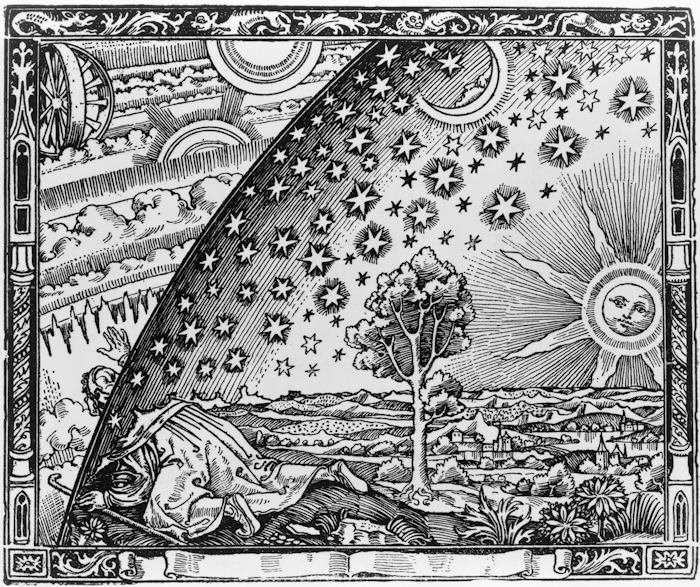
Flammarion's woodcut, Wanderer at the Edge of the World, Paris 1888, Source Wikipedia
This image also beautifully illustrates how a person can be with his head spiritually at home in Valhalla with the Einherjar, while their body remains a creature in the earthly world, where the Tree of Life is also suggested.
The semicircle can also remind us of Freyja's hall, which is described above as follows:
In Folkvangr (“People's Field”) is the ninth hall, and there Freyja decides on the seats in the hall. She chooses half of the fallen each day; the other half belongs to Odin.
Interestingly, the text speaks of seats rather than gates or rooms, which reminds us of possession and ownership in the earthly world. In a rough and simplified form, one could imagine the following scheme of the realms of consciousness, showing how the spaces flow into, exist within, and contain one another:
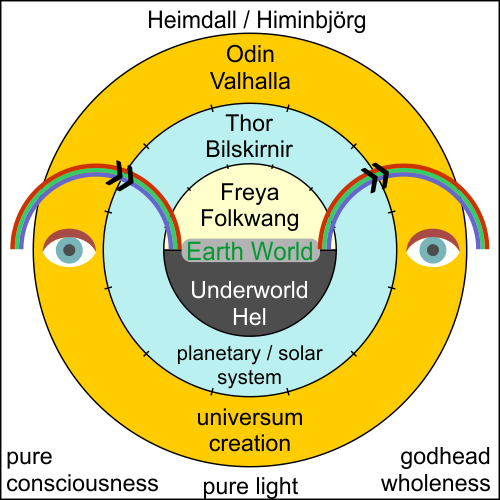
One should, of course, always be aware that such distinctions are produced by our conceptual understanding and are its creations. In this respect, one can also reflect on the relationship between Odin and Thor as father and son: the father as creator and the son as creature, who, as God and self, were to become one again. As Christ also said: “I and the Father are one.” Thus, unity and diversity are also united, for Thor, above all, fights under Odin's rule against the frost giants and the solidification of nature in order to preserve the diversity of life. And in this way, the realms of consciousness of Valhalla and Bilskirnir also unite through the open gates into the whole in the sense of perfection.
If we want to delve deeper into the interplay of numbers, we can also find the digital root of 9 in the number 540, which is why it is also divisible by 9. We have already considered the number nine as a circular and cyclical number of renewal. This is further illustrated by the wonderful symbol of the golden ring Draupnir (“Dripper”), which is described in “Skirnir's Ride” (verse 21):
The ring I give you, which burned in the fire with Odin's young son (Baldr):
Eight of equal weight are they, which drip from it every ninth night.
According to legend, this golden ring was created by the dwarves, nature spirits, along with Freyr's golden boar and Thor's hammer. Here we also find the number eight, representing the 800 Einherjar who, on the “Night of Renewal”, simultaneously pass through each gate of Valhalla to fight the wolf. This results in the enormous number of 540 x 800 = 432,000 warriors who, as the “Army of Unity”, march into battle simultaneously—the great battle at the end of the creation cycle. This final battle is called Ragnarök in the Edda. This name can be interpreted as “the fate of the gods” or “the meaning of the gods' origin”. Then the wolves, and especially Fenris, can break free from their restraints and devour all that is transient. But we will discuss this in more detail later. We already find a hint of it in the Song of Grímnir (verse 10):
The place is easily recognizable to anyone who comes to Odin as soon as they see it:
A wolf hangs before the western gate, and an eagle soars above it.
Thus, the hungry wolf of transience waits at the western gate, where the sun sets, and “before the gate” signifies: in the earthly world, where transience is restrained so that something can come into being in space and time. The eagle hovering above the wolf reminds us of Odin's eagle, which we encountered as a symbol in the story of Kvasir and Suttungr. There, it represents the possibility for ego-driven consciousness to rise above earthly transience and perhaps even attain immortality in the divine. In this respect, one could see a certain tension between the eagle and the wolf, like two paths that consciousness can take, and between which the great struggle is decided.
Then, in the Song of Grímnir (verse 9), it says:
The place is easily recognizable to anyone who comes to Odin, as soon as they see it: The roof is constructed with spears, the hall is covered with shields, and the benches are strewn with coats of mail (or populated with armoured warriors).
The spears that join the roof remind us of Odin's spear, which we encountered earlier as a symbol of the waves acting upon the sea of causes. Here, too, the spears can be seen as representing the natural laws of cause and effect, which shape and form everything within the realm of consciousness in creation. The shields forming the roof remind us of the boundaries of this hall and thus also the boundaries of the realm of consciousness. Similarly, the warriors use their shields to protect themselves and defend their space to live against external attacks. We have also found the shield as a symbol of security and protection in various forms in the Beowulf saga. From a spiritual perspective, we could see it as a shield of consciousness, especially the warrior's mindfulness and presence. Thus, the shield also limits the warrior's awareness.
If we now consider the Earth in its current spherical shape, we could imagine the following symbolic image of Valhalla as a “supernatural world”, so that we could even view the entire universe as Valhalla, or “Hall of Warriors”:
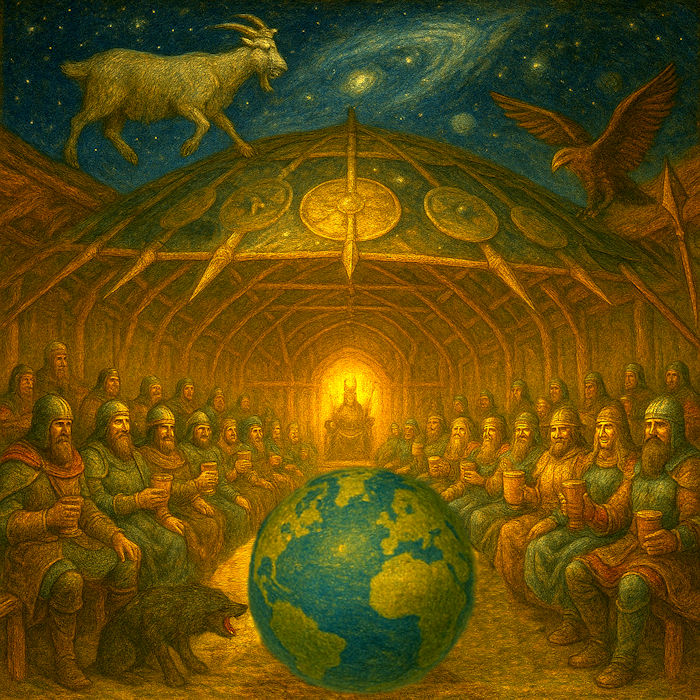
The proportions are difficult to illustrate. We know today from astronomy how vast and boundless the universe is compared to our tiny Earth, and even compared to our entire planetary and solar system. And in the background of this universal battleground, one could see the luminous Big Bang as the creator.
41. Gangleri said: “An immense multitude is in Valhalla. Truly, Odin is a most powerful ruler, commanding such a great host. But what pastime do the Einherjar have when they are not drinking?” - The High One replied: “Every day, after they have dressed, they put on their armour and go out into the courtyard. They fight and slay one another. This is their pastime (or combat game). And when the day's meal (between morning and noon) approaches, they ride home to Valhalla, where they sit down to drink. As it says here (in the Song of Vafthrudnir, verse 41):
All the Einherjar fight (slay) each other day after day in Odin's courtyard. They choose the fallen and ride home from the battle. Then they sit together all the more reconciled.”
This passage again offers much food for thought: First, we encounter the days again, which we can understand as symbolic of the gates of Valhalla. We could imagine the Einherjar passing through these day-gates, traversing time and space into “Odin's Court”, the Garden of Creation, and even reaching Midgard, our earthly world. To do so, they don their clothes and armour, which is reminiscent of a process of embodiment: the clothing as an external body, and the armour as conceptual intellect, so that they become tangible beings capable of fighting each other in the earthly world of opposites. For why should they fight in the divine realm? If one considers the divine realm as a holistic one, there can actually be no fighting there.
Then, in battle, the Einherjar “strike and slay” each other. That is, they all fall, and there are no victors. This is ingenious, because it means there are also no losers, and that is their great gain. The act of “falling” makes them all “fallen”, and we can think of this as the fall of consciousness into the unconscious, which we usually call dying and death. Similarly, we also say “falling asleep”, which also refers to a lower level of consciousness. And in principle, even the idea of leaving Valhalla is a fall of consciousness in relation to the realms of consciousness. Thus, every fighter must also be a fallen being, because he fights against something and thereby falls from perfect wholeness into a world of opposites.
Then it says: “They choose the slain and ride home from battle.” What does that mean? Just as they have slain one another, so they also choose one another as Einherjar for Valhalla. How can this be understood? We can only really understand this for Einherjar who fight in the “Army of Unity”, and not for self-willed, egocentric beings who fight for themselves. And between them lies the crucial question: What nourishes each consciousness? As it says above: “And when the day’s meal (between morning and noon) approaches, they ride home to Valhalla, where they sit down to drink.” For here the boiled boar “Sæ-Hrimnir” is eaten and the milked mead of the goat Heidrun is drunk. This is what the Einherjar nourish themselves on, although “few know what the Einherjar eat”. And this likely means that they live on spiritual nourishment that does not harden materially, and on the other hand, on the divine elixir of unity, so that they do not fall into separation. Thus, consciousness remains fluid and vibrant, is not overwhelmed by frost giants, but can, by and large, always rise again.
But why is there talk of a morning meal in Valhalla? Here, one must consider the perspective: From the Einherjar's point of view in Valhalla, the “gate of day” leads into the dark night of a darkening consciousness because it is materially embodied. They dress, so to speak, in the evening and return in the morning. Then the boar is also spiritually cooked, which is reborn “in the evening”.
From an earthly perspective, the image is reversed: From our point of view, this gate leads into the bright day of an ever-brightening consciousness because it is holistically, or divinely, spiritualized. In this sense, the Einherjar are born in the light of the earthly world in the morning and, like all creatures, fall at the end of their earthly day, but not into the darkness of hell or the cave of a separated being, but back in their wholeness into the divine light. Thus, they fall, so to speak, from one eye of Odin to the other. Where else should they fall? From this perspective, their morning meal in Valhalla appears like a Last Supper in our earthly world, simultaneously recalling the Christian symbolism of the Eucharist at the end of the earthly day. Similarly, Christ says: “No one ascends into heaven except he who has descended from heaven.” (John 3:13)
This falling or dying into the divine light is, incidentally, also an experience reported by many near-death experiences. Goethe, too, beautifully captured it:
And so long as you lack this:
Die and become!
You are but a dreary guest
on the dark earth.
(Goethe, “Blessed Longing,” 1814)
This naturally alludes to the major theme of “rebirth”. The cyclical thinking of arising and passing away is addressed in many Norse myths and often symbolized by the number nine of cyclical renewal. Specifically, regarding rebirth, we read in the concluding prose of the Edda text “The Second Song of Helgi, the Hunding-Slayer”:
It was a belief in ancient times that one would be reborn, but this is now called old wives' superstition. It is said of Helgi and Sigrun that they were reborn. He was then called Helgi Haddingeheld and she Kara, Halfdan's daughter, as told in the Song of Kara, and she was a Valkyrie. (after Arnulf Krause)
Such ideas can be found in many ancient cultures. However, one should approach them with caution, because the crucial question is: “Who or what is reborn?” Our ordinary ego all too readily grasps this idea to strengthen itself and even to imagine itself as immortal. Perhaps this is precisely why, in the Christian tradition, the concept of cyclical rebirth was somewhat suppressed in favour of the unique earthly lifespan and eternal resurrection. For a strong ego naturally leads more and more to separation, to identification with one's own body, and thus to the darkness of hell, like a dark cave.
However, this concept of rebirth can also be used to rediscover oneself in the grand scheme of things. Then, rebirth becomes a principle of learning within creation: All unresolved problems and conflicts are repeatedly drawn from the sea of causes, born, and embodied so that they can be recognized and resolved.
This grand goal is also addressed in the final line of the verse: “Then they sit together all the more reconciled.” It is about dismantling the divisions created by the divisive ego and rediscovering profound peace in holistic consciousness, so that God and I, as Father and Son, become one again. Then the struggle ends when the combatant disappears: not because anything is suppressed, but because in wholeness and divinity there is no longer any separation.
It is important to understand: The Einherjar do not practice outside of creation, but within it. Valhalla is not a separate training ground above the worlds, but a realm of consciousness within Odin's universal consciousness, and thus at the very heart of creation itself. Everything thought, felt, and learned there flows into all of creation. And what do the Einherjar learn and practice? Courage and perseverance, faith in God, and fearlessness, especially in the face of death and defeat in battle; a conscious living and a conscious dying, as some near-death experiences describe. In other words, a divine consciousness, which we also call “holistic reason” and consider the highest human capacity. For only in wholeness can nothing be lost, and this is recognized when one recognizes oneself as pure consciousness within everything. Accordingly, the Einherjar also fearlessly enter the final great battle of Ragnarök, for they know that even there, nothing true is lost, because truth remains.
Valkyries
Now we will complete the description of Valhalla and consider the following passage from “Gylfi's Illusion”:
There are others who are to serve in Valhalla, who bring the drink and provide the crockery and beer mugs. They are described as follows in the Song of Grimnir (verse 36):
Hrist (“Shaking”) and Mist (“Cloud/Mist”) shall bring me (Odin) the horn; Skeggjöld (“Axe-Age”) and Skögul (“Shocking”), Hild (“Battle”) and Thrud (“Power”), Hlökk (“Noise”) and Herfjötur (“Host-Fetter”), Göll (“Tumult”) and Geirahöd (“Spear-Noise”), Randgrid (“Shield-Protection”) and Radgrid (“Council-Protection”) and Reginleif (“God's Inheritance”) - they bring beer to the Einherjar.
They are called Valkyries, and Odin sends them into every battle. There, they choose the men destined for death and determine the victory. Gud (“Clash”), Rota (“Onslaught/Devastation”), and the youngest Norn, Skuld (“Guilt/Karma”), also ride out to choose the slain and decide the battles. Jörd (“mother earth”), the mother of Thor (the protector of Midgard), and Rinda (“Protector”), the mother of Vali (the life principle, who fights against the darkness and avenges Baldr's death), are also counted among the Aesir (goddesses).
(Gylfaginning §36, translation based on Arnulf Krause and other sources listed below)
Until now, it was said that the fallen themselves have the choice to be chosen as Einherjar and enter Valhalla according to their own will. For that is their free will: whether they serve the divine will in the “Army of Unity” or, as separate beings, follow their own selfish desires. Indeed, this freedom is something every human being, and in principle every creature, possesses.
However, the text now speaks of Valkyries, whose name means “chooser of the fallen”. This suggests that there are also female, or natural, beings who determine the freedom of men, or rather, of the spirit. Thus, we find the theme of “spirit and nature” again: the freedom of the spirit and the natural laws of cause and effect, which “Odin sends into every battle”, as a kind of divine will or the will of the Creator in creation. In this respect, we can consider the Valkyries as personifications of nature, as the “natural conditions and circumstances” under which we fight and which reveal how and for what we fight. In Valhalla, nature serves and provides the physical vessels for the “food and drink” of the spirit in the form of our bodies. And in worldly combat, nature provides the natural conditions in the arena, such as the age of weapons, the weather, enemies, forces, protection, fate, chance, disease, and all other natural conditions, as the names of the Valkyries can be interpreted. In this respect, they are closely related to the Vanir, who are viewed more as holistic gods and goddesses of nature, while the Valkyries express the diversity of nature more fully. The Edda mentions at least 52 Valkyries who serve this wholeness. Accordingly, they are not referred to as Odin's wives, like Jörd and Rinda, but as his servants.
Thus, the Valkyries serve Odin with the “wine of illusion and creative power”: as creative power to “awaken” (Hrist), and as the power of illusion for the outward forms of creation, which appear like clouds of mist (Mist) from the Well of Birth. This mist is also found as “Nibel” in the Nibelung saga, as well as “Nifel” in Nifelheim. And the beer, as an “intoxicating drink” that the Valkyries serve to the Einherjar and all other warriors, is a reminder of the power of illusion.
The many names of the Valkyries can only be translated in a suggestive way. We have included the usual translations above in the text. As beings of natural circumstances and conditions, the Valkyries are also closely connected to the Norns of Fate, especially Skuld, whose “debt” is reminiscent of the Indian concept of karma, similar to merit and sin in a Christian perspective. In this respect, the Valkyries are responsible for the death and fall of consciousness or spirit within nature and can grant the illusion of gain and loss, as well as the great victory when consciousness can rise again to the divine. For the spirit always possesses this freedom, depending on the direction in which it directs its will: either toward the illusion of separation as a lone warrior or toward wholeness as an Einherjar in the army of unity. Perhaps one could also say: The spirit is free in its origin, but bound in its effect; as a head it`s free, and bound as a river.
To learn more about the nature of the Valkyries, we would now like to look at the “Sigrdrifa Song” about the Valkyrie Sigrdrifa as a “victory driver”:
Sigurd (“Victory-Protector”) rode out to Hindarfjall (“Mountain of the Hinds”) and turned south towards Frankish lands. On the mountain, he saw a great light, as if a fire were burning, shining up to the heavens. But as he passed through, there stood a shield-fortress, and from it rose a banner. Sigurd went into the shield-fortress and saw that a man lay there, asleep in full armour. He first removed the helmet from his head: then he saw that it was a woman. But the mail was tight, as if it had grown into the flesh. Then he cut the mail with his sword Gram (“wrath”), from the head down, and then also at both arms. Then he took the mail (breastplate) from her. But she awoke, sat up, looked at Sigurd, and spoke:
1. “What tore my mail? Why did my sleep break? Who freed me from the dark bonds?”
Sigurd answered: “Sigmund’s son! Just now Sigurd’s sword tore through the rcorpse flesh for the raven.”
2. Sigrdrifa spoke: “Long I slept, long I lingered in sleep, long is the suffering of humankind. Odin caused me to be unable to break the sleep runes.”
Sigurd sat down and asked her name. Then she took a horn filled with mead and gave him a potion of remembrance (Simrock: love potion).
3. Sigrdrifa spoke: “Hail to the day! Hail to the sons of the day! Hail to the night and her relatives! Look upon us with unwrathful eyes, and grant us, the seated ones, victory!
4. Hail to the Aesir, hail to the Aesir women! Hail to the manifoldly beneficial earth! Grant us both glorious ones eloquence and wisdom, and healing hands, as long as we live!”
She called herself Sigrdrifa (“Victory-Driver”) and was a Valkyrie. She told the story of two kings who had fought against each other. One was named Hjalmgunnar (“Helmet-Warrior”), an old and the strongest warrior, whom Odin had promised victory. The other was named Agnar (“Sword-Warrior”), Auda's brother (presumably from “Wealth/Possessions”), whom no being would protect. Sigrdrifa felled Hjalmgunnar in battle. But Odin, in revenge, pricked her with a sleep-thorn and said that from then on she should never again win victory in battle, but should instead marry. “But I told him that I would vow against that, never to marry a man who could be afraid.”
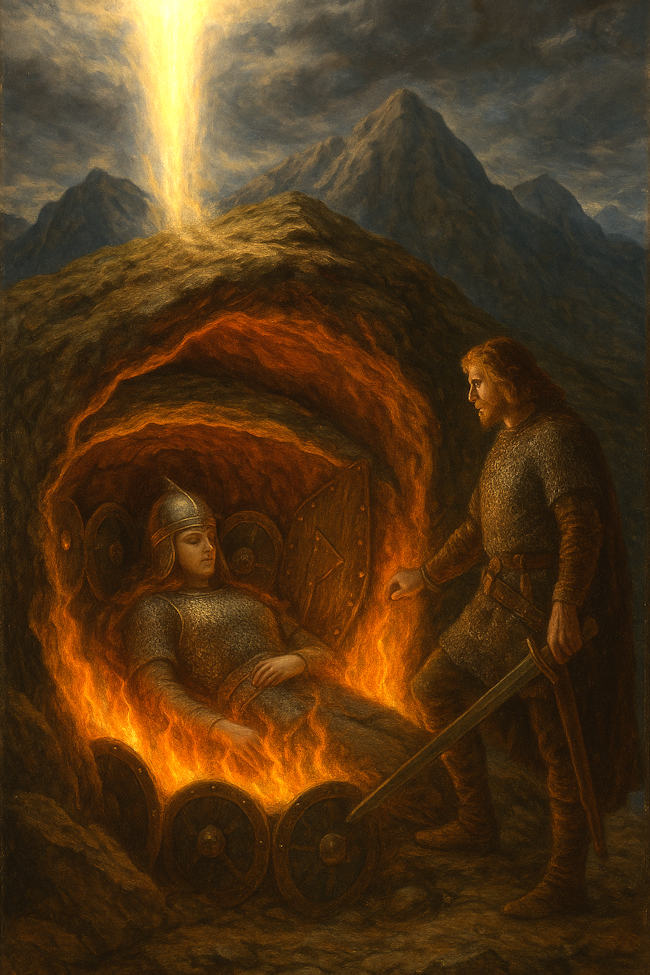
Here is described, in a wonderfully symbolic way, what happens to a Valkyrie who no longer serves the divine will but instead unites with a wilful spirit. She clearly possesses this freedom. But then, along with this spirit, she is restrained, bound, and banished—put to sleep, so to speak—to prevent her further efficacy until she reunites with a holistic spirit. Thus, she falls into the inertia of our physicality, down to the matter of hard, rocky mountains. And it is said that here she is no longer to achieve her own victories but must wed another man or spirit in order to be able to come alive again. For every cause must, of course, eventually have an effect and cannot be banished and sleep indefinitely.
Accordingly, the Valkyrie vows that she will not marry any man capable of fear, which again reminds us of the fearless spirit of the Einherjar. This spirit appears here in the role of Sigurd as “protector of victory”, who naturally recalls our Siegfried from the Nibelung saga, whom we encountered there in the role of all-encompassing reason. Thus, he was free from fear and immortal like a divine spirit. Only his physical form was transient.
And so, he now rides out on his steed of physicality to the “Mountain of the Hinds”. We encountered the stag in Valhalla as a symbol of the fighting spirit, from whose antlers the rivers of opposing qualities flow into the world. From a feminine perspective, these are the natural circumstances and conditions personified as Valkyries. The “Land of Franks” could be a reference to the “Land of the Brave or Free”, thus also to Valhalla, toward which Sigurd turns, southward into the light. He saw a great light emanating from the mountain, shining “up to the heavens”. In this, we may already see a hint of what is then described with wondrous symbolism: how Sigurd discovers and recognizes the inner essence of nature.
Similarly, the renowned physicist Hans-Peter Dürr stated that matter is essentially “frozen light”, and Konstantin Wecker sings about it: “You may grasp it, but you cannot comprehend it. Whatever you see is only frozen light.” This again reminds us of the mountain and frost giants. Therefore, Sigurd, with his holistic consciousness, can penetrate the inner essence of matter. Other sources describe a ring of fire in which everything transient burns away, except for the imperishable, which we also call “pure consciousness”. The text speaks of a “shield castle,” which reminds us of the symbolism of the shields on the roof of Valhalla, serving to limit or protect realms of consciousness. Accordingly, we find here such a narrowly confined space that consciousness can barely move, which we then call “sleep”, or, if it becomes even narrower, hell or death. Sigurd was able to penetrate this shield fortress and initially saw a man, or rather a spirit, in armour. This outer shell reminds us of the armour of conceptual reason, like the “dead flesh of ravens or thoughts”. From this emerged the hardened armour, like a wall around the heart of love, whereby holistic love, through separation, becomes desire and hatred, which we usually experience in our external world. When Sigurd had cut through and opened this outer armour with his spiritual sword, he saw a woman, a being of nature, who now awoke, straightened up, and spoke to him.
Thus, spirit and nature now speak to one another, consciousness to consciousness, one eye of Odin to the other. They ask, “What? Why? Who?” in order to recognize each other and, in doing so, themselves. In this way, nature offers spirit Heimdall's horn of mead as a “remembrance potion” of “self-knowledge”, which is also a “love potion”, as Karl Simrock translated it.
In Siegfried's Nibelung saga, we find Brunhild (“who fights with the cost of mail”) and Kriemhild (“who fights with the helmet”) in this context, whom we have interpreted there as the soul of nature and outer nature. Here in the Sigrdrifa song, we encounter both symbolically united in one being, as a Valkyrie with helmet and mail. The Edda also contains a connection between Brunhild and the story of Sigurd mentioned above, in the Book of Skalds:
“Sigurd rode until he found a house on a mountain. In it slept a woman clothed in helmet and mail. He drew his sword and cut the mail from her: then she awoke and called herself Hilde. She was called Brynhild and was a Valkyrie. (Book of Skalds §41 according to Karl Simrock)”
The separation of Brunhild and Kriemhild makes the love story in the Nibelung saga considerably more complicated, because Siegfried naturally loves above all the soul of nature, and he connects external nature with King Gunther, who represents reason. The divisive ego, in the form of Hagen, then intrudes and kills reason. This gives rise to the much-described problems and tragedies. A holistic, healing love would be better. For with such a love, all contradictions between spirit, soul, and nature would heal and disappear through wisdom and wholesome action, which is also the aim of Sigrdrifa's prayer.
Hail to the gods, hail to the goddesses!
Hail to the manifoldly beneficial earth!
Grant us both glorious ones eloquence and wisdom,
and healing hands, as long as we live!”
Sigurd (“Victory Protector”) spoke and asked her to teach him wisdom, for she knew the message of all worlds. And Sigrdrifa (“Victory Driver”) spoke:
5. “I bring you beer, you apple tree of gathered coats of mail (in battle), mingled with might and powerful glory, full of enchanting songs and healing runes, with good incantations and love runes.
6. Victory runes you must know if you wish victory, and carve upon the hilt of the sword: some on the point, some on the edge, and twice you must invoke Tyr (the T-rune for the “God of Just Victory”).
7. You must know the beer runes if you want to ensure that another man's wife won't cheat on you when you trust her. They must be carved on the horn and the back of the hand, and an “N” (the N-rune for distress and hardship) should be drawn on the fingernail.
8. The contents must be blessed, and one must guard against misfortune. Add leeks (as a medicinal plant) to the drink: then I know for certain that your mead will never be mixed with misfortune.
Verses 9-17: Further description of the birth runes, wave runes, twig runes, speech runes, and wisdom runes.
18. All the inscribed runes were scraped off, mixed with holy mead, and sent on long journeys. They are with the Aesir, some with the Elves, some with the wise Vanir, and some with humankind.
19. These are book runes, these are birth runes, and all are beer runes and excellent power runes for him who can possess them pure and uncorrupted for his salvation. Use them, if you have taken them, until the gods perish.
Much like Odin, who recognized the meaning and power of the runes as signs of nature when he hung on the World Tree and contemplated its roots, Sigurd also learns the runes from nature. This, it seems, is nature's purpose: to allow us to recognize its inner essence and, in doing so, ourselves. This is the wisdom of Kvasir, which nature can teach us. Yet this wisdom, too, is referred to here as “beer”. Just as the Valkyries in Valhalla pour beer, so too does Sigrdrifa say: “Beer I bring you.” For all forms of nature are, of course, a stimulating drink of illusion for the mind, similar to a dream in which creatures arise and pass away. But this wisdom can also be used for healing, as verse 19 suggests, where the deeper meaning of all creation resonates. The great question is: Do we want to hear the inner voice of wisdom within nature?
20. “Now you must choose, since choice is offered to you, you tree of sharp weapons. Whether to speak or remain silent is up to you! All misfortune is predetermined (or caused).”
21. Sigurd spoke: “I will not yield, even if I were doomed to die, for I was not born fearful. I will have your kind counsel in full, as long as I live.”
(Sigrdrífumál after Arnulf Krause, Karl Simrock, and Edward Pettit)
Verses 22 to 37 then offer much good advice on creating happy conditions in life. That is to say, just as the Valkyries have their freedoms and are not mere automatons, so too are natural conditions and circumstances fluid and shapeable, and not everything is predetermined and foreseeable. Therefore, it is beneficial and wholesome to live mindfully and as consciously as possible in the world, to recognize the hidden meaning of nature, and to follow its benevolent counsel. Unfortunately, the ending of this song is missing from the Edda text. However, there is a good retelling in the 13th-century “Völsunga saga”, which ends as follows:
Sigurd said: “No wiser woman can be found than you, and I swear that I will have you, for you are after my own heart.” She replied: “I too will have you and no other, even if I could choose among all men.” Thereupon they both swore fidelity to one another (and became engaged).
(Völsunga saga §21 according to Karl Simrock, who refers to it in the final prose)
In summary, all the circumstances and conditions in nature are meant to serve Odin as the All-Father and divine spirit of wholeness. Similarly, the Valkyries are meant to serve the Einherjar in the world's battle hall, the holistic consciousness. Thus, natural diversity serves spiritual unity. However, if, contrary to the divine command, they serve and unite with a wilfully separate mind, then a separate realm of consciousness arises, like the wilful battle hall of an egoistic being. Then consciousness falls ever deeper into unconsciousness, into sleep until death, into physicality until matter, and into the lower worlds until the darkest cavern of the underworld. In this way, light falls into darkness. But eventually, this separate mind must also have its effect, because, in the grand scheme of things, nothing can be lost. Eventually, he will be reawakened by holistic consciousness, by Sigurd, who protects true victory, and by Siegfried, the true victory of peace, which brings no further battles because in pure love there are no more contradictions. And how this spirit of separation then manifests in the world and passes away is illustrated by such wonderfully symbolic stories as the Nibelung saga, which is also recounted in a modified form in the Edda. With their help, one can recognize: The nature of divine creation does not kill, but rather works in the spirit of God toward holistic life. Only that which is wilfully separated must pass away. In this sense, all the Valkyries are also “Sigrdrifas”, “victory-drivers”, for all natural circumstances and conditions drive us toward the highest victory.

