
| Content | Next | About |
The World of Gylfi’s Delusion (Gylfaginning §1-§37)
The name Gylfi can be interpreted as ‘Foaming Wave’. Thus, this concerns the ‘delusion of the foaming wave’: a wave of illusion composed of many little bubbles, little spaces of consciousness inhabited by the most varied beings, arising and passing away. A wave upon the Sea of Life with a crown of foam. Where does this wave come from?
1. King Gylfi ruled the lands now called Sweden. It is told that he gave a wandering woman, as a reward for her entertainment, as much arable land within his kingdom as four oxen could plough in one day and one night. Yet this woman belonged to the race of the Aesir and was called Gefjun (‘the Giver of Wealth’). She took four oxen from Giantland in the North—they were her sons by a giant—and yoked them to a plough. But it ploughed so broadly and deeply that it tore the land free. The oxen drew it westward out to sea until they stopped in a strait. There Gefjun secured the land. She gave it a name, calling it ‘Zealand’. And where the land had been torn out, a lake afterwards appeared, now called Löger in Sweden (today presumably Vänern). Its bays are arranged like the headlands of Zealand. Of this, the skald Bragi the Old spoke:
Joyfully Gefjun drew from Gylfi the island’s freehold. The oxen sweated for Denmark’s increase. Four heads and eight forehead-moons (eyes) the oxen bore, and they dragged the spoils to Zealand.
The text begins with concentrated symbolism, which we have already attempted to interpret in the section ‘The Nine Sisters as Nine Waves’. Meanwhile, in the Mill Song of Frodi’s Peace, we have also encountered Sweden as the realm of lone warriors, where ‘Fjölnir’ reigns as king: the ‘manifold knowledge’ of discrimination, and thus also nature’s diversity. There Gylfi was born, and there the waves with their crowns of foam arise upon the Sea of Life. Opposite lies Denmark, Frodi’s realm of the sons of the gods, surely also the home of the Einherjar, who serve the divine holistically within the host of unity.
Thus, at some point in life, a goddess comes to visit, much as Odin visited Vafthrudnir. It is Gefjun, the ‘Giver of Wealth’, who ‘sustains and entertains’ all living beings, so that in her we may also recognize nature’s divine, or holistic, soul. If we learn to love her, we may wish to give her part of our kingdom. What happens then? We can readily imagine that a holistic goddess naturally takes not merely a part of us as her freehold, but our entire heart, symbolically also the soul’s seat. Thus, with the help of four giant-forces, she draws Gylfi’s heart from Sweden to Denmark, where it becomes the island of ‘Zealand’.
The meaning of the four oxen from Giantland, with their four intellectual heads and eight eyes, can be considered in various directions. On the one hand, they evoke the forces of the four elements with their opposing effects within consciousness, drawn in Giantland from Mimir’s Well of the Intellect. On the other, we may also think of the four directions and eight worlds surrounding Midgard within the World Tree, which grows precisely to draw us toward the divine. At least the symbolism of the four mighty oxen from Giantland makes clear what great power is needed to draw a lone warrior’s heart back toward the Einherjar. And after this ‘change of heart’, King Gylfi now begins to reflect:
2. King Gylfi was a clever man, skilled in magic. He greatly marvelled that the people of the Aesir were so powerful that everything went according to their will. He considered whether this came from their own power or was brought about by the divine powers to whom they sacrificed. Thus, he secretly undertook a journey to Asgard, assuming the form of an old man and not revealing himself. But the Aesir were wise, possessing the gift of foresight. They saw his journey before he arrived and presented him with sensory illusions. When he entered their stronghold, he beheld a hall so high that he could scarcely see over it. Its roof was covered with golden shields like a shingled roof.
Clever and skilled in magic presumably means that Gylfi understood nature’s worldly magic well. Yet evidently not everything went according to his will, and perhaps he was also slowly growing old, so that he now looked with a questioning spirit toward the gods’ realm, to which his heart, too, had been drawn. Thus, he came to Asgard in the form of an old man who ‘did not reveal himself’, because he had not yet recognized himself and was now setting out in search.
Naturally, the gods knew who he was, yet received him with sensory illusions. Why? Well, at present his conceptual mind, which can think only in opposing forms, could understand nothing else. This ‘illusion of the gods’ recalls the wine of the ‘power of illusion and creation’, which nourishes Odin and, fundamentally, all sons of the gods. In the Bible, we find the beautiful parable of God’s vineyard. From the Edda’s perspective, we may also imagine the Einherjar working and serving the divine there within bodily creation. This is the power, and presumably also the purpose, of worldly illusion with its diversity of forms.
Thus, in Asgard’s divine stronghold, Gylfi beheld a great hall whose end he could not see. Its roof was covered with ‘golden shields’, as is also told of Valhalla. Here, the ‘hall’ again recalls a space of consciousness, the gold truth, and the shields protection, so that this divine world’s space of consciousness is protected by truth. Hence, he could not discern its end, presumably also meaning its origin.
Thus, Thjodolf of Hvin (a renowned skald) also said that Valhalla was roofed with shields:
Upon their backs the battle-tested (insightful) men made Svafnir’s shields shine like shingles, for stones were being hurled at them.
This mystical verse recalls the insightful nature of the Einherjar dwelling in Valhalla. Ordinarily, swinging shields onto one’s back was regarded as a sign of flight in battle, when warriors turned away from the enemy and sought to protect their backs from arrows and missiles. Yet here, it was presumably an insightful feat of mastery in battle, protecting survival against the stones that evoke material rigidity. Why?
Svafnir means ‘Bringer of Sleep’, or ‘Killer’. This is also the name of a venomous serpent gnawing at the root of Yggdrasil, the Tree of Life. Its scales recall dragon-scales, considered impenetrably hard to all worldly weapons in many legends. On the other hand, Svafnir is also mentioned as a name of Odin, who, as the All-Father, naturally embodies himself everywhere within creation. Thus, this presumably concerns the great question of the spirit in which one bears this protective shield. Accordingly, one fights either as a lone warrior or as an Einherji, for a partial possession or possession of the whole. This is probably also why Valhalla’s roof is symbolically covered with these golden shields: to protect the whole, rather than each protecting his own share with his own shield.
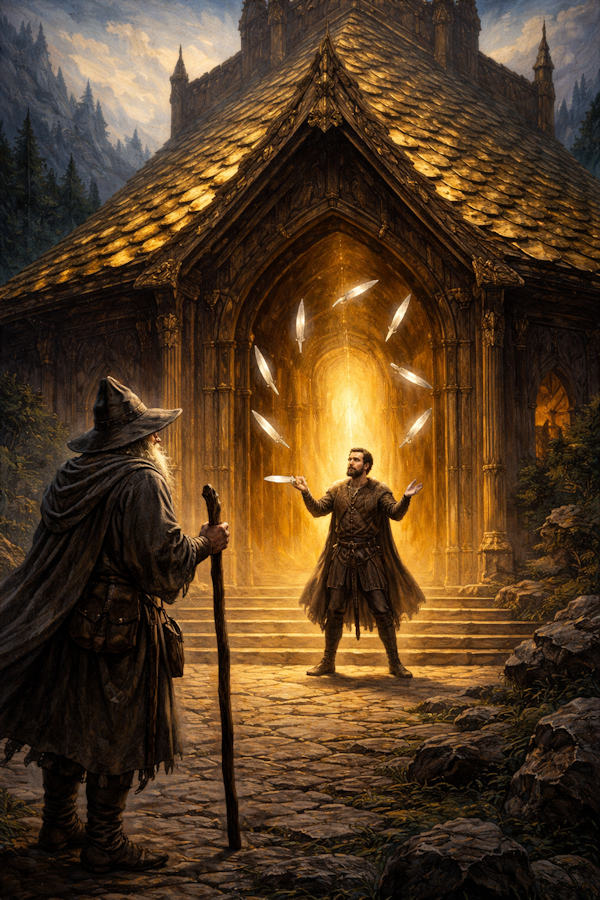
Gylfi saw a man before the hall’s entrance juggling knives, with seven in the air at once. This man asked his name. He called himself Gangleri and said he had come by winding paths and was seeking lodging for the night. He also asked to whom this hall belonged. The man answered that it belonged to a king: ‘I shall bring you to him. Then you can ask his name yourself.’ Thereupon he entered the hall, Gangleri followed, and directly behind his heels the doors closed. There he saw many rooms and numerous people: some played games, others drank, and still others practised fighting with weapons. He looked about, and much of what he saw seemed incredible. Then he spoke:
Behind every door one should look about before going farther.
For it is uncertain whether enemies sit before one upon the bench.
Whom does Gylfi meet here in Asgard, before the hall’s entrance? In this man, or spirit, we may rediscover the conceptual mind, ‘juggling’ the eight worlds around it—one of the intellect’s greatest arts. For juggling two or three worlds is already difficult, while seven or eight require divine mastery. Each world is like a sharp knife capable of dividing, or at least wounding, our holistic being, although it consists only of the light of consciousness.
Hence, this man of intellect asks the newcomer’s name, just as Gylfi asks the king’s name, for the conceptual mind needs different names and concepts for everything separate. Thus, he calls himself Gangleri, a ‘Weary Wanderer’ coming from the day of life, where he found his own world in Midgard and established his kingdom and ‘lodging’. Yet his day of life seems slowly to be drawing to a close, and we may imagine him now seeking ‘lodging for the night’ in Asgard, to ‘stay overnight’ and preserve life even beyond death.
To this end, the divine intellect leads him into the great hall, whose doors immediately close behind him. What has he left behind? Is he now imprisoned? Has he lost anything? What awaits him now? He evidently beholds an entire world within the hall: many rooms and many people playing their games, drinking mead or beer, and practising battle with weapons. Yet it is again a world full of differences and separate beings, where enemies might lurk everywhere, for his intellect can grasp it in no other way. Nevertheless, it seems incredible to him, already suggesting the first doubts.
Similarly, in Asgard’s divine world, we, too, see different gods, goddesses, Einherjar, and other beings who seem to contradict and even fight one another. Our ordinary intellect can grasp it in no other way. Yet it is always good to question belief in outward forms rather than letting it turn to stone.
He beheld three high seats, each higher than the next, with three men seated upon them. He asked the names of these chieftains. The one who had led him inside answered that the man in the nearest high seat was a king. He was called ‘the High One’ (‘Har’), the one above him ‘the Equally High One’ (‘Jafnhar’), while uppermost sat the one named ‘the Third’ (‘Thridi’). The High One then asked the newcomer whether he had any further business. Food and drink were available to him, as to everyone in the High One’s hall. He (Gangleri) said he first wished to ask whether any wise man was within. The High One answered that he would not emerge whole unless he were wiser.
Stand while you ask.
Let the one who answers sit.
Even the king of this realm he beheld as three different men, or spirits, upon three seats of differing height, which in those days symbolized a ruler’s status. Accordingly, he was given three names. Presumably, these symbolize three manifestations of Odin, not explained further beyond their names, yet answering Gangleri’s questions at different levels in varying degrees of detail.
Yet ‘food and drink were available, as to everyone in the High One’s hall’, already suggesting a holistic knowledge on which one may nourish oneself here. Nevertheless, Gangleri asks for a particularly ‘wise man’. The High One therefore admonishes him that ‘he will not emerge whole unless he himself is wiser’. A wonderful answer, also given by Vafthrudnir to his guest! ‘Whole’ signifies healing and wholeness. And as long as one has not attained this wisdom, one naturally remains imprisoned within one space of consciousness or another.
Thus, Gangleri, as ‘Wave-Rider’ and ‘World-Wanderer’, now begins questioning his foaming world of forms, in dialogue with the forms themselves, behind which naturally stands divine, or holistic, consciousness. This is presumably also our conceptual mind’s task: to question outward forms and fathom the world’s mysteries, gaining holistic wisdom and rediscovering divine vision. Gangleri, too, is now upon this path.
The final verse again recalls the ‘intellect’, which is to rise and question what sits enduringly upon the throne and foundation of everything, upon the ‘Philosopher’s Stone’. Thus, we need not be surprised when the text above says that ‘the High One’ sits lowest, yet all are ‘equally high’. Only the intellect looking at something sees such differences.
3. Gangleri began his questions: Who is the noblest and oldest (first and most original) of all gods?
The High One answered: He is called All-Father in our language, but in ancient Asgard he had twelve names. The first was All-Father; the second Herran or Herjan (Commander of the Host); the third Nikarr or Hnikarr (Awakener); the fourth Nikud or Hnikud (Stirrer); the fifth Fjölnir (Much-Knowing, Manifold); the sixth Oski (Wish-Fulfiller); the seventh Omi (Keen-Hearing); the eighth Biflidi or Biflindi (the One with the Painted Shield); the ninth Svidurr (Spear-Thrower); the tenth Svidrir (Spear-Bearer); the eleventh Vidrir (Stormer); and the twelfth Jalg or Jalk (Stallion).
The question-game begins with the greatest question: Who is the first of all gods? An absurd question, really, if God is a holistic being. Yet the conceptual mind needs distinctions, and so God himself gives it several names. First, a holistic name: All-Father, the Father of Everything as creator-god. Then twelve names for different aspects, twelve again recalling a number of wholeness. Similarly, Hinduism contains long lists of names for God’s aspects, such as Shiva’s or Vishnu’s 108, or even 1008, names. For perhaps the maddest and most foolish thing the intellect can do is quarrel over God’s names, as still happens in religions today. Hence: ‘Hallowed be thy name…’—healed and whole.
Gangleri then asked: Where is this god, what can he accomplish, and what glorious deeds has he performed?
The High One answered: He lives for all time, rules his realm, and brings about all things, great and small.
Then the Equally High One spoke: He created heaven, earth, and air, together with everything belonging to them.
And the Third said: Most important, however, is that he created the human being and gave him a soul that shall live and never die, even though the body decays into earth or burns to ashes. All humans of the right faith shall live and be with him himself in the place called Gimle or Vingolf. But the wicked (hostile ones) go to Hel and then to Niflhel. That is below, in the ninth world.
Wonderful! Above all, we should read the final answer attentively and take it to heart. Here, consciousness’s two great paths are addressed: either as a lone warrior who believes he dies with his body and ends spiritually in Niflhel; or as an Einherji fighting within the host of unity, conscious that only the body dies while his soul lives eternally within wholeness, or the divine. For him, the ninth world is no one-way dead end, but a world of bodily renewal and regeneration within nature’s realm. For his spirit is directed not toward separation and boundaries, and thus death in Niflhel, but toward the divine in Asgard. Gimle and Vingolf, too, are thought to lie in this direction. Gimle presumably means ‘Protected from Fire’, and Vingolf ‘Hall of Friends’ or ‘Wine-Hall’, recalling Valhalla. This is discussed more fully in section 17. Here, too, the Edda explicitly emphasizes that the worldly direction in which one travels and develops within the Tree of Life and Worlds is a question of faith. Already this is a wonderfully divine invitation to ‘stay overnight’.
Gangleri then asked: What did he do before heaven and earth were created?
The High One answers: He was then among the frost giants (Hrimthurses).
This answer, too, given only by ‘the High One’ at the highest level, offers much food for thought. What did God do before heaven and earth were created? The lofty answer is: ‘He was there.’ With whatever was there. And what was there before the creation of heaven and earth? According to Eddic cosmology, the frost giants—at least from a bodily perspective concerning bodily creation from the ice giant Ymir. In the preceding song, Vafthrudnir spoke of this in verse 29:
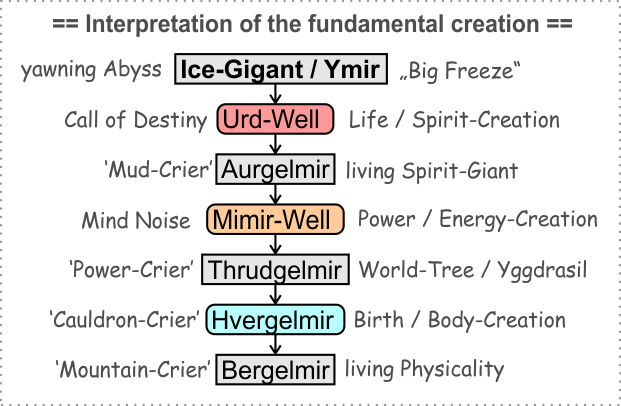
Countless years before the earth was created, Bergelmir (‘Mountain-Crier’) was born. Thrudgelmir (‘Power-Crier’) was his father, Aurgelmir (‘Mud-Crier’) his grandfather.
There we also attempted to interpret the giants. Aurgelmir would be the thawing Ymir, who as an ice giant symbolizes the frozen universe. Thrudgelmir then evokes the World Tree’s creation as a creation of force and energy, and Bergelmir the material, living creation from which the earth, too, arose. The ending Gelmir, meaning ‘Crier’, recalls creation’s urge to express itself and work out its effects. Between them, in a schematic outline of creation, we might imagine the three wells:
Yet what was the origin of everything?
4. Gangleri asked: What was there in the beginning, how did everything arise, and what came before?
The High One answered: It was as stated in the Seeress’s Prophecy (Völuspa, verse 3):
Once was the time when nothing was. There was neither sand nor sea, nor cool waves. Earth did not exist, nor heaven above it. There was only the yawning abyss (Ginnungagap), but grass nowhere.
Now things become exceedingly complicated for the intellect. How can one understand something incomprehensible because it no longer has distinctions or boundaries? The intellect can approach it only indirectly through inference, and there are two ways: either backward toward the origin of everything or forward toward the end of everything. Modern cosmology faces the same problem. What existed before the Big Bang? The traditional answer is: nothing, at least nothing recognizable—perhaps a ‘quantum vacuum or zero-point energy’. And how does the universe end? A widespread hypothesis speaks of the ‘Big Freeze’, the universe’s ‘great freezing’: ultimately the temperature reaches a value exactly the same everywhere, so that no thermodynamic work remains possible, ending in the universe’s heat death (or cold death)… (Wikipedia: Big Freeze)
Similarly, the Edda plays with both conceptions. Here it says: ‘Once was the time when nothing was.’ Yet the original Völuspa reads: ‘Once was the time when Ymir lived.’ Wonderful—Ymir as the incomprehensible! A living nothingness, a living stillness, yet containing everything, so that everything can arise from it again. Thus, the end can be united with the beginning once more, as the Bible says: ‘I am the Alpha and the Omega, the beginning and the ending, saith the Lord, which is, and which was, and which is to come, the Almighty.’ (Revelation 1:8) Modern cosmology likewise has hypotheses that challenge and profoundly question our ordinary intellect.
Afterwards the Equally High One spoke: Many an age before earth was created, Niflheim also arose, and at its centre lies the spring called Hvergelmir. From it flow the rivers bearing these names: Svöl (Cooling), Gunnthra (Fighting), Fjörm (Hastening), Fimbulthul (Mightily Roaring), Slidr (Terrible) and Hrid (Stormy), Sylgr (Swallowing) and Ylgr (Wolfish), Vid (Wide) and Leiptr (Lightning-Like). Gjöll (Resounding) lies nearest to Hel’s gate.
The ‘Equally High One’ now speaks of the World Tree, within which Hvergelmir’s spring bubbles forth. It arose before earthly, or bodily, creation and is thus likewise only indirectly comprehensible. Like Thrudgelmir, it resembles a network of forces seeking expression and effect. Thus, from Hvergelmir’s Spring of Birth, bodily creation arises within Niflheim’s mist-world, for ‘Nifl’ means ‘Mist’, presumably also in the sense of illusion, increasingly condensing and embodying itself. Hence, this creation begins with various rivers whose names evoke aspects of bodily creation, now born as Bergelmir and flowing into the world.
Particularly interesting is the river Gjöll, often called the ‘River of the Dead’. Yet here we are told that it does not flow into death as an ending in Hel, but passes nearer its gate than all the other rivers. Its name means ‘Resounding’ and reminds us that it connects the end to the beginning again. Only those who cross this river, moving from the living bank to the dead, can end in Hel.
Then the Third said: First, however, was the region in the world’s southern half called Muspel. It is radiantly bright and hot. This region stands in flames and burns, unbearable to those who are strangers there and do not have their home in it. Surt (or Surtur) is the name of the one guarding its boundary. He has a flaming sword, and at the world’s end he will set out, ravage, and destroy all the gods. He will burn the whole world with fire. Thus it is said in the Seeress’s Prophecy (Völuspa, verse 52):
Surt (the fire giant) comes from the South with the branches (flames) of destruction. From his sword shines the sun of the gods of the fallen. Rocky mountains break and giantesses fall; mortals walk the Hel-path (everything transient passes away), and heaven breaks apart.
The ‘Third’ takes a step back, saying that before Niflheim’s watery mist in the North, Muspelheim’s fire shone in the South, as it were to thaw the frost giant. Naturally, this happens in the interplay of spirit and nature between Muspelheim and Niflheim, for it is spirit that gives life. Elsewhere we have reflected at length upon this spirit-fire. It is closely connected to the Well of Destiny and resembles a fire of destiny burning everything that does not correspond to the destiny of causation. Hence, the name Surtur also means ‘the Dark One’ or ‘the Darkening One’: a fire burning and darkening everything that is not to exist, live, and act. Thus, he ultimately also brings about Ragnarök, the ‘Destiny of the Gods and Their Creation’.
5. Gangleri asked: How did everything develop before the races (families of beings) arose and humans (living beings) multiplied?
The High One answered: There were the rivers called Elivagar. When they had flowed far from their source (their origin), the poisonous foam they carried became as hard as the slag flowing from a fire. Ice arose, and when this ice remained in place and ceased flowing onward, it spread over everything there. The spray (mist) arising from the poison also froze into rime, and all this rime covered everything else within Ginnungagap (the ‘Yawning Abyss’).
Asked about the emergence of different living beings, the High One first answers with their transience. Elivagar can be interpreted as ‘Ice-River’ or ‘Ice-Wave’. It is a river of rivers, recalling the river of all creation, moving away from its source and thus its origin. Through this separation, the foam-bubbles of separate living beings’ separate spaces of consciousness arise. In this we may also recognize the poison of separation: the original sin, as it were, of separation from God, or wholeness. This means living beings are no longer conscious of their divine and holistic origin. Upon this path, living beings separate themselves from life itself, nature from spirit, and water from fire. Thus, the water of life begins to freeze and become rigid. Where does this occur? In Ginnungagap, the ‘Yawning Abyss’, the primordial ground of everything, consciousness’s infinite space. This process ends in the ‘Big Freeze’, in the ice giant also called Ymir.
Afterwards the Equally High One spoke: The part of Ginnungagap extending northward filled with heavy ice and rime, with rain and storms within. But Ginnungagap’s southern part was its opposite through the sparks and glowing particles flying from Muspelheim.
When this separation disappears again—as eventually it must, being merely an illusion within time and space—the opposites of spirit and nature, fire and water, reappear, acting upon one another to restore balance.
The Third said: Just as cold originated in Niflheim, together with everything harsh, everything near Muspel was hot and dazzlingly bright. Yet Ginnungagap was as mild as windless air. When the hot current of air met the rime, it thawed and dripped, and from these thawing drops life arose through the power of the one who had sent the heat. The body of a man emerged, called Ymir. Yet the frost giants call him Aurgelmir. From him descend the races of frost and mountain giants, as stated in the Short Prophecy of the Seeress (in the Lay of Hyndla, verse 33):
All seeresses descend from Vidolf (‘Forest-Wolf’), all sorcerers from Vilmeid (‘Wish-Tree’), but the workers of harm from Svarthöfdi (‘Black-Head’); all giants come from Ymir.
And the giant Vafthrudnir says of this (in answer to the question of Aurgelmir’s origin): From Elivagar poison-drops spurted and grew until a giant (Ymir, or Aurgelmir) arose from them. Our families all arose together there; hence they are always profoundly terrible.
Wonderful! Ginnungagap as the primordial ground always remains as it is, ‘mild as windless air’: neither hot nor cold, neither this nor that—simply incomprehensible. Nevertheless, living beings’ consciousness can experience opposites within it. Thus, a man, or spirit, suddenly arises, called Ymir. In him the frost and mountain giants see their ancestor, especially in Aurgelmir, thawed into life. The only question is: What does their intellect understand by this ancestor? The entire Lay of Vafthrudnir, which we have already examined, revolves around this. The giants ordinarily understand him as bodily creation, thus above all as Bergelmir. They cannot recognize the divine within him, and this makes their families terrible, producing much suffering through the poison of separation. Herein also lies the Lay of Vafthrudnir’s vision: ultimately rediscovering divinity and wholeness as their origin.
Thus, the question now stands: Who was Ymir, or Aurgelmir? How could the diversity of beings arise from a giant?
Gangleri asked: How did the races grow from this, and how did things develop so that several humans (different living beings) arose? Do you consider the one you have just spoken of a god?
The Equally High One said: By no means do we acknowledge him as a god. He was wicked (hostile), like all his descendants. We call them frost giants. It is told that, while sleeping, he began to sweat. Then beneath his left arm a man grew, and (beneath the right) a woman. And one foot begot with the other a (six-headed) son, from whom all the families descend. These are the frost giants. We call the old (oldest) frost giant Ymir.
Asked about separation into different living beings, not the ‘High One’ but the ‘Equally High One’ answers from the frost giants’ world of conceptions, as Vafthrudnir explained it in his song before breaking through to divine consciousness. According to this understanding, Aurgelmir was no god, or holistic being, for within himself he created a separation into man and woman, or spirit and nature, like the World Tree’s two sides. Thus, he was no longer a whole being but a hostile one, which may also be called wicked.
The six-headed son was then Thrudgelmir, the ‘Power-Crier’. We may symbolically imagine him arising from Mimir’s Well of the Intellect between Aurgelmir’s two feet as the Wells of Urd and Hvergelmir. Accordingly, this six-headed son also recalls the World Tree itself: the upper six worlds are his heads, Muspelheim and Niflheim his two arms; his body would be Jötunheim’s trunk, and the feet, or roots, on which he stands would be the two Wells of Destiny and Birth. From the latter, Bergelmir was then born as material physicality.
This would be the fundamental conception of creation through separation. From this perspective, Ymir, too, would be a frost giant as the primordial father of separation between fire and water, spirit and nature. And all descendants would likewise live in separation.
Similarly, modern cosmology describes the universe’s origin as a ‘creation through separation’. In the early universe’s extreme heat, matter and antimatter particles arose from light, immediately merging again and radiating away as light. This happened countless billions of times per second. Matter and antimatter should actually have annihilated one another completely, leaving an empty universe composed solely of radiation. Yet for a reason still not fully understood, there was a tiny excess of matter: approximately one extra matter particle for every ten billion pairs. As the universe cooled, the energy was no longer sufficient to form new particle pairs. The existing particles and antiparticles annihilated one another almost completely one final time. Only the tiny excess of matter remained, forming everything we see today: galaxies, stars, planets, and ourselves. From this creation through separation arose the enormous universe’s material body—Bergelmir as God’s vineyard, as it were…
Yet where, then, do the gods as holistic beings come from? Is there also a creation of wholeness and healing? Gangleri therefore continues asking about Ymir’s nature:
6. Gangleri then said: Where did Ymir live, and what nourished him?
The High One answered: First the ice began to thaw, and from it emerged the cow called Audhumla (the ‘Hornless, Milk-Rich One’ or ‘Rich in Destiny’). Four streams of milk flowed from her udder, and with these she nourished Ymir.
But Gangleri then asked: What sustained the cow?
The High One said: She licked the icy stones, which were salty. On the first day she licked the (salt-) stones, a man’s hair emerged from them in the evening; on the second day, a man’s head. On the third day, a whole man was there. He is called Buri (‘Reconciliation’). He was beautiful in form, tall and strong. He had a son named Börr (‘Son’). This son took a wife named Bestla (‘Bark, Tree-Bark’), daughter of the giant Bölthorn (‘Evil-Thorn’), and with her had three sons: the first was called Odin (‘Inspiration’), the second Vili (‘Will’), the third Ve (‘Consecration’). And it is my belief that this Odin and his brothers will be the rulers of heaven and earth. We believe he should be called thus. That is the name of the man we esteem as the greatest and most renowned. And you, too, may well call him so.
Now things again become difficult for our intellect, for the ‘High One’ answers. How did a holistic god without separation arise from Ymir? First, we would have to imagine the ice not thawing from outside, but thawing itself from within, because the fire was inwardly present and now became effective again. Symbolically, a cow appears, in whom we may recognize nature’s holistic soul. Hornless then means without battling opposites. Destiny points toward the principle of causation. And the four streams of milk recall nature’s four fundamental elements: earth, water, fire, and air. They now flow again from the thawed ice and nourish Ymir’s holistic spiritual being, which in turn gives life to the birthing cow, or nature. Thus, spirit and nature act as unity within the whole, and a living ‘development’ begins, unfolding what had been enfolded. This occurs, as it were, from the Well of Destiny, and the intellect cannot comprehend it, for it had not yet been created with its world of distinctions.
Thus, salt now enters the picture. It is an ancient symbol of physicality, which can dissolve within the water of life, yet also crystallize, solidify, and materialize again. Nature’s soul licks it, ensuring that tangible forms emerge once more. First a man’s, or spirit’s, hair, recalling thoughts growing from the head into the world. Then a man’s head appears as holistic intellect, or reason. Finally, a whole man as holistic, or divine, spirit, within whom spirit, soul, physicality, and nature were united as man and woman. This happened because nothing separate or external participated in this ‘development’. Difficult to grasp! At least two fundamental paths of embodiment from Ymir thus appear: Buri, as ‘Reconciliation and Healing’, symbolizes the creation of wholeness; and Bölthorn, as ‘Evil-Thorn and Harm’, the creation of separation.
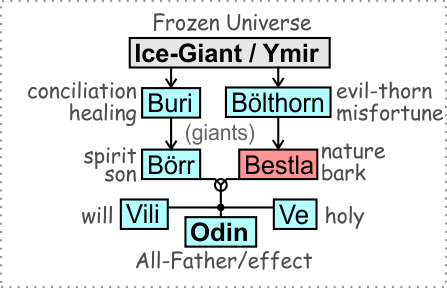
Thus, from Buri a divine son arises as a healing spirit, while from Bölthorn a daughter in need of healing arises as outward, opposing, and often hostile nature. Bestla’s name is difficult to interpret and evokes the outer ‘tree-bark’ of the World Tree’s trunk and branches. Ultimately, the divine spirit reunites with outward nature to heal the harm. From this marriage three divine beings are born, Odin, Vili, and Ve, now having imaginable forms with which our intellect can work. In the broadest sense, we might also recognize in them Father, Son, and Holy Spirit. It is often argued here that Snorri Sturluson was already Christian and incorporated Christian conceptions into the ancient texts. Yet this need not be so. Such trinities also exist in other ancient religions, such as Brahma, Vishnu, and Shiva in Hinduism. For wherever something is to move, a trinity will be found. Had there been no third force beside matter and antimatter in the Big Bang, our world would not exist either, and everything would be pure light. In relation to this trinity, we might thus also reflect upon the three divine beings answering Gangleri’s many questions here as the High One, the Equally High One, and the Third.
7. Gangleri asked: What was the state of peace between them? Who was mightier?
The High One answered: Börr’s sons shattered the giant Ymir. When he fell, so much blood flowed from his wounds that they drowned the entire race of frost giants in it. Only one escaped with his family. The giants call him Bergelmir. With his wife he found refuge upon a ship (or mill-casing), where he remained. From him descend the races of frost and mountain giants, as stated here (in the Lay of Vafthrudnir, verse 35):
Countless years before the earth was created, Bergelmir was born. This I remember first: that this wise giant was laid upon a ship (or mill-casing).
Thus, the newborn gods shatter Ymir’s rigid nature, making it into living diversity again. His blood becomes the water of life, drowning everything which, according to the gods’ judgement, should no longer exist. Here, we rediscover the Flood’s symbolism, and might suppose Snorri had again incorporated Christian conceptions. Yet here, too, this symbolism appears in many other religions, often long before the biblical text. It seems a relatively important conception in the creation story, whose meaning has inspired much reflection. Fundamentally, the Flood recalls a cleansing and renewal similar to the spirit-fire at creation’s end. Yet it occurs more upon nature’s side with water’s help, and thus especially at creation’s beginning. A ship was often imagined, loaded at God’s wish with whatever was to survive and become the foundation of further creation. This ship, floating upon the Sea of Life, or Causes, is also called an ark, from Latin ‘arca’, meaning ‘chest or container’. Here, this ship is loaded with Bergelmir and his nature, standing for material, bodily creation as it is to survive according to divine judgement. Yet the Old Norse word can also mean ‘mill-casing’, recalling the mill Grotti from Frodi’s Mill Song. Thus, all creation, too, is fundamentally a ‘problem-solving mill’.
Regarding modern cosmology, we might ask here: Who, after the Big Bang, allowed the antiparticles to ‘perish’ in the interplay of particles and antiparticles, leaving the universe’s matter behind?
Thus, after the Flood, creation is now divine, and all gods and creatures are aspects of the All-Father.
8. Gangleri then asked: What did Börr’s sons accomplish that makes you consider them gods?
The High One answered: There is much to tell of this. They took Ymir, brought him into Ginnungagap (the ‘Yawning Abyss’), and created earth from him: from his blood the sea and waters were made, from his flesh the earth, and from his bones the mountains. They made stones and rubble from his teeth, his molars, and the bones that had broken.
Thus, Odin and his brothers became the creator-god, together, as it were, with Vili as creative will and Ve as creation’s blessing. They made this creation within Ginnungagap, the ‘Yawning Abyss’, recalling the Fenris Wolf’s gaping jaws, between heaven and earth: a cosmic space between subject and object, within which Ymir’s energetic being materializes again.
Modern cosmology, too, knows cosmic space as something exceedingly wondrous, far beyond our ordinary intellect. It is not static but resembles a dynamic (‘yawning’) fabric intimately connected with time. Such space has no boundaries, and therefore no outside. Nor does it have a centre: each observer always stands at the centre of space and can look in every direction as far as the Big Bang. Moreover, it expands at unimaginable speeds, dependent upon distance and capable even of exceeding light’s speed, since space itself is no object. Many scientific mysteries remain concerning this, and at present their number is growing. Thus, it is not so absurd when, from a spiritual perspective, we speak of a ‘space of consciousness’, for this might make certain things more comprehensible…
At least, even then in the ‘Dark Ages’, there was an astonishingly farsighted conception of cosmology, described in the symbolic language of the time:
The Equally High One said: From the blood flowing and spreading from the wounds, they created the sea. Once they had together created and secured the earth, they led this sea all around it. Most humans will consider it impossible to cross.
Here, we may think of a continent surrounded by an ocean. Or of the earth floating in cosmic space, or the bodily world upon the Sea of Life, or Causes. Crossing the latter seems especially difficult, if not impossible, to us.
The Third said: They also took his skull, made heaven from it, and set it upon the earth at four corners. At each corner they placed a dwarf, named Austri, Vestri, Nordri, and Sudri (East, West, North, and South). Then they caught the sparks flying about, flung upward from Muspelheim. They fastened them in the midst of Ginnungagap above and below in heaven, to illuminate heaven and earth. They gave places to all the fires: some were (fixed) in heaven, others flew freely beneath it. Yet they assigned them a fixed place and determined their courses. Ancient lore tells that the times of day and the counting of years were thereby ordered. Thus it says in the Seeress’s Prophecy (Völuspa, verse 5):
The sun knew not where her hall was;
The moon knew not what power he possessed;
The stars knew not where their dwelling was.
Thus it happened in the beginning.
It remains wonderful! Even the cardinal directions are not objective, but living nature spirits from the microcosm, serving the divine within the macrocosm. And the heavenly lights consist of Muspelheim’s spiritual sparks of fire, coming from the Well of Destiny. There, the gods also hold their court, ensuring order within the world. For without a holistic spirit providing natural laws, creation naturally could not endure.
What, then, are the benefit and blessing? One answer would be: Only within such holistic order can consciousness learn, rising from the illusory bubble of separation back to wholeness and truth. Were everyone able to live their own dream unhindered, as the giants wish, this would not be possible. Gylfi’s ‘foaming wave’, the ‘weary wanderer’ Gangleri, is now also upon this path of learning:
Gangleri said: Great are the events I hear of here. It is the most astonishing work, created for great benefit (blessing). How, then, was the earth formed?
The High One answered: Its outer shape is circular, and the deep sea lies all around it. The lands upon its shores they gave to the giants’ races as dwellings. But in earth’s centre they built a rampart around the world against the giants’ attacks. For this stronghold they took the giant Ymir’s eyebrows, naming it Midgard. Then they took his brain, flung it into the air, and made the clouds from it, as told here (in the Lay of Grimnir, verses 40/41):
From Ymir’s flesh the earth was created, and from his blood the sea, the rocks from his bones, the trees from his hair, and from his skull heaven.
But from his eyelashes the friendly counsellors (gods) created Midgard for the sons of men, and from his brain all the exceedingly fierce clouds were created.
There were surely many different conceptions of the earthly world at that time. For the everyday intellect, a flat earth surrounded by an impassable sea was probably the most practical conception for daily life.
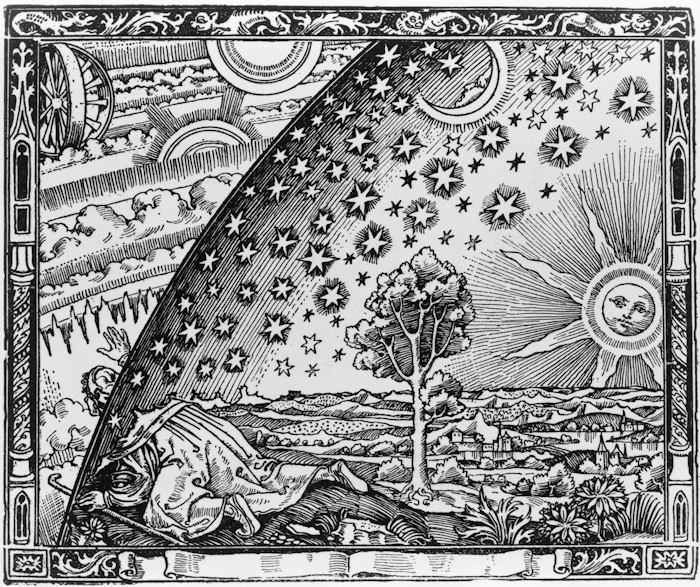
Flammarion’s engraving, Wanderer at the Edge of the World, Paris 1888, source: Wikipedia
The macrocosm’s giants lived all around the human world, yet humans in Midgard were protected from their dominance. Eyebrows, eyelashes, and eyelids are fitting symbols of this ‘rampart’, for they protect the eye. Similarly, human consciousness and senses are protected from the overpowering giants, whom ordinary senses cannot perceive. Later, we shall encounter this principle of Midgard’s separation as the Midgard Serpent.
Thus, the earthly world was symbolically created from Ymir: from his liquid being the liquid, from his solid being the solid, from hair as thoughts the trees within the forest of conceptions, from the brain as intellect heaven with its bright lights of illumination and mighty clouds of darkening. Powerful symbolism!
9. Gangleri said: It seems most significant to me that they brought about the creation of earth and heaven, set sun and stars in place, and divided the day’s halves. But where did the humans who inhabit this world come from?
The High One answered: As Börr’s sons walked along the seashore, they found two tree-trunks. They lifted them up and created humans from them. The first (Odin) gave them soul (spirit, breath) and life; the second (Vili), intellect and the ability to move; the third (Ve), outward form, speech, hearing, and sight. They gave them clothing and names. The man was called Ask (‘Ash’), the woman Embla (‘Elm’ or ‘Climbing Plant’), and from them arose the human race, given Midgard as its home.
Humanity’s emergence, too, is symbolically described as representative of all living beings. We may see here two tree-trunks from the forest of conceptions, which had sunk within the Sea of Causes. Now they reappear, and the gods make embodied humans from them. Thus, humans, too, are divine creatures and can become conscious of this origin again. The man’s name recalls the World Tree itself, while the woman would be his soul; they can unite fruitfully and become spiritually one, recognizing themselves again as wholeness. Herein presumably lies creation’s great goal.
Next they created for themselves the stronghold in the world’s centre called Asgard. This is called Troy (‘Stronghold of the Gods’). There the gods and their kin dwelt. Much happened there and spread across earth and through the air. There is a place there called Hlidskjalf (‘High Seat of Far-Sight’). Whenever the All-Father sat upon his high seat, he saw what all worlds and every individual human were doing. He knew of all things he beheld. His wife was called Frigg (‘Beloved’), daughter of Fjörgvin (also Fjörgyn as ‘Mountain Range’, or mountain giant). From their family descend those whom we call the Aesir’s race, who inhabited ancient Asgard and the surrounding lands. This family descends from gods. But he may be called All-Father because he is the father of all gods and humans, and of everything accomplished (and created) through him and his power. Thus, earth (Jörd), too, was his daughter and (then became) his wife. By her he had his first son, Aesir-Thor. He possessed might and strength. Hence, he surpasses all living beings.
The gods, too, created a stronghold, setting themselves apart from the overpowering giants so that they could act within the world and fulfil their task. The corresponding story is told later in section 42. And like Midgard, Asgard stands at the world’s centre. For every observer always stands at the universe’s centre. Odin’s throne, from which everything can be surveyed, is also a powerful symbol of this. In practice, it is his own eye of pure consciousness.
Modern science, too, fundamentally strives for such far-sight, yet more through bodily means. Thus, there are now great space telescopes with which we can look in every direction almost as far as the Big Bang. This brings us wonderful insights. Yet can we also recognize ourselves within them? Or upon this path do we become ever more attached to the bodily world of transience, to our strange conception of ‘objectivity’?
What, then, does the All-Father do within the world? Naturally, he marries the All-Mother, here called Frigg. Symbolically, she is the daughter, or soul, of the mountain giant Fjörgyn, presumably signifying Bergelmir in principle. In its feminine form, Fjörgyn is also used as a byname of Jörd, Mother Earth. Thus, Odin marries bodily creation’s holistic soul, and hence also earth itself, which he, as All-Father, had bodily created. From this, divine power is born in Thor’s form, through which he can act within the world and above all protect Midgard.
10. Nörfi or Narfi (‘Dark Giant’) was the name of a giant living in Giantland. He had a daughter named Nott (‘Night’), black and dark-coloured as befitted her race. She was married to the man called Naglfari (‘Nail-Ship’ as a ship of the dead); their son was named Aud (‘Emptiness, Destiny, Abundance’). Afterwards her husband was Annar (the ‘Other’), and their daughter was called Jörd (‘Earth’). Finally, she married Delling (‘Dawn’), who (likewise) belonged to the Aesir’s race. Their son together was Dagr (‘Day’), bright and beautiful like his father. The All-Father took Nott and her son Dag, gave them two horses and two chariots, and sent them up into heaven. There, each was to travel around the earth for half a day. Nott rides first with the horse called Hrimfaxi (‘Dark Horse, Frost-Mane’). Each morning it moistens the earth with its foam (as morning dew). Dag’s horse is called Skinfaxi (‘Light Horse, Shining-Mane’). All heaven and earth are illuminated by its mane.
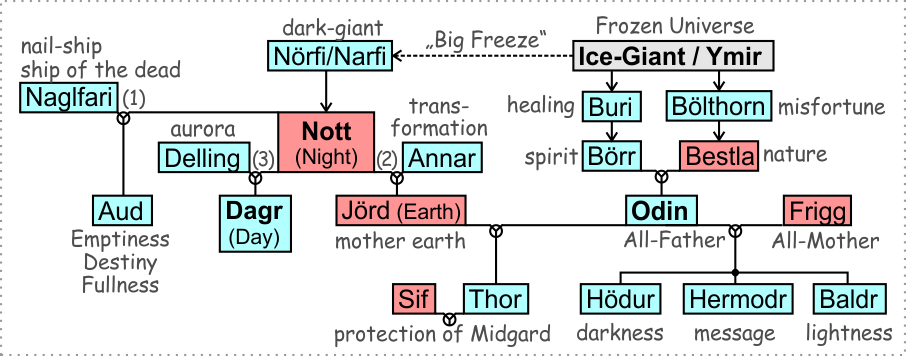
Here, we may recognize night and day as yin and yang: the dark feminine and the bright masculine. Thus, night, as the daughter, or soul, of the rigid dark giant, becomes the one who gives birth to the new creation. To this end, she unites with three men, or spiritual principles:
First with Naglfari, karma’s ship of the dead, recalling the ‘Sea of Causes’ into which everything dying sinks. Karmic deeds cling to this ship like ‘nails’, as it were, seeking to work out their effects again within a new creation. Dark night thus bears a son named Aud, or Auðr, meaning ‘Emptiness, Destiny, and Abundance’. He recalls the cow Audhumla mentioned at the beginning, bringing forth the empty space for creation, which then seeks to be filled through karmic destiny.
Afterwards, night marries Annar, the ‘Second and Other’, as the spiritual principle of transformation, in whom we may recognize an aspect of the divine All-Father. From this marriage, Mother Earth is born as the place of growth and experience.
Night’s third husband is Delling, divine dawn, likewise an aspect of the All-Father, bringing divine light into the world as the yang principle. Thus, movement, change, and growth are possible within nature’s Vanir-realm.
Three similar principles to Aud, Jörd, and Dagr may then be rediscovered in spirit’s Aesir-realm as Hödur, Hermodr, and Baldr. Earth would then be the ‘Messenger’ between day and night as creation’s purpose. For the realms of spirit and nature naturally always mirror one another.
The two horses of day and night then evoke the embodiments of sun and moon, while their chariots might be regarded as the daytime blue sky and the starry night sky, forming a garment for Aud. Yet Gylfi’s intellect does not make things quite so simple, as we shall read.
Thus, the interplay of night and day concerns both the visible world’s emergence from Ymir’s darkness and our daily experience of day and night within consciousness’s light. Here, we may reflect deeply upon light’s nature. The modern vision of the ‘Big Freeze’, too, knows this dark giant as an enormous, boundlessly dark universe after even the last star has gone out. In this regard, Aud evokes the space and causation of the Big Bang, Delling as dawn its light, and Jörd as earth the universe’s matter arising from it. Yet how could a new creation’s luminous Big Bang arise from the ‘Big Freeze’s’ dark giant? Modern physics knows a wonderful property of light: because light itself has no mass, it exists beyond time and space. Thus, for light itself, ‘from light’s perspective’, everything becomes possible again. For this dark giant, too, still consists of light.
Hence, the beginning of John’s Gospel says: ‘The light shines in the darkness, and the darkness has not grasped it.’ And the biblical creation story begins: ‘God said, Let there be light: and there was light…’ For everything can arise from light.
11. Gangleri then asked: How does he (the All-Father) direct the courses of sun and moon?
The High One answered: A man called Mundilfari (the ‘Time-Moved One’) had two children. They were so beautiful and handsome that he named his son Mani (‘Moon’) and his daughter Sol (‘Sun’). He gave her in marriage to the man called Glen (‘Gleam’). But the gods became angry at this presumption (in naming them). They seized the siblings and placed them up in heaven. They made Sol drive the horses drawing the sun’s chariot. The gods had created her to illuminate the world, composed of sparks flying from Muspelheim. Her horses are called Arvak and Alsvid (‘Early-Wakeful’ and ‘All-Swift or All-Certain’). Beneath their shoulders the gods placed two bellows to cool them, called Iron-Cool in some songs. Mani directs the moon’s course and determines full moon and new moon. He took two children from earth named Bil and Hjuki (‘Moment’ and ‘Crouching or Healing’) as they came from the spring called Byrgir (the ‘Concealing One’). Upon their shoulders they carried the (bucket) called Sægr (‘Sea’) and the pole Simul (‘Bearer, Endurance’). Their father is called Vidfinn (‘Forest-Wanderer’). These children follow Mani, as can be seen from earth.
This answer from the ‘High One’, too, greatly challenges our ordinary intellect. First there is a man, or spirit, moved by time. Here, we may think of the Mimir-intellect, imagining two conceptual children with names recalling two luminous beings whom the gods had placed in heaven from spiritual Muspel-sparks, but who did not yet move. Thus, the gods were challenged to connect the two intellectual creations with their divine creation and bring them to life. Why is this described so intricately? Evidently, this concerns the great question: What would heavenly light be without intellectual constructions, without creation’s Mimir-intellect? Ever since, the sun rises and sets, as does the moon, which also waxes and wanes. For bodily creation’s life consists in cyclical arising and passing away.
Thus, the sun’s two horses fundamentally recall the horses created and embodied for day and night. By day, Arvak as ‘Early-Wakeful’ draws the sun across the visible sky, while during the night Alsvid as ‘All-Swift or All-Certain’ brings her back beneath the earth, as it were. The divine bellows beneath their shoulders recall lungs for the cooling breath of life, through which bodily life protects itself against Muspel-fire. Similarly, the Lay of Grimnir also describes Iron-Cool and a shield before the sun, protecting bodily creation against her fire:
37. Arvak and Alsvid shall wearily draw the sun upward from here. Yet beneath their shoulders the friendly counsellors, the Aesir, concealed cooling iron.
38. Svalin (‘Cooler’) is the shield standing before the sun, before the radiant goddess. Mountains and surf, I know, will burn if it falls away from there. (Grímnismál, verses 37/38)
Why the moon has no horse is unclear. Perhaps he is indirectly drawn along by the sun’s horses. For from earth, sun and moon appear almost equally swift, as swift as earth’s rotation. The moon’s light, too, is closely connected with the sun, reflecting only sunlight. Thus, the moon is also a common symbol of the reflecting intellect, which mirrors the pure light of consciousness without being its source, and therefore has no light of its own.
Accordingly, understanding the moon’s waxing and waning, his strange markings, and his influence upon sea-tides and plant growth has presumably always challenged humans. Many symbolic stories thus arose over time. For example, the ancient Indian Mahabharata contains a story of the moon’s wasting disease. The text above speaks of two children of Vidfinn, the ‘Forest-Wanderer’, again recalling the intellect within the forest of conceptions. Presumably, they are brother and sister, symbolizing waxing and waning from Byrgir’s spring as opposing living beings, and the eternally youthful principle of life as children. The bucket and carrying pole connecting the two children also recall the sea’s tides: one child bails water out each day, while the other pours it back. Some scholars also recall the old nursery rhyme ‘Jack and Jill’ in this connection. At least people believed they could see these two children in the moon’s markings from earth:
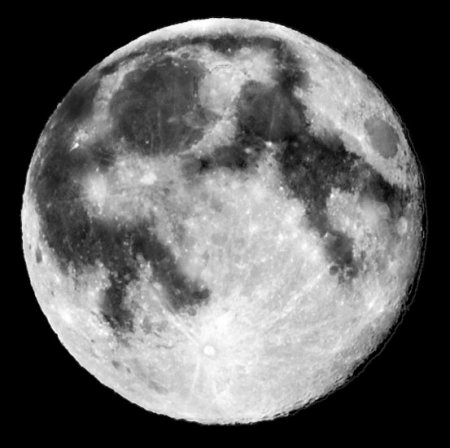
Source: Wikipedia
12. Gangleri then said: Swiftly the sun moves, almost as though afraid. She could scarcely run faster even if she feared her death.
The High One answered: It is no wonder she hastens so swiftly. The one seeking her is near. And she has no escape but to flee.
This theme, too, offers much food for thought. Modern science also knows a maximum speed of light. Light cannot flee any faster from ‘the one seeking it’, namely the observer. Why does light flee from him??? Since the Big Bang, it has fled into cosmic space’s boundless expanse. Yet it is still there, for even today we can observe light from the Big Bang. Thus, the sun, too, is still there, although constantly fleeing—at least ‘apparently’. What wondrous activity is this?
Gangleri asked: Who causes her this distress?
The High One answered: There are two wolves. The one following immediately behind her is called Sköll (‘Deception, Shadow’). She fears him, and he will seize her. But the one running before her is called Hati (‘Hatred’), son of Hrodvitnir (‘Renowned Wolf’, the Fenris Wolf), and he wishes to seize the moon, which will indeed happen.
From a natural perspective, we might first think of solar and lunar eclipses: one wolf devours the sun, and the other, upon the same path, the moon. Similar symbolism appears in Vedic astrology with Rahu and Ketu. Another aspect is the sun and moon’s destruction at Ragnarök, discussed later.
Yet when the ‘High One’ tells such things, he surely also means something higher: Who pursues and moves light through space and time? We have encountered wolves as symbols of transience, and thus they are also causes of time. The sun’s light is pursued above all by Sköll, an illusion producing darkness, ultimately extending to the ‘Big Freeze’s’ dark giant. What constitutes this illusion of transience? Hati precedes it: ‘Hatred’ as the principle of separation, especially between light and observer, object and subject, through which light’s speed also appears. The moon, as the reflecting intellect, is again involved, yet it, too, is transient and can exist only within space and time.
In this circular pursuit of light, we may fundamentally rediscover the three basic forces of desire, hatred, and ignorance, tirelessly circling as the axis of the Buddhist Wheel of Life and moving all worlds. Similarly, this happens here within the World Tree of Life. Thus, consciousness’s pure light, itself unmoving and unchanging, also appears to move.
Gangleri said: Where do these wolves come from?
The High One said: A giantess dwells east of Midgard in the forest called Jarnvid (‘Iron Forest’). There live the giant-women called Jarnvidjur (‘Women of Iron Forest’). The old giantess bears many giants as sons, all in wolf-shape. These wolves descend from there. It is told that the one called Managarm (‘Moon-Dog’) will be this race’s strongest. He is filled with the life of all who die. He will swallow the moon and spatter heaven and all the air with blood. Therefore the sun loses her radiance, and winds become storms, raging to and fro. Thus it says in the Seeress’s Prophecy (Völuspa, verses 40/41):
Eastward sat the old woman in Iron Forest, bearing Fenrir’s brood (the ‘Marshy Ones’) there. From all of them, one in particular, in giant-shape, becomes the moon’s devourer.
He fills himself with the bodies of the doomed and reddens the gods’ seat with red blood. Black becomes the sunshine in the following summer, full of terrible storms. Do you know how to interpret it?
Where does transience come from? From Iron Forest in Giantland, a forest of iron conceptions, a giant-nature of the macrocosm consisting of rigid intellect. Modern science, too, seeks such ‘objectivity’ to create something enduring and reliable, as the giants attempt in Jötunheim. Is this perhaps the wrong path toward imperishability? For, as the text says, precisely there the ravenous wolves of transience are born. Why?
The mightiest wolf is the Moon-Dog. How wondrous! Indeed, a dog is fundamentally also a tamed wolf, tamed as a watchdog and hunting dog. For whom? Perhaps for the moon himself as a symbol of the reflecting giant-intellect, to protect it. And we are told that he feeds upon death: dead, or rigid, conceptions, of which death is presumably the deadliest. Does this sound familiar? Modern science, too, asserts that this universe is 99.9999999999…% dead, with life merely a tiny peripheral phenomenon. Yet the wolf-nature remains, and such an intellect of ‘objectivity’ creates its own death. What is to protect us brings us death. Mad indeed!
Thus, we may imagine the Moon-Dog becoming the wolf Hati, swallowing the moon-intellect and darkening divine heavenly light with its blood as deadly poison; and from hatred as the principle of separation, wild storms of spirit arise as spirit is forced into opposites. Thus, the living separates from the dead, and this path leads into Hel’s realm of the dead as an apparent ending, again guarded by a dog: Garm, the dog of the dead.
Later we shall rediscover this connection between transience, separation, and death in the children of Loki and the giantess Angrboda: the Fenris Wolf, the Midgard Serpent, and Hel, goddess of the dead. Hence, Thor also travels tirelessly through Giantland, shattering this giant-intellect and preserving a living creation. Accordingly, the Lay of Harbard says:
I was in the East, striking giants (Jötuns) and harmful women who went to the mountain. Overwhelming would be the race of giants if all remained alive. It would be the end of humans in Midgard. (Lay of Harbard, verse 23, based on Arnulf Krause and Karl Simrock)
13. Gangleri then asked: What path leads from earth to heaven?
The High One answered with a laugh: That is not a wise question. Have you never been told how the gods created the bridge called Bifröst (‘Shining Path’, as a bridge of light) from earth to heaven? You must have seen it already. Perhaps you call it a ‘rainbow’. It consists of three colours, is very strong, and is fashioned with greater skill and craftsmanship than other structures. Yet strong as it is, it will break when Muspel’s sons come riding across it. Their horses swim through great rivers; then they charge onward.
Gangleri said: I cannot understand the gods creating the bridge with confidence if it can collapse. Surely they can create whatever they wish.
The High One said: The gods deserve no blame for this work. Bifröst is a good bridge, but there is nothing in this world on which one can rely when Muspel’s sons ravage.
Here, the theme of ‘light’ continues. The ‘High One’ laughs at the question concerning the path between earth and heaven, between natural diversity and divine unity. What else but consciousness’s light? Have you never seen the light? This concerns a special light created by the gods: a created and visible light of diversity with three primary colours, beautifully symbolized by the rainbow.
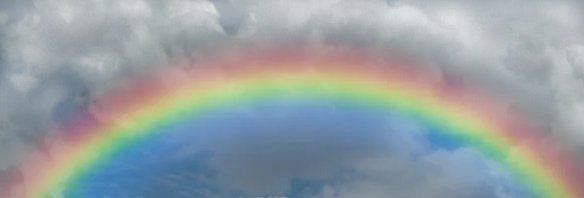
Only when heaven weeps
Do you behold the colours within light.
Tao Shan (205-283)
Of the three colours, Snorri explains only red in section 15. Other texts of the period also mention green and blue, still known today as primary colours from which all other colours, even white, can be mixed. Our televisions and other screens ordinarily work with these. We can also play symbolically with these colours. From above, from heaven, red would be creation’s dawn, then appearing as the yellow sun. Green evokes growth and the World Tree’s green leaves, and blue the water of life at its root. From below, from an earthly perspective, blue, which appears a cold colour to us, evokes Niflheim’s water upon the World Tree’s nature-side. Green and yellow would be the tree’s crown and trunk. Red is the tree’s fiery spirit-side, where Muspelheim’s fire, too, ensures like a ‘firewall’ that not every creature can enter the heaven of pure light, as section 15 then says:
The red you see within the bow is burning fire. If all who wished were led across Bifröst, the mountain giants, too, would ascend into heaven.
Thus, the distinction between heaven and earth would disappear. What would creation’s goal then be? Hence, this distinction disappears only at Ragnarök within Muspel-fire. What remains then? Can light perish?
14. Gangleri asked: What did the All-Father do once Asgard was built?
The High One said: In the beginning, he appointed rulers and decreed that they should decide living beings’ destinies with him and deliberate upon the stronghold’s arrangement. This happened at the place called Idafield (‘Field of Work, Field of Renewal’), at the stronghold’s centre. Their first work was to build the court containing their twelve seats, together with the high seat occupied by the All-Father. This house is the best and largest upon earth. Outside and within, everything is as though made of gold. This place is called Gladsheim (‘Home of Radiance’). Then they built another hall, a temple belonging to the goddesses and a magnificent building. It is called Vingolf (‘House of Joy, Wine-Hall’). Afterwards they erected a building where they kindled forge-fires. They made hammer, tongs, and anvil, and with their help all other tools. Next they worked ore, stone, and wood, and the ore called gold so abundantly that every part of their houses and all furnishings consisted of it. This time is called the Golden Age, until it was corrupted by the arrival of women from Giantland.
Here, Asgard is described, the All-Father’s divine world, consisting above all of truth’s gold—pure light, as it were. For gods are naturally holistic beings, as evoked by the circle of their twelve seats, twelve as a cyclical number of wholeness around the All-Father’s throne. Accordingly, the divine beings occupying these seats as rulers are particular aspects of the divine, enabling the conceptual mind to imagine this world of gods at all. Thus, a distinction is also made between gods and goddesses, the latter even receiving their own hall, whose name already recalls the divine wine of the power of illusion and creation, through which natural diversity’s world is created. This is also Idafield, the gods’ field of work and activity, determining conditions and circumstances within living creation according to causes, and thus deciding all beings’ destinies. For only the gods possess the necessary holistic vision. At least, we can imagine it thus. Fundamentally, it is naturally the causes themselves that produce effects. Yet our ordinary intellect perceives these connections only far too shortsightedly and narrowly.
Thus, the gods themselves provided everything, creating nature’s tools within their spirit-fire—their weapons, as it were—and all creation was their divine stronghold. Hence, creation began with a golden age of truthfulness. What does such a world of gold mean? This powerful symbolism also inspires stories such as that of King Midas: out of his great love of gold, he was granted the wish that everything he touched turn to gold. Yet then he faced starvation, unable to eat the gold. This presumably does not concern such rigid gold, but the great question: Is there anything one can love unconditionally, whatever form or ‘state’ it assumes within the ‘intellect’? In this regard, we often speak of truth’s pure gold, consciousness’s golden light. Whoever loves this light can see and love it everywhere within creation. As though sitting in a cinema and loving above all the light upon the screen, whatever images appear within it.
Indeed, this would be a world of pure light, a Golden Age, until feminine nature’s images and conceptions became overpowering in Giantland. The Völuspa (verse 8) also speaks of three daughters of giants. Some scholars see in them the birth of the three Norns, who now help determine destiny. Yet we might also think of the general dominance of desire, hatred, and ignorance among nature’s intellectual giants, ending the golden age of the gods’ sole sovereignty and beginning the separation of the different worlds. At least the gods were now challenged to oppose the macrocosm’s giants with the microcosm’s dwarves:
Then the gods sat upon their seats and issued their laws. They recalled how the dwarves in earth’s realm and deep beneath the earth had become alive, like maggots within flesh: the dwarves had first formed and come to life within Ymir’s flesh. They were maggots then. Yet through the gods’ decision they received intellectual knowledge and human form. Nevertheless, they dwell within earth’s realm (Jörd), and (even) in stones. Modsognir (‘Courage-Drinker’) was in the former, and Durin (‘Sleepy One’) in the latter. Thus it says in the Seeress’s Prophecy (Völuspa, verses 10-16):
Then all the counsellors went to the judgement-seat, the most holy gods, and deliberated who should create the dwarves’ people from the bloody river and Blainn’s (the ‘Dark-Blue’ Ymir’s) bones. There many human-like forms arose, dwarves within earth’s realm (Jörd), spoken forth by Durin.
And these names she lists (the seeress in the Völuspa):
Nyi and Nidi (Full Moon and New Moon), Nordri, Sudri, Austri, and Vestri (North, South, East, and West), Althjof (Mighty Thief), Dvalin (Sleeping), Nar (Corpse), Nain (Dead One), Niping (Grief), Dain (Deceased), Bifur, Bafur, Bömbur (Fat, Swollen), Nori, Ori (Mad), Onar (Other), Oin (Fear), Mjödvitnir (Mead-Wolf), Vigg (Spear, Horse) and Gandalf (Magic-Elf), Vindalf (Wind-Elf), Thorin, Fili, Kili, Fundin (Finder), Vali (Fallen), Thror (Growing), Throin (Grown), Thekk (Beloved), Lit (Coloured), Vit (Wise), Nyr (New), Nyrad, Rekk (Counsellor), Radsvid (Wise Adviser).
And these, too, are dwarves, dwelling in stones, while those above dwell in earth’s realm:
Draupnir (Dripper), Dolgthvari (Foe-Borer), Haur (Grey-Haired), Hugstari (Stubborn Thinker), Hledjolf (Shield-Wolf), Gloin (Glowing), Dori (Harmful), Ori (Mad), Duf (Sleepy), Andvari (Present), Heptifili (Smooth Handle), Har (Grey-Haired), Sviar (Vanishing).
And these came from Svarinshaug (Stone-Mound) to Aurvangar (Wet Meadow) in Jöruvellir (Earth-Field), from where Lovar (the Praiseworthy One) comes, and these are their names:
Skirfir (Spitter), Virfir (Dyer), Skafid (Harmful Sorcerer), Ai (Ancestor), Alf (Elf), Yngvi (Freyr-Worshipper), Eikinskjaldi (Oak-Shield), Fal (Mud), Frosti (Frost), Fid (Sorcerer), Ginnar (Deceiver).
Thus, the gods oppose the giants’ striving for monotony within the macrocosm with a diversity of dwarves as nature spirits within the microcosm. This is a wonderful vision, which would become clearer still if we could translate the many dwarves’ names more precisely. Yet often there are only vague interpretations, which we have inserted in parentheses as well as possible.
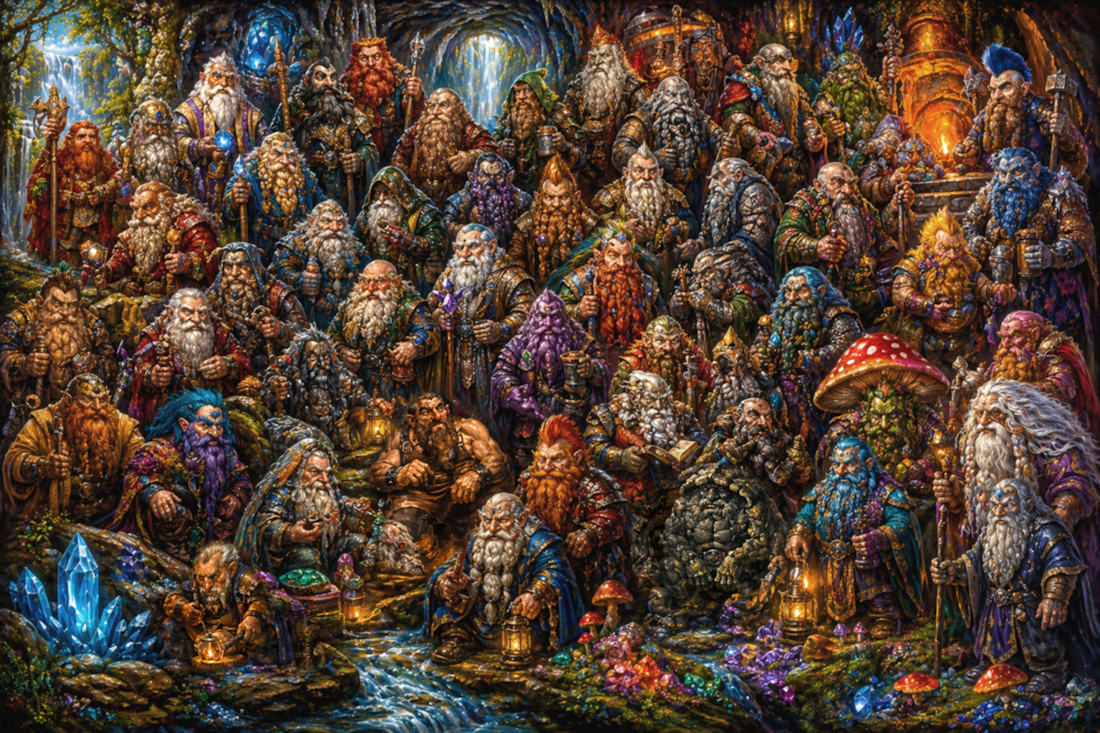
Where do they come from? The gods ‘remembered’ how they came to life within Ymir’s body like maggots, digesting this body and transforming it into life again. And this, too, is what the gods seek: a living creation.
Through the gods’ decision, they received intellectual knowledge and human form. Wonderful! They are thus intellectual creatures from Mimir’s Well, within whom humans can recognize and rediscover themselves. Hence, we also imagine dwarves as small humans, and giants as large humans. And the great goal presumably consists in human beings recognizing themselves within the greater whole.
First, two fundamental kinds are described, with the natures of Modsognir and Durin: courage for life and sleepiness. In them, we may recognize the principles of movement and inertia, activity and passivity. Thus, the former act more within Mother Earth’s living realm, while the latter are found in rigid matter. Yet their names, too, are interesting, likewise suggesting a spiritual creation fundamentally just as alive, capable of regeneration and renewal. This is also suggested by the final group of nature spirits, coming from stone back to fertile earth. Indeed, wonder, magic, illusion, knowledge, and intellectual creation, in both healing and harmful directions. Nothing fixed and dead, as we imagine matter today from an objective perspective.
Admittedly, this sounds like a fairy tale. Yet modern science, too, knows this. For example, Hans-Peter Dürr, a leading physicist at the Max Planck Institute, said in a 1997 interview on the theme ‘The Spiritual Is the Driving Force’, in brief: Nature plays like a child with a certain presentiment… Whoever has no new ideas behaves like matter and is a bore… Matter is congealed spirit that can think of nothing new. Therefore, we should not attach such importance to matter, but to the human being who has a new idea at every moment… (from 14:35)
Thus, as nature spirits, dwarves embody living creation’s manifold formative aspects. Their names also make clear that some ‘nature-spirits’ incline more toward the Tree of Life’s nature-side, as far as Niflhel. Others incline more toward its spiritual side, toward Light-Alfheim. Wherever something arises and passes away, they can be found. Wonderful! Thus, they now serve the gods. Some old legends also contain stories of giants attempting to enslave dwarves and use them for their own purposes. Yet this theme is not developed further in the Edda. There, they chiefly serve the gods as smiths of weapons and tools, preparers of the poet’s mead, and a source of gold (like Andvari).
15. Gangleri asked: What is the gods’ chief place and sacred site?
The High One answered: It is by the ash Yggdrasil. There, the gods are to hold their council every day.
To this question, the ‘High One’ again answers with the gods’ holistic nature: they continually rule, counsel, and judge within the sacred, or whole, Tree of Life and Worlds. He calls this tree Yggdrasil, ‘Ygg’s Horse’. Ygg is another name of Odin as All-Father, also meaning ‘the Terrible One’. Thus, the great question arises: To whom is this tree terrible?
Yet the discriminating intellect can make little of the ‘High One’s’ brief answer and asks: ‘What can be said of this place?’ Then the ‘Equally High One’ answers.
Gangleri asked: What can be said of this place?
The Equally High One said: The ash is the greatest and best of all trees. Its branches spread across the entire world and extend over heaven. Three roots support the tree, spreading far: one toward the Aesir, the second toward the frost giants, where Ginnungagap (the ‘Yawning Abyss’) once was. The third extends toward Niflheim (the ‘World of Mist and Darkness’). Beneath this root lies Hvergelmir (‘Seething Spring, Cauldron-Crier’), and Nidhöggr (‘Hatred-Striker, Hatred-Serpent’) gnaws at it from below. But beneath the root extending toward the frost giants is Mimir’s spring, concealing cleverness and intellect. Its owner is called Mimir. He is full of wisdom, for he drinks from this spring with Gjallarhorn (Heimdall’s horn). There the All-Father came and asked for a draught. Yet he received none until he pledged his eye. Thus says the Seeress’s Prophecy (Völuspa, verse 28):
Already I know, Odin, where you concealed the eye, in Mimir’s renowned well. Mead Mimir drinks each morning from the Father of the Fallen’s pledge. Do you know how to interpret it?
The ash’s third (or first-mentioned Aesir-) root extends toward heaven, and beneath it is a most sacred spring, called Urd’s Well (the ‘Spring of Destiny’). There the gods have their judgement-place. Every day, the Aesir ride across Bifröst (the bridge of light) to that place. Hence, it is also called the Aesir-Bridge.
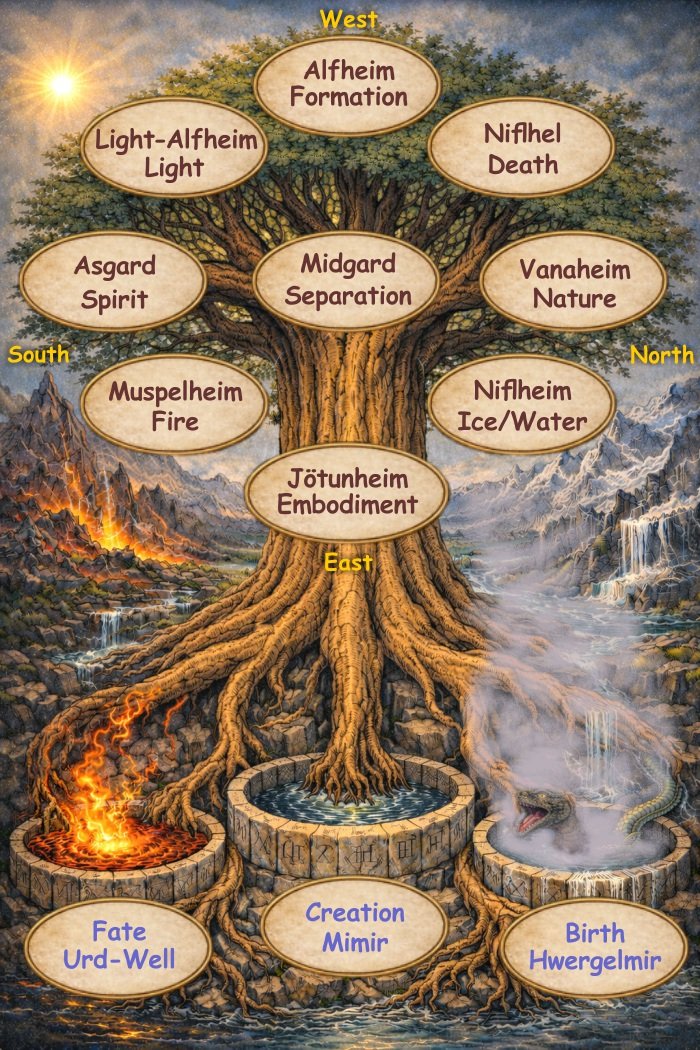
We, too, have reflected and written much about the all-embracing ash as the Tree of Life and Worlds. In the section ‘The Nine Worlds’, this gave rise to the following image:
Below, we see the three wells at the tree’s three main roots. At Mimir’s Well, the All-Father pledges his eye of consciousness for the Mimir-intellect, which then draws from it with the horn of Heimdall, the ‘Consciousness Shining Homeward’, bringing forth the entire intellectual creation from the Sea of Life, or Sea of Causes. This is surely one of the entire Edda’s most powerful symbols. From it, too, arise Jötunheim’s intellectual giants of the macrocosm, tending toward embodiment and rigidity.
Upon the tree’s fire-side, or spirit-side, lies Urd’s Well as spiritual creation’s Spring of Destiny. Here the gods hold their court concerning the connections between causes and effects, and here Muspelheim’s fire also acts as a ‘fire-wall’, ensuring that not all the intellect’s conceptions and wishes can become reality. This is called ‘destiny’: what is sent to us, and what we are sent into.
The third well lies upon the tree’s water-side, or nature-side. It is the source of bodily birth and the bodily creation of transient creatures. The well is called Hvergelmir, a ‘Seething Spring’, producing Niflheim’s mist of illusion all the way up to Niflhel. The name itself actually means ‘Cauldron-Crier’, recalling living beings’ bodily ‘cauldrons’, seeking expression and effect here. Nidhöggr also rules here as the ‘Hatred-Serpent’, or ego-serpent, with the poison of separation. From this arise lone warriors who, unlike the Einherjar, are ‘struck by hatred’ and follow the path to Niflhel, ending there in Hel’s realm of the dead.
The Aesir’s horses bear these names: Sleipnir (Gliding Along) is the best. He belongs to Odin and has eight legs. The others are Glad (Radiance), Gyllir (Golden), Gien (Shining), Skeidbrimir (Swift Runner), Silfrintop (Silver-Mane), Sinir (Muscular), Gisl (Scourge), Falhofnir (Pale-Hoof), Gulltop (Gold-Mane), and Lettfeti (Light-Foot). Baldr’s horse was burned with him, while Thor goes on foot to the judgement-place, wading through rivers with these names (in the Lay of Grimnir, verse 29):
Körmt (‘Boundary’) and Örmt (‘Serpent’), and the two Kerlaugar (‘Cauldron-Baths’), Thor must wade through every day when he goes to judge at the ash Yggdrasil, for the Aesir-Bridge (Bifröst) stands entirely in flames, and the sacred waters boil.
The horses are further described as bodily aspects upon which the spiritual gods ride over the bridge of light to the Well of Destiny at the Tree of Life’s root, to counsel and judge there. The best horse is Sleipnir, the ‘Gliding One’, or ‘Changing One’, in whom we may recognize the All-Father’s entire creation. His eight legs evoke a composite being of masculine and feminine, or spirit and nature. The other horses suggest bodily creation’s luminous nature, but also silver as the reflecting intellect, muscular strength, the scourge of restraint, and the power of movement. Thor is an exception, presumably coming from Midgard and already partly having become a bodily aspect himself. Hence, he goes on foot and must wade through embodiment’s rivers to become free of it. For only thus can he judge independently and participate in the gods’ righteous court.
This principle of purification is also suggested by the rainbow bridge, the ‘Gods’ Bridge’, whose protective rampart of fire and water admits only what is whole. The blue colour’s water-rampart upon nature’s side recalls the Flood’s description. And the ‘boiling of the sacred waters’ reminds us that everything bodily and rigid is boiled apart here, so that no mountain or frost giant can penetrate this rampart. The red fire-wall is described next:
Gangleri then asked: Does fire burn upon Bifröst?
The High One said: What you see as red within the (rain-) bow is burning fire. Were everyone who wished led across Bifröst, the mountain giants, too, would ascend into heaven. Many glorious places exist in heaven, yet divine protection extends over them all. A magnificent hall stands there at the spring beneath the ash. From it come three maidens called Urd, Verdandi, and Skuld (‘Destiny, Becoming, and Guilt’). These maidens decide humans’ (or living beings’) lifespans. We call them Norns. Yet there are others who come to every newborn child to determine its lifespan. Some descend from the gods, others belong to the Elves’ race, and a third kind comes from the dwarves, as stated here (in the Song of the Dragon Fafnir, verse 13):
Of very different origins, I say, are the Norns. They do not share one ancestry. Some descend from the Aesir, some from the Elves, and some are daughters of Dvalin (the ‘Sleeping One’).
Thus, here at Urd’s Well, where the gods assemble, we find a magnificent hall as a space of consciousness, from which three maidens emerge. They are feminine beings of nature, recalling three aspects of the soul as the principle of causation, seeking masculine spirit to realize themselves in life. Hence, Urd’s Well also lies upon the Tree of Life’s spirit-side. Their names are Urd, Verdandi, and Skuld: ‘Destiny, Becoming, and Guilt’. The traditional interpretation sees in them past, present, and future. From a spiritual perspective, we would regard Urd as the present. For the source itself is the present, where the gods, too, gather as beings of the present. Verdandi would then be future becoming, and Skuld past guilt within creation’s river. Here, we may also think of karma’s concept, seeing in them general destiny, personal merit, and personal guilt.
Thus, the three fundamental Norns seemingly become many further Norns for the different personal beings, determining their lifespans and paths according to accumulated causes. In relation to Urd, Verdandi, and Skuld, the first Norns descend from the gods. The second kind descends from the Elves, presumably meaning the Light-Elves as formation’s goal of spiritual development. The third kind presumably descends from dwarves as Dark-Elves: the past’s ‘sleeping’ debts, binding beings into natural physicality. For matter is past. We also know that some atoms are almost as old as the universe. We can readily imagine the ancient dwarves within them. Ultimately, this also suggests that past and future are above all intellectual creations, while actually only the divine, or holistic, present exists: the eternal light within which everything appears. Hence, Urd’s Well is also called particularly sacred.
Thus, manifold living beings may be imagined as many little waves upon creation’s river, arising and passing away, yet always connected to the river. It then depends upon each intellect whether such a wave understands itself as a lone warrior or as an Einherji, arising again and again, fundamentally connected above all to the divine, holistic source, the All-Father’s eye.
Gangleri remarked: If the Norns determine humans’ destinies, they decide most unjustly. For some have a good and rich life, others little good and little esteem. Some have long lives, others short.
The High One said: Good and noble Norns provide a good lifespan, but over those humans who suffer ill, bad Norns rule.
Destiny offers much food for thought. Ego-beings regarding themselves as separate lone warriors ordinarily believe they can determine their own destiny. From their perspective, this even works. They accumulate personal causes, debts and merits, which then work out their effects in the future and generate new causes. Yet the weaker the ego becomes, the more one becomes an Einherji. Who then determines destiny? We can imagine the gods with their serving dwarves within the microcosm determining destiny within the macrocosm. The small reveals itself in the great, the inward in the outward, spirit in nature. Thus, we may also imagine one’s lifespan already determined at birth. Such views occur in many ancient cultures, and it is surely deeply reassuring and liberating from many fears to place one’s destiny so completely into the hands of gods and nature spirits.
Similarly, Skirnir, Freyr’s servant as an aspect of Odin, speaks with complete trust in ‘Skirnir’s Journey’:
My lifespan was determined to within half a day, and my entire life laid down.
Gangleri, too, is presumably upon this path. Yet he still sees separation: between gods and Norns, good and bad, long and short, mine and yours. Naturally, the question of justice then also arises, just as many people in Christian settings ask why God permits so much injustice.
To this great question, the ‘High One’ again answers only briefly, challenging our intellect. He says there are good and bad Norns within separation. This means good and bad appear through fateful causation, and this is just. For within separation there can be no other justice. Yet both experiences are fundamentally destiny, which one can no longer change but can accept. Herein presumably lies ‘destiny’s’ great message: recognizing divine will within it and thus finding ‘Amor Fati’, love of destiny. This is the great path out of the separation of opposites back into wholeness, where divine justice is rediscovered. For at the source there are no good or bad Norns.
Indeed, this acceptance is the right path, yet difficult to understand. Our ordinary intellect is accustomed to holding on to the good and blocking the bad. Thus, in both directions, it obstructs what seeks to work out its effects and find release within consciousness’s light. Acceptance is therefore no deadly passivity, stupidity, or inertia, but the most living and healing activity within creation’s river: the best one can do here, the holiest service to God within the vineyard.
The fundamental problem is thus separation, and this theme now continues:
16. Gangleri asked: What further wondrous things can be told of the ash?
The High One said: Much remains to tell. An eagle sits within the ash’s branches, possessing much knowledge, and between its eyes sits the hawk called Vedrfölnir (‘Wind-Spoiler’). The squirrel called Ratatosk (‘Gnawing Tooth’) runs up and down the ash. It exchanges spiteful words between the eagle and Nidhöggr (‘Hatred-Striker, Hatred-Serpent’). Four stags enter the branches and bite off the leaves. They are called Dain, Dvalin, Duneyr, and Durathror (‘Killing, Sleeping, Dark-Ear, and Door-Thriver’?). So many serpents are in Hvergelmir with Nidhögg that no tongue can count them. Thus it is said here (in the Lay of Grimnir, verse 35):
The ash Yggdrasil endures hardship beyond what humans know: the stag grazes above, decay spreads all around, and below Nidhöggr gnaws.
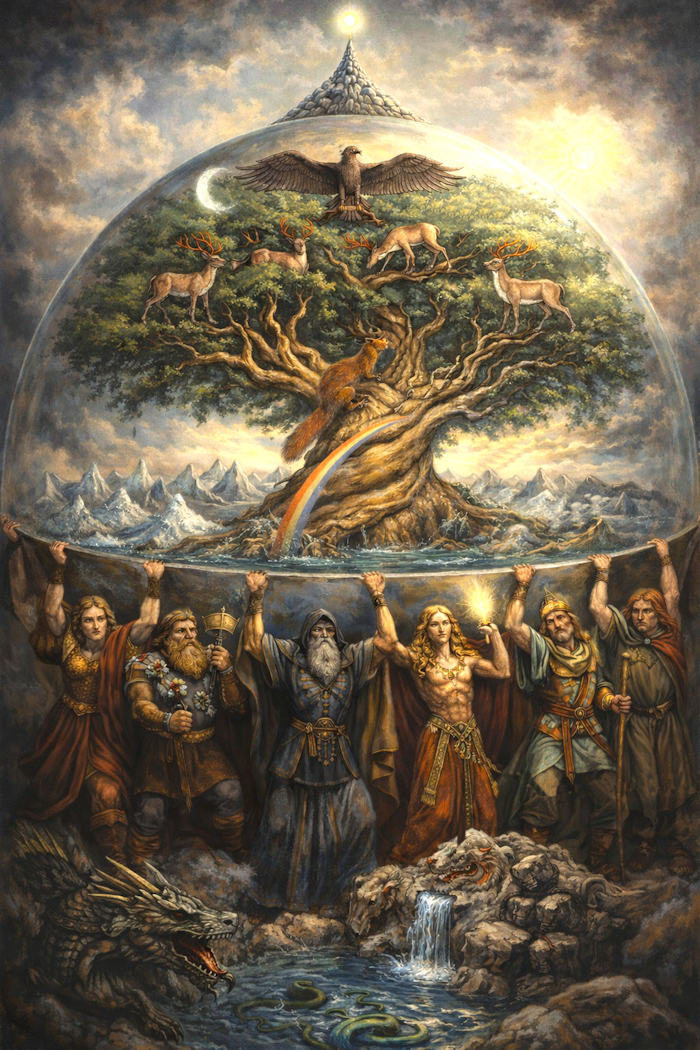
It also says (in the Lay of Grimnir, verse 34):
More serpents lie beneath the ash Yggdrasil than any foolish human believes: Goin and Moin (in earth and in marsh), Grafvitnir’s (Grave-Wolf’s) sons, Grabak and Grafvöllud (Grey-Back, or Old Wolf, and Field-Digger), Ofnir and Svafnir (Exaggerator and Sleep-Bringer, or Killer). I believe they constantly gnaw at the tree’s shoots.
Here, the question concerns how the Tree of Life and Worlds functions and what essential functions can be found within it. This is again described symbolically, and we, too, have already written extensively about this symbolism. We would like to summarize it briefly once more. In the eagle, king of birds, we may recognize desire seeking to rise within the Tree of Life. Even Odin transformed himself into an eagle when the poet’s mead was at stake. The hawk between its eyes recalls a trained hunting bird pursuing objects of desire. Thus, as the ‘Wind- or Spirit-Spoiler’, it is presumably the great obstacle to raising natural desire from separation’s realm into holistic love, all the way to the gods’ heavenly realm, into consciousness’s pure light.
Until this is accomplished, hatred exists within separation’s realm as desire’s opposite, recognizable in Nidhöggr as serpent or dragon. And between hatred and desire, the conceptual mind’s ignorance runs to and fro as Ratatosk, the ‘Gnawing Tooth’, symbolically shaped as a squirrel. Thus, in desire, hatred, and ignorance, we may recognize three fundamental spiritual principles around which everything within this Tree of Life and Worlds revolves.
Four stags are then listed. These might signify four fundamental bodily principles, eating the tree’s shoots and leaves—the manifold living beings—within diversity’s branches. Their names are Dain, Dvalin, Duneyr, and Durathror, difficult to interpret, perhaps as ‘Killing, Sleeping, Dark-Ear, and Door-Thriver’. Here, we might think first of ageing and death; second, bodily inertia and sleep; third, the darkening of the senses, preventing one from hearing or seeing divine wholeness; and fourth, the growth of bodily partitions, closing like doors yet also capable of opening again.
Finally, at Hvergelmir’s Well of bodily birth, a multitude of serpents is mentioned, in whom Nidhöggr, as ego-serpent or dragon, multiplies into living beings’ diversity, ensuring their death through separation’s poison. This symbolism is most interesting: countless others arise from one ego-serpent. Yet fundamentally there is only one ego, always one’s own. Once it is defeated, all the others are defeated too, for separation then no longer exists. The ego is thus the fundamental problem behind every separation, and therefore transience and death. In the Edda, the three great symbols of the Midgard Serpent, the Fenris Wolf, and Hel as goddess of the dead stand for this.
Yet foolish, or ignorant, humans cannot or will not recognize this fundamental problem of separation in order to resolve it. They live as lone warriors, believing their life begins with bodily birth and ends with death. Thus, they practically live only upon the World Tree’s nature-side, between Niflheim and Niflhel.
It is further said that the Norns dwelling at Urd’s Well draw water from it every day. Mixed with the sand lying beside the well, they pour it over the ash. This prevents its branches from drying out or rotting. The water is so sacred that everything entering the well becomes as white as the membrane inside an eggshell. As also stated here (in the Völuspa, verse 19):
An ash I know standing, called Yggdrasil, a tall and sacred tree watered with white sand. From it comes the dew falling in the valleys. Evergreen it stands above Urd’s Well.
The dew that falls from it to the earth is called honeydew, and the bees feed upon it. Two birds called ‘swans’ live (and feed) in Urd’s Well, and the species of bird bearing that name descends from them.
Thus, the ‘High One’ suddenly shifts from the Well of Birth to the Well of Destiny, from which the Norns of fate draw: from the nature-side of the Tree of Life to its spirit-side. Are there truly different wells, or only one? Who creates all these separations? Does this tree truly have a spirit-side and a nature-side, or is it a holistic tree? Are there three or more Norns, or only one? What difference is there between the gods’ court and the Norns of fate? Are there many gods, or only one God? Are there different halls, buildings, and worlds, or only a single space of consciousness, as suggested in the image above?
Similarly, we are now told that the Norns water the tree from outside with the water of destiny. Yet it also has roots drawing the water of life into the tree from within. Who separates the tree’s inside from its outside? What does ‘watering with white sand’ mean?
From a natural perspective, we might first think of atmospheric moisture, carbon dioxide, and airborne dust. We know from our biology lessons that a tree lives above all on light and strives toward light. Through tiny openings in its leaves, it can ‘breathe’ and absorb water, nutrients, and above all carbon dioxide from the atmosphere. This leads to an astonishing fact: a tree consists largely of carbon absorbed not from the ground but from the air. This means that the tree’s ‘solid matter’ is literally built from the invisible substance of the air. Thus, the outward conditions of the air, too, ensure the tree’s growth in a balance between drying out and rotting.
From a spiritual perspective, we may recognize the task of the Norns as feminine beings of nature chiefly in outward formation, while masculine spirit acts and shapes more from within through the roots. Thus, the Norns also pour the water of life onto the Tree of Life from outside, yet mixed with the sand lying beside the well. And when this sand meets the healing water from the Well of Destiny, it becomes white, like the membrane inside an eggshell. Here, once again, we encounter symbolism difficult to translate and still more difficult to interpret. A typical saying of the ‘High One’, then, challenging our conceptual mind.
The Old Norse word ‘aurr’ can be translated as ‘sand’ or ‘earth’. Since it lies around the well, it is thus the substance from which the well flows: the substance of embodiment, which we have already encountered in the salt-symbol of the Lay of Frodi. Thus, the ‘white sand’ also recalls this salt, which can dissolve in water and crystallize and embody itself from it again. And with this ‘salt-water’, the Norns might also water the tree.
The Old Norse word ‘hvítr’ is usually translated as ‘white’, but can also mean ‘bright’ and ‘shining’. This attribute thus evokes not merely a physical colour but also light’s spiritual nature. In this regard, it presumably also signifies the purification of everything entering the Well of Destiny: it loses its own colour and becomes white again, holistic and divine, pure light, pure wisdom.
In this regard, the white membrane inside an eggshell is presumably also cited as an example of a fateful separation that can be overcome. There is much to reflect upon in this membrane: how it separates the inside from the outside, and how it fulfils its biological task of protecting and sustaining life…
Thus, the water of life, as atmospheric moisture, changes back into dew upon the cool earth. Symbolically, this is described as honeydew, the sweet nectar within the Tree of Life’s blossoms. This, in turn, connects the inside with the outside, for this sugary fluid consists chiefly of carbon and water—‘air become liquid’, as it were. Similarly, the industrious bees connect with the blossoms and produce honey for the famous mead, the divine drink of wholeness, to overcome all separations, closing the circle once again. Wonderful symbolism!
Finally, we are told of two swans living together as a loving pair in Urd’s Well. They, too, have received white garments in this holy water. Around this symbolism are woven many ancient legends of swan-beings who can shed their feathered garments and bathe and regenerate in this well as in a fountain of youth. Hence, all birds of this kind descend from them, and yet within the greater whole they are but one bird: a living being capable of purifying itself across the generations through destiny’s power, in the play of love between masculine and feminine. Thus, it can return to the divine source and rise toward pure light. Wonderful!
In this regard, we may reflect on the difference between Urd’s Well with its swans and Hvergelmir full of serpents, between the spirit-side and nature-side, between spiritual renewal and bodily birth, which then reunite in Mimir’s Well.
17. Then Gangleri said: You can tell me much about heaven. What other principal places are there besides Urd’s Well?
The High One said: There are many magnificent places there. There is a place called Alfheim (‘Home of the Nature Spirits’). The people of the Light Elves live there, while the Dark Elves dwell below in the earth (in the realm of Jörd as the daughter of Night). They differ in appearance and still more in their experiences. The Light Elves are fairer in form than the sun, but the Dark Elves are blacker than pitch. There is also the place called Breidablik (‘Far and Wide Radiance’), and nothing is more splendid. Then there is the place named Glitnir (‘Shining One’), whose walls, like all its seats and pillars, are of red gold, while its roof is silver. There is also the place called Himinbjörg (‘Heaven’s Stronghold’), at the edge of heaven by the bridgehead, where Bifröst touches heaven. There is also a great dwelling called Valaskjalf (‘Seat or Realm of the Fallen’). It belongs to Odin. The gods built it and covered its roof with pure silver, and in this hall stands the high seat called Hlidskjalf (‘High Seat of Far-Sight’). When the All-Father sits upon it, he surveys all the worlds.
Thus, with his conceptual mind, Gangleri now asks about further places, worlds, and halls within the great Tree of Life. And the ‘High One’ speaks above all of the upper world, closest to heaven’s light. There lies the realm of the Elves, or ‘nature spirits’, who incline more toward the light of the tree’s spirit-side, while others incline more toward its dark nature-side. These are spaces of consciousness of greater or lesser luminosity, fundamentally consisting of the gold of truth. Only their roofs and other boundaries are made of the silver of intellectual knowledge. Ultimately, they all belong to Odin’s ‘court’ as the All-Father: the realm of creatures who have fallen into separation and thus also into formation and struggle. There, Odin has his throne of ‘Far-Sight’, from which he surveys all the worlds: his eye of pure consciousness, which sees through everything. A more detailed description of these ‘places’ appears in the very first verses of the Lay of Grimnir.
At the southern end of heaven stands the hall that is fairest of all and more radiant than the sun. It is called Gimle (‘Protected from Fire’) and will remain when heaven and earth have perished. Good and righteous people of all ages dwell there. Thus, it is said in the Prophecy of the Seeress (Völuspa, verse 64):
I see a hall standing, fairer than the sun, roofed with gold, in Gimle. There faithful companies shall dwell and enjoy happiness forever.
Then Gangleri asked: What protects this place (Gimle) when Surt’s fire burns heaven and earth?
The High One said: It is said that farther south (of Light-Alfheim), a second heaven exists above the first (which is perishable in fire), and it is called Andlang (‘Endlessly Long’). Yet above them is a third heaven called Vidblain (‘Wide-Blue’). We believe that this place (Gimle) lies in that heaven. And we believe that some Light Elves already dwell there now.
Here, the ‘High One’ speaks of the pure light on which the entire tree lives and toward which the entire tree strives. In our image of the World Tree, we have symbolically depicted this light of Gimle at the upper left, above Light-Alfheim and Asgard, as a sun also called the ‘Elf-Ray’ or ‘Illuminator of Elves’. We are told that, unlike the spaces described before, this hall, or space of consciousness, has a roof not of silver but of the gold of truth, and thus consists of eternal light, boundless in space and time. For all images within light are transient, but light itself is eternal. Likewise, all forms within consciousness are transient, but consciousness itself is eternal. What else could it be? Otherwise, it would already have passed away.
Beneath, or within, this eternal heaven, we may imagine Andlang: a space of consciousness with endless time, in which the essential beings of the gods, nature spirits, Einherjar, and other creatures ‘survive’ even across creation’s cycles. Within such a space, we can still imagine movement and change, as in the endless Sea of Causes. And within this space lies creation’s space of consciousness, with Asgard and the entire World Tree, within which many further spaces and ‘places’ form in turn, as described at the beginning. Yet above everything is Gimle.
Which Light Elves already inhabit Gimle? The light-dwarves? From a modern perspective, we may reflect here on photons, which can act within space and time yet have no rest mass of their own, and are thus eternal light beyond time and space. Likewise, our consciousness in the here and now is within eternity. And the ‘High One’ says: This is divine faith, holistic faith. As Johann Gottfried Herder also wrote in verse:
A dream, a dream is our life
Here upon the earth;
Like shadows upon the waves we drift
And fade away,
And measure our slow steps
By space and time,
And stand (without knowing it) amidst
Eternity.
18. Gangleri asked: Where does the wind come from? It is so strong that it moves great seas and kindles fire. Yet mighty though it is, it cannot be seen, for its nature is wondrous.
Then the High One said: I can certainly explain that to you. At heaven’s northern edge sits the giant called Hräsvelg (‘Corpse-Devourer’). He has the shape of an eagle, and when he spreads his wings for flight, the wind arises beneath them. As it is said here (in the Lay of Vafthrudnir, verse 37):
Hräsvelg is his name, who sits at heaven’s edge, a giant in eagle’s form. From his wings, they say, the wind comes over all humankind.
Thus, Gangleri, too, now asks about the source of that invisible force so mighty in our world, moving so much. From a natural perspective, wind arises through regions of high and low pressure as the atmosphere attempts to balance differences in air pressure. Its driving force is again chiefly the sun, heating the earth’s surface unevenly.
Yet the ‘High One’s’ answer reaches further. To this end, he shifts his attention from the southern heaven of the Tree of Life’s spirit-side back to the northern heaven of its nature-side. There, in the treetop, sits a giant of the intellect who has assumed desire’s eagle-form and beats his wings to rise into heaven. He is called ‘Corpse-Devourer’, sitting, as it were, above Niflhel and living upon dead bodies, just as our objective intellect, in its thirst for knowledge, likes to live upon dead objects. Yet this brings him neither into Andlang’s heaven nor Gimle’s. Indeed, not even into Asgard or Light-Alfheim, for he refuses to leave the tree’s nature-side. He merely produces a great deal of wind within the thinking intellect. That is, with his two wings, he creates many differences, separations, and opposites, which then seek to balance themselves through ever more thoughts. We know this in principle from our modern natural science, which has generated so much knowledge yet cannot reach the spirit-side. Thus, we draw no closer to holistic, or divine, wisdom either.
More and more, more and more, more and more
And the wind blows over the sea again
More and more, more and more, more and more
I shall catch it and bring it here to you…
(Song by Herwig Mitteregger, 1985)
19. Then Gangleri asked: How does the great difference arise by which summer is said to be hot, but winter cold?
The High One answered: No wise man should ask this, for everyone knows the answer. Yet since you are so ignorant and have heard nothing of it, I shall nevertheless consider it good that you ask foolishly once rather than continue knowing nothing of something one ought to know. Svasud (‘Pleasant’) is the name of summer’s father. He leads a happy life, so that when things go well, it is called ‘pleasant’ after his name. Winter’s father, however, is called alternately Vindljoni (‘Wind-Being’) and Vindsval (‘Wind-Cold’). He is a son of Vasad (‘Wet-Cold’). These families were wild and cold-hearted, and winter has their character.
Thus, the ‘foaming wave’ continues investigating the origin of separation and asks where the difference between hot summer and cold winter comes from. From a natural perspective, it is again the sun, standing higher and shining more hotly in summer than in winter. And yet we know that it is not the sun that changes and moves, but our earthly world relative to the sun.
The ‘High One’ answers that a wise man, or spirit, should not keep asking about more differences, but finally recognize the nature of separation and discrimination. For this renders many further questions unnecessary.
Differences arise not somewhere in the outward world but in the observer’s conceptual, thinking intellect, which sees itself as separate from the world. This already creates a fundamental separation. Thus, the ‘High One’ points once more toward separation’s source: through the conception of pleasant and warm, summer appears; through unpleasant and cold, winter appears, although creation is holistic and divine. This is the intellect’s spiritual wind, generating separations and differences. It moves and changes everything, even making us cold and hard-hearted. From this arise the spring, summer, autumn, and winter of life, until the water of life seems to freeze in death. Against this the gods fight, above all Thor with his hammer. And this happens on the great scale as on the small, from creation’s ages through creatures’ life cycles to the course of seasons and days.
Gangleri now seems to have recognized this, so that the following questions turn again from nature toward the spirit-side, focusing above all on the gods as holistic beings:
20. Gangleri said: Who are the Aesir in whom humans should believe?
The High One answered: There are twelve divine Aesir.
Then the Equally High One said: The goddesses are no less holy and possess just as much power.
Why should humans believe in gods? The greatest benefit might be seen in the human being’s ability to recognize himself, too, as a holistic being. This allows the persistent notion of separation to be overcome: that one is merely a transient creature born and dying with the body, whose life begins and ends. This opens a far wider perspective to the spirit, and the human being can develop from a lone warrior into an Einherji. Along this path, identification with one’s own body slowly dissolves, general suffering becomes easier to bear, the terrible fear of losing one’s life disappears, and many further problems accumulated over long periods by the ego-intellect can dissolve. Yet who are these ‘gods’ as holistic beings in whom one should believe? Do they truly exist? And in what form?
This great question effectively opens a new chapter on Gangleri’s path, and the answer is again given on three levels. For nothing can really be said about the pure Godhead itself, since it has neither form nor boundaries that our conceptual mind could grasp. Thus, the ‘High One’ answers briefly and concisely with the holistic circle of the twelve divine Aesir. The ‘Equally High One’ continues to distinguish masculine and feminine in terms of spirit and nature, which are likewise holy, whole, and holistic. And finally, the ‘Third’ descends to the conceptual level of names:
And the Third said: Odin is the foremost and oldest of the Aesir. He rules all things. Though the other gods are powerful, they all serve him, as children serve their father. Frigg is his wife, and she knows everything about human destiny. Yet she makes no prophecies. As it is said here, when Odin himself spoke with the Ase called Loki (based on Lokasenna, verse 29):
Mad you are, Loki, and out of your senses! Why do you not stop, Loki? I believe Frigg knows all destinies, even though she does not speak of them herself.
Odin is called the All-Father because he is the father of all gods. He is also called the Father of the Fallen because he accepts as sons all those who fall upon the battlefield. He receives them into Valhalla and Vingolf (‘Hall of the Fallen’ and ‘Wine-Hall’), where they are then called Einherjar. He is also called Hangagud, Haptagud, and Farmagud (‘God of the Hanged, the Captive, and the Burdened’).
The closest we can come to an essentially inconceivable ‘Godhead’ is the conception of Odin, whose name also means ‘Inspiration’: the holistic spirit making everything alive and changeable. Thus, he is the All-Father of everything that arises, of all creatures falling into separation and thereby into bondage and struggle: the creator-god and the spirit of all effects. And whoever recognizes himself within this and rediscovers himself in the holistic hall, in Valhalla and Vingolf, becomes his spiritual son, an Einherji fighting ‘within the host of unity’ as long as creation endures.
If God is now regarded as the All-Father, there must naturally also be an All-Mother. We may see his wife Frigg in this role; her name can be interpreted as ‘Beloved’. In the play between masculine and feminine as spirit and nature, she would then be nature’s holistic soul as the principle of causation. She embodies, as it were, the potential causes that spirit then brings to life and works out. Hence, she also knows everything about the destiny of humans and all other beings, yet does not pronounce it herself, for this is why she is married to Odin. Ultimately, however, it is only our intellect imagining such separations in order to grasp something. For spirit and nature can in truth no more be separated than cause and effect. Thus, both can always be found within every masculine and feminine being. An example is provided by the seeresses, Walas or Völvas, described several times in the Edda. They know destiny and also pronounce it themselves, thereby acting creatively. Similarly, the gods, too, know destiny when they assemble in court at the Well of Destiny.
Thus, it is a play of names and concepts devised and imagined by the intellect to understand the world in which it lives. This is probably our instrument on the path of knowledge, culminating in the renowned recognition of oneself in All. Problems arise, however, when such names and concepts harden and claim to be truth. Hence, it has always made sense to give the divine a diversity of names, just as it appears in nature as a diversity of forms. Only thus do we have a chance of recognizing the nameless and formless as unity in diversity: God in All.
He also named himself in many other ways when he came to King Geirröd (in the Lay of Grimnir):
I am called Grimr (Masked One) and Gangleri (Weary Wanderer), Herjan (Commander of Hosts), Hjalmberi (Helmet-Bearer), Thekk (Beloved) and Thridi (Third), Thud (Pale One, Colourless One), Ud (Benefactor), Helblindi (Who Does Not See Hel) and Har (High One), Sad (True One) and Svipall (Changeable One) and Sanngetall (Finder of Truth), Herteit (Host-Glad) and Hnikarr (Awakener), Bileyg (One-Eyed), Baleyg (Fire-Eyed), Bölverkr (Evil-Doer), Fjölnir (Much-Knowing, Manifold), Grimnir (Masked One), Glapsvid (Wise Seducer) and Fjölsvid (Supremely Wise), Sidhött (Long-Hat), Sidskegg (Long-Beard), Victory-Father, Hnikud (Stirrer), All-Father, Atrid (Attacker) and Farmatyr (God Who Bears Everything), Oski (Wish-Fulfiller) and Omi (Keen-Hearing), Jafnhar (Equally High), Biflindi (With Painted Shield), Göndlir (Sorcerer) and Harbard (Greybeard), Svidurr (Spear-Thrower), Svidrir (Spear-Bearer), Jalk (Stallion), Kjalarr (Sledge-Driver) and Vidurr (Forest), Thror (Prosperous One), Ygg (Terrible One), Thund (Mighty One), Vak (Watchful One), Skilfing (Protector), Vafud (Waving One), Hroptatyr (Calling God), Gaut (Goth or Divine One), and Veratyr (God of Humankind).
Within this diversity of names, we also rediscover Har, Jafnhar, and Thridi—the ‘High, Equally High, and Third’—with whom Gangleri speaks here, whose own name is likewise on the list. Thus, they, too, are aspects of Odin, as presumably is everything within creation. Ultimately, one may recognize that God always speaks only with himself within himself, one divine eye with his other eye. Wonderful! Yet for the intellect, the path to this remains long:
Gangleri said: Very many names you have given him. I believe great knowledge must lie behind them, if one possesses the understanding and examples of the events belonging to each of these names.
The High One answered: Much knowledge is needed to explain all this precisely. Nevertheless, let me tell you briefly that most names—as many as there are languages in the world—were given because all peoples had to translate his name into their own language, to invoke him and make petitions for themselves. Yet some events from which the names were formed occurred upon his journeys. They are recounted in the stories. And you cannot call yourself a wise man if you know nothing to tell of these great deeds.
Here, the question is presumably how much knowledge one needs to recognize God behind all his names. The ‘High One’ answers briefly with the natural diversity of peoples and languages. This means that no manifold knowledge actually lies behind them: all the names essentially mean the same thing—God, the greater whole. Naturally, one can tell the most varied stories about this. Yet the wisdom of these stories lies not in much knowledge but in the message reaching beyond all knowledge. These are the true ‘stories of the gods’ that a wise human being can tell.
Our modern world, too, is crammed with knowledge. How many books, films, and stories every human being consumes nowadays! Yet does this bring us closer to God, to wholeness, perfection, and contentment? Here, one might reflect on the skalds’ poetic mead in Kvasir’s story, and how Odin himself obtained and drank it.
21. Then Gangleri said: What are the names of the other Aesir? What are they capable of, and what great deeds have they accomplished?
The High One said: Thor is the most prominent among them. He is also called Aesir-Thor or Öku-Thor (‘God-Thor’ or ‘Chariot-Thor’, or alternatively ‘God-Thunder’ or ‘Rolling Thunder’). He is the strongest of all gods and humans. He rules over the realm called Thrudvang (‘Field of Strength’), and his hall bears the name Bilskirnir (‘Lightning-Strike’). Within this hall are five hundred and forty rooms. It is the largest house known to humankind. Thus, it is said in the Lay of Grimnir (verse 24):
Five hundred rooms and forty—such, I reckon, is Bilskirnir (Thor’s palace) in its entirety. Of all the houses I know to be roofed, I know my son’s to be the greatest.
Thor has two goats named Tanngnjost and Tanngrisnir (‘Teeth-Grinder’ and ‘Teeth-Gnasher’), and a chariot when he travels; the goats draw this chariot. He also possesses three treasures: first, the hammer Mjölnir (‘Crusher’), well known to the frost and mountain giants when it is swung through the air. And no wonder, for it has shattered many a skull of their fathers and kinsmen. The second outstanding treasure he possesses is a belt of strength. When he puts it on, he gains twice the strength of the Aesir. Yet he has a third great treasure: iron gloves. He cannot do without them at the hammer’s handle. No one, however, is so wise that he could recount all his heroic deeds. Yet I could tell you so many stories about him that ages would pass before everything I know had been said.
Thus, the manifold gods are all sons, or spiritual aspects, of the All-Father. Fittingly, Gangleri asks about the nature of the individual gods to understand the entire Godhead more comprehensively. The ‘High One’ answers, beginning with Thor, the ‘Thunder-God’. We have already reflected and written much about him in the chapter ‘The Nature of Thor’. In him, we may recognize the personified power and strength of the gods, but also the ‘righteous wrath of the gods’, directed above all against the mountain and frost giants: against rigidity within nature, and in this sense in support of the life of all creation. He was begotten by Odin and born to Jörd, Mother Earth. Thus, his sphere of action is called Thrudvang, the ‘Field of Strength’, where physical strength can grow fruitfully for living creation. His hall Bilskirnir, as the realm of ‘Lightning-Strike’, recalls the space of consciousness of embodied living beings. Within creation, these precede the thunderclap like flashes of lightning, appearing briefly and passing swiftly away. For everything that arises must also pass away again. The 540 gates are likewise described for Valhalla and thus connect these two spaces. Yet the number’s significance remains unclear.
Thor’s chariot recalls earthly physicality, enabling movement upon the earth. It is drawn by two goats, evoking the worldly play of opposites and, through their teeth, the ‘bite’ as the driving force that allows something to move here. Thor himself can slaughter these goats, use them as food, and regenerate them with his hammer. Powerful symbolism!
His principal weapon is the hammer Mjölnir, the ‘Crusher’, feared by the frost and mountain giants. For with this weapon, he fights the overwhelming rigidity and solidification within creation, thereby ensuring its living mobility. Thus, it is not a weapon of deadly destruction but a divine instrument for life within creation. It was fashioned by the dwarves as nature spirits within the realm of formation and praised most highly by the gods.
A second symbolic instrument is his belt of strength. Through it, he can, as it were, concentrate and direct his holistic divine powers toward a particular goal. Accordingly, his strength multiplies as well.
A third symbolic instrument is his iron gloves. We may regard them as a kind of protective gloves, shielding him against action’s karmic effects. This is probably also most important for a god, for otherwise he would lose his holistic nature, fall into separation like other creatures, and accumulate karmic guilt.
Thus, Thor, too, remains a divine being who can never be fully comprehended. And the final two sentences confirm this: ‘No one, however, is so wise that he could recount all his heroic deeds…’
22. Gangleri remarked: I should also like to ask for new things about other Aesir.
The High One said: A second son of Odin is Baldr, of whom only good can be told. He is the best, and all praise him. He is so beautiful and bright in form that radiance shines from him. There is a plant so white that it is compared with Baldr’s eyebrows. It is the whitest of all plants, and from it you can recognize his beauty, both of hair and body. He is the wisest of the Aesir, the most eloquent and gracious. Yet this quality is associated with him: his judgment cannot endure. He dwells in the place called Breidablik (‘Far and Wide Radiance’), which is in heaven. In this place, nothing can be impure. As it is said here (in the Lay of Grimnir, verse 12):
Breidablik is the name of the place where Baldr has built himself a hall, upon the land where I know the fewest curse-runes to lie.
Just as Thor fights upon earth for the eternal principle of life, the ‘High One’ now speaks of the eternal principle of light, begotten by the All-Father and born and embodied through Frigg, the All-Mother as creation’s pure soul. This ‘brightness’ is one of the Godhead’s most fundamental aspects. For everything consciousness can recognize naturally appears between eternal brightness and eternal darkness, which is then born as Baldr’s blind brother Hödur. Logically, these principles must be eternal, for otherwise they would already have passed away. Thus, the Edda also tells that they survive Ragnarök. Only the forms in which the creative intellect imagines these principles are transient.
Here, the ‘High One’ mentions a plant, presumably sea mayweed, still called Baldursbrá (‘Baldr’s Eyebrows’) in Icelandic today. Its blossoms recall a sun with white rays. Hence, chamomile is counted among the important solstice herbs still traditionally gathered around the summer solstice (St John’s Day). It is regarded as a plant bringing blessings and warding off dark powers.
This transience of light taking form is presumably also suggested by the quality that his judgment cannot endure. This means that pure brightness will never exist within time and space. Here, we may again recall the nature of photons: as modern science knows, a photon exists in itself beyond time and space, yet as an effect within the world it is transient, or changeable. Gangleri will later hear the story of ‘Baldr’s Death’ concerning this.
Accordingly, Baldr in himself dwells within a pure and holy heavenly realm, named among the highest places in the Lay of Grimnir, directly beside Heimdall’s realm, yet situated more on the nature-side according to our table. In this regard, the ‘High One’ now also speaks of a typical ‘god of nature’:
23. A third Ase is the one called Njördr. He lives in heaven at the place named Noatun (Ship-Place, Sea). He determines the wind’s course and governs sea and fire. He is invoked for sea voyages and fishing. He is so rich and blessed with success that he can bestow some of his abundance of land and wealth upon humans. For this, too, he is invoked. Njördr is not descended from the Aesir. He grew up in Vanaheim, but the Vanir gave him to the gods as a hostage, taking in exchange the one called Hönir. He was part of the peace agreement between gods and Vanir.
Between brightness and darkness, bodily creation now appears. This, too, is an aspect of the Godhead: the unshaped can assume shape and the formless form. Wonderful! This formative power can be found as a holistic being in the nature gods of the natural elements. In the Edda, Njördr above all represents this as god of wind, sea, and fire. Thus, he lives at the boundary between the Sea of Causes and earthly creation, as it were as the foundation of material creation, symbolically upon the seashore. One might also see in him a holistic being of Bergelmir, purified by the flood and transformed into divine creation.
We might imagine the war between Aesir and Vanir at the end of the golden age, when nature’s power became overwhelming and threatened the gods’ rule. We have already written at length about this symbolic ‘War of the Vanir’ in the section on ‘Mimir’s Head’. It ended with a peace treaty, in which both sides recognized one another as gods and symbolically exchanged hostages to this end. Thus, Njördr became an Ase, while Hönir, whom we have interpreted as divine, or holistic, reason, became king of the Vanir within nature. This means that spirit and nature were recognized as unity by both sides. For here, too, it is only the conceptual mind that creates this separation between spirit and nature. No such separation exists for a divine being.
Njördr has a wife named Skadi, daughter of the giant Thjasi. Yet Skadi wishes to have the dwelling that belonged to her father. It lies in the mountains at the place called Thrymheim (‘Home of Battle-Clamour’). Njördr, however, wishes to live close to the sea. They agreed to spend nine days in Thrymheim, then the other nine in Noatun. But when Njördr returned from the mountains to Noatun, he spoke these words:
‘Hateful to me are the mountains; I was not there long, only nine days. The wolves’ (loud) howling seemed ill to me compared with the swans’ song.’
Skadi answered:
‘And I could not sleep upon the seashore because of the birds’ cries. The gull woke me every morning when it came from the sea.’
Then she travelled up into the mountains and dwelt in Thrymheim. She often travels on snowshoes with her bow, hunting animals. She is called Snowshoe-Goddess or Ski-Dis, as it is said here (in the Lay of Grimnir, verse 11):
Thrymheim is the name of the place where Thjasi dwelt, the overpowering giant. But now Skadi, the gods’ radiant bride, inhabits her father’s ancient dwelling.
The ‘Story of Thjasi and Skadi’ is told at the beginning of the Skaldic Book, and we have already interpreted it in detail. Skadi is the daughter and symbolically the soul of a frost giant who transformed himself into an eagle, seeking through his desire to become physically immortal within the world. For this, he was struck down by the gods, and in compensation for this deed, they offered Skadi marriage to a god of her choice. Yet her vision could see no more than their feet, with which they stood upon the earth. Although she wished for beautiful Baldr as her husband, she chose Njördr, which also corresponded to her nature. Thus, Skadi, the mountain and frost giant’s daughter, became the winter goddess and still likes to inhabit the icy mountains where wolves howl with hunger. Her marriage to Njördr thus becomes a symbol of the wave-play of natural embodiment within Draupnir’s ring of regeneration, like the wave-play of summer and winter, seemingly living apart yet connected to one another.
24. Njördr of Noatun later had two children: one was named Freyr (as the fertile summer god), and his daughter Freyja (as goddess of love and fertility). They were beautiful in appearance and powerful. Freyr is the foremost among the Aesir. He governs rain and sunshine, and thus the earth’s fertility. It is favourable to invoke him for good harvests and peace. He also determines human wealth. Freyja is the most esteemed of the goddesses. In heaven, she possesses the dwelling called Folkvang (‘Field of the People’). When she rides to battle, she receives half the fallen warriors; Odin receives the other half. As it is said here:
Folkvang is its name, where Freyja decides the seats within the hall. Half the fallen she chooses every day; the other half belongs to Odin.
Her hall Sessrumnir (‘Room of Many Seats’) is large and magnificent. When she travels, she rides in a chariot drawn by cats. For humans, she is the most readily approached in invocation, and from her name comes the title of honour by which noble women are called ‘ladies’. She delights in love songs, and it is useful to invoke her in matters of love.
Thus, Njördr begot with the winter goddess a fertile summer god, as well as a goddess of love and fertility. These two can be regarded as the great goal within the play of spirit and nature: love to overcome separation, and fruitful power for eternal renewal and regeneration.
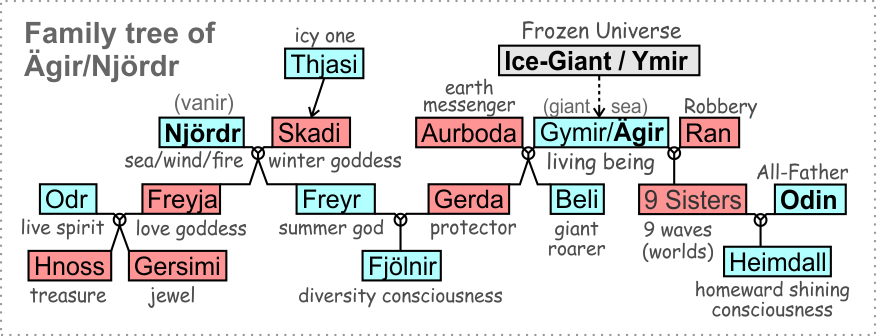
Thus, Freyja rules within the realm of embodiment and receives half the fallen warriors. This presumably concerns their nature rather than their number: Odin provides for spiritual renewal, and Freyja for bodily regeneration within nature’s realm. The lone warriors who end in Hel, spiritually and physically, are not mentioned here, and perhaps this is merely their own imagining. Here, the emphasis is that everyone has a seat within Freyja’s great, or holistic, hall, just as in Odin’s Valhalla.
Like Thor, Freyja, too, travels in a bodily chariot, drawn, however, by two cats. These recall the protection of the home against greedy mice, for which cats were often kept. In her nature, Freyja is often compared with Frigg, and her husband’s name, Odr, also recalls Odin. Thus, Gangleri will hear in section 35:
Freyja is married to a man called Odr (‘Spirit of Life, Inspiration’). Their daughter is called Hnoss (‘Treasure’): she is so beautiful that everything beautiful and precious is named after her. Odr went away on distant journeys, and Freyja weeps for him; her tears are red gold.
Ever since, the soul of physicality has wandered through the world seeking her husband, the spirit that makes everything alive. In doing so, she weeps tears of the red gold of true love. Wonderful! What a marvellous vision of how outward nature’s beauty and love serve to rediscover life’s imperishable spirit.
25. Then Gangleri said: These Aesir seem mighty to me. And it is no wonder that you possess such great power when you have knowledge of the gods and know whom to approach with which requests. Are there still more gods?
The High One said: There is another Ase called Tyr. He is the boldest and most courageous, and greatly determines victory in battle. It is good for brave men to invoke him. One who goes ahead of other men without fear is called Tyr-bold. He is also so wise that someone exceptionally wise is called Tyr-wise. A sign of his courage is this: when the Aesir persuaded the Fenris Wolf to let them place the fetter Gleipnir (‘Causation’) upon him, he did not trust them to free him from it again. Thus, they put one of Tyr’s hands into his mouth as a pledge. But afterwards, the Aesir no longer wished to free him. Thereupon, he bit off the hand at the place now called the ‘Wolf-Joint’. Tyr is therefore one-handed and is not called a peacemaker among humans.
Gangleri’s question is interesting, for it reveals that he is still unaware of who he himself is and with whom he is actually speaking. Yet breaking through to this awareness is also very difficult. Another aspect of the Godhead now stands for this supreme victory: Tyr as the ‘God of Righteous Victory’. For whoever fights for justice in a higher, holistic sense cannot truly lose. This contrasts with lone warriors, who will ultimately always lose, whatever they fight for, because they live in separation.
The story of the fetter Gleipnir is told in detail later, in section 33. Among all the gods, only Tyr was willing to give his hand as a pledge, just as Odin gave his eye as a pledge. It was even his right hand, which he gave as a symbol of justice and seemingly lost because the gods did not keep their promise to unbind the wolf—and fundamentally neither wished nor were able to do so. For who could undo the fetter of ‘causation’ once it has been fastened? How just and truthful, then, is this creation? How just is it to bind transience, so that everything arising does not immediately pass away again? Thus, justice’s right hand now lies pledged within the belly of the Fenris Wolf: the omnipresent transience seeking to devour everything that has arisen. We may reflect deeply upon this, as the ‘High One’ presumably intends:
Thus, Tyr is now one-handed, just as Odin is one-eyed, to make creation and learning within time and space possible. Hence, Tyr is also no ‘peacemaker’ within the world, for life within time and space remains an eternal struggle against transience. This means that true peace cannot be found in transient things, but only beyond time and space. Perhaps this is precisely the ‘righteous victory’: sacrificing one hand as the wolf-joint of transience in order to act ‘one-handed’ beyond worldly opposites, beyond ‘me against you’ or ‘gain against loss’, just as Odin looks ‘one-eyed’ with the eye of insight. This kind of holistic action is the Tyr-courage and Tyr-wisdom of righteous victory, for only then is justice also possible.
Accordingly, ‘righteous victory’ would be no triumph over an enemy, but victory over one’s own identification with the transient, so that no loser remains. For only where there is no loser can victory be just. And whoever, like Tyr, is truly willing to sacrifice his ‘hand’ as the wolf-joint within transience’s jaws has already won, for he shows that his roots lie in the imperishable.
From this holistic perspective, nothing is ever lost, neither a hand nor an eye. For how could anything be lost within wholeness?
26. Another is called Bragi. He is renowned for his wisdom, and above all for his eloquence and verbal art. He excels in poetry, which is called Bragr (‘Poetry’) after him. Those who surpass others in verbal art, whether woman or man, are called Bragr-men or Bragr-women after his name. His wife is Idun. Within her chest (Eski, the ‘Little Ash-Wood Chest’), she keeps the apples the gods must eat when they grow old. Then they all remain young, and so it will be until Ragnarök.
Gangleri remarked: It seems exceedingly important to me that the gods have her in their keeping and trust Idun.
The High One spoke, laughing as he did so: Once, things very nearly went wrong. I shall tell of that, but first you shall hear more of the Aesir’s names.
Another important aspect of the Godhead is the poets’ inspiration for stories capable of raising the conceptual mind toward the divine. This is also evoked by the German verb dichten, ‘to compose poetry’, suggesting the verdichten, or ‘condensing’, of scattered, manifold knowledge into wholeness. Here, this is represented by Bragi, the god of poets, who effectively narrates the entire Skaldic Book for Gymir, or Ägir, as a ‘living being’ within the Sea of Life.
As a god, Bragi was begotten by Odin. His mother is not explicitly named in the Edda. Considering the stories, we would think of Gunnlöd, daughter of the mountain giant Suttung. He had concealed the poetic mead within a mountain of matter and set his daughter, or soul, to guard it there. Yet Odin penetrated to her and united with her to regain the poetic mead for the gods. And surely this union did not remain fruitless…
Bragi’s wife is Idun, the ‘Renewing and Rejuvenating One’, goddess of youth and immortality with the golden apples. In these, we may recognize the imperishable fruits of truth, through which the forms of the gods remain young and alive throughout creation’s entire cycle. Thus, these fruits also appear within divinely inspired poetry, preserving the holistic divine beings immortally within our memory.
Yet once, things very nearly went wrong. This presumably alludes to the story of the frost giant Thjasi, who wished to gain Idun for himself and keep her as his wife in order to become physically immortal. Yet this caused the divine and spiritual to begin ageing and dying. Our modern natural science presumably attempted something similar in the course of the ‘Enlightenment’, which is why Friedrich Nietzsche wrote of the ‘madman’:
‘God is dead! God remains dead! And we have killed him! How shall we comfort ourselves, the murderers of all murderers? The holiest and mightiest thing the world has yet possessed has bled to death beneath our knives—who will wipe this blood from us? With what water could we cleanse ourselves? …’ (The Gay Science)
Fortunately, however, this happened only ‘nearly’. Ultimately, the divine saves itself. For Idun, too, is merely an aspect of this incomprehensible Godhead. In her nature, she recalls Draupnir, the ring of renewal and regeneration. Thus, in the song ‘Odin’s Raven Spell’, she is also called a daughter of the dwarves, or nature spirits, and associated with Urd. For destiny, too, provides renewal and regeneration. In this regard, we may also think of the two swans within Urd’s Well.
Thus, we now proceed still further into spiritual depth, and simultaneously to the greatest height:
27. One is called Heimdall, also known as the White Ase. He is mighty and holy, and was born of nine maidens who were sisters. He is also called Hallinskidi (‘Ram, Horned One’) and Gullintanni (‘Gold-Tooth’), for his teeth are of gold. His horse is called Gulltopp (‘Golden Mane’). He dwells upon Himinbjörg (the ‘Heavenly Stronghold’) beside Bifröst (the ‘Bridge of Light, or Rainbow Bridge’). He is the gods’ guardian and sits at heaven’s edge to protect the bridge against the frost and mountain giants. He needs less sleep than a bird and sees a hundred miles by night as by day. He also hears grass growing upon the earth and wool upon sheep, and thus everything that can be heard at all. He has a trumpet called Gjallarhorn (‘Calling Horn’), and when he blows it, it is heard in all worlds. Heimdall’s sword is called Hofund (Hǫfuð, ‘Head or Man’s Head’). It is further said (in the Lay of Grimnir, verse 13):
Himinbjörg is its name, where Heimdall, they say, rules the holy place. There, within his peaceful home, the gods’ guardian blissfully drinks the sweet mead.
He also says himself in Heimdall’s Song (whose text has unfortunately been lost):
I am the son of nine mothers, born of nine sisters.
Another mighty and holy aspect of the Godhead is Heimdall. His name can be interpreted as ‘He Who Illuminates Home or World’, or ‘He Who Shines Homeward’. In this sense, he is the light of the world, the light of consciousness between brightness and darkness, in which we may recognize a great task: leading the creatures who have fallen into worldly separation and struggle back home into the divine. For this, he, too, fights. His byname Hallinskidi recalls a fighting ram, and Gullintanni the golden tooth as the ‘bite of truth’. Thus, he also literally rides upon truth, upon pure light in heaven above the Rainbow Bridge. There, upon the bridge between heaven and earth, he guards the gods’ heavenly realm. We already know this Rainbow Bridge as a protective wall of fire and water, admitting nothing possessing form and separate from the Godhead. Indeed, through this the gods are protected as holistic beings.
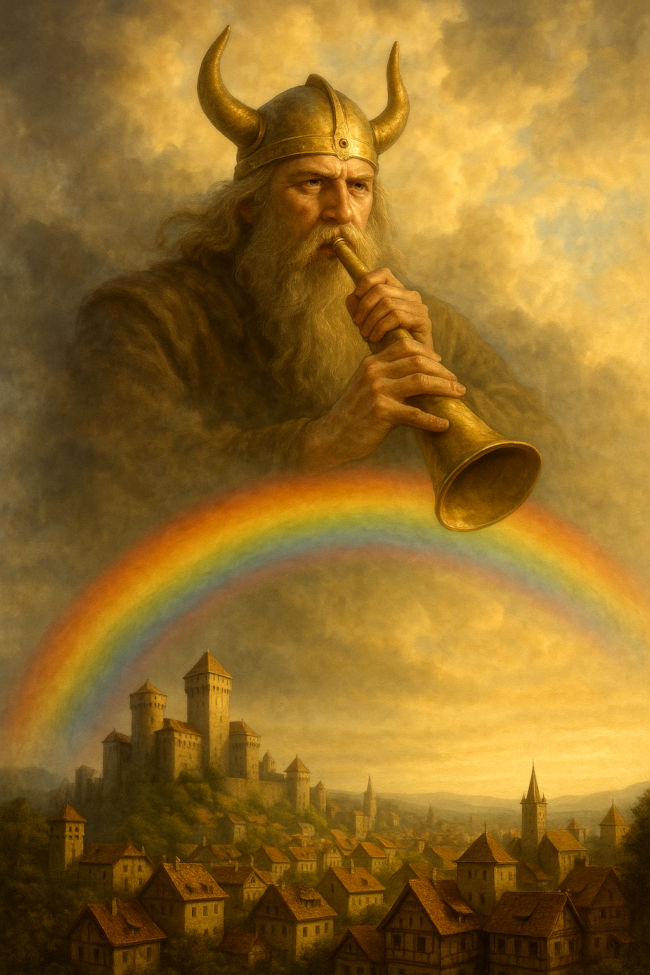
In this sense, Heimdall is pure vigilance, mindfulness, or awareness, which fundamentally never sleeps and can survey everything. Thus, ‘he hears grass growing upon the earth and wool upon sheep’. This presumably signifies an awareness unbounded by bodily senses. What kind of awareness is this? Here, one might think of divine consciousness no longer binding itself to limited, transient forms, but recognizing imperishable, formless consciousness itself—God in All, as it were. Similarly, yoga speaks of four levels of consciousness: dreamless deep sleep, dreaming sleep, dreamlike wakefulness, and dreamless wakefulness as the highest level, containing everything else within itself.
Toward this highest state, the call of consciousness presumably also sounds through Gjallarhorn, heard in all worlds—indeed, even in deep sleep’s darkness. As a manifestation of the Godhead, this call was symbolically begotten by Odin and born of nine maidens, who, as daughters of Ägir, the Sea of Life, are also regarded as nine waves. In practice, we may see in them the nine worlds and the entire Tree of Life, which fundamentally grows toward the light for this call of Heimdall alone. It is the call of divine consciousness into the heavenly light of the eternal Godhead, addressed to all creatures who have fallen into the separation of form and thus live within the World Tree in time and space.
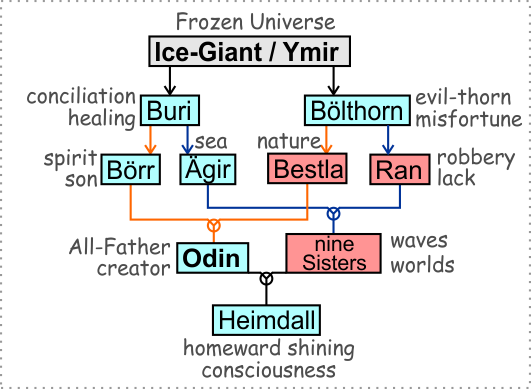
His weapon, or sword, can be interpreted as ‘Man’s Head’, recalling the healing human intellect, or better still human reason. Accordingly, section 15 above also said that the Mimir-intellect draws everything comprehensible—and thus, in principle, the entire creation—from Mimir’s Well with Heimdall’s Gjallarhorn. And for this, Odin pledged his eye.
28. Another Ase is called Hödur. He is blind and exceedingly strong. Yet the gods did not wish this Ase to be named, for his deed might remain too long in the memory of gods and humans.
Here, the ‘High One’ again challenges our ordinary intellect, which can think only in opposites. Thus, we also believe we understand the story alluded to concerning Hödur’s deed: as the ‘blind Ase’, Hödur embodies the eternal principle of darkness and is ‘exceedingly strong’, so that he could even kill his brother Baldr as the eternal principle of brightness and send him to Hel. Thereupon, Odin begot Vali as the eternal principle of life, and Rinda gave birth to him. Immediately after his birth, he killed the ‘exceedingly strong’ Hödur and sent him, too, to Hel.
How can this be understood? Surely the story is full of contradictions. How can these be resolved? How can we get such opposites out of our memory again to rediscover divine wholeness? This is presumably why the gods do not wish us to speak too much of ‘darkness’ and preserve this concept in our memory. Perhaps it would be better to be able to see pure light in this, too. As it is also said: ‘The light shines in the darkness, and the darkness has not grasped it…’
Similarly, our modern cosmology also knows an ‘exceedingly strong’ darkness governing our universe: on the one hand, ‘dark matter’, invisible to our senses and measuring instruments, yet holding galaxies together through its enormous gravitation. On the other, ‘dark energy’, which causes the universe to expand and thus creates space and time. In this regard, darkness, too, provides movement within the universe, and thus the apparent change and transience of eternal light. It thereby makes possible what we call ‘living and dying’, including ‘Baldr’s death’.
There are also scientific approaches that can help us recognize light within darkness again, thus dissolving the seemingly irreconcilable opposition between brightness and darkness. For instance, the theory that our entire universe, with all its light, might exist within a black hole. Or Hawking radiation: even black holes radiate and, in principle, emit light. Or the quantum fluctuations of the dark vacuum. Ultimately, even the ‘Big Freeze’s’ dark frost giant still consists of the Big Bang’s light. Wonderful!
Thus, the ‘apparently’ opposing brothers Baldr and Hödur were not begotten by the All-Father and born to the All-Mother in vain. For between them is a third brother named Hermodr. His name means ‘Host-Courage’, recalling the Einherjar’s courage in battle. He is also regarded as the gods’ messenger. Perhaps this concerns above all that courageous message within life’s struggle: ‘the light shines in the darkness’, as Gangleri will hear later in the story of Baldr’s death.
29. One is called Vidar, the silent Ase. He has a sturdy shoe and is of similar strength to Thor. In the end, the gods have a strong ally in him.
Thus, this struggle to dissolve seemingly irreconcilable opposites is also an important aspect of the Godhead. The name Vidar can be interpreted as ‘Warrior of the Forest’, and he is also called the ‘Silent Ase’ or ‘God of Silence’. He was begotten by Odin and born to the giantess Grid, whose name means ‘Peace’. Thus, we may see in him the silent warrior within the forest of conceptions, capable of peacefully reconciling the intellect’s worldly opposites. This is also the path of silent yogis, Zen monks, and ascetic forest hermits. This path has always been very powerful. For as soon as the wilful intellect falls silent, who then speaks? And who is silent? Thus, in his struggle against the intellect bound to form, he is of similar strength to Thor, perhaps even stronger, as will later be revealed at Ragnarök. There, the sturdy, enduring shoe is also explained, with which he can even defeat the all-devouring Fenris Wolf.
30. Another is called Ali or Vali, a son of Odin and Rinda. He is bold in battle and an unerring marksman.
Now the intellect would like to say: Surely silence and stillness sound like rigidity and death! Not necessarily, for this concerns a living and creative stillness, the primordial ground of everything, from which all arises. And for this there is another important aspect of the Godhead: Vali, in whom we may recognize the eternal principle of life. Thus, alongside Vidar, Hödur, and Baldr, Vali is the fourth son of Odin to survive Ragnarök as an eternal principle. His name recalls the struggle of the fallen. Likewise, all creatures who have fallen into separation fight above all for their lives. For only within separation can one imagine the fear of losing one’s own life, and thus the challenge to fight for it.
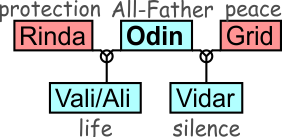
Hence, Vali is bold in battle and an unerring marksman. For the principle of life also includes the creative aspect, so that every living thought directed toward an imagined goal is effective and eventually reaches its goal.
What, then, is life? The struggle for consciousness, to reach all desired goals, have all desired experiences, gain all desired possessions, and acquire all desired knowledge. Fundamentally, these are indeed proper goals. The great question, however, is: By what path can we reach them and find great fulfilment? By the path of the giants in Jötunheim?
31. Ullr is the name of one who is Sif’s son, Thor’s stepson. He is so fine an archer and skier that no one can match him. He is also handsome in form and possesses a warrior’s skills. It is good to invoke him in single combat.
If we now speak of life, change, transformation, and regeneration naturally belong to it as well. Hence, Ullr as the god of winter is another important aspect of the Godhead. Not merely because he provides winter after summer within life’s cycle, but above all because, as a god, he preserves life through winter’s frosty season. Thus, as a divine and holistic being, he ensures that life does not become completely rigid but can continually renew and regenerate itself. Hence, one can recognize beauty and divine perfection in winter, too; through this recognition, one can win every single combat and overcome every opposition. Thus, with thought’s arrow from the intellect’s bow, one always strikes the great goal. Wonderful!
His mother is Sif, who, together with Thor, protects life within the earthly realm. Who his original father is remains unclear in the Edda. Thor is named only as his stepfather. In the section on ‘Thor’s Family’, we considered whether Njördr might perhaps be his father. Then Njördr would have begotten Ullr, the winter god, as a Vanir, and Freyr, the summer god, as an Ase.
32. Forseti is the name of Baldr’s son by Nanna, Nep’s daughter. He dwells in heaven within the hall called Glitnir (‘Shining One’). All who come to him over legal disputes depart reconciled. It is the finest court of justice among gods and humans. As it is said here (in the Lay of Grimnir, verse 15):
Glitnir is the name of a hall supported by gold and likewise (like Valaskjalf) roofed with silver. Forseti dwells there most of the time, settling every dispute.
Another aspect of the Godhead belongs to natural life: ‘problem-solving’, here called Forseti. His name means ‘the Presiding One’, and the president is still called ‘Forseti’ in Icelandic today. His father is Baldr, the god of brightness, and his mother is Nanna, fundamentally meaning simply ‘Mother’ in the sense of nature. His grandfather’s name, Nep, evokes ‘kinsman’ or ‘nephew’. In our interpretations of the ‘Nibelung Cycle’, the term ‘nephew’ was often used for important heroes who were nevertheless readily overlooked or given little attention within the world. Thus, Nep as a giant might point toward Bergelmir.
Forseti’s luminous hall symbolically stands upon truth’s golden pillars, yet is roofed with the silver of the intellect and thus bounded, unlike his father’s hall, Breidablik as ‘Far and Wide Radiance’. In our table in the ‘Lay of Grimnir’, both halls lie on the nature-side. There, the intellect works within its limits, seeking justice and attempting to master and ultimately settle the conflict of natural opposites. This happens on different levels of consciousness, best of all within divine light, where all opposites can dissolve. Accordingly, Forseti’s hall lies between Baldr’s Breidablik, the hall of silent light, and Skadi’s Thrymheim, the hall of battle-clamour where hungry wolves howl. In this regard, we might recognize Forseti as a being of wisdom: a synthesis of Hönir and Mimir, of holistic reason and creative intellect, a just judge working with divine light to solve problems. Indeed, this wisdom should be president over all our lives.
This again recalls creation’s goal: resolving the accumulated problems from the Sea of Causes. And the best solution remains divine light, for everything can dissolve within consciousness’s pure light.
Thus, the circle closes with Baldr. And we continue with Loki, through whom the great circle will also close with Odin.
33. Among the Aesir is also counted the one whom some call the Aesir’s slanderer, the source of deceit and the disgrace of all gods and humans. Thus is named Loki (the ‘Interwoven One’ or ‘Rascal’), or Lopt (the ‘Airy’ or ‘Incomprehensible One’), son of the giant Farbauti (‘Hostile Striker’). His mother is called Laufey (‘Foliage’) or Nal (‘Needle’). His brothers are Byleist (‘Wave-Strike’) and Helblindi (Who ‘Does Not See Hel’, also a divine name of Odin). Loki is handsome and pleasing in appearance, yet has a bad character and is unpredictable in his behaviour. He surpasses everyone in cleverness, but also in every kind of deceit. He continually brought the Aesir into difficulties, yet often resolved them through cunning. His wife is called Sigyn (‘Bringer of Victory’), and their son is Nari or Narfi (the ‘Narrowing and Limiting One’).
We have already written a long chapter on the ‘Nature of Loki’, so we shall be brief here. Loki is probably the Godhead’s most important aspect in making it perfect and holistic. If we imagine gods capable of acting within the world, there must logically also be a divine counter-effect. Thus, in Loki we may recognize the ‘divine spirit of contradiction’, which is difficult to understand. People readily turn him into a villain, devil, or demon. Yet this makes it still harder to bring him back into divine wholeness. Hence, the Edda insists that despite his contradictory appearance, he remains an Ase and thus a god.
It is surely no coincidence, then, that Loki completes the representative circle of twelve Aesir around Odin as a symbol of wholeness, or the Godhead. Besides the twelve Aesir described—Thor, Baldr, Njördr, Tyr, Bragi, Heimdall, Hödur, Vidar, Vali, Ullr, Forseti, and Loki—there are naturally many more whom the intellect can distinguish as aspects of the Godhead, presumably even infinitely many. The selected list surely also possesses structural significance, and we can readily recognize how one aspect flows into another.
The name Loki recalls what is ‘interwoven and entwined’, so that, like a loop, he also closes the circle of effects. And because his nature is so difficult to grasp, he is presumably also called Lopt, the ‘Airy One’.
In practice, Loki himself can even be regarded as a mirror of Odin, as we may recognize in our structural interpretation of the family trees:
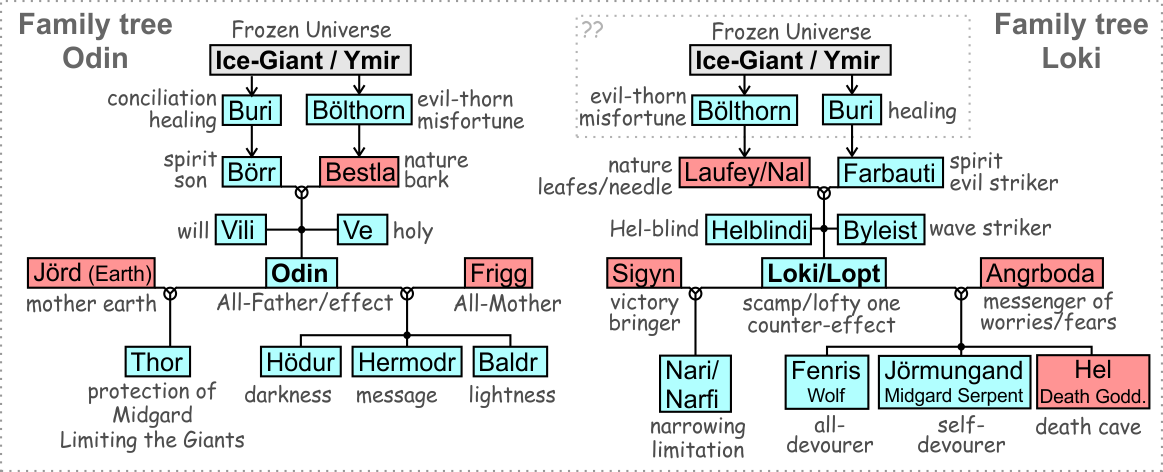
(see also the Edda Family Tree PDF)
Opposite Bestla, Odin’s mother, stands Laufey as Loki’s mother: the Tree of Life’s long-lived bark opposite the transient foliage of its leaves. Likewise, the spirit-fathers Börr and Farbauti mirror one another as Reconciliation and Enemy-Striker. In this regard, one might also derive Loki’s parents from Bölthorn and Buri. Perhaps Nal is also intended to recall the ‘Evil-Thorn’.
Like Odin, Loki, too, has two symbolic brothers: his will would then be Helblindi, who does not see Hel and whose name also belongs to Odin. And his blessing would be Byleist, the wave-strike, for every wave naturally needs a counter-wave.
Opposite Jörd, Mother Earth, we find Sigyn as the Bringer of Victory, which is presumably also the earthly world’s task. And just as Thor limits the giants within the macrocosm, Narfi recalls the narrowing and limiting of the dwarves within the microcosm. Thus, they protect Midgard, the middle world between macrocosm and microcosm, where we, too, live as humans. For a living creation needs these boundaries, which disappear only in the ‘Big Freeze’. Ultimately, Loki himself is narrowed, limited, and bound through Narfi when the gods kill Narfi, as we shall hear.
34. Yet Loki had more children. Angrboda (‘Messenger of Sorrow, Source of Fear’) was the name of a giantess in Giantland, and with her Loki had three children: one was the Fenris Wolf, the second Jörmungand (‘Giant Serpent’), that is, the Midgard Serpent, and finally the third was Hel (the goddess of the dead).
Opposite the All-Mother Frigg, we find Angrboda as nature’s omnipresent cares and fears. Thus, their children, too, mirror three eternal principles in three temporal principles. Opposite eternal darkness stands all-devouring transience as the Fenris Wolf; opposite the message of wholeness, the message of separation as the Midgard Serpent; and opposite eternal brightness, mortal light as Hel, goddess of the dead.
But the gods knew these three siblings were growing up in Giantland. Through prophecies, they learned that great misfortune would befall them through the siblings, and everyone felt they could expect only the worst from them, first because of their mother’s qualities, but still more because of their father’s. Then the All-Father sent the gods to seize these children and bring them to him. When they arrived, he cast the serpent into the deep sea extending around all the land (Midgard). Yet the serpent grew so greatly that it lies in the midst of the sea around all lands, biting its own tail.
Thus begins the play of effect and counter-effect within creation in space and time, for only here can a separation appear between them. The Midgard Serpent also symbolically stands for this, and its poison of separation is the fundamental problem from which all life’s cares, fears, and suffering arise. This problem then grows so large that it continually bites its own tail and lives upon itself. A spiritual expression of this is our ordinary intellect, which lives only through distinctions. Every thought it pursues already presupposes a distinction. Hence, we ordinarily live within a separated, or bounded, bubble of consciousness that may be called ‘Midgard’. Who could break this ‘vicious circle’ lying within the deep Sea of Causes?
Hel (‘The Concealing One’ or ‘Cavern’) he banished to Niflheim (the ‘Mist-World’), granting her rule from there over the nine worlds (of creation). For she was to share all dwellings with those sent to her: humans dying of illness and old age. There she possesses a great dwelling, and her fences are exceptionally high, with large barred gates. Eljudnir (Misery, Icy Cold) is her hall’s name, Hunger her bowl, Desire her knife, Ganglati (Sluggishness) her servant, Ganglöt (Laziness) her maid; Danger of Falling is the threshold over which one enters, Sickbed the bed, Glittering Harm her bed-curtain. One half of her is black, the other flesh-coloured. Thus, she is easily recognized, with a rather sombre and grim expression.
A counter-effect to eternal life’s eternal light is death within space and time, when the separated bubble of consciousness becomes ever narrower and more confined. Thus, the All-Father also banishes death into a world of mist, as into a dream-world on the Tree of Life’s nature-side. Only a consciousness that does not fall as an Einherji fighting for wholeness is sent into death, to Hel: one that, as a lone warrior, dies of itself, of its own separated body, with which it has fully identified throughout its lifetime. For only a lone warrior can imagine death as an end to himself, thereby creating ‘fence and bars’ for a cavern of the dead.
Indeed, consciousness, which can assume every form, can assume this form as well. Such an end in eternal rest might even be good if there were no unresolved problems still seeking resolution, under which consciousness must suffer in ‘hunger and desire’. Thus, even in death there remains an illness seeking healing, rooted above all in separation’s fundamental problem, in the ‘bed-curtain of the sickbed’. It is therefore probably better to imagine death as a world of suffering in Niflhel rather than as release from suffering. In this regard, death in Hel, too, is only half black; the other half appears as human as the sombre, grim suffering we experience in Midgard as well.
The Aesir kept the wolf (Fenris as the ‘Marshy One’) with them, and only Tyr (the ‘God of Righteous Victory’) had the courage to approach and feed him. Yet when the gods saw how much he grew each day, and all prophecies said he would bring their ruin, the Aesir resolved to make an exceedingly strong fetter, which they called Löding (‘Growth’). They brought it to the wolf and invited him to test his strength against it. This seemed no difficult task to him, and he let them do as they wished. At his first kick against it, the fetter broke. Thus, he freed himself from Löding. Next, the Aesir made a second fetter of twice the strength, which they called Dromi (‘Inertia’). Again, they asked the wolf to try it and told him that he would become very famous for his strength if such massive metalwork could not hold him. The wolf considered that these bonds were indeed very strong, yet also remembered that his strength had grown since he broke Löding. It occurred to him that he must take this risk if he wished for fame. Thus, he allowed the fetter to be fastened. When the Aesir declared themselves finished, the wolf shook himself and struck the fetter against the ground. He exerted himself mightily, braced against it, and the chain snapped, scattering its pieces far and wide. Thus, he freed himself from Dromi. Ever since, people commonly say that someone ‘loosens himself from Löding’ or ‘frees himself from Dromi’ when pursuing something vigorously (with force).
Afterwards, the Aesir feared they would be unable to bind the wolf. Hence, the All-Father sent a messenger of Freyr named Skirnir (‘The Radiant One’) down to the dwarves in Dark-Alfheim, ordering them to forge the fetter called Gleipnir (‘Causation’). It was made from six things: the sound of cats’ paws and a woman’s beard, the roots of a rock and a bear’s sinews, a fish’s breath and a bird’s spittle. And if you have not heard this event before, you can find a true example here at once to show that you are not being deceived. You will have observed that a woman has no beard, that no sound arises from a cat’s walk, and that no roots lie beneath a rock. Yet truly, everything I have told you is equally true, even if some things among it cannot be verified by you.
Another mighty counter-effect throughout creation is transience. For everything that arises must naturally pass away again. Yet why does it not pass away at once? Who restrains transience’s ravenous wolf? Here, the gods themselves do so with the help of the little nature spirits. First, they attempt to strengthen living growth. Yet transience naturally grows with growth, making the wolf still stronger. A second attempt is inertia, to slow passing away, as the mountain and frost giants attempt through rigid matter. This already gives the wolf more to struggle against. The third attempt is the most ingenious: making a fetter from things not yet present, or only indirectly inferred—from ‘primordial causes’, as it were. For these strengthen themselves the more one does not wish to have them. Only when nothing new can arise does this fetter of causation lose its power, for then this creation, too, has outlived itself and reached its end. Thus, this fetter recalls Draupnir, the ring of renewal, and one might say: causation makes creation endure by stretching time without stopping it. Ragnarök, as creation’s end, would then be a kind of ‘collapse’ of causation within space and time, when there is no more renewal.
Gangleri said: I can certainly recognize that this is true. I can indeed see what you took as examples. But how was the fetter forged?
The High One answered: I can certainly tell you. It became smooth and supple as a silk ribbon, yet as firm and strong as you will soon hear. When the fetter was brought to the Aesir, they thanked the messenger for his trouble. Then they travelled out upon the water called Amsvartnir (the ‘Dark Sea’ of Causes), to the island named Lyngvi (‘Heathland’, as pastureland for living beings). They summoned the wolf, showed him the silk ribbon, and challenged him to break it. They said it was somewhat stronger than seemed likely for something so thin, for each passed it to the next and tried his bodily strength upon it, yet it did not break. Then they said the wolf would break it. He answered: ‘This ribbon seems to me such that I can win no glory from it, even if I tear it to pieces. But if it has been made with skill and cunning so that it only appears so thin, this ribbon shall not touch my legs.’ The Aesir said: ‘You will quickly tear this narrow silk ribbon to pieces, for you broke the strong iron chain before. Yet if you cannot break this ribbon, you will no longer be able to frighten us gods, and we shall unbind you.’ The wolf said: ‘If you bind me so that I cannot free myself, you act in a way that makes your help unlikely to come to me. Hence, I am not eager to let this ribbon be fastened upon me. Yet before you accuse me of lacking courage, let one of you place his hand in my mouth as a pledge that all is honest.’ Each Ase looked at the next, and there now seemed to be two problems. No one wished to offer his hand, until finally Tyr (the ‘God of Righteous Victory’) stretched out his right hand and placed it in the wolf’s mouth. And when the wolf pulled, the ribbon tightened and grew still harder. For the more he tried to free himself, the tighter the ribbon became. Then everyone laughed except Tyr, for he lost his hand.
Thus, transience’s all-devouring wolf was bound with the fetter Gleipnir, with causation’s power. For this, Tyr as the God of Righteous Victory pledged his hand, just as Odin as the All-Father pledged his eye for creation. What does this mean?
On the one hand, we may see in this a ‘divine asymmetry’, necessary for creation’s endurance, as modern physics also knows. For in perfect symmetry, everything would immediately cancel itself out, and nothing could exist within time and space. This requires a breaking of symmetry, as is also assumed in the Big Bang. Had everything remained symmetrical, matter and antimatter would immediately have annihilated one another, and the wolf would have devoured creation in its infancy. Similarly, in modern cosmology, we might compare the fetter Löding with dark energy, which makes the universe grow unimaginably fast, and the fetter Dromi with dark matter, which acts like an invisible glue, holding enormous galaxies together through inertia. And Gleipnir recalls quantum gravity, connecting the very smallest of the quantum world within the microcosm with the very greatest within the macrocosm. It is the invisible network of information and causality holding everything together…
On the other hand, Tyr thereby became ‘one-handed’, as Odin became ‘one-eyed’. In this, we may also see true victory within creation. That is: whoever is truly prepared to sacrifice his ‘hand’, and thus also his action, within transience’s jaws has already won, for he shows that his roots lie within the imperishable, where there is no more duality, no opposites, and no separation. Within this wholeness, or Godhead, no one can lose anything either, neither a hand nor an eye. Toward this courage and wisdom, the ‘High One’ now also attempts to lead our intellect:
When the Aesir saw that the wolf was fully bound, they took the cord attached to the fetter, called Gelgja (‘Pole’, as a connection). They drew it through a thick stone slab named Gjöll (like the river of the dead bearing the same name), fastening it deep within the earth. They also took a great stone called Thviti (‘Sling-Stone’), cast it still deeper into the earth, and used it as a peg for the rope. The wolf opened his jaws wide, struggled violently, and sought to bite them. Then they thrust a sword into his mouth, its hilt touching the lower palate and its point the upper. This is the prop holding his jaws apart. He howled terribly, and slaver flowed from his mouth. This is the river called Van (‘Expectation, Hope’, or Hunger). There the wolf remains until Ragnarök.
Thus, this ultimately concerns connecting everything with everything again. Here, we may think of the famous ‘Philosopher’s Stone’, regarded as the imperishable foundation-stone of all things. It covers the river of the dead, and everything is built upon it and connected to it. In this, we may again see a symbol of formless consciousness, capable of assuming all transient forms while remaining imperishable itself.
Finally, another solution to transience’s problem is suggested: the sword of wisdom, also recalling Forseti. Its point symbolizes ‘unity’, and its hilt would then be a ‘conceptual grasp of unity’. With these two, one can also block the wolf’s hungry jaws, for logically there can be no transience within unity. Where could anything pass away within wholeness? Thus, within transience’s jaws, a wide space opens for creation, as it were between heaven and earth, between unity and diversity. And diversity is a ‘conceptual grasp of unity’, within which transience must naturally also exist. For everything arising within the diversity of forms must pass away again, yet remains within unity as wholeness. Thus, within this space of transient creation, the river of hunger flows with all our expectations and hopes for a long time, until Ragnarök.
In this way, the gods tamed the All-Devourer. Symbolically, we may rediscover this taming in the two wolves Geri and Freki as ‘Desire’ and ‘Voracity’, now lying at the feet of the All-Father, who sits upon the throne of eternal consciousness, the ‘Philosopher’s Stone’ and foundation-stone of all things. There, they await the food Odin gives them, as we shall hear in more detail. Wonderful!
Yet Gangleri has evidently understood only partly:
Gangleri said: Exceptionally wicked children Loki had, yet all these siblings are of great significance. But why did the Aesir not kill the wolf, since they could expect only evil from him?
The High One answered: So highly did the gods esteem their sanctuary and place of peace that they did not wish to stain it with the wolf’s blood, although the prophecies foretell that he will kill Odin.
Naturally, the ‘desire to kill’ can fundamentally be no divine, or holistic, solution, for the notion of killing is a separation from life, and would thus only strengthen the nature of transience, severance, and death still further. Such an attempt would therefore rob the gods of their holy, peace-loving, holistic nature, and they would no longer be gods.
Thus, the description of the holistic circle of gods around Odin as the All-Father concluded with Loki. Through such conceptions, the intellect attempts to recognize different aspects of the one Godhead. And none other than the Godhead itself speaks here to the intellect, which has wandered through the worlds for so long. Now it has grown old and come to Asgard. There, it attempts, as it were, to bring its many conceptions of the world beneath one roof. Thus, after the masculine side has been explained, it now also asks about the world’s feminine side, within the customary play of love between Yin and Yang as spirit and nature:
35. Then Gangleri asked: What goddesses are there?
The High One answered: Frigg (‘Beloved’) is foremost. She possesses the dwelling called Fensalir (‘Marsh- or Water-Hall’), which is especially magnificent. Another goddess is Saga (‘Story’). She dwells at Sökkvabekk (‘Bench of the Sunken’), and this is a great dwelling. The third is Eir (‘Grace’); she is the finest healer.
Just as the entire circle of gods can be regarded as aspects of the All-Father, the whole diversity of goddesses can be recognized as aspects of the All-Mother, nature’s holistic soul. Accordingly, they, too, are called goddesses because they are aspects of wholeness which only the intellect knows how to distinguish.
Frigg is regarded as ‘foremost’, as Odin was also described. And just as Odin rules in Valhalla, the ‘Hall of the Fallen’, Frigg possesses Fensalir, the ‘Marsh-Hall’, likewise recalling creatures sinking into creation’s marsh, a mixture of life’s water and physicality’s matter. Yet precisely this ‘hall of consciousness’ on nature’s side is described as especially magnificent, just as much splendour and beauty can be found in nature when one recognizes the beautiful, and above all the divine. Then all creation becomes a dwelling of love and healing.
The most healing aspect of this creation is that here the legends of the gods are told, speaking of divinity and wholeness to heal separation’s illness. Thus, we may recognize in Saga Bragi’s feminine aspect: upon the beer- or mead-bench, they tell sacred stories to the sunken creatures, reminding them of their origin, healing and uplifting them. Thus, the Lay of Grimnir (verse 7) says that refreshing waves rush over Sökkvabekk, and Odin and Saga drink cheerfully together there every day from golden cups. Accordingly, we also find this hall directly beneath Valhalla, and even on the spirit-side, in our table for the Lay of Grimnir.
The goddess Eir, the finest healer, stands for this healing aspect of the All-Mother as ‘Grace’ or ‘Help’ within creation. In the Song of Fjölswid, she is named as one of the nine maidens sitting at Menglöd’s feet on ‘Healing-Mount’. The number nine recalls the golden ring of renewal, and Menglöd the soul of nature.
The fourth, Gefjun (‘Giver of Wealth’), is a virgin, and those who die as virgins serve her. The fifth is Fulla (‘Abundance’). She, too, is a virgin and wears her hair loose, with a golden band around her brow. She carries Frigg’s chest, keeps her shoes, and is initiated into her secrets.
Another aspect of the All-Mother is the great abundance of riches she can give through nature’s manifold forms. Yet for what purpose? We know that all forms which have arisen must also pass away again. Fortunately, the gods have ensured that this does not happen immediately, allowing us to work with them for a while and learn from them. And the greatest wealth we can find here is presumably what the goddess Gefjun gave King Gylfi at this story’s beginning: that our heart is drawn from the lone warrior within separation’s realm toward the Einherji within the realm of wholeness and divinity. How can this happen? By recognizing that the abundance we all instinctively seek is not found through accumulating ever more transient things, but through overcoming separation, so that one becomes All quite of one’s own accord.
Why do we wish to be something special when we can be Everything?
Fulla then stands for this divine, or holistic, abundance: the virgin wearing her hair loose with a golden band around her brow. We have often interpreted hair as a symbol of thoughts, now able to grow openly and without limit from the intellect. And the golden band recalls a bond of truth connecting and uniting everything. Thus, she carries the treasure-chest of the All-Mother and all nature, also keeping the shoes, or ground, upon which nature’s soul stands. Hence, she also knows all nature’s secrets. What spirit would not wish to unite with this virgin? She could even reveal to our scientists the ‘theory of everything’ they seek so strenuously. And yet she, too, is merely one particular aspect of the All-Mother and nature’s holistic soul, just like Freyja:
Freyja (‘Lady’), the sixth goddess, is revered as highly as Frigg. She is married to the man called Odr (‘Spirit of Life’), and their daughter is Hnoss (‘Treasure’). She is so beautiful that splendid and valuable treasures (hnossir) are called by her name. Odr went on long journeys, for which Freyja wept. Yet her tears are red gold. Freyja has many names because she gave herself different names when travelling among foreign peoples in search of Odr. She is called Mardöll and Hörn, Gefn and Syr (‘Sea-Radiance, Flax, Giving One, and Sow’). Freyja possessed Brisingamen (‘Fire-Jewel’). She is also called Vanadis (‘Vanir-Goddess’).
Who now draws our spirit, after our heart, toward this divine abundance of wholeness? To this end, Freyja, the goddess of love and fertility, is now described. In her, we may see outward nature’s beauty and loveliness, also an aspect of the All-Mother. Thus, she is married to the spirit of life, as Frigg is to Odin. Yet he is a wandering spirit, still searching within outward nature and travelling through time and space. Accordingly, her necklace Brisingamen also suggests a fiery radiance of natural beauty between head and body as spirit and nature, striking everyone’s eyes. The Middle High German verb ‘brisen’, in the sense of ‘fasten’ or ‘pierce’, still recalls this. This necklace, too, was made by the little nature spirits, as a later fourteenth-century work called ‘Sörla tháttr’ recounts:
According to it, the goddess Freyja watched the four dwarves Álfrigg, Dvalin, Berlingr, and Grérr forging a golden necklace within a rock. Freyja offered the dwarves gold and silver for the jewellery, yet they were not interested. They declared that each would give Freyja his share of the necklace if she shared his bed for one night. Freyja agreed, acquiring the precious necklace in this way. (Source: Wikipedia)
Symbolically, these four dwarves recall nature’s four elements and their beauty. Freyja had to unite with them to gain her outwardly seductive beauty, which, however, is also transient. Thus, it is difficult for the spirit of life to unite enduringly with her—that is, to find spiritual unity within natural diversity, the imperishable within the transient. Yet this is why Freyja exists and wanders through the world among ‘foreign peoples’. Why are they foreign to her? Because they do not recognize her true nature. Everywhere she seeks the spirit of life that makes her alive. For it is spirit that gives life. And to whoever can unite with her and fructify her with life, she bears a wonderfully beautiful daughter, in whom we may recognize nature’s holistic soul, probably the greatest treasure to be found within nature. And for this she weeps tears of the red gold of true love. Wonderful!
The seventh goddess is Sjöfn (‘Love’). She attends carefully to turning human minds toward love, those of women and men alike. After her name, loving affection is called love (sjafni). The eighth is Lofn (‘Permission’). She is so kind and favourable in invocation because she received permission from the All-Father and Frigg to establish marriages between humans, women and men, even if these had previously been forbidden or entirely rejected. Hence, permission (lof) is named after her, and this is why she is greatly praised by humans. The ninth is Var (‘Vow’). She listens to human oaths and agreements concluded between women and men. Hence, these are also called vows of fidelity (várar). She punishes those who break them.
As an outward aspect of this holistic love between spirit and nature, we find marriage between man and woman within the outward world. First, Sjöfn serves this as the natural instinct of sexual attraction, through which, from a certain age, man and woman seek one another to mate and provide regeneration. It is a natural force luring the individual out of isolation. Outward characteristics and qualities still play a great role here.
Lofn strengthens this love beyond all family, social, and societal boundaries, already expressing the great goal of overcoming every separation. Many ancient legends and fairy tales concern this great struggle to win the beloved princess or prince. Thus, love can overcome even the greatest obstacles when supported by the fateful permission of the All-Father and All-Mother.
The third stage is Var, the sacred marriage vow through which the bodily bond is also to become spiritual union. This means that love should no longer rest upon outward qualities, which naturally change and transform with age, but upon the unchanging core, the imperishable to be found within the transient. For only this can be truly loved; everything else is more akin to illusory desire, always ending in ‘disillusionment’. Along this path, one can ultimately recognize God himself within the other, fulfil sacred marriage’s purpose, and attain the highest: divine self-knowledge.
Whoever breaks this sacred marriage naturally falls back into separation, and thus into suffering, which may also be regarded as punishment for this adultery.
The tenth goddess, Vör (‘Perception’), is clever and asks many questions, so that nothing remains hidden from her. There is a saying that a woman becomes aware (vör) of what she learns. The eleventh is Syn (‘Refusal’). She guards the hall’s doors and closes them against those who should not enter. At the Thing (the judicial assembly), she is also appointed to ward off claims she does not wish to uphold. Hence, people say that a refusal (syn) has been pronounced when something is rejected. The twelfth goddess is Hlin (‘Protection’). She is appointed to protect those humans whom Frigg wishes to save from danger. Hence, it is said that whoever brings himself to safety saves himself (hleinir). The thirteenth, Snotra (‘Wisdom’), is wise and well-mannered. From her designation, the wise (snotr) woman or man who exercises moderation takes their name.
Here, we may now reflect upon how, after the sacred vow, one must naturally also follow the corresponding path. This path of knowledge is another important aspect of nature. The first goddess upon it is Vör, perception, above all feminine, or natural, perception through bodily senses. While we can dream all manner of things in sleep, sensory perceptions and their corresponding experiences already limit our dream. Thus, outward nature helps us pass from the level of consciousness of dreaming sleep into dreamlike wakefulness, in which we can perceive connections to an outward world. Yet we can still speak of a dream, for we ourselves judge our perceptions as good and evil, mine and yours, this and that, from our limited relative perspective.
Here, the next goddess enters: Syn as ‘Refusal’. We begin to recognize as lies some perceptions accepted as truth merely through inattentiveness. At first, this chiefly concerns the good and evil of circumstances decided for us by the gods at the Well of Destiny in their daily court. These are our customary complaints against destiny when not all our wishes are immediately fulfilled. Thus, this goddess guards our hall of consciousness, and above all the gates of bodily senses, against the enemies of falsehood.
A further step is recognizing the goddess Hlin, who protects us within nature insofar as we bring ourselves to safety. That is, insofar as we move from separation into wholeness and rise from lone warriors to Einherjar. Then all nature is always there for us and on our side.
The fourth goddess is Snotra, wisdom. She ensures that within perception, the discriminating intellect reunites with holistic reason. Through this, illusory desire transforms into true love, reaching pure divine love: a consciousness capable of loving every form of consciousness because it loves itself. This is also the transition from dreamlike wakefulness to dreamless wakefulness. Here, too, nature helps us recognize that all her forms and manifestations are as transient as dream-images. In awakening, everything disappears, and we recognize dream-images as dreams, the forms of consciousness as consciousness.
The fourteenth, Gna (‘Elevation’), is sent by Frigg into various worlds upon her errands. She owns the horse that races through air and water, called Hofvarpnir (‘Hoof-Tosser’). Once, as she rode, some Vanir saw her passage through the air. Then one asked:
What flies there? What moves there and glides through the air?
She answered:
I do not fly, although I move. Through the air I glide upon Hofvarpnir, whom Hamskerpir (‘Shaper of Forms’) begot with Gardrofa (‘Fence-Breaker’).
From Gna’s name, that which rises high is said to tower (gnäfar). Sol and Bil (‘Sun and Moon-Woman’) are also counted among the goddesses, but their nature has already been discussed.
Just as the circle of the Aesir was closed with Loki as counter-effect, we now find Gna, who, as a goddess of nature, can raise all fallen creatures again. Ultimately, this is nature’s most important aspect: she can raise everything that has fallen into separation back into wholeness. Thus, she rides creation’s horse, as Odin rides Sleipnir, the ‘Gliding One’. The Vanir, or nature beings, see her riding not merely upon earth but from the depths of water to heaven’s highest heights. Astonished, they ask: ‘Who or what is moving there?’ This is one of the greatest questions one can ask in life. And the goddess answers as a holistic being: she herself does not fly, yet moves with all creation, begotten by the ‘Shaper of Forms’ with the ‘Fence-Breaker’. The Shaper of Forms recalls the Mimir-intellect as creator from Odin’s eye, and the Fence-Breaker nature’s great goal of breaking open all the spirit’s limitations. Similarly, Sleipnir was born to Loki in a mare’s shape and begotten by a giant’s horse that, as the ‘Shaper of Forms’, built Asgard’s wall.
Thus, the goddess Gna ultimately also recalls the beings of sun and moon, visible in heaven and enticing the spirit to rise. Regarding the fourteen numbered goddesses, one might think of half a lunar cycle, from new moon to full moon, from nature’s invisible soul as the holistic principle of causation to her outward appearance. This may be recognized as the full moon, or perfection, when spirit and nature reunite in sacred marriage, or mystical wedding, so that spiritual unity and natural diversity merge into wholeness and divinity.
Wonderful! Although this text about the goddesses is relatively short, it contains such depth that an entire book could be written about it. Beyond this, many further holistic aspects of nature serve in Valhalla. Thus, answering Gangleri’s question about the goddesses, the ‘High One’ continues:
36. There are others who are to serve in Valhalla, bringing drink and tending the dishes and beer-jugs. Thus, they are named in the Lay of Grimnir (verse 36):
Hrist (‘Shaking/Jolting’) and Mist (‘Cloud/Mist’) shall bring me (Odin) the horn; Skeggjöld (‘Axe-Age’) and Skögul (‘Shaking’), Hild (‘Battle’) and Thrud (‘Strength’), Hlökk (‘Clamour’) and Herfjötur (‘Host-Fetter’), Göll (‘Tumult’) and Geirahöd (‘Spear-Clamour’), Randgrid (‘Shield-Protection’) and Radgrid (‘Counsel-Protection’), and Reginleif (‘Divine Inheritance’)—they bring beer to the Einherjar.
They are called Valkyries (‘Choosers of the Fallen’), and Odin sends them into every battle. There, they choose those doomed to die among men and determine victory. Gud (‘Battle-Action’), Rota (‘Onslaught/Devastation’), and the youngest Norn, called Skuld (‘Guilt/Karma’), also ride out to choose the fallen and decide battles. Likewise, Jörd (‘Mother Earth’), Thor’s mother (the protector of Midgard), and Rinda (‘Protectress’), Vali’s mother (the principle of life), are counted among the goddesses.
We have already written at length about the Valkyries in the chapter on the ‘Nature of Odin’. Briefly, they can be regarded as servants of Odin and his circle of gods. According to the gods’ fateful decisions at Urd’s Well, they provide the natural conditions and circumstances living beings encounter within life’s struggle. Thus, their natural diversity also finds expression in their particular names, which, again, can only be translated suggestively.
Thus, they serve the All-Father in Valhalla, the ‘Hall of the Fallen’ within creation’s realm. They offer struggling living beings the water of life as a brew of beer, which can also be drunk as the gods’ mead, and provide the corresponding ‘vessels’ as nature’s forms and manifestations. Thus, they ‘choose’ the paths of those doomed to die among men—that is, the imperishable spirit’s transient forms—and determine victory in battle according to the warrior’s spirit, either as a lone warrior or as an Einherji.
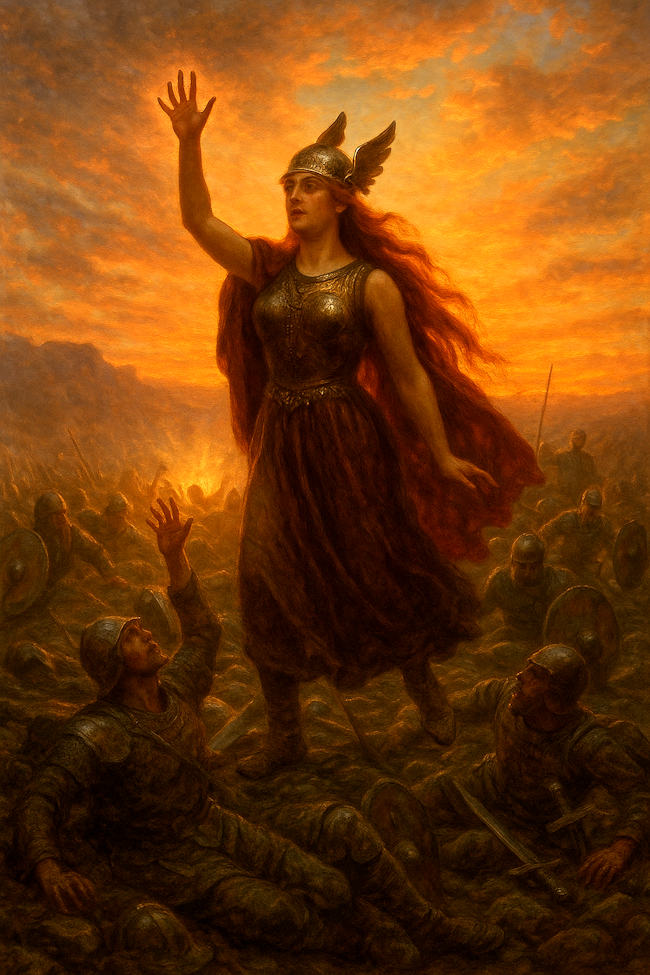
Thus, as natural aspects, they serve spirit, and as goddesses above all Odin’s holistic spirit. In doing so, they work closely with Skuld, the Norn of destiny as guilt or karma, as well as with Jörd as Mother Earth, Rinda as life’s protectress, and, naturally, all other feminine aspects of nature.
To clarify our previous reflections upon the play of love between spirit and nature still further, the ‘High One’ concludes by recalling the story of how Freyr and Gerda became husband and wife:
37. Gymir (Ägir, or ‘Sea’) was the name of a man, and his wife was Aurboda (‘Earth-Messenger’). She descended from the race of mountain giants, and their daughter was Gerda (‘Protectress’), the most beautiful of all women. One day, Freyr (the fertile summer god) had come to Hlidskjalf (Odin’s ‘Throne of Far-Sight’) and looked out over all the worlds. But when he turned north (toward nature), he saw a large and beautiful house upon a farmstead. A woman was walking toward this building. And when she raised her hands to open the door before her, a radiance shone from them across air and water, illuminating all the worlds. Thus, Freyr’s presumption in seating himself upon that one holy seat was avenged: he departed full of sorrow. On returning home, he neither spoke nor slept nor drank. No one dared address him.
Then Njördr (Freyr’s father) summoned Skirnir, Freyr’s servant, and ordered him to go to Freyr. He was to ask for a word with him and enquire why he was so angry that he spoke to no one. Skirnir (the ‘Radiant, Clarifying One’) said he would go, though reluctantly, for he expected an ill response. When he came to Freyr, he asked why he was so sorrowful and spoke to no one. Freyr answered that he had seen a beautiful woman and was so distressed on her account that he could no longer live unless he obtained her. ‘And now you shall go, ask for her hand on my behalf, and bring her here, whether her father wishes it or not. I shall reward you well.’ Skirnir replied that he would undertake this journey on his behalf, but Freyr should give him his sword. It was so good that it fought by itself. And Freyr did not hesitate, but gave him the sword.
Then Skirnir undertook the journey, wooed the woman on his behalf, and obtained her promise of marriage. Nine days later, she wished to come to the place called Barrey (‘Pine Forest, Barley Island, Pasture Island’) and celebrate her wedding with Freyr. Skirnir brought Freyr this news, and he spoke these words:
Long is one night, long are two; how can I endure three?
Often a month seemed shorter to me than half a night before the wedding.
We have already attempted a detailed interpretation of this story in the section ‘The Story of Gerda and Freyr (Skirnir’s Journey)’. Briefly: what did Freyr see upon Odin’s Throne of Far-Sight, with a consciousness capable of seeing through outward forms? He saw nature’s pure soul and immediately fell in love. Yet first the pain of separation becomes conscious, naturally serving its purpose of overcoming separation. Here, Skirnir serves as consciousness’s radiant, clarifying light when given the sword of wisdom. The successful wooing is told at length in the song ‘Skirnir’s Journey’. The nine days recall the cycle of renewal until the new-moon night, when they ‘meet in a windless place known to them both’, as ‘Skirnir’s Journey’ puts it. There, the discriminating intellect falls silent with its stormy thoughts, making the eternal wedding between spirit and nature possible.
All this naturally happens within Gymir himself, in whom we may recognize the principle of a living being. As a ‘thawed Ymir’, he appears within the Sea of Life and begets with Ran the nine waves, or worlds, upon this Sea of Causes. His soul is Gerda as the ‘Protectress’ of causation. And just as Gylfi’s heart, the soul’s seat, was drawn toward the divine by Gefjun, Freyr as summer god now divinizes Gymir’s soul. This happened after Gymir, as Ägir, came to Asgard and heard Bragi’s stories of the gods there, as described in the Skaldic Book. Following this inward wedding, in life’s summer, as it were, comes the harvest season for life’s great victory. The ‘Lay of Hymir’, ‘Loki’s Flyting’, and the Skaldic Book tell how Ägir, in return, invites the gods to his home and brews them beer in a cauldron which they must obtain themselves.
Now we may imagine how, under the summer god’s blessing, barley could grow in Barrey, the ‘Barley Island’, as the substance for this beer, which then became mead as the divine drink of wholeness. This great path is also described in ‘Loki’s Flyting’ as a path of silence, simply ‘being conscious’, so that Ägir could silently observe this entire development within himself. Thus, Vidar, too, participated: the god of silence and silent warrior within the forest of conceptions. Ägir’s silence is symbolically represented by Beli, Gerda’s ‘roaring’ brother, whom Freyr killed. This presumably happened automatically with the silent wedding in the forest of conceptions upon ‘Barley Island’. For when spirit and nature reunite as unity and diversity, the desiring intellect’s clamorous thoughts also come to rest. What moves is only the Sea of Life and creation itself, as the goddess Gna proclaimed.
Gymir as the Sea of Ägir
This is why Freyr was unarmed when he fought Beli (the ‘Roarer’, Gerda’s giant-brother) and slew him with the stag’s antler.
Gangleri remarked: It is astonishing that so mighty a man as Freyr would give away his sword without possessing a second one equally good. This put him at a great disadvantage when he fought the one called Beli. I believe he deeply regretted that gift then.
The High One replied: It mattered little when he encountered Beli. Freyr could have struck him down with his hand. Yet the time will come when lacking his sword will seem worse to Freyr, when (at Ragnarök) Muspel’s sons come to lay everything waste.
The stag’s antler recalls living diversity as a consciousness of diversity, recognizing itself again as consciousness within nature’s diversity. This is also represented by Fjölnir, described in the Ynglinga Saga as the son and fruit of this inward wedding, who ultimately drowns in a vat of mead in the palace of Frodi, the peaceful sage. Powerful symbolism! In the Edda, Fjölnir is named several times as a byname of Odin and is thus also an aspect of the All-Father.
The question about Freyr’s sword is again a typical conception of the discriminating intellect. Can a god, as a holistic being, ‘give something away’? Can he still ‘lack’ anything after the great wedding? Indeed, this is probably only an ‘apparent ill’, as the text says. For in practice, only a god’s outward form disappears at Ragnarök. And this is also important, lest our intellect become too attached to it…

