
| Content | Next | About |
The World of Gylfi’s Delusion (Gylfaginning §38-§54)
38. Then Gangleri asked: You say that all men who have fallen in battle since the world’s beginning have now come to Odin in Valhalla. What food does he have to offer them? I imagine there must be a great multitude there.
The High One answered: What you say is true. An immense multitude is there, and many more will come. Nevertheless, they will seem too few when the wolf comes. Yet never are there so many people in Valhalla that the flesh of the boar called Sährimnir will not suffice for them. He is cooked every day and whole again by evening. But this question you now ask seems to me one about which few are wise enough to speak truthfully. Andhrimnir is the cook’s name, Eldhrimnir the cauldron’s. Thus it is said here (in the Lay of Grimnir, verse 18):
Andhrimnir has Sährimnir (the boar) cooked in Eldhrimnir, the finest flesh. Yet few know what the Einherjar eat.
Thus, Gangleri now begins to understand the ‘High One’ and recognize divine wholeness. This is represented first by Valhalla, the ‘Hall of the Fallen’, the All-Father’s space of consciousness. Within it, we may recognize all creation with all the men, or spiritual creatures, who have fallen into separation and thus into struggle, and continue to fall. Gangleri sees this hall as unity, but its beings still as diversity. Thus, he wonders what sustains the growing multitude within this hall.
The ‘High One’ initially confirms this view, yet also says that Valhalla never becomes full. It is therefore rather a spiritual hall without physical boundaries, growing with its contents. Modern cosmology, too, knows that the space of our universe expands at an unimaginable speed. Yet ultimately, this growth cannot stop the wolf of transience, as the fetter Löding of growth already showed. For everything that arises must also pass away again.
What sustains this growing multitude? They all live upon the same nourishment, symbolized here by a boar who continually regenerates. Our modern science would speak of energy, continually transforming in accordance with the law of conservation of energy and never capable of being destroyed. The Edda speaks of the boar Sährimnir. His name consists of Sä for sea and Hrim for frost, recalling the frost and mountain giants. This therefore concerns a crystallization, or embodiment, of the water within the Sea of Causes. This boar of ‘Water-Embodiment’ is cooked in the cauldron Eldhrimnir, whose name may be translated as ‘Fire-Embodiment’. In this image of fire and water, we rediscover spirit and nature. A third ‘Hrimnir’ is the cook Andhrimnir, who may then be interpreted as ‘Anti-Embodiment’. He thaws, as it were, what has frozen within the fire-cauldron, transforming matter into energy, which serves as nourishment for renewed embodiment.
Yet we are told: ‘Few are wise enough to speak truthfully about it.’ What is energy? What is matter? Who cooks and transforms them? Our modern science has also gained profound insights into these matters, although they are often described only through abstract mathematical formulae such as E=mc². This, too, contains three components: energy, mass, and the speed of light. And the speed of light, as a property of light, would accordingly be the cook. This means that light’s movement through space transforms energy into mass and vice versa. Wonderful! There is much to reflect upon in this ‘property’ of light, as also in dark energy and dark matter, of which our universe is said largely to consist. Indeed, perhaps only very few truly know what constitutes the finest flesh eaten by the Einherjar. What is the essence that never passes away, yet can transform into every form?
This also addresses the nature of the Einherjar, who live within this cycle of regeneration. Thus, they do not exist as lone warriors or ‘single-use creatures’, but form ‘one single host’, as their name may be interpreted, thereby fighting within the ‘host of unity’ for the divine, or wholeness.
Gangleri asked further: Does Odin have the same food as the Einherjar?
The High One answered: The food set upon his table he gives to his two wolves, called Geri and Freki (‘Desire and Voracity’). He himself needs no food. Wine is both drink and food to him. Thus it is said (in the Lay of Grimnir, verse 19):
Geri and Freki are fed by the glorious, battle-seasoned Father of Hosts,
But Odin, renowned in battle, lives always (eternally) upon wine alone.
Two ravens sit upon his shoulders and whisper into his ear everything they see and hear. They are called Hugin and Munin (‘Thought and Memory’). At daybreak, he sends them out to fly over the entire world, and they return for the day-meal (of the Einherjar around noon). From them, he learns much news. Hence, he is called the Raven-God. Of this it is said (in verse 20):
Hugin and Munin fly over the mighty earth each day. I worry about Hugin (‘Thought’), lest he fail to return. Yet I fear still more for Munin (‘Memory’).
Now an even greater question arises: Does the All-Father, as creator-god, also live upon this substantial nourishment through which the Einherjar repeatedly embody themselves? Is the creator-god a creature? The ‘High One’ answers that all food offered to him for embodiment he gives over to transience through the two tamed wolves. Thus, upon his throne of far-seeing consciousness, he becomes the ruler over transience. This means that he himself does not embody himself, and every conception of him possessing form is merely an intellectual construction. This is precisely what makes him the All-Father and creator-god.
What, then, sustains him? What does the wine mean? Here, one might first think of the water of life refined into spiritual wine, just as Jesus at the wedding in Cana transformed the water of purification into fine wine. In this refinement, we might recognize creation’s meaning and purpose. This is presumably also recalled by the biblical symbolism of God’s vineyard, where, in principle, the Einherjar also labour.
Yet wine is also an intoxicating drink and, in relation to the creator-god, evokes the ‘power of illusion and creation’. Hinduism speaks here of Maya, Vishnu’s power, from which Brahma was then born as creator-god. Hence, we were told at the very beginning, when Gangleri came to Asgard, that ‘the gods presented him with sensory illusions’. This is evidently the path of our intellectual world.
Thus, in sovereignty over transience, we may recognize the Father of Hosts’ accustomed struggle, and in the consciousness that he lives eternally upon wine alone, the victorious glory of this struggle.
Finally, the two ravens, symbols of thought and memory, also recall wine as the ‘power of illusion and creation’, supplying the information and knowledge it requires. Modern science, too, has recognized in these a deeper source of creation than its previous concept of energy. The renowned quantum physicist Anton Zeilinger says: ‘Information is the universe’s primordial substance—reality and information are the same.’
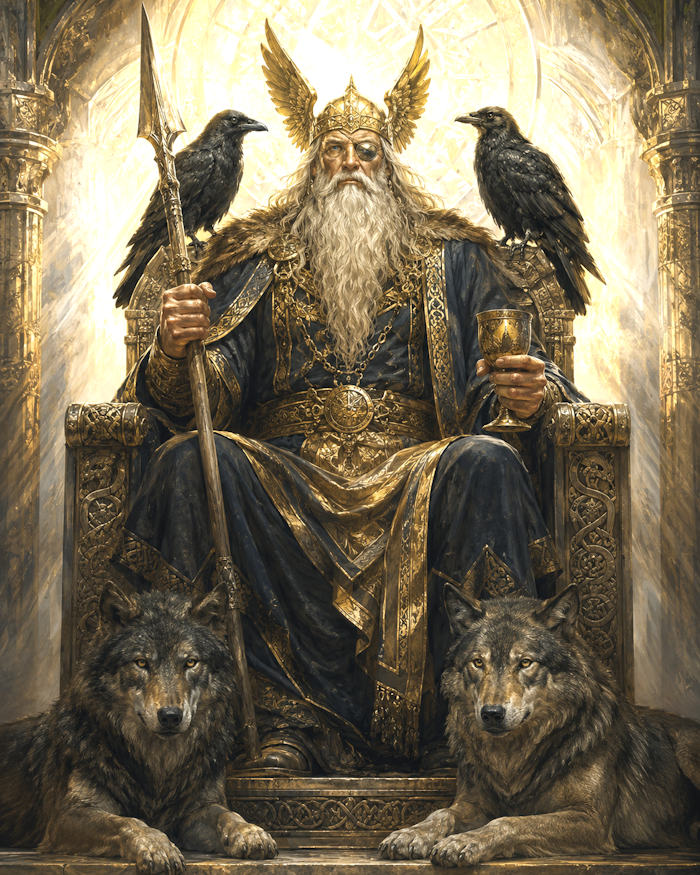
When the spiritual sun rises at daybreak, the All-Father sends these thought-ravens throughout the world, and when it stands highest at noon, they return to their origin: to the creator-god, to the divine itself. Then the boar Sährimnir, too, is cooked, and the Einherjar can nourish themselves upon him to embody themselves. Afterwards, the spiritual sun sinks, and the night of physicality falls.
Hence, the All-Father is also called the Raven-God. He sits upon the throne of far-seeing consciousness and, by observing information with the Mimir-intellect, draws creation from his eye. Similarly, quantum physics states that the observer creates reality and actuality through the information of measurement.
Finally, we are told that the All-Father worries that thought and memory could be lost. What a wonderful concern! Thus, he ensures not only the natural law of conservation of energy but also the spiritual law of cosmic conservation of information. Within the greater whole, nothing can therefore be lost. Everything merely transforms within the eternal play of waves.
39. Then Gangleri asked: What do the Einherjar have to drink that is as abundant for them as their food? Or is water drunk there?
The High One said: That is a curious question. Do you really believe the All-Father invites kings, jarls (princes), and other mighty men to himself and gives them water to drink? I know that many who come to Valhalla would consider water a dearly bought drink if they knew of no better welcome there, having previously suffered wounds and received death-blows. I can tell you something else about this: the goat named Heidrun stands atop Valhalla and eats leaves from the branches of the renowned tree also called Lärad. Mead flows from her udder, filling a great vessel every day. There is so much that all the Einherjar have enough to drink.
Thus, the Einherjar remain within the wave-play of birth and death in this ‘Hall of the Fallen’, returning again and again to Odin’s throne. This means they fall no farther than into God’s hand. One might also say: they are drawn from Odin’s eye and fall back into it. Gangleri now asks whether their spiritual drink is also refined and given as abundantly as their bodily food. Or do they always drink the same water from the Sea of Causes, circling endlessly in the same wave-play?
The ‘High One’ answers: Then striving for something higher, struggle, and suffering within the world would have no meaning. Hence, he also calls the World Tree and Tree of Life Lärad. The name can be derived from Old Norse ‘læra’, which may be translated as ‘to learn and teach’. Thus, the Tree of Life becomes a Tree of Learning. This would be a meaningful purpose of creation, enabling the water of life from the Sea of Causes to be refined.
Symbolically, this is represented by the goat Heidrun, feeding upon the leaves, or embodied beings, growing upon this tree’s branches. Heiðr may be translated as ‘bright, clear, serene, and radiant’, thus evoking the ‘Light-Rune’ as the secret of light existing above Valhalla beyond time and space, yet also illuminating and permeating all creation. Thus, like the cow Audhumla, the ‘Hornless One Rich in Milk’, the goat again recalls light’s movement as the cook of E=mc², transforming matter into energy. Hence, she consumes the Tree of Life’s leaves, and from her udder flows the Einherjar’s mead, with which she in turn nourishes her children, transforming energy into matter.
This mead, as ‘Light-Milk’, would accordingly be the refinement of the water from the Sea of Causes: sweet mead as the divine drink of wholeness, the great secret of light. Thus, in German, too, we encounter the ‘Heit-Rune’ in many words, such as Menschheit, Weisheit, Freiheit, Einheit, and Ganzheit—humanity, wisdom, freedom, unity, and wholeness. Through this, creatures can rise out of the separation into which they have fallen, making learning within creation worthwhile. Such learning upon the path toward wholeness is, in turn, possible only if life is a continuum and not every newborn living being begins from zero. The All-Father ensures this through his conservation of energy and information, and this is also what the Einherjar stand for in life’s struggle.
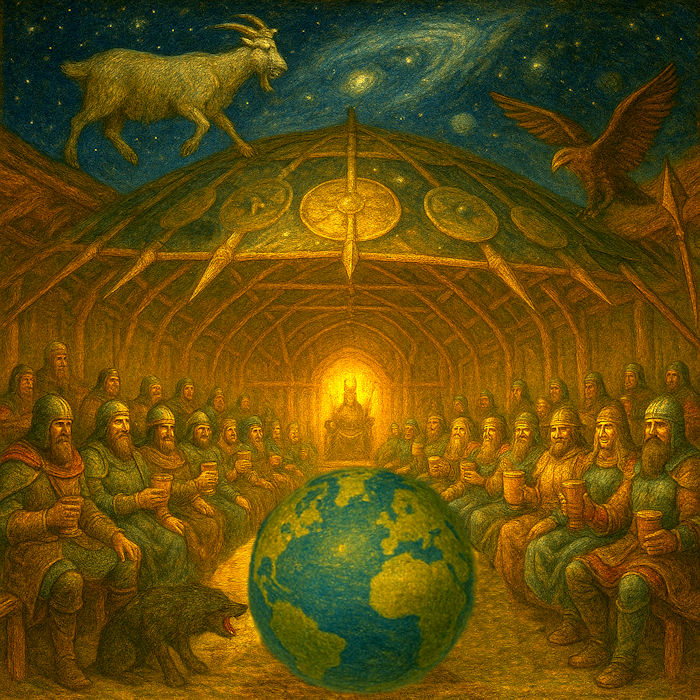
There is much to reflect upon in this learning process within creation. At every living being’s birth, evolution seems to seek an optimum of memories, so that the child is not immediately overwhelmed, yet possesses sufficient knowledge and abilities to be curious and begin life’s struggle. Similarly, we may consider an optimum for lifespan and circumstances of life, between too little learning and understanding of relationships on the one hand, and too much habit, burden, and rigidity on the other. Against this rigidity of form, reflected in the symbolism of frost and mountain giants, Thor, as an aspect of Odin, then fights with his hammer within the world…
Gangleri remarked: This goat is exceedingly useful to them. An extraordinarily good tree it must be from which she feeds.
Then the High One said: Still more significant is the stag Eikthyrnir (‘Oak-Thorned’), who stands upon Valhalla and eats from the tree’s branches. So much drips from his antlers that it flows down to Hvergelmir (‘Seething Spring, Cauldron-Crier’). And from there flow the rivers named Sid, Vid, Sökin, Eikin, Svöl, Gunnthra, Fjörm, Fimbulthul, Gipul, Göpul, Gömul, and Geirvimul. They flow through the Aesir’s realm. These are also named: Thyn, Vin, Thöll, Höll, Grad, Gunnthrain, Nyt, Nöt, Nönn, Hrönn, Vina, Vegsvinn, and Thjodnuma.
The luminous being of wholeness is surely exceedingly useful within the Tree of Life, for wholeness is the great goal. Yet the paths leading there are still more significant. For this, we may regard the stag as a symbol of the fighting spirit, standing upon Valhalla’s ground and feeding not only upon leaves, but, especially in winter, more upon the bark of branches. Similarly, the account of Yggdrasil already mentioned four stags recalling the bodily struggle in life. In this stag’s branching antlers, with which he also fights, we may recognize the Tree of Life’s branching crown. And from the tips of these branches, the water of life drips back in individual drops into the Sea of Causes, to be born anew in Hvergelmir’s spring.
To this end, many rivers are listed here, symbolically flowing again into the Tree of Life’s limbs and branches. Some flow more toward the spirit-side, into the Aesir’s realm; others more toward the nature-side, into the Vanir’s realm. These manifold river-names are also listed in the Lay of Grimnir (verses 27/28). They can be translated only suggestively and evidently express the diversity of natural qualities within the contest of opposites: Slow, Broad, Wild, Hasty, Furious, Cold, Combative, Roaring, Ageing, Swelling, Failing, Wave-Rich, Torrential, Desiring, and so forth. These rivers, too, recall light’s movement through space, and thus also the flow of energy and all creation within time and space.
Interestingly, the river of the dead, Gjöll, is absent from this list of the ‘High One’, although the ‘Equally High’ still included it in the fourth section. Coincidence? It could also be intentional, for this concerns the world of the Einherjar, for whom there is no ending in death as lone warriors imagine it. Hence, the river of the dead and its bridge into the realm of the dead play no significant role here either.
40. Gangleri remarked: Wondrous news you now tell me. Valhalla must be an enormous building, and great crowds must often press before its gates.
The High One answered: Why do you not ask how many doors the hall has and how large they are? When you hear it, you will say it would be astonishing if everyone could not go out and in as they pleased. And it is also true that finding room within is no harder than entering. You may hear it here in the Lay of Grimnir (verse 23):
Five hundred gates and forty are, I believe, in Valhalla. Eight hundred Einherjar pass together through each gate when they march out to fight the wolf.
Here, the cosmology of Valhalla continues. If one can enter this hall as a space of consciousness, one naturally imagines gates and doors. Perhaps rather like heaven’s gates, before which the departed queue because each is examined closely.
The ‘High One’s’ answer is again deeply mystical: ‘Why do you imagine something without asking me? When you hear my word, you will wonder that not everyone can go out and in according to their will. And this is not difficult at all.’ It is ‘merely’ a question of will. This again recalls Valhalla’s spiritual nature as a space of consciousness which anyone can enter. In principle, we are even all inside already, for it is a holistic god’s holistic hall. The only question is whether we are conscious of this. An appropriate will is needed to be an Einherji.
What, then, are the gates of a space of consciousness? Here, our intellect plays an essential role: to what extent it opens our vision or obstructs and closes it with conceptions. Thus, these gates resemble filters of consciousness at which consciousness, as it were, accumulates. Often, we must wait a long time or even fight before these obstacles dissolve. This is struggle within space and time, a process of learning. Above all, what matters is the will: in which direction one looks and fights, toward separation or wholeness.
We have already reflected at length upon the 540 gates in the section ‘Odin as Father of the Fallen in Valhalla’. Briefly, they recall above all a passage into the hall Bilskirnir, likewise described above as having 540 gates. This is the hall of Thor, protector of the bodily world. And just as Thor is a son and aspect of Odin, we may also imagine this hall of the Son within Valhalla, the All-Father’s holistic hall. The gates themselves are dynamic passages: the daily round of the Einherjar, as it were, between Valhalla and Bilskirnir. There, within the bodily world, they fight the wolf of transience to learn and rediscover the imperishable. A simplified outline might look as follows:
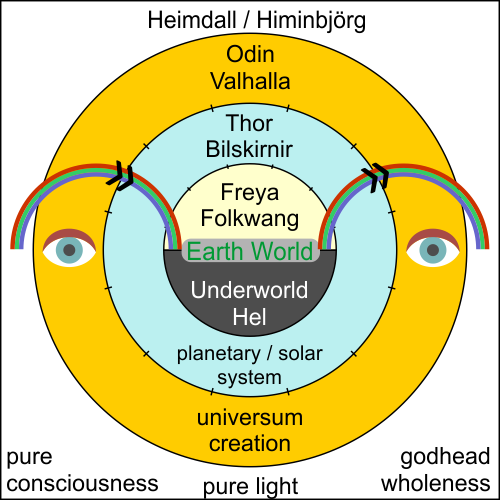
In principle, we might therefore also think of the gates as days. Yet why there should be precisely 540 is unclear. With 360 days, one could imagine the circular number of 360° in a symbolic annual cycle of 12×30 days. Yet 540 days are 18×30, an additional half-circle. A tentative theory recalls Folkvang, Freyja’s hall, of which it is said that she chooses half the fallen, while the other half belong to Odin.
Yet the 540 gates might also suggest 9×60 in relation to the nine worlds, each appearing enclosed within a circle in separation. For 60, too, is a circular number, familiar from the circle of minutes and seconds.
Regarding the 800 Einherjar, eight evokes mindfulness and infinity (∞) as a passage toward the nine of renewal. And one hundred recalls the perfect host of unity, what we today call 100%. At Ragnarök, all creatures then pass simultaneously through all the gates into the bodily world, to encounter the all-devouring Fenris Wolf at the end of the cycle of creation.
41. Gangleri said: An immensely great multitude is in Valhalla. Truly, Odin is an exceedingly mighty ruler if he commands so great a host. Yet how do the Einherjar pass their time when they are not drinking?
The High One answered: Every day, once they have dressed, they put on their armour and go out into the courtyard. They fight and fell one another. This is their pastime (or battle-play). And when the day-meal (between morning and noon) approaches, they ride home to Valhalla, where they sit down to drink. As it is said here (in the Lay of Vafthrudnir, verse 41):
All the Einherjar strike down (fell) one another day after day in Odin’s courtyard. They choose the fallen and ride home from battle. Then they sit together all the more reconciled.
Here, we may reflect upon the Einherjar’s ‘daily round’. Around noon, they nourish themselves in Valhalla upon the cooked boar Sährimnir. Then their embodiment begins, their dressing and putting on armour, and evening falls in Valhalla. The sun of consciousness moves into Bilskirnir’s bodily world, the space of consciousness of embodied living beings, which may also be regarded as Odin’s courtyard of Valhalla. There, the Einherjar are born in the earthly world’s morning light and fall, like all creatures, at the evening of their earthly day—yet not into the darkness of the hell, or cave, of a separate being, but back into divine light within wholeness. Thus, they appear again in Valhalla’s morning light, sitting together all the more reconciled and drinking mead, which suggests their learning process.
Born to die,
Destined for life.
But what you say is true: Odin is mighty. Many examples bear witness to this. Thus it is expressed in the Aesir’s own words (in the Lay of Grimnir, verse 44):
The ash Yggdrasil is foremost (highest and best) among trees, Skidbladnir among ships, Odin among the Aesir, Sleipnir among horses, Bifröst (the ‘Light- and Rainbow-Bridge’) among bridges, Bragi (‘God of Poets’) among skalds, Habrok (‘Highest Garment’) among hawks, and Garm among hounds.
Here, symbolically gathered together, are creation’s mightiest principles: the World Tree and Tree of Life; Skidbladnir as the body-ship, which will be described more closely; Odin as the All-Father and divine whole; Sleipnir as his bodily horse of creation; Bifröst as consciousness’s light-bridge, connecting and uniting everything; and Bragi as narrator of the sacred stories of the gods, through which to rediscover divinity and wholeness. Added to these is Habrok, a trained hunting bird pursuing objects of desire, evoking a ‘heavenly and holistic garment’, presumably the best thing one can hunt. Finally, Garm, probably the ‘Barker’ or ‘Growler’, is the finest watchdog as a tamed and trained wolf. For he guards Hel’s realm of the dead, presumably the hardest realm to guard. Yet this is evidently what the dead desire, wishing there to hold fast to death and dead things. And ultimately, nothing is lost there either. Indeed, one may cling to this conception, too, and formless consciousness can assume even this form, remaining attached to it until Ragnarök.
Gangleri’s intellect now asks about the mighty principles of creation just listed that have not yet been explained more closely. He begins with Sleipnir, Odin’s eight-legged horse. Next comes the question of Skidbladnir, the body-ship, answered through the long story of Utgard-Loki. Finally, the question concerns the realm of the dead and is answered by the story of Baldr’s death. We have already treated all these stories at length and interpreted them from a spiritual perspective. For completeness, we include the text again here, with brief reminders of our interpretation. Where possible, we shall seek to deepen this interpretation somewhat within the narrative’s flow and add some meaningful comparisons with modern cosmology.
42. Gangleri asked: Who owns the horse Sleipnir (the ‘Gliding One’)? And what can be said of him?
The High One answered: You do not know Sleipnir’s qualities because you know nothing of the circumstances of his birth. Yet this will make you consider the stories worthwhile. The gods’ settlement was still in its beginnings after they had built Midgard and Valhalla. Then a builder came to them and offered to build them, in three half-years (seasons), a stronghold-wall so good that it would provide reliable protection against the mountain and frost giants, even if they broke in over Midgard. Yet as his payment, he demanded Freyja for himself and wished to have the sun and moon. The Aesir then assembled and took counsel. They concluded an agreement with the builder: he should receive what he demanded only if he completed the stronghold in a single winter. But if any part of the structure remained unfinished on the first day of summer, he would have broken the contract. And no one was to help him with the work. When they stated these terms, he demanded permission to receive help from his horse, named Svadilfari (‘Unfortunate Wanderer’, or ‘Wanderer in the Mud’). And on Loki’s advice, they agreed to this.
The ‘High One’ now traces the question of Odin’s bodily horse back to the great question of how the separation between spiritual and bodily realms arose: between the world of spiritualization and the world of embodiment. This thus also concerns the symbolic wall with its 540 gates between Valhalla and Bilskirnir, the realms of Odin and Thor, of Father and Son.
When living beings arose in Midgard at creation’s beginning, a builder appeared as a giant of the intellect, offering to build such a wall between spirit and nature that the spiritual divine beings would have no need to fear the rigidity of form brought by mountain and frost giants. As payment, he demanded the worldly light of sun and moon, together with the goddess Freyja as nature’s lovable beauty and fertility. Thus, the builder was presumably more concerned with protecting his bodily world from the gods. Hence, he offered to build this wall over three half-years, in which we may recognize the 540 gates as 540 days (3×6×30). Yet the gods granted him only the winter half-year as the time of rigidity, not summer, when Midgard should spiritually blossom and grow. In return, the giant of the intellect demanded the help of his horse as a being of material embodiment, which should serve him in this. Naturally, Loki had to praise the plan, for a spiritual world naturally needs a counter-effect and an opposite as a bodily world.
In this regard, we may imagine that only a half-circle of this wall around Freyja’s realm was materially embodied. The other two half-circles, forming a wall between Valhalla and Bilskirnir, would then be more spiritual, or subtle in substance. Here, we might in principle think of Bifröst, the light- and rainbow-bridge, which we have already encountered as a fire- and water-wall.
In terms of modern cosmology, this ‘subtle wall’ might suggest dark matter, which, above all as a kind of ‘glue’ or ‘gravitational cage’, ensures that our galaxy holds together rather than expanding as rapidly as the universe’s space as a whole. The other ‘half-wall’ would then be visible matter. Similarly, science also states that matter within the universe consists of around 85% dark matter, with only a small portion of 15% being visible. This is the matter of atoms and molecules, with which the ‘builder can wall himself in’, as it were, giving rise to suns, planets, and also our body-castles.
This makes clear that the builder constructs this wall not around the gods, but rather around himself and his world. For how could one build a wall around holistic, boundless gods? Hence, this wall arises not outside, but within Valhalla.
He began building the stronghold on the first winter’s day, and even at night hauled stones with his horse. Yet the Aesir found it astonishing what great rocks the horse pulled. It did twice as much work as the builder. But an inviolable pledge and many oaths bound them to their agreement, because the giant did not consider it safe to be among the Aesir without such a covenant if Thor came home. At that time, however, Thor had travelled east to fight fiends. As winter passed, the stronghold’s construction progressed rapidly, and the fortification was already so high and strong that no one could attack it. When only three days remained before summer’s beginning, everything was finished except the stronghold’s gate. Then the gods assembled upon their judgement-seats and took counsel. Each asked the other who had advised marrying Freyja into Giantland and spoiling air and heaven by taking away the sun and moon and giving them to the giants. And all agreed that this must have been advised by the one who most often counselled ill: Loki, Laufey’s son. They said he would suffer an ill death unless he could devise a way for the builder to fail to fulfil the contract, and they attacked Loki. In his fear, he swore oaths that he would ensure the builder broke the contract, however hard he tried.
Naturally, this wall of visible matter must not become finished and perfect. The stronghold’s gate must never close. Otherwise, eternal winter would reign. Here, Loki enters the scene again: the divine spirit of contradiction, the divine counter-effect to the ‘good’, which becomes complete only with the ‘bad’. For good and bad are relative intellectual concepts within separation’s realm of thought. Thus, Loki now also ensures that the ‘inviolable pledges and oaths’, within which the intellect wishes to become rigid, are broken again.
And that same evening, when the builder went out with his horse Svadilfari (‘Unfortunate Wanderer’, or ‘Wanderer in the Mud’) to fetch stones, a mare came from the forest. She ran toward the stallion and neighed. But when the stallion realized what kind of mare this was, he became wild, tore his ropes apart, and ran to her. She galloped away into the forest, and the builder ran after them, seeking to catch the stallion. Yet the horses continued running all night, and that night the work stood still. Nor was the following day’s work carried out as before. But when the builder saw that his task could not be completed, giant-rage seized him. Then the Aesir knew for certain that a mountain giant had come among them, so the oaths no longer had to be kept. They called Thor, who came at once, and the next moment the hammer Mjölnir flew through the air. He paid the builder’s wages, and these were not the sun and moon; indeed, he even denied him a dwelling in Giantland. For the first blow struck so that his skull shattered into many pieces. And he sent him down to Niflheim. Yet Loki’s encounter with Svadilfari had been such that some time later he bore a foal. It was grey and had eight legs. This horse is the best among both gods and humans. Thus says the Seeress’s Prophecy (Völuspa, verses 25/26):
Then all the counsellors went to the judgement-seat, the most holy gods, and considered who had mingled all the (fresh and wholesome) air with evil and given Odr’s wife (Freyja) to the giants’ kin.
Then the oaths broke, the given words and sworn pledges, all the solemn agreements exchanged between them. Thor alone struck there, filled with (divine) wrath, for he seldom remains seated when he hears of such things.
Thus, the builder who strove for rigidity of form is now recognized, shattered by Thor, and sent back to Niflheim, to the Well of Birth. Not into death in Niflhel, therefore, but into the river of creation, so that creation remains alive.
From the perspective of modern physics, one might compare the builder with the electromagnetic force holding atoms, and thus all bodily matter, together. This is the fundamental builder, forcing energy into form with the strong nuclear force as his workhorse. Thor would then be the impulse of energy ensuring that this form does not become a prison of singularity, but remains a living, vibrating space.
Thus, through sexual desire, Loki also ensures that the workhorse abandons his ‘unfortunate path’. To this end, he transforms himself into the feminine counterpart of the male horse, which now follows a ‘fortunate path’: protecting living creation through living reproduction. Upon the path of union between masculine and feminine as spirit and nature, Loki then gives birth to the grey, eight-legged horse Sleipnir, the ‘Gliding One’. His grey coat reminds us that he is a creature between light and darkness, like this entire creation. And his eight legs evoke a holistic being of four masculine and four feminine legs, which may also be interpreted as eight pillars of bodily creation. Upon this eight-legged horse of living creation, whose wholeness also made him long-lived, rides no mountain or frost giant, but Odin himself as creation’s All-Father and the ‘ninth’ power of renewal—a wonderful symbolism:
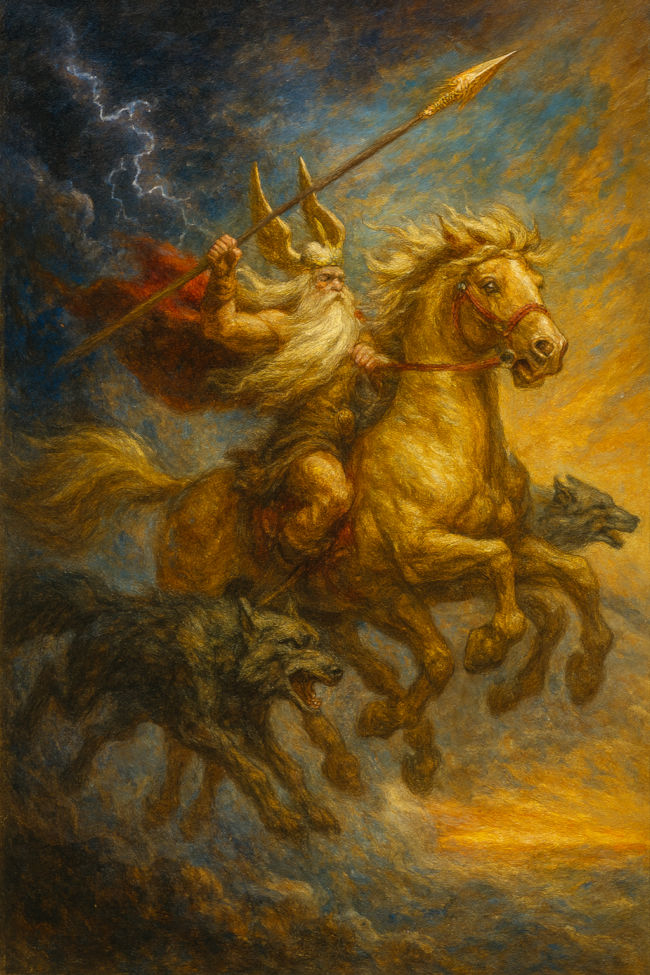
Thus, Loki gave birth to the living river of creation to prevent material rigidity. Here, too, Loki appears as counter-effect and can even assume the feminine nature of birth-giving nature. Is this good? Is this bad?
43. Gangleri asked: What can be said of Skidbladnir, the best of all ships? Is there no ship equally good?
The High One answered: Skidbladnir is the finest ship, built with supreme craftsmanship. Yet Naglfar (the ‘Nail-Ship’ as ship of the dead) is the largest ship and belongs to Muspel (the fire giant at Ragnarök). Many dwarves, sons of Ivaldi (‘Ale- or Beer-Power’), built Skidbladnir and gave the ship to Freyr. It is so large that all the Aesir, together with their weapons and armour, can find room in it. As soon as its sail is raised, it has a favourable wind wherever one wishes to sail. Yet when it is not to be at sea, it is made of so many parts and with such great skill that he (Freyr) can fold it like a cloth and carry it in his pocket.
Within this river of living creation, living bodies can now arise from rigid matter after winter’s time. Such a living body appears like a ship in the water of life upon the Sea of Causes, built by many little dwarves and given to the summer god Freyr, the spirit of summer. Here, we may think of life’s summer, a time of growth, mobility, and fertility. The name Skidbladnir literally means ‘Joined Together from Thin Planks’. On the one hand, this might allude to the living body’s fragility, and on the other to the delicate artistry of bodily cells, where countless little nature spirits work within the microcosm.
The comparison with the death-ship Naglfar might remind us that even then, many beings wished to cling to death and dead things at the end of their bodily lives (symbolically, like their nails), unable to let go of their material bodies. Thus, the death-ship grows ever larger, and contributing to it is probably not conducive to a living creation. Accordingly, in section 10 above, the being Naglfari was married to Night. This recalls the lone warriors’ path into the dark realm of the dead, as opposed to the Einherjar’s path within living creation, in ‘God’s vineyard’.
Thus, we are also told that in Skidbladnir, this finest ship of life, all gods are present with all divine powers, while free will determines the direction of travel in the spirit’s wind. This also recalls Gymir, who invited all the gods into himself, as an ‘ark’ upon the sea for the ‘archiving’ of survival:
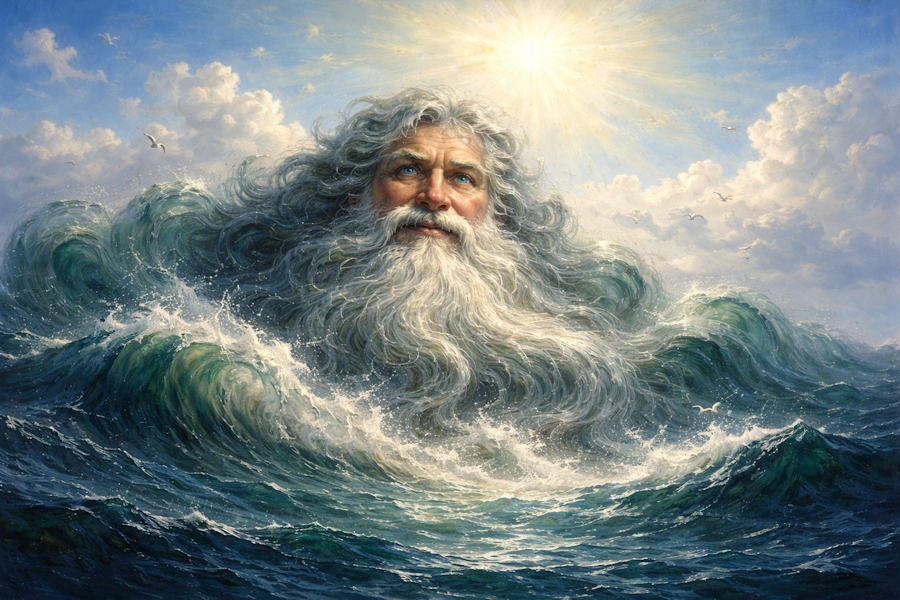
The final sentence in the ‘High One’s’ answer is also deeply mystical. We would interpret it to mean that although destiny determines the lifespan, when ‘the body-ship is no longer to be at sea’, Freyr has the power to fold this ship like a cloth woven from destiny’s threads and put it into his pocket. The pocket recalls the Sea of Causes, from which the living body can then unfold again within the Well of Birth.
44. Gangleri said: Skidbladnir is a good ship, yet a great deal of magical art must have been involved before it was finished. Has Thor never come to a place where he encountered something so mighty and strong that it surpassed him in strength and magical power?
The intellect now presumably asks about the magical art that transforms dead matter into living bodies. Our modern science, too, wrestles with this question, and perhaps we shall never receive a true answer. ‘Magical art’ is therefore a good term for this enlivening power. This recalls the divine ‘power of illusion and creation’ already discussed. We might also speak of spirit, information, or consciousness. Yet what is this? Evidently, nothing tangible.
Thus, Gangleri’s intellect cannot grasp it either. Yet he still seems to have a concept of a god such as Thor, who struggles for living creation. Hence, he asks whether anything mightier exists in life’s struggle, surpassing him in strength and magical power. And this is a truly great question, capable of breaking through our limited world of conceptions.
The High One answered: I believe few can speak of this, yet some things have caused him great difficulty. But if it had truly been the case that anything was so mighty and strong that Thor could not gain victory over it, then it should not be spoken of. For there are many examples of this, yet everyone should believe that Thor is strongest.
Here, the ‘High One’ again establishes the great goal: to recognize the highest and mightiest in Thor as well, as in the divine itself. For as soon as one regards a god as something separate, inferior, or conditioned, he loses his holistic nature, and thus also his higher meaning for our intellect. Nevertheless, our intellect wishes to know something ‘about’ this:
Gangleri then said: It seems to me that I have asked you about a subject no one wishes to discuss.
Then the Equally High said: We have heard of events that seem too incredible to us to be true. Yet the one who knows how to speak the truth sits here before you. And you should not believe that he will now lie, having never lied before.
Gangleri remarked: Here I shall remain and listen to whether any answer can be found to this matter. Otherwise, I shall consider you overcome if you cannot tell me what I ask.
Then the Third said: It is now clear that he wishes to hear this event, even if speaking of it seems unpleasant to us.
Only reluctantly do the gods speak of their boundaries, for these are not their own boundaries but those of our intellectual conceptions. And we ordinarily confuse the two. Yet Gangleri now seems ready for his ordinary intellect to begin shattering, allowing divine light to shine. Here, the ‘Third’ enters the scene, recalling Bragi, the god of poets. He tells a wonderful divine story, using Thor’s power to shatter our ordinary intellect still further. This concerns not only the gods but also our conceptions of life and death. In principle, Skidbladnir’s theme thus continues: What is life, what is illusion’s magic, and how real is our outward world of physicality?
This story begins with Öku-Thor (‘Chariot-Thor’) setting out with his he-goats and chariot, accompanied by the Ase named Loki. In the evening, they came to a farmer and received lodging for the night. And that evening, Thor took his goats and slaughtered both. They were then skinned and placed in a cauldron. Once they were cooked, Thor and his companion sat down to their evening meal. He also invited the farmer, his wife, and their children to eat. The farmer’s son was named Thjalfi (‘Limiter/Shaper/Servant’?) and his daughter Röskva (‘Capable/Brave One’). Thor laid the goatskins before the fire and told the farmer and his household to throw the bones upon them (unharmed). Yet Thjalfi, the farmer’s son, held one goat’s thighbone, opened it with his knife, and broke it open down to the marrow.
Thor spent the night there, but rose before daybreak and dressed. He took the hammer Mjölnir, raised it, and consecrated the goatskins. Then the goats arose, but one limped on a hind leg. Thor noticed and said that the farmer, or someone of his household, must have handled the goat’s bones carelessly. He found that the thighbone was broken.
Thus, Thor and Loki now embody themselves with their chariot as effect and counter-effect within our world. And here, all embodied beings also feed upon this physicality. The farmer and his wife may symbolically be regarded as human beings within the play of spirit and nature. Their children recall intellect and soul. Thus, it is the intellect that can prevent physicality’s perfect regeneration by breaking open the ‘bone marrow’. This is the essence from which the body-ship can ‘unfold’ again. Thor’s hammer serves this purpose, ensuring a living creation.
From a modern medical perspective, too, bone marrow is fundamental to the body’s regeneration and renewal. Without functioning bone marrow, the ongoing renewal of blood and a human being’s natural survival would be impossible. Every day, it produces many billions of new red blood cells to replace old ones. At the same time, immune cells continually arise there to fight infections and support healing processes, along with platelets indispensable for wound healing and blood clotting.
Beyond this, one might also think symbolically of living beings’ genes. As long as these are not destroyed, their bodies can be reproduced. And behind the genes, we may recognize a field of information as a foundation enabling living bodies to arise from atomic building blocks.
There is no more to tell of this. Everyone can imagine how terrified the farmer must have been when he saw Thor lower his eyebrows over his eyes. Yet what the farmer could still see of Thor’s eyes made him think he would die from his gaze alone. Thor gripped the hammer’s shaft so tightly that his knuckles turned white. The farmer and his family did what could be expected: they cried out loudly and begged for mercy. They offered everything they possessed as compensation. When he saw their fear, his wrath passed and he calmed himself. And in recompense, he took their children, Thjalfi and Röskva, to be his servants. Ever since, they follow him everywhere.
Thus, the ‘righteous wrath of God’ appears when our intellect impairs living regeneration within creation. What can we do about it? Best of all, surrender everything we consider our own. Then we surrender intellect and soul to the divine, serving as Einherjar. Now a great miracle occurs: the god accepts them, thereby himself becoming human as well, allowing such stories of his supposed weakness to be told.
45. He left his goats there and continued eastward toward Giantland as far as the sea. Then he crossed the deep sea. When he came to a coast, he went ashore, accompanied by Loki, Thjalfi, and Röskva. They had walked only a little while when they encountered a great forest. Through it they walked all day until darkness. Thjalfi was the fastest runner among them. He carried Thor’s sack, but provisions for the journey had been poorly arranged. Once it grew dark, they sought lodging for the night and found an extraordinarily large house. The doorway was at one end, occupying the house’s entire width. They took this as their night’s lodging. Yet in the middle of the night, a great earthquake arose: the ground beneath them moved in waves, and the house shook. Thor rose and told his companions to do likewise. They felt their way forward and found a side-chamber on the hall’s right, which they entered. Thor sat at the entrance, while the others remained inside behind him, afraid. Yet Thor held his hammer, ready to defend himself. Afterwards, they heard a great noise and tumult.
Thus, the journey now leads east toward Jötunheim, the world of embodiment—naturally more of a spiritual journey without chariot and goats. The deep sea recalls the water of life within the Sea of Causes, and the land material embodiment within this sea. Thus, all four together entered the giants’ realm, nature’s macrocosm. The great forest recalls the forest of conceptual notions, and there our perception also grows dark. Thjalfi, who as the intellect can run almost as fast as thoughts, carries memory’s provision-sack, which nevertheless never seems entirely sufficient. Thus, they ‘spend the night’ together in a body-house, and the earthquake recalls its transience. We may now imagine how these four companions appear, act, and thus also live together within the outward world of physicality:
At daybreak, Thor went outside and saw a man lying in the forest not far away. He was not exactly small; he slept and snored loudly. Then Thor thought he understood the noises they had heard during the night. He put on his belt of strength, and Aesir-power grew within him. At that moment, the man awoke and sprang up quickly. Yet it is said that, on this one occasion, Thor was too astonished to strike him with the hammer. Thus, he asked his name, and the man called himself Skrymir (‘Boaster’). ‘But you,’ he said, ‘I need not ask your name. I know you are Aesir-Thor. Yet where have you dragged my mitten (glove)?’ Skrymir then stretched out his hand and picked up the mitten. Thor now saw that he had mistaken it for a house during the night, and the side-chamber had been the mitten’s thumb.
The breaking day recalls consciousness awakening and now ‘looking around’. And together with the intellect, the god believes he understands something. Wonderful! Thus, he puts on his belt of strength and concentrates holistic consciousness upon a form. At that moment, this form awakens into consciousness, rises, and becomes alive. More wonderful still! And the intellect allows this form to persist, being frozen in astonishment.
It is a giant within the macrocosm, working with living beings’ bodies, which then appear like his gloves. Similarly, we may imagine the many organs and cells living within a human body, with which we work.
It is also a wonder that the giant knows Thor’s name, thus possessing a concept of him. This already recalls the builder in the preceding story, who knew the gods and sought protection from them behind a bodily wall. And just as the gods initially failed to recognize the builder there, Thor likewise has no concept of the giant here, so the giant must name himself. His name is Skrymir, which may be interpreted as ‘Boaster’, and we shall yet hear what great things he has to say.
Skrymir asked whether Thor wished to have him as a travelling companion, and Thor agreed. Then Skrymir took his bundle, untied it, and began breakfasting. Yet Thor and his companions camped elsewhere. Skrymir suggested that they should eat together, and Thor agreed. Afterwards, Skrymir tied all their provisions into one bundle and threw it over his shoulder. He led the way throughout the day, walking with rather great strides. Late in the evening, Skrymir chose a night’s resting place beneath a great oak and said to Thor: ‘I should like to lie down to sleep. Take the provision-bundle and prepare your evening meal.’ And already Skrymir fell asleep and snored loudly. Thor took the bag and tried to untie it. Yet what must be told of this will seem incredible: he could loosen no knot and move no strap-end so as to make the strap any looser than before.
Thus, five now journey through the day of a bodily life within the forest of conceptions: effect, counter-effect, intellect, soul, and embodiment. The great oak recalls the Tree of Life, beneath whose protection all living beings ‘spend the night’, while the provision-bundle recalls the karmic bundle of our accumulated causes, upon which all living beings more or less feed together. That material embodiment within the macrocosm now ties this karmic bundle so tightly that its contents are barely accessible, preferring to sleep, suggests bodily inertia. The yogis, too, know this well, consciously seeking to let this karma work itself out and become exhausted—fundamentally also the Einherjar’s task. And because this is the task of living beings, even a god cannot open this karmic bundle. Yet he grows angry and attempts to strike down bodily inertia:
When he saw that he could not succeed at this task, he grew angry and grasped the hammer Mjölnir with both hands. Step by step, he went to where Skrymir lay and struck him on the head. Yet Skrymir awoke and asked whether a leaf had fallen upon his head, and whether they had finished eating and were ready to sleep. Thor said they would go to sleep at once. Then they went beneath another oak [or: to the other side of the oak]. Yet truthfully, you must be told that none slept without fear. And in the middle of the night, Thor heard Skrymir snoring so loudly in deep sleep that the whole forest echoed. Then he rose and went to him, swung the hammer swiftly and with full force, and struck him squarely upon the crown. He felt the hammer’s point sink deep into the skull. At that moment, Skrymir awoke and asked: ‘What is it now? Did an acorn fall upon my head, and what is the matter with you, Thor?’ But Thor hurried back, answering that he had just awoken. The giant said it was the middle of the night and still time to sleep. Thor then thought that if he had the opportunity for a third blow, he would never see him again. Yet now he lay down and watched for Skrymir to fall sound asleep again. Shortly before dawn, when he heard that the giant must have fallen asleep, he rose and ran to him. He swung the hammer with all his might and struck the upward-facing temple. The hammer sank into the head as far as its shaft.
Wonderful symbolism, offering much to reflect upon deeply! Embodiment within the macrocosm wishes above all to sleep and dream, upon the Tree of Life’s nature-side. Thor fights against this with his hammer, for it is no peaceful sleep. Three times he attempted it, and the hammer penetrated ever deeper into the giant’s head. Yet he did not kill him. Nor was this the great goal; rather, it was to shatter the giant-intellect rigidified in form. We shall learn later why this seemingly failed. At least the giant awoke three times, now shows the company its onward path, and himself withdraws humbly:
But Skrymir sat up, stroked his temple, and remarked: ‘Some birds must be sitting above me in the tree. When I awoke, it seemed a twig had fallen from the branches onto my head. Are you awake, Thor? It must be time to rise and dress. You have no long journey left to the stronghold called Utgard (“Outer Garden or Enclosure”). I heard you whispering among yourselves that I was no small-grown man. Yet you will see greater men still when you reach Utgard. I shall give you one more piece of good advice: do not boast about yourselves! For Utgard-Loki’s followers would hardly permit such little lads to swagger. Otherwise, you had better turn back. That seems better for you in any case. But if you insist upon travelling farther, then go east. I must now go north toward the mountains you see there.’ Skrymir took his bundle, threw it over his shoulder, and turned aside from them into the forest. And it is not said that the Aesir wished to see him again.
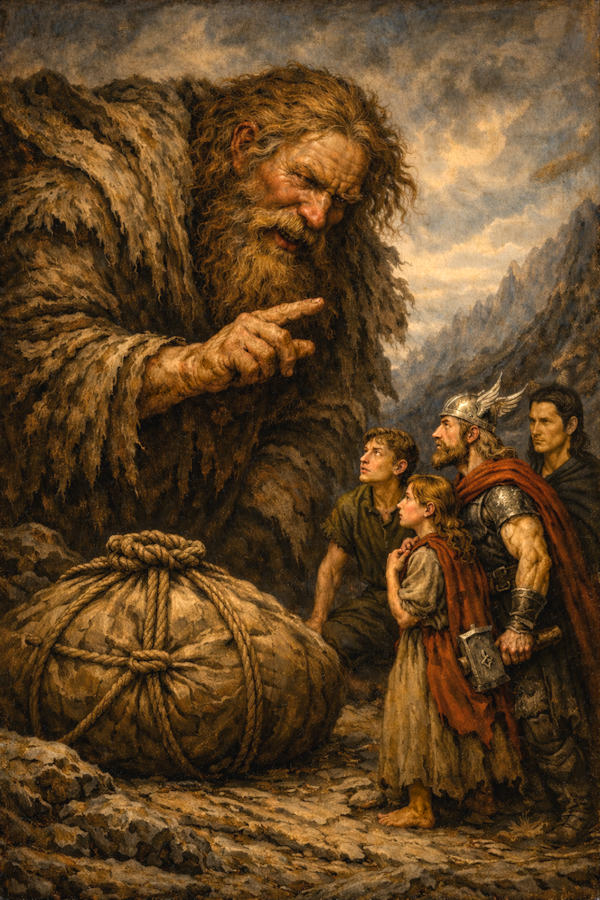
The giant continues north into nature’s Vanir-realm, while sending his company east with friendly advice toward Utgard’s royal stronghold, the centre of embodiment within the giants’ world—figuratively, within the World Tree’s trunk. There rules Utgard-Loki, a Loki, as it were, of the macrocosm’s outward world. Thus, he again recalls the builder’s counter-effect in the preceding story. Yet what does material embodiment within the macrocosm act against? Against spiritual freedom within the microcosm? What is embodiment’s purpose? Why do atoms, molecules, suns, earths, and bodily living beings arise? So that intellect and soul can enter this stronghold?
46. Thor and his companions continued their journey, walking until midday. Then they saw a stronghold standing upon a plain, and they had to tilt their heads far backwards to see over it. They approached the stronghold, but a portcullis had been lowered at the gate. Thor went to it but could not open it. Yet in their eagerness to enter the stronghold, they squeezed between the bars and thus got inside. They saw a great hall and went toward it. The door stood open. They entered and saw many men upon two benches, most of them very large. Next, they came before King Utgard-Loki and greeted him.
Evidently, the four as effect, counter-effect, intellect, and soul were not particularly welcome in embodiment’s royal stronghold, as Skrymir had already suggested. Yet they are spiritual beings capable of entering any physicality, thus standing, despite every obstacle, in the midday light before embodiment’s king:
Yet he turned toward them only slowly, grinned contemptuously, and remarked: ‘It is late [It would take too long] to ask for news after so long a journey. Is it not as I believe, that this little fellow is called Öku-Thor (“Chariot-Thor”)? Yet you might be more than you seem to me. What abilities do you travelling companions believe yourselves to possess? No one should remain here among us who does not master some knowledge or skill better than most others.’
As with Skrymir, Thor is also recognized by Utgard-Loki, and the connection between the two will be revealed later. Then the king wastes no words: he is concerned not with news from the wide world but with the heart and nature of his sovereignty—overwhelming power. And the first to face this claim is Loki, who always comes last as the counter-effect following every effect:
Then the one who had arrived last, named Loki, said: ‘I possess an art which I am ready to test immediately: no one in here can eat his meal faster than I.’ Utgard-Loki answered: ‘That is indeed an art, if you possess it. It shall be put to the test!’ He called toward the far end of the bench, ordering the one named Logi (“Fire”) to come forward and compete with Loki. Then a trough was taken, set upon the floor, and filled with meat. Loki sat at one end, Logi at the other, and each ate as quickly as possible until they met at the trough’s centre. Loki had eaten all the meat from the bones. Logi, however, had devoured all the meat together with the bones and even the trough. Hence, everyone considered Loki to have lost the contest.
At first, one might suppose that Loki was very hungry after the long journey and used this cunning to obtain plenty of food quickly, especially since Skrymir had tied up the provision-bundle. Viewed more deeply, this speed in consuming recalls the swift counter-effect following every effect, and thus also the principle of dissolution accompanying every creation, so that everything arising must sooner or later pass away again. The consuming of bones recalls this story’s beginning, when Thjalfi broke a bone from Thor’s goats and ate the marrow. Loki, however, leaves the bones intact so that life is preserved and bodily flesh can regenerate. By contrast, Logi even devoured the trough. Thus, at the end, we shall also come to know him as a fire giant and overpowering fire of destruction. Yet in the outward world, our intellect sees Loki as less powerful, having lost the wager.
Hence, Edda scholarship also places great emphasis upon clearly distinguishing Loki and Logi, although their names sound very similar and their natures are described in very similar terms. For our intellect, their difference lies above all in Logi burning in separation as a fire giant within Utgard, thereby becoming a fire of destruction, while Loki acts as a divine being within wholeness, where nothing can be lost or destroyed.
Finally, we may also ask why a fire giant should be found at all in Utgard, Jötunheim’s royal stronghold, when he really belongs in Muspelheim’s realm of fire. Here, we might again think of energy, the foundation of all matter, as we learned from E=mc². Through light’s movement in space, energy can transform into mass, and naturally back again as well. Perhaps Utgard-Loki himself is even this fire giant—an Utgard-Logi?
Afterwards, Utgard-Loki asked what the other young man could accomplish. Thjalfi answered that he could race anyone Utgard-Loki appointed. Utgard-Loki remarked that this was a good ability and that he must indeed believe himself very swift if he practised this art. At once, he arranged to test it. Utgard-Loki rose and went outside. There was a good course across a flat plain. Then he called a lad named Hugi (“Thought”) and ordered him to race Thjalfi. They began their first run. Hugi drew so far ahead that at the course’s end (the turning point), he could turn back toward Thjalfi. Utgard-Loki remarked: ‘Thjalfi, you must try harder if you wish to win the race. Yet it is true that no one has come here who seemed swifter to me.’ Then they ran a second race. Yet when Hugi reached the finish and turned around, he was an arrow-shot ahead of Thjalfi. Utgard-Loki said: ‘Thjalfi seems to me to race well. Yet I no longer believe he can win. This will become clear when they run the third race.’ Then they ran once more. And when Hugi reached the finish and turned, Thjalfi had not even reached the course’s halfway point. Then everyone declared the contest decided.
Again, wonderful symbolism: a race between intellect and thought. Who reaches the goal faster? Who is mightier? Three races are run. And each time, the intellect grows slower. What happens when the intellect pursues a thought continually circling the same course? Especially when urged to exert itself ever harder? Thus, every intellect presumably loses its light-footed speed the more it strains, binds itself to a goal, and pursues circling thoughts, until it virtually ‘comes to a standstill’ as a defeated intellect.
Here, too, the question ultimately concerns the difference between intellect and thought. Like Loki and Logi, Thjalfi and Hugi are alike in their essence. Yet while thought lives in wilful separation, the intellect can seek connections and strive toward wholeness the more it serves the divine, as Thjalfi serves Thor. And yet, within the outward world of diversity, every wilful thought appears mightier than an intellect serving the divine.
Afterwards, Utgard-Loki asked Thor what skill he wished to show them. Surely so many stories had been composed about his great deeds. Thor replied that he would most gladly compete with a man in drinking. Utgard-Loki agreed, went into the hall, and called his servant. He ordered him to bring the great penalty-horn from which his followers ordinarily drank (after losing a wager or contest). Soon the servant came forward with the horn and placed it in Thor’s hand. Utgard-Loki said: ‘From this horn, it is considered good drinking to empty it in a single draught. Some empty it in two, but no one is so weak a drinker that he cannot manage it in three.’ Thor examined the horn. It did not seem very large, but rather long. Being very thirsty, he began to drink. He took great gulps and thought he would not need to bend to the horn again. Yet when he had to catch his breath and lowered the horn, he saw how much he had drunk. The difference seemed tiny, as though scarcely less remained in the horn than before. Utgard-Loki remarked: ‘Well drunk, but not much. I would not have believed it had I been told that Aesir-Thor could drink no more. Yet I know you will empty it with your second draught.’ Thor gave no answer, but raised the horn to his mouth, thinking he would now drink more. He strained at drinking until he had to draw breath. He saw that the horn’s point still did not rise as high as he wished. And when he took the horn from his mouth and looked inside, it seemed scarcely diminished compared with the first time. At least a clear rim was now visible within the horn. Utgard-Loki said: ‘What is the matter, Thor? Will you spare yourself again on your next draught, hoping that this will benefit you? It seems to me that if you now take a third draught from the horn, you must intend it to be your mightiest. How can you count among us as so great a man as the Aesir call you, unless you show more of yourself in other contests than is visible here?’ Then Thor became angry, raised the horn to his mouth, and drank as eagerly as he could. He strained greatly at this draught. And when he looked into the horn, a difference was now most clearly discernible. Then he gave it back and would drink no more.
Surely, holding one’s drink at a feast was also a virtue of great heroes. There was presumably also the great penalty-horn, or horn of penance (vítishorn), through which one could wash down a loser’s sorrow and show oneself a victor again. Yet this text surely concerns a deeper meaning:
What does a god drink? Why does a god drink? And why is this his greatest strength? Of Odin, it is said that he drinks only wine: the wine of illusion’s and creation’s power from the Sea of Causes. Accordingly, at the very beginning of the chapter on Odin’s nature, we encountered Mimir’s creation, drawing creation with Heimdall’s horn from Mimir’s Well at Yggdrasil’s root.
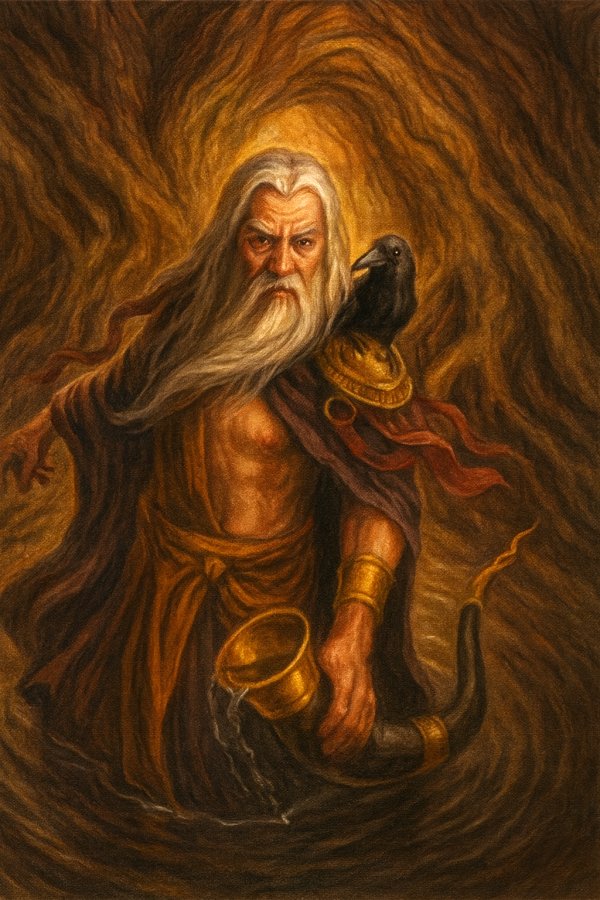
Accordingly, Mimir’s Well is also the source and foundation of Jötunheim as the giants’ world of embodiment, as clearly visible in our image of the World Tree above. In this regard, the ‘great penalty-horn’ recalls Heimdall’s horn of creation. It summons living beings, as it were, on account of their karmic guilt, so that they may drain it and return to their pure origin.
The best drinker would naturally be God himself, being almighty and boundless. Yet why does he fail to empty the penalty-horn here? Because Thor appears with the limited human intellect within space and time. Hence, like Thjalfi, he strains three times and can drink only a limited amount from the boundless horn. And as will later be revealed, even this is already unimaginably much, for this horn lies with its point in the sea, recalling the Sea of Causes. Yet where does he drink it into? As he drinks, it flows back again. Thank God! Otherwise, creation would end without having fulfilled its purpose.
Nevertheless, within our outward world, it seems a weakness of God that he cannot entirely drain guilt’s penalty-horn. Yet this is our task as living beings, best fulfilled as Einherjar. For ‘whoever has made the karmic soup must also spoon it up’. And from the gods’ stories, we may learn how best to do this and what makes the best spoon. Could we recognize Thor beyond time and space as pure divinity, then united with him, we would already have spooned up, drunk, and digested the entire soup. Heidrun, too, points toward this: the Light-Rune as light’s divine secret, and Heimdall as consciousness shining homeward. Yet Utgard-Loki still rules over our intellect through his magical art:
Utgard-Loki remarked: ‘It is now clear that your strength is not as great as we believed. Yet do you wish to attempt further trials? So far, we have seen you achieve nothing here.’ Thor answered: ‘I can face further contests. Yet at home among the Aesir, I would have found it strange to hear such draughts called small. What contest will you now offer me?’ Utgard-Loki said: ‘Young lads here perform what is considered a small thing: lifting my cat from the ground. Yet I could not speak thus to Aesir-Thor had I not seen that you are far less significant than I thought.’
At once, a grey, rather large cat ran across the floor. Thor went toward her, placed his hands beneath the middle of her body, and tried to lift her. Yet the cat arched her back as far as he raised his hands. And when he stretched her as high as he possibly could, the cat raised just one leg, and Thor could take the contest no farther. Then Utgard-Loki remarked: ‘The contest went as I expected. The cat is rather large. Thor, however, is slight and small among such great men as we have here.’
As a symbol, the cat recalls the protection of the household against greedy mice. Cats were often kept and cared for to this end. Thus, we shall later learn that, for Utgard, this cat symbolized nothing less than the mighty Midgard Serpent, coiling around the human world to protect supposed property through separation.
In this regard, they again opposed Thor with a fundamental principle of their embodiment, testing his strength. And indeed, he again shook the giants’ foundations mightily. Yet here, too, completely abolishing this fundamental principle of embodiment was evidently not his divine task. Once more, this resulted in his being considered weak. Accordingly, he now challenges the giants to attack and defeat him themselves:
Thor said: ‘If I am as weak as you call me, let someone come here and fight me—now I am angry.’ Utgard-Loki looked around the benches and answered: ‘I see no man in here who would not consider it beneath his dignity to fight you.’ He continued: ‘But let us see. Summon my old nurse Elli (“Old Age”). Thor may wrestle with her if he wishes. She has brought down men who seemed no weaker to me than Thor.’ Then an old woman entered the hall. Utgard-Loki told her to wrestle with Aesir-Thor. There is nothing more to say of it: the contest went so that the harder Thor strained in wrestling, the more firmly she stood. Then the old woman began seeking an opening, and Thor grew unsteady upon his feet. A fierce wrestling match ensued, and before long he sank onto one knee. Then Utgard-Loki stepped forward and ordered them to stop wrestling. He said Thor could not afford to challenge any more of his followers to a wrestling match. Night had now fallen. Utgard-Loki assigned places to Thor and his companions, and there they spent the night, well entertained.
After guilt and separation as fundamental principles of embodiment, the third great challenge now enters the struggle. It is the principle of ageing, most feared within the world of embodiment. Hence, it presumably seems the mightiest being even to the giants. The symbol of the ‘old nurse’ is well chosen: as an old woman, she recalls transient nature; as a nurse, she reminds us that without her, one would not have grown.
Without ageing, no growth.
Without passing away, no arising.
Can Thor, as a god, resist ageing? Can he defeat it? Here, too, the dynamic is again described profoundly for our intellect: the harder he strains and fights against it, the more firmly it persists. This is presumably true of every illusion: the harder one fights against it, the more it manifests as reality. Yet Thor could not be defeated by her. He sank only onto one knee, presumably signifying his aspect possessing form.
Utgard-Loki ended the contest and declared to our intellect: ‘What kind of god is this, who cannot even defeat an old woman as ageing nature? He is no worthy opponent for all the heroes among my followers, for all embodied lone warriors.’ Thus, night fell in Utgard, and divine light sank beneath the earth. The divine thus ‘spends the night’ here, ‘well entertained’, for naturally it also lives upon embodiment. And when the divine light moves again, it dresses itself with its companions serving the divine, preparing for a living ‘departure’ within a living creation:
47. When morning dawned, Thor and his companions arose, dressed, and prepared to depart. Then Utgard-Loki came to them and had breakfast brought. There was no lack of good hospitality, food, or drink. Once they had eaten, they wished to leave. Utgard-Loki accompanied them outside and walked a little way beyond the stronghold with them. Yet in parting, he spoke to Thor, asking how he thought his journey had gone and whether he had met any man mightier than himself. Thor said he would not claim to have suffered no great disgrace in their encounter: ‘For I know you will call me a weak man, and I am not content with that.’
Thus, Thor had fought hard, yet failed to attain his goal of being recognized as the strongest in the world. Or had he? At least he voiced his discontent to Utgard’s king. It is noteworthy that within Utgard, he did not use his hammer, although he repeatedly grew angry. Perhaps the hammer was already at work within the body-castle? The question also arises of Röskva’s role upon this journey, as she was no longer mentioned after their arrival in Jötunheim. If we regard her as the soul, beside Thjalfi as the human intellect, then as the principle of causation she must have greatly influenced the whole story’s course. Perhaps this is why the story seems so human to us, allowing us, too, to rediscover within it our weaknesses and strengths in relation to divine and spiritual power.
Perhaps this entire story even took place within a human being’s body-castle. And when the divine day dawns, we awaken and prepare to ‘depart’ from the body-castle to return to our true home. Utgard-Loki, too, now leaves the body-castle together with Thor and his companions. And what a wonder! No longer does he speak arrogantly, but great words of truth:
Utgard-Loki remarked: ‘Now I shall tell you the truth, since you are outside the stronghold. As long as I live and have any say, you shall never enter it again. And I know for certain that you would never have entered had I known beforehand how great your strength was. With it, you almost brought us into the gravest danger. Yet I deceived you with sensory illusions. The first time I encountered you was already in the forest. When you sought to untie the provision-sack, I had tied it with iron wire, and you could not discover how to loosen it. Next, you dealt me three blows with your hammer. The first was the weakest, yet so strong that it would have killed me had it struck true. But beside my hall, you saw a mountain containing three square valleys, one especially deep: these were the marks of your three hammer-blows. I pushed that mountain before your blows, but you did not notice.’
Wonderful! Utgard-Loki now reveals himself as Skrymir, a true ‘Great-Speaker’, and truly speaks great things: had he recognized God’s power earlier, it would never have entered a body-castle. How he can prevent this, we learn at the story’s end. Then he also admits that his arrogance within the body-castle arose from fear of God’s power. And out of fear, he presented the divine spirit with sensory illusions—above all, naturally, to himself, for only thus was embodiment possible. Through this, he sought to secure his karmic provision-sack against divine access and embody himself as a material mountain giant, protecting himself from the divine hammer-blows. Wonderful is the one who can see through these illusions!
Why had Thor not seen through them? On the one hand, because he was travelling with the human intellect. On the other, even God can act only within illusions. Through what else should he act? Hence, we like to speak of God’s ‘power of illusion and creation’, symbolically recognizable in the wine upon which Odin feeds as divine All-Father and creator-god. Thus, all creation presumably appears so that we may recognize God’s power and see through illusions, as now happens to Utgard-Loki. Hence, he continues:
‘So it was also in the contests you held with my followers. Loki contested the first: he was very hungry and ate swiftly. Yet the one called Logi was a wild fire, and after consuming the slaughtered meat, it swiftly burned the trough as well. When Thjalfi raced the one called Hugi, that was my thought. Thus, Thjalfi could not be expected to match its speed at all. But when you drank from the horn and it seemed scarcely diminished, I know for certain that this was a wonder I could not have believed possible. For the horn’s other end lay out in the sea, but you did not see it. Yet when you now come to the sea, you can see how much you drank from it. This decrease is now called the ebb.’
And he continued: ‘No smaller did it seem to me when you lifted the cat. And to tell you the truth, everyone was terrified when they saw you lift one of its legs from the ground. For this cat was not what it appeared to you. It was the Midgard Serpent, encircling all the land. It was barely long enough for its tail and head to touch the earth. For you raised your hands so high that little distance remained to heaven. But in the wrestling match, too, a great wonder occurred when you held out so long and sank only onto one knee while wrestling Elli. For no one who grows so old and encounters old age has ever escaped being brought down by it, nor will anyone ever do so.’
Thus, Utgard-Loki now recognizes God’s power and reveals his magical art of illusion to it, and above all to himself. This means he becomes conscious of his own illusion, through which he had created the body-castle around himself. In principle, this also describes the magical powers through which the living body-ship Skidbladnir was created.
From the perspective of modern physics, one might regard Logi’s fire as energy, Hugi’s thought as information, and the penalty-horn as a field of information and quantum entanglement. The cat protecting property recalls the strong nuclear force as binding energy, while the nurse, as the principle of ageing and transience, recalls entropy as thermodynamic equilibration. The builder would then be above all the electromagnetic force, allowing a living body-ship to arise from these fundamental principles upon the Sea of Causes. In this regard, Utgard-Loki also recalls the builder of the wall between spiritual and bodily worlds in the preceding story.
Then Skrymir concludes his magnificent and truthful speech, saying:
‘But now it must truly be said that we must part. And it will be better for both sides if you do not encounter me again. Next time, I shall conceal my stronghold with these and other illusions, so that you gain no power over me.’
Here, we might suddenly doubt again whether Skrymir has truly spoken truthfully. Why does he wish to ‘separate’ himself from the divine spirit? Why does he no longer wish to ‘encounter’ it? Why does he speak of ‘illusions’ again and seek through them to be mightier than God? An illusion of illusions? Well, perhaps our human intellect can grasp it no other way. Thus, Thor now swings his hammer to shatter even the last remnants of the intellect possessing form:
But when Thor heard these words, he grasped his hammer and swung it through the air. Yet as he was about to strike, he could no longer see Utgard-Loki anywhere. Then he turned back toward the stronghold, intending to smash it. Yet there he saw only a wide, shining plain, with no stronghold remaining. Then he turned and continued his journey until he returned to Thrudvang (‘Field of Strength’). And truly, it must be said that he had resolved to attempt an encounter with the Midgard Serpent, which happened later. Now I believe no one can tell you more truth about this journey of Thor’s.
Wonderful! Here, we now learn how Skrymir protects himself from divine supremacy in future: first, the ego-king disappears, and then his body-castle as well. A brilliant solution! Consciousness relinquishes identification with a fixed form. Then there is nothing left to shatter and nothing left to defend. Wonderful!
For only the builder can dismantle his own building again. This is the law of karma: ‘Whoever has made the soup must also spoon it up.’ From a spiritual perspective, this is above all the intellect. It possesses the ability to distinguish and separate, building its existence in form as a lone warrior, yet it can also recognize connections on an ever-greater scale, serving wholeness as an Einherji and dismantling its existence in form again.
Was this perhaps the great goal of Thor’s journey? For what kind of god would Thor be if he failed and could not reach his goal? Was his third hammer-blow successful after all, as the text said earlier: ‘Thor then thought that if he had the opportunity for a third blow, he would never see him again.’
Modern science, too, was able to have a similarly wonderful experience when it examined matter more closely and could find nothing solid. A hydrogen atom resembles an Olympic football stadium. At the centre spot sits the positive atomic nucleus, no larger than a grain of rice, embodying 99.9% of the mass. The negative atomic shell extends to the outermost spectator stands, where somewhere a tiny electron circles. Everything else is vacuum, and even the ‘particles’ commonly called electrons, protons, and neutrons are fundamentally nothing solid, but merely waves. Matter’s apparent solidity is therefore only an appearance of interacting forces—Thrudvang, as it were, the ‘Field of Strength’ as Thor’s realm.
Utgard-Loki, too, now lives up to his name, for he is now the ‘Loki of Utgard’, the counter-effect to the body-castle. Thus, transient embodiment presumably exists only to be overcome, allowing the imperishable to be found. Hence, Skidbladnir is not the largest but the best of all ships. What a magnificent story! Matter’s illusion disappears, and what remains? A boundlessly vast and shining field of consciousness, no longer obstructed, darkened, and limited by conceptions. What a wonder! God himself sees this field as a holistic being within his own eye, alone and perfect.
Nevertheless, he continues his work within creation, in the ‘field of his power’. Naturally, this concerns above all overcoming the fundamental problem of delimitation and separation, helping creatures who have fallen into separation. Hence, the following story, too, revolves around the Midgard Serpent.
48. Then Gangleri said: Very mighty is Utgard-Loki, a master of illusion and magic! Yet one can also see that he is so mighty because he has followers possessing great strength. Did Thor not take revenge upon them?
The High One answered: It is known, even to those who are not learned, that Thor made everything good again on the journey now to be recounted. He did not remain home long but swiftly prepared for a new journey, taking neither chariot nor goats nor companions. In the guise of a young lad, he travelled through Midgard, and one evening came to a giant called Hymir. Thor spent the night there. At daybreak, Hymir rose, dressed, and prepared to row out to sea to fish. But Thor sprang up, was quickly ready, and asked Hymir to let him row out to sea with him. Yet Hymir said he would be of little help, being small and still a young man: ‘And you will grow cold if I remain out there as long as I am accustomed.’ But Thor said he could row so far from land that it was uncertain which of them would first insist upon returning. He grew so angry with the giant that he was ready to strike him down with his hammer at once. Yet he refrained, intending to test his strength elsewhere.
Here, we may imagine the builder of the material body-ship being reborn in Midgard as Hymir, beginning another ‘daily round’ as the life of an embodied being. The god appears again as a ‘young lad’ and spends the night with the builder. When the worldly day dawns, the builder dresses and embodies himself to row his body-ship upon the Sea of Causes and fish for nourishment. Upon this fishing voyage, we are reluctant to stray too far from the supposed solid ground of our limited world of conceptions. Here, we may recall our image of the World Tree, with Midgard at the crown’s centre, from which its limbs branch outward and all the other worlds open around it. Mostly, we prefer to cling bodily to Midgard, otherwise fearing the loss of our accustomed possessions and sinking into the deep sea.
Here, Thor now assumes his divine task and quite literally challenges us ‘outward’. Interestingly, this time Hymir does not recognize him as a god, only as a weak human being, strongly recalling Midgard as our human world. Hence, the name Hymir might etymologically be interpreted as the ‘Darkened One’, meaning an ignorant being. Thus, we, too, see ourselves as weak humans and gladly wish to become overpowering giants. Yet perhaps our true strength lies precisely within our weakness, where Thor himself can reveal himself…
He asked Hymir what they should use for bait, but Hymir advised him to obtain bait himself. Then Thor went to where he saw Hymir’s herd of oxen. He seized the largest ox, named Himinhrjodr (‘Heaven-Destroyer’), tore off its head, and took it to the shore. Meanwhile, Hymir had launched his boat. Thor went aboard and sat aft upon the bailing space. He took two oars and rowed, yet Hymir believed they were moving because of his own rowing, for he sat at the very front of the ship and rowed swiftly. Then he said they had reached the grounds where he customarily sat to catch flounder. Yet Thor wished to row farther, and they swiftly travelled a long distance more. Finally, Hymir said they had gone so far out that the Midgard Serpent made it dangerous to remain there. Yet Thor wished to continue rowing a little longer and did so. Hymir, however, was in an exceedingly ill humour.
The ox-head from the giant’s herd symbolically recalls the battling, thick-headed ego-intellect within the realm of separation. Thus, it becomes the ‘Heaven-Destroyer’, destroying heaven’s wholeness. Yet Thor can make good use of it…
Thus, divine power also sits within the body-ship, fundamentally moving everything. Yet we ordinarily believe we move the body-ship through our own strength and according to our own will. And when we sometimes become conscious that we are rather being moved, we are seldom pleased, just as Hymir grew ill-humoured. Yet ultimately, only through this divine power do we reach our journey’s true goal.
Yet the giant fears approaching the Midgard Serpent. Why? Is he afraid of crossing his boundary, leaving his accustomed sphere of life, his ‘comfort zone’? He would rather catch flounder: flatfish symbolically recalling shallow, superficial thoughts and effects. And indeed, most humans presumably feel the same. Why do we find it so difficult to cross our ordinary world’s boundaries and expand our consciousness? Modern science offers every possibility for this, whether within quantum physics’s microcosm or astronomy’s macrocosm. Our technology already lets us look so deeply and so far, yet we do not rediscover ourselves there because we cling to our limited earthly form of life. Yet divine power still urges us toward creation’s goal:
After Thor had laid aside the oars, he prepared a rather strong fishing line, and the hook was no smaller or less strong. He fastened the ox-head upon it, cast it overboard, and the hook sank to the bottom.
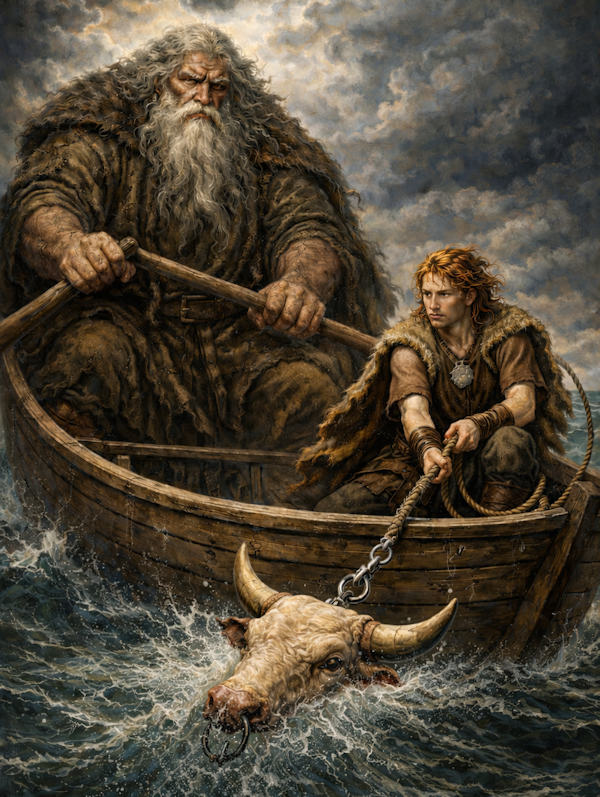
And truly, you must be told that Thor now deceived the Midgard Serpent no less than Utgard-Loki had deceived him when he lifted the serpent (in a cat’s form) with his hands. The Midgard Serpent snapped up the ox-head, and the hook pierced her palate. But when she noticed, she moved so violently that both Thor’s fists struck the ship’s side. He grew angry, and his Aesir-strength increased. He braced himself so firmly that he thrust both legs through the ship and reached the seabed. Then he hauled the serpent up to the ship’s side.
If we regard the ox-head as the stubborn ego-intellect, it is naturally no wonder that the ego-serpent of delimitation bites upon it. What else would she bite? Perhaps this ego-intellect even exists only so that Thor can draw the fundamental problem of separation before our eyes and make us conscious of it. Naturally, all this is a play of deception, magical power, and illusion, as is the entire body-ship Skidbladnir. Yet it is ideally suited for this, and Thor can show his full Aesir-strength here. The divine power now stands not upon Skidbladnir’s ‘thin planks’, but upon the floor of the Sea of Causes, and thus upon the ground of Everything. Here, we might again think of pure consciousness, the famous Philosopher’s Stone, the imperishable within transience. Powerful symbolism!
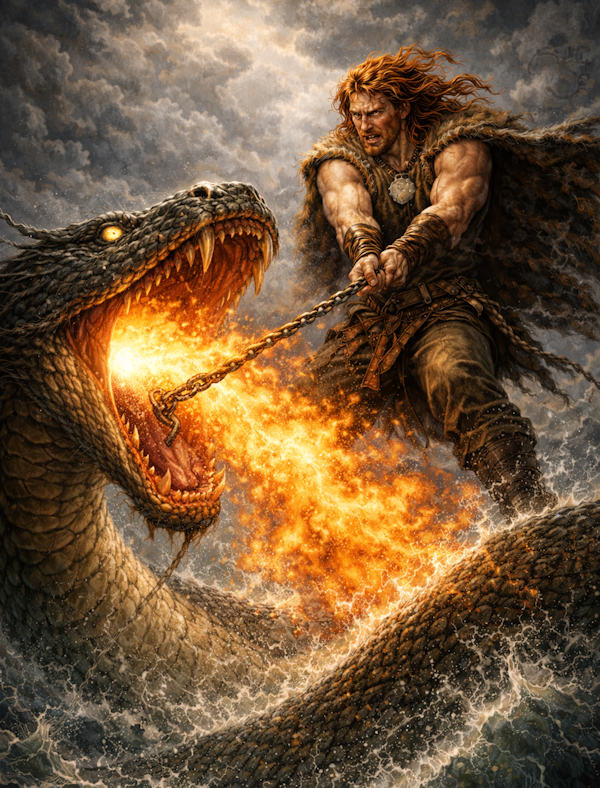
Yet this must be said: no one has ever witnessed so terrible a sight who did not see Thor looking upon the serpent with a piercing gaze, while she stared up from below and blew poison. It is said that the giant Hymir changed colour, grew pale, and became afraid when he saw the serpent and the sea flowing in and out of the boat. Yet at the moment Thor grasped his hammer and swung it through the air, the giant took his bait-knife and cut Thor’s fishing line at the gunwale. The serpent sank back into the sea, and Thor hurled his hammer after her. It is said to have shattered her head beneath the waves. Yet what I believe to be true, and shall tell you, is that the Midgard Serpent still lives and lies within the sea. But Thor swung his fist and struck Hymir upon the ear so that he fell overboard, leaving only the soles of his feet visible. Afterwards, Thor waded ashore.
The symbolism described recalls the rising of the Kundalini serpent, of which Indian yogis speak. They, too, know that this is exceedingly difficult to endure.
What is this sight that no one can endure? Here, one might reflect upon someone’s downfall: that of our delimited ego-being as a person. This occurs when divine, holistic power first brings into consciousness and then shatters the serpent of delimitation surrounding us, spewing separation’s poison. In doing so, this blow is directed above all against our ego-intellect. Herein presumably lies our greatest fear: Who am I then? Who am I when the entire sea flows into my body and out again (as in our image of Gymir as Ägir)?
We would probably react like Hymir, cutting the divine fishing line while the god swings his hammer—probably also with the ‘bait-knife at the gunwale’, symbolically recalling discrimination’s knife at the bodily sheath. Yet this evidently no longer helps, for Thor never swings his hammer in vain, without reaching his goal. On the contrary, his fist strikes us as well, and like Hymir, we plunge headlong into the sea’s dark depths.
What might have happened if Hymir had not cut the fishing line, but watched trustingly like a yogi? Then divine power could have drawn Hymir’s head, too, upward into wholeness’s heaven, into Valhalla to the Einherjar, or even into pure heavenly light. Yet Hymir resisted. Thus, his being had to be reversed again, and he plunged headfirst into the dark depths.
Thus, Thor had at least shattered Hymir’s Midgard Serpent. Yet Hymir himself had not overcome her, so that his giant-head possessing form, or intellect, sank back into the Sea of Causes together with the body-ship. Thus, the Midgard Serpent of our human world also continues living within the Sea of Causes; Thor will shatter her only at Ragnarök.
Nevertheless, this was already a great success, for at least the fundamental problem had become conscious. Similarly, many yogis have already allowed the Kundalini serpent to rise and work out its effects, thereby making the path of yoga conscious.
And Hymir? Is he dead now? In principle, yes, for he cut the fishing line and thereby fell back into separation, thus not becoming an Einherji. Yet what does death mean? Can gods kill? How does a living body-ship become a death-ship? This is the subject of the following story, likewise told by the ‘High One’.
49. Then Gangleri asked: Have other adventures befallen the Aesir? An immense heroic deed Thor accomplished upon this journey.
The High One answered: We must also tell of the event that seemed very grievous to the Aesir. This story begins with Baldr the Good having violent dreams threatening danger to his life. When he told the Aesir of these dreams, they took counsel together, resolving to demand assurances of peace toward Baldr against every kind of danger. Thus, Frigg took oaths that fire and water should spare Baldr, as should iron and every kind of metal, stones, earth, trees and all diseases, animals, birds, poison, and serpents. Once this was agreed and known, it became an amusement for Baldr and the Aesir that he should stand before their assembly. Of all the others, some should shoot at him, others strike at him, and still others throw stones. Whatever they did, nothing harmed him, and everyone considered this a great benefit.
Who can understand a god dreaming of his death and fearing his downfall? Indeed, as humans, we can understand it. And this is presumably what the story concerns. Thor did not hurl his hammer after the Midgard Serpent in vain. Now the boundaries between Midgard and the other worlds gradually fade. The wall between spiritual and bodily worlds crumbles. After Thor united with Thjalfi and Röskva as human intellect and human soul, the ‘High One’ now describes how the other gods, too, become increasingly human. And why? So that humans may recognize themselves within the gods. Hence, it is also said:
‘God became man, so that man might become God.’
Thus, the gods now also seem to dream like us humans, no longer conscious that it is only a dream. This means they identify with the forms they have assumed as aspects of the holistic Godhead. Thus, the formless light of consciousness can identify with the forms appearing within the light. Wonderful! Surely, therefore, this dreaming story does not revolve by chance around Baldr, the god of light.
Light is an exceedingly remarkable phenomenon within our world, perhaps even consciousness’s most important and fundamental phenomenon. Modern science, too, has gained astonishing insights into light: not only that light can be frozen and transformed into matter, but also that the speed of light is the fastest movement within the universe. For itself, light is said even to be infinitely fast, and thus everywhere simultaneously. Only through observation does a finite speed appear. In this regard, light also possesses a certain eternity, as long as it is not bound within space and time by an observer. This recalls Odin’s two eyes again. Thus, as soon as light is seen, it becomes transient, and yet it merely transforms.
This story of Baldr’s death also seems to revolve around this fundamental theme: How can eternal light seemingly become transient and even die? To clarify this, the gods attempt to take Baldr’s dream seriously and protect his visible form from death.
Yet what happens when light wishes to be immortal even in its form—as a photon, as it were, within the realm of effect? One would then have to ensure that no one could any longer seize and absorb a photon. In this story, Frigg now assumes this task: the All-Mother and Odin’s wife, in whom we may recognize nature’s soul, ensuring the necessary ‘oaths’ within the realm of causation. At first, this even seems to succeed. Wonderful!
Yet what would physically happen if no particle in the universe were allowed to injure, or absorb, a photon any longer? Then the world as we know it would perish at once. No eye could see anything anymore. Matter would dissolve, and all molecules and atoms would disintegrate. The universe would end in the ‘Big Freeze’. Astonishing! Thus, we can readily imagine how the gods, through their desire for immortality in form—above all a human desire—immediately also ushered in creation’s path toward destruction, leading to Ragnarök.
For all must crumble into Nothing,
If it would persist in Being.
(One and All, Goethe)
Yet naturally, there are also causes preventing this from happening immediately. Thus, this divine effect now brings forth Loki’s natural counter-effect, directly challenged by the gods’ claim:
Loki, Laufey’s son, saw this and disliked Baldr’s invulnerability. He went to Frigg in Fensalir (‘Marsh- or Water-Hall’), taking a woman’s form. Frigg asked whether this woman knew what the Aesir were doing at the Thing-assembly. She said they were all shooting at Baldr and nothing injured him. Frigg remarked: ‘Neither weapons nor trees will harm him. I have taken oaths from them all.’ The woman asked: ‘Have all things sworn to spare Baldr?’ Frigg answered: ‘West of Valhalla grows a tree-shoot called mistletoe. It seemed too young to me to demand an oath of it.’ At once, the woman departed. Loki seized the mistletoe, tore it off, and went to the Thing. There, Hödur stood far outside the assembly’s circle, for he was blind. Loki asked him: ‘Why do you not shoot at Baldr?’ He answered: ‘Because I cannot see where he stands, and because I have no weapon.’ Loki remarked: ‘Do as the others do and honour Baldr as they do. I shall point you toward where he stands. Throw this twig at him!’ Hödur took the mistletoe and, following Loki’s guidance, shot it at Baldr. The missile pierced him, and he fell dead upon the earth. Thus arose the greatest grief among gods and humans alike.
In Frigg, we may recognize nature’s soul and the principle of causation. Accordingly, she asks about effects and explains their causes. Her hall is Fensalir, the ‘Marsh- or Water-Hall’, which may be interpreted as the Sea of Causes. Into this water of life, every creature eventually sinks, to be drawn forth and born again. To enter this hall, Loki must transform from a masculine spirit into a feminine soul. Thus, within the Sea of Causes, he can find both the cause of Baldr’s invulnerability and the cause of his vulnerability. Afterwards, he returns from there, transforming again into the masculine spirit of effect. Wonderful!
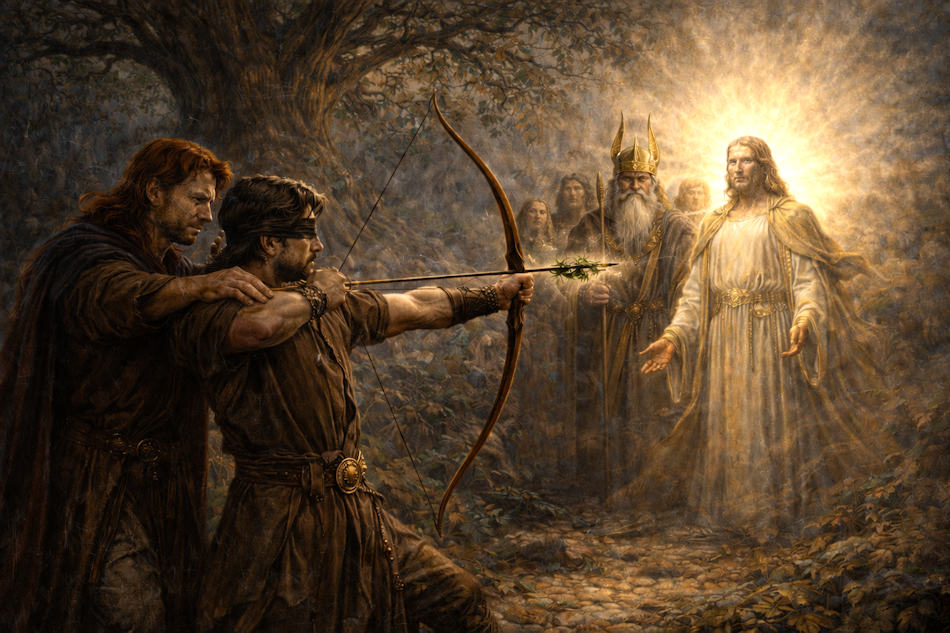
The instrument of effect is a mistletoe shoot ‘growing west of Valhalla’, where the sun sets: within our transient world’s night- and dream-consciousness. Mistletoe is an ancient and deeply mystical symbol. Its roots are not in the earth; rather, it grows, as it were, within the Tree of Life between heaven and earth, as between spirit and nature. Thus, it is relatively ‘unbound’, also in terms of oaths and responsibility, perhaps explaining why it seemed too young, immature, and weak to Frigg. Yet often the greatest strength lies precisely in being unbound, as does the prerequisite for a living world. For a completely bound world would be dead.
The one who acts is Hödur, the blind god of darkness, born as the brother of Baldr, the radiant god of brightness. Between these two eternal principles, the living creation of our visible world can appear within the harmonious play of opposites.
Our modern science, too, recognizes principles within the universe that can escape the ‘oaths’ of natural laws governing cause and effect. Here, one might think of quantum fluctuations or the weak nuclear force, which ensure a living creation. The weak nuclear force in particular recalls the frail mistletoe twig within the mighty Tree of Life. It acts far less conspicuously than the electromagnetic force or the strong nuclear force, yet is responsible, among other things, for symmetry violations and radioactive decay. Without it, there would be no suns, no transformation of energy, and no chemistry of bodily life.
What would life be without change? Even eternal life knows the transformation of forms, an eternal arising and passing away. Why is this the greatest sorrow among gods and humans alike, as the final sentence says? Here, the connection between gods and humans reveals itself again, as both now evidently cling to forms. And there is probably truly no greater suffering in our world than attachment to forms. From this arises the notion of death. And like us humans, the gods, too, now grow rigid within this intellect:
When Baldr had fallen, none of the Aesir could speak a word or raise their hands to touch him, and they looked at one another. All agreed about who had done this, yet no one could avenge him, for this was a great sanctuary of peace. And when the Aesir attempted to speak, they instead burst into tears. Thus, none could put his sorrow into words for another. Yet Odin suffered this loss most grievously among them, for he knew best what great harm and loss Baldr’s death had brought upon the Aesir.
How can divine reason become rigid within the bodily intellect? For the ‘great peace’ at the Thing assembly mentioned here is evidently more rigid than alive as well. Divine reason is holistic reason and must naturally be sustained by all beings within creation, including us humans. When this does not happen, the gods, too, suffer through us humans, above all Odin as the All-Father. Thus, each may first ask himself to what extent reason, as holistic consciousness, is alive or rigid within him. In this respect, the divine, holistic power that every human being carries within and can become conscious of is also addressed here.
How, then, can we, through reason and intellect, restore this pure light of consciousness to life?
When the gods came to their senses again, Frigg spoke and asked who among the Aesir wished to win all her affection and favour by riding the Hel-road, attempting to find Baldr, and offering Hel a ransom if she would let Baldr return home to Asgard. And the one named Hermodr (‘Host-Courage’, as the gods’ messenger), the brave one, a son of Odin, declared himself willing to undertake this journey. Sleipnir (‘the Gliding One’), Odin’s horse, was brought forth. Hermodr mounted him and set out.
Here, the world’s inversion already becomes clear as the gods come to their ‘senses’: the soul of nature, who should really tend to physicality, now worries about Baldr’s spiritual path and sees him entering Hel. And the soul’s great goal, as causation within nature, is to redeem the light of consciousness from there and bring it into the holistic world of the gods again. Wonderful! The ransom recalls the story of the otter’s ransom and the gold of truth.
Who is ready for this great task? Here Hermodr enters the scene, the third brother between Hödur and Baldr, who has the courage within the host. This again recalls the host of the Einherjar, and herein probably lies the great message of living creation between brightness and darkness. Thus, he also rides Odin’s horse, in which we may see the whole of bodily creation, to fulfil his task as the gods’ messenger.
At this point, we may reflect on the strange claim that the Vikings were determined to die by force of arms in order to reach Valhalla. Here, however, it is clearly described that not even a god such as Baldr reaches Valhalla by this means. Evidently, then, the path one takes depends less upon armed violence than upon attachment to the body.
And just as the soul of nature worries about Baldr’s spirit, the gods now, strangely enough, worry about his body:
The Aesir took Baldr’s body and brought it to the sea. Hringhorni (‘Ring-Horn’) was the name of his ship, the greatest of all ships. The gods wished to launch it and burn Baldr upon it, but the ship would not move. They therefore sent to Giantland for the giantess named Hyrrokkin (‘Fire-Wrath’). When she arrived, she rode a wolf and held a venomous serpent as her reins. She dismounted, and Odin called for four berserkers (death-defying heroes) to watch over her mount. Yet they could not restrain it until they threw it down. Meanwhile, Hyrrokkin went to the ship’s prow and pushed it with her first heave so forcefully that fire shot from the rollers and the entire land shook. This angered Thor. He seized his hammer and would have shattered her skull had not all the gods asked that she be spared. Afterwards, Baldr’s body was carried onto the ship. But when his wife Nanna (‘Mother/Bold One’), Nep’s daughter, saw this, her heart broke with sorrow and she died. She, too, was laid upon the funeral pyre, which was then kindled. Thor stood before it and consecrated it with Mjölnir (his hammer, the ‘Crusher’). But a dwarf called Lit (‘Coloured Formation’) ran before his feet. Thor kicked him into the fire, where he burned.
What might we imagine the light-god’s ship to be? Essentially everything that can appear as forms within the light of consciousness. Thus, it is naturally the greatest of all ships. The name Hringhorni means ‘Ring-Horn’ and recalls the ring of renewal, since all forms of light continually transform, as well as Heimdall’s horn, for herein also lies creation’s great message. Yet through attachment to a form and the prohibition of injury, this ship became a ship of the dead, just as Naglfari is also called the greatest ship. Hence, the gods can no longer move it, for they themselves have brought about this attachment, naturally in connection with the human intellect, which clings to its physicality. Here we may see the great difference between Skidbladnir and Naglfari: a living body-ship of transformation and a death-ship of rigid form. And we can readily imagine the former sailing upon the water of life and the latter sinking into the Sea of Causes.
But how can a body now be burned if nothing may move or change any longer? Without light’s mobility, no mass can be transformed into energy, as we know from E=mc². Then even the boar Sährimnir could no longer be cooked in Valhalla. Who can help?
Here, too, an inverted world appears. Just as Thor previously shattered the soul of the mountain and frost giants, who tended toward rigidity, the gods now seek help from precisely there. Thus, it was probably good that Thor had fulfilled his task, for now the giantess can help the gods overcome their rigidity. This sounds mad, yet it is the principle of a holistic world in which nothing can be lost. Especially since Thor himself had ensured that the Midgard Serpent was ‘relieved’ of its task in Midgard, so that the boundaries between the worlds now blur. This made it possible for the human intellect in Midgard to imagine even a god from Asgard dying and entering Niflhel.
Thus, a giantess as ‘Fire-Wrath’ now comes riding the wolf of transience, which she reins in with the poison-spitting ego-serpent. Even this tamed wolf can now be controlled by the gods only with the greatest effort, and only for a while. Yet the giantess can move the ship with a brief heave, so powerfully and fiercely that it greatly shames the gods and makes the whole world tremble.
This especially angers Thor, regarded as the strongest of the Aesir, who wished to avenge himself with his hammer. Yet even this freedom was no longer his, so he had to vent his anger upon a dwarf. In principle, he thereby also cast the dwarves’ formative power into the fire. And this fire of destruction will now continue growing until Ragnarök. For the entire creation had evidently reached its peak and was now approaching its natural decline. Thus, we may imagine the whole of creation, too, transforming into a ship of the dead steering toward Ragnarök, just as Hermodr rides Sleipnir along the Hel-road. Nevertheless, Thor consecrated the pyre with his hammer, surely hoping that life might arise from it again.
In Nanna, Baldr’s wife, we may see Mother Nature. Just as Frigg symbolizes the soul of nature, Nanna might here stand for outward nature, which, with light’s apparent death, likewise becomes a dead nature. For when the light of spirit is dead, the light of nature is also dead, as our modern natural science likewise sees it. Nanna and Baldr’s son is called Forseti, the ‘Presiding One’, the god of justice, in whom we may recognize the meaning of all creation. Yet he is not mentioned in this story, although he surely also acts in Loki’s spirit. Instead, her father Nep is named, whose name evokes ‘cold’ through the Old Norse word ‘napr’, recalling the frost giant Ymir, who was ‘thawed’ into living nature again. Yet general rigidity now sets in anew: the thermal heat death of a ‘cremation’ within the Sea of Life, ultimately ending in the ‘Big Freeze’.
People of many lineages came to this cremation. First, it must be told of Odin that Frigg came with him, as well as the Valkyries and his ravens. Freyr came in his chariot with the boar called Gullinborsti (‘Golden Mane’) or Slidrugtanni (‘Sharp Tooth/Terror-Tusk’). Heimdall (the ‘Home-Shining One’) rode the horse named Gulltop (‘Golden Forelock’), and Freyja travelled in her cat-drawn chariot. Many frost and mountain giants also came. Odin laid upon the pyre the golden ring called Draupnir (‘Dripper’). It possessed the property that every ninth night eight golden rings of equal weight dripped from it. Baldr’s horse, too, was led onto the woodpile with all its harness.
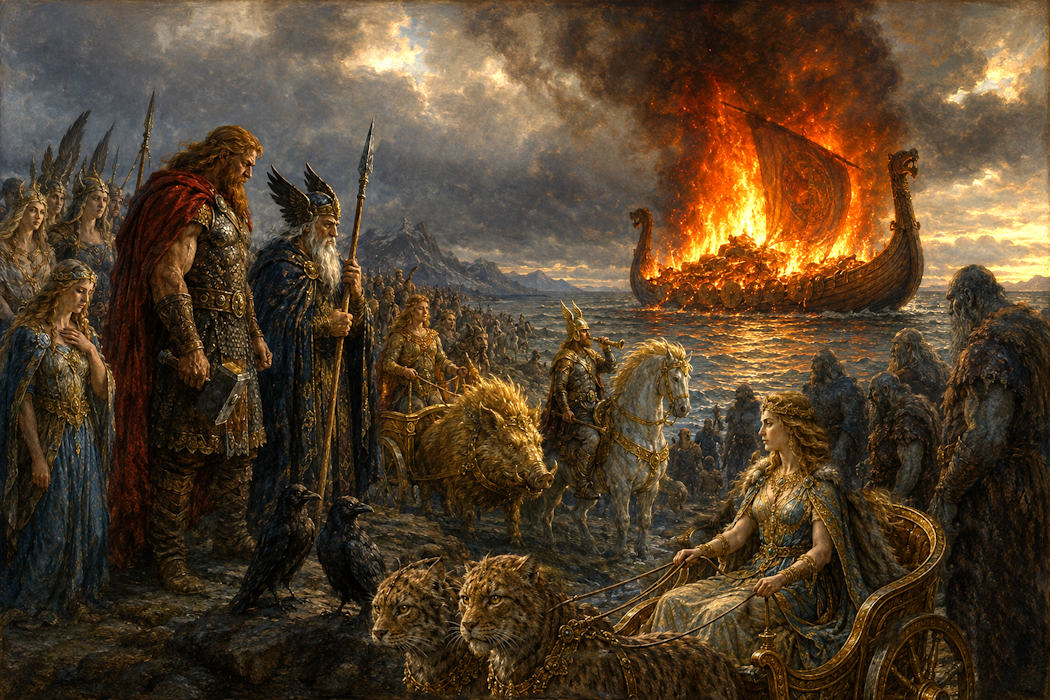
Who now shares in this ‘cremation’, which ushers in creation’s decline? First, naturally, Odin as the All-Father, most closely related to Baldr’s nature. With him come Frigg as the soul of nature and the Valkyries as his servants, who are to help fallen creatures, among whom Baldr’s body now also belongs. His two ravens, Hugin and Munin, also come as thought and memory, for this entire story is naturally a play of thought and memory. They are joined by Freyr as the summer god and Freyja as the goddess of love, who have probably lost the most through Baldr. Interestingly, the frost and mountain giants from the macrocosm also come, presumably in the giantess’s retinue. Their natural essence is to wish to hold on to forms of light, and they therefore also deeply lament their loss. Fortunately, Heimdall comes as divine consciousness as well, to illuminate Baldr’s way home from the darkness that killed him.
Absent are the dwarves from the microcosm, whom Thor cast out, and naturally Hönir as divine reason, as well as Loki as Odin’s counterpart. Nor is blind Hödur mentioned again; he has presumably withdrawn by now, although we shall reflect further on this later.
Just as Thor blessed the pyre with his hammer, casting the microcosm of formation into the fire as he did so, Odin now likewise lays the golden ring of renewal upon the pyre, surely hoping to restore Baldr to life. Yet in doing so, he also relinquishes the power of renewal from his divine hand. We have already reflected in detail upon this golden ring’s nature in the section ‘Draupnir, Ring of Renewal’.
Finally, it is also emphasized that all the divine sons and daughters appear upon their bodily vehicles as aspects possessing form. Thus, in ships, chariots, mounts, and draught animals, we find many symbols of physicality’s nature, expressing different aspects on different levels and offering much food for thought. Likewise, the many gods symbolize different aspects of the one divine essence. Baldr’s horse, too, is thus led onto the pyre with all its harness, once again clearly reminding us that this concerns the death and burial of a bodily bound form of the light-god.
This happened, as it were, from nature’s bodily perspective. And what happens from a spiritual perspective?
Of Hermodr, however, it must be told that he rode for nine nights through dark and deep valleys, seeing nothing until he came to the river Gjöll (the river of the dead, ‘Resonance’) and rode onto the Gjöll Bridge. It is covered with shining gold. Modgud (‘Courage-Goddess’) is the name of the maiden guarding the bridge. She asked his name and lineage and said: ‘The day before, five hosts of dead men rode across this bridge. Yet beneath you alone the bridge resounds even more loudly, and you do not have the appearance of dead men. Why do you ride here along the Hel-road?’ He answered: ‘I wish to ride to Hel to seek Baldr. Or have you perhaps seen him upon the Hel-road?’ She said: ‘He rode across the Gjöll Bridge here, and the Hel-road runs downward to the north.’
Here, the darkness we foresaw physically, when no light may be injured or absorbed any longer, is now described within the spiritual world. And yet the light shines even in this darkness, but the darkness can no longer recognize it, so that an apparent river of death flows here in the deep valley.
The name Gjöll is curious for the river of the dead. For the name also means ‘Battle-Clamour and Shouting’, whereas one expects deathly silence here, where dead men, or spirits, ride across the bridge. Yet since the ‘nine nights’ following darkness already evoke renewal, it is probably better to call the river ‘Resonance’. It thus flows between the two shores of life and death and need not necessarily end in Hel as a dark cave of consciousness, but can return again. This is presumably also why the bridge is covered with shining gold, for even here the light of truth is not lost. Indeed, it is above all here, between life and death, that it can be found.
The great question is whether one has the courage not only to cross this bridge into death, but also to return to life without clinging to past forms. Hence, the bridge between life and death is also guarded by the ‘Courage-Goddess’. And this ‘courage’ to return belongs above all to the Einherjar, who fight for the divine within the host of unity, so that their life, too, cannot be lost within the greater whole and need not end in Hel with the goddess of death.
Naturally, Hermodr, too, possesses this courage as ‘Host-Courage’ and the gods’ messenger. Thus, as a holistic being, he rides the Hel-road upon Sleipnir, Odin’s horse, naturally intending also to return. This is presumably why the bridge resounded so loudly, as though all creation were riding across it. Wonderful!
Then Hermodr rode until he came to Hel’s gate. He dismounted, tightened the saddle-girth, mounted again, and spurred the horse. And the horse leapt so powerfully over the gate that it came nowhere near it. Hermodr then rode to the hall, dismounted, and entered. There he saw Baldr, his brother, sitting in a place of honour, and he remained with him all night. But at daybreak, Hermodr demanded of Hel that Baldr should ride home with him, and told her how great the grief among the Aesir was. Hel answered: ‘It must be tested whether Baldr was truly as beloved as people say. If all living and dead things in the world weep for him, he shall return to the Aesir. Yet he remains with Hel if anyone objects or refuses to weep for him.’ Then Hermodr rose, and Baldr accompanied him out of the hall. He took the ring Draupnir and sent it to Odin as a remembrance. Nanna likewise sent Frigg a garment and other gifts, and Fulla a golden finger-ring. Afterwards, Hermodr rode back along his path, came to Asgard, and recounted all the events he had seen and heard.
Thus, from the bridge over the river of the dead, it is still a long way to Hel’s gate—the ‘point of no return’, as it were. This lattice, too, can be regarded as a wall built from attachment to forms that consciousness no longer wishes to release. When these forms then perish, the consciousness identifying with them naturally perishes as well. This is one way to imagine Hel, or hell. And it is probably above all a conception of the intellect. Thus, the intellect can now also accomplish a masterful feat. It can dismount from creation’s horse to tighten its saddle still further. Thus, it succeeds in leaping over Hel’s gate with all creation, without clinging to it in the slightest or being thrown off. Wonderful! This is the divine messenger’s ‘Host-Courage’!
Thus, he even enters the hall as Hel’s space of consciousness. There he finds his brother Baldr again and remains all night. At daybreak, he wished to ride home with him. Here, too, there is much to reflect upon: How can night end and morning dawn in dark Hel? This, too, probably happens only within Hermodr’s intellect, because he wishes to return to the world upon Odin’s horse. For Hel herself, it is presumably possible only at creation’s end, when everything transforms back into pure light. Then Baldr, too, can return to the gods, when no being any longer wishes for or desires darkness. Only then can there be a god of brightness, a holistic light. And this is also the condition imposed by the goddess of death.
Our modern cosmology, too, speaks of this. At creation’s beginning, in the Big Bang, there was only pure light in the dance of a perfect symmetry between particles and antiparticles. Only when this symmetry was broken and not all wished to become light again did a very few particles remain that wished for darkness—approximately one in 1,000,000,000. From these arose the matter we still know today. Here, too, we may find the principle of attachment, for some atoms still cling to the form they assumed more than thirteen billion years ago, shortly after the Big Bang. And as long as even one particle of matter remains, this holistic light cannot exist. Until the next Big Bang…
With this message, Hermodr, too, now essentially returns to our world between light and darkness. Returning from Hel upon creation’s horse was another masterful feat of the intellect. Why could he do it? Because he was not dead, like Baldr and Nanna? What is ‘dead’? Is death merely a dream? A conception of the intellect?
On his return, he also brings back the ring of renewal for Odin, since it understandably serves no purpose in Hel. And Nanna’s ‘dead nature’ gives further wonderful gifts: the garment of matter for nature’s living soul, and a golden ring for ‘Abundance’, to recognize spiritual unity within natural diversity and, united in both, rediscover truth. Wonderful!
Thus now begins the human-gods’ search for the divine light of truth throughout all the worlds of creation:
At once, the Aesir sent messengers throughout the world to ask that Baldr be wept out of Hel (to free the god of light from the realm of the dead through their tears). All humans and other living beings did so, as did the earth, stones, trees, and every metal, just as you will also have seen these things weep when brought from frost into warmth.
Can absolute perfection be found within the natural diversity of forms? Within certain boundaries, this seems possible, as within Asgard’s boundaries or those of other worlds. Yet across all boundaries?
Our modern science also works toward this. In many areas, it seems to have attained a certain perfection. ‘Living beings, plants, earth, stones, and all matter’ appear to obey its laws. Quantum mechanics describes the microcosm of the smallest particles with an almost absolute mathematical elegance and precision. Within these boundaries, matter ‘obeys’ perfectly. And Einstein’s general theory of relativity describes the macrocosm of gravitation, space, and time on a cosmic scale with perfect symmetry. Yet science has so far failed to discover the great ‘theory of everything’ uniting all areas. Somehow, something always appears within the realm of forms to counteract this claim. Whenever science attempts to order a system perfectly, chaos arises elsewhere. For matter exists at all only because it is imperfect. A perfectly symmetrical universe would be pure, formless energy. There would be no stones, trees, or metals. The diversity of forms requires the breaking of symmetry.
The weeping of all beings in the world who long for wholeness within eternal light is again wonderful symbolism. On the one hand, it was surely still a marvel in those days that warm air condenses upon cool things, making dewdrops appear like tears. On the other, we may again think symbolically of every visible form as ‘frozen light’, capable of thawing in love’s spiritual warmth and becoming ‘living water’—indeed, even pure and formless energy, as well as pure and formless consciousness. If all forms did this, an eternal god of brightness would exist again. Yet there would also be no more life within space and time between darkness and brightness. And for this, Loki must now become active once again:
Yet when the messengers were returning home, having fulfilled their errands well, they discovered one further cave in which a giantess sat. She called herself Thökk (‘Thanks, Darkness’). They also asked her to weep Baldr out of Hel. Yet she said:
‘With dry tears Thökk will weep for Baldr’s funeral journey. Neither from the Old One’s living son nor from his dead son did I gain any benefit. Let Hel keep what she has.’
It is thought that this was Loki, Laufey’s son, who had treated the Aesir most wickedly.
Here, this story of Baldr’s death ends, as brief and mystical as a Zen koan. These masterful words of the ‘High One’ seek to be deciphered and seen through. Let us try:
The name Thökk is an interesting play on ‘gratitude’ and Old Norse ‘Døkkr’, meaning ‘darkness’. Indeed, we should be grateful to darkness, for only thus does our life between light and darkness exist, within which we can learn to recognize ourselves as perfection in all forms. Thus, in this giantess, too, we can rediscover the nature of Hödur and Loki, with Loki once again transforming himself into a woman, giving rise to a typical pair of spirit and nature. The play surrounding pure light thus repeats itself. A single exception, a tiny disturbance, suffices to prevent perfection within the natural world of manifold forms. This must probably be sought on another level.
Accordingly, the nature of blind Hödur as the god of darkness also resonates in Thökk’s saying. For blind darkness is understandably the only one deriving no benefit from light. Hence, it also weeps dry tears. Presumably, these are invisible tears, unable to reveal themselves or work their effects within the world’s light. The dark cave recalls Niflhel. Hel herself is Loki’s daughter, born to Angrboda, the ‘Messenger of Sorrow’. Hence, as the goddess of death, she, too, is essentially a giantess within nature, like her mother.
Thus, Baldr essentially dies a second time. And this second death within darkness probably means nothing other than the death of his blind brother Hödur. For the two always belong together. Without them, no world between brightness and darkness could exist. They are like two sides of the same coin, two aspects of the one divine essence, now beginning to die as creation declines, just like all the other aspects.
The corresponding story of Hödur’s death is suggested in two songs. First, in the Völuspa:
31. I saw Baldr, Odin’s child, his fate determined like that of a bleeding sacrificial beast. High above the field had grown the mistletoe twig, slender and very beautiful.
32. From this wood, which seemed thin, came the dangerous missile of harm, and Hödur shot it. Yet Odin’s son, Baldr’s half-brother (Vali), was swiftly born and began to kill when one night old.
33. He neither washed his hands nor combed his hair before carrying Baldr’s deadly archer (Hödur) to the funeral pyre. Yet Frigg wept in Fensalir (‘Marsh- or Water-Hall’) for Valhalla’s distress. Do you know how to interpret it?
And in the Lay of Vegtam, ‘Baldr’s Dreams’, we read:
10. Odin said: Do not be silent, seeress; I wish to question you until everything is known. I still wish to know: Who will avenge this dreadful deed upon Hödur and bring Baldr’s slayer to the funeral pyre?
11. The seeress said: Rinda (‘Protectress’) bears Vali in the western halls, and this son of Odin will fight when one night old. He neither washes his hands nor combs his hair before carrying Baldr’s hostile archer (Hödur) to the funeral pyre. Under compulsion I spoke, but now I wish to be silent.
There is no story of the deed itself. Thus, it remains an invisible story, like darkness itself—a story without a story. Symbolically, we may think of Draupnir, the ring of renewal, being returned to Odin, and imagine Vali now begotten by Odin as the ‘Spirit of Life’ and born to Rinda as creation’s ‘Protectress’. Thus, in Vali we may see the principle of life, killing darkness through his birth and presence alone. This sounds absurd, yet birth, life, and death belong together. Nevertheless, they are all eternal principles which therefore also survive Ragnarök, as we shall ultimately hear from the ‘High One’ in section 53:
Vidar and Vali live, for neither the sea nor Surt’s flames have harmed them… Then Baldr and Hödur come from Hel’s realm. They all sit together and converse. They remember their secret knowledge and tell of events that once took place, of the Midgard Serpent and the Fenris Wolf…
How, then, does death arise? Essentially, through separation from life. Indeed, the fundamental problem behind all the world’s problems can be recognized in separation. Separation gives rise to boundaries, boundaries to attachment to forms, and attachment to rigidity and death. From a spiritual perspective, every separation is a construction of the discriminating intellect. Hence, death, too, is a conception of the intellect, just as essentially all creation is drawn by the Mimir-intellect from Odin’s eye, from pure and formless consciousness—as pure and formless as brightness.
What, then, would life be? Acceptance of death as resonance. Acceptance of the flowing transformation of all forms within the formless. Acceptance of Draupnir, the golden ring of renewal and regeneration. Acceptance that the intellect may create ever more complex connections and overcome every boundary to rediscover spiritual unity within natural diversity. Acceptance that every effect has a counter-effect, and that perfection therefore cannot exist within the world of effects. Herein lies eternal life: the perfect within the imperfect, the imperishable within the transient.
50. Then Gangleri said: Loki brought about a great deal when he first caused Baldr to die and then prevented his release from Hel. Was this avenged upon him in any way?
The High One said: It was repaid to him in a way he will feel for a long time. When the gods had grown as angry with him as might be expected, he fled and hid upon a mountain. There he built a house with four doorways so that he could look in every direction. During the day, he often assumed a salmon’s shape and hid at the place called Franangr Waterfall (‘Foaming Gorge’).
Indeed, who can calmly endure a counter-effect to his own effect? Even the gods, under the human intellect’s influence, are no longer capable of this.
What, then, is creation’s situation? Eternal divine light dreams that it has become a mortal creature. The gods counteract this, demanding that all creatures refrain from killing this creation. They thereby produce the counter-effect that death appears and eternal light dies. Thereupon, they demand that all creatures weep for eternal light so that it may become alive again. From this arises a grieving creation, worrying about eternal light and suffering under death. Darkness, in turn, counteracts this, neither worrying about light nor suffering under death. Wonderful! Thus, effect and counter-effect dance together in a circle, Odin and Loki as two sides of the same coin, or divine essence.
Yet this is how the creative intellect develops. First, through discrimination, it creates an ordered creation within the Tree of Life of the nine worlds. Then, by recognizing interconnections, it creates growing complexity, so that the boundaries of order fall away and it becomes one great whole again. Between these two—discrimination and synthesis—there seems to be a summit or culmination for the creative intellect. Afterwards, the worlds flow back into one another like waves within the play of opposites: gods become creatures so that creatures may become gods again. Brightness becomes darkness so that darkness may become brightness again. Life becomes death so that death may become life again. Yet it remains a divine dream: Baldr’s dream within the eternal light of the divine.
Thus, like us humans, the gods now dream that the counter-effect is to blame for all problems. And once again, effect and counter-effect reverse. Now Loki builds himself a house at creation’s culmination. And from there the gods drive him down into a dark cave of suffering, for that is where they already wished to see him as Thökk. Thus, the entire creation goes downhill, for Loki, too, is a divine, holistic being…
The following story concerns this process, told by the ‘High One’ to Gangleri, the weary wanderer between the worlds. Naturally, it is filled with concentrated symbolism. The foaming waterfall recalls the river of creation, now falling ever more mightily and already approaching the sea, where it disappears again into the Sea of Causes. The mountain recalls creation’s summit and culmination, where Loki builds himself a house with four doors, through which he can look and go in every direction. This probably means that he wishes to preserve his ‘overview’ and remain open in every direction—or at least able to flee in every direction so as not to be bound. That is, either back toward the source, onward into the sea, or toward one of creation’s riverbanks, which may symbolically be interpreted as light and darkness, or spirit and nature.
What kind of house is this, open in every direction at creation’s culmination? Divine consciousness?
Still more powerful is the symbol of the salmon-shape that he assumes ‘during the day’, in worldly light. We have already encountered the salmon in the story of the ‘Otter’s Ransom’, when Loki killed the otter who had caught a salmon in the waterfall and wished to eat it heedlessly. Its red flesh reminded us of red gold as a symbol of living truth. It is also a traditional symbol of the return to the source and life’s regeneration. For at the end of its life in the sea, it swims tirelessly up the river of its birth to the source where it was born, to mate and reproduce there. Then it dies, sacrificing its body as nourishment for further growth. Thus, in it we may also see the true nature of living creation, striving to return to its source and sacrifice its body there for a new creation.
Thus, Loki now dwells in a house at creation’s culmination, which all the gods actually desired. And during the day, in the world’s intellectual light, he lives in the waterfall, where the river of creation’s descent is steepest. There he wishes to remain as the greatest divine counter-effect, refusing to be bound.
Then he considered what cunning plan the Aesir might devise to catch him in the waterfall. And as he sat in the house, he took linen thread and tied knots in the manner used ever since to make a net. Before him burned a fire. Then he saw that the Aesir were no longer far away, for Odin had seen his whereabouts from Hlidskialf (‘High Seat of Far-Sight’). At once, he sprang up and ran out into the river, but threw the net into the fire.
Now matters become still more intricate. Loki devises the net with which he himself might be caught and bound in salmon-form. Behind this lies the great question: How can a divine man, or spirit, who is freedom itself, be bound? Bondage actually exists only within nature through the laws of cause and effect. Spirit must be free, above all divine and holistic spirit; otherwise, there would be no freedom at all. The only way, then, is for him to bind himself, for naturally he also possesses this freedom. Thus, through the thinking intellect, he himself assumes the forms of water, river, salmon, and net. Nature thereby enters the picture again.
The net is thus a powerful symbol of nature’s bonds, consisting of many knotted threads, or ‘bands’, in which we may also see nature’s interwoven soul. And perhaps this net, too, exists only to recapture the spirit that has lost itself in dreams. This again recalls consciousness’s ‘self-realization’. Loki’s name is also interpreted in this direction and derived from the Germanic root ‘luk’, referring to everything connected with noose, knot, loop, and closure. In this respect, the net’s symbolism also reminds us that, depending upon its mesh size, only certain beings within space and time can be caught and comprehended.
Yet the thoughts of such a net, in turn, belong to spirit, and this presumably also enabled Odin upon his Throne of Far-Sight to recognize that it could only be Loki, who as a divine spirit devises his own bondage. For all thoughts are naturally also carried by Odin’s two ravens, Hugin and Munin, to him as the creator-god, who then ensures their realization. And as he now rises to seize Loki, Loki simultaneously springs up to flee into the river of creation. Again, then, effect and counter-effect.
The fire burning before Loki might also symbolize spirit. In this regard, Odin as spirit would rise within the fire, and Loki accordingly leap into the water: a counterplay of fire and water, as it were, which also forms a foundation of bodily life. Yet why does he throw the net he devised into the fire? At first, one might think he wished to burn it there so as not to be bound by it. Yet naturally nothing burns within spirit’s fire without producing an effect. Even every thought has some effect. We may therefore examine this symbolism more deeply and imagine that Loki thereby wished to bind the spirit within the fire. And this also seems to happen, for it is not Odin himself who appears in Loki’s house, but Kvasir with the other Aesir. We have already encountered Kvasir as divine intellect and worldly wisdom, in which we may see a bound form of divine reason:
When the Aesir came to the house, the cleverest of them all, called Kvasir, entered first. When he saw the ashes in the fire where the net had burned, he recognized that this must have been a device for catching fish, and told the Aesir. At once, they set about tying a net after the one they saw in the ashes, which Loki had made. When the net was finished, the Aesir went to the river and cast it into the waterfall. Thor held one end of the net, all the other Aesir held the other, and they dragged it. But Loki escaped and lay between two stones. They dragged the net over him, yet noticed something alive moving before it. Hence, they went up to the waterfall a second time and cast the net. They attached something so heavy that no one could slip beneath it. Then Loki swam before it, and when he saw how near the sea was, he leapt over the net’s rope and up the waterfall.
Thus, clever Kvasir as divine intellect now retrieves the thought of the net of bondage from the ‘ashes of the fire’—from what does not burn within spiritual fire, just as Mimir draws creation from the water of the Sea of Causes. And the gods realize the thought and tie the net, to which they then bind themselves to use it within the river of creation. Thor stands upon one riverbank, the other gods upon the other. What are the two shores of creation’s river? Life and death, light and darkness, or spirit and nature.
Here, too, Thor as Earth’s son plays a leading role, and we may reflect on his transformation. Previously, he fought the mountain and frost giants with his hammer for a living creation. Yet after Baldr’s death and Thor’s killing of the dwarf Lit as ‘Coloured Formation’, he now appears to fight bodily life within the river of creation from death’s shore—no longer with his hammer, but with a net of bondage. Interestingly, the gods also drag the net not from the sea against the current toward the source and waterfall, as one might expect, but with the current toward the sea and the river’s end. For they no longer fight for living creation, but against Loki, and thus against their own effect.
Now only two possibilities remain for the fish, or living beings, within the river of creation: either they flee down into the Sea of Causes, where the river of creation also ends, or they allow themselves to be caught in the net of bondage. For the path back to the source is now closed. This is most thought-provoking!
Loki attempts to escape twice: once passively beneath the net, and once actively above it. Yet both attempts are recognized and thwarted by the gods. Thus comes the third attempt:
Now the Aesir saw where he was, ran up again, and divided their host between the river’s two banks. Thor, however, waded along the river’s middle, and thus they proceeded toward the sea. Yet Loki saw two possibilities: moving toward the sea was perilous to his life, while the other choice was to leap over the net again. And this he did. As swiftly as possible, he leapt over the rope. Thor reached for him and caught him, but he slipped through his hands, so that he held him fast only by the tail. For this reason, the salmon is narrow at the rear.
Thus, the gods’ destiny now takes its course. Thor himself enters the river of creation and thereby becomes a transient creature, just as Loki has assumed the salmon’s shape. The other gods are separated and distributed upon the two shores. Loki recognizes the danger to bodily active life within the Sea of Causes and again attempts to leap over the net to escape bondage. Yet Thor now also blocks the upward escape toward heaven and seizes Loki’s salmon-form. Only with difficulty, however, could he grasp the slippery creature by its tail—at its end and chief source of propulsion, as it were. For how can life be held fast? Above all where it wishes to move, and naturally where it has its end. Hence, bodily life also diminishes toward its end. Yet precisely this is its chief driving force, like a fish’s tail-fin, which is probably also what the final sentence means.
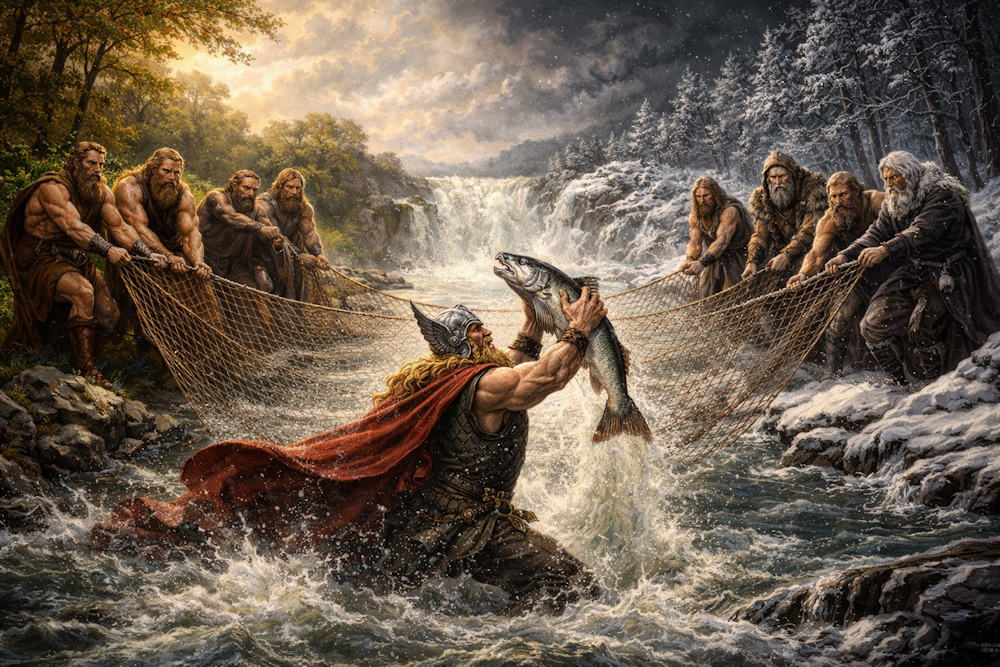
Now Loki was captured without any guarantee of his safety, and they took him into a cave. There they took three flat stones, stood them on edge, and pierced a hole through each. Then Loki’s sons were seized: Vali and Nari, or Narfi (the ‘Narrowing and Limiting One’). The Aesir transformed Vali into a wolf, who tore his brother Narfi apart. They then took his entrails and bound Loki with them upon the three sharp stones. One stood beneath his shoulders, the second beneath his loins, and the third beneath the backs of his knees, and these fetters turned to iron. Then Skadi (‘Harm’ or ‘Loss’, as the goddess of winter) took a venomous serpent and fastened it above him so that its poison dripped onto his face. Yet Sigyn, his wife, stands beside him, holding a basin beneath the falling poison. When this vessel is full, she goes away and pours out the poison. Meanwhile, however, it drips onto his face. He convulses so violently that the whole earth shakes. This you call an earthquake. There he lies in fetters until Ragnarök.
The concentrated symbolism continues. Loki is now caught within the river of creation and bound in a dark cave, recalling Niflhel, as well as matter’s unconsciousness, when a water-being becomes a stone-being. Thus, the circle also closes around Thökk’s dark cave, where the gods wished to see Loki. Creation’s destiny thus takes its course. Through the salmon’s capture and bondage within the cave of the dead, the power of renewal and regeneration is symbolically bound as well. Draupnir’s ring thereby wanders into the cave of the dead again. Thus, the gods bind one another, and these bonds will not be loosened again until Ragnarök.
To this end, Loki’s son Vali is transformed into a wolf that tears his brother Narfi apart. This is particularly thought-provoking. Until now, we have encountered a Vali as Odin’s son, born as the principle of life to Rinda as the ‘Protectress’, who through his birth avenged Baldr’s death upon Hödur as the god of darkness. Now a second Vali suddenly appears, a son of Loki and Sigyn as the ‘Bringer of Victory’. Here, we may consider whether the same principle of life is meant or two different principles. At least the Aesir transform this Vali into a wolf of transience, which naturally belongs to the principle of life—at least bodily life as we know it, as arising and passing away. With this wolf they then kill another son of Loki and Sigyn: Nari or Narfi, the ‘Narrowing and Limiting One’. They thereby essentially kill the principle of bodily life, which can exist for a time within space and time only through consciousness’s limitation and narrowing. What remains is the principle of life itself: the eternal and boundless life of pure consciousness, formless in its essence.
In this regard, we can readily imagine that Vali, Loki’s son, actually means Odin’s son of the same name. For as far as we know, he is mentioned nowhere else in the entire Edda (see also English Wikipedia: Vali). One might suspect a scribal error. Yet perhaps it is also a challenge for our intellect. For what is the difference between Odin and Loki, between effect and counter-effect?
Thus, with Vali’s help as the principle of life, the gods now bring about the passing away of bodily creation’s living limitation. This is brilliant symbolism, for creation’s dissolution evidently means nothing other than dissolving bodily limitations.
Thus, we may now imagine Loki also bound through Narfi by his three other children: Hel, Jörmungand, and Fenris. Namely, within Hel’s dark cave of the dead, beneath the Midgard Serpent as self-devourer and the threatening Fenris Wolf as all-devourer. The serpent’s venom would again be separation and demarcation, also dripping as slaver from transience’s hungry wolf-jaws. We know this poison, which becomes death’s poison, in a similar sense from the venom- and fire-spitting dragons of other ancient legends. Loki and Angrboda’s three children—the ‘Messenger of Sorrow’ who brings suffering—are presumably also signified by the three flat stones that previously lay upon the river of creation’s bed. They are now ‘pierced’ for bondage and ‘erected’ for divine judgement. Standing as sharp stones beneath Loki’s shoulders, loins, and knees, they recall the binding of his effective power, reproduction, and mobility. Thus, essentially the salmon, too, as a symbol of living beings’ renewal and regeneration, was bound. This bondage occurs through his son Narfi as ‘Narrowing and Limitation’, whose entrails as the bodily source of strength now harden into iron chains.
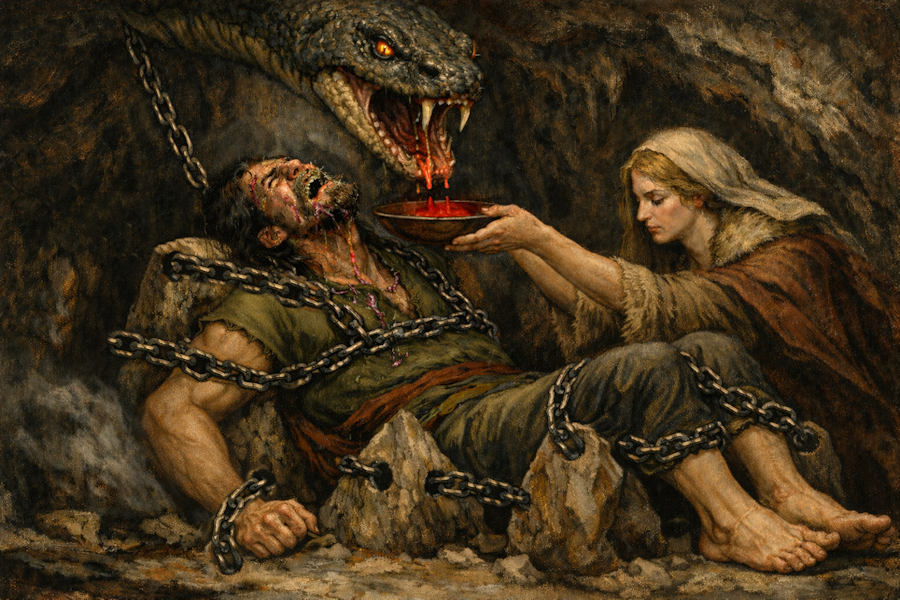
Loki as a ‘Counter-Wave’
Thus, the image of a cave of painful suffering now appears, formerly also called ‘hell’. And indeed, from the beginning, Loki also embodies painful suffering within creation, for every counter-effect is naturally suffering when one cannot be content with what is. Nevertheless, Loki remains an Aesir god, a holistic being, so that all creation suffers with Loki. His wife Sigyn now evidently ensures this, catching the painful venom in a basin and pouring it out when the vessel is full. Where does it flow? It can really only flow back into the river of creation, so that all other creatures now also suffer death’s pains with Loki. This is presumably also why Skadi, as the goddess of winter, enters the scene, now heralding wintertime for all creation. Accordingly, the Völuspa says in verse 36:
A river flows from the East through valleys of poison, with knives and swords: Slid (the ‘Dangerous, Cruel One’) is its name.
Thus, every drop of this poison now becomes a bodily death, whose suffering shakes the whole earthly world in its apparent permanence, in the small as in the great. For the power of renewal and regeneration now lies bound within earthly matter. Remarkably, nowhere in the Edda until now has suffering so painful and agonizing been described within Hel’s realm of the dead as it is now for Loki. This would mean that it is above all divine suffering, bearing its divine meaning within creation. Hence, Sigyn, now at Loki’s side, also means ‘Bringer of Victory’, as opposed to Angrboda as ‘Bringer of Suffering’. For naturally, divine victory within creation stands at the end.
Drawing these thoughts together, we may imagine the following image of the ‘wave of creation’, to which Loki forms, as it were, a ‘counter-wave’. This is also suggested in the image above if we regard the three pointed stones as the wave’s turning points, creating trough-crest-trough, or beginning-middle-end:
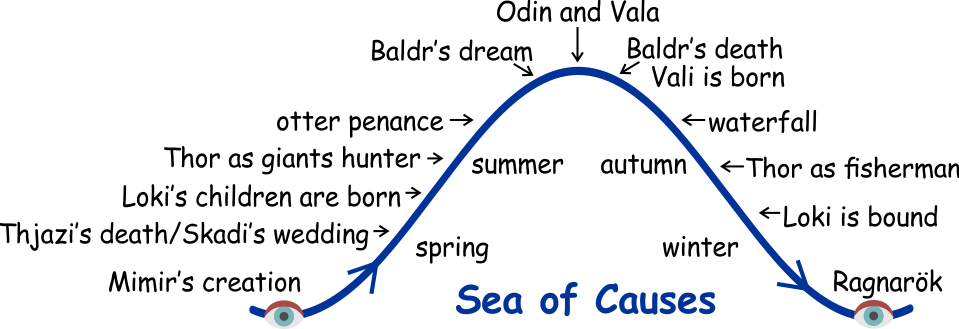
Thus, creation flows from one of Odin’s eyes into the other. As its culmination, we might regard Odin and Vala’s ‘self-realization’ or ‘enlightenment’, as we interpreted it in the section ‘Baldr’s Dreams (Lay of Vegtam)’, when spirit-nature recognizes itself. Thus, after finding oneself comes self-recognition as the culmination, followed now by self-realization in action. Accordingly, Odin himself rode creation’s horse until his meeting with Vala. And now Hermodr rides Sleipnir, the ‘Gliding One’, to realize the message. Accordingly, Odin, too, is no longer described as an agent but as one who recognizes, just as he recognized Loki in his house at the culmination within the river of creation. Then, with Baldr’s death, creation’s dissolution begins, as eternal brightness’s form disappears. Hence, all worldly and bodily limitations also dissolve, and opposites balance themselves in battle. Indeed, this is evidently a painful process, a suffering ultimately borne by the divine itself.
Accordingly, the next chapter of ‘Gylfi’s Delusion’ now describes Ragnarök:
51. Then Gangleri asked: What can be said about Ragnarök? I have heard nothing of it before.
The High One answered: Many important events must be told of it. First, winter will come, called Fimbulwinter (‘Great Winter’). Then snow drives in from every direction. There is bitter frost and sharp wind, and the sun no longer shines. There are three such winters in succession, with no summer between them.
The Old Norse name Ragnarök consists of ‘regin’ and ‘rök’. Regin (genitive plural ragna) means the ‘Ruling Ones, Counsellors, and Mighty in Knowledge’. Ordinarily, this is understood to mean the gods. Yet we may also think of all beings acting through knowledge, or information—practically the entire creation arising from the Mimir-intellect. Rök means ‘Development, Destiny, and the Meaning of Origin’. Thus, this concerns ‘the destiny of the gods and all creation’, or, briefly, ‘the destiny of intellectual creation’. And the gods decide this at the Well of Destiny, for they remain holistic beings.
Thus, from a bodily perspective, creation essentially ends again at its origin, the ice giant Ymir, when winter is no longer followed by a summer of life’s regeneration and renewal. This cosmological symbolism of the ‘great winter’ again strongly recalls our modern cosmological conception of the universe ending in the ‘Big Freeze’. Science understands this as thermodynamic cold death, when all opposites balance and no thermodynamic work is possible any longer. Then all suns go out, and everything sinks into cold darkness, almost to absolute zero at 0 kelvin (approximately −273.15 °C).
The three winters again recall the wall that the master builder wished to erect between spirit and nature at creation’s beginning. Yet the gods then permitted only one winter. Within this wall, we interpreted Valhalla’s 540 gates, which are now, as it were, closed in the ‘Big Freeze’, so that nothing can move any longer.
Before this, however, we may imagine a time of tremendous struggle, as more and more boundaries fall, familiar orders break apart, and all opposites collide to balance themselves in battle, in the small as in the great:
Yet first, three other winters will come, during which battles rage throughout the world. Then brothers slay one another out of greed, and no one spares father or son in the slaughter and killing of kin. Thus, the Prophecy of the Seeress says (Völuspa, verse 45):
Brothers will fight one another and bring each other death; sisters’ sons will break the bonds of kinship. Ill fares humankind: much adultery, an axe-age, a sword-age, split shields, a wind-age and wolf-age, until the world perishes.
The three winters before the great winter of the ‘Big Freeze’ might refer to the creation cycle’s final wintertime, first within Midgard’s human world, then upon the Tree of Life’s nature-side, and finally upon its spirit-side, which are now also described further.
From a modern cosmological perspective, too, gigantic struggles will occur within the universe. Smaller stars such as our sun swell into red giants, swallowing and burning nearby planets. Afterwards, they cast off their outer gas envelopes, while the remaining stellar core shrinks into an extremely dense, slowly cooling white dwarf. Massive giant stars end in tremendous explosions, supernovae. They hurl vast quantities of matter into space, leaving behind neutron stars or black holes. Entire galaxies, too, will collide and ultimately merge. At the centres of such giant galaxies, supermassive black holes might collapse together and become still larger black holes amid tremendous outbursts of energy and gravitational waves. These black holes could then be the last ‘gigantic giants’, swallowing stars, gas, and even entire solar systems over unimaginable spans of time, until the universe grows ever colder, darker, and emptier.
The ‘High One’ describes something similar in the symbolic language of his time:
Then something monstrous happens: the wolf (Sköll) devours the sun, and this appears to humankind as a great calamity. Afterwards, the other wolf (Hati) seizes the moon and causes equally great harm. The stars disappear from the sky. These events also include the whole earth shaking with its mountains, tearing the trees from the ground. The mountains, too, collapse, and all fetters and bonds break and snap. Then the Fenris Wolf is freed.
Why are the wolves of transience now freed? Here, we may recall that the gods themselves transformed Vali, as the principle of life, into a wolf to bind the divine counter-effect within the cave of death. Logically—and even ‘Loki-cally’—they thereby also consigned their own effect to death. It was thus only a question of time before hungry transience was freed again, which they had bound and tamed at creation’s beginning. For only thus could Mimir’s creation endure for a while within time and space, allowing the intellect to learn from it.
Yet everything that arises must also pass away. The two wolves were already described in section 12 as Sköll and Hati, which may be interpreted as the illusion of darkening and the hatred of separation, or discrimination, that enables this illusion. Thus, the worldly sunlight disappears first, causing all outward forms of nature to vanish. Consequently, the intellect’s reflecting moonlight also disappears. And since it can no longer distinguish anything outwardly, the whole of outward nature collapses with the forest of conceptions. Nature’s outward order thus disappears, with all its natural laws and bonds within space and time.
In principle, all feminine beings of causation and birth within nature thereby disappear as well. Accordingly, the description of Ragnarök now shifts toward a more spiritual perspective, in which masculine symbols, as spiritual aspects of the divine and creation, play the leading roles:
The sea floods the land because the Midgard Serpent writhes in giant-rage, seeking to crawl ashore. Then it also happens that Naglfar, the ship bearing that name, breaks loose. It consists of dead people’s nails. Hence, caution is needed when someone dies with uncut nails, for he supplies much material for the ship Naglfar. Yet gods and humans do not wish it to be completed. And upon this flood floats Naglfar. Hrymr is the name of the giant steering the ship. The Fenris Wolf rushes forward with gaping jaws. His lower jaw touches the earth, his upper jaw heaven. He would open his mouth still wider if there were room. Flames blaze from his eyes and nostrils. The Midgard Serpent spits so much venom that it poisons all the air and water. She, too, is terrifying and stands beside the wolf.
How did the gods bind the all-devouring Fenris Wolf at creation’s beginning? It was impossible with the fetters of growth and inertia, and possible only with Gleipnir, the fetter of causation—essentially nature’s soul. Precisely this fetter now loosens, for creation has lost its power of regeneration and renewal. And when nothing new can arise any longer, only the transience of the old remains: all the forms accumulated within creation’s river through formal demarcation within time and space.
Thus, with the Fenris Wolf as Loki’s son, his brother Jörmungand is also freed, having become the Midgard Serpent as the principle of demarcation and self-binding. This principle now turns over, stirring up the Sea of Causes and bringing forth much that was bound, repressed, and suppressed within the river of creation. This includes above all the dead, who cling as lone warriors within the death-ship and did not wish to become Einherjar within the life-ship. We have already spoken of nails as symbols of bodily attachment to what is dead. Likewise, we have discussed how the gods fought for life together with the Einherjar, lest all creation become a ship of the dead.
In this respect, the giant Hrymr, steering the death-ship, already recalls the ice giant Ymir as the embodiment of all Hrimthursar, or frost giants. For bodily creation is returning there upon its path toward the ‘Big Freeze’. To this end, the Fenris Wolf now opens his jaws of transience across creation’s entire space, for all arisen forms must pass away along this path. This is death’s fiery poison, which then spreads everywhere.
Before this, however, opposites also clash within the spiritual realm, probably a far more important struggle, allowing them to balance and pass away:
With a great crash, heaven breaks apart, and Muspel’s sons ride forth from there. Surt (or Surtur) comes first. Before him and behind him burns fire. His sword is excellent and outshines the sun’s radiance. As they ride across the Bifröst Bridge, it collapses, as already foretold (in section 13). Muspel’s sons advance onto the field called Vigrid (‘Battle-Wave, Battle-Rider’). The Fenris Wolf and Midgard Serpent also come there, as do Loki, Hrymr, and all the frost giants with him. Loki is followed by Hel’s entire host. Muspel’s sons, meanwhile, form an army of their own, appearing exceedingly radiant. The field Vigrid measures a hundred miles on every side.
Just as order breaks apart within nature’s earthly realm, it now also breaks apart within heaven’s spiritual realm. Through this breaking, a wondrous fire-being appears to burn all the pieces. Thus, in this respect, too, creation ends with the same principle with which it began, when Muspelheim’s sparks thawed the ice giant Ymir.
What kind of fire is this? Since Muspelheim’s world lies so near Urd’s Well of Destiny, we may first reflect upon a fire of destiny burning everything that should not endure. Thus, section 4 above said:
First, however, was the region in the world’s southern half called Muspel. It is radiantly bright and hot. This region is aflame and burning, unbearable for those who are strangers there and do not have their home within it. Surt (or Surtur) is the name of the one who keeps watch at the land’s boundary. He has a flaming sword, and at the world’s end he will set forth, lay waste, and destroy all the gods. He will burn the whole world with fire.
Yet the name Surtur means ‘the Dark One’. He is therefore a dark and invisible being, visible only through his effects, above all his flaming sword or his sons, Muspel’s sparks. Until now, he was bound by heaven’s divine order, guarded his boundaries, and served the gods’ decisions of destiny at Urd’s Well. Yet now all boundaries vanish, and he fulfils his task without limits.
From a modern cosmological perspective, we might think of cosmic energy’s tremendous power, itself invisible yet revealed through its effects. Already in the Big Bang, it ensured that particles and antiparticles arose and fused again within light’s dance. Without energy, there would be no visible light, no movement or formation of matter, no suns, planets, or galaxies, neither space nor time. Hence, it also ensures matter’s dissolution at creation’s end.
Surtur resembles this invisible power of destiny. When cosmic order breaks apart and he crosses his boundaries, the dark primordial fire encounters the gods’ formed world. They destroy one another in an act of all-pervading transformation, dissolving everything possessing form and returning the universe to its formless origin, to plant the seed of a new creation.
From a physical perspective, the collapse of Bifröst’s bridge of light and rainbow between heaven and earth through Surtur’s eruption with his retinue recalls that light-energy can no longer materialize. Here, too, we see that the old creation has lost the power of regeneration and renewal, and that, cosmologically, the ‘Big Freeze’ approaches.
Thus, the bridge between light and matter, between heavenly light and the earthly world, breaks apart, and pure light increasingly withdraws from creation. Everything still remaining of the Tree of Life as a world of form now becomes Vigrid: a great battlefield where all creatures meet for the final struggle. That this field measures a hundred miles in every direction again recalls the symbolic number 100 for wholeness, which we still know today as 100%. It is thus the entire worldly field of transience, the universe’s whole fabric of space-time, extending as far as the all-devouring Fenris Wolf can open his jaws.
When this happens, Heimdall rises, blows with all his strength into Gjallarhorn (‘Calling-Horn’), and awakens all the gods, who hold a Thing assembly together. Then Odin rides to Mimir’s Well and receives Mimir’s counsel for himself and his followers. The ash Yggdrasil trembles, and nothing between heaven and earth is without fear and terror.
The ‘High One’ now continues to describe this process of dissolution above all from a spiritual perspective, through creation’s and the divine’s masculine, or spiritual, aspects. To this end, Heimdall, as consciousness ‘shining homeward’, calls all divine beings to the final struggle, to return home to their origin.
This is, as it were, a spiritual struggle of consciousness, a struggle of information. From a modern cosmological perspective, too, a connection can be seen between energy and information. Quantum physics, above all, teaches that information stands behind every energy. Thus, the physicist Anton Zeilinger also says: ‘Information is the primordial substance of the universe—reality and information are the same.’
If information and knowledge are so fundamental, it also makes sense that the gods now deliberate and Odin even consults Mimir’s head, or intellect, at the Tree of Life’s root-spring. And what counsel does he receive there? Presumably, what we shall now read: how the river of creation from Mimir’s Well is to end, and who must fight whom in order to dissolve.
Does Odin not know this himself? Why must he seek counsel? Odin is no lone warrior, but a model for the Einherjar. Thus, Ragnarök is also no physical process of unconscious nature, but a conscious development of information. And all beings that have ever lived or will yet live take part. This is ensured not only by the law of energy conservation, but also by information conservation. This is the destiny of the ‘Counsellors and Mighty in Knowledge’, enabling a learning process within creation, for knowledge is power.
In the final sentence, we may find a further explanation of the name Yggdrasil, for Yggr also means fear and terror. Thus, the World Tree ultimately becomes a ‘Bearer, or Horse, of Terrible Fear’. And creatures’ most terrible fear probably remains losing the form to which they cling. Symbolically, we may now imagine Odin himself riding this horse into the final battle, for Yggr is also one of Odin’s bynames. Regarding self-realization, it would be better to say that Odin allows himself to be moved by it, contributing only the eye of consciousness.
The Aesir and all the Einherjar arm themselves and advance onto the field. Odin rides first, wearing the golden helmet and splendid mail, carrying the spear called Gungnir (the ‘Waving One’). He advances against the Fenris Wolf, and Thor stands beside him. Yet Thor cannot aid him, for he fights fiercely with the Midgard Serpent. Freyr meets Surt, and a hard struggle develops before Freyr falls. His death comes from lacking the good sword he gave Skirnir. Then the dog Garm, chained before Gnipahellir (‘Cliff before the Cave’), also breaks free. He is the most terrible monster and fights Tyr, and they will kill one another. Thor slays the Midgard Serpent and walks nine further steps. Then he falls dead to earth from the venom the serpent blows upon him. The wolf devours Odin, bringing his death. Yet immediately afterwards, Vidar rushes forward and places one foot upon the wolf’s lower jaw. Upon this foot he wears the shoe for which material has been collected throughout all time: the leather pieces cut from shoes at toe or heel. Hence, whoever intends to help the Aesir should throw these pieces away. With one hand, Vidar then seizes the wolf’s upper jaw and tears his mouth apart. This brings his death. Loki fights Heimdall, and they kill one another. Finally, Surt hurls fire over the earth, and the whole world burns.
Thus, with the gods now come the Einherjar, who serve the divine, through Valhalla’s many gates. As the Lay of Grimnir says:
Five hundred gates and forty are, I believe, in Valhalla. Eight hundred Einherjar pass together through each gate when they set out to fight the wolf.
Just as Bifröst’s light-bridge broke, we may now imagine these gates also closing behind the Einherjar, who all stream simultaneously onto the battlefield for the final great struggle. Odin himself leads them. His golden helmet recalls protection for his head. Just as Thor’s symbolic protective gloves guard against attachment to his deeds, this helmet presumably guards against attachment to the thinking intellect. And what could protect better than the gold of truth? Accordingly, the splendid breastplate recalls protection for the heart as the soul’s seat. And the spear Gungnir recalls the All-Father’s divine will, which never misses its goal.
The first struggle is described between Freyr and Surt: between the summer god of fruitful formation and fiery energy, now merging again in their essence, so that Freyr’s form disappears. With this, the dwarves, too, essentially disappear as nature spirits of formation within the microcosm. And this could happen because the discriminating intellect’s cutting sword was no longer present. Wonderful!
The second struggle appears between Tyr and Garm: between the god of righteous victory and the watchdog guarding the dead in Hel. Indeed, the greatest and most righteous victory is victory over death. And the final death is the victor’s death, who now merges again within wholeness, where separation no longer exists, and thus neither does death. And with this, the dead, too, essentially disappear together with Hel. Wonderful!
The third struggle appears between Thor and the Midgard Serpent, the principle of demarcation. Thus, Thor’s hammer reached its goal; not in vain had he hurled it at the Midgard Serpent during his voyage with Hymir. The nine steps again recall the power of renewal, now absent. Thor and the Midgard Serpent thus also balance each other within wholeness, for when there is no demarcation and self-binding any longer, nothing needs shattering either. Through this, the frost and mountain giants of the macrocosm, possessing form, essentially disappear as well. Thor, as an aspect of the divine, had thereby fulfilled his task. And separation’s serpent-venom also fulfils its final task, separating Thor from his bounded form, so that he merges with the divine again. Wonderful!
Now that the principles of formation, death, and demarcation have dissolved, the way is open for Odin and his Einherjar to meet the Fenris Wolf, the principle of transience. The pointed brevity of the description is worthy of the ‘High One’. That is: a story without a story, a battle without battle, and a light without light. Wholeness remains wholeness, divinity remains divinity, and truth remains truth. This is the mastery surpassing every intellect. To this end, it was also worthwhile for the Einherjar to practise daily in battle for the divine throughout the long creation cycle. What passes away consists only of names and conceptual notions created by the creative intellect. Wonderful!
What now happens to the Fenris Wolf once transience has swallowed everything transient into itself? Now creation falls silent. And here appears Vidar, the god of silence and silent warrior within the forest of conceptions. For silence naturally belongs to the imperishable principles. What kind of silence is this? Is it the pure light of awareness? What does the leather shoe mean as the foundation of imperishable awareness? This symbol offers much food for thought. Presumably, it concerns what is cut off and separated to create a particular form within space and time. One should become conscious of this, release it, and throw it away to help the gods. The Old Norse text even means this literally as ‘throwing onto the path’. What is it that one should not hold on to or cling to at the front and back along the path? Every wearer of shoes, above all the Einherjar, should presumably develop this light of awareness. For ‘this way round, too, a shoe takes shape’—to adapt the German saying—and even a divine, imperishable one. With this single imperishable shoe, Vidar now places his foot upon the wolf’s lower jaw and seizes the upper jaw with his hand. Then he tears apart mouth and throat. He thereby kills all-devouring transience. Wonderful! And we can readily imagine him thereby creating, from transience’s very nature, a new space for everything transience had swallowed: a new space for a new creation.
Now that creation is silent and Odin as All-Father and creator-god has passed away in his effect, Loki as counter-effect must logically also pass away to attain the creation cycle’s goal. Thus, the very last struggle appears between Loki and Heimdall: between counter-effect and creation’s goal as consciousness shining homeward. In them, too, we may recognize the same divine essence. They, too, have attained their goal and now dissolve one another to merge within the divine.
Thus, there is now no holding back within creation. All aspects of the divine have merged again within wholeness, and whatever else one can imagine as formations possessing form burns within Surtur’s fire. Surtur is then the only principle remaining of the earthly world from a physical perspective: pure energy, slowly cooling for lack of fuel into the ‘Big Freeze’ and becoming an ice giant again, a Ymir. One might also speak of ‘frozen water of life within the Sea of Causes’.
In this respect, Ragnarök may be regarded as a cosmic return to the symmetry broken in the ‘Big Bang’. Effect and counter-effect are now balanced again; cause and effect can no longer be perceived separately, and thus nothing arises within space and time any longer.
Thus, it is said in the Prophecy of the Seeress (Völuspa, verses 46-57):
Loudly Heimdall blows, the horn is raised high, and Odin takes counsel with Mimir’s head. Trembling stands the ash Yggdrasil, the old tree groans, and the (fire-) giant breaks free.
What of the Aesir? What of the Elves? All Giantland (Jötunheim) trembles. The Aesir go to the Thing. The dwarves groan before stone doors, the wise ones of the mountain-wall (or earth). Do you know how to interpret it?
Hrym comes from the East, raising his shield before him. Jörmungandr (the Midgard Serpent) writhes in giant-rage (Jötun-rage). The serpent raises waves. The eagle cries, and his pale beak tears the dead. Naglfar (the ‘Nail-Ship’, as a ship of the dead) is loose.
A ship comes from the East; Muspel’s (the fire of destiny’s) people will come across the sea, and Loki steers. All the ignorant come with the wolf, bringing Byleist’s (the ‘Wave-Blow’s’) brother (Loki) with them.
Surt (the fire giant) comes from the South with the branches (flames) of destruction. From his sword shines the sun of the gods of the fallen. Rocky mountains break and giantesses fall; mortals take the Hel-road (everything transient passes away), and heaven breaks apart.
Then further sorrow befalls Hlin (the ‘Protecting One’, Frigg), when Odin prepares to fight the (Fenris-) wolf, and Beli’s radiant slayer (Freyr) to fight Surtr. There Frigg’s beloved (Odin) will fall.
Then comes Vidar, the Victory-Father’s mighty son, to fight the beast of the fallen (the Fenris Wolf). With his hand, he drives the sword into Hvedrung’s son’s heart (the Fenris Wolf as Loki’s son). Thus, the father is avenged.
The renowned son of Hlödyn (Thor, son of Jörd, Mother Earth) walks dying away from the serpent, not fearing the new moon. All mortals must leave their dwelling (in Midgard), for Midgard’s protector strikes with all his strength (divine wrath).
The sun will darken, the land sinks into the sea, and the bright stars fall from heaven. Glowing smoke and fire rage; great heat rises even to heaven itself.
Elsewhere it is also said:
Vigrid is the name of the field where battle takes place between Surt and the gentle gods. It measures a hundred miles on every side. It is appointed as their place.
We shall examine the Völuspa’s verses more closely as a concluding synthesis at this chapter’s end. Essentially, they briefly repeat the preceding description of Ragnarök with only a few differences.
Finally, we might ask about the timescale. Here, the Edda offers symbolic indications, such as the three winters. Our modern science speaks of more than five billion years until our sun passes away, and regarding the ‘Big Freeze’, even unimaginably many trillions of years. Our sun’s age is likewise estimated at approximately five billion years, placing it midway through its life. The universe is about 13.8 billion years old, thus still very young compared with the time remaining until the ‘Big Freeze’. Yet at least since Einstein’s discoveries, we know that no absolute time exists within the universe.
In principle, people already knew this in earlier times. Thus, the Bible speaks of seven days from the creator-god’s perspective, each day appearing as a thousand years from the human perspective. The ancient Indian Puranas speak of one day for the creator-god Brahma, appearing to us humans as approximately four billion years. And Brahma himself is said to live for more than three hundred trillion years. Such effects of relativity can be explained through modern physics as time dilation. This means that the faster one moves and approaches light-speed, the faster earthly time passes relatively, until, theoretically, at light-speed one even enters eternity, or simultaneity. For light itself no longer experiences time. According to this physics, the Christian creator-god would theoretically have to move at more than 99.999999999% of the maximum speed of light, and Brahma an almost immeasurably tiny amount faster—less than 0.01 km/h. This also makes practical sense if we regard the creator-god as the personified universe, moving and expanding near light-speed, beyond our limited conceptions of space and time. (From our article on ‘Time and Light’.) Thus, when a god speaks of ‘three winters’, very great spans of time may also be meant. Equally, one can experience this process within a single lifetime if consciousness moves and expands accordingly.
The question now also arises: If, from a physical or bodily perspective regarding energy, creation becomes an ice giant again as the ‘Big Freeze’, what happens from a spiritual perspective regarding information?
52. Then Gangleri said: What happens afterwards, when the whole world has burned and all the gods are dead, and all the Einherjar and all humankind? Did you not say earlier that every human being will live in some world for all time?
The Third answered: There are many good dwelling places and many bad ones. Best of all is to be in Gimle (‘Fire-Protected’) in heaven.
What remains when everything transient has passed away? The imperishable remains as energy and information, as well as light’s essence and consciousness itself. We may reflect on this in the present section. This concerns one of the Edda’s greatest messages, often given little attention. Gangleri’s question refers to section 3, where we read:
God lives for all time, rules his realm, and brings about all things, great and small… Most important, however, is that he created the human being and gave him a soul that shall live and never die, even though the body decays into earth or burns to ashes. All humans of the right faith will live and be with him himself at the place called Gimle…
Here, beyond the World Tree’s transient Mimir-creation within time and space, a world of immortality is described, enduring throughout all time. Yet what is to live there is not bodily form, but the soul as the principle of causation. It is therefore a formless realm of potential energy and information, which may also be called the Sea of Causes or Possibilities. Here, no bodily mass has yet formed. Thus, this realm recalls pure light, which likewise has no mass in itself, yet can serve as a carrier of information. And as long as light has no mass, it is also beyond time and space—in eternity, as it were. Hence, Gimle is no ordinary ‘place’, but rather a heaven of existence, just as the physical universe is no ‘place’, but the foundation of all places and worlds.
This pure heaven of Gimle was already described in detail in section 17: how it is brighter than the sun and why it survives Surt’s fire. Some consider it paradise, yet that is described only in the following section. It is a formless realm without distinction within time and space, without separation between subject and object, where Odin’s eyes are one eye again. It has no boundaries, pervades everything, and contains everything as well—like formless consciousness, capable of assuming any form. Thus, it is the highest level of consciousness attainable: the wholeness of everything, the divine itself, within which everything ‘survives’.
It is thus a realm possessing no form, yet excluding no form either. This makes it so difficult to speak about. Presumably, this is also why it is not the ‘High One’ who speaks of it, but the ‘Third’, who now symbolically describes the halls, or spaces of consciousness, included within this realm:
There is an exceedingly plentiful supply of good drink for those who enjoy it in the hall called Brimir (Ymir). It stands in Okolnir (‘Never-Cold’). Another good hall, standing upon Nidafjöll (‘New-Moon Mountain’), is built from red gold. It is called Sindri (‘Sinter, Hardening’, as formation). Brave men of good conduct shall dwell in these halls. In Naströnd (‘Corpse-Shore’) stands a great, wicked hall, its doorway facing north. It is woven entirely from serpents’ backs, like a house of wickerwork. Yet all the serpents’ heads point inward and spit venom, so that streams of poison flow along the hall. Oath-breakers and murderers pass through these streams, as is said here (in the Völuspa, verses 38/39):
A hall I see standing far from the sun in Naströnd (‘Corpse-Shore’), its doors facing north. Poison-drops fall through the roof-opening; this hall is entwined with serpents’ backs. There, perjurers and murderers must wade through grievous streams.
Yet in Hvergelmir (‘Boiling Spring, Cauldron-Crier’, as the Well of Birth), it is worst of all: there Nidhögg (‘Hate-Striker, Hate-Serpent’) torments the bodies of the dead.
The first space, Okolnir (‘Never-Cold’), recalls the giants’ macrocosm, which never becomes cold here, just as the ‘Big Freeze’, too, never reaches absolute zero temperature. Thus, the water of life always remains a draught of joy here.
The second space, Nidafjöll (‘New-Moon Mountain’), recalls the dwarves’ microcosm, from which we have already encountered Sindri and Brokk as ‘Nature-Spirit’, creators of the golden ring Draupnir. Thus, it is the new-moon realm of renewal and formation, whose mountain, or matter, fundamentally consists of the gold of truth.
And the third space, Naströnd (‘Corpse-Shore’), recalls the World Tree’s northern side, as it were between Niflheim and Niflhel, between birth and death, where material bodies wash ashore upon creation’s bodily riverbank. Indeed, compared with pure divine light, this is a dark and terrible space of consciousness, woven from the ego-serpents of demarcation, which spit their poison of separation into this space. Thus, the spirit of separation lives here, having broken the divine marriage vow between spirit and nature, unity and diversity. Here dwell, as it were, the dead within the Sea of Causes, stubbornly clinging to a form of their own. And they loathe having to assume another form in the Well of Birth.
Thus, within this light, we may find the potentiality of all possibilities, of everything imaginable, from the eternal heaven of bliss to the eternal hell of suffering. And where is the actual world, where changes are possible, where something can arise and pass away?
53. Gangleri therefore asked: Are any gods still alive then, and is there still an earth and a heaven?
The High One said: The earth rises from the sea, green and splendid. Grain grows of its own accord. Vidar and Vali live, for neither the sea nor Surt’s flames have harmed them. They dwell upon Idavöll (the ‘Field of Idun’s Renewal’), where Asgard once stood, and Thor’s sons Modi and Magni (‘Courage’ and ‘Might’) come there, bearing Mjölnir (the hammer, ‘Crusher’). Then Baldr and Hödur come from Hel. They all sit together and converse. They remember their secret knowledge and speak of events that once took place, of the Midgard Serpent and Fenris Wolf. Then they find in the grass the golden tablets that the Aesir had owned. Thus, it is said (in the ‘Lay of Vafthrudnir’, verse 51):
Vidar and Vali (Odin’s sons, ‘Silence’ and ‘Life’) dwell in the gods’ sanctuaries when Surt’s flame goes out. Modi and Magni will possess Mjölnir at the end of Vignir’s (Thor’s) battle.
And at the place called Hoddmimirsholt (‘Wood of Mimir’s Treasure’), two humans (living beings) hide from Surt’s flames, named Lif and Lifthrasir (‘Life’ and ‘Urge for Life’). Morning dew serves as their food. And from these humans (or living beings) descend so many lineages that they populate the whole world. As is said here (in the ‘Lay of Vafthrudnir’, verse 45):
Lif and Lifthrasir will hide in Hoddmimir’s wood. Morning dew is their food, and from them the generations arise again.
It will also seem wondrous to you that the sun has borne a daughter no less beautiful than she herself was. She follows her mother’s course, as is said here (in the ‘Lay of Vafthrudnir’, verse 47):
A daughter Elf-Glory (the sun) bears before Fenrir seizes her. She shall ride her mother’s path when the counsellors die.
Thus, the great circle now closes, and a new creation cycle’s beginning is described. Just as creation was previously explained from a bodily, or energetic, perspective through the ice giant Ymir, it is now explained from a spiritual perspective through the realm of information within the Sea of Causes. Thus, Odin’s sons Vidar and Vali, as ‘Silence’ and ‘Life’, now establish a new creation upon the eternal field of renewal—as it were within eternal consciousness’s Gimle-light, the eye of the divine.
From the water of life, a new, fertile earth appears within the Sea of Causes. A golden, paradisal age begins, in which no one need worry about sufficient food, for Mother Earth nourishes everyone. A new sun appears in heaven, born from the old one and taking over her task of warming and illuminating the earthly world. And this new world is then also populated:
In Vidar, who avenged his father Odin upon the Fenris Wolf and effectively freed him again, we may essentially recognize a new Odin as All-Father and creator-god. Vali would then be the new Loki as living counter-effect to silence. Thor’s son Magni as ‘Might’ may be imagined as a new Thor, now taking over his father’s task with the hammer. His brother Modi as ‘Courage’ recalls Hermodr, ‘Host-Courage’, now standing again as creation’s messenger between Baldr and Hödur, between brightness and darkness. Learning within space and time thereby becomes possible again, and the new gods together remember the ancient, hidden knowledge within the Sea of Causes to solve the accumulated problems. Accordingly, the golden tablets in the grass suggest living truth’s divine, holistic message.
In the human pair that survived within the Mimir-intellect’s forest of conceptions, we may also recognize the earth’s population generally. Thus, bodily living beings now arise again within the play of masculine and feminine as the ‘Urge for Life’ and the ‘Form of Life’, populating the entire earthly world through their generations. Morning dew recalls the water of life, now precipitating, condensing, and embodying itself again everywhere as nourishment in manifold forms at creation’s dawn, especially the mist in Niflheim near the Well of Birth.
Our modern science, too, can convincingly explain how earth and sun will pass away and can arise again from their substance. Yet it has no convincing explanation for how new living beings then arise upon the earth. Nor can it convincingly answer the great question of how a ‘Big Bang’ follows a ‘Big Freeze’. A great gulf likewise remains between relativity theory’s macrocosm and quantum physics’ microcosm. And unfortunately, the study of spirit increasingly withers away. This means that our modern natural science can produce tremendous quantities of knowledge, yet cannot close the great circles to answer life’s important questions satisfactorily. Hence, so little contentment exists within our world today. In this respect, people were evidently already much further advanced in earlier times. And this is probably precisely the point when the ‘High One’ concludes:
But if you can still ask further questions now, I do not know where you get them from. For I have heard no one tell more of the world’s course. Now make use of what you have heard!
For what should we use this world’s knowledge? What should we learn from it? What is the meaning of our experiences within the world? Is modern science moving in the wrong direction? Or is it only a question of time before it, too, can solve human problems profoundly? Thus, the general illusion might disappear and the suffering of selfish demarcation pass away. Human desire could then transform into pure love without hatred. And thus humans could recognize themselves again within the greater whole, beyond birth and death. Would that not be wonderful!
Teachings that lead to dispute and strife
cannot free us from birth and death.
(Hui-Neng, Zen master)
54. Next, Gangleri heard a great commotion all around him and looked to the side. Yet when he looked around, he was standing outside upon a flat field, seeing neither hall nor stronghold any longer. Thereupon, he went on his way and returned to his realm. There he recounted the events he had seen and heard. And after him, one person told these stories to another.
(Gylfaginning, based on Arnulf Krause, Karl Simrock, and Arthur Gilchrist Brodeur)
Wonderful! Thus, the great circle of ‘Gylfi’s Delusion’, too, closes with the long story’s beginning, where it was said:
King Gylfi (‘Foaming Wave’) assumed an old man’s shape and did not reveal his identity. Yet the Aesir were wise, possessing the gift of foresight. They saw his journey before he arrived and presented him with sensory illusions…
Now he has arrived in his original home. Following his heart, his head, too, has now been drawn into the divine light. And thus ‘Gylfi’s Delusion’ ends. Wonderful!
There is nothing real in my teachings.
If you understand this, you will be rich enough
to live truly at ease.
(Lin-Chi, Zen master)
Here, too, we may reflect upon the difference between the ancient stories of the gods and modern science. Since the ‘Enlightenment’, scientific knowledge has above all claimed truth for itself. The old stories, by contrast, were more a means of finding truth, which cannot be grasped and held fast. And for this, they were and remain exceedingly valuable. Likewise, nature’s living diversity may be regarded as a transient means of rediscovering the imperishable. Similarly, the Buddha is said to have declared: ‘Monks, I shall show you the teaching as a raft, suitable for crossing over, not for holding on to.’

