
| Content | Next | About |
The Seeress’s Prophecy (Völuspa) — Summary
After the long text of ‘Gylfi’s Delusion’, we would now like to attempt a further summary of the worldview outlined there, with the help of the frequently quoted Völuspa. In doing so, we, too, wish to close a great circle, for it was with the first verse of the Völuspa that we began our long journey into the Edda’s spiritual world in the chapter on the nature of Odin.
1. I ask a hearing from all beings, higher and lower sons of Heimdall! The Father of the Fallen (Odin) wishes me to proclaim faithfully to all beings the oldest lore that I remember.
What kind of being is this seeress, Völva or Vala, who remembers at the Father of the Fallen’s wish and can foresee what will happen? How can the future be foreseen? At least, certain effects can be inferred from their causes. In this respect, the seeress recalls the soul of nature as the principle of causation, which also lives within the Sea of Causes. She now asks all masculine, or spiritual, beings to listen, so that she can work out her effects within creation’s process of learning. These are the higher and lower sons of Heimdall, the consciousness shining homeward that calls all beings back to their original home. And this is surely also the wish of the Wal-Father of creation, the father of the ‘fallen’, the All-Father of creatures that have fallen into separation through form.
Here, we should note the connection between masculine and feminine as spirit and nature. For if we consider only the side of nature, we quickly arrive at a mechanistic worldview of compulsory causation, as happened to many natural scientists in the nineteenth century. Yet twentieth-century quantum physics made it clear once again that not everything in our world is predetermined and calculable. Spirit naturally always has its freedom, above all divine spirit, which here does not compel remembrance but wishes for it. For it is spirit that gives life, and life naturally also means freedom: the living out of wishes…
2. I remember the primevally born giants who once raised and nourished me. Nine worlds I know, nine branches of the glorious World Tree, still hidden in the mother-soil.
3. Once was the time when Ymir lived. There was neither sand nor sea nor cool waves. Earth did not exist, nor heaven above it. There was only the yawning abyss (Ginnungagap), but nowhere any grass.
Remembrance begins with Ymir, who can be regarded as the frozen Sea of Causes in which nothing can move any longer, like the ‘Big Freeze’ of modern cosmology. Ymir thus also stands for the nature of the macrocosm’s frost and mountain giants, beings possessing form and tending toward rigidity. As a being of both sexes, Ymir is also the mother-soil in which the World Tree, with its nine great branches of fundamental worlds, still lies hidden as seed or potential. Thus, there was not yet any effect, and therefore no embodiment and no growing life of experience, like grass growing from seeds as a symbol of growing living beings. There was only a ‘yawning abyss’, a fundamental space as the primal ground of everything. Here, one might think of a physical energy field, or, from a spiritual perspective, a space of consciousness, capable of opening like a yawning mouth.
4. Until Börr’s sons (Odin, Vili, and Ve as inspiration, will, and consecration) raised the land and created mighty Midgard. The sun shone from the South upon the hall’s stones; then green grass grew from the earth.
We have encountered the South as the World Tree’s spirit-side, and the sun there recalls Gimle, the ‘fireproof’ heaven in which spiritual beings survive Ragnarök within eternal light. We may now imagine these spiritual beings, as the spiritual sun, thawing the ice giant Ymir—the ‘hall’s stones’—again. Thus, the water of life flows once more, and from the Sea of Causes they can raise, or draw forth, an earthly world of growing living beings: Midgard, the middle world within the World Tree, where grass flourishes and humans, too, come to live. Thus, the Tree of Life and of the Worlds begins to grow, appearing at first as a tender shoot and fundamentally consisting only of Midgard. It lives upon sunlight, grows toward it, and strives for eternal light.
5. The sun, the moon’s companion, laid her right hand from the South upon heaven’s rim. The sun did not know where she had her hall. The stars did not know where their dwelling was. The moon did not know what power he possessed.
Thus, the spiritual sun now also becomes a bodily sun for worldly light, which is then reflected as moonlight within the intellect. She appears with her right hand, or righteous effect, at the boundary between spiritual heaven and natural earth. For the sun shines impartially upon all creatures. Spirit, or consciousness, must now also provide the knowledge of where and how these heavenly lights are to act within nature. The moon’s power already recalls the Mimir-intellect of creation from Odin’s eye at the World Tree’s middle root. And this is probably also creation’s mightiest power.
6. Then all the counsellors (the mighty knowing ones), the holiest gods, proceeded to the judgement-seat and took counsel. They gave names to night and her (three) children (Aud, Jörd, and Dagr as space, earth, and day). They named morning, noon, afternoon, and evening, to count time.
Thus, divine, or holistic, spirit now gives the knowledge that allows nature to move and act. For knowledge is power, and information shapes outward effects from within. This includes above all the concepts through which the intellect can grasp appearances within space and time.
In ‘Gylfi’s Delusion’, the judgement-seat of the holiest gods is described at Urd’s Well of Destiny, at the World Tree’s spiritual root, as it were. There, they assemble daily in judgement to determine circumstances within creation’s play of cause and effect. For only a holistic spirit possesses the necessary far-sight. Yet fundamentally, all this happens of its own accord. Only our intellect needs conceptual distinctions for it.
7. The Aesir met upon Idavöll (the ‘Field of Idun’s Renewal’), where they raised altar and temple high. They prepared nourishment, forged precious things, created tongs, and fashioned tools.
The Field of Renewal recalls creation’s entire field. The temples recall creatures and the bodies of living beings, within which the divine is worshipped and receives offerings upon the altar of the intellect. To this end, they prepare spiritual and bodily nourishment. From this, the intellect forges spiritual and bodily riches with the tongs of concepts and other tools. And everything arises and exists within the divine.
8. Cheerfully they play a board game (such as Hnefatafl) in the courtyard (of creation). They lacked no gold, until three daughters of giants came, very mighty ones, from Giantland.
Thus, Idavöll now resembles a game-board upon which creatures are moved like playing pieces. The gods themselves play this cosmic game as conceptual aspects of the divine, allowing our intellect to understand them and learn from the game. And fundamentally, they even play with themselves, insofar as they are holistic beings. The game began in a golden age, when the gold of truth was not lacking. Yet then three daughters came from Giantland, and the golden age ended. Or rather, it was concealed by the struggle of opposites, as the problems seeking resolution within this game emerged.
Here, we may imagine that the World Tree had meanwhile grown strong, with its trunk in particular becoming increasingly developed and hardened, symbolically representing the world of Jötunheim, or Giantland. The daughters recall the giants’ souls. The gods also married them, to lead them back toward the divine. Thus, many goddesses arose from them. Frigg, too, the All-Father’s wife, was a giant’s daughter who then became the divine All-Mother.
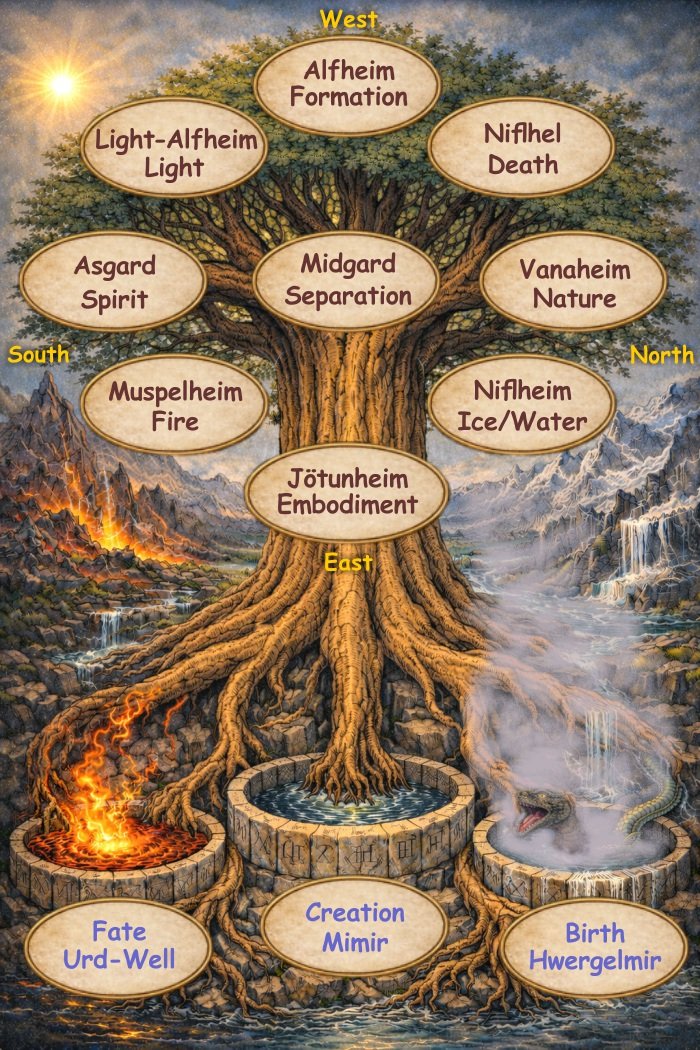
Some scholars also see the three Norns of Destiny in the three daughters, although these are described only farther down in the text as arising from the Well of Destiny. At least the macrocosm’s mountain and frost giants now appear to become ever mightier, threatening divine sovereignty upon the game-board. Against this threatening dominance of giants within the macrocosm, the gods now set the microcosm’s dwarves: Alfheim against Jötunheim, formation against rigidity:
9. Then all the counsellors, the holiest gods, proceeded to the judgement-seat and took counsel as to who should create the people of the dwarves from Brimir’s (Ymir’s) blood and Blainn’s (the ‘dark’ Ymir’s) bones.
10. Then Modsognir (‘Courage-Drinker’) had become the most excellent of all dwarves, and Durinn (‘Sleepy One’) the second. Thus, they created many dwarves in human shapes within the realm of the earth (Jörd), spoken forth by Durinn (awakened from sleep).
11. Nyi and Nidi (Full Moon and New Moon), Nordri, Sudri, Austri, and Vestri (North, South, East, and West), Althjof (Mighty Thief), Dvalinn (Sleeping), Bifurr, Bafurr, Bömburr (Fat, Swollen), Nori (Little Fellow), An (Noble Friend) and Anarr (Other), Ai (Great-Grandfather) and Mjödvitnir (Mead-Wolf).
12. Vigg (Spear, Horse) and Gandalf (Magic-Elf), Vindalf (Wind-Elf), Tharinn (Yawner), Thekk (Beloved) and Thorinn (Daring), Thror (Growing), Vit (Clever), Lit (Colourful), Nar (Corpse) and Nyrad (New Counsel), Reginn (Mighty Knowing One) and Radsvid (Wise Counsellor). Thus have I duly enumerated the dwarves.
13. Fili (File), Kili (Wedge), Fundinn (Finder), Nali (Needle), Hepti (Handle), Vili (Will), Hanarr (Ability), Sviurr (Mobility), Frar (Swiftness), Hornbori (Horn-Bearer), Fräg (Glory) and Loni (Boring), Aurvang (Wet Meadow), Jari (Marshy), and Eikinskjaldi (Oak-Shield).
14. Now it is time to show humans the dwarves from Dvalinn’s host (the ‘Sleepy One’s’), down to Lofarr (the ‘Praiseworthy One’). They went from the hall’s stones (from Ymir) to Aurvangar’s seat (the ‘Wet Meadow’) in Jöruvellir (within the earth’s realm).
15. There were Draupnir (Dripper) and Dolgthrasir (Enemy-Zeal), Har (High One), Haugspori (Mound-Walker), Hlevang (Field-Protection), Gloi (Glowing), Skirfir (Spitter), Virfir (Dyer), Skafid (Harmful Sorcerer), and Ai (Forefather).
16. Alf (Elf), Yngvi (Freyr-Worshipper), Eikinskjaldi (Oak-Shield), Fjalarr (Concealer), and Frosti (Frost), Finn and Ginnarr (Deceiver). This long ancestral list down to Lofarr (the ‘Praiseworthy One’) will be remembered as long as the world endures.
Thus, from Ymir’s blood and bones, the gods awakened a colourful host of dwarves as nature spirits, setting them against the material rigidity of the frost and mountain giants upon creation’s game-board to keep creation alive. These dwarves, or nature spirits of manifold formation within the microcosm, should be imagined as little humans, just as gods and giants were also imagined as humans, allowing us to recognize ourselves in them. In this way, the human being can expand consciousness, overcome egotistical separation, and eventually rediscover himself as a whole within everything. These dwarves appear as ‘nature spirits’ in great diversity. Some incline more toward the World Tree’s spirit-side, toward Light-Alfheim; others more toward its dark nature-side, as far as Niflhel.
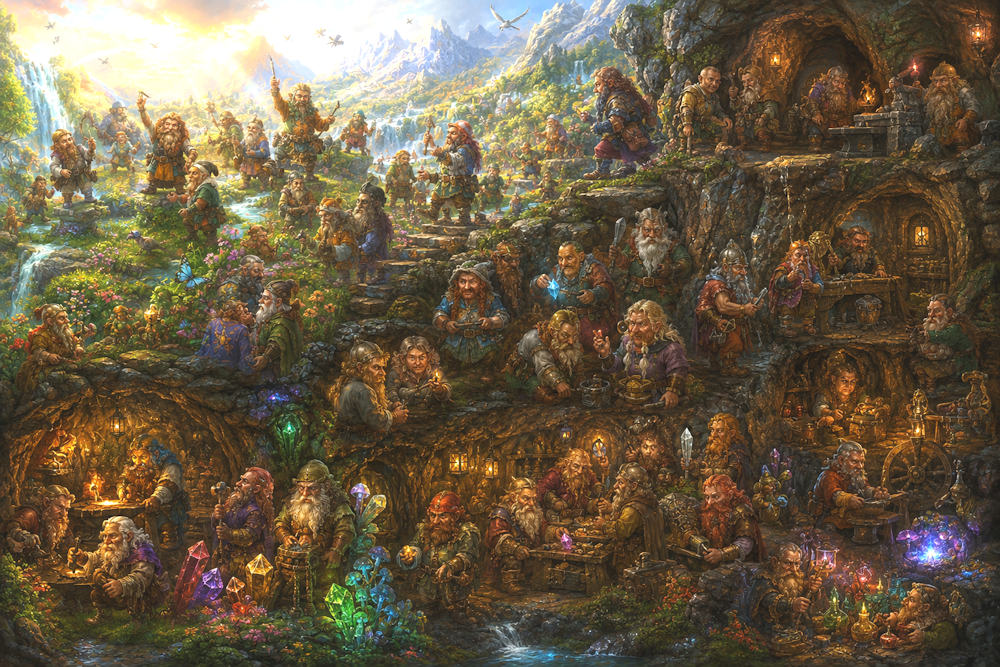
Thus, we may imagine that after Odin and Jörd’s wedding as All-Father and Mother Earth, their son Thor was born. With his birth, the dwarves, too, were awakened, forging Thor’s hammer, as well as Draupnir, the ring of renewal, and many other weapons and tools for the gods to preserve a living creation. In this respect, the creation, or awakening, of these nature spirits as formative forces from sleep within Ymir’s body has surely not been described here in such detail without reason. For it is the prerequisite for more complex living beings, such as humans, now being able to arise from hardened matter. Thus, we may see millions of dwarves at work within their millions of cells, allowing the complex organism to function as a living whole.
17. At last, three from the host of mighty and benevolent Aesir came to the dwelling. Upon the shore they found Ask (‘Ash’) and Embla (‘Elm’ or ‘Climbing Plant’), powerless and without destiny.
18. They possessed neither soul nor reason, neither blood nor movement, nor fair appearance. Odin gave them soul (spirit, breath of life), Hönir (Vili) gave reason, and Lodurr (Ve) gave blood and fair appearance.
‘Gylfi’s Delusion’ §9 gives a fuller account:
As Börr’s sons walked along the seashore, they found two tree-trunks. They lifted them up and created humans from them. The first (Odin) gave them soul (spirit, breath) and life; the second (Vili), intellect and the ability to move; the third (Ve), outward form, speech, hearing, and sight. They gave them clothing and names. The man was called Ask (‘Ash’), the woman Embla (‘Elm’ or ‘Climbing Plant’), and from them arose the human race, to whom Midgard was given as a home.
Here, we may regard the emergence of humans as symbolic of all more complex living beings. The tree-trunks recall Jötunheim’s trunk, now brought to life again within the crown through the diversity of living beings, with the help of the manifold dwarves. Yet we may also think of the ‘tree-trunks’ from the forest of conceptions that had sunk into the Sea of Causes and now reappear upon creation’s shore. Divine spirit makes them effective and alive again within Midgard.
Thus, in the names Ask and Embla, we may also recognize the World Tree’s two essential sides as spirit and nature, fundamentally manifesting in all living beings as a play of masculine and feminine, of begetting and giving birth. They can now fruitfully connect and unite, recognizing themselves again as wholeness within the golden ring of regeneration. For this, the Tree of Life and of the Worlds has grown:
19. An ash I know standing, named Yggdrasil, a lofty tree sprinkled with white sand. From it comes the dew that falls into the valleys. Evergreen it stands above Urd’s Well.
Now that the more complex living beings, and above all humans, have been created—falling, like all creatures, into separation and the struggle for life—the Tree of Life is called ‘Yggdrasil’. Yggr means ‘Fear and Terror’ and is also a byname of Odin. Drasil is an old, solemn word for ‘horse’. Thus, the World Tree becomes a ‘bearer, or horse, of terrible fear’, upon which the Father of the Fallen rides to attain creation’s great goal.
The white sand recalls the crystallizing salt of embodiment within this tree. From a natural perspective, we may think of the carbon dioxide in the air, which the tree absorbs through its leaves to embody itself. For a tree consists largely of carbon, absorbed above all from the air. In return, it breathes out the oxygen upon which living beings such as we humans live. Besides the moisture in the air, this is also evoked by the dew that falls and condenses within the valleys as the water of life.
The root of this tree may be imagined within the eternal Sea of Causes as Urd’s Well, or the Well of Destiny, allowing the World Tree of Life to grow and flourish again and again.
20. From there come three much-knowing maidens, from the water lying beneath the tree. One is called Urd, the second Verdandi, and the third Skuld (‘Destiny, Becoming, and Guilt’). They carved (the runes) into wood, laid down decrees, and chose the lives of human children, the destiny of humans.
Here, the play with the number ‘Three’ gradually becomes clearer. We have already reflected upon the symbolism of threefoldness as a triangle of action in many fairy tales and legends. Wherever something is to move, three forces or principles can be found. Simply put: effect, counter-effect, and direction of action. In this text, too, the great message probably lies in recognizing within this threefoldness a triune whole, and even unity. In this respect, the Tree of Life’s three wells are in truth only one well, the three giantesses only one soul of the giants, and Börr’s three sons only one son. Odin, Vili, and Ve as inspiration, will, and consecration are only one creator-god, as are Odin, Hönir, and Lodurr, or Loki, as effect, reason, and counter-effect. Even Odin and his two ravens are a unity, as are Odin and his two wolves. And just as the World Tree’s three wells are only one well, the three worlds upon the spirit-side are only one world. The same applies to the three worlds upon the nature-side and the three worlds between them. Ultimately, spirit and nature, with all the nature spirits and spirit-natures between them, are also only one whole and divine reality. Accordingly, the three Norns of Destiny—present, future, and past—are a wholeness, an eternal presence in the here and now, inseparable from creatures. The seeress then also merges with this holistic Norn of Destiny, allowing her now to speak in the third person:
21. She remembers the people’s first battle in the world, when they thrust spears into Gullveig (‘Gold-Draught’) and burned her in the High One’s (Odin’s) hall. Three times they burned the thrice-born one, often and ever again, yet she still lives.
Here, too, a holistic hall of the High One is described, recalling Valhalla, where the Einherjar assemble and practise battle, fighting and serving ‘within the host of unity’. Hence, Valhalla means ‘the Hall of the Fallen’: all creatures that have fallen into the struggle for life through separation by form, yet can never fall out of wholeness and divinity. Naturally, this concerns humans above all, allowing us to rediscover ourselves in this story. And because the gods gave them life, spirit, and nature within time and space, they have now themselves become human through their wholeness. Hence the saying: ‘God became human so that the human being might become God.’
Thus, in Valhalla they now struggle with their destiny, here called Gullveig, a ‘Gold-Draught’ recalling the gods’ mead that the Einherjar drink and digest in Valhalla. This is probably also Valhalla’s purpose: to burn away karmic destiny. The spears recall the power of creative will to awaken fateful effects seeking to be worked out and burned away—not killed in Niflhel, but lived out.
22. Heidr (‘Shining, Filled with Light’) they called her wherever she came into houses, a seeress prophesying well. She worked magic with (rune-) staves. She worked magic wherever she could. She worked magic with devotion and was ever also the delight of wicked women.
Heidr may now be regarded as the seeress’s radiant light when she enters the houses, or bodies, of living beings. She recalls Heidrun, the Light-Rune, symbolically standing as a goat upon Valhalla like Gimle’s sun, allowing mead to flow from her udder as the ‘Gold-Draught’ for the Einherjar: the ‘light-milk’ with which she nourishes her children. From a spiritual perspective, we may reflect here upon formless consciousness, capable of assuming all forms and sustaining all beings. Indeed, this truly seems like a great magic, when information becomes reality, just as energy becomes matter. This mysterious magic appears everywhere within creation and can be recognized behind all forms, signs, and letters. To this, holistic consciousness gives itself without ever becoming exhausted.
What is ‘consciousness’? One might say ‘knowledge in motion within being’. Thus, a flow of knowledge within existence. In this respect, we may think not only of mead as the divine drink of wholeness, but also of the wine of the ‘power of illusion and creation’, upon which Odin lives as All-Father and creator-god, or intoxicating beer as the ‘gold-intoxication’ upon which the diversity of beings lives.
The wicked women recall those souls and natural beings that do not unite with the gods in the struggle for unity to become goddesses, but instead unite with egotistical lone warriors who seek to cling to forms of their own through separation. Naturally, they, too, live upon this light of consciousness and find delight in its magic, capable of appearing in any form whatever.
23. Then all the counsellors (the mighty knowing ones), the holiest gods, proceeded to the judgement-seat and took counsel as to whether the Aesir should pay compensation or whether all the gods should receive offerings.
How, then, should the holy, or holistic, gods respond to this fateful magic that has emerged from the Sea of Causes within Urd’s Well after the awakening of nature spirits and more complex living beings? Should they make offerings for it? Or should they receive, and even demand, offerings?
24. Odin hurled the spear and shot it into the host: that was the first battle in the world. Broken was the rampart of the Aesir’s stronghold; battle-hardened Vanir roamed the field.
Odin’s spear is called Gungnir, the ‘Waving One’, recalling the awakened waves of will from the Sea of Causes, which now become effects battling one another. The boundary-wall between spirit and nature thus also shatters, for Midgard now exists between them as our human world. Here, Aesir and Vanir meet in great battle as gods of spirit and nature. This struggle is also described as the Vanir War. It ended in a peace treaty, recognizing one another as gods and symbolically exchanging hostages to this end. Thus, Njördr became an Ase, while Hönir, whom we have interpreted as divine, or holistic, reason, becomes king of the Vanir within nature. This means that spirit and nature were recognized by both sides as a divine unity. In this way, the gods followed both paths: they sacrificed themselves and themselves received these sacrifices.
The divine demands no more than it gives itself.
25. Then all the counsellors proceeded to the judgement-seat, the holiest gods, and took counsel as to who had mixed all the (fresh and good) air with poison and given Odr’s wife (Freyja) to the giant’s kin.
Here, the question now arises: who actually erected this wall between spirit and nature, contaminating all the air breathed by living beings with the poison of separation? Who had given beautiful Freyja, the goddess of sensual love, beauty, and fertility, married to Odr as the spirit of life, to the material giants of fixed form? The corresponding story is told in ‘Gylfi’s Delusion’ §42. Naturally, Freyja as a holistic goddess also belongs to the mountain giants. Yet they wished to hold her as selfish property and built this wall around themselves to that end. Thor, however, shatters it again, above all within their heads of rigid intellect:
26. Thor alone struck there, filled with (divine) wrath, for he seldom remains seated on hearing such things. Then oaths broke, pledged words and vows, all the weighty agreements exchanged between them.
When the gods recognized this selfish motivation of personal possession as deceit against themselves, they were no longer bound by any peace treaty. Thus, their struggle now turns against those beings seeking to contaminate divine creation with the poison of separation. This happens above all in Midgard and Jötunheim, where Thor now fights, especially with the hammer the dwarves forged for him.
Thus, the circle here fundamentally closes with the arrival of the three giant-daughters within the gods’ realm and the awakening of the dwarves as nature spirits in Alfheim, opposite Jötunheim’s world. Between them lies Midgard at the centre of all worlds, at the end of the hardened trunk where the great boughs branch out, leaving the paths into all worlds open to Midgard’s beings.
27. She knows of Heimdall’s horn, hidden beneath the holy tree accustomed to light. She sees an earthy river flowing from the Father of the Fallen’s pledge. Do you know how to interpret it?
Here, a new section begins concerning the World Tree of Life, which lives upon light and strives toward light. For beneath, or behind, this tree lies hidden Heimdall’s horn: the consciousness ‘shining homeward’ that calls all beings back to their original home, into Gimle’s eternal light. It is called a holy tree, for it, too, is a holistic being arising from the Father of the Fallen’s eye and embodying itself as the earthly river of creation. Then follows the refrain ‘Do you know how to interpret it?’, now repeated nine times in all. This makes clear once again that we are dealing with symbolic language challenging the reader’s intellect to interpret these profound words. We, too, wish to do our best…
28. Alone she sat outside when the Old One came, Ygg’s (-drasil’s) being among the Aesir, and looked into her eyes. (Then she said:) ‘What do you all ask of me? Why do you all test me? I know everything, Odin, where you hid your eye, in Mimir’s renowned well. Mead Mimir drinks each morning from the Father of the Fallen’s pledge.’ Do you know how to interpret it?
Here, too, the vision of unity is required: of creator, creation, and appearance. Hence the words: ‘Alone she sat outside…’ Thus, all creation fundamentally consists only of the seeress’s radiant light, of Gimle’s eternal sun, pure consciousness that knows everything. And everything seen appears within God’s holistic eye, which he gave as a pledge to redeem again at creation’s end. This eye, too, may be regarded as a symbol of consciousness hidden within the Sea of Causes, allowing fateful causes to work themselves out and be burned away. Thus, each morning when the light of the worldly sun rises, the Mimir-intellect draws from this eye, bringing forth the entire intellectual creation to drink this flow of knowledge as mead, as the ‘Gold-Draught’ and divine drink.
Thus, Odin is also called the holistic ‘Being of the World Tree’ and addressed by the seeress in the plural: ‘What do you all ask of me?’ For as the holistic Father of the Fallen and All-Father, he naturally unites all creatures within himself. This is also why he asked, and now acts as Father of Hosts and exemplar of the Einherjar within the struggle for life:
29. The Father of Hosts offered her rings and necklaces. In return, he received words of wisdom and prophetic magic, for she saw far and wide over every world.
Thus, he gives the seeress the rings of unity and the necklace of outward beauty between the intellectual head and physicality, receiving in return wisdom and the magical vision of all worlds. For how could he help creatures if he possessed only pure vision within pure light? Thus, he now also sees their problems, arising through conceptual distinctions within the intellect. And so ‘God became human so that the human being might become God’. This ‘God-Human’ is also represented by his two ravens Hugin and Munin as thought and memory, with which he can think like humans, and his two wolves Geri and Freki as desire and voracity, feeding like humans. Here, we may also recall Odin’s Rune Song, beginning with these words:
I know that I hung nine long nights upon the Wind-Tree, wounded by the spear, consecrated to Odin, myself to myself, upon the tree whose root no one can discern. I received neither food nor drink. Then I looked downward, pondering runes. Attentively I listened, learned them with a sigh: at last I fell to earth…
Thus, Odin himself was wounded by his own spear of creative will and learned upon the World Tree the words of wisdom and secrets of the magical runes, as humans should learn them to recognize themselves and rediscover themselves within wholeness. This ‘self-knowledge’ may be seen as the high point in the cycle of creation. Afterwards comes ‘self-realization’ within the struggle for life, working out karmic guilt and culminating in Ragnarök, the ‘Destiny of the Mighty Knowing Ones’.
30. She saw Valkyries (‘Choosers of the Fallen’), come from afar, ready to ride to the Gothic people (the people of the gods). Skuld (‘Guilt’) held a shield; Skögull (‘Shaking, Awakening’) was the second, Gunn (‘Combat’), Hild (‘Battle’), Göndull (‘Magic Staff’), and Geirskögull (‘Spear-Awakening’). Now they are named, the commander’s (Odin’s) women, ready to ride across the land as Valkyries.
We have encountered the Valkyries as servants of the Father of the Fallen. The people of the gods recall the All-Father’s creatures, fighting their fateful struggle for life. We may imagine the Valkyries embodying the circumstances of battle, repeatedly awakening the fighters and choosing them for battle according to karmic guilt. Hence, the Norn of Destiny Skuld is also named here as a Valkyrie, causing the struggle for life above all as karmic guilt. Her shield might remind us that this guilt cannot be attacked and killed directly, but must be worked out and lived through in battle. And depending on how the fighters respond to circumstances within the struggle for life, their paths, too, are chosen, leading either along the Einherjar’s path to Valhalla or as lone warriors to Niflhel.
31. I saw Baldr, Odin’s child, with destiny appointed like a bleeding sacrificial beast. High above the field had grown, slender and very beautiful, the mistletoe twig.
In this struggle for life of ‘self-realization’, we may regard the gods as guides and exemplars. The comparison with the bleeding sacrificial beast recalls verse 23 and the gods’ self-sacrifice. Thus, they even demonstrate the path to Niflhel: how holistic light in Baldr’s form as the god of light can dream of its own death, die, and take the path to Niflhel. The corresponding story was told at length in ‘Gylfi’s Delusion’ §49. The cause of this death was attachment to a form of light that was not to be harmed and was to endure eternally. Even if the strictest laws are established, one small exception suffices to break through every supposed security within any form of creation. The little mistletoe twig symbolically served this purpose here: at Loki’s wish, the blind brother Hödur, god of darkness, shot it at Baldr, causing Baldr to die, at least in his form as the god of light.
Thus, we may imagine how spiritual attachment to a particular form leads spirit possessing form into the dead end of death when that form passes away and disappears. This is precisely what we ordinarily imagine as death, just as Baldr apparently dies. To overcome this conception, our intellect is now challenged:
32. From this wood, which seemed thin, came the dangerous shaft of harm, and Hödur shot it. Yet Odin’s son, Baldr’s half-brother (Vali), was swiftly born and began killing when one night old.
33. He washed not his hands nor combed his hair before carrying Baldr’s deadly archer (Hödur) to the funeral pyre. But Frigg wept in Fensalir (‘Marsh- or Water-Hall’) over Valhalla’s distress. Do you know how to interpret it?
Without divine light, this creation would naturally disappear into darkness at once. Thus, with Rinda, creation’s ‘Protectress’, Odin now begets a son named Vali, whom we may interpret as the principle of life. For life, too, is a divine light. Accordingly, through his birth alone Vali kills the divine principle of darkness in Hödur’s form, preserving creation. Wonderful symbolism! Life kills the darkness that killed the light…
Frigg is Odin’s wife, the All-Mother at the All-Father’s side, as it were. And just as Odin rules in Valhalla, the ‘Hall of the Fallen’, Frigg rules in Fensalir, the ‘Marsh- or Water-Hall’, recalling the earthly world as Valhalla’s courtyard, where creatures live, as it were, in a ‘marsh’: a mixture of embodied earth and the water of life. There, she weeps over Valhalla’s distress, for Baldr and Hödur did not follow the Einherjar’s path to Valhalla, but the lone warriors’ path to Niflhel. Naturally, this is a grievous blow to the Einherjar in Valhalla and a great challenge to learn from it, above all the insight that the downfall of creation possessing form cannot be stopped, as the seeress also saw:
34. Then Vali can bind the bonds of death, and very firm were the fetters, made from entrails.
Just as Vali had killed light’s counter-effect, he now also binds Loki, the divine being of counter-effect, at the gods’ wish. For Loki had ensured Baldr’s mortality, and the gods now fear he might also bring about their own downfall together with creation possessing form. The corresponding story is told at length in ‘Gylfi’s Delusion’ §50, where it becomes clear that Loki acted rather as a counter-effect against this downfall. Nevertheless, the gods wished to restrain and bind him, above all Thor, who fights rigidity. Thus, Loki’s binding occurs symbolically through the entrails of his own son Narfi, the ‘Narrowing and Limiting One’.
35. A captive she saw lying beneath the forest of bubbling springs (Hveralundr), a figure of harm resembling Loki. There sits Sigyn (‘Victory-Bringer’), grieving for her husband. Do you know how to interpret it?
He was bound beneath the Tree of Life’s springs, within the Sea of Causes, as it were, because he was now regarded as a ‘figure of harm’. Fundamentally, this is a cave or hell similar to Niflhel, but evidently in the East beneath the World Tree’s trunk, where the painful poison of separation and demarcation now drips onto him. There, his wife Sigyn mourns him, catching the cruel poison in a bowl and emptying it when full:
36. A river flows from the East through valleys of poison, with knives and swords: Slid (the ‘Dangerous, Cruel One’) it is called.
Here, we may readily imagine how Loki’s binding and torment through the poison of separation only accelerate creation’s downfall all the more painfully. Was this sacrifice intended? For through Loki, it is again the divine itself enduring this suffering, apparently necessary for holistic ‘self-realization’ and the burning away of karmic destiny. And Sigyn, as the ‘Victory-Bringer’, ensures that this poison of separation ‘with knives and swords’ can flow through the World Tree’s trunk into all worlds, allowing all beings to share this suffering and work it out. This also reveals Sigyn’s nature as the soul of nature and principle of causation, ensuring within the Sea of Causes that the effects bound there are brought forth again. This would mean that the victory of all creation lies in working out and overcoming this poison of separation. And all creatures are to participate here.
37. In the North, in Nidavellir (the ‘Dark Fields’, or Nidafjöll as ‘New-Moon Mountain’), stood a hall of gold belonging to Sindri’s kin (‘Sinter, Hardening’ as formation). Another stood upon Okolnir (‘Never-Cold’), a giant’s beer-hall, and he is called Brimir (Ymir as the ice giant).
Now, within this Sea of Causes beneath the ‘springs in the forest of conceptions’, the seeress sees other spaces beside Loki’s cave, described in ‘Gylfi’s Delusion’ §52 as eternal realms in which beings can even survive Ragnarök. Here, she sees the dwarves’ space within the microcosm, as well as that of the macrocosm’s giants. The gold again recalls the truth from which everything arises and exists. And Ymir’s space, too, never becomes entirely cold, just as the ‘Big Freeze’ never reaches absolute zero in temperature. For causes can never become completely rigid, but must eventually work out their effects.
38. A hall she saw standing far from the sun upon Nastrand (‘Corpse-Shore’), its gates facing north. Drops of poison fall through the roof-opening; this hall is entwined with serpents’ backs.
39. There she saw men who broke their oaths, murderers, and the one who seduces another’s ear-whisperer (‘Ear-Rune’ as wife, or nature) wading through arduous streams. There Nidhögg (‘Hatred-Striker, Hatred-Serpent’) sucked in the bodies of the dead. The wolf tore the men apart. Do you know how to interpret it?
The third space of Nastrand, as ‘Corpse-Shore’, recalls the dark realm of the dead, far removed from Gimle’s eternal sun. Its gates face north toward the World Tree’s natural realm, between Niflheim and Niflhel, as it were. This space is created by the ego-serpents of demarcation, spitting their poison of separation into it. Thus, onto this ‘Corpse-Shore’ is washed from the river of creation the egotistical spirit of separation that has broken the divine marriage-vow between spirit and nature as spiritual unity and natural diversity with its runic message, and has not followed the Einherjar’s path. This spirit believes in its own death, thereby becoming its own murderer, and the ego-serpent of hatred draws it, together with its bodily corpse torn by the wolf of transience, into this space of consciousness of grievous suffering, repeatedly arising from it.
40. Eastward sat the Old One in the Iron Forest, giving birth there to Fenrir’s brood (the ‘marshy’ wolves). Of them all, one particular wolf in a giant’s shape will become the moon’s devourer.
41. He fills himself with the bodies of the doomed and reddens the gods’ dwelling with red blood. Black grows the sunshine in the following summer, full of terrible storms. Do you know how to interpret it?
How does this darkened space of consciousness of the dead arise? The eastern Iron Forest recalls a forest of iron-hard conceptions, the rigid giant-intellect clinging to outward forms. The Old One recalls the giantess Angrboda, the ‘Messenger of Sorrow’, Loki’s first wife, who bore him three children: the Fenris Wolf, the Midgard Serpent, and Hel, goddess of the dead, as the principles of transience, demarcation, and death. Here, we may imagine this happening as a counter-effect at creation’s beginning in the golden age, to bring forth the problems to be resolved within the cycle of creation. These principles were then bound for a time, allowing a learning process within creation. Now they free themselves again and fulfil their task upon the path to Ragnarök.
First, the wolf Hati frees himself as egotistical ‘Hatred’, swallowing the reflecting lunar intellect into the marsh of transience. This wolf feeds upon the bodies of doomed lone warriors who live only for themselves, believe in death as the final destination, and do not serve as Einherjar within the host of unity. From their perspective, even the eternal gods bleed and die. And with the moonlight of the reflecting intellect, their sun with its light of life also disappears, so that within the dark realm of the dead they no longer see a fruitful summer of renewal.
42. There upon the burial mound sat the giantess’s guardian, cheerful Eggther (‘Servant of the Sword’s Edge’), playing the (fateful) harp. Beside him, within the Gallows Forest, crowed the splendidly red rooster called Fjalarr (‘the Concealing, Deceiving One’).
The discriminating intellect as the ‘Servant of the Sword’s Edge’ recalls Utgard-Loki, who, as Utgard’s king in Jötunheim, sits upon matter’s mountain. Now, as ‘Loki of the Outer World’, he guards the nature of Angrboda, the ‘Messenger of Sorrow’, who has meanwhile transformed into Sigyn as the ‘Victory-Bringer’. Hence, he cheerfully plays destiny’s harp, for after the course of Thor’s journey to Utgard, he fundamentally knew where Ragnarök’s destiny leads.
The ‘Gallows Forest’ would then again be the ‘Iron Forest of hardened conceptions’, which, through binding in form, become deadly gallows for those who cling to them. There in Giantland, illusion’s fire-red rooster now calls to Ragnarök’s last great battle.
43. Among the Aesir crowed Gullinkambi (‘Golden Comb’), awakening the Father of Hosts’ men. Another crows beneath the earth, a soot-red rooster, within Hel’s halls.
The symbolic rooster fundamentally recalls Heimdall’s horn, the consciousness ‘calling homeward’ that now also awakens the gods and Einherjar within Valhalla and calls them to the great battle. The ‘Golden Comb’ might suggest the gold of truth now seeking to smooth the tangled thoughts that had grown from the head of intellectual creation. Similarly, within Hel’s dark realm of the dead, a ‘soot-red rooster’ also crows, contrasting with Giantland’s ‘splendidly red rooster’. The ‘red’ recalls the fire that burns away fateful karmic guilt: visibly blazing in the outer world, but hidden beneath black soot and almost smothered within the realm of the dead. Thus, it also becomes clear here that the realm of the dead offers no eternal rest, as some believe.
What is no longer mentioned here is the dwarves’ realm: as nature spirits of formation, they evidently no longer play an important role at Ragnarök. This might mean that creation’s power of renewal and regeneration has been lost, as in an over-aged human body. Here, we may recall the symbolic story of Baldr’s death, when Thor thrust the dwarf Lit as ‘colourful formation’ into the funeral fire, just as Odin gave the ring Draupnir to the fire.
44. Loudly now howls Garm (as a watchdog) before Gnipahellir (the ‘Cliff before the Cave’). The fetter will break, and the wolf run free. Much lore she knows, and farther ahead I foresee the mighty Ragnarök of the victory-gods:
Garm is ordinarily described as the watchdog of Hel’s realm of the dead. Here, he presumably stands more generally for a wolf of transience, tamed and chained as a watchdog to protect a particular dwelling of beings. These boundaries now disappear on the path to Ragnarök, when opposites seek to dissolve within battle. Thus, the chain, or fetter, also breaks, and the tamed watchdog becomes once more a devouring wolf of transience, bound only for a while within space and time. Naturally, the seeress can foresee this, too, within the play of cause and effect.
For this is Ragnarök, the ‘Destiny (rök) of the Mighty Knowing Ones (regin)’, thus ‘the destiny of the gods and all creation’: of everything, as it were, that has arisen from knowledge, or information, through Mimir’s intellectual creation. And this destiny is naturally a ‘victory of the gods’, thus a victory of wholeness over every demarcation and separation. What else?
This verse is now repeated four times, evidently for four levels, or stages, of Ragnarök. Regarding the first three, we may think of the three ‘Gelmir’ giants as ‘Criers’, described as ‘Speaking Forth’ within creation’s process. Now, together with the Tree of Life’s three wells, they dissolve again in reverse order and return to silence:
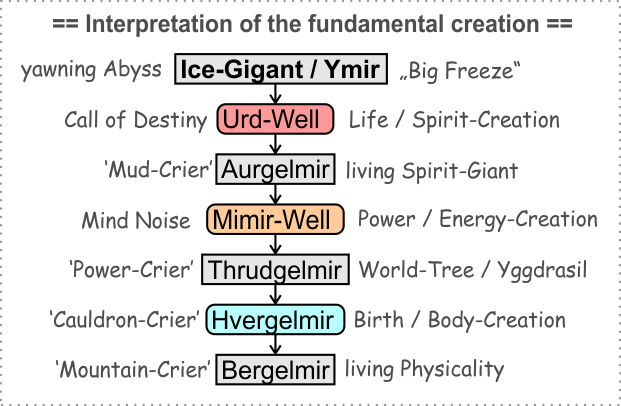
Thus, the seeress can infer the process of dissolution from that of creation. For the way in is also the way out.
The first level may be seen in Midgard, the world of complex embodied living beings such as we humans, born as egotistically separate individuals from Hvergelmir’s Well:
45. Brothers will fight one another and bring each other death. Sisters’ sons will break the bonds of kinship. Harsh it is in the world, much adultery, axe-age, sword-age, shields split, wind-age, wolf-age, until the world perishes: no man will spare another.
46. Mimir’s sons play; destiny flares at the ancient Gjallarhorn (Heimdall’s ‘Calling Horn’). Loudly Heimdall blows, the horn is raised high, and Odin takes counsel with Mimir’s head.
Thus, order in Midgard breaks down first, and everyone fights everyone, above all masculine, or spiritual, beings. All bonds break, for everything bound now seeks to dissolve again. Thus, ‘Mimir’s sons’, whom we may imagine as all creatures, play their last great battle-game when karmic destiny flares and burns away beneath the heavenly call of consciousness shining homeward.
At Mimir’s Well at the Tree of Life’s root, Odin consults the head of the Mimir-intellect, for as commander and exemplar of the Einherjar, he is a holistic being who does not act wilfully. And what counsel does he receive there? Presumably, what we shall now read: how the river of creation from Mimir’s Well seeks to end, and who must fight whom in order to dissolve.
47. Trembling stands the ash Yggdrasil; the ancient tree groans, and the (fire-) giant frees himself. All upon the Hel-paths are terrified before Surt’s kinsman devours it (before fire devours the World Tree).
Through Midgard’s dissolution as the heart of the aged World Tree, the entire Tree of Life now also passes away. And naturally, the beings upon the Hel-paths who do not serve as Einherjar are most terribly frightened by this downfall, seeing in it an ending in death.
The burning of the entire World Tree within destiny’s fire, now coming from Muspelheim because this boundary, too, disappears, already suggests Ragnarök’s second level. From the perspective of modern physics, we may think here of matter’s transformation into energy between Jötunheim and Muspelheim. This would be, as it were, the energetic dissolution of rigid matter. And when everything has burned, the ‘Big Freeze’ follows, recalling Ymir once more.
We have reversed the order of the following two verses to make the structure of these levels clearer:
49. Loudly now howls Garm before Gnipahellir (the ‘Cave-Cliff’). The fetter will break, and the wolf run free. Much lore she knows, and farther ahead I foresee the mighty Ragnarök of the victory-gods:
48. What of the Aesir? What of the Elves? All Giantland (Jötunheim) trembles. The Aesir go to the Thing. The dwarves groan before stone doors, the wise ones of the mountain-wall (or earth). Do you know how to interpret it?
What are the gods doing? They assemble in judgement at Urd’s Well and there prepare Ragnarök’s third level. The dwarves have been enclosed behind matter’s stone doors and can no longer act formatively. In their diversity, they were created by the gods to set more complex living beings against the overpowering giants tending toward rigidity. Now these little nature spirits have fulfilled their task and dissolve again together with earthly matter and everything dead, or rigid.
50. Hrym comes from the East, raising his shield before him. Jörmungandr (the Midgard Serpent) writhes in giant-rage (Jötun-rage). The serpent raises waves. The eagle cries, and his pale beak tears the dead. Naglfar (the ‘Nail-Ship’ as the ship of the dead) is loose.
51. A ship comes from the East; Muspel’s (destiny’s fire’s) people will come over the sea, and Loki steers. All the ignorant come with the wolf and bring Byleist’s (the ‘Wave-Blow’s’) brother (Loki) with them.
52. Surt (the fire giant) comes from the South with the branches (flames) of destruction. From his sword shines the sun of the gods of the fallen. Rocky mountains break and giantesses fall; mortals take the Hel-path (everything transient passes away), and heaven shatters.
In Hrym, we may recognize the epitome of all Hrimthurses, or frost giants, seeking to protect themselves from transience with their shield of materialization. With Midgard’s downfall, the Midgard Serpent, too, is now freed, stirring up the Sea of Causes with everything seeking to cling here to what is dead, or rigid. Thus, the ship of the dead emerges, and as a counter-effect Loki steers it toward burning within destiny’s fire, releasing this bound energy as well. Accordingly, the eagle’s cry recalls the power of universal desire, seeking to dissolve and consume the dead again, too.
Through this, Loki also becomes free again from his cave in the East beneath the falling World Tree, where he lay bound. Muspel’s people recall all rigid beings within dissolving creation, consecrated to destiny’s fire. These are the ignorant who seek to cling and hold on to a particular form, having not yet recognized the truth of the formless: the pure light of Gimle’s eternal consciousness, which cannot be burned. They come with the wolf of transience because they cling to transient things, simultaneously bringing Loki’s counter-effect with them.
For this recognition of truth, or ‘self-knowledge’, we may hear the universal call of all creation: the eagle’s cry, the rooster’s awakening call, Garm’s howling, and Heimdall’s calling horn. Everything calls for this eternal light shining in Gimle, from which everything arises and within which everything passes away again. Herein probably also lies the runic secret of all nature’s forms.
This sun of the gods of the fallen also shines within the flames of Surt, the fire giant from Muspelheim, destiny’s fire from the Well of Destiny, where the gods of the fallen held their final assembly of judgement within this cycle of creation. Thus, the name Surtur actually means ‘the Dark One’, for he is an invisible being made visible only through his effects. This is precisely what makes recognition so difficult: recognizing the formless within form, the eternal within time, and spiritual unity within natural diversity.
Accordingly, Surt now comes from the South, from the World Tree’s spiritual realm, dissolving everything dead with his fire so that it may become alive again. The mountain giants and their souls collapse, everything transient passes away, and the heaven of space and time shatters, having hitherto contained and held together all creation. What remains? What does not burn in the fire?
Now begins dissolution’s third stage, at the level of knowledge or information, as it were. Here, too, we have reversed the order of the following two verses to make the structure of these levels clearer:
54. Loudly now howls Garm before Gnipahellir (the ‘Cave-Cliff’). The fetter will break, and the wolf run free. Much lore she knows, and farther ahead I foresee the mighty Ragnarök of the victory-gods:
53. Then further sorrow arises for Hlin (the ‘Protecting One’, Frigg), when Odin prepares to fight the (Fenris-) wolf, and Beli’s radiant slayer (Freyr) against Surtr. There Frigg’s beloved (Odin) will fall.
55. Then comes Vidar, the Victory-Father’s mighty son, to fight the beast of the fallen (the Fenris Wolf). With his hand, he drives the sword into the heart of Hvedrung’s son (the Fenris Wolf as Loki’s son). Then the father is avenged.
Here, the All-Father now meets the All-Devourer, to the All-Mother’s grief, for naturally she knows that the feminine passes away with the masculine. Thus, their meeting may simultaneously be regarded as creation’s dissolution, without any further story of battle: an end of knowledge and an end of Mimir’s creation, as it were. Then all the conceptual distinctions created by the creative intellect dissolve. And with this, Freyr as the summer god of growth also meets destruction’s fiery energy, and they become one being again.
What remains is Vidar, the eternal god of silence and silent warrior within the forest of conceptions, who now also dissolves the All-Devourer. The sword’s point, which he thrusts into transience’s heart, recalls the principle of unity that overcomes all transience, for within wholeness nothing can be lost. Our modern physics, too, knows this as the law of conservation of energy, and even of information. Loss can exist only within separation, and Thor now also resolves this problem:
56. Then comes Hlödyn’s renowned son (Thor, son of Jörd, Mother Earth), and Odin’s son goes to fight the monster (the Midgard Serpent). With all his strength (divine wrath), Midgard’s protector strikes, and all mortals must leave their dwelling (in Midgard). Nine steps Fjörgyn’s son (Thor, son of Jörd) takes, dying, away from the serpent, unafraid of the new moon.
Thus, Thor and the Midgard Serpent now also meet directly and dissolve one another, and the principle of demarcation and separation disappears. Naturally, Thor also disappears as a separate aspect of the divine, having now fulfilled his task, as have all the other aspects. The nine steps recall renewal’s power after the dark new moon, so that Thor, too, dies without fearing that anything could be lost.
57. The sun darkens, the land sinks into the sea, the bright stars fall from heaven. Fiery smoke rages against the Preserver of Life (Surt against Vali?); great heat rises even to heaven itself.
Thus, darkness now falls when discriminating knowledge no longer exists, nor any effective information. Everything conceptual sinks into the Sea of Causes as the moonlight of the reflecting intellect disappears. And the energy of everything burned by the fire now fills the entire heavenly space, spreading without limit and slowly cooling toward the ‘Big Freeze’ of a Ymir. Our modern science also knows this; what it has not yet found, however, is the Preserver of Life. Hence, it still puzzles over how a ‘Big Freeze’ can become the ‘Big Bang’ of a new creation again.
Here, the ancient wise ones were evidently further advanced, for now comes Ragnarök’s fourth stage: the dissolution of dissolution, as it were, the gods’ eternal victory:
58. Loudly now howls Garm before Gnipahellir (the ‘Cave-Cliff’). The fetter will break, and the wolf run free. Much lore she knows, and farther ahead I foresee the mighty Ragnarök of the victory-gods:
59. She sees the earth rise once more from the sea, newly green. Waterfalls tumble; above flies the eagle who (sits upon the rock and) hunts fish.
Thus, the ‘Preserver of Life’ now draws the energy together again; Ymir as the ‘Big Freeze’ becomes fluid and alive once more, and a fertile earth can embody itself anew from the Sea of Causes. The water of life flows again, and desire’s hungry eagle sits upon embodiment’s rock within the World Tree to hunt its nourishment in creation’s river. What lies behind this desire? What is creation’s desired goal? Why does the tree grow and strive toward the light?
Thus, desire now hunts after life. Wonderful! And the fish recall the salmon as a symbol of creatures repeatedly regenerating within the water of life in creation’s river.
60. The Aesir meet upon Idavöll (the ‘Field of Idun’s Renewal’), speaking of the mighty earth-girdle (the Midgard Serpent) and remembering great events there, and Fimbultyr’s ancient runes (the ‘Mighty Tyr’ as god of righteous victory).
61. There, the wonderful golden tablets they possessed in primordial days will be found again within the grass.
Now, the holistic gods appear again upon the ‘Field of Renewal’ of Idun, the goddess of youth and immortality with golden apples, or imperishable fruits of truth. Upon these fruits live the gods’ forms as aspects of the divine, remaining young and alive throughout the entire cycle of creation. And within this ‘Field of Consciousness of Renewal’, with the help of the ‘seeress’ from the Sea of Causes, they remember Midgard’s earthly world and the great path to creation’s great goal. This path practically embodies itself within all creatures, whose forms may be interpreted as runic symbols. For within them can be found creation’s secret, the ‘wonderful golden tablets in the grass’: the message of original truth shared by all beings in their origin.
Thus, creation now begins again with a golden age. Why? This conception can be found in many ancient creation myths. For example, the Bible’s paradise, the golden age in Hesiod’s ancient Greek account, or the golden Satya Yuga of the ancient Indian Puranas. For a human being, too, it would surely be terrible and unbearable to encounter immediately after birth all the problems to be resolved throughout life. Hence, here, too, creation now begins again with a golden age in which the holistic gods rule and the egotistical principle of demarcation and separation has not yet become overpowering, although it will grow in order to be healed:
62. The fields will grow unsown; all harm will heal. Baldr will come. Hödur and Baldr dwell upon Hropt’s (the ‘Calling One’s’) place of victory, the sanctuary of the gods of the fallen. Do you know how to interpret it?
63. Then Hönir (divine reason) can choose the branch of destiny, and the two brothers’ sons (the sons of Hödur and Baldr, or Vidar and Vali?) inhabit wide Windheim. Do you know how to interpret it?
Here, Baldr and Hödur now appear again as the eternal principles of brightness and darkness, which in truth can never die, within a new creation’s Field of Renewal: the place of victory of Hropt, whose name as the ‘Calling One’ is a name of Odin, but also recalls Heimdall, the ‘Homeward-Calling One’.
Naturally, a third principle must join these opposing principles of light and darkness to give the play of opposites a direction of development. Thus, Hönir appears here, whom we have interpreted as divine reason, to lead the creative Mimir-intellect from separation back to wholeness. This is probably also the branch of destiny that Hönir chooses as creation’s goal: Ragnarök as the Destiny of the Mighty Knowing Ones. Within this triad, the two brothers also recall Vidar and Vali, the eternal principles of silence and life, whom we may imagine as Odin and Loki within renewed creation. Similarly, the Edda’s Skaldic Book begins with a story of Odin, Loki, and Hönir, who, as effect, counter-effect, and reason, ‘set out from home into the world’. And this world may be seen as Windheim, the wide world within the wind of moving, or acting, spirit, where all creatures are born as children of brotherly opposites and inhabit this world.
64. A hall she sees standing, fairer than the sun, roofed with gold, in Gimle. There faithful companies will dwell and enjoy delight forever.
Here, creation’s great goal is now named: Gimle’s eternal space of consciousness, meaning ‘Protected from Fire’, bounded only by the gold of truth. Whoever leaves truth also leaves this light-filled space, shining more beautifully than any worldly sun. This consciousness may be regarded as the great goal of the faithful Einherjar, who serve the divine within the host of unity and enjoy eternal bliss there.
65. Then comes the Strong One from above, the Mighty One to the judgement of the counsellors (the mighty knowing ones), who guides (counsels) everything.
66. And from below, from Nidafjöll (the ‘New-Moon Mountain’), comes flying the dark dragon, the glittering serpent Nidhöggr (‘Hatred-Striker, Hatred-Serpent’). He carries corpses within his wings’ plumage: now she will sink.
(Völuspa, based on Arnulf Krause, Edward Pettit, and Old Norse sources)
As a crowning conclusion, the field of tension in which creatures fight their struggle for life is suggested once more: a struggle growing ever harsher and more painful after creation’s golden age, ultimately to be resolved within Ragnarök’s great victory. From above comes the divine, with mighty knowledge from consciousness’s eternal light, within which all creation appears. From below, from darkness’s ‘New-Moon Mountain’, or the Sea of Causes, come the corpses as repressed problems seeking resolution. These are carried above all by the ego-dragon and hatred-serpent as principles of demarcation and separation. For separation may be regarded as the foundation of all problems, fears, and suffering.
Now she will sink: on the one hand, this may refer to the seeress, sinking back after her message into the Sea of Causes from which divine spirit awakened her. On the other, the hatred-serpent might also sink if we understand the seeress’s message (Do you know how to interpret it?). Then divine, holistic love could triumph over hatred, allowing desire’s eagle within the Tree of Life to attain its goal in Gimle’s eternal light. A happy ending!?
Here, our intellect, still upon the path, may now ask: What meaning does the struggle for life have if creation begins anew again and again? Are the problems from the Sea of Causes never resolved completely? Indeed, these are difficult questions. On the one hand, brightness and darkness are logically eternal principles. For if they were transient, they would already have passed away. On the other, divine consciousness must always be free; otherwise, someone above or outside it would have to bind it. And what is free can naturally assume any form. To recognize this, we would need to be conscious that it is free divine consciousness, rather than clinging with this consciousness to any form. Here, the intellect again enters the picture, asking these questions of meaning only when it sees demarcation and separation within time and space. Thus, we are caught in a vicious circle. And this is the problem seeking resolution…

