
| Content | Next | About |
The Lay of Sigrdrifa
As the tits foretold in their fateful prophecy, Sigurd’s onward path now leads him first to the Valkyrie Sigrdrifa, the ‘Victory-Driver’. We have already encountered the first part of this text in the first chapter on ‘The Nature of Odin’, in the section on the Valkyries. Following the course of Sigurd’s story, we shall therefore bring together our interpretation once more, deepen it where possible, and take a closer look at the second part of her teaching:
Sigurd (‘Victory-Protector’) turned south towards Frankland and rode up Hindarfjall (the ‘Mountain of the Hinds’). On the mountain he saw a great light, as though a fire were burning, and its radiance shone up to heaven. As he drew closer, there stood a fortress of shields, with a banner rising above it. Sigurd entered the shield-fortress and saw a man lying there asleep in full armour.
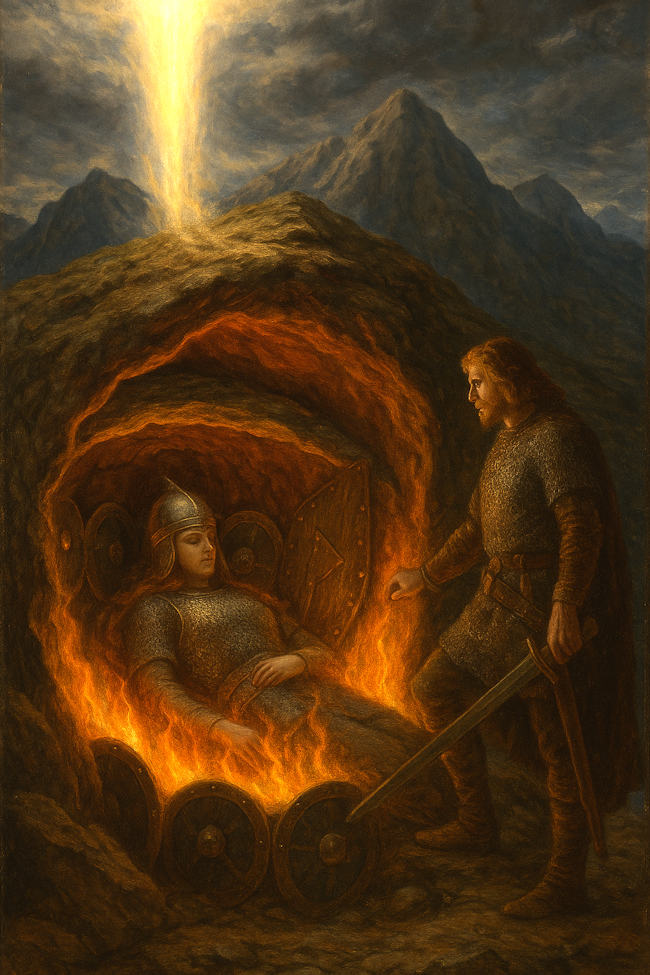
First he took the helmet from the sleeper’s head: then he saw that it was a woman. The mailcoat (her coat of armour) was so tight that it seemed to have grown into her flesh. With his sword Gram he cut through the mailcoat, downwards from the head, and then along both arms. Then he took it off her. She awoke, sat up, looked at Sigurd and said:
1. What cut through my mailcoat? Why was I woken from sleep? Who freed me from the dark fetters?
Sigurd answered: Sigmund’s son! Sigurd’s sword has just cut the raven’s carrion-flesh from you.
Etymologically, Frankland suggests a ‘Land of the Bold or the Free’ west of the Rhine as the river of life. In the Lay of Helgi it is also described as King Sigmund’s realm, the realm of Sigurd’s father, and would thus be his inheritance too. Southwards probably refers to the journey from Denmark to Frankland, but symbolically it also suggests the spiritual side of the World Tree, leading towards the light that rises to the heaven of Gimle. Similarly, we can see the two banks of the Rhine as the spiritual side and the natural side of the river of life, with Frankland lying on the spiritual side. Thus, to begin with, this is more of a spiritual journey to the ‘Mountain of the Hinds’.
In Valhalla we encountered the stag as a symbol of the fighting spirit, from whose antlers the rivers of opposing qualities flow into the world. The hinds might accordingly represent the feminine, natural side of this process: the circumstances, conditions and causes of life, which also appear personified in the Valkyries. As for the mountain, we might think symbolically of the Alps, the source region of the Rhine as the river of life. And the mountain peak suggests the passage between earth and heaven, between the physical and spiritual worlds.
There Sigurd finds a sleeping Valkyrie, evidently waiting for him to awaken her. First he penetrates the shield-fortress. We have already encountered shields on the roof of Valhalla as symbols that enclose a space of consciousness. This space can become so restricted that hardly anything can move within it, a state we then call ‘sleep’. Within this space of consciousness he initially sees a man, or spirit, in full armour, symbolically recalling the battle armour of the conceptual intellect: the ‘dead flesh of dark ravens or thoughts’, as it were. Beneath the helmet, which recalls the Aegis-Helmet of life-form, however, he discovers a female being of nature, suggesting beneath this helmet the inner soul of nature.
As a coat of armour, the mailcoat suggests outer material nature, which has, as it were, grown onto the soul. Sigurd cuts through it with his sword of wisdom, penetrating to the living essence, which then awakens in the interplay of spirit and nature and begins to speak and act. For it is the spirit that gives life…
2. Sigrdrifa said: Long I slept, long I lingered in sleep; long is the suffering of humankind. Odin brought it about that I could not break through the sleep-runes.
Sigurd sat down and asked her name. Then she took a horn filled with mead and gave him a draught of remembrance.
There is a wonderful symbolism in the Valkyrie’s falling asleep and awakening. In this way the divine ensures that the causes of accumulated problems sleep hidden in nature until the spirit awakens them at the right time, so that they can take effect and be resolved in life. This is also why some accumulated problems in our own lives confront us only at a certain age, when sufficient wisdom and strength are also present to resolve them. And yes, resolving such problems can be a long path of suffering through many generations.
So Sigurd too now sits down and turns towards the unresolved problem in nature. As holistic reason, which has by now also united within itself the purified essence of Regin and Fafnir as human intellect and ego, he asks for the problem’s name. His first answer is a horn filled with mead, a draught of remembrance. Wonderful! This too is powerful symbolism. The horn recalls Heimdall’s calling-horn, and thus the consciousness that lights the way home towards creation’s great goal. We have already encountered mead as the divine drink of wholeness. In this wholeness the spirit can remember the great goal of victory. And remembrance speaks:
3. She said: Hail to day! Hail to the sons of day! Hail to night and her kinswoman! Look upon us here with unclouded eyes, and grant victory to us who sit here!
4. Hail to the Aesir, hail to the Asynjur! Hail to the earth, useful in so many ways! Grant us both, the glorious ones, healing words, thoughts and deeds for as long as we live!
The great goal, then, is salvation: the healing of all wounds of separation in unity, wholeness and the divine. Hail to all beings of day and night, of light and darkness, of spirit and nature! Hail to all aspects of the gods and goddesses within the all-embracing divine! Hail to the useful diversity of nature within spiritual unity! Hail to all words, thoughts and deeds, that they may bring healing for as long as life endures!
Yes, herein surely lies the great goal of creation. And to this end spirit and nature unite here as Sigurd and Sigrdrifa, as though in a mystical marriage, to realize this great victory. Wonderful!
She called herself Sigrdrifa (‘Victory-Driver’) and was a Valkyrie. She related that two kings had fought against one another. One was called Hjalm-Gunnar (‘Helmet-Fighter’). He was old at the time and the greatest of warriors, and Odin had promised him victory. The other was called Agnar (‘Sword-Fighter’), brother of Auda (the ‘Rich, Wealthy One’), whom no one was willing to protect. Sigrdrifa brought down Hjalm-Gunnar in battle. In revenge, however, Odin pricked her with a sleep-thorn and decreed that henceforth she should no longer decide victory in any battle, but should marry. ‘But I told him that in return I vowed to marry no man who could know fear.’
Thus nature now calls herself ‘Victory-Driver’ and, as a Valkyrie, provides the fateful circumstances in the struggle of living beings. To this end she unites once more with Sigurd, holistic reason as the ‘Victory-Protector’. For the great spiritual goal should never be forgotten, as can so easily happen amid nature’s many forms.
To make this clear, a short story is told here that gives us much to ponder. The ‘Helmet-Fighter’ suggests a man, or spirit, beneath the helmet of life-form who, as a solitary fighter, had evidently grown old in body but also powerful, suggesting above all spiritual power. He was therefore apparently ready to be chosen in battle as an Einherji and raised to Valhalla. Yet the natural circumstances let him fall again, choosing Agnar as victor instead. As the ‘Sword-Fighter’, Agnar symbolically recalls Sigmund, Signy’s brother, who in principle was already an Einherji. And Sigurd was now continuing his father’s path.
But why did Odin wish to choose the solitary fighter Hjalm-Gunnar as victor? Here we can recognize the great spiritual goal of creation: to lead solitary fighters out of their separation and make them Einherjar once more in the army of unity. Similarly, the Bible says: ‘As I live, says the Lord GOD, I take no pleasure in the death of the wicked, but rather that the wicked turn from their way and live.’ (Ezekiel 33:11)
Perhaps this was also why, in the battle between Sigmund and Lyngvi, Odin let Lyngvi prevail and Sigmund fall. For Einherjar do not perish in death. Sigurd later continued this struggle and won on a holistic level where there is no longer any losing or any loser, either spiritually or physically. Only in this way can solitary fighters too reach Valhalla and become Einherjar. In this regard Gangleri says to the Father of the Slain in ‘Gylfi’s Illusion’, §38: ‘You say that all men who have fallen in battle since the beginning of the world have now come to Odin in Valhalla.’
A similar theme is explored in the ‘Lay of Grimnir’. There Odin, as Allfather, initially supported Geirröd, while Frigg, as Allmother, cared for Agnar, who perhaps does not bear the same name by chance. Later he too can be recognized as an Einherji, born anew in the golden ring of regeneration as Geirröd’s son, again named Agnar, and receiving instruction in the holistic view from Odin himself.
God’s justice is no simple matter as long as our intellect remains caught in separation and sees solitary fighters fighting ‘against one another’, as the text above also says of the two kings. Perhaps we would do better to write ‘with one another’.
However that may be, in practice the search for the precise causes of Sigrdrifa’s being put to sleep is endless. For in Ran’s net everything is, of course, connected with everything else. What matters is that, as a serving Valkyrie, she did not follow Odin’s spirit, and so was destined to unite once more with such a spirit. And, as she had vowed as a Valkyrie, this can only be a holistic spirit that fears no loss. This spirit now appears in Sigurd as holistic reason, to awaken her again and let her become effective in life.
Sigurd spoke and asked her to teach him the wisdom of all worlds, since she knew their signs and messages.
Thus Sigurd now also asks the essence of nature for instruction, having already been taught by Odin’s spirit in the ‘Lay of Regin’ and by the birds as the inner soul of nature in the ‘Lay of Fafnir’. Three stages of instruction thus appear: spirit, soul and nature. In principle, these also reflect the three wells of the World Tree and Tree of Life, from which the manifold creatures can learn to recognize spiritual unity and realize the great victory.
And Sigrdrifa said:
5. Beer I bring you, apple-tree of gathered mailcoats (in battle), blended with might and mighty glory, full of magic songs and healing runes, with good spells and runes of love.
Here Sigrdrifa no longer speaks as the inner, all-embracing soul of nature and remembrance, which offered the horn of mead as the divine drink of wholeness, but as outer, manifold nature, bringing beer that strengthens yet also intoxicates. Similarly, the Valkyries in Valhalla were said to offer beer to the Einherjar. For to the spirit all forms of manifold nature are naturally an intoxicating drink of magic and illusion, like a dream in which creatures arise and pass away.
Yet the intoxicating diversity of these forms has its meaning and use in creation, for within them we can recognize the so-called ‘runes’. The word means ‘whispering, mystery and magical sign’. Thus in all forms of creation we can recognize magical signs and messages and fathom the deep mystery of their power. Odin himself likewise recognized the great significance and power of the runes as signs of nature when he hung for nine nights on the World Tree and gazed deep into Mimir’s well of intellectual creation, into his own eye of consciousness.
Nothing other than the gold of truth thus lies hidden in these runes, and the way to it is the love-rune of true love beyond desire and hatred. This is also why, in the battle of gathered mailcoats or bodies, Sigurd is called an apple-tree that can bestow Idun’s golden apples as eternal fruits.
6. Victory-runes you must know if you wish for victory, and carve them on the sword’s hilt: some on the point, some on the edge, and twice you must name Tyr (the T-rune for the ‘God of Just Victory’).
The most important weapon in battle is, of course, the sword of wisdom. Within it lies the mystery of victory in the flow of creation. The sword’s hilt suggests the intellect’s concepts, its edge the power of discrimination, and its point the ability to recognize connections and work towards spiritual unity. Upon all these parts and functions of the intellect we should impress the victory-rune of holistic reason as the ‘Victory-Protector’, in order to realize the just victory of wholeness. Here ‘just’ means that ultimately everyone wins, and there are neither losers nor loss. And this applies in two ways, both inwardly and outwardly, spiritually and physically.
7. Beer-runes you must know if you do not wish another man’s wife to betray your trust. On the horn you shall carve them, and on the back of your hand, and on your fingernail draw the need-rune (the N-rune for the compulsion of fate).
8. You must bless the vessel to protect yourself from harm, and put leek into the drink: then I know that your mead will never be mixed with harm.
Here we can reflect on the ‘intoxication-rune’ as the mystery of the illusion and magic of the diversity of outer forms. Those who are aware of this mystery do not allow natural forms, which seemingly belong to other beings, to deceive them in their trust in wholeness and the divine. With this rune-mystery we should mark the drinking-horn from which, with the water of life, we drink both the mead of spiritual unity and the beer of natural diversity.
The back of the hand suggests the impulse to act, and the fingernail attachment to physical solidity, as we have already encountered this nail-symbol in the ship of the dead, Naglfari. Upon them we should impress the need-rune or fate-rune and become aware that physical solidification and physical action in this world are conditioned by karmically accumulated fate. Under the laws of cause and effect, we must inevitably encounter this fate.
With this insight we can bless the bodily vessel with wholeness and protect it from harm. As a member of the onion family, the leek might suggest the causes that grow in the water of life and seek expression as outer forms. Yet inwardly they are empty and formless, like the hollow green of an onion: a magic of forms arising from formless consciousness.
9. Birth-runes you must know if you wish to deliver a child and release it from the woman. On your palms you shall carve them, trace them around the (wrist-) joints, and then ask the Disir (women of fate) for help.
For this insight we should also recognize the mystery of birth: that as bodily living beings we are here in this world to ‘deliver’ accumulated causes. They can then grow like children in nature, take effect and eventually loosen their bonds and become free. In contrast to the back of the hand as the impulse to act, this rune should be impressed upon the palm, presumably indicating the goal of bodily action. The joints suggest living mobility, and the Disir recall the Valkyries, who provide the fateful circumstances and conditions in the struggle of life.
10. Surf-runes you shall carve if you wish to keep your sail-steeds (sailing ships) safe upon the water. On the stem you shall carve them, and on the rudder-blade, and burn them with fire into the oar. Then no breaker is so steep and no wave so dark that you will not return home safe and whole from the sea.
The insights of the preceding runes now also become, in practice, a protection-rune for the ship of the body upon the waves in the sea of life, where it sails in the wind of the spirit. With this protection as the ‘Victory-Protector’, we do not sink and fall back into darkness, but can return home whole to the light, to heaven in Gimle.
11. Branch-runes you must know if you wish to be a healer and tend wounds. On the bark you shall carve them, and on the trunk of the tree whose branches lean eastwards.
We should also recognize the mystery of the branches, which seemingly branch out and separate from one another in the Tree of Life, from the frail twigs of bodily living beings to the strong boughs of the great worlds. Whoever recognizes the mystery of wholeness within them becomes a true healer and can heal the wounds of separation. For everything that falls into separation inclines, in principle, towards the east, towards Jötunheim, towards rigidity and becoming woody.
12. Judgement-runes you must know if you do not wish anyone to harm you out of hatred. You shall wind them, weave them and join them all together at that Thing (assembly) where people go for a perfect (just) judgement.
The mystery of justice, too, lies in reason’s holistic vision. An egoistic solitary fighter who lives in separation and whose intellect is not guided by holistic reason can therefore never exercise true justice, because he judges everything according to his own wilful interests.
This verse makes especially clear how, in the course of these three lays, the foundations are laid ever more firmly for a reasonable resolution of the great human problems that later break out fatefully, among other things, in the quarrel between Gudrun and Brynhild (as between Kriemhild and Brünhild in the German Nibelung legend).
13. Thought-runes you must know if you wish to be wiser in insight than any other person. Hropt (the ‘Speaking One’, Odin) devised, carved and interpreted them from that liquid which dripped from Heiddraupnir’s (‘Light-Dripper’s’) head and from Hoddrofnir’s (‘Treasure-Opener’s’) horn.
What is the rune-mystery of the thoughts upon which the intellect rests? Here we can again think of formless consciousness, which can assume any form. For this Odin, as Allfather and creator-god, pledged his eye, so that with this eye of consciousness he might bring forth creation from the water of life and Sea of Causes. Accordingly, the head suggests Mimir’s well as the source, and the horn Heimdall, the ‘Home-Caller’, as the goal of creation. Between them the stream of thoughts of intellectual creation drips and flows in Draupnir’s golden ring of regeneration, finally to return to its origin and rediscover the golden treasure of truth.
14. On the rock he stood with Brimir’s blade (Ymir’s, the ice-giant), wearing a helmet upon his head. Then Mimir’s head spoke the first word in wisdom and proclaimed the signs of truth.
The enduring rock on which the Allfather and creator-god stands recalls the philosophers’ stone as the foundation of imperishable truth. Brimir’s blade might mean the discrimination of opposites that thaw out of the ice-giant, out of the frozen Sea of Causes, as it were. And the helmet might mean the Aegis-Helmet or intellect’s helmet of life-form, which in essence the creator himself wears as the divine. With this, creation began through the word. Through the power of knowledge, the manifold forms and signs appear out of formless consciousness, so that truth may be rediscovered within them: pure and imperishable consciousness.
15. On the shield, he said (the Mimir-intellect), they were carved, which stands before the shining god (the sun); on Arvak’s ear and Alsvinn’s hoof (the two sun-horses, ‘Early-Wakeful’ and ‘All-Wise’); also on the wheel that turns beneath Hrungnir’s chariot, on Sleipnir’s teeth and on the straps of the sledge.
Our intellect should recognize this mystery of creative thoughts upon the shield before the sun. Without this filter, everything would at once be burnt by its fire and disappear in its bright light. Thus the sun seems to move, rising and setting, day after day and life after life, and in its light the forms of this world appear through the filter of thought, together with all our knowledge.
Hrungnir’s chariot suggests the material body of the mountain-giant Hrungnir, whom we encountered in his story as a typical materialist. He sought to protect himself from Thor’s attack with his shield by standing upon it himself. Thus the idea of enduring matter, intended to protect bodily form from transience, is naturally also a construct of thought. Whoever fathoms this mystery recognizes that this protective shield too turns like a wheel within the golden ring of renewal and regeneration. For everything flows and everything changes.
Thus the human being lives between heaven and earth, between the bright sun and dark matter, as though between two mighty shields upon which the intellect should recognize the thought-runes.
Sleipnir is the eight-legged horse ridden by Odin, and thus symbolizes the whole of creation. His teeth, with which food is chewed, suggest on the one hand the processing of accumulated problems, and on the other transience, which is naturally also a construct of thought whose mystery we can fathom in order to find the imperishable within it.
Similarly, the sledge with its straps suggests the bonds of the body in the winter realm of rigidity. These too are constructs of thought whose mystery we can discover in order to find liberation and release from them.
16. Likewise on the bear’s paw and on Bragi’s tongue (the divine poet’s), on the wolf’s claws and on the eagle’s beak, on bloody wings and at the bridge’s end, on the deed of deliverance and on the footprint of healing.
Here too we should recognize the thought-runes and their mystery. The bear’s paw suggests active creative power in the realm of nature; Bragi’s tongue, the stories of the gods in the realm of spirit; the wolf’s claws, the power of transience; the eagle’s beak, hungry desire in the Tree of Life; the bloody wings, wounds in life’s struggle; and the bridge’s end, death as a passage. The deeds of deliverance suggest holistic action, and the footprint of healing the path of the Einherjar towards holistic reason, to heal the wounds of separation in unity and wholeness.
17. Likewise on glass and on gold and on the well-being of humankind, in wine and in beer and on the seat of the will, on Gungnir’s point (Odin’s spear) and on Grani’s breast (Sigurd’s horse), on the Norn’s nail and on the owl’s beak.
Transparent glass, pure gold and peaceful well-being suggest the true values of people in those times, and are also mental concepts for truth. Wine and beer are symbols of the power of illusion and creation in the water of life. The seat of the will is the thinking intellect, and Gungnir, the ‘Surging One’, is Odin’s spear as divine will. Its point symbolizes unity as the goal of divine will. This will naturally also works in Grani’s breast, the bodily steed of Sigurd as the ‘Victory-Protector’. The Norn’s nail suggests the nailed-down compulsion of fate, and the owl’s beak the grasping nature of the dark night. The beaks of eagle and owl, birds of prey of day and night, might have a similar meaning here to Sleipnir’s teeth.
18. All the runes that had been carved were scraped off, mingled with holy mead and sent (again) on far-reaching paths. Some are with the Aesir, some with the elves, some with the wise Vanir, and some are held by humankind.
All these magical signs upon nature’s forms are, of course, transient and disappear again, mingled with the holy mead as the divine drink of wholeness, only to appear anew on far-reaching paths in the golden ring of renewal. Thus they appear in all worlds: in the spiritual realm of the healing gods and in the natural realm of the wise Vanir, and between them in the realm of the dwarfs as nature-spirits of formation, as well as in the human realm of Midgard. The giants’ realm is absent from this list, presumably because it tends so strongly towards rigidity.
The wise Vanir recall the story of the Vanir War between spirit and nature as unity and diversity at the beginning of creation. It ended in a peaceful exchange of divine wisdom, so that we can now recognize natural diversity in spiritual unity, and spiritual unity in natural diversity.
19. These are the book-runes, these the birth-runes, and all the beer-runes and excellent power-runes. Whoever can use them unadulterated and unspoilt for their own healing, let them use them, once learned, until the Counsellors (the mighty knowing ones) perish.
Thus we can read nature’s signs and messages like a book, to fathom their mystery. What is at stake is nothing less than truth and the healing of all wounds of separation in unity and wholeness. Yes, we should make use of this opportunity to learn for as long as creation endures through the power of knowledge.
20. And Sigrdrifa continued: Now you must choose, since a choice is offered you, tree of sharp weapons: speech or silence—consider it yourself in your spirit! All harm is foreordained (or caused).
21. Sigurd answered: I shall not flee, even though you know that death is destined for me. I was not born to cowardice. All your loving counsels I shall accept for as long as I live.
Here Sigrdrifa appears once more as a Valkyrie and offers the intellect, which has grown into a ‘tree of sharp weapons’, a choice of fateful circumstances. For as soon as any knowledge enters our consciousness from the Sea of Causes, the causes begin to take effect in nature. Such is the tremendous power of knowledge.
Our freedom now lies in whether we flee from this and thus suppress the effects again, or accept them and allow them to unfold. This surely succeeds best with the healing spirit of holistic reason, which knows true love and can read all nature’s ‘counsels’ as love letters, so as to heal the harm accumulated through fate. And this becomes possible when spirit and nature have united in true love.
22. Sigrdrifa said: First I counsel you to remain blameless towards your kin. Do not take revenge at once, even if they incur guilt. For this, they say, benefits the dead.
The intellect’s concept of guilt is naturally a powerful source of separation, and thus also of harm in the world. Ultimately it also gives rise to the idea of death as separation from life. This is why the Lord’s Prayer says: ‘Forgive us our debts, as we also forgive our debtors.’
This is also the view of holistic reason, through which we can recognize all creatures as ‘our kin’. Whoever recognizes this kinship in unity no longer needs to repay guilt with revenge, but can forgive its causes, allow them to take effect, and finally let them heal.
In this light we can also better understand the long story of Sigurd and Gudrun that follows, in which the unresolved causes of guilt, deception, desire, hatred and revenge unfold, and mutual accusations bring many deaths. There we can also rediscover and reflect upon Sigrdrifa’s further counsels:
23. Second I counsel you to swear no oath unless it is true. Bitter fetters await the faith-breaker, for grievous is the wolf (the transience) of oaths.
What oath can we swear in this world if we do not know the truth? Such oaths become painful bonds, like a vow of loyalty to our own body. If they do not accord with truth, they are necessarily transient. Whoever clings to them nonetheless creates great suffering, becomes a faith-breaker and banishes themselves from holistic truth into wilful separation.
24. Third I counsel you not to quarrel with a foolish man at the Thing. For a person without reason often speaks more harmful words than they realize.
Another great source of harm is quarrelling with the intellect’s words and concepts, especially at the Thing, where the issue is justice and ‘being right’. If reason descends to this level, where egoistic solitary fighters dispute their supposed ‘rights’, it easily loses its holistic view.
25. Everything remains flawed if you keep silent. Then you seem born to cowardice or justly accused. Dangerous is people’s talk if you do not establish a good name. On the following day let his life-breath depart, and so repay people for their lies!
Yes, as long as holistic reason remains silent, everything remains flawed, because perfection cannot be realized. But how does reason work? At first it is simply a holistic vision as self-knowledge. With this the great victory beyond time and space has indeed already been attained, for reason itself is this victory, just as Sigurd is the ‘Victory-Protector’. In practice, however, self-realization in time and space must follow with the help of the intellect. This is where reason’s effect and reality in the world become apparent, which can extend over many generations and is difficult to understand. For holistic reason does not act as a solitary fighter in a limited body, but in the greater whole as the unity of spirit and nature. Here we can think of the magnificent stories of Jesus, Buddha, Krishna and many other holy figures.
The final sentence should also be understood in this light. Reason must not remain silent in the face of a lie, but must overcome it through truth in the course of time, days and lives. The liar’s ‘life-breath’ then means above all the spirit that utters the lie. Reason lets this spirit follow the path of healing, so that truth may be realized in wholeness and what is flawed may heal. In this way reason repays people’s lies. Thus they themselves must experience the effects of their words, thoughts and deeds in space and time, for otherwise no learning process is possible.
26. Fourth I counsel you: if a sorceress full of harm and guilt lives beside the road, it is better to pass on than seek lodging with her, even if night overtakes you.
Here we can think of the principle of embodiment in nature, which appears on the spirit’s path like a spell of illusion. Yet within it work harm in the sense of separation, and the guilt of accumulated causes that seek to be overcome. It is therefore better not to settle too firmly into the body and cling to it, but to continue on the spiritual path of the Einherjar, even when the night of death threatens.
27. Those who fight need Fornjot’s far-seeing eyes (the ‘Primordial Giant’ of nature), wherever they must fight in anger. For often sorceresses skilled in harm sit beside the road, dulling sword and spirit.
Yes, this path requires holistic reason’s far-seeing eyes from the primordial ground of nature, wherever we must struggle with opposites. The sorceresses on either side of the path embody opposing knowledge, which can make the spirit sluggish and the sword of wisdom blunt as soon as we become partisan and cling to one side of the opposites. Then we become partisan solitary fighters and leave the unity of the Einherjar.
28. Fifth I counsel you: even if you see beautiful brides upon the benches, do not let the silver of kinship determine your sleep! Lure no women into kisses!
Do not let nature’s beautiful sensory forms seduce you either! Desire and attachment quickly arise from them. This is not the gold of truth, but the silver of the reflecting intellect, which entangles you in the dream of illusion.
29. Sixth I counsel you: even if hostile words pass between men over beer, do not quarrel drunkenly with quarrelsome people. For wine robs many of their wits.
The intoxication of beer again suggests the enchanting illusion in which we see nature’s diversity but are unaware of its spiritual unity. From this arises the conflict of opposites and solitary fighters.
Behind this intoxication, however, stands the noble wine that we have already encountered as a symbol of the power of illusion and creation, and which is also Odin’s only nourishment as creator-god. For those who become aware of the wholeness and divinity at work within it, this wine is transformed, as it were, into mead as the divine drink of spiritual unity. Those who do not recognize this unity, however, experience the noble wine only as the intoxication of beer, drawing the intellect into the natural diversity of separation and opposites. And there it also loses itself.
30. Quarrels and beer have brought suffering of the soul to many men: death to some, great harm to others. Many are the things that grieve humankind.
Yes, herein lies the source of masculine, or spiritual, suffering through the soul of nature. From this arise the ideas of death and harm through separation within nature’s diversity. Such ideas of the intellect grieve the human spirit and cloud the pure consciousness of spiritual unity.
Yet this suffering too belongs to the path of learning through worldly experience. Precisely within it, the human being can recognize the causes of separation and finally rediscover healing in wholeness.
31. Seventh I counsel you: if you come into conflict with a courageous man, it is better to fight than to burn in the house with all your wealth.
Thus we should now also fight in the outer world, while remaining aware that this is a struggle among courageous men and therefore above all a spiritual struggle. It is fought with the intellect, which should ideally be guided by holistic reason.
The goal is not to retreat into the house of the body and be burnt there with all our wealth. For, as we read in the preceding lay, the golden treasure of truth also includes the golden Aegis-Helmet of life-form, the golden mailcoat of outer formation and the sword of wisdom, with which we should fight in the world as Einherjar.
32. Eighth I counsel you to guard against misdeeds and avoid deception. Seduce neither maidens nor married women, and do not arouse their lust!
Even if, like Sigurd after his victories so far, we possess the holistic power to do so, we should guard against violating the social order. Even once we recognize that this world exists through the power of illusion, we should not wilfully misuse this power for personal purposes. This is not the path of the Einherjar.
33. Ninth I counsel you to bury the dead wherever you find them upon the earth, whether they died of sickness, at sea or by weapons.
34. A bath should be prepared for those who have died; their hands and head should be washed, their hair combed and dried before they are placed in the coffin, and they should be asked to sleep in blessedness and healing.
Here too we can first consider that Sigurd should continue to observe the customary rites for the dead in human society. Beyond this, we can reflect on how holistic reason, which recognizes spirit and nature as one, should treat the dead whom the intellect finds in the earthly world.
Nature says we should ‘bury’ them: in German, bestatten, literally to give them a place in the world. The Old Norse text here uses ‘bjarga’, which we have already encountered in verse 9 as ‘bjargrúnar’, translated there as ‘birth-runes’ in the sense of bringing to safety and delivering. In essence, then, this means that reason should not let the dead simply perish and come to an end somewhere, but shelter and save them in the whole and lead them back into the golden ring of renewal and regeneration.
To this end we should cleanse those who have died, especially their hands as symbols of their deeds and their heads as symbols of their thoughts, which are then also combed and dried. To some scholars, the coffin here suggests a Christian influence from customary coffin burial. The Old Norse source uses the word ‘kista’, meaning ‘chest’ or ‘box’. Similarly, the word ‘lúðr’ is also used in the sense of ‘mill-box’ or ‘coffin’, usually interpreted as ‘ship’ or ‘ark’ (as, for example, in the ‘Lay of Vafthrudnir’, verse 35). In this light this ‘chest’ can also suggest a ship burial, such as the one described at Baldr’s death.
In principle, of course, the point is to return physically and spiritually to nature’s cycle, which we can also envisage within a buried coffin. Death is thus no final end, but a passage, a sleep that should be blessed and healing, so that we can awaken from it purified and with renewed strength upon the path of healing—ideally as Einherjar in the army of unity.
35. Tenth I counsel you never to trust the promises of a wolf’s offspring if you have slain his brother or brought down his father: a wolf dwells in the young son, even if you gladden him with gold.
Here too we can reflect on the idea of death and how it is passed down through the generations as a ‘wolf’. We have already encountered the wolf as a symbol of transience. The great problem is that whoever believes in death as a final end will kill again and again, believing that this can also eliminate their problems. As long as this concept is lodged in the intellect, even all the gold of truth is of no use. Here we can recall the beginning of these three profound lays, when the gods sought to compensate for Otter’s death with the gold of truth.
36. Quarrels and hatred—do not believe they sleep, nor sorrow either! A prince who is to be foremost among humankind must wield intellect and weapons.
Yes, quarrels and hatred cannot simply be killed either. At most they sleep briefly, as does the sorrow of accumulated suffering. For behind them stand causes that seek to take effect. And this happens best without continually accumulating new causes in the process. To this end the intellect and its weapons should be guided by holistic reason, which should be foremost among humankind. Similarly, in other lays Sigurd is called the foremost and mightiest of human beings.
37. Eleventh I counsel you, when harm arises, to see what path it takes. A long life I foresee for the prince, yet mighty conflicts have arisen.
(Sigrdrífumál, following Arnulf Krause, Edward Pettit and the Old Norse source)
Here the teaching of nature as the ‘Victory-Driver’ comes to an end. And this is surely also the purpose of nature with its laws of cause and effect: to let the intellect recognize connections in space and time, how harm and healing arise and what paths they take. To this end the ‘Victory-Protector’, as the principle of holistic reason, will live as long as creation lives, even though his embodiments are transient.
At the same time, this lay of Sigurd and Sigrdrifa also ends here. We can well imagine how, following this awakening of Sigrdrifa as a divine Valkyrie and the essence of holistic nature, and through her union with Sigurd as the essence of holistic spirit, the natural circumstances of the continuing story were, as it were, born. And within them the ‘mighty conflicts’ then arise, to be recognized and resolved.
What was still united in Sigrdrifa separates again as nature’s diversity into many bodily forms, which we shall then encounter as people in different families over many generations. We can rediscover Sigrdrifa’s two principal aspects as the essence of nature in the symbols of helmet and mailcoat described at the beginning, relating to inner and outer nature. It was above all the inner, all-embracing soul of nature that offered the horn of mead as the divine drink of wholeness, while the rune-mysteries and counsels for action were explained more by outer, manifold nature.
Thus these symbols of helmet and mailcoat, which also belong to the golden treasure, continue to run through the long story. In the German Nibelung legend we can rediscover these two aspects of nature as Kriemhild and Brünhild: she ‘who fights beneath the helmet’ and she ‘who fights with the mailcoat’. Between them there also arises the mighty conflict between inner and outer nature, between unity and diversity. A similar story is now told in the Norse Nibelung tradition between Gudrun, daughter of Grimhild and Gjuki, and Brynhild, daughter of Budli.
Thus the last three lays have ingeniously set out the foundations for understanding the ancient Nibelung legend from a spiritual perspective too. This is why we have also tried to interpret them as fully as possible.
Unfortunately, a substantial passage of text has been lost from the Codex Regius manuscript at precisely this crucial point. It breaks off after the beginning of the sixth counsel, and eight leaves are then missing. The remaining counsels were supplied from other manuscripts, which had evidently copied only the teaching. We may therefore assume that this teaching ended with the eleventh counsel. This also makes sense, for twelve as the number of wholeness is reserved for the gods. Outer nature should always remain somewhat imperfect, so that development is possible.
Presumably, then, only a short concluding prose passage has been lost from the manuscript here. Following the Völsunga Saga and Karl Simrock, we might imagine the following closing prose:
Sigurd said: ‘No wiser woman can be found than you. And this I swear, that I wish to have you, for you are after my own heart.’ She answered: ‘I too wish for you and no other, even if I could choose among all men.’ And they sealed this with oaths to one another. (Völsunga saga §21, following Karl Simrock, who refers to it in his closing prose)
And these oaths were surely true. To conclude, we can therefore still ask the much-discussed question: is Sigrdrifa identical with Brynhild? From a spiritual perspective the answer would be yes and no. Sigrdrifa is clearly described as a Valkyrie, a divine being of holistic nature. As such she can naturally also assume outer forms and appear as Brynhild. At the same time, however, she is also the essence of Grimhild and above all of Gudrun, the ‘God-Rune’. Thus Brynhild herself says in ‘Brynhild’s Ride to Hel’, verse 7: ‘In the echoing valleys all who knew me called me Hild beneath the Helmet.’ The Völsunga Saga in particular struggles with this holistic vision of spirit and nature. It attempts to combine the different lays and traditions into a human, worldly life-story through numerous alterations and additions, losing much spiritual depth in the process. Thus it consistently turns Sigrdrifa into a human Brynhild, and must therefore invent narrative devices such as Grimhild’s potion of forgetfulness for Sigurd, so that he then marries her daughter Gudrun.

