
| Content | Next | About |
The Norse Nibelung Legend of the Edda
Snorri Sturluson gives us a summary of the Norse tradition of Sigurd and the Nibelungs in his book of skaldic poetry, where he explains numerous circumlocutions, known as ‘kennings’, for gold. From a spiritual perspective, these invite reflection on the manifold forms that the gold of truth can assume:
32. How should gold be referred to? By calling it Ägir’s fire (the sea’s), or Glasir’s foliage (a ‘shining’ tree in Asgard with golden leaves), Sif’s hair, Fulla’s headband, Freyja’s tears, the giants’ speech, voice and words, Draupnir’s drops, or rain or showers from Draupnir and Freyja’s eyes (the golden tears she weeps for Odr, her husband as the spirit of life and reason), the otter-compensation and the Aesir’s ransom, the seed of the Fyris Fields (the gold scattered by Hrolf Kraki during his flight), Hölgi’s mound-roof (his burial mound of alternating layers of gold, silver and earth), the fire of all waters and of the hand (of spirit), as well as stones, cliffs or the radiance of the hand (of nature).
From section 39, Snorri first tells briefly, and with only a few alterations, what we have already read in the last three lays. Those who wish can read it once more as a reminder:
39. Why is gold called otter-compensation? It is told that the Aesir Odin, Loki and Hönir set out to explore the world. They came to a river and followed it to a waterfall. There was an otter there that had caught a salmon in the waterfall and was eating it with blinking eyes (drowsing inattentively). Loki picked up a stone, threw it at the otter and struck its head. Loki boasted of his catch, for with a single blow he had taken both an otter and a salmon. They then took the salmon and otter with them.
Thus they came to a farmstead and went inside. The farmer who lived there was called Hreidmar (‘Nest-Glory’). He was very strong and exceedingly skilled in magic. The Aesir asked for a night’s lodging and said they had sufficient food with them, showing the farmer their catch. But when Hreidmar saw the otter, he called his sons Fafnir (‘Clasping/Grasping One’) and Regin (‘Counsellor, Mighty Knowing One’) and said that their brother Otter (‘Inspiration, Reason’) had been slain, and told them who had done it. Father and sons immediately attacked the Aesir, seized and bound them (taking custody of Odin’s spear and Loki’s shoes), and said that this otter had been a son of Hreidmar.
The Aesir offered a ransom for their lives, as much as Hreidmar himself wished to demand. This was agreed with him and confirmed by oaths. The otter was then skinned. Hreidmar took the otter’s skin and told them to fill it with red gold and cover it entirely. This was to be their reconciliation.
Odin then sent Loki to Svartalfheim, and he came to the dwarf called Andvari (‘Presence, Mindfulness’). He was in the water as a fish, and Loki caught him with his hands. As a ransom for his life, he demanded all the gold he had in his rock. When they entered the stone, the dwarf brought out all the gold he possessed. It was a very great treasure. Yet he quickly concealed a small gold ring in his hand. Loki saw this and demanded that he surrender the ring. The dwarf begged him not to take it, for with this ring he could increase his gold again if he were allowed to keep it. But Loki replied that he should not retain a single penny, took the ring and went outside. The dwarf then declared that the ring should bring death to whoever possessed it. Loki said this seemed good to him, and declared that this prophecy should hold, provided that he himself brought it to the ears of those who took possession of the ring.
Here some alterations to the ‘Lay of Regin’ become apparent. There Loki caught the dwarf Andvari as a pike in the waterfall with Ran’s net. Snorri, by contrast, emphasizes Loki’s role in passing on the prophecy that this golden ring (of renewal) brings death to everyone who wishes to possess it. From a spiritual perspective this also makes sense, for as a counter-effect to the egoistic striving for possession, Loki now ensures that the transience of all possessions ‘comes to our ears’, so that we can learn from it. Thus we can see a curse in it, but also a blessing.
He went away, came to Hreidmar and showed Odin the gold. When Odin saw the ring, it seemed beautiful to him, and he took it from the treasure. The rest of the gold he handed to Hreidmar, who filled the otter-skin as tightly as he could and stood it upright when it was full. Odin then came to cover the skin with gold and asked Hreidmar to check whether it was entirely covered. But he examined it very closely and saw one whisker still showing. He demanded that it be covered, or the peace would not hold. Odin then brought out the ring, covered the whisker with it and said that they were now released from the otter-compensation.
But once Odin had taken his spear and Loki his shoes, and they no longer needed to be afraid, Loki declared that Andvari’s words should hold: this ring and the gold should bring death to their owner, and this should take effect from now on. This is why gold is called otter-compensation and the Aesir’s ransom.
40. What more is there to tell of the gold? After Hreidmar had received the gold as compensation for his son, Fafnir and Regin demanded their share as compensation for their brother. But Hreidmar would not grant them a single penny of the gold. The brothers then made the harmful decision to kill their father for the gold. Once this was done, Regin demanded that Fafnir divide the gold equally with him. But Fafnir replied that he could hardly be expected to share the gold with his brother after killing his father for it. And he told Regin to leave, or he would meet the same fate as Hreidmar.
Fafnir took the helmet that Hreidmar had possessed and put it on his head. It was called the Aegis-Helmet, and all living beings are afraid when they see it. He also took the sword called Hrotti (‘Violence’). Regin, by contrast, possessed the sword named Refill (‘Wall-Hanging, Weaving’). He fled, while Fafnir went up to Gnitaheath (‘Rubble-Heath’) and made his lair there. He assumed the form of a serpent (or dragon) and lay down upon the gold.
Regin, however, travelled to King Hjalprek (‘Helpful Ruler’) in Thjod (‘Human Folk’) and became his smith. There he fostered Sigurd, son of Sigmund, son of Völsung, and of Hjördis (‘Sword-Dis’), daughter of Eylimi (‘Healing Branch’).
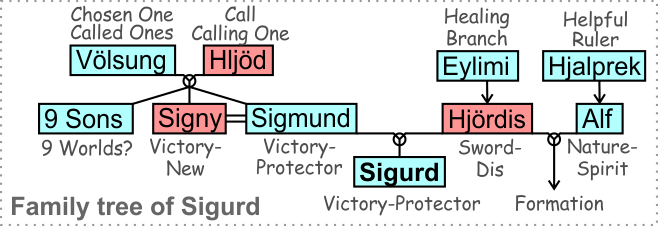
Among all warrior-kings, Sigurd was the most outstanding in lineage, strength and courage. Regin told him where Fafnir lay upon the gold and urged him to win it. Then Regin forged the sword called Gram (‘Wrath’). It was so sharp that when Sigurd held it in running water, it cut in two a tuft of wool that the current carried against its edge. With this sword Sigurd then split Regin’s anvil from the top down to the wooden base.
Afterwards Sigurd and Regin went to Gnitaheath. There Sigurd dug a pit in Fafnir’s path and sat down inside it. When Fafnir crawled towards the water and passed over the pit, Sigurd thrust the sword through him, and this caused his death.
Regin then came forward and said that Sigurd had killed his brother, and proposed as reconciliation that he take Fafnir’s heart and roast it over the fire. Regin himself bent down, drank Fafnir’s blood and lay down to sleep.
While Sigurd was roasting the heart and thought it must be cooked through, he touched it with his finger to test how firm it was. But when the juice from the heart ran onto his finger, he burnt himself and put his finger into his mouth. When the heart’s blood touched his tongue, he understood the language of birds and comprehended what the tits sitting in the tree were saying.
The first said: There sits Sigurd, stained with blood, roasting Fafnir’s heart over the fire. Wise would the giver of rings seem to me if he himself ate the shining muscle of life.
And the second tit said: There lies Regin, taking counsel with himself, intending to betray the youth who trusts him. In anger he devises evil thoughts; the smith of harm wishes to avenge his brother.
Sigurd then went to Regin and slew him. Afterwards he went to his horse, called Grani, and rode until he reached Fafnir’s lair. There he took the gold, tied it into loads, bound it onto Grani’s back, mounted himself and rode on his way.
Now the story has been told after which gold is called ‘Fafnir’s bed or dwelling’, ‘metal of Gnitaheath’ or ‘Grani’s burden’.
41. Sigurd then rode on until he found a house on a mountain. A woman lay asleep inside, wearing helmet and mailcoat. He took his sword and cut the mailcoat from her. She awoke and called herself Hild (‘Battle’). She is also called Brynhild and was a Valkyrie.
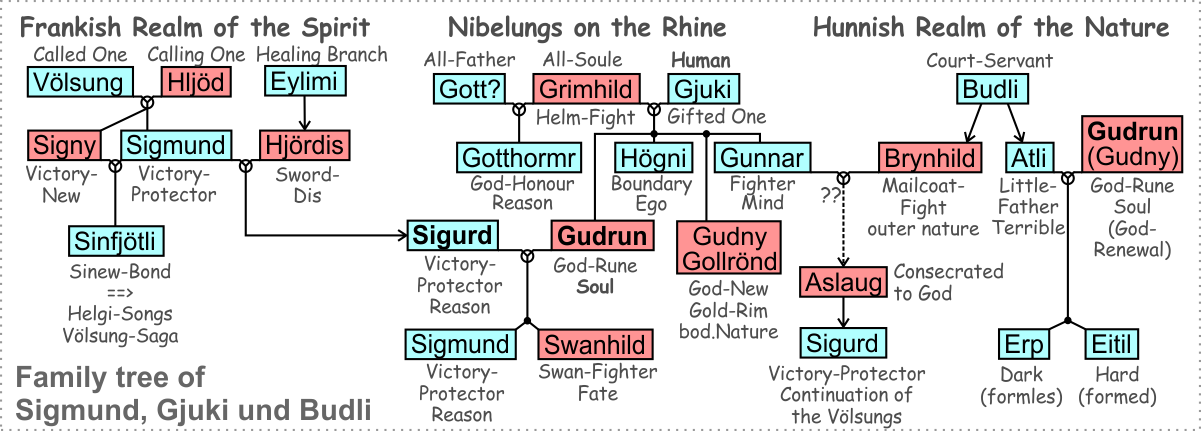
Here the Norse version of the Nibelung story now begins, in the fateful interplay between the two families of Gjuki and Budli. In a sense, the symbolic playing board also changes from the Tree of Life with its nine worlds to the surroundings of the Rhine as the river of life. We can imagine its source region in the south, in the Alps, where the dwarfs of Alfheim as nature-spirits of formation now also have their home. There we might also see the ‘Mountain of the Hinds’, where Sigrdrifa was awakened. The river’s mouth leads into the North Sea, back into the Sea of Causes. Between them lies Burgundy as the ‘Battle-Fortress’, here the human realm of Gjuki, like Midgard. Once again, we can see the two banks of the Rhine symbolically as spirit and nature, like the two sides of the Tree of Life and World Tree. To the west lies Sigmund’s Frankish realm, where Gudrun and Sigurd as reason should now rule. To the east lies Budli’s Hunnish realm, where Brynhild and Gunnar as intellect should rule under reason’s guidance.
Sigurd rode on from there and came to the king called Gjuki (the ‘Gifted and Giving One’). His wife was called Grimhild (she ‘who fights beneath the helmet’). Their children were Gunnar (‘Fighter’), Högni (‘Guardian of Boundaries’), Gudrun (‘God-Rune’) and Gudny (‘God-New’). Gotthormr (‘God-Honourer’) was Gjuki’s stepson. Sigurd remained there a long time. Gudrun, Gjuki’s daughter, became his wife. Gunnar and Högni swore blood-brotherhood with Sigurd.
Afterwards Sigurd and Gjuki’s sons went to Atli, son of Budli (‘Court-Servant’), to seek the hand of his sister Brynhild for Gunnar. She lived on Hindarfjall (‘Mountain of the Hinds’), and a wall of fire surrounded her hall. For she had vowed to marry only the man who dared to ride through the wall of fire.
Sigurd and the Gjukings, also called Niflungs (Nibelungs), then rode up the mountain, and Gunnar was to ride through the wall of fire. He had the horse called Goti (‘Goth’), but this horse did not dare to enter the fire. Sigurd and Gunnar then exchanged their forms and names, for Grani would carry no man other than Sigurd. He mounted and rode through the wall of fire.
That same evening he celebrated his wedding with Brynhild. But when they lay down in bed, he drew the sword Gram from its sheath and laid it between them. After rising and dressing in the morning, he gave Brynhild as a bridal gift the gold ring that Loki had taken from Andvari, and took another ring from her hand as a keepsake. Sigurd then mounted his horse and rode to his companions. Gunnar and he exchanged forms once more, and they returned home to Gjuki with Brynhild. Sigurd had two children with Gudrun: Sigmund (‘Victory-Protector’) and Swanhild (‘Swan-Fighter’).
We have already examined and interpreted the German version of the Nibelung legend in detail on our website, ‘The Spiritual Message of Our Old Fairy Tales’. The underlying legendary material seems to have travelled widely in those times. It is therefore understandable that the names were adapted accordingly. It is harder to explain why the plot also changed so greatly in many places, since even the question of the legend’s original core remains unclear.
What we can rediscover here, however, is the spiritual message, which was probably originally the most important aspect of this legend. Thus it was also ingeniously set out from the perspective of the Old Norse worldview in the last three lays of Regin, Fafnir and Sigrdrifa. Unfortunately, from this point several lays about Sigurd’s and Gunnar’s weddings and Sigurd’s death have apparently been lost from the old manuscripts, so we must initially rely on retellings such as Snorri’s here.
From a spiritual perspective, here too we find an ingenious beginning. In the family of Gjuki and Grimhild we can once again recognize the inner nature of a human being endowed with reason. In principle, this human being recalls Hreidmar with his three sons and two daughters. Building on this, the same spiritual structure is now apparently portrayed on another level of consciousness and connected with the inherited Nibelung story.
Here Grimhild becomes the wife of Gjuki, the ‘Gifted and Giving One’. This evidently means a human being ‘endowed with reason’, namely endowed with Gotthormr. His name can be interpreted as ‘God-Honourer’ and understood as holistic reason, just as Otter was a son of Hreidmar. He is described as a stepson, and symbolically we might imagine God himself as the father who begot him with Grimhild, giving rise to a human being ‘endowed with reason’, who at least carries the potential for holistic reason within.
Grimhild would then be the All-Soul and thus, in essence, also the Allmother of nature. Her name can be understood as ‘Mask-Fighter’ or ‘she who fights beneath the helmet’. Thus she works as soul and as the principle of causation beneath the mask or helmet of transient life-forms. Similarly, from the masculine or spiritual perspective, Grimnir was described as the ‘Masked One’, behind whom the Allfather and creator-god concealed himself.
Gudrun as the ‘God-Rune’ and ‘divine mystery’ evidently has a meaning similar to Grimhild. She is then the soul of the human being endowed with reason and, like her mother, should be recognized as an all-embracing soul. It is therefore fitting that Sigurd as holistic reason marries and unites with her. For this purpose Sigrdrifa had also revealed the mysteries of the runes to him. Thus Sigurd in turn begot a pair of children with Gudrun: another Sigmund as the ‘Victory-Protector’, who is to continue the path of the Einherjar, and a Swanhild as the ‘Swan-Fighter’, recalling the pure white swans on the Well of Fate where the gods sit in judgement. In this we might recognize a pure and divine fate, which we can accept with reason and allow to unfold with true love. It is surely with this pure awareness that Otter too should have eaten the salmon.
Thus in Gotthormr, Sigurd and Sigmund we find three aspects of holistic reason in the human being, which we can understand as reason’s potential, effectiveness and continuation. Why three? On the one hand, this again creates a ‘triangle of effects’. On the other, there is no other way to understand something holistic, because it has no graspable boundaries. This is also why, in the stories of the gods, the one all-embracing Godhead was explained through the gods’ different aspects.
The second daughter of Grimhild and Gjuki is called Gudny. Her name can be interpreted as ‘God-New’ and recalls the golden ring of renewal and regeneration in outer nature. She is not described further in the surviving texts. In the ‘First Lay of Gudrun’, a Gullrönd appears in her place as ‘Gold-Rim’, whose name suggests the outer forms of the gold of truth. Thus she could symbolically represent the outer, bodily nature of the Gjuki-human.
Gjuki and Grimhild’s two sons are here called Gunnar and Högni, naturally recalling Gunther and Hagen in the German Nibelung legend. Here too we can interpret them as intellect and ego, intended above all to look after the human being’s bodily, formed nature. In this they resemble the brothers Regin and Fafnir. Their initial oath of loyal blood-brotherhood with Sigurd is a good sign. For as long as the ego-intellect sees itself as one with reason and accepts holistic guidance, the human being is on the healing path of the Einherjar.
Gunnar and Brynhild’s wedding is also described ingeniously here. The intellect can conquer outer nature, penetrate it and unite with it only with the help of holistic reason. For only reason’s vision of holistic life can overcome the seemingly impenetrable energy-envelope of material nature and reach its true, living essence. In doing so we can recognize that it is above all the intellect that brings forth the conceptual forms of manifold nature through its power of knowledge or information.
To this end Sigurd hands the golden ring of renewal and regeneration to Brynhild as outer nature and likewise receives a ring from her hand, which can be seen as the ring of unity. Wonderful! Thus we can recognize diversity in unity and unity in diversity. In this way the human intellect too finds itself on the healing path towards unity, inclining more towards holistic reason than towards the separating ego.
The site of this wedding is again placed at the source of the river of life, on the ‘Mountain of the Hinds’, where outer forms arise and where Sigurd had already found and awakened Sigrdrifa. It also makes sense that reason lays the sharp sword of wisdom between itself and outer nature on the wedding night, for pure reason is not intended to fertilize outer nature directly. This activity is the task of the conceptual intellect, which attends to the bodily and conceptual outer world.
The Edda, however, nowhere describes a child of Gunnar and Brynhild. From a spiritual perspective it would be surprising if this particular marriage between intellect and outer nature had remained fruitless, especially since the stories of the gods place the Mimir-intellect at the well of creation. In the German Nibelung legend, Gunther and Brünhild have a son named Siegfried who survives the later downfall of the Nibelungs. Snorri, by contrast, describes a daughter named Aslaug after the downfall of the Gjukings, continuing the development of humankind in a new cycle of legends.
Her name can be derived from the ‘Aesir’ and might mean ‘Consecrated to God’. Although the new cycle of legends describes her as Brynhild and Sigurd’s daughter, in the present story only Gunnar can actually have fathered a child with Brynhild. We therefore take the liberty of seeing Aslaug here as a daughter of Gunnar and Brynhild and including her in the family tree as a possible continuation of human history.
For behind all this stands the great question: what is actually the difference between holistic reason and conceptual intellect, between Sigurd and Gunnar? We can again imagine the outward change of form described between intellect and reason taking place beneath the Aegis-Helmet of life-form, just as Siegfried’s cloak of invisibility is used in the German Nibelung legend. Such a transformation is also conceivable from a spiritual perspective, for in essence both are pure and formless consciousness, which can assume different forms. This is also why Sigurd could take the purified essence of Regin and Fafnir into himself in the ‘Lay of Fafnir’.
Finally, then, Gunnar’s and Sigurd’s two horses also suggest two kinds of embodiment: either as a solitary fighter led by the intellect, or as an Einherji led by reason, who does not fear the fire of annihilation. The name ‘Goti’ recalls the Goths as ‘god-gifted’ human beings, who should use their gift to become Einherjar. They are also called ‘Nibelungs’, the ‘Mist-Beings’, who according to the Norse worldview are born bodily in Niflheim from the Well of Serpents. Grani, by contrast, comes from Denmark, the realm of the gods’ sons, and descends directly from Sleipnir, Odin’s horse.
Thus there was surely a truly golden age within this Gjuki-human endowed with reason, lasting several years. Usually little is reported of such wholesome times, because they offer too little interesting nourishment for our intellect. But then the ‘mighty conflict’ foretold by Sigrdrifa broke out once more and put human truthfulness to the test:
It happened once that Brynhild and Gudrun went to the water to wash their hair. When they reached the river, Brynhild waded out from the bank and said she did not wish her head to touch the water flowing from Gudrun’s hair, because she had a more courageous and noble-minded husband. Gudrun then followed her into the river and replied that she must now wash her hair farther upstream, because the man she had as husband was equalled in courage and noble spirit neither by Gunnar nor by anyone else in the world. For he had slain Fafnir and Regin and acquired the inheritance of them both.
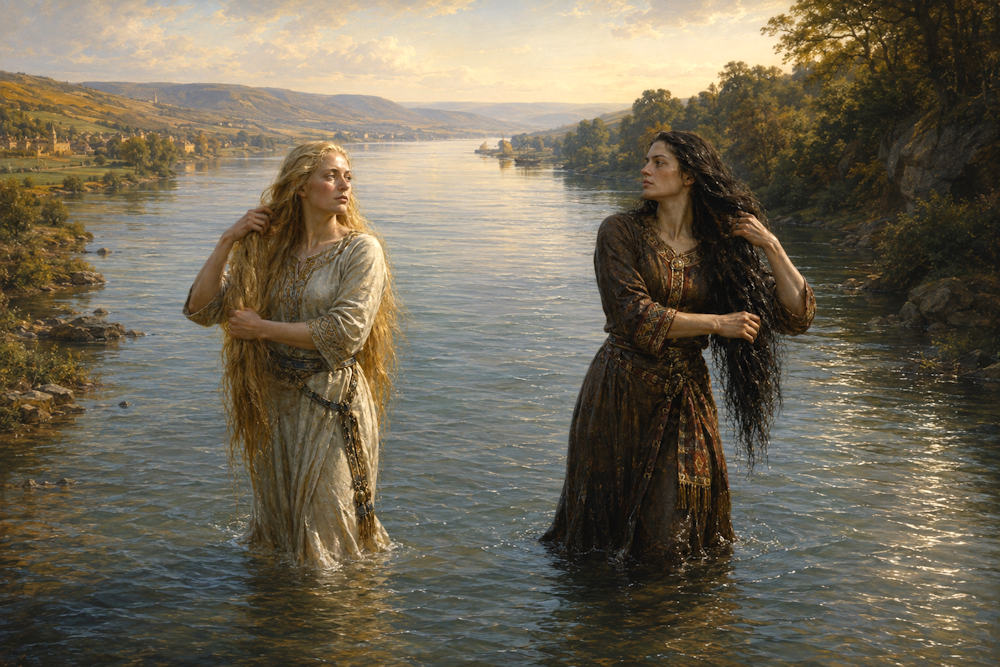
Brynhild replied: ‘It is worth more that Gunnar rode through the wall of fire when Sigurd did not dare.’ Gudrun laughed and said: ‘Do you really believe Gunnar rode through the wall of fire? I think the man who came to your bed was the one who gave me this gold ring. But the gold ring you wear on your hand and received as a bridal gift is called Andvari’s Gift, and I do not believe Gunnar won it on Gnitaheath (“Rubble-Heath”).’ Brynhild then fell silent and went home.
Here again is an ingenious symbolism that gives us much to ponder. From a spiritual perspective the issue is the difference between inner and outer nature, between unity and diversity. In the German Nibelung legend, this quarrel between Kriemhild and Brünhild escalated outside a church over who had the right to enter first before the assembled people. This is a most curious question outside a house of God, which should surely be a temple of wholeness and unity.
The quarrel between Gudrun and Brynhild escalates similarly here. We have often encountered hair as a symbol of thoughts growing from the head, which can be cleansed in the flow of creation. Both inner and outer nature attend to this. But which of the two is mightier and joined to a higher spirit? Do thoughts flow from unity into diversity, or from diversity into unity?
For Sigurd as holistic reason, this question is clear. He recognizes Gudrun, Grimhild and Brynhild as different aspects of the same wholeness that he had already discovered in Sigrdrifa. Similarly, the Buddhist Heart Sutra says:
Form is emptiness, emptiness is form.
Emptiness is nothing other than form;
form is nothing other than emptiness.
For the discriminating intellect, however, this question is difficult to answer. For as soon as outer nature claims precedence, inner nature responds with a counterclaim. This is also our intellect’s usual path: it first grows up amid the diversity of outer forms and can then develop towards recognition of inner unity. Accordingly, Gunnar too is now challenged by Brynhild as to whether he inclines towards holistic reason or the separating ego:
Afterwards she incited Gunnar and Högni to kill Sigurd. But since they were bound to him by oaths, they urged their brother Gotthormr to kill him. He pierced him with a sword while he slept. When Sigurd received the wound, he hurled the sword Gram at him, and it cut Gotthormr in two. Thus Sigurd died, as did his three-year-old son named Sigmund, whom they slew. Afterwards Brynhild pierced herself with a sword, and she was burnt together with Sigurd. Gunnar and Högni then took Fafnir’s inheritance and Andvari’s Gift for themselves and ruled the lands.
Thus Brynhild now reveals how true the ego-intellect’s oaths are, as Sigrdrifa had also foretold. The ego-intellect feels threatened by holistic reason, wishes to kill it and no longer accept its guidance. Gunnar and Högni cannot, however, carry out this deed themselves, for the part cannot kill the whole. They therefore incite their brother Gotthormr. That is, they pervert the ‘God-Honour’ of reason with which the human being was endowed into Gudormr as the ‘God-Serpent’, as the following fragment of the Lay of Sigurd also describes in greater detail.
Sigurd’s being killed in his sleep again recalls the ‘Lay of Regin’, in which Otter was slain by the divine Loki because of his drowsy inattentiveness. Thus holistic reason can, in essence, only kill itself when it is no longer aware of its wholeness. And in truth it does not die at all, but merely disappears from the human space of consciousness, as does Gotthormr through Sigurd’s sword.
It is above all the conceptual ego-intellect that is responsible for this human inattentiveness towards wholeness and the divine. And at root it is the separating ego that kills reason’s vision of holistic life, makes the human being a solitary fighter and ultimately kills itself in the process.
That Gunnar and Högni also kill the three-year-old Sigmund makes their responsibility especially clear. Evidently they fear that the son might later avenge his father, as Sigrdrifa had foretold, allowing reason to come alive once more. Thus they kill not only reason’s present effectiveness in Sigurd, but also its possible continuation in Sigmund.
With this Brynhild, too, had evidently fulfilled her task as an aspect of Sigrdrifa. She kills herself and has herself burnt on the pyre together with Sigurd, Sigmund and Gotthormr, the three aspects of reason, as the Völsunga Saga relates in greater detail. This makes sense, for without holistic reason life immediately disappears from outer nature. Sadly, our modern natural science likewise regards 99.999999… per cent of the universe’s outer nature as dead (source: Harald Lesch) and cannot recognize holistic life. What a pity!
Högni’s role as the human ego, however, remains difficult to fathom in the other surviving lays of the Edda too, much as in every human being. Initially Högni even seems to represent Sigurd’s interests and advises against the fatal deed. Yet he later also says plainly to Gudrun: ‘We have killed Sigurd with the sword.’ Gunnar himself does not dare to say this.
Here it becomes clear that it is above all the intellect that forms, strengthens or weakens the ego in the human being. As long as Gunnar follows holistic reason, Högni too remains integrated into the healing order. But as soon as Gunnar turns away from Sigurd, Högni emerges as the separating power of the ego. The symbolic connection between Högni and the ego-dragon Fafnir finally becomes still clearer when his heart too is cut from his body at the end.
Accordingly, Gunnar and Högni now take possession of Sigurd’s golden treasure, Fafnir’s inheritance, given by Andvari as ‘Presence’—a presence that also meets us as a counterpart. Here we can again think of pure consciousness as the gold of truth, which can assume any form. But what becomes of it when the ego-intellect wishes to possess and use it without holistic reason? Will it be a blessing or a curse for the human being bereft of reason?
King Atli (‘Little Father’, but also the ‘Terrible One’), Budli’s son and Brynhild’s brother, then received as his wife Gudrun, who had been Sigurd’s, and they had children (Erp and Eitil). King Atli then invited Gunnar and Högni to visit him, and they accepted this invitation. But before setting out from home they hid the gold of Fafnir’s inheritance in the Rhine, and this gold has never been found again since.
King Atli, however, had an army ready there and fought Gunnar and Högni until they were captured. King Atli had Högni’s heart cut from his body while he was still alive. This caused his death. Gunnar he had thrown into a serpent-yard. A harp was secretly given to him, however, and he played it with his toes because his hands were bound. He played the harp so that all the serpents fell asleep except one adder. This crawled to him and bit him below the breastbone, driving its head into his chest. There it fastened onto his liver until he died.
Gunnar and Högni are called Niflungs and Gjukings. This is why gold is also called the ‘Treasure of the Niflungs’ or ‘Inheritance of the Niflungs’.
Why Gudrun now married King Atli has prompted much reflection and many different stories from a human perspective. From a spiritual perspective this actually happens of its own accord once the human being has killed holistic reason. For then we can no longer live in spiritual unity, but only in natural diversity on the natural side of the river of life. Accordingly, our inner soul as the principle of causation also joins itself to outer nature. And we can imagine how Gudrun thereby takes on more of the essence of her sister Gudny, of ‘divine renewal’ in the golden ring of natural regeneration.
Budli’s family in the Hunnish realm stands symbolically for outer nature. The name Budli can be interpreted as ‘Court-Servant’, which accords well with outer nature’s task, with its laws of cause and effect. Thus it serves the divine court where the gods sit in judgement daily at the Well of Fate.
Budli’s spiritual son is Atli. His name can be interpreted as ‘Little Father’, but also as the ‘Terrible One’, as he appears to the unreasonable solitary fighter as nature’s hostile spirit: a terrible father who is actually benevolent and wishes to educate his children with divine justice.
Thus Högni and Gunnar as ego-intellect must now follow the human soul into outer nature, which in Brynhild had lost its life for the human intellect. In doing so they also conceal the gold of truth as ‘Rhinegold’ in the river of life and must leave it behind there, where humankind can one day rediscover it. The spirit of this nature receives them with corresponding hostility, and they are captured and bound, as ultimately happens to every solitary fighter in nature, to be cleansed of delusion.
To this end the ego’s heart is cut out, so that it loses what is most important and essential to it: its supposed property, on which the ego lives. Thus Högni dies, just as Fafnir died as the ego-dragon.
In outer nature the bound intellect is thrown into a ‘serpent-yard’ (Ormgarð). The serpents suggest the thoughts of separation with which it must now live in its world of opposites. It no longer has the freedom to overcome them finally, for its ‘Victory-Protector’ is dead. The harp ‘secretly given’ to it again points to a divine gift. It suggests the intellect’s ability to calm its thoughts through order and harmony and, as it were, put them to sleep. Yet without holistic reason it cannot overcome them finally. One adder always remains awake, however, and this might mean the discriminating intellect itself, so that it ultimately destroys its own liver as the seat of vital force and dies from the serpent-venom of separation.
Thus the human being without reason dies as an embodied ego-intellect, yet the soul continues its path as Gudrun within divine wholeness, for the problem is still far from resolved:
Soon afterwards Gudrun killed her two sons and had drinking vessels made from their skulls with gold and silver. The funeral feast for the Niflungs was then held. At this banquet Gudrun had mead poured for King Atli in these vessels, mixed with the boys’ blood. Their hearts she had roasted and given to the king to eat. And once this was done, she told him herself in many harsh words.
There was no shortage of intoxicating drink, so that most of the people sitting there fell asleep. That night she went to the king while he slept, accompanied by a son of Högni. They slew him, and this was his death. Then they set the hall on fire, and all who were inside were burnt.
Now dark night falls, and the human solitary fighter follows the path of death from Niflheim to Niflhel. Everything seems to sink into dark death. It was surely to this very funeral feast that Atli had invited the ego-intellect. Gudrun as the soul of causation now also kills the two sons she had borne Atli, for the third was evidently still missing from the living triangle of effects.
What do these two masculine, or spiritual, beings mean? In other sources they are called Erp and Eitil. As so often, their etymological meaning is not unambiguous. We might think of ‘Dark’ and ‘Hard’, again suggesting the formless and the formed as the spiritual principles of formless unity and formed diversity. Here too we might think of Gudrun’s connection with her sister Gudny in outer nature. In this light Gudrun would have borne Erp and Gudny Eitil.
Accordingly, their skulls as seats of the intellect also become two separate drinking vessels, adorned with the gold of formless truth and the silver of manifold forms. Both vessels contain mead as the divine drink of wholeness, but each is mingled with the essence of either formless unity or formed diversity. King Atli drinks from both vessels of the intellect and also eats the roasted hearts as the essence of his sons. Similarly, Sigurd had eaten Fafnir’s heart and drunk the blood of Regin and Fafnir. Yet here a different meaning is probably intended: the essence of the sons returns into the father, and with this there is no further development, so that King Atli falls asleep or at least loses his drive. This message from Gudrun was certainly not pleasant, but it followed the logic of causation. For without reason’s holistic spirit of life, unity and diversity harden into mere opposites, incapable of bringing forth any new living development.
Yes, on the human level this symbolism appears exceptionally cruel. Thus in many further lays and texts Gudrun is often portrayed as a grim and cruel avenger, while Högni, in whom the real evil of the separating ego lies, is readily glorified as a courageous and steadfast hero. Yet in essence Gudrun is merely fulfilling her task as the soul of causation. This happens through no wilful malice, but as a naturally necessary consequence when the human being, with the ego-intellect, kills the divine reason with which they were endowed. Therein lies the real cruelty…
Now we can well imagine the two drinking vessels of the intellect passing separately through the hall. From the silver vessel people drink the intoxicating beer, causing ‘most of the people to fall asleep’ in dreamlike illusion and unconsciousness. Those who drink only from the golden vessel and recognize formless unity, by contrast, remain awake, but no longer concern themselves with the manifold forms of the world and see no reason to prevent the destructive fire. Here we can reflect on the two extremes of spiritual nihilism and materialistic eternalism. Between them the golden ring of renewal revolves, provided we can contemplate the greater whole in reason’s living light. Otherwise night falls…
In this ‘night’ Atli too is now killed, having evidently fulfilled his task as Gudrun’s husband. Högni’s son is used symbolically for the deadly spirit, presumably meaning Högni’s heart and essence. For the separating ego-spirit is naturally also a deadly spirit. In other sources this son is called ‘Niflung’, meaning ‘Mist-Being’. And this is also the mist-clouded spirit that goes from Niflheim, from the serpent-well of birth, to Niflhel, to end there in death.
Accordingly, this ‘funeral feast’ for the spirit and body of the Nifl-human ends in a mighty pyre, in which the entire hall as a space of consciousness burns with all its contents. Thus the soul has now lost both Sigurd’s spiritual unity and Atli’s natural diversity. An understandable reason to wish to destroy itself too and sink into the sea of life:
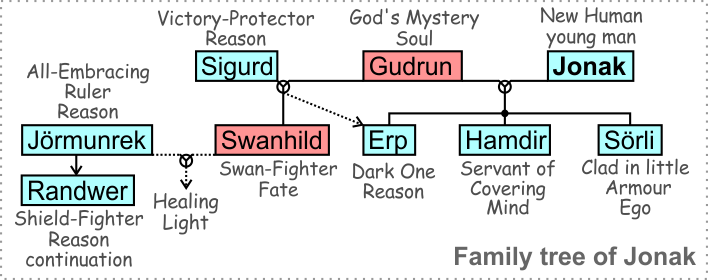
Afterwards she went to the sea, leapt into the water and wished to kill herself. But she was driven across the fjord and came to the land belonging to King Jonak. When he saw her, he took her in and married her. They had three sons, called Sörli, Hamdir and Erp. All had raven-black hair, like Gunnar, Högni and the other Niflungs.
Here it becomes clear that the soul of causation cannot remain submerged for long in the sea of life, because this is also a Sea of Causes. Soon it surfaces again to resolve the accumulated problems and is driven into a new land in the realm of nature.
The new names are again difficult to interpret. Jonak might suggest a ‘Young Man’ or ‘Young Fighter’, a new human spirit that once more joins itself to the soul of causation. From a spiritual perspective we might think of a descendant of Budli in the Hunnish realm on the natural side of the Rhine as the river of life. The names of their three sons, Sörli, Hamdir and Erp, can be understood as ‘Clad in Little Armour’, ‘Servant of the Covering’ and ‘Dark One’. Thus they again suggest the spiritual powers of Högni, Gunnar and Gotthormr as ego, intellect and still-darkened reason.
In this way a living triangle of effects appears once more. And we can imagine how Erp, who seemingly became dead, formless unity, comes alive again as the human gift of reason. Thus in principle Sigurd’s son Sigmund also lives on here, for true reason is immortal. Similarly, ego and intellect also awaken from death, albeit still darkened. For all three had ‘raven-black hair’, recalling the darkened, mist-clouded thoughts of the Niflungs. Yet there is also a ray of light from a fate guided by reason:
Swanhild, daughter of the young Sigurd, also grew up there, and she was the most beautiful of all women. The mighty King Jörmunrek (‘All-Embracing Ruler’, Ermenrich) heard of this. He sent his son Randver (‘Shield-Fighter’) to woo her for him. When he came to Jonak, Swanhild was entrusted to him to bring her to King Jörmunrek.
Then Jarl Bikki (the king’s counsellor) suggested that it would be better for Randver to have Swanhild as his wife, since both were young, whereas Jörmunrek was old. This counsel pleased the young people. Bikki reported this to the king. Jörmunrek then had his son seized and led to the gallows. Randver took his falcon, plucked out all its feathers and asked that it be sent to his father. Then he was hanged.
When Jörmunrek saw the falcon, he recognized that his power was coming to an end, because he was old and without a son, just as the bird could not fly without feathers. When the king later returned from hunting in a forest, he saw Swanhild sitting bleaching (washing and combing) her hair. They then rode over her and trampled her to death beneath the horses’ hooves.
Here we rediscover a brief version of the old German legend of Emperor Ermenrich, which we have already explored and interpreted in detail on our fairy-tale pages. Accordingly, in King Jörmunrek as the ‘All-Embracing Ruler’ we can once again recognize the reason of a Sigurd, which should rule holistically as emperor. It would thus have been healing for the human being if Jörmunrek had united with Swanhild as pure fate, to accept it and allow it to take effect and heal within his realm. In his son Randver as the ‘Shield-Fighter’, we might accordingly rediscover a Sigmund as the ‘Victory-Protector’, intended to continue the path of the Einherjar. In this light, Erp, Jörmunrek and Randver again present the three aspects of holistic reason as inherited potential, effectiveness and continuation.
What a healing life it would be if the human being could entrust their fate, and thus also their soul, to holistic reason, to the divine itself! Then the intellect would serve in the army of unity and the ego would be a holistic self. After self-knowledge, this would be the great path of self-realization that yogis, monks and Einherjar have followed for so long. Yet our human being is evidently not yet ready, and the old obstacles appear once more:
In Bikki we can rediscover the two imperial counsellors Sibich and Ribestein from the German legend, who as ego and intellect should serve within the human being in the bodily world under the rule of reason. Yet out of jealousy they wished to take power themselves and began to misuse the trust placed in them for their own interests. Bikki intrigues similarly here: he tempts Randver to reach for his father’s fate, then tells the father that his son has betrayed him with Swanhild. Thus he creates the impression that the soul of pure fate too has lost her purity.
This again shows how the ego-intellect cannot kill reason directly. Yet as soon as holistic reason allows itself to be ruled by the separating ego-intellect, it destroys itself. For in doing so it loses its wholeness and takes on the nature of the ego-intellect. Thus the latter once again ensures that human reason is ruined and kills its own offspring. With this the human being loses the nature of an Einherji and becomes a solitary fighter.
Thus he rides out to hunt in the forest of his ideas and, through attachment to his physicality, also destroys his soul of pure and divine fate, which was meant to cleanse the hair or thoughts. In other words, he now wishes to subdue and kill his personal and supposedly hostile fate through physical violence. Just as today we still seek to solve humankind’s great problems primarily by physical means, with much technology, chemistry and energy, which is above all a form of suppression and evidently destroys human reason.
In the German legend the falcon-symbol is a goshawk, whose German name, Habicht, recalls ‘Hab-Ich’ (‘I have’). On this path it ultimately loses everything it sought to gain, when the human being destroys the holistic reason with which they were endowed.
At this point we could reflect at length on the symbolism of stepchildren. Gudrun too brought her daughter Swanhild into her new marriage, and from a spiritual perspective possibly even her son Erp, whose essence, like Sigmund’s and Sigurd’s, is fundamentally immortal. Stepchildren play highly significant roles in many old legends and fairy tales, often as innocent, pure and virtuous beings who also suffer. We need only think of Snow White, Cinderella or Goldmarie in Mother Holle. In earlier worldly life it was probably also not uncommon for stepchildren to be brought into a marriage, since people often died prematurely of illness or in wars. Today such ‘blended families’ arise mainly through separations and divorces. A particular dynamic of belonging, identification and recognition can develop among the children. A healing resolution of such conflicts has surely always lain above all in seeing stepchildren as ‘God-given’ children. Accordingly, we also find them repeatedly in the stories of the Edda. Hjördis brought the newborn Sigurd into her marriage with Alf. Gotthormr was Gjuki’s stepson, and Erp also plays such a role in some versions. Thus Randver too would have become a stepson after King Jörmunrek’s marriage to Swanhild. In these stepsons we can symbolically recognize the God-given spirit of pure reason, just as in the stepdaughter Swanhild we can now recognize God-given pure fate.
Yet King Jörmunrek’s reason once again falls under the rule of the ego-intellect. By having Randver and Swanhild killed, he rejects God-given pure fate and at the same time creates a new, wilful and physically bound fate for himself. This is why Gudrun as the ‘divine mystery’ and soul of causation must again undertake the task of retribution, whose ultimate great goal is healing. For such a spirit should not reign as king within the human being:
When Gudrun heard of this, she urged her sons to avenge Swanhild. As they prepared for the journey, she gave them mailcoats and helmets so strong that no iron could harm them. She also counselled them, when they reached King Jörmunrek, to go to him at night while he slept. Sörli and Hamdir were to cut off his hands and feet, but Erp his head.
Thus the soul as the principle of causation now urges on the three spiritual powers of ego, intellect and reason, to resolve the problem of fate suppressed through physicality. To this end she gives them helmets and mailcoats as symbolic protection for their inner essence and outer form. That ‘no iron can harm them’ might mean that no sword can cut these spiritual beings apart or discriminate between them any further in conceptual terms. No other weapon can therefore penetrate them either, and so they are indestructible as ‘elementary principles’. Together this triad would be capable of winning the great victory over the sleeping King Jörmunrek. In his sleep we again encounter the symbolism of inattentiveness that had already proved fatal to Otter, Sigurd and Gotthormr.
In this triad as a ‘triangle of effects’, each power has its particular task, symbolized here by foot, hand and head. With Sörli, the foot suggests the ego, which through personal boundaries enables the human being, like every other living being, to follow a path of development through time and space. With Hamdir, the hand suggests the intellect, which enables the living being to act effectively. With Erp, the head should rule over everything as divine reason and holistic vision—ideally enlightened, as symbolized by the halo of the saints. Briefly put: the head recognizes and guides, the hand acts and brings effects, and the foot journeys and carries these effects through time and space.
We can now imagine their task as freeing these three fundamental spiritual principles from their attachment to the rigidifying physicality into which King Jörmunrek had fallen through his deceptive ego-intellect. By cutting off his head, hands and feet, they are to release reason, intellect and ego from their bondage to this rigid embodiment. In doing so they would also free themselves and rediscover the great victory in wholeness.
This is a most astonishing message: how reason, intellect and ego, united, can redeem and free themselves from bodily bondage. But:
On their way they asked Erp what help he would give them when they met King Jörmunrek. He answered that he would help them as the hand helps the foot. They thought it worth nothing at all for the foot to lean upon the hand. And since they were also angry with their mother, who had sent them on their way with hate-filled words (calling for revenge), they wanted to do what would seem worst to her. So they slew Erp (with a stone), for she loved him most.
Here the great human problem is addressed: how difficult the ego-intellect finds it to recognize the true value of reason’s holistic vision. For reason seems to do nothing. Its essential task is to be aware of wholeness and unity and to guide with this holistic vision. This is precisely why it also struggles so much in our present world, where the separating ego-intellect chiefly rules. To the latter, reason seems to have no discernible use in the daily struggle for life.
That the mother loves Erp most, and the other two brothers conspire against him and kill him, again recalls the motif of the stepson and half-brother. The manner of his death is discussed in greater detail at the end of the story, for he is actually invulnerable and immortal, above all as holistic reason. Thus we can imagine him buried and bound beneath a heavy stone by his brothers, just as King Jörmunrek was bound by physicality. From a spiritual perspective we can think of a hardening and rigidification of the living principle of reason through the intellect’s conceptual power. Reason is not truly destroyed in the process, but buried beneath the weight of physicality and suppressed from conscious life. This is also why, in the stories of the gods, Thor travels with his hammer, to shatter such hardenings and rigidities once more.
And so something extraordinary happens here too:
Shortly afterwards, as Sörli strode along, he slipped with one foot and supported himself with his hand. Then he said: ‘Now the hand has supported the foot. It would be better now if Erp were still alive.’ When they came to King Jörmunrek at night while he slept and cut off his hands and feet, he awoke and called for his men to wake. Hamdir then said: ‘Now the head too would be off if Erp were still alive.’ The retainers leapt up and attacked them, but could not wound them with their weapons. Jörmunrek then called out that they should stone them to death. And so it happened. Sörli and Hamdir fell there. And with this the entire line of Gjuki, with all its descendants, was dead.
What is extraordinary is that the ego-intellect begins to recognize reason’s useful nature, above all through its loss, when it is no longer present. The brothers slowly grasp that everything has always belonged together and that nothing lives solely for itself. They recognize how the foot needs the hand, and the hand the head. Without reason they could indeed cut foot and hand, as powers of the deceptive ego-intellect, away from embodiment, but could not free the head from its bodily bondage, so as to recognize everything once more unbound and free within wholeness. Only then could the human being return to the spiritual side of the Rhine and live as an all-conscious ruler in the Frankish realm of the ‘Bold and Free’.
But as it is, the bodily bound head, even while dying, calls for its retainers in the realm of nature, whom we might imagine as the laws of nature. And the two brothers meet the same end as they had previously (presumably) inflicted upon their brother Erp: they are stoned to death, suggesting material embodiment, hardening and rigidification in outer nature. Thus all three remain bound to the heaviness of this nature with its laws. And if we regard it as dead because the vision of holistic life is absent, they too appear dead, as does the entire Gjuki-human. This is how the human being endowed with reason ends when they kill their reason: remaining trapped in death as a solitary fighter, unable to rise to Valhalla as an Einherji.
Yet there are two rays of light. On the one hand Gudrun lives on, the eternal soul of nature as the ‘divine mystery’. On the other, the separating ego-intellect’s awakening recognition of the value of holistic reason is surely not lost in the Sea of Causes either. And with this even a third ray of light appears:
This is why the mailcoat is called the ‘Clothing or Garment of Hamdir and Sörli’. A daughter survived the young Sigurd, named Aslaug (‘Consecrated to God’). She was brought up by Heimir (the ‘One at Home’) in the Hlym Valleys (‘Echo’ or ‘Noise’ Valleys), and great lineages sprang from her. It is also told that Sigmund, Völsung’s son, was so powerful that he could drink poison without being harmed. His son Sinfjötli and Sigurd, however, had such tough skin that no poison harmed them when it touched their bare skin from outside. The skald Bragi composed these verses about it:
Upon the fishing-hook it hung,
the eel of Völsung’s drink, curved and writhing,
when Thor, who found Lit’s companion,
drew it from the dark waters.
(Skáldskaparmál §39-41, following Arnulf Krause, Arthur Gilchrist Brodeur and the Old Norse source)
Thus the mailcoat as the body’s outer material armour is also called the ‘Clothing or Garment of the Ego-Intellect’, when outer nature, through the ego-intellect’s power, veils the gold of truth through form: pure consciousness as Odin’s eye.
The third ray of light is Aslaug, Brynhild’s daughter ‘consecrated to God’, of whom we have already spoken. Following the story so far, we can in practice imagine only Gunnar as her father. In other stories Brynhild speaks of Sigurd, as Snorri also hints here, for it was from him that she received the golden wedding-ring of renewal and regeneration. This ring, recalling Draupnir, comes from the dwarfs as nature-spirits and powers of formation, and we can well imagine it being passed on by the dying Brynhild as outer nature to her daughter. In this light Aslaug was also endowed with Sigurd’s holistic spirit and in this sense ‘consecrated to God’. Thus she survives the downfall of Gjuki’s line and can continue the great human lineages in the realm of nature.
Outside the Edda, the longer ‘Saga of Ragnar Lodbrok’ tells of this, and Gunnar-intellect’s symbolic harp reappears, which he played with his foot, though not without a head. This even suggests a holistic spiritual fatherhood of reason, intellect and ego for Aslaug, ‘consecrated to God’. Thus we are told how Heimir conceals the child inside a harp and protects her on his journey. This is a beautiful image of how the intellect’s harp of thoughts preserves the seed of a new development. Through Aslaug the inheritance of the Völsungs continues in a new cycle of legends. Later she bears Ragnar another Sigurd, with the ‘Serpent in the Eye’, to confirm her noble descent. (See Wikipedia, Aslaug.)
The poison suggests the ego-poison of separation, through which holistic reason can be driven out of human consciousness as soon as it allows itself to be ruled by it. Sigmund was protected against this poison inwardly, and Sinfjötli and Sigurd outwardly, again recalling the symbolic protection of helmet and mailcoat in relation to inner and outer nature. Accordingly, we can imagine Sigmund being killed in the outer struggle and Sigurd in the inner one. The tough skin also recalls the German legend of Siegfried, who gained an invulnerable horny skin by bathing in dragon’s blood, except for the spot covered by a linden leaf.
The story of Sinfjötli is told in the context of the Helgi lays and at greater length in the Völsunga Saga. His name might symbolically mean ‘Sinew-Bond’ and suggests the continuation of fate. He was begotten by Sigmund with his twin sister Signy to avenge the death of their father Völsung. Later his stepmother Borghild (‘Fortress-Fighter’) offered him a drinking-horn of poisoned beer. While his father Sigmund could drink the poison without harm, Sinfjötli died from it. Evidently he had fulfilled his task. Sigmund brought the body to the sea. There a mysterious ferryman appeared, took Sinfjötli into his boat and disappeared with him. The ferryman is often interpreted as Odin, bringing Sinfjötli to the Einherjar in Valhalla.
The concluding verse recalls the story of Thor fishing the Midgard Serpent out of the sea of life, which we have already encountered as a symbol of separation. This makes clear once more that the issue here is the serpent-venom of separation, which the Einherjar drink in this world, to digest it inwardly and let it take effect outwardly. Herein surely lies their great task as fighters in the army of unity: to resolve the accumulated fundamental problem of ego-separation.
Summary of Sigurd’s Heroic Story So Far
We have now encountered several stories in which we can rediscover the fundamental ‘triangle of effects’ of ego, intellect and reason on different levels of consciousness and from different perspectives. The stories draw on various old legends and have been ingeniously woven together here. From a spiritual and symbolic perspective, we might briefly see them as follows, finding in them a masterpiece of human psychology:
At the beginning stands the story of Hreidmar, ‘Nest-Glory’, whom we can regard, like the biblical Adam, as a ‘human being of holistic reason’, still able to encounter the gods. Yet his rational spirit of life became inattentive, no longer fully aware of wholeness and the divine while taking nourishment in the river of life. Thus holistic reason died, struck down by divine power, just as reason can only ever kill itself, through unconsciousness of itself. Yet God takes nothing away without giving something better:
Thus Hreidmar became a ‘human being endowed with truth’, given the gold of truth that can assume any outer form, together with the golden ring of renewal and regeneration. Yet he wished to possess this gift personally. This is why reason did not come alive again within him; instead his ego-intellect reached for the gold of truth and killed the truthful human being, who now fell into the separation of masculine and feminine, into spirit and nature. As he died, he asked his two daughters, as inner soul and outer nature, to take revenge upon this ego-intellect of the spirit, which is surely also the fundamental task of nature with its laws of cause and effect.
For this great victory of reason over the ego-intellect, Sigurd was born as the ‘Victory-Protector’. He came, saw and conquered, for he embodied victory itself. To this end we are told how he united within himself the purity of reason, intellect, ego and physicality together with the golden treasure of truth. With this he was once more a holistic, divine human being, who, like Christ, should now help all other human beings towards the same. For this purpose he awakened Sigrdrifa, nature’s ‘Victory-Driver’, who provided the appropriate circumstances and teachings about nature’s rune-mysteries. Thus every human being now has the opportunity to reunite their soul with holistic reason as the ‘Victory-Protector’, thereby realizing divine wholeness within themselves.
Accordingly, the symbolic story continues with Gjuki, the ‘human being endowed with reason’, who in turn had three sons as the spiritual powers of ego, intellect and God-given reason, as well as two daughters as inner soul and outer nature. So that reason might again become the human being’s guiding essence, Sigurd married his soul, Gudrun. Yet the ego-intellect did not wish to submit to reason and accept its guidance, but corrupted God-given reason and thereby killed Sigurd and his son Sigmund, who was meant to continue the path as an Einherji. Through this Gotthormr, the human being’s God-given reason, also died, and Gjuki’s two daughters Gudrun and Gudny, as inner soul and outer nature, are once more challenged to take revenge upon the faithless ego-intellect.
To this end the soul unites with Atli as the spirit of outer nature. Without reason’s vision of holistic life, this nature now appears as dead material nature, with only scattered individual living beings dwelling in separation from one another, as though on a ‘Rubble-Heath’. The ego-intellect must follow the soul to the spirit of this seemingly dead nature, is itself killed there, and in the great funeral feast Atli himself also dies as the spirit of this nature, together with his sons. Thus everything seems to end in death.
Yet the eternal soul of nature lives on and emerges again from the Sea of Causes. In doing so she brings her daughter Swanhild as holistic fate, and from a spiritual perspective also her son Erp as the inherited potential for holistic reason. This shows that the soul as the principle of causation is an all-embracing soul of nature. Thus she unites once more with a human spirit in outer nature, and the story continues with King Jonak.
Once again ego, intellect and reason are born ‘dark-haired’, and through holistic fate the old unresolved problem resurfaces in this human being ‘endowed with reason’. To help him, King Jörmunrek appears with his son Randver, in whom we might symbolically see Sigurd once more with his son Sigmund, wishing to accept this human being’s fate in the form of Swanhild. But he too is deceived by the ego-intellect and falls into bodily bondage, as is always possible in this world. There is actually nothing bad in physicality itself as long as reason rules as holistic vision. As soon as the ego-intellect takes the lead, however, the human being is overwhelmed by bodily ego-attachment and tries to fight fate physically. Thus Jörmunrek has his son hanged and Swanhild trampled beneath his horses’ hooves.
Now Gudrun as soul and the principle of causation is challenged once more, and she sends the spiritual and fundamentally indestructible elementary principles of ego, intellect and reason into battle against King Jörmunrek’s bodily attachment, so that together they may rediscover their purity, freedom and wholeness. Yet here too the old problem repeats itself: the ego-intellect fails to recognize reason’s true value and kills it—at least seemingly—with the stone of bodily matter, behind which also lies the conceptual rigidification brought about by the intellect. And without reason, ego and intellect are finally overtaken by the same death. Thus the human being endowed with reason ends in death once more, dying as a separated solitary fighter, unable to rise as a holistic Einherji in the army of unity.
Yet there are rays of light from experience and insight guided by reason, and development continues, for the soul of nature remains immortal, as does the divine spirit of reason. How much further this development must go to resolve the fundamental problem of separation is a great question, which our intellect can probably never answer as long as it is joined to the ego in time and space. And when it is no longer so joined, the question is already answered and the problem dissolves like the mist of the Nibelungs… Wonderful!
Comparing the Norse and German Nibelung Legends
When we compare this Norse tradition with the German Nibelung legend, we encounter many similar underlying motifs despite the considerable differences. Names, family relationships and sequences of events changed in the course of transmission and were connected with other cycles of legends. Yet from a spiritual and symbolic perspective, in both versions we can recognize a profound portrayal of the inner human being. The individual figures embody masculine and feminine powers of spirit and nature: above all the fundamental spiritual ‘triangle of effects’ of ego, intellect and reason in connection with the feminine duality of inner soul and outer nature. And above all stands the great question: can the ego-intellect accept the guidance of holistic reason on the path of truth, or does it seek wilfully to rule over the human being, nature and fate?
The German Siegfried corresponds to the Norse Sigurd. Both defeat a dragon, win a golden treasure and find the imperishable essence. In the Norse myth Sigurd kills Fafnir as the ego-dragon, understands the language of birds after tasting his heart’s blood and takes the gold of truth to himself. In the German legend Siegfried bathes in dragon’s blood and gains a horny skin that protects him from external weapons. A linden leaf, however, prevents complete invulnerability. Thus a small spot of his bodily and conceptual form remains through which the ego-intellect can later kill him.
Siegfried also wins the Nibelung treasure through a quarrel between brothers. Schilbung and Nibelung cannot agree over their paternal inheritance, thus recalling Regin and Fafnir, who kill their father Hreidmar and then fight over the gold themselves. Siegfried also defeats the dwarf Alberich and wins his cloak of invisibility. Symbolically, this can be compared with Fafnir’s Aegis-Helmet: both confer the power to change the visible appearance of the inner essence.
Yet while Sigurd loads the golden treasure onto his horse Grani, thereby uniting the gold of truth with his physicality, Siegfried leaves the treasure behind in the Nibelung realm of outer nature, where Alberich as a nature-spirit of formation continues to guard it. In this we can recognize a great significance: the gold of truth also lies in outer nature. Thus Siegfried unites the two banks of the Rhine as spirit and nature into the great ‘Peace of Victory’, the meaning suggested by his name. Only after his death does Kriemhild have the treasure brought to the Burgundians’ realm. Through this, outer nature symbolically loses the gold of truth and then becomes the realm of death for the Burgundians’ ego-intellect, who are now called Nibelungs or ‘Mist-Beings’. Similarly, in the Norse tradition, with Sigurd’s death Brynhild as outer nature also loses her life.
In the German Nibelung legend we might rediscover Sigurd’s battle with King Lyngvi to avenge his father’s death in the struggle against Kings Lüdegast and Lüdeger of Denmark and Saxony. Siegfried defeats both kings and takes them captive. Unlike an ordinary battle of revenge, however, he does not kill them, but helps ultimately to transform the terrible war into lasting peace. Here the essence of the ‘Peace of Victory’ is already revealed.
As the story continues, it is especially confusing that the Norse Gudrun takes on the role of the German Kriemhild, while Gudrun’s mother Grimhild corresponds to the German Queen Ute. The names Gunnar and Gunther, Högni and Hagen, and Brynhild and Brünhild, by contrast, correspond more clearly. Here too we can recognize in the royal family the inner nature of a human being endowed with reason: Kriemhild embodies the inner soul, Gunther the conceptual intellect and Hagen the boundary-drawing ego. Siegfried joins them as holistic reason and unites with the soul, Kriemhild.
Brünhild, by contrast, appears as a mighty queen of outer nature. She lives not on the ‘Mountain of the Hinds’ behind a wall of fire, as in the Norse legend, but behind a wall of water in the sea, at Castle Isenstein, the ‘Iron Stone’. Like the armour of the mailcoat, this name too suggests a rigidified physicality that is difficult to penetrate. Brünhild possesses superhuman strength and will marry only the man who defeats her in her deadly contests. The Gunther-intellect cannot win this outer nature’s love by its own strength. For this it needs Siegfried and his cloak of invisibility, the hidden omnipotence of holistic reason. For only under its guidance can the intellect truly conquer outer nature, win its love and join with it in a living unity. Without this reason, nature remains alien and hostile to it, ultimately even becoming deadly.
Thus, like Sigurd and Gunnar, Siegfried and Gunther also symbolically exchange their appearances. Siegfried invisibly performs the deeds outwardly attributed to Gunther. This means that the intellect can unite in marriage with outer nature only with the help of holistic reason. But as soon as it conceals this connection and passes off reason’s achievements as its own, a lie arises that must later be revealed.
In the Norse tradition this deception is exposed through Andvari’s ring. In the German legend Brünhild’s ring and girdle play a similar role. Siegfried takes these tokens of her natural power from her and gives them to Kriemhild. Thus the powers or mysteries of outer nature pass to the inner soul. When Kriemhild later displays these tokens, the deception is revealed.
The quarrel between Gudrun and Brynhild takes place at the river, where both wash their hair. In the German legend Kriemhild and Brünhild quarrel outside a church over who may enter first. Both places have a similar spiritual significance: the river is the stream of life in which discriminating thoughts should be cleansed, and the house of God is a temple of wholeness and unity. It is precisely in these places that the question of precedence, and thus of separation between inner soul and outer nature, should be resolved.
Yet in both versions this quarrel escalates, and the intellect seeks a solution in alliance with the ego rather than with reason. The ego emerges still more clearly in Hagen in the German legend and supports the murder of reason. Hagen wins Kriemhild’s trust and persuades her, out of love and concern, to mark Siegfried’s vulnerable spot. Here the soul is thus misused for murder, as Gotthormr is in the Norse legend. And finally Hagen kills Siegfried with Siegfried’s own spear, for he himself lacks the power to do so with his own weapons, because the part cannot overcome the whole. Yet the deeper reason why the separating ego can kill holistic reason lies in the intellect’s turning away from reason. With this the human being loses awareness of wholeness and can no longer resolve the conflict of worldly opposites in a healing way. This inattentiveness appears both in Kriemhild and in Siegfried, especially when he was careless about his weapons. In this regard we can also think of the death of Sieglinde, Siegfried’s mother.
After Siegfried’s death, Kriemhild has the Nibelung treasure brought from the realm of nature guarded by Alberich to Burgundy. This recalls the golden treasure that Loki fetched from the dwarf Andvari after Otter’s death and handed to Hreidmar. Kriemhild does indeed try to use the gold for good through generous giving, but here too holistic reason cannot come alive again. Hagen fears the power Kriemhild might gain with the treasure, seizes control of it and thus removes it from the soul. Yet like Fafnir, he too cannot use the gold of truth for healing. He sinks it in the Rhine, thus hiding truth in the river of life. Although the treasure endures imperishably, it is no longer accessible to the human being without reason.
Now the inner soul as the principle of causation is called upon to resolve the problem in another way. That is, it actually resolves itself through the accumulated causes. Thus Kriemhild marries Etzel, as Gudrun marries Atli. In both versions the soul thereby reaches the Hunnish realm on the side of outer nature, which with the death of holistic reason had lost its holistic vitality and become a realm of death. Accordingly, in the Norse version Brynhild dies as Atli’s sister, while in the German version we can think of the death of Helche, Etzel’s kind-hearted wife.
There is much to ponder in the similarities between Atli and Etzel. The name Etzel can be derived from the Middle High German ‘etze’, meaning pastureland, thus suggesting a pasture in the realm of nature which, according to the old legends, provided for many great heroes. Walthari and even Hagen spent part of their youth there; Rüdiger served Etzel as margrave; and Dietrich and Hildebrand found refuge with him from Emperor Ermenrich, whom we encountered in the Norse legend as King Jörmunrek.
Etzel’s royal castle is described as standing on the Danube. In his heyday, when Queen Helche was alive, his rule extended far beyond the Rhine into the Frankish realm. Yet with Siegfried’s death and Emperor Ermenrich’s dying reason, death spread ever wider. Etzel’s sons Erp and Ortwin died in the Battle of Ravenna, after which their mother Helche also died of grief. After the lost Battle of Ravenna, the heroes guided by reason, Dietrich and Hildebrand, also withdrew from the living world to Etzel’s royal castle as an alternative to senseless death on the battlefield.
Thus fate also led Kriemhild to this castle. She became Etzel’s second wife and bore him a son named Ortlieb. Like the Norse Gunnar and Högni, Gunther and Hagen then also had to follow their soul as the principle of causation into the realm of outer nature, to this castle. In doing so they left the Rhine as the river of life, where they also left the golden treasure behind, and followed the Danube, which flows east into the ‘Black Sea’ and became their river of death. Thus both died in Etzel’s royal castle with their entire Nibelung retinue, so that here too the splendid banquet became their funeral feast.
One particular feature is that Kriemhild sought above all the death of Hagen, whom she recognized as her chief enemy. Hagen therefore also brought about the final escalation of the fighting by killing Kriemhild and Etzel’s little son before everyone’s eyes. Yet Kriemhild repeatedly offered Hagen a chance to sacrifice himself for all the other Nibelungs and relinquish his ego-nature by returning the golden treasure. But he vehemently refused, seeing himself as a hero.
Thus the Nibelungs’ remaining power was finally broken above all by Dietrich and Hildebrand with their retinue, who in this final battle became effective and alive once more as holistic reason and an intellect guided by reason. In the end only Gunther and Hagen remained, defeated and captured by Dietrich himself. Yet Hagen continued to refuse to reveal the Rhinegold’s hiding place, thus causing Gunther’s death as well. Finally Kriemhild herself seized Siegfried’s sword, which Hagen had appropriated, and killed him with it.
Hildebrand could not understand this incredible deed by a woman and slew Kriemhild before King Etzel’s eyes. From a spiritual and symbolic perspective, we might see here how the intellect guided by reason makes one out of two again, so that the contentious opposition between inner and outer nature disappears. And just as Gudrun survives in the Norse version, here Brünhild, who had remained by the Rhine, survives.
Thus Kriemhild died after overcoming the ego and apparently fulfilling her task. Unlike the Norse Atli, King Etzel remains alive, but sinks into deep grief and lethargy in this realm of death. In this respect he recalls King Barbarossa, the sleeping king of the Kyffhäuser legend, whose power has withdrawn from the living world and awaits a new awakening. Perhaps Atli’s death in the Norse tradition has a similar meaning.
In the German legend, the Burgundian survivors include in particular the two sons of Siegfried and Gunther, once named after each other’s father out of mutual affection, again recalling reason and intellect. Similarly, Dietrich and Hildebrand also survive as reason and intellect. After this fundamental victory over the ego they return to their homeland in the living world, where the great problem of Ermenrich now clarifies and resolves itself, as the Thidrek Saga relates.
Brünhild survives with them, and the ‘Nibelungenklage’ tells how in Burgundy she learns of her husband Gunther’s death and the downfall of the other Nibelungs. She collapses physically under the news and regrets her former quarrel with Kriemhild. This means that inwardly she becomes reconciled and united with her once more. She then comes alive again, summons the great figures of the realm and, together with the old counsellors, assumes the government and guardianship of her young son Siegfried. He is crowned king and is to continue the Burgundian realm with renewed reason.
In the Norse tradition we can think here of Aslaug, Brynhild’s daughter, who later also gives birth to a Sigurd, thus continuing the development in a new cycle of legends. In both versions, then, a child of outer nature survives, through whom the spirit of reason can appear anew in the human world.
What we might miss in the Norse tradition, however, is a figure of the intellect such as Hildebrand, reason’s faithful servant: an intellect guided by reason and acting accordingly, running through many old German legends and accompanying Dietrich on his long path through rule, exile, struggle and homecoming. Here we might also think of the young Gunther, son of the slain Siegfried, who presumably then ruled on the lower Rhine in Xanten, where his father was born and his grandfather Siegmund was still alive.
Thus from a spiritual perspective both traditions reveal the same fundamental idea: the human being is endowed with holistic reason and through it could unite ego, intellect, soul and physicality into a living whole. Yet the ego-intellect wishes to possess truth as a separate personal property, attributes reason’s effectiveness to itself and finally destroys the holistic guidance to which it should entrust itself. The gold of truth then sinks into the river of life, yet remains there imperishably preserved. The human being can rediscover it at any time, once they no longer reach for it in order to possess it personally, but are ready to let its truth guide them towards wholeness. The only question is whether this requires a god like Loki once more, to bring forth the hidden gold, or whether a Sigurd is enough, who recognizes it, wins it and knows how to use it for healing…

