
| Content | Next | About |
The Short Lay of Sigurd (and Longer Lay of Brynhild)
1. Once Sigurd (the ‘Victory-Protector’), the young Völsung (as the ‘Chosen One’), who had already won victory, came to Gjuki (the ‘Gifted and Giving One’). He received the pledges of loyalty of the two brothers (Gunnar and Högni), and the brave men bound themselves together by oaths.
2. They offered him a maiden and a wealth of precious things: the young Gudrun (‘God-Rune’), Gjuki’s daughter. The young Sigurd and Gjuki’s sons drank and took counsel together for many days.
Thus the effectiveness of holistic reason enters the Gjuki-human endowed with reason and unites with his soul. Together with the ego-intellect, mead and beer are drunk, the human being learns holistic recognition, and with this the intellect should finally conquer and win outer nature.
3. At last they set out to woo Brynhild. Sigurd, the young Völsung, accompanied them and knew the way. He himself would have won her if he could have had her (yet this was not to be).
4. The southern man laid a bare sword, a blade adorned with signs, between them both. Neither did he attempt to kiss the woman, nor did the Hunnish king clasp her in his arms. He handed her over to Gjuki’s son as an untouched maiden.
From a spiritual perspective the old problem appears once more: holistic reason cannot unite directly with outer nature’s diversity. Between them must lie the sword of the discriminating intellect, the ‘blade adorned with signs’, presumably Gram here, Sigurd’s sword forged for him by the Regin-intellect. In the Norse World Tree, the ‘southern man’ suggests a spiritual hero, namely Sigurd, who had assumed Gunnar’s form, presumably with the Aegis-Helmet from the dragon’s treasure. In this way the discriminating intellect, behind which stands holistic reason, was to marry outer nature and thus become the ‘Hunnish king’ in nature’s Budli-realm.
It is puzzling why Sigurd is also called a ‘Hunnish king’ several more times later in the lay, although from a spiritual perspective this position should actually belong to Gunnar after his marriage to Brynhild. The usual scholarly interpretation is that in the north ‘Hunnish’ was generally understood as ‘southern’. But why is Sigurd in particular described in this way? The Edda clearly traces his origins to Denmark and Frankland, and by his paternal inheritance he is actually a ‘Frankish king’. Why can Franks be Huns, but Huns not Franks? In Zen Buddhism it is said:
Wherever I go, there he is.
He is none other than myself, yet I am not he.
(Dongshan, Zen master)
This might mean: unity is the foundation of diversity, but diversity is not unity. For:
The whole is more than the sum of its parts.
(Aristotle, Greek philosopher)
Thus perhaps Brynhild too (and later even Högni) sees in Sigurd the true king of the Huns as the realm of outer nature, because Gunnar could not rise to this level…
5. She knew no fault in herself in life, no death-bringing harm and no injustice, either real or apparent. Yet grim powers of fate intervened.
6. Alone she sat outside at the day’s evening. Then she began to speak openly: ‘Sigurd I must have—or else die—the young man in my arms!
7. Now I have spoken it, yet already I regret it: Gudrun is his wife, but I am Gunnar’s wife. Cruel Norns (of fate) created long yearning for us.’
Yes, outer nature itself bears no guilt. She is a pure maiden, as reason hands her over to the intellect. In her pure essence she strives quite naturally towards holistic reason in ‘long yearning’. Together with the inner soul as the principle of fateful causation, she thus fulfils her great task in creation. This is why Brynhild knows that without reason’s wholeness she must die in separation, and as outer nature she speaks this openly. It is now the intellect’s task to heal this pain of separation, for together with the separating ego it has itself accumulated the corresponding causes. And we must eat the broth we have made for ourselves…
8. Often she goes inside (the house), filled with harm and icy cold, every evening when Gudrun and Sigurd go to bed and he wraps his wife in (warm) covers. The Hunnish king loves his wife.
9. Brynhild thought: ‘I go bereft of yearning and of the (loving) man. With grim thoughts I must console myself!’
10. Then, out of this hatred, she began to incite killing: ‘You will lose everything, Gunnar: my land and myself. With you as prince I shall never live contentedly!
11. I shall return to where I was before, to my closest kin. There I shall sit and sleep my life away, unless you have Sigurd die and become a higher prince than the others!
12. Let us also have the son (Sigmund) follow his father (Sigurd)! A young wolf should not be allowed to grow for long. For as long as the son lives, revenge threatens and reconciliation is unlikely.’
In practice we can think here of the natural ageing process. While reason and soul remain young and constant in their love, intellect and outer nature grow old. In doing so they can harden in their habits like the frost- and mountain-giants in the stories of the gods, fought by Thor with his hammer. It was surely with a similar purpose that Gudrun went to Thora in Denmark, the realm of the gods’ sons, at the end of the preceding lay.
Why can the rational intellect not preserve the same warm-hearted love for outer nature as reason does for the inner soul? Where does outer nature’s transient and deadly character come from, now threatening loss and separation? And where do Brynhild’s ‘grim thoughts’ come from, if not from the intellect of her own husband or spirit?
Yes, these are the great questions of the ancient sages. How can unity and diversity be brought together? Between them, the intellect is now challenged to find a solution:
13. Gunnar grew troubled and hung his head. All day he sat there turning thoughts over. He no longer knew clearly what he wanted or what action would be most fitting and best for him. He knew that he would lose the Völsung (‘Chosen One’) and painfully miss Sigurd (as the ‘Victory-Protector’).
14. In turn he considered each (of the two possibilities) for an equal length of time. Until then it had not been customary for wives to leave a royal house again. He then began to summon Högni to secret counsel (without Sigurd), for in him he found a close confidant in everything.
Here the fundamental problem becomes clear: the Gunnar-intellect of the Gjuki-human endowed with reason has the freedom to choose how to respond to the Valkyrie’s circumstances. Yet it does not recognize the meaning of the test set by the ‘Victory-Driver’, and finally turns away from reason towards Högni, the separating ego. Everything had begun so promisingly, and they had been able to live together for several happy years. Why does the intellect no longer seek joint counsel with Sigurd, holistic reason, to which it had already bound itself through the oaths of blood-brotherhood? Why is bodily brotherhood with Högni stronger than spiritual brotherhood?
15. Gunnar said: ‘Brynhild alone is worth more to me than all others. Budli’s daughter is the best of women! Sooner shall I give up my life than lose this lady’s treasures!
16. Do you wish us both to betray the army-leader for the sake of wealth? It would be good to rule over the Rhinegold, possess the wealth contentedly and enjoy happiness in peace.’
Is this love or desire?
17. Högni then answered spontaneously: ‘It does not befit us both to do such a thing: to break sworn oaths with the sword, sworn oaths and given pledges of loyalty!
18. We two know no happier men on earth, as long as the four of us (presumably Sigurd, Gunnar, Högni and Gotthormr) rule the people together and the Hunnish Battle-Baldr lives (Sigurd as the radiant “Victory-Protector”). Nor is there any finer bond of kinship on earth, if in time we can raise five sons and multiply our lineages well.
19. I know precisely where all this comes from: Brynhild’s desires are too great!’
Wonderful! Such an ego guided by reason could be our best friend, a holistic ‘I am’. It does not deliberate long, but answers spontaneously. Only one small problem remains: it sees the blame for suffering in outer nature. Yet it is not outer nature’s desires that make us suffer, but those of the intellect married to it. And because the ego seeks the blame not within the human being but in others, holistic reason must naturally die. Here too this happens through Gotthormr, the human potential for reason. The ego-intellect misuses and corrupts it, turning it into its opposite: from wholeness to separation, from healing to killing:
20. Gunnar said: ‘We two shall prepare Gotthormr (“God-Honourer”) to kill, our younger and more ignorant brother. He stands outside the sworn oaths, the sworn oaths and given pledges of loyalty.’
21. It was easy to incite the carefree one, and already the (severing) sword entered Sigurd’s heart.
22. The battle-ready one (Sigurd) avenged himself at once in the room and threw his sword at the carefree one. With full force Gram’s brightly shining iron blade flew from the king’s hand against Gotthormr.
23. His enemy fell in two: hands and head (as the upper body) fell to one side, but the feet (as the lower body) fell backwards on the spot.
Like the ego, reason too does not deliberate long. In its essential freedom it is carefree and readily lends itself to any purpose. Thus it can even kill itself, just as formless consciousness can seemingly assume any form and even become unconscious.
This unbridled carefreeness of reason is also described at the beginning of the German Nibelung legend (following Wilhelm Wägner) in Siegfried, who carelessly killed the Mimer-intellect, but was rebuked for it by his parents and admonished to show compassion.
Feet, hands and head symbolically recall the story of Erp, Hamdir and Sörli. That Sigurd’s sword Gram, forged by the Regin-intellect, here separates the feet as a symbol of ego from hand and head as intellect and reason could be an interesting final message from Sigurd. At any rate, they are separated, and through separation wholeness passes away.
24. Gudrun had fallen asleep without care in bed beside Sigurd. Yet when she awoke she was robbed of all joy, for she was swimming in the blood of Freyr’s (the summer-god’s) friend.
Yes, now winter falls within the Gjuki-human, for with wholeness the power of renewal and regeneration is also lost. He is no longer an Einherji, but falls into the state of a solitary fighter who ends in death.
Sleep again suggests inattentiveness or unconsciousness, for only through this can reason’s holistic awareness pass away.
25. Then Gudrun clasped her hands together so violently that the stout-hearted one (the gravely wounded Sigurd, once more) rose up in bed and said: ‘Do not weep so bitterly, Gudrun, very young bride: your brothers live!
26. My heir (Sigmund) is still far too young to escape the enclosure of enemies. Through the decision they have recently made, they have prepared something grievous and harmful for themselves.
27. No such sister’s son (as Sigmund) will ride behind them to the Thing in future, even if they raise seven others (sons). I know precisely what is happening now: Brynhild alone brings forth all this harm.
28. (For) the maiden loves me more than any other man. Yet I committed no wrong against Gunnar. I preserved kinship and the sworn oaths, so that no one could call me his wife’s lover.’
That Gudrun’s brothers live again recalls that the slain Gotthormr was only her stepbrother. According to his symbolic name, he embodies the potential for reason given by God. Her brothers’ survival is meant to comfort Gudrun, for this creation surely concerns above all the ego-intellect’s life and living itself out together with the inner soul as the driving causation.
Reason too can die only seemingly, from the perspective of separation. The planned murder of Sigurd’s young son Sigmund is also foreshadowed here. With him all three aspects of holistic reason then die: its potential in Gotthormr, its effectiveness in Sigurd and its continuation in Sigmund.
Just as Högni as ego previously spoke of five sons to be raised together, Sigurd now speaks of seven. Alongside the five senses, we might also think here of intellect and ego.
And just as Högni saw the cause of suffering in Brynhild’s desires, reason now speaks similarly, though surely from a holistic perspective. Thus Sigurd sees the Valkyrie as the ‘Victory-Driver’, who provides the outer circumstances and fateful conditions of life, bringing forth all the harm that seeks healing within creation. She does this out of love for holistic reason, thereby serving the creator-god and Allfather Odin. And reason ensures that the intellect can live and learn within this space of consciousness between unity and diversity—if we allow it to live…
29. The woman gave out her breath, but the king his life. Gudrun then clapped her hands so violently that the drinking-cups in the corner (of the room) resounded and the geese in the courtyard cried loudly.
The forceful exhalation and loud clapping of hands suggest the activity of the inner soul as the principle of causation. This time, however, Sigurd does not awaken once more; instead the clapping penetrates the outer world, into living beings’ drinking-cups and out into the whole courtyard of creation, where the geese as symbols of wholeness loudly proclaim the deed. Yes, this is the nature of wholeness, in which nothing is lost. And thus Brynhild hears it too:
30. Then Brynhild, Budli’s daughter, laughed with all her heart for the last time, when from her bed she heard Gjuki’s daughter’s resounding lament.
31. Then Gunnar, lord of warriors (the ‘Hawk-Bearer’), said: ‘Do not laugh at this so joyfully in the chamber, hateful woman, as though it promised you good! Why does the bright colour fade from your face, bringer of harm? I think (and fear) you are near death.
32. Among women you would deserve that we strike down (your brother) Atli before your eyes too. Then you would see in your brother (as we in Gotthormr) a bloody wound, bleeding wounds that you would have to bind (and heal)!’
As an outward story we could imagine Gunnar and Högni witnessing Sigurd’s murder and having to see their brother Gotthormr killed in the process too. Gunnar had evidently not expected this, which surely explains his anger towards Brynhild, whom he loved above all else, or at least desired. Presumably the young Sigmund was also killed by Gunnar and Högni at this time. Afterwards Gunnar returned to the bedchamber to Brynhild, who heard Gudrun’s resounding lament from there.
Her last laughter now announces a time of suffering and death within the Gjuki-human without reason. For as a Valkyrie she naturally sees the causes and corresponding fate together with Gudrun, and as outer nature she speaks them openly:
33. Brynhild then said: ‘No one can accuse you of lacking courage in battle, Gunnar! Yet you have already killed more than enough. Atli fears your anger little. Of you two, he will live longer and always be more powerful.
For killing leads into death…
34. I shall tell you, Gunnar—although you yourself know it precisely—how early you became entangled in guilt. I was neither too young nor pressed (to enter a marriage). In my brother’s hall I was richly endowed with possessions.
35. Nor did I wish a man to possess me before you sons of Gjuki came riding to the court: three men on horses, mighty kings (Gunnar, Högni and Gotthormr or Sigurd). Yet your journey need not have been made.
Yes, without ego, intellect and reason on their horses of physicality, no outer nature would be needed for development within it.
36. But Atli told me that he would not let the inheritance be divided, neither gold nor lands nor any share of acquired property, unless I let myself be given in marriage. Although he had handed property over to me when I was very young (already in my early years) and granted me my years of life.
As Brynhild’s brother, Atli would be the masculine spiritual aspect of outer nature. He animates her, grants her lifespan and gives her the gold of truth with the wealth of manifold formation and the power to renew transient forms.
37. Then my mind wavered as to whether I would rather fight and bring down warriors, bold in my mailcoat, (instead of marrying) according to my brother’s will. This would then have become widely known and a torment of the spirit to many a man.
What is outer nature’s task? Should it rule as an invincible fighting machine? Or should it serve the spirit and lead through diversity to the recognition of unity, just as through transience to the recognition of the imperishable?
38. We reached an agreement between us (Brynhild and Atli). My mind was far more set on receiving (true) treasures, the red rings of Sigmund’s son (Sigurd). No other man’s wealth did I desire.
39. Thus I pledged myself then to that mighty king who sat with the gold upon Grani’s back. Yet neither his eyes nor his form resembled yours—even if you consider yourselves kings of the people!
Now, however, she saw Gunnar as intellect upon Grani’s back with the gold of truth and became his wife through reason’s power. Yet as long as holistic reason stood behind the discriminating intellect, this was no problem, for in this way natural diversity loves spiritual unity.
40. One alone I loved, not several. No changeable mind did the jewel-adorned Skögul bear (‘Shaker, Awakener’, the name of a Valkyrie in Völuspá, verse 30). All this Atli will later learn when he hears of my completed journey of death.
41. For never should a woman (as a Valkyrie) thoughtlessly guide another man through life (to Valhalla). Then my sufferings will be retribution for it.
To make the spiritual meaning clearer, we read ‘annan ver’ in this verse—‘another man’—rather than ‘annarrar ver’, ‘another woman’s husband’. This clarifies Brynhild’s task as a Valkyrie: she must not thoughtlessly choose any man other than an Einherji and guide him to Valhalla, as was told in the ‘Lay of Sigrdrifa’. For through the murder of holistic reason, the Gjuki-human became a solitary fighter who now follows the path into death to Niflhel. And Brynhild as outer nature goes ahead. Atli will later hear of her ‘completed journey of death’ and respond accordingly.
42. Then Gunnar, lord of the retinue, rose and put his arms around the woman’s neck. All came, though they were different, with healing intent to dissuade her (from her journey of death).
43. Yet now she thrust everyone away from her neck and would let no one dissuade her from the long journey.
Without holistic reason the intellect, with its entire retinue of different senses and other powers, can no longer hold on to outer nature’s living wholeness. While the path to Valhalla is short, because in essence we are already there, the journey to Niflhel seems long. At any rate, the human being’s separated bubble of consciousness moves far from holistic life, as though on a journey into a galactic black hole. Escape seems difficult, although in essence everything remains within wholeness and nothing is lost.
44. Then he again summoned Högni to secret counsel: ‘I wish all the men to come into the hall, yours together with mine—for the need is now great—to see whether we can prevent the woman’s journey of death and whether in time the harm may pass. Thus let us do what necessity demands.’
Will the ego be willing to unite its powers? Can it help others preserve their lives?
45. Yet Högni answered only: ‘Let no man keep her from the long journey, from which may she never be born again! Misshapen she came from her mother’s womb. Always she was born for harm, for torment of the spirit to many a man!’
Here it becomes clear how the concept of death as an end without return arises above all through the ego. Why does the ego prefer a dead outer nature that does not come alive again? Fafnir, the ego-dragon who wished to live with his gold on the dead ‘Rubble-Heath’, already suggested this. In this regard we can also think of our modern natural science, which favours a dead and mechanistic nature because it seems more calculable and controllable. This is why many scientists maintain that life arose in a dead nature. Perhaps it is the other way round after all, and dead nature arose within life, as described here…
46. Displeased, he (Gunnar) turned away from the conversation towards where the ‘forest of neck-rings’ (a kenning for a noblewoman) was distributing precious things.
Symbolically, the point here is surely not merely that women enjoy adorning themselves and then distribute their jewellery as they die. The neck-ring again recalls the connection between head and body, which can act with its hands and travel paths with its feet. This connection is perhaps also outer nature’s task. Thus the ring is a symbol of wholeness, and as a neck-ring it serves to bridle the spirit through physicality. The living body thereby becomes a great treasure for spiritual development. Accordingly, the forest recalls nature’s living world of ideas, which now, before Gunnar’s eyes, ‘distributes’ its treasures from the wholeness of life into the separation of death.
47. She surveyed all her possessions, the dead maidservants and the women of the hall. She put on the golden mailcoat—which was not well in accord with her purpose—before dividing herself with the sword’s edge (presumably the arteries in her arms).
The dead maidservants suggest the objects of the senses in a dead nature, and the women of the hall the bodies within the space of consciousness. Thus outer nature now wraps herself again in the golden mailcoat of impenetrable armour or form, which nevertheless consists of the gold of truth. Sigurd could penetrate this mailcoat when he awakened Sigrdrifa. Surely her goal was not to put it on again, but to reveal her inner essence of holistic life. Yet without reason this is no longer possible.
Here too nature as a holistic being must symbolically kill herself again by ‘dividing herself’, at least from the separating perspective of a Gjuki-human without reason. For a holistic being is, after all, a whole and has no external enemy. An enemy can appear only inwardly as her own essence, just as Sigurd too was killed through Gotthormr.
48. She sank sideways onto a cushion, and the sword-wounded woman reflected on her decision:
49. ‘Now let those come who desire gold and receive from me things lesser than this. To each I give decorated jewellery, an embroidered cloth, a blanket and shining garments.’
What does the cushion mean, onto which dying nature sinks? Who catches everything so that it never perishes? And what is nature’s decision? Here we can again reflect on wholeness and the divine…
And what does outer nature give bodily beings? Certainly, in essence they all seek the gold of truth, yet desire above all the outer forms. The decorated jewellery suggests coveted beauty; the embroidered cloth, the interwoven threads of karmic fate; the blanket, the concealment of the inner and the sleep of unconsciousness; and the shining garments, the outer bodily form in the light of consciousness.
50. All were silent and reflected on their decision. Then all answered together: ‘Enough have died—we wish to live on! Let the women of the hall win honour!’
Wonderful! The bodies in the hall of consciousness desire not merely outer forms, but above all to live, to win honour. What are life’s honour and gain? Wherein lies the meaning of a living body? Is it about the great Peace of Victory with the pure gold of truth?
51. Finally the linen-clad woman, young in years, answered thoughtfully: ‘I do not wish anyone, unwilling and hard to persuade, to lose their life for our sake.
52. Yet less treasure will burn upon your bones—nothing of Menja’s wealth (the pure gold of Frodi’s peace in the Mill Song)—when you have departed to seek me out!
Behind this symbolism presumably lies an ancient funeral rite still generally familiar to the listeners of those times. Thus in some old graves, alongside personal possessions, the skeletons of horses and dogs have also been found, and in rare cases even human sacrifices. This was surely an expression of the old belief in life after death. Yet the particular motivation behind it remains open. Was it a holding on to transient forms, or a letting go towards eternal life?
Born to die,
Destined to live.
What happens to the spirit whose body wishes to live separately and independently in outer nature? Brynhild says in essence: when the treasure of the body then burns, the gold of truth has not yet been reached, nor holistic peace won. For the spirit goes into death in separation as a solitary fighter.
Accordingly, this alludes to the Mill Song of Fenja and Menja, which we have already discussed. There it is symbolically explained how the opposites in the bodily world exist to grind the karmic seeds into the golden flour of essential truth, into the peace of wisdom and pure consciousness. Thus Brynhild as outer nature now also works with the Gunnar-intellect within the Gjuki-human:
53. Sit down, Gunnar! I shall tell you that the paling bride (after Sigurd’s death) has no hope of life. Yet your ship will not sink entirely into the sea, even when I have given up my life-breath.
54. You two, you and Gudrun, will be reconciled sooner than you think. With a king (Half in Denmark), the knowing (pregnant) woman carries to term her sorrowful memories of her dead husband.
55. There a maiden will be born—the mother brings her forth: Swanhild (the “Swan-Fighter”, daughter of Gudrun and Sigurd). She will be whiter than the bright day and the rays of the sun.
The reconciliation of soul and intellect recalls the balancing of cause and effect in life. For the point is not to destroy life, but to let unresolved causes take effect. How this happens Brynhild as a Valkyrie now foresees in fate, sooner than Gunnar can think and act.
Just as Sigmund’s pregnant wife went to King Alf in Denmark to give birth there to Sigurd as the ‘Victory-Protector’, Gudrun will give birth there to her daughter Swanhild under Thora’s care. In Swanhild as the ‘Swan-Fighter’ we can symbolically see pure fate in life’s struggle, just as two swans swim upon Urd’s well, where the gods sit in judgement daily. King Alf, or Half as he is also called in the Second Lay of Gudrun (verse 13), recalls the elves as nature-spirits of formation in Denmark as the realm of the gods’ sons.
After seven half-years fate is ripe enough, Gudrun returns to the Rhine as the river of life, and Gunnar himself ensures that fate takes effect:
56. You will give Gudrun to a good man—a deadly arrow for the multitude of warriors. Not by her own will shall she be given in marriage. My brother Atli (“Little Father”, but also the “Terrible One”), son of Budli (the “Court-Servant”), will take her as wife.
After outer nature had died for Gjuki without reason, the intellect too must now follow the fateful law of cause and effect and entrust the soul to the spirit of dead nature. This spirit now appears as Atli, who as the son of the divine court-servant becomes for this ego-intellect not a good little father, but a terrible avenger, the deadly arrow for all solitary fighters.
57. Many things I must remember: how you treated me when you had bitterly deceived me. I was robbed of my own choice while I still lived.
Yes, the Valkyries are to choose the Einherjar and lead them into the army of unity in Valhalla. This surely would have happened if holistic reason had continued to stand behind the ego-intellect and guide it. The bitter deception lay above all in the murder of reason.
58. You (Gunnar) will wish to have Oddrun as your wife, yet Atli will not permit it. You two will incline secretly towards one another. She will love you as I should have loved you, had a good fate been granted us.
The name Oddrun can be interpreted as ‘Spear-Point Rune’, and spiritually as the ‘Mystery of the Holistic Will’. Thus we can also think of ‘Odr’, the holistic spirit of life that Gunnar now seeks and wishes to have in outer nature. Accordingly, in other lays Oddrun is described as Budli’s daughter and the sister of Brynhild and Atli. Yet without reason this marriage with Oddrun can endure no more than the one with Brynhild.
59. Atli will treat you cruelly. You will be thrown into a narrow serpent-yard (and die there).
Where does the desire of the intellect without reason lead? Thus the intellect will have to die in a malignant ego-world of opposites, unable to find holistic life and therefore true love. And with the intellect its entire world of consciousness finally dies too, into which it has narrowed and enclosed itself without holistic reason:
60. Soon afterwards it will also happen that Atli loses his life-breath, his happiness and his sons’ lives. Gudrun, wounded in mind (in her soul), will stain him with blood in their marriage-bed with sharp blades.
This is again brought about by the soul as the principle of causation, wounded and torn in its holistic sense by reason’s death.
61. It would be more fitting for Gudrun, our sister, to follow her dead first husband, if she were given good counsel or had a mind like ours.
Here the wound of division between Gudrun and Brynhild becomes clear, which had already expressed itself in their quarrel and which the intellect should have healed with reason’s help. Yet now Gudrun and Brynhild seem to go separate ways, although they are only two aspects of the same Valkyrie, as inner soul and outer nature. Brynhild goes into death, while Gudrun must live on and allow the accumulated causes to take effect.
At this point we can also consider why the Gunnar-intellect did not act differently after Brynhild had revealed his future fate. Evidently there was no turning back once reason had been killed within the Gjuki-human, as was also suggested through Oddrun. We usually think that the more we follow our own ego-will, the more freely we live. In practice the opposite surely happens: the human being thereby binds themselves ever more tightly to their self-created fate.
This fundamental problem of the separating ego-intellect is addressed once more as the story continues:
62. Only hesitantly do I now speak: yet she will not lose her life for our sake. High waves will carry her to Jonak’s ancestral land.
63. There they (Gudrun and Swanhild) will stand under the protection of Jonak’s sons (Erp, Hamdir and Sörli). Later she will send Swanhild, her daughter by Sigurd, out of the land (into marriage with King Jörmunrek).
64. Bikki’s counsels will bring Swanhild to ruin, because Jörmunrek (the “All-Embracing Ruler”) lives for harm (and follows his wicked counsellor). With this Sigurd’s entire line passes away, and Gudrun will have still more to weep for.
The wave upon the sea of life is a powerful symbol for the soul. Seemingly there are countless waves upon the sea. Yet in essence there is only a single wave, inseparably connected with the entire sea. For where does a wave begin and where does it end?
We have already encountered and interpreted the story of Jonak and Jörmunrek in the book of skaldic poetry. In Jörmunrek, who resembles Emperor Ermenrich in the German legend, we can again see holistic reason, which could have lived out Swanhild’s pure fate. Yet here too the old problem repeats itself: as the counsellor Bikki, the ego-intellect takes power, turns imperial reason into its opposite and brings Swanhild to ruin, so that reason finally dies again too. At least for Gudrun, who as the eternal soul continues her path in the human world and seemingly must mourn many more dead until the great Peace of Victory is realized. Thus to the ego-intellect this earth seems a gigantic funeral pyre:
65. One request I still have of you, and it will be my last request in this world: have a pyre built upon the field so large that there is room enough for all who have died with Sigurd.
How many bodily living beings have already failed to attain holistic vision and died with Sigurd? In this regard the field of the great pyre recalls all the earth’s topsoil, formed over many millions of years by dead living beings. Is this outer nature’s final great request to our intellect, that this topsoil should remain fertile?
66. Let the fortress (of the pyre) be adorned with cloths and shields, with well-dyed foreign (Frankish) cloth and the multitude of foreigners (the Frankish servants). On the other side of me the Hunnish king (Sigurd) shall burn.
Thus the cloths suggest the interwoven karmic bonds and the shields the protection of fertility. The wordplay between Frankish and Hunnish might again point to the two banks of the Rhine as spirit and nature. The Frankish would then be the spiritual foundation of everything: of karma, of the five maidservants as the five senses, and of the eight male servants as powers of renewal and regeneration. The Hunnish would then be the natural form of transient physicality, burning upon the pyre in order to transform.
67. On the other side of the Hunnish one, my servants adorned with neck-rings shall burn: two at the head and two hawks (at the feet). Then everything is evenly distributed.
68. Between us both the ring-adorned sword shall lie once more, the sharp iron blade—as when we climbed into one bed together and were called husband and wife.
69. Then the shining, ring-adorned gates of the hall shall by no means fall upon his heels (and close behind him) when my retinue follows him from here. Surely our journey will not be a poor one (no loss)!
70. For five maidservants follow him and eight servants of noble birth, my childhood retinue (which grew up with me) and my paternal inheritance, which Budli gave his child.
This arrangement of the pyre surely also has symbolic significance. Although the text is difficult to interpret, with regard to the ‘even distribution’ we might imagine the following scheme:
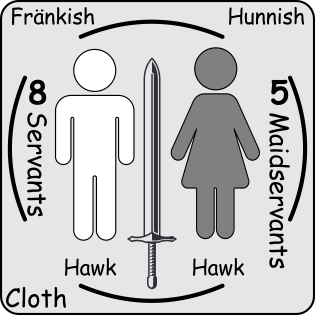
The sword is presumably Sigurd’s sword Gram and symbolically recalls the Rhine as the river of life between the spiritual and natural sides, where the discriminating ego-intellect also finds its bodily living space. We might accordingly recognize this ego-intellect in the two hawks, hunting birds whose German name, Habicht, suggests ‘Hab-Ich’ (‘I have’). We have already interpreted the eight servants adorned with neck-rings in connection with the golden ring Draupnir, from which eight new rings arise every ninth night. This was made from the gold of truth by the dwarfs as nature-spirits, as the ring of renewal and regeneration, and given to Odin. Similarly, this power is given to Sigurd here so that the gates of the hall of consciousness do not close behind him, as in the death of solitary fighters, but can open anew to life again and again, like Valhalla’s gates for the Einherjar. Thus Brynhild’s daughter Aslaug later gives birth to another Sigurd, as the continuing ‘Saga of Ragnar Lodbrok’ relates. Finally, the five maidservants suggest the five senses through which the spirit can perceive outer nature. Yes, there is much to ponder in this symbolism…
In principle this fortress of the pyre again recalls the shield-fortress where Sigurd found and awakened Sigrdrifa. Why does she as a Valkyrie end in a similar fortress once more, repeating the old story? Has she again chosen the wrong man against Odin’s will? Then she should have chosen Hjalm-Gunnar. Yes, surely her task this time too was to choose Gunnar, so that the Gjuki-human endowed with reason could become an Einherji. And initially she had done so. Yet finally we must ask: are outer nature’s outward circumstances to blame when the intellect joins itself to the separating ego rather than to holistic reason? Perhaps Gudrun and Brynhild had done their best?
71. Much I have said, and more I would say if ruling fate gave me more time to speak. My voice fades, the wounds swell (and bleed out). Only truth I spoke, and thus I shall die (let it happen).’
(Sigurðarkviða in skamma, following Arnulf Krause, Edward Pettit and the Old Norse source)
Thus outer nature speaks diversity forth from truth. Yet without holistic reason her voice fades and her lifeblood flows away, unable to regenerate in nature’s cycle. Then nature hardens like the mountain- and frost-giants into dead matter. And herein too lies a message of creation…

