
| Content | Next | About |
Brynhild’s Ride to Hel
After Brynhild’s death two pyres were built, one for Sigurd, and this burned first. Brynhild was burnt upon the other, and she lay in a wagon hung with divine (precious) fabrics. Thus it is told that Brynhild travelled in the wagon along the road to Hel (into the realm of the dead) and passed through a farmstead (or cave) where a certain giantess lived (the wife or daughter of a mountain-giant).
The two separate pyres suggest the sword of discrimination with which our intellect works between spirit and nature. While Sigurd-reason burns earlier and more swiftly, because as eternal victory it is already at its goal, Brynhild-nature seems to undertake a longer journey through space and time. That her wagon was outwardly ‘hung with divine fabrics’ recalls outer nature’s divine and thus also holistic essence. Who draws this wagon? On her way to Hel she thus enters the realm of the mountain-giants’ dead matter and meets a giantess there. In her we can symbolically recognize the soul of the rigidified and petrified mountain-giants, and this is in principle the essence of death.
1. The giantess said: you should not drive through my stone-supported farmstead! It would better befit you to weave borders (ornamental bands) than to seek another woman’s husband (namely Sigurd).
2. Why do you, change-seeking head, wish to visit my dwellings from the foreign land (Frankland)? You, free-handed Var of gold (goddess of the sacred marriage-vow), if you wish to know, have washed blood from a man’s hands (Sigurd’s?).
A quarrel now develops between them, similar to that between Gudrun and Brynhild. It begins with accusations against Brynhild, that as outer nature she should attend to the artful forms of changeable diversity rather than seek in Frankland the holistic spirit married to Gudrun, the all-embracing soul of nature. The ‘free-handed goddess of the true marriage-vow’ might be meant sarcastically, since in the end she no longer returned Gunnar’s love. She preferred to seek Sigurd’s purity, although he had Fafnir’s and Regin’s blood on his hands.
3. Brynhild answered: do not reproach me, rock-bride! Even though I was on a Viking voyage (in battle), I shall be held the higher of us two wherever people recognize our nature.
4. The giantess said: Brynhild, as the daughter of Budli (the ‘Court-Servant’), you were born into the world for the greatest harm: you brought Gjuki’s (the ‘Gifted One’s’) children to ruin and destroyed their good household!
5. Brynhild then answered: if you really wish to know, all too uncomprehending one, I shall tell you clearly (in wise words) from the wagon how Gjuki’s heirs made me loveless and oath-breaking:
6. The courageous (understanding) king had our coverings, those of eight sisters, carried beneath an oak. I was twelve winters old, if you wish to know, when I swore my loyalty to the young prince.
7. All who knew me in Hlymdalir (the ‘Echo’ or ‘Noise Valleys’ of the world of thoughts) also called me ‘Hild beneath the Helmet’ (‘Fighter beneath the Helmet’).
Here the story of the Valkyrie Sigrdrifa as the ‘Victory-Driver’ is told in brief. As the Allfather and creator-god’s servant, she was to provide the natural circumstances and conditions in creation, to guide living beings according to the divine judgement of fate. The eight sisters, as the feminine side of the eight servants, might suggest the eight formed worlds beneath the World Tree, which continually renew and regenerate in the ninth night through the ninth world of the formless gods. The courageous king then already suggests the essence of Sigurd as holistic or divine reason, and the twelve winters a time of perfection that still had to become fruitful and effective.
Brynhild, she ‘who fights with the mailcoat’, is here the outer aspect of the Valkyrie Sigrdrifa, who as outer nature was also to provide above all for the human world of Midgard. Her inner aspect, as the inner soul of nature, would then be the ‘Fighter beneath the Helmet’. Whoever knows her in the ‘Echo Valleys’ of consciousness therefore always sees both aspects.
Her goal as Odin’s servant is naturally to lead living beings’ intellect not into Hel as solitary fighters, but to Valhalla as Einherjar:
8. Then in the land of the Goths (the ‘Land of the God-Gifted’) I first let the old Hjalm-Gunnar (‘Helmet-Fighter’) go to Hel and gave victory to Auda’s (the ‘Rich, Wealthy One’s’) young brother. At this Odin became exceedingly angry with me.
9. In Skatalund (‘Grove of Heroes’) he enclosed me with red and white shields whose edges touched. And only he who knew fear nowhere in the land might awaken me from my sleep.
10. Around my southern hall he set the tall devourer of all wood blazing and commanded that only one man should ride through: he who brought me the gold that lay beneath Fafnir.
11. The good giver of gold rode on Grani to where my foster-father (Heimir, the ‘One at Home’?) ruled over the benches. He alone appeared there as a Viking of the Danes, better than all others in the retinue.
Here Sigrdrifa’s divine story merges with Brynhild’s human story. It is made clear that Odin as creator-god wishes the intellect beneath the helmet of reason, with the gold of truth, to be chosen by the Valkyrie, to reach Valhalla as an Einherji. The southern hall again recalls the source of the river of life in the Alps, and the wall of fire the spiritual barrier of fate.
There is much to ponder about Brynhild’s foster-father. ‘Gripir’s Prophecy’ and the ‘Völsunga Saga’ speak of Heimir, the ‘One at Home’, who lives in Hlymdalir. This place was also mentioned above in verse 7. Brynhild’s daughter Aslaug later grows up there too. The ‘Short Lay of Sigurd’ speaks of Atli, who provided for Brynhild in her early years. And as a Valkyrie, we would have to think of the Allfather and creator-god Odin as foster-father.
Where does outer nature arise and grow up? Naturally at creation’s source. Until now we have spoken of the ‘Mountain of the Hinds’, which we can readily imagine in the south as the Rhine’s source region in the Alps. There not only the elves as nature-spirits of formation are at home, but also the petrified mountain-giants, with whose soul Brynhild now speaks.
In principle we might also think of the Elbe, whose name likewise recalls elves and alfs, and thus the river of life and formation. Its mouth into the North Sea lies below Denmark, where Gudrun went, and its source is in the Giant Mountains, again recalling the giantess with whom Brynhild now speaks.
In this light we can also see Brynhild’s journey as a return to her own source. And only a fearless Sigurd can awaken her from it again and again. According to Odin’s command, this holistic reason as the ‘Viking from the Danish Realm of the Gods’ Sons’ is essential, for only it fears no loss in the land of creation and thus cannot itself be lost, because nothing can be lost in wholeness. Yet this spirit also knows no grasping desire for outer nature with its diversity of transient forms:
12. We slept contentedly in one bed, as though he had been born my brother. Neither of us could lay a hand on the other (put an arm around the other) for eight nights.
13. Then Gudrun, Gjuki’s daughter, accused me of having slept in Sigurd’s (her husband’s) arms. Then I learned what I did not wish to know: that they had deceived me in my choice of husband!
Thus in the ninth night reason hands pure outer nature over to the intellect, so that she can fruitfully renew and regenerate. The discriminating intellect too has the strength for this as long as holistic reason’s power stands behind it. This goes well for a while, and the Valkyrie is ready to choose the intellect as an Einherji. To this end she provides the outer circumstances of the decisive test, which appears in the quarrel between Brynhild and Gudrun. The intellect’s freedom now lies in how it responds. Can it recognize unity, to fight as an Einherji in the army of unity?
Thus the Valkyrie learns what she did not actually wish to learn: that the ego-intellect deceived her in her choice of husband. For it was not yet ready to realize its sworn loyalty to reason in life. Gudrun’s accusation was therefore also justified: it was still Sigurd who had fertilized Brynhild in the ninth night, because Gunnar had not yet internalized the essence of holistic reason. And so the struggle of life must continue:
14. All too long are women and men born into bitter conflict in life! We two shall spend our life together, Sigurd and I. Sink away, brood of the (mountain-) giants!
(Helreið Brynhildar, following Arnulf Krause, Edward Pettit and the Old Norse source)
A wonderful message! Sigurd and Sigrdrifa, as spiritual unity and natural diversity, will always live together. She drives the intellect towards the great victory, and he protects it in truth. What is to sink away is the essence of death, the intellect’s rigidification in seemingly dead matter. Thus outer nature can be awakened and born again and again, to flow as the river of life…
The Death of the Niflungs
Gunnar and Högni now took possession of all the gold, Fafnir’s inheritance.
Thus a new ego-dragon now sits once more upon the gold of truth. What happens when we seek to hold on to truth in separation and isolation, without holistic reason? Then we seek to hold on to limited forms of truth and in doing so lose truth itself, which in life can assume any form. With this, holistic life is naturally lost, because consciousness hardens in particular forms, and the Gjuki-human lives in a hostile, deadly nature where peace no longer reigns:
Discord then prevailed between the Gjukings and Atli, for Atli held them responsible for the death of Brynhild (his sister). As reconciliation it was agreed that they should give him Gudrun as wife. Before she consented to marriage with Atli, she was given a potion of forgetfulness to drink. Atli’s (and Gudrun’s) sons were Erp and Eitil (the ‘Dark One’ and ‘Hard One’?). Swanhild, however, was the daughter of Sigurd and Gudrun.
Yet the Gjuki-human must entrust his Gudrun-soul to the Atli-spirit of outer nature as long as he wishes to have a bodily form. The ‘potion of forgetfulness’ at first appears a makeshift device to continue the story intelligibly. As the principle of causation, the soul cannot actually forget anything. Yet some things can be suppressed for a while. Thus several years surely passed, until:
King Atli invited Gunnar and Högni to visit him and sent (as his messenger to them) Vingi or Knefröd (‘Swaying and Violent Decision’??). Gudrun knew of the deception and sent a message in runes that they should not come. As a token she sent Högni the ring Andvaranaut (‘Andvari’s Gift’) and tied wolf’s hair to it.
The two messengers’ names are very difficult to interpret. Vingi might recall the Old Norse verb vinga, ‘to move to and fro, sway’, or wini, ‘friend’. Knefröd could consist of kné, ‘knee’, and fróðr, ‘wise, knowledgeable, learned’, but also of knefi, ‘fist’, and ráð, ‘counsel, decision, plan’. In the German Nibelung legend these messengers are called Swemmelin and Werbelin, two minstrels whose names suggest ‘swimming and wooing’ in the river of life. Here everyone can reflect for themselves on what enticement might draw the ego-intellect into a dead nature, just as Fafnir wished to live on a ‘Rubble-Heath’.
Gudrun recognized this deception and provided the runes as outer signs of nature pointing to the inner essence. Particular mention is made of the ring, which we have already encountered, like Draupnir, as a symbol of nature’s ring of renewal and regeneration. This time, however, it is bound to wolf’s hair, suggesting the transience that threatens the ego-intellect without holistic reason, because without awareness of holistic life no renewal is possible.
Gunnar had wooed Oddrun (‘Spear-Point Rune’), Atli’s sister, but did not win her. He then took Glaumvör (she ‘who keeps watch amid the noise’) as his wife. Högni, however, married Kostbera (the ‘Bearer of Nourishment and Possibilities’), and their sons were Solar, Snävar and Gjuki (‘Sun-Warrior’, ‘Snow-Warrior’ and ‘Gifted and Giving One’).
Interestingly, the Gunnar-intellect still seeks Oddrun, the ‘Spear-Point Rune’ as the ‘Mystery of the Holistic Will’, surely recalling its fundamental purpose. Yet without holistic reason it can have only Glaumvör, the noise of thoughts in consciousness.
The Högni-ego seeks nourishment and opportunities to affirm itself in this world. As a spirit of separation, it sounds strange that he marries a woman. Yet surely no spirit can live in this world without nature. This marriage is a particularly new aspect in this prose passage. His spiritual sons suggest the war of desire between opposites, but also the essence of the Gjuki-human, for whom the ego forms a foundation. Thus in this triad we can again recognize a ‘triangle of effects’.
But when the Gjukings came to Atli, Gudrun asked her sons to plead for the Gjukings’ lives. Yet they would not. Högni’s heart was cut out, while Gunnar was placed in a serpent-yard. He played the harp and lulled the serpents to sleep, but one (venomous) adder bit him to the liver (as the seat of vital force).
Without reason’s vision of holistic life, Gudrun and Atli’s two sons, in whom we can symbolically recognize the formless and the formed, were surely not truly capable of life either. Thus they also had no interest in the ego-intellect’s life. The Högni-ego’s heart was therefore cut out, as had also happened to the Fafnir-dragon, for severing is simply the ego’s nature. And the Gunnar-intellect must live in a world of opposing and thus also poisonous thoughts, which can indeed be lulled to sleep for a while with the harp of harmony and order. Yet without holistic reason the poison will finally corrode the vital force, because the intellect itself produces this grievous poison.
Thus life cannot renew and regenerate. And so the Gjuki-human without reason ends as a separated solitary fighter in the death of Hel, unable to rise to Valhalla as an Einherji in the army of unity. This is the ‘Death of the Niflungs’, the ‘Mist-Beings’ on the path from Niflheim to Niflhel, at least from their limited perspective of consciousness.
King Thjodrek (‘Mighty King of the People’, Dietrich) was with Atli and had lost almost all his men. Thjodrek and Gudrun lamented their sorrows to one another. She told him her story and said:
(Dráp Niflunga, following Arnulf Krause, Edward Pettit and the Old Norse source)
This closing passage presumably serves as a transition to the Second Lay of Gudrun. It recalls the Thidrek Saga, known in German as the Dietrich legend. There we could interpret King Dietrich as growing reason, overwhelmed in battle with Emperor Ermenrich as declining reason, having lost almost all his powers. Thus he sought refuge with King Etzel or Atli and played a decisive part in overcoming the Hagen-ego. Afterwards he could return victoriously to his homeland with the Hildebrand-intellect. Although he does not appear as a person in the following Lay of Gudrun, we can imagine no better partner for Gudrun in conversation than reason growing anew:
The Second Lay of Gudrun
1. I was a maiden among maidens. My mother raised me, radiant in the women’s chamber. I loved my brothers above all else, until Gjuki adorned me with gold, wrapped me in gold and gave me (as wife) to Sigurd.
2. Thus was Sigurd among Gjuki’s sons like a green (healing) leek grown from the (low) grass, or like a long-legged stag among wild beasts, or like glowing red gold beside grey silver.
3. Until my brothers begrudged me having a husband superior to all. They could neither sleep nor settle the quarrel before they had Sigurd die.
4. Grani (Sigurd’s horse) came from the Thing (the judicial assembly). The loud hooves could be heard, yet Sigurd himself did not come with him. All the (other) mounts were covered in sweat, accustomed to toil beneath warriors (in deadly battle).
5. Weeping I went to speak with Grani, my cheeks wet with tears. I asked the horse for news. Then Grani hung his head and lowered it into the grass. The horse knew his master lived no more.
Here another new aspect appears: Sigurd was killed not in his sleep but at a judicial assembly, presumably on the spiritual side of the Rhine, a spiritual court within the Gjuki-human. The ego-intellect was unable to endure holistic reason’s superior power. Rather than rise as an Einherji into the army of unity, it preferred to kill reason in order seemingly to rise above it. Yes, our consciousness is capable of this too, as the philosopher Friedrich Nietzsche also wrote: ‘God is dead, and we have killed him…’
6. Long I hesitated, long my thoughts swayed to and fro, before I asked the guardian of the people (Gunnar) about the prince (Sigurd).
7. Gunnar lowered his head. Yet Högni told me of Sigurd’s terrible death: ‘Slain he lies beyond the river (the Rhine). He killed Gotthormr and is now left to the wolves (as prey)!
8. Look for Sigurd there on the road south! There you hear ravens croaking, eagles crying and wolves howling around your husband: all delight in their feast of the dead.’
The ego loves half-truths. What else? It lives on them…
9. Then I (Gudrun) said: ‘Why must you tell me of such suffering, Högni, and take away all joy? May ravens tear your heart apart in far-off human lands—in a vastness you do not know!’
10. Högni answered only once (spontaneously), averse to healing thoughts and full of grief: ‘You will have still more to weep over, Gudrun, when the ravens tear my heart apart!’
Such is the importance the narrowly confined ego gives itself, and it also likes to ensure that we suffer greatly when it is wounded.
11. After this conversation I went alone from there into the forest to gather the remains (of Sigurd) from the wolves. I no longer wept, nor struck my hands together, nor lamented my husband like other women, as I sat starving (consumed by grief) beside Sigurd.
12. It seemed to me the darkest night as I sat in pain beside Sigurd. Better than anything it seemed to me if the wolves had robbed me of life, or if I had been burnt like birchwood.
13. Down from the mountain (highland) I travelled for five days, until I recognized Half’s high hall (King Half or Alf in Denmark).
Geographically, the ‘five days’ make little sense. Yet behind them we can find a magnificent symbolism: just as Brynhild went after Sigurd’s death to the source of the river of life in the mountain highlands, Gudrun now goes to the lowlands, to the river of life’s goal, where it flows back into the Sea of Causes. Do they separate? No, for just as we can recognize Brynhild and Gudrun as two aspects of the Valkyrie, so the river’s source and goal are connected in nature’s cycle. In this regard the ‘five days’ might suggest Draupnir’s ring of renewal and regeneration: Brynhild goes four days into the highlands of the Alps to the ‘alfs’, and after nine days they symbolically meet in King Alf’s ‘high hall’, recalling the nature-spirit of formation…
14. Seven half-years I sat with Thora (the feminine form of Thor), daughter of Hakon (the ‘High Son’), in Denmark. To my delight she embroidered with golden threads pictures of southern halls and Danish swans.
15. We both depicted in pictures and embroideries what the heroes accomplished as the ruler’s retainers: red shields, Hunnish fighters, sword- and helmet-armed hosts in the ruler’s retinue.
16. Sigmund’s ships glided from the shore, with gilded masks and carved stems. We both embroidered upon the cloth how Sigar (‘Victory-Fighter’, presumably Sigmund) and Siggeir (‘Victory-Spear’ or will to victory) fought one another in the south of Funen (a Danish island).
In Thora we might now recognize Brynhild again, as outer nature with its diversity of transient forms fights against rigidification, like Thor. To this end many images are formed from golden threads of fate, appearing from the Sea of Causes and recalling unresolved problems that still seek resolution in the river of life. Once again the focus is above all the ancient struggle between Sigmund and Siggeir, between ‘Being Victory’ and ‘Wanting to Win’, reason and ego-intellect in the realm of the gods’ sons, as also related in the Völsunga Saga.
The daughter Swanhild is not mentioned here. Presumably the fateful pictures with the Danish swans are intended to express a similar symbolism.
17. Then Grimhild, the Gothic woman (Gjuki’s wife), learned what state of mind I was in. She laid aside the pictorial embroidery and called her sons, to ask them insistently who wished to replace their sister’s (Gudrun’s) son (Sigmund) or compensate her for her slain husband (Sigurd).
18. Gunnar declared himself willing to offer gold to atone for the guilt, and Högni likewise. Grimhild (Gudrun’s mother) then asked who wished to set out, saddle a steed, harness a wagon, ride a horse, fly a falcon and shoot arrows with the yew-bow.
19. Valdar of the Danes, together with Jarizleif, Eymod as the third, and Jarizskar (declared themselves ready to bring Grimhild to Gudrun in Denmark). Then they entered like princes, the retainers of Langbart (of the Lombards, but also a name of Odin). They wore red woollen cloaks, adorned mailcoats and towering helmets, were girded with short swords and had dark-brown hair.
20. Each wished to win me with precious gifts and well-considered words. Thus they tried to regain my trust despite the many sufferings—yet I did not trust them.
What forms can we trust? What gold could the ego-intellect still offer without true reason? These can only be transient forms and mental words, which can grant no true comfort.
Grimhild appears here as the bearer, and as Gudrun’s mother she evidently plays a role in this lay similar to Gullrönd as Gudrun’s sister in the ‘First Lay of Gudrun’. This is one of the few places in the heroic lays where Grimhild as Gjuki’s wife intervenes in events. To this end she ‘laid aside her pictorial embroidery’ of fate and called her sons’ ego-intellect and further spiritual powers into action.
The names of the four powers are again difficult to interpret: Valdar suggests a ‘Ruling Fighter’, who surely knew the way to Denmark, and Eymod ‘Enduring Courage’. The names Jarizleif (Jaroslav) and Jarizskar are probably of Slavic origin and thus point towards the Huns. For Old Norse listeners they could also recall jara, ‘battle’, thus ‘Battle-Inheritance’ and ‘Battle-Lock’.
21. Grimhild had a filled drinking vessel brought to me, cool and painful, to forget the quarrel and guilt. The drink was strengthened with Urd’s power (the Norn of fate), with icy sea and the son’s blood (Sigmund’s?).
22. In the horn manifold signs were carved and reddened, yet I could not interpret them: a long heath-fish (a long serpent) from the land of the Haddings (‘Long-Haired Ones’), an uncut ear of grain and the inner paths (entrails) of animals.
23. In the beer effective (healing) ingredients were combined: herbs from every forest and burnt acorns, the hearth’s dew (soot), sacrificed entrails and boiled pig’s liver, for it soothed thoughts of guilt and quarrelling.
24. After they (??) had drunk of it in the hall, they forgot everything about the prince’s (Sigurd’s) bodily fate. Three kings (Jarizleif, Eymod and Jarizskar?) knelt before me before Grimhild herself came to speak with me.
The Norn of fate recalls Urd’s well, where the gods decide fate daily; the icy sea, embodiment in the sea of life; and the son’s blood, the water of life. The drinking-horn recalls creation’s horn with the mystical runes of manifold nature; the long serpent, the ego- or Midgard Serpent of separation and boundaries; the land of the Long-Haired Ones, the world of thoughts in outer nature’s Hunnish realm; the uncut ear of grain, the unprocessed seeds of karmic causes; and living beings’ entrails, their task of digestion, that is, the inner or spiritual paths of animal nature for transforming and processing vital forces, drives and causes into bodily effects. As intoxicating beer, the drink itself was intended to be a healing draught above all for the bodily world.
That Gudrun could not interpret outer nature’s signs and evidently also distrusted the bodily healing draught and had not drunk it points to her nature as inner soul. Yet it sounds as though she had offered the drinking-horn to the Hunnish messengers, who at first appeared like princes and now resembled three kings. Thus they recognized Gudrun’s essence as the ‘God-Rune’ and knelt before her. Afterwards Grimhild herself appeared:
25. And Grimhild said: ‘I give you gold to accept, Gudrun, a wealth of treasures from your dead father’s (Gjuki’s) inheritance, red gold rings, Hlödver’s halls (the “Glorious Fighter”, Frankish Chlodwig, German Ludwig) and all the coverings (precious tapestries and bed-curtains) for the fallen prince (Sigurd).
26. (I also give you) Hunnish maidens who weave with weaving-frames and work gold beautifully, to bring you joy. You alone shall command Budli’s (the “Court-Servant’s”) wealth, honoured with gold and given (as wife) to Atli!’
Grimhild now appears as nature’s mother-soul, whose husband had died. Meister Eckhart also taught on this symbolic theme:
By this ‘widow’ we understand the soul. Because the ‘husband’ was dead, the ‘son’ too was dead. By the ‘son’ we grasp (indirectly) reason, which is the ‘husband’ in the soul. Because she (the widow) did not live in reason, the husband was dead, and therefore she was a widow. Our Lord said to the woman at the well: ‘Go home and bring me your husband!’ (John 4:16). He meant: because she did not live in reason, which is the husband in the soul, she did not receive the ‘living water’, which is the Holy Spirit; for this is poured out only for those who live in reason. Reason is the highest part of the soul, where with the angels it shares a being-with and an enclosure within angelic nature. Angelic nature touches no time; so too does reason, the ‘husband’ in the soul: it too touches no time. If one does not live therein, the ‘son’ dies. This is why she was a ‘widow’. (Sermon 52)
In a similar way we can reflect here on Grimhild and the death of Gotthormr and Sigurd.
The name Grimhild is somewhat confusing, however. It recalls the German Kriemhild, she ‘who fights beneath the helmet’, appearing here as Gudrun. Grimhild instead takes the maternal role of the German Ute, whose name suggests ‘Heiress’. Thus she now also hands the bodily and spiritual paternal inheritance to Gudrun to settle the karmic debts. And together with the Hunnish maidens, who weave outer forms and shape the gold of truth, her onward path leads to the Hunnish Atli as the spirit of outer nature, which with Sigurd’s and Brynhild’s death had become a deadly nature.
27. Yet I (Gudrun) answered: ‘I do not wish to go with (another) man and marry Brynhild’s brother (Atli)! It does not befit me to increase the lineage with Budli’s son and delight in life.’
28. Grimhild then said: ‘Do not seek to repay the men (for their guilt) with hostility, for we first caused it! When you bear sons again, you shall live as though both Sigurd and Sigmund were alive in them.’
How can the inner soul unite with the spirit of outer nature without holistic reason, become fruitful in diversity and give birth to life? Nevertheless, no hostility should arise from this between inner soul and outer nature. Here Grimhild too sees herself as the soul’s principle of causation, which after all strives to resolve the conflict of opposites in life.
29. Yet I answered: ‘I cannot give myself to joy, Grimhild, nor place hope in a new hero, after the corpse-greedy one (wolf) drank Sigurd’s heart’s blood together with Hugin (Odin’s thought)!’
30. Grimhild said: ‘Of all princes I have found him (Atli) the noblest in lineage and in many things the best. Him you shall have until age overcomes you! Without a husband you shall remain if you do not wish for this one!’
What hope has life when holistic reason can be devoured by the wolf of transience, and this even appears as a divine thought? Grimhild sees the spirit of outer nature as the best path. And surely this is now also the only path under the laws of cause and effect. Yet Gudrun does not willingly follow it. She would then become an outwardly transient soul whom age can overcome. Why must she follow it nonetheless? And how?
31. I then answered: ‘Do not seek so persistently to force this harmful kinship upon me! He will harm Gunnar and tear out Högni’s heart. And I shall not rest until I have taken the life of the spirited driver of the game of sword-edges.’
32. Weeping Grimhild heard these words, that harm awaited her sons and great damage her children. And she said:
33. ‘Lands I give you still, and a retinue of people: Vinbjörg and Valbjörg (“Mountain or Shelter of Wine and the Slain”), if you will accept them. Keep this all your life and be content, daughter!’
34. Then I finally said: ‘Then I shall choose this one (Atli) among kings and marry under compulsion from my kin. Yet this man will bring me no joy, nor will the brothers’ misfortune become protection for the sons.’
Gudrun naturally foresees the ego-intellect’s fate. She sees that without living reason in wholeness there can be no renewal and regeneration of life. For such foresight is her nature as the inner soul of causation. Grimhild seems not to have seen this, grieves and seeks another solution. Evidently, as mother-soul, she now places the outer world with its human population in her daughter’s care. These are the living beings who have become embodied through the wine of illusion and the fall into separation. This seems finally to have convinced Gudrun, and she follows this fateful path, compelled by causation, even though initially it leads further into death: the death of her brothers, her sons by Atli and Atli himself.
And this responsibility Gudrun is to ‘keep all her life’. How good that as the divine mystery and inner soul of nature she never dies!
35. Soon every young man was seen upon a horse, and the foreign (Frankish) women were placed in wagons. Seven days we rode over cold land, another seven we drifted through the waves, and for the third seven we walked over dry land.
36. There the gatekeepers of the high fortress (of Atli) opened the gate before we rode into the courtyard.
The horses suggest the physicality upon which the spirit rides, and the women’s wagons the soul’s laws of causation. The three times seven days of the journey surely also have symbolic meaning. The seven days over cold land recall the seven half-years of a long winter that Gudrun spent with Thora in Denmark after Sigurd’s death, now coming to an end. This is also why Sigurd was called the friend of Freyr, the summer-god. There now follow seven days’ journey through the waves in the sea of life and transformation, perhaps also a journey upon the river of life. Finally, the dry land suggests the outer nature of embodiment, which after Sigurd’s and Brynhild’s death lacks fruitful rain and living blessing. This might also mean the time Gudrun spent with Atli.
(In this fortress Gudrun lived for a while as Atli’s wife and bore him two sons, Erp and Eitil. Later Atli had Gunnar and Högni invited to him and killed, as Gudrun had foreseen. And now Gudrun continues to tell what happened afterwards in the night:)
37. Atli woke me, and I seemed to myself full of ill intent because of my kinsmen’s death.
What freedom remains when holistic reason does not live? Just as Brynhild was compelled to kill herself, Gudrun to marry Atli, and Gunnar and Högni to go to their deaths, so Gudrun too is now further compelled to kill. She herself wonders at her ill intent, turned from life into death. Is it a dream from which one can awaken?
38. He said: ‘Just now the Norns (of fate) woke me. I ask you to interpret the prophecy of the journey of suffering (my harmful dream). I dreamed that you, Gudrun, Gjuki’s daughter, pierced me with a treacherous sword.’
39. I answered: ‘A dream of iron foretells fire, and a woman’s anger means self-deception and desire. I shall burn out your suffering to tend and heal you, even though you are hostile to me.’
Whoever dreams of weapons will experience battle, and whoever dreams of embodiment will experience transience. Thus the anger of nature and her soul as the principle of causation also appears through self-deception and desire. Yet everything happens for the spirit’s healing. An astonishing message!
40. Atli said: ‘I dreamed that here in the courtyard (two) young shoots had fallen, which I wished to raise. They had been torn out with their roots, reddened with blood and carried to the (beer- and dining-) benches. I was asked to eat them.
41. I dreamed that (two) hawks flew from my hand without prey to the houses of harm (of death). I dreamed their hearts were eaten (by me) with honey, sorrowful in mind, swollen with (life-) blood.
42. I dreamed that (two) young dogs broke loose from my hand, both howling and robbed of joy. I dreamed their flesh had become corpse-flesh. Against my will I was to eat the corpse-flesh.’
Here, of course, the subject is Atli and Gudrun’s two sons, Erp and Eitil, torn out by the roots because without living reason they had no foundation for life. The hawks suggest the weapons of desire, and the dogs transient embodiment through self-deception. Thus it is also the spirit of outer nature that must consume and digest these sons: their drive, their lifeblood and their bodily flesh. Is all this only a dream?
43. I answered: ‘Here warriors have resolved upon a sacrifice, and the white ones (pure sacrificial animals; Gudrun naturally thinks of her two sons) will have their heads cut off. Within a few nights they will be consecrated to death and consumed by the retinue shortly before dawn (as a morning meal).’
44. Afterwards I lay down, yet I did not wish to sleep. Resolute I lay in bed—this I shall do.
(Guðrúnarkviða ǫnnur, following Arnulf Krause, Edward Pettit and the Old Norse source)
The book of skaldic poetry reported the two sons’ death as follows:
Soon afterwards Gudrun killed her two sons and had drinking vessels made from their skulls with gold and silver. The funeral feast for the Niflungs was then held. At this banquet Gudrun had mead poured for King Atli in these vessels, mixed with the boys’ blood. Their hearts she had roasted and given to the king to eat. And once this was done, she told him herself in many harsh words.
Who, then, killed the two sons? Who had resolved upon this sacrifice? Was it the ego-intellect that had killed reason? Or the inner soul of nature as the principle of causation? What does it mean when a Gudrun as the ‘God-Rune’ kills her sons and even her husband, the killer himself? Who is to blame for this death? The ‘Third Lay of Gudrun’ now revolves around this question of guilt.
The Third Lay of Gudrun
Herkja (the ‘Dragging, Grudge-Bearing One’) was the name of a maidservant of Atli who had formerly been his lover. She told Atli she had seen Thjodrek (‘Mighty King of the People’, Dietrich) and Gudrun together. Atli was very displeased by this. Then Gudrun asked:
1. ‘What ails you continually, Atli, Budli’s son? Why are you so sad and never laugh? It would seem nobler to the princes if you spoke with the men and looked at me.’
2. Atli answered: ‘This grieves me, Gudrun, Gjuki’s daughter, what Herkja told me in the hall: that you and Thjodrek slept beneath one blanket, only lightly covered in linen.’
3. Gudrun then said: ‘For all this I shall swear oaths to you by the white, holy stone, that with Thjodmar’s son I did not do what woman and man might do (sexually) together.
4. Not once did I embrace the honourable army-leader and prince. Quite different were our thoughts as we both inclined sorrowfully towards confidential conversation.
5. Thjodrek came here with thirty men, yet not one of them lives any longer. You robbed me of my brothers and the mailcoat-bearers (their retinue). Thus I lost all my nearest kin. (We spoke together of this great sorrow.)
6. Send for Saxi (“Sword-Man”, presumably a priest for the ordeal of guilt), ruler of the southerners! He knows how to consecrate the boiling cauldron.’
7. In the hall seven hundred men assembled to witness how the king’s wife reached into the cauldron.
8. And Gudrun said: ‘Now Gunnar does not come, and Högni I do not call. Henceforth I shall see my dear brothers no more! With the sword Högni would avenge such disgrace. Yet now I must prove my innocence myself.’
9. With her white (pure) hand she reached to the bottom (of the cauldron) and brought up the precious stones. Then she said: ‘Look here, you men! I have become free of guilt, in a holy manner, even as this cauldron boils.’
10. Then Atli rejoiced from his heart when he saw Gudrun’s hands unharmed. And he said: ‘Now let Herkja go to the cauldron—she who wished to bring Gudrun harm (and guilt)!’
11. Never did anyone see a more pitiful sight than this: how Herkja’s hands burned there! Afterwards they led the maidservant into a foul swamp (where she sank). Thus Gudrun stilled her sorrow (at the accusation).
(Guðrúnarkviða in þriðja, following Arnulf Krause, Edward Pettit and the Old Norse source)
The Old Norse word herkja means ‘to drag oneself along’ and, from a spiritual perspective, suggests the karmic guilt dragging itself through the spirit of all outer nature. This is, as it were, the bodily original sin of separation and boundaries within wholeness or the divine through the ego-intellect. The question now is whether Gudrun too is guilty of this sin, since she has now been bodily married to Atli as the spirit of outer nature. Does she break this marriage-vow when she turns spiritually towards holistic reason, appearing here in the role of Thjodrek or Dietrich? How can spiritual unity and natural diversity exist together? The ego-intellect of Gunnar and Högni would try to resolve this question of guilt with the sword of discrimination and thereby kill Herkja. Yet they no longer live. Thus Gudrun as the ‘God-Rune’ submits to a so-called ‘judgement of God’, an ordeal by hot water widespread in the Middle Ages. She passes this test through her purity, and the guilty one sinks into the swamp of the earth or earthly physicality.
What kind of test of guilt is this? With our present worldview we find such ‘judgements of God’ difficult to understand. For we see the living body above all as a physical and chemical machine working according to the laws of nature. And the great question is: how powerful can the spirit’s influence upon the body be? Is there a clear limit? That we can move the body with the mind is still generally accepted, as are psychosomatic illnesses. Beyond this there are also many studies of placebo and nocebo effects, which are difficult to explain scientifically.
This already suggests that the spirit can have a very great influence upon the body. According to Christian tradition, the apostle John was thrown into a barrel of boiling oil in Rome. He remained completely unharmed and emerged strengthened. Western researchers and travellers of the nineteenth and twentieth centuries repeatedly reported Indian yogis touching glowing iron bars or pouring boiling water over their skin without developing blisters. The fakir Kuda Bux from Kashmir travelled to London in 1935, where, under the supervision of the renowned University of London Council for Psychical Research, he walked across a trench of glowing coals. The researchers examined his feet before and after the walk: there were no burns at all. He also held his hands over an open fire without harm to the skin. We could cite many further examples of this kind… Magic, spiritual power or the natural power of consciousness?
Thus Gudrun too, as the ‘God-Rune’ and inner soul of nature, surely had this power to rise above the natural limitations of outer physicality. Perhaps we can put it this way: as long as consciousness clings with the ego-intellect to physicality or other forms, a certain guilt is always involved. And for so long Herkja, the beloved maidservant of outer nature’s spirit, pursues us with accusations of straying, adultery, disgrace and unfaithfulness. Every bodily ordeal then also becomes pitiful suffering. Yet now the ego-intellect had died and Gudrun had proved her innocence. In this light we can now try to understand her further path too.
The Old Lay of Atli
Gudrun, Gjuki’s daughter, avenged her brothers, as has become generally known. She first killed Atli’s sons, then Atli himself, and burnt his hall with its entire retinue. This lay was composed about these events.
1. Atli sent a messenger to Gunnar, a knowledgeable and trusted rider called Knefröd (‘Inevitable Decision’?). He came to Gjuki’s court and Gunnar’s hall, to his benches around the hearth and to the delicious beer.
2. There the retainers (of Gunnar) drank wine in Valhalla (as Odin’s hall is also called). Yet the concealers (of their guilt in Sigurd’s and Brynhild’s death) were silent, for they feared the Huns’ anger (under Atli’s rule). Then Knefröd called in a cold voice, the man from the south who sat upon a raised bench:
3. ‘Atli sent me here as a mounted messenger on a well-bridled horse through the unknown Myrkvid (“Dark Forest”), to ask you, Gunnar (and Högni): come both with ring-adorned helmets to his bench, to visit Atli in his house!
4. There you can choose shields and smoothly shaved ash-spears, red-gold helmets and a multitude of Huns (as fighters), with silver-gold saddlecloths, foreign red garments, spears, pikes and bridled steeds.
5. He would also give you the field of broad Gnitaheath (“Rubble-Heath”, where the Fafnir-dragon also lived), he said, (your choice) of ringing spear and gilded stem, great treasures, the dwellings of Danpr (on the River Dnieper) and the famed forest that people call Myrkvid (“Dark Forest”).’
How does consciousness come from Valhalla, from the river of life, into a deadly nature: into the dry land of ‘Rubble-Heath’, into the dark forest of ideas where life’s light fades, to the river of death flowing into the Black Sea? How can the free spirit be compelled to do so?
Here too it becomes clear that this is a symbolic geography. The German tradition speaks of the Danube, where Etzel had his realm. For the Nibelungs this river becomes the river of death, which finally does indeed flow into the Black Sea (as does the Dnieper). A ride from the Dnieper to the Rhine, for example from Kyiv to Worms, would, however, be around 1,800 kilometres long. Gudrun would then also have had to cover a similar distance in twenty-one days…
Instead of the Rhine we might again think geographically of the middle Elbe. The ‘man from the south’ would then in practice have come over the Ore Mountains, whose impenetrable woodland was called Miriquidi in the early Middle Ages. Along these lines we might also imagine that Danpr actually means the Danube. The field of Gnitaheath could then suggest the Hungarian Puszta, a grass steppe with few trees, hot and dry in summer, just as Gudrun also explicitly travelled through ‘dry land’ in the third week of her journey, as explained in the ‘Second Lay of Gudrun’.
Symbolically, ‘Rubble-Heath’ recalls the desolate land where the ego-dragon Fafnir dwelt. This is now also offered to the ego-intellect of Gunnar and Högni. In this light the ‘man from the south’ can also simply stand for a spiritual messenger now challenging the Gunnar-intellect. And the latter again takes counsel with the Högni-ego, for Sigurd-reason is dead:
6. Then Gunnar turned his head and said to Högni: ‘What do you counsel us both, courageous man, now that we hear such things? Until now I knew no gold on Gnitaheath for which we both did not possess something of equal worth.
7. We possess seven halls full of swords with golden hilts. My horse is the best and my sword the sharpest. My bows adorn the benches and my mailcoats are gilded. My helmet and shield are the brightest and come from Kjar’s hall (the “Courageous One”, a ruler’s name). My equipment alone is better than that of all the Huns!’
8. Högni answered: ‘What do you think the woman (Gudrun) wished to suggest when she sent us a ring wrapped in a heath-dweller’s coat? I believe she gave a warning. A heath-dweller’s (wolf’s) hair I found woven around the red ring: wolfish is our path if we ride after this offer!’
9. No descendant urged Gunnar on, nor any other close kinsman, neither rune-interpreter nor counsellor, nor those who were powerful. Then Gunnar raised his voice with great courage, as the famed king was bound to do in the mead-hall:
10. ‘Rise, Fjörnir (“Life-Protector”), and let the warriors’ golden cups pass from hand to hand through the hall!
11. Grey-coated wolves will rule the Niflungs’ inheritance if Gunnar is lost! Black-coated bears will bite with their fangs and gladden the wolf-pack if Gunnar does not return!’
Curious! Against all arguments, the intellect nevertheless decides to make the journey. Thus in the mead-hall of wholeness Gunnar must surely, because of his guilt in Sigurd’s and Brynhild’s death, follow his soul, whom Grimhild had sent to Atli, into a deadly nature. Even the ring of renewal is entwined there with wolf’s hair, with thoughts of transience. Högni is evidently afraid of this, yet Gunnar now seeks life’s struggle upon this path. And if he does not survive, no one is to survive. Who, after all, could live in this world without intellect?
12. Fearless retainers tearfully escorted the battle-bold king of the land out of the courtyard. Then Högni’s younger heir (presumably his youngest son Gjuki) bade them farewell: ‘Go now whole and understanding to where your thoughts draw you both (and your mind impels you)!’
At least one remains behind, the little youngest Gjuki, who now presumably stays with his grandmother Grimhild by the Rhine as the river of life. Thus a human being endowed with reason can grow up there once more. Similarly, in the German Nibelung legend Gunther’s little son, named ‘Siegfried’ after his brother-in-law, remains behind in Burgundy by the Rhine with his grandmother Ute.
13. The bold men let the bridled horses thunder with their hooves through unknown Myrkvid over the mountains. All Hunnish land trembled as the hard-minded (resolute) men rode along, driving the whip-shy horses across the lush green fields.
14. They saw Atli’s land and the mighty watchtowers, where Bikki’s (or Budli’s?) warriors stood upon the high fortress, and the (royal) hall above the southern peoples, built for sitting-benches, with enclosing walls and shining shields, spears and pikes. There Atli drank wine in Valhalla, while outside the guards watched for Gunnar and (his retinue), should they come visiting with ringing spear to awaken the ruler (Atli) to battle.
Wonderful! Atli too lives in Valhalla on the wine of the power of illusion and creation, like Odin himself. And outside, in the outer world, watchfulness is practised in battle.
Bikki recalls King Jörmunrek’s treacherous spirit, which naturally plays a great part in this struggle. Some scholars, however, suspect a scribal error. Then these could be Budli’s warriors, those of the ‘Court-Servant’, which also makes sense…
15. Their sister (Gudrun) was the first to notice her two brothers entering the hall, for she had drunk little beer. She said: ‘Now you are betrayed, Gunnar! What can you, mighty one, do against the Huns’ harmful deeds? Leave this hall quickly!
16. It would have been better for you, brother, to come in your mailcoat instead of visiting Atli’s home with ring-adorned helmets alone. Then you would have sat in the saddle on sun-bright days and made the Norns (of fate) weep over bodies necessarily grown pale. You would have made these shieldmaidens of the Huns know the harrow (for a fertile field) and thrown Atli himself into the serpent-yard. But now this serpent-yard is destined for you both!’
Yes, a living Brynhild would be better than wearing the ring of wholeness merely as an ornament upon the intellect’s helmet of life-form. Otherwise we are ‘betrayed’ within an outer nature of harm, lose the holistic light, and fate takes the path of death rather than fruitful life with constant renewal. Who would then have to live in the serpent-yard of poisonous, opposing thoughts?
17. Gunnar answered: ‘Now it is too late, sister, to assemble the Niflungs (King Gunnar’s entire army). Far away is the band of men to be sought, the fearless warriors beyond the reddish mountains (the Ore Mountains) by the Rhine!’
18. Then Gunnar was seized by the Burgundians’ allies (Atli’s warriors, allied to the Burgundians through Gunnar’s marriage to Brynhild). They put him in fetters and bound him fast.
19. Högni slew seven (opponents) with the sharp sword and thrust the eighth into the hot fire. Thus must a courageous man defend himself against enemies, as Högni defended Gunnar’s hands (as Högni fought in place of the bound Gunnar’s hands, but was then also bound himself).
Yes, now it is too late to fight holistically as an Einherji in the army of unity. The intellect is bound in outer nature, yet the ego fights on. Here we can think of seven spiritual powers of outer nature that it can kill with the sword of sharp discrimination, such as the powers of sensing and acting. An eighth power evidently could not be discriminated, such as the power of spirit itself, and was thrust into the fire of annihilation.
Thus the ego now takes over the bound intellect’s struggle. And in essence this is not wrong, for as ‘I am’ the ego itself is an immortal and unshakeably courageous being. Many people seek this too as ‘self-assurance’, but sadly often without holistic reason. Thus through the discriminating intellect it falls into separation, boundaries and bondage. It becomes a separating ego. And what does the intellect then say?
20. Then they asked the bold ruler of the Goths (Gunnar) whether he wished to buy life with gold.
21. Gunnar answered: ‘First Högni’s heart shall lie bloody in my hand, cut with a sharp-edged knife from the bold rider’s breast, the king’s son’s!’
Can the intellect give up the gold of truth for a holistic life? Or does it wish to go on possessing and holding it? Here the great symbolic circle closes with the opening story of Regin and Fafnir, and the intellect demands the courageous ego-heart.
22. Then they cut the heart from the breast of Hjalli (‘Scaffolding’), laid it bloody upon a dish and brought it to Gunnar.
23. Yet Gunnar, lord of men, said: ‘Here I have the heart of Hjalli the coward, unlike the heart of Högni the brave. It still trembles violently as it lies upon the dish, and twice as much it trembled when it lay within his breast!’
24. Then Högni laughed as they cut the heart from the living wound-smith (or helmet-smith). Weeping was the very last thing on his mind! Bloody they laid it upon the dish and brought it to Gunnar.
25. Then the famed Gunnar, the Niflung-Spear (“Will of the Mist-Being”), said: ‘Here I have the heart of Högni the brave, unlike the heart of Hjalli the coward. It trembles only a little as it lies upon the dish, and still less it trembled when it lay within his breast!
Thus the intellect now also wishes to possess the courageous ego-heart, the much-sought ‘self-assurance’, rather than the coward’s shaky ‘scaffolding-heart’, which the Huns in the realm of outer nature accordingly offer it. For without reason’s vision of holistic life, there can be no true security here in the realm of transient forms. Yet what happens when we seek to cut the heart from a living body and hold on to it? Gunnar continues:
26. Thus you, Atli, shall be far from my eyes, just as you will remain far from the gold rings. For the Niflungs’ entire treasure is now hidden with me alone. Högni lives no more!
27. Always I was in doubt while we both lived. Now I have none, since I alone live. Let the swift Rhine rule over the warriors’ metal of strife (the coveted gold), over the Niflungs’ divine inheritance! In the surging water let the slain-rings (rings of the fallen) shine, rather than gold gleam upon the hands of the Huns’ sons!’
Thus Gunnar now does what Regin had wished to do earlier. He tries to overcome his doubts about rulership by having all supposed rivals eliminated. First holistic Sigurd-reason and finally also the separating Högni-ego. Thus here the Gunnar-intellect appears as ruler between the eternal polarities: between reason and ego, unity and diversity, brightness and darkness.
In the German Nibelung legend this struggle is seen from another perspective. There Hagen refuses to reveal the hidden golden treasure as long as his king Gunther lives. Gunther is then beheaded, and at the sight of the severed head Hagen responds much as Gunnar does here: now he is all the more determined not to reveal the treasure and rejoices in possessing the secret for himself alone. For this he is finally killed by Kriemhild. Thus in the German tradition the separating ego emerges more strongly as the fundamental problem, while here the Norse version focuses more on the discriminating intellect. Both perspectives are justified, for the actual problem remains separation.
Thus Gunnar too now wishes to keep the gold of truth from Atli, the spirit of outer nature, who is even to disappear from his eyes of consciousness. It is good that he does not wish to hide the gold like the Fafnir-dragon on the dry ‘Rubble-Heath’, but in the Rhine as the river of life. Yet in doing so he also separates himself from the gold of truth, from eternal consciousness that can assume any form. Thus Atli, as the spirit of outer nature to whom he begrudges the gold, now becomes a deadly spirit for him:
28. Then Atli commanded: ‘Set the wheeled wagons in motion! The captive is now in fetters!’ And then the draught animal, enemy of the bridle, drew the treasure-guardian and enemy-ruler to his death.
29. Mighty Atli, their kinsman by marriage, rode upon the maned Glaum (‘Noise’), surrounded by thorns of strife. Gudrun, the victory-goddess, … held back her tears and walked into the hall of noise.
30. Gudrun said: ‘May it befall you too, Atli, as you have kept the oaths you often swore to Gunnar and once spoke: by the sun in the southern hall, by Sigtyr’s (Odin’s, the “Victory-God’s”) mountain peak, by Hölkvir (Högni’s horse) of the resting-bed (movement in stillness), and by Uller’s (the winter-god’s) ring!’
The wheeled wagons suggest the wheelwork of nature’s laws of cause and effect, now set in motion because the Gunnar-intellect has bound itself to them through its own behaviour. The draught animal Atli rides suggests the noise of quarrelling thoughts in a world of opposites, unable to find rest without holistic reason.
The oaths of outer nature’s spirit surely consist in its actual purpose: to raise the intellect as an Einherji rather than lead it into death. Through this sworn bond between intellect and nature, Atli too must then inevitably follow Gunnar’s path. Yet first the intellect falls into the serpent-yard of opposing thoughts with their deadly poison of separation:
31. The multitude of men threw the king alive into a yard teeming with crawling serpents. There Gunnar was alone and, full of defiant courage, struck the harp with his hand (his intellect), so that its strings resounded. Thus must a courageous ring-giver defend the gold against men!
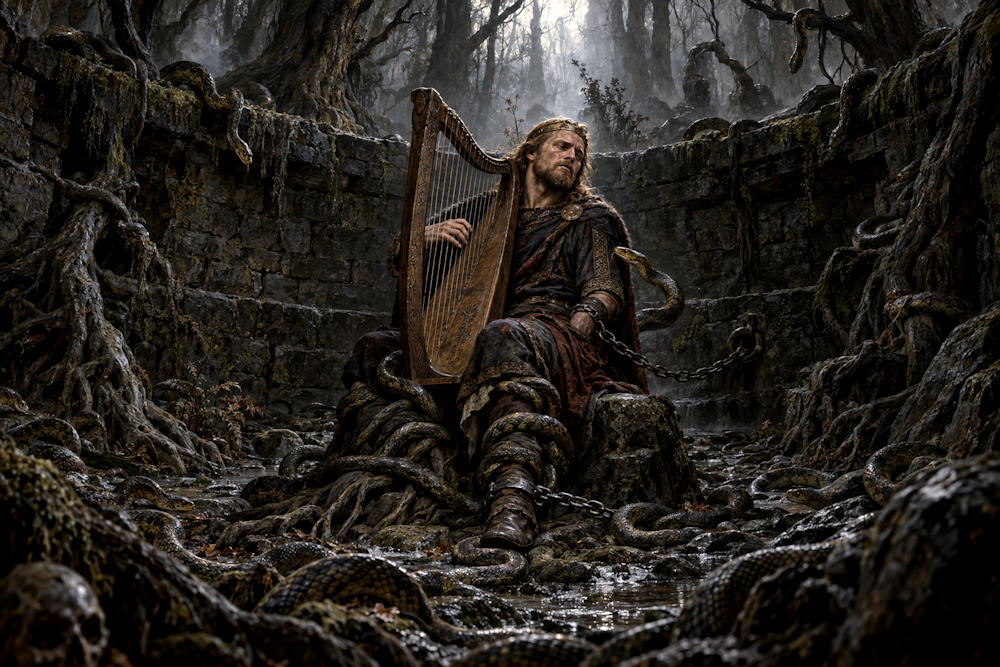
32. After the killing (of Gunnar in the serpent-yard), Atli let the gravel-trampling horse run back into his land (to his castle courtyard). In the courtyard there was great noise from tightly packed horses and the clashing weapons of men returned from the heath.
Here it is already suggested that Atli’s courtyard now in principle resembles Gunnar’s serpent-yard. And within it Gudrun appears as the soul of nature and principle of causation like a deadly serpent, unwilling, yet inevitably:
33. Then Gudrun went out to meet Atli with a gilded cup, to offer the ruler retribution: ‘Joyfully in your hall, ruler, you can receive from Gudrun the young beings who have gone to Nifl (into the mist)!’
34. Atli’s wine-filled beer-cups also resounded as the Huns assembled in the hall. One after another (or: boldly), the long-bearded men entered.
35. Then the bright-faced woman looked darkly as she brought them drink, an uncanny Dis (woman of fate) for the princes. Unwillingly (yet inevitably) she chose food to accompany the beer for the pale-nosed ones (princes). Afterwards she spoke words of reproach to Atli:
36. ‘Your sons’ hearts, sword-giver, you have eaten with honey alongside corpse-blood (from the gilded cup). Now, brave one, you can digest the slaughter-food of human beings, eat it as beer-food and raise it to the high seat!
37. Henceforth you will call neither Erp nor Eitil, the two beer-gladdeners, to your knees! Never again will you see them in the middle of the hall, giver of gold, shafting spears, trimming manes or driving horses!’
There is much to ponder here: how can separation be overcome and unity won without killing diversity in the process? How can Atli, the spirit of outer nature, and his two sons, whom we have interpreted as the formless and the formed, become one and rule together? Similarly, Sigurd had drunk Regin’s and Fafnir’s blood and eaten Fafnir’s heart, to receive their powers into a higher wholeness. Yet what happens when this union takes place without the ‘Victory-Protector’s’ holistic reason? Victory of life or deadly defeat?
38. Noise arose upon the benches, an uncanny song of men and a rumbling beneath the divine fabrics (the hall’s wall-hangings). The Hunnish people wept—only Gudrun did not. She shed no tear, neither for her bear-strong brothers nor for her beloved young and inexperienced sons whom she had borne Atli.
39. The Goose-Bright One (swan-like Gudrun) sowed gold, and with red rings she gladdened the servants of the house. She let fate grow and the shining metal flow. Never did the woman spare the houses of life (of the hoarded golden treasure).
Yes, thus the gold of truth should flow within creation, rather than be held fast in wilful forms as Fafnir attempted on ‘Rubble-Heath’ and Gunnar in the river of life. Then there is no reason to weep either. For this gold is there for creation’s servants, as ‘red rings’, above all for the Einherjar in the army of unity…
40. Atli was inattentive and had drunk himself weary. He had no weapon with him and did not guard against Gudrun. Often this interplay had been better, when the two embraced lovingly before the princes.
How could the spirit of outer nature guard against the inner soul of causation when joined to an intellect like Gunnar’s? What weapon could it carry for protection? Thus here another great circle closes with the beginning of the long story, with Otter’s inattentiveness. What does this inattentiveness mean? Consciousness falls from holistic vision into wilful form and is thereby bound. Thus divine, holistic love becomes the opposites of desire, hatred and death:
41. With a hand eager for death she gave the marriage-bed blood to drink with a pointed weapon (and killed Atli). Then she let the (hunting and guard) dogs loose, drove them before the hall doors and, as the bride (of fate’s fire), awakened the retainers (and Atli’s servants in the hall) with hot flame. This she brought about in retribution for her brothers.
42. To the fire she gave all who were inside and had returned from Myrkheim (“Dark Home”) after Gunnar’s killing. The old beams collapsed, the houses of life (the bodies) smoked and the Budli courtyard burned. The life-bearing shieldmaidens also burned within it and sank into the hot fire.
Like Högni, Gudrun now also fights with sword and fire. Perhaps it is even the continuation of Högni’s struggle, just as the book of skaldic poetry also related that Atli was killed with the help of a son of Högni. Thus here too it was described at the beginning that of Högni’s sons only Gjuki remained at home, while the other two, Solar and Snävar, had evidently travelled with him. For the inner soul of nature naturally needs a masculine spirit in order to act. Symbolically, we might also think of Högni’s heart as his essence, becoming effective here and at the same time burning itself up as well.
The return from Myrkheim clarifies the serpent-yard’s location and recalls Myrkvid, the ‘Dark Forest’ of mental ideas that become poisonous serpents without holistic reason.
Here too it becomes clear that this is above all a symbolic story. And perhaps the contradictions and breaks in the outer story exist chiefly to help us reach the spiritual background. For outwardly it is difficult to explain why no one could escape the burning hall. From a spiritual perspective the hunting and guard dogs might suggest the desires and wish to hold on that prevent the spirit from leaving its hall of consciousness. Similar symbolism can be found in Garm, Niflhel’s guard dog.
Thus the path of life without reason now ends in an all-encompassing death. Even outer nature now seems dead, its spiritual powers destroyed in the fire. This recalls the path into dark Niflhel.
43. Now this has been fully told. Since then no woman in a mailcoat has set out in such a way to avenge her brothers. The radiant one had brought the word of death to three kings of the people (Högni, Gunnar and Atli?) before she herself died.
It is told in greater detail in the ‘Greenlandic Lay of Atli’.
(Atlakviða, following Arnulf Krause, Edward Pettit and the Old Norse source)
Here we can recall once more the connection between Brynhild and Gudrun, how in essence they represent two aspects of the Valkyrie Sigrdrifa. The ‘word of death’ suggests the nature of causation, which exhausts itself in taking effect.
We might bring this together as follows: as the ‘Victory-Driver’, Sigrdrifa had embodied the circumstances under which the Gylfi-human endowed with reason could walk the royal path together with Sigurd-reason as the ‘Victory-Protector’, the path of the Einherjar in the divine army of unity. Yet the human intellect always also has the freedom to choose how it responds to these circumstances. Thus in the end it nevertheless followed the path of the egoistic solitary fighter, leading into the death of dark Niflhel, at least from the wilful perspective to which it clings and by which it is bound…
Whether Sigrdrifa, Gudrun and Brynhild have truly died is something we can ponder at length. Perhaps they merely sleep in unconsciousness, waiting for Sigurd to awaken them again. At any rate, the Edda’s story of Gudrun continues, as the book of skaldic poetry relates:
Afterwards she went to the sea, leapt into the water and wished to kill herself. But she was driven across the fjord and came to the land belonging to King Jonak.…

