
| Content | Next | About |
The Heroic Lays of the Edda
Having written so much about the gods and how, over time, they became increasingly human, we would now like to seek, within the Edda’s heroic lays, those human beings who followed the ideal of the Einherjar and became increasingly divine. The main obstacle upon this path was suggested in the final verse of the Völuspa in the preceding chapter: the ego-dragon and the serpent of hatred as principles of demarcation and separation. With this in mind, we would now like to continue our journey into the Edda’s spiritual world, first examining how the dragon Fafnir, whom Sigurd later defeated, could arise.
The Lay of Regin (The Otter’s Ransom)
We have already encountered this story in the chapter on ‘The Nature of Loki’, in ‘The Story of the Otter’s Penance’, as a condensed account from the Skaldic Book. To refresh our memory and deepen the interpretation, we would now like to examine the ‘Lay of Regin’, upon which the Skaldic Book drew:
Sigurd went to Hjalprek’s (‘Helpful Ruler’s’) stud farm and chose a horse there, thereafter called Grani (the ‘Grey, Bearded One’). Regin, Hreidmar’s (‘Nest-Glory’s’) son, had also come to Hjalprek. He was more skilful than any other man and a dwarf in stature. Clever he was, fierce, and versed in magic.
King Hjalprek’s name can be interpreted as ‘Helpful Ruler’. The Völsunga Saga relates that he ruled in Denmark, which we have already interpreted symbolically on several occasions as the realm of the sons of the gods. The saga further recounts: When King Sigmund (‘Victory-Protector’) had fallen in battle, his pregnant wife Hjördis (‘Sword-Dis, Sword-Goddess’) went to King Hjalprek and there gave birth to Sigurd, Sigmund’s renowned heir, whose name likewise means ‘Victory-Protector’. Afterwards, Hjördis married Alf, a son of King Hjalprek, whose name symbolically recalls the elves, or dwarves, as nature spirits created by the gods to shape bodily forms. Thus, the boy Sigurd grew up at King Hjalprek’s court, where Regin became his foster-father and teacher.
Symbolically, he thus receives his physicality from Hjalprek’s stud farm in the realm of the sons of the gods, enabling him to move within the bodily world, just as Odin rides upon Sleipnir. Thus, Sigurd became an exceptionally outstanding hero. The Völsunga Saga continues:
Regin said to Sigurd: ‘It is strange that you wish to become the kings’ stable-boy and go about like a vagabond.’ Sigurd answered: ‘That is not the case, for I share in all their decisions (the kings’), and whatever I wish is at my disposal.’ Then Regin said: ‘Ask Hjalprek, then, to give you a horse.’ Sigurd answered: ‘That will happen at once if I wish it.’
Sigurd went to the kings. The king asked him: ‘What do you wish to receive from us?’ Sigurd answered: ‘I would like a horse for my enjoyment.’ The king said: ‘Choose a horse yourself, and whatever else you desire from our wealth.’
The following day, Sigurd went into the forest and encountered an old man with a long beard whom he did not know. The man asked where Sigurd intended to go. He answered: ‘I wish to choose a horse; give me good counsel in this.’ The man said: ‘Let us go and drive them toward the river called Busiltjörn (“Wild Waters”).’ They drove the horses into the river’s depths, but all quickly swam ashore except one stallion, which Sigurd chose. He was grey in colour and young in years, tall in stature, and full of promise. No one had yet mounted his back. The bearded man said: ‘This stallion descends from Sleipnir, and he must be trained carefully, for he will become better than all other horses.’ Thereupon, the man disappeared. Sigurd named the stallion Grani (the ‘Grey, Bearded One’), and he was the finest stallion. Yet it was Odin who had come to him.
(Völsunga Saga, chapter 13, based on Paul Herrmann)
Regin undertook Sigurd’s upbringing and instruction and loved him dearly. He told him of his ancestors and of the events when Odin, Hönir, and Loki had once come to Andvari’s waterfall, where there were many fish. A dwarf named Andvari (the ‘Present, Mindful One’) had long dwelt in this waterfall in the shape of a pike, obtaining his nourishment there.
Regin continued: Otter was our brother’s name. He often entered the waterfall in an otter’s shape. Once, having caught a salmon, he sat upon the riverbank eating with blinking eyes (drowsing inattentively). Then Loki struck him dead with a stone. The Aesir thought themselves most fortunate and stripped the otter of its pelt.
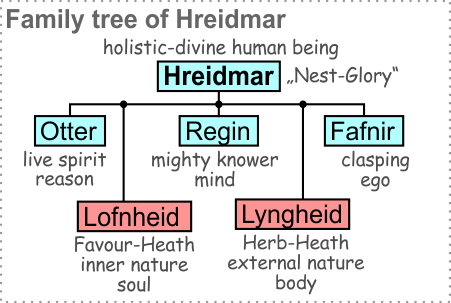
Here, Regin tells the story of his father Hreidmar and his brothers Otter and Fafnir. The name Hreidmar can be interpreted as ‘Nest-Glory’: an earthly being, as it were, establishing a nest in which to act gloriously. The Skaldic Book describes him as a ‘powerful farmer, versed in magic, upon his farmstead’. Thus, he symbolically recalls a bodily human being living, serving, and working within earthly creation. His ‘knowledge of magic’ points toward that power of consciousness which can identify with bodily forms and thereby produce illusions.
His three sons, Fafnir, Regin, and Otter, may be regarded as spiritual beings within this human being, whom we would like to interpret as ego, intellect, and reason. We have already encountered the meaning of Regin’s name as the ‘Mighty in Knowledge’ or ‘Power of Knowledge’, in the sense of the creative intellect. Fafnir can be interpreted as ‘Clasping’ or ‘Grasper’, thus later becoming the ego-dragon. We have interpreted Otter (Old Norse ‘Otr’) in relation to ‘Odr’ as the divine spirit of life, and thus also as the holistic reason received by human beings from the gods. Accordingly, the Völuspa, verse 18, says of the enlivening of the first human pair: ‘Odin gave them soul (the breath of life), Hönir gave reason (Odr), and Lodurr gave blood and fair appearance.’
Thus, this entire story can fundamentally be imagined within a single human being: how ego, intellect, and reason may behave and develop within him. The waterfall recalls the water of life within the river of creation. There lives Andvari, the ‘Present One’, in whom we may recognize consciousness hunting its nourishment there like a pike. And as a dwarf, he recalls the nature spirits’ power of formation.
Thus, Otter, too, as the spirit of life within a human being, seeks his nourishment within the river of creation, yet should live as holistic reason and remain mindful, in accordance with the goal of the divine, and thus also of all creation. Accordingly, the gods Hönir, Odin, and Loki now appear as divine reason, effect, and counter-effect. We have already written much about this ‘triangle of effects’, through which creation is to develop toward holistic reason.
Yet human reason ‘blinked’, became inattentive, and was no longer conscious of its divinity as it fed upon the salmon, symbolizing creatures continually regenerating within the river of creation. While feeding upon forms within this river, it forgot the divine wholeness surrounding it and fell into animality, appearing here symbolically as an otter. Thereupon, Loki, as the necessary counter-effect, fulfilled his task ‘for the gods’ good fortune’, striking down this fallen reason, degenerated through inattention, with a stone symbolizing its rigidity. Now, within life’s process, it is challenged to recognize itself again and rediscover its true nature. Sigurd, as developing reason, will later play the principal role in this ‘self-knowledge’.
Then ‘they stripped the otter of its pelt’. This might mean that they freed reason from its outward animal form and presumably consumed its inner essence together, returning it to wholeness and bringing it forth anew as Sigurd.
That same evening, they took lodging with Hreidmar and showed their catch. Then we captured them and imposed this ransom for their lives: to fill the otter’s pelt with gold and cover it outwardly with red gold. They then sent Loki to obtain the gold. He came to Ran (‘Robbery, Lack’, Ägir’s wife), received her net, and went to Andvari’s waterfall. There he cast the net before the pike, which swam into it.
A marvel! How can gods be taken captive? Indeed, with the loss of holistic reason, human beings can no longer recognize pure gods either. They now see them bound by guilt and rightly demand restitution from them, to free themselves from the gods’ guilt. Here, the old saying applies: ‘God takes nothing without giving something better in return.’ This better thing is gold as a symbol of truth, for this is holistic reason’s true nature.
Here, too, Loki is called upon as the counter-effect. Where is the gold of truth found? Naturally, with Andvari, ‘Presence’ within the water of life. Here, we may again think of pure consciousness, just as our modern science also knows: ‘Information is the primordial substance of the universe.’ Accordingly, the Skaldic Book also calls gold the ‘fire of water, sea, or river’, as well as the ‘fire, light, or gleam of Ägir, Ran, or Ägir’s daughters’.
How, then, can this ‘Presence’ be caught to obtain the gold? Ran’s net is a wonderful symbol for this. Ran means ‘Robbery’, also in the sense of ‘Lack’, recalling nature’s driving force: a constant fear of loss and an enduring sense of imperfection. Thus, she is the wife of Ägir, the sea-giant within the water of life, whom we have encountered as a general symbol for living beings. Ran and Ägir together have nine daughters, who may be regarded as nine waves, or nine worlds. With these nine daughters, Odin begot Heimdall, consciousness shining homeward, calling and leading everything back to its true home. Powerful symbolism!
Ran’s net would thus be a ‘net of robbery’, meaning that this net of nature catches everything within the Sea of Life that has apparently been stolen from us, so that nothing can be lost. For everything is connected with everything else within a holistic net. Thus, the dwarf Andvari, too, is caught in this unerring net: present consciousness, embodied within the water of life as a pike and ‘predatory fish’.
1. Then Loki said: What fish is this, swimming in the flood, that does not know how to protect itself from harm? Ransom your head from Hel and find me the fire of the spring!
Who is this fish within the river of life? Has it recognized itself? Or does it regard itself as a bodily form, vulnerable and mortal? Loki says: ‘Redeem your head of intellect, with its conception of death, from Hel, and find me the fire of the spring!’ The ‘fire of the spring’ may be regarded here as a powerful circumlocution for the gold of truth, found at the river of creation’s source: ‘Truth’, evoking what was whole before anything came into being.
There is also much to reflect upon in ‘find me’. He is to find the gold of truth for the god. Does God not himself possess truth in boundless abundance? Indeed, he is truth itself. Yet his concern is that creatures rediscover this truth at the source, toward which Heimdall also calls us. And this truth cannot be found and possessed for oneself in separation, but only within wholeness and the divine. Hence, ‘find me’, rather than ‘give me’. For what could one give a god?
2. Andvari: Andvari is my name; Oinn (‘Fear’) was my father’s name. Through many a waterfall I have wandered. A wretched Norn decreed in primordial days that I should wade (and wander) through water.
I, too, would probably answer similarly if asked: ‘Who are you?’ For I identify with my name and my descent from parents who likewise feared loss and death. Naturally, I also cling to my life story, which usually seems so wretched and unsatisfactory that I see life’s meaning in changing the fateful circumstances within the river of life according to my conceptions. Yet this is probably not yet the gold of truth Loki means. Hence, he asks further:
3. Loki: Tell me, Andvari, if you wish to preserve your life in the halls of humankind: What punishment do the sons of men receive when they wound one another with words?
4. Andvari: Grievous punishments befall the sons of men who wade in Vadgelmir (the river ‘Wading-Cry’). The consequences of the untrue words one lies about another must be suffered for a long time yet.
These two brief verses are often passed over, for they seem to contribute nothing to the outward story and were also omitted from the Völsunga Saga. Yet from a spiritual perspective, we may find within them the key to the gold of truth, and thus also to the profoundly spiritual worldview described in the Edda.
How can ‘present consciousness’ preserve eternal life? By seeing through the nature of the words and concepts with which the smith of the intellect works. Hence, ‘creation through the word’ plays a central role in this worldview of the Edda, and accordingly, we have encountered Mimir’s Well at the trunk of the Tree of Life and World Tree as intellectual creation. Hvergelmir, too, as the ‘Cauldron-Crier’ and Well of Birth for embodied living beings, recalls the ‘speaking forth’ of creative words. Furthermore, the creation story speaks of three ‘Gelmirs’, or ‘Criers’: Bergelmir, Thrudgelmir, and Aurgelmir. We now find another in Vadgelmir, recalling the wild river of creation through which we must wade.
What is this wondrous nature of words—or, in modern terms, ‘information’—concealed ‘in forms’ and ‘formatting’ them? Within it, we may recognize the origin of all creation and of ourselves, thus finding the gold of truth, capable of assuming all forms. Those who do not know this truth use words as concepts of this world, attempting to hold them fast and cling to them. Thus, they become illusions and lies within a world of separation and demarcation.
Yet truth remains, and all forms arising from it strive back toward their source after working out the karma accumulated through words, thoughts, and deeds. And this can be a long journey of happiness and suffering through time and space. Loki now looks upon this gold of truth and foresees, within the river of creation, the long path of self-realization for the human being who receives this gold in order to become a person of reason again.
Loki saw all the gold Andvari possessed. Yet after bringing forth the gold, he kept one ring back. Loki took it from him.
Thus, the dwarf now brings forth the gold of truth. Presumably, this is also why the gods created, or awakened, the dwarves in the creation story: to fulfil this magnificent task as nature spirits within the microcosm of formation. The golden ring recalls Draupnir, the ring of renewal and regeneration within nature. The dwarves also forged this and handed it to Odin, the All-Father. Claiming this ring for oneself and wishing to hold it fast is a profound problem that will play an important role throughout the long story to follow. Here, too, Loki now begins to counteract this problem, taking the withheld ring from Andvari and returning it to Odin, as we shall read.
Then the dwarf went into the stone and spoke:
5. This gold, which Gust (‘Breath of Wind, Breath of Mist’) possessed, will bring death to two brothers and strife to eight nobles. My treasure will benefit no one.
Thus, the dwarf now enters the matter of physicality and begins to act through the power of the word. Indeed, within the struggle of opposites, the gold of truth can kill every illusion of duality, leaving no personal ego to derive benefit from it.
In practice, we may think here of the two brothers Regin and Fafnir, as well as many further brothers and kinsmen who will yet quarrel and die throughout the long story of the royal heroes.
In the Skaldic Book, this ‘utterance’ of the dwarf, often also interpreted as a curse, refers above all to the golden ring, recalling Draupnir, the ‘Dripper’, from whom eight rings of equal weight drip every ninth night. These might also be the ‘eight nobles in strife’, perhaps even the eight worlds surrounding Midgard, the realm of separation where mortal creatures live. In this respect, we may regard this golden ring of renewal and regeneration as a driving force for life’s struggle within nature’s realm. Here, it can also become a curse as soon as we wish to hold fast to a particular form, possess it, and refuse to let it go again. And this happens when the nature of the gold of which this ring consists is not recognized.
The Aesir handed Hreidmar the treasure, filled the otter’s pelt with it, and set it upon its feet. Then the Aesir were to lay gold over it and cover it. Once this was done, Hreidmar stepped forward and saw one whisker still protruding. He demanded that this, too, be covered. Then Odin brought forth the ring Andvaranaut (‘Andvari’s Gift’) and covered the hair.
Thus, the otter, symbolizing fallen reason, is set upon the feet of truth again, weighed against the gold of truth, filled with it, and covered outwardly as well. True reason within the human being would thereby actually be restored, and the human being could live as a person of reason, serving the divine as an Einherji with a holistic vision. Yet things probably do not happen quite so quickly, for the human being must also contribute his part and surrender his consciousness holistically to this end.
Thus, the hair Hreidmar still saw symbolically recalls a thought seeking to protrude from this truth. Presumably, Hreidmar’s personal claim of ownership is meant, which Odin himself now covers with the golden ring of regeneration. This means that whatever Hreidmar wishes to hold fast must pass away and be transformed within nature’s cycle through cause and effect, as in a great ‘problem-solving mill’, until this problem of attachment is resolved. This is precisely the purpose of Andvaranaut, the ‘Dwarf’s Gift’, as nature’s power of formation.
6. Then Loki said: The gold is now paid to you, and great recompense you have for my head. Yet it will bring your son no good fortune. It brings death to you both.
Loki now also counteracts this thought of personal ownership, saying: Such a human being will die through his ego, which he raises like a son and which plays its role here symbolically as ‘Fafnir’, as ‘Grasper and Clasping’. Yet this gold of truth would have been fully capable of redeeming and freeing the head, or intellect, of the divine from all guilt, thereby also bringing about one’s own liberation and redemption.
7. Hreidmar: Gifts you gave, yet no gifts of love; you gave with no holy intent. You would have lost your lives had I known this harm beforehand.
This reaction is typically human: ‘God does not love me! He does not heal me!’ No, you do not love God, but only yourself as a selfish lone warrior, rather than as an Einherji serving the divine. How could God heal you if you yourself do not wish to be healed and whole?
8. Loki: Worse still is what I believe I know: the strife of kinsmen and descendants will not end. I believe those rulers are yet unborn for whom this is destined to become hatred.
Indeed, as long as egotism lives within humanity and continues to be inherited, strife between human beings cannot end. For within separation and demarcation, true love is impossible; only desire and hatred born of ignorance prevail, because truth has not been recognized and holistic reason does not rule.
9. Hreidmar: I intend to possess the red gold as long as I live. Your threats I do not fear. Now return whence you came!
Thus, Hreidmar maintains his egoistic claim of ownership within space and time, wishing to possess the gold as something conceptual rather than recognize it as truth. He does not fear the divine prediction, presumably believing that he will no longer be responsible for subsequent developments after his bodily death. Yet precisely herein lies the illusion of the separate human being. In reality, everything unresolved within consciousness continues to act: in descendants, in the world, and within creation’s stream of cause and effect. Yet Hreidmar refuses to see this, and with this ignorance pushes the holistic gods back out of his world, so that he may enjoy his treasure undisturbed as a personal possession.
Fafnir and Regin demanded compensation from Hreidmar as Otter’s kinsmen, for their brother. Yet he refused. Then Fafnir killed the sleeping Hreidmar, his father, with the sword.
Thus, holistic reason cannot become alive again within this human being because of his claim of ownership, even though the gods have done everything toward it. Then the human being of reason is killed by his own ego, having fallen into the sleep of inattention and become unable and unwilling to recognize truth any longer. Thus, he transforms into an ego-driven animal being, whom we shall later encounter as the ego-dragon.
Yet in dying, he still remembers two feminine, or natural, beings whom every human being carries about and within himself alongside his spiritual sons:
10. Hreidmar called for his daughters: Lyngheid (‘Herb-Heath’) and Lofnheid (‘Favour- or Permission-Heath’), you see my life stolen away! Much is compelled by the distress (of destiny).
Lyngheid answered: Seldom will a sister, even upon losing her father, avenge the sorrow (of his murder) upon her brothers.
In these two feminine, or natural, beings, we may again recognize nature’s outward formation and inward soul. For nature may be imagined symbolically as a ‘heath’, a pasture where all creatures grow and flourish. Hreidmar himself naturally speaks with Lyngheid, nature’s outward formation. Yet she is connected with the inward soul, who, as the principle of causation, will ensure the future working out of all karmic words, thoughts, and deeds. These consequences, however, seldom appear immediately. Ordinarily, they act through the masculine spirit embodying their effects, often even across several generations.
11. Hreidmar said: Bear and raise a daughter, then, wolf-hearted Dis, if you cannot obtain a son by a prince. Give the maiden a husband in great distress (of destiny)! Then her son can avenge your sorrow.
Indeed, nature and her soul of causation may be regarded as a ‘wolf-hearted Dis’, a woman of destiny or even a goddess whose nature works with the wolf of transience, so that the pain and suffering of unresolved causes may work themselves out and dissolve. Future events are thus also suggested here. The daughter recalls Hjördis as the ‘Sword-Dis’, and her son Sigurd as the ‘Victory-Protector’. The natural principles of Lyngheid and Lofnheid can then also be rediscovered in Grimhild and Brynhild. Fundamentally, two paths are thereby suggested: a direct and an indirect path.
Then Hreidmar died, and Fafnir took all the gold. Regin demanded his share of his father’s inheritance, but Fafnir refused. Thereupon, Regin sought counsel from Lyngheid, his sister, as to how he should claim his paternal inheritance.
12. She said: You should ask your brother kindly and with a nobler disposition for the inheritance. It is not fitting that you demand the treasure from Fafnir with the sword.
Thus, the human being of reason now dies, and the ego assumes wilful sovereignty over consciousness. The intellect, too, is thereby deprived of the gold of truth, and the Skaldic Book relates that Regin was sent out into the wide world under threat of death. This also makes sense, preventing him from turning inward within the human being and perhaps threatening the ego’s rule.
Yet outward nature helps the intellect, and presumably this is also why she was created. Through practical experience, she asks and persuades it to fight for the gold of truth with kindness and noble disposition, rather than with the violent sword of the ego. This presumably means the noble reason Regin finds in Sigurd.
Regin told these things to Sigurd, who came one day to Regin’s house. There he was kindly received, and Regin spoke (to himself at the time):
13. Here into our halls (of King Hjalprek) has come Sigmund’s son, the boldly resolute hero. He has more courage and strength than an old man (like me), and I hope to gain booty from the greedy wolf (Fafnir).
14. I shall raise the prince, bold among his people. Now a son of Yngvi (the worshipper of Freyr, the summer god) has come to us. He will be the mightiest ruler beneath the sun, and his fateful glory will resound throughout all lands.
Thus, the divine gift of holistic reason now enters the world of human beings endowed with reason, the world of the sons of the gods, as the ‘Victory-Protector’—bright and fruitful as the summer god. The Regin-intellect recognizes its holistic power beneath the worldly sun, joins with it, and strives to ‘raise’ it. Yet its spiritual motivation remains the desire for booty and gain. Thus, it acts as a lone warrior rather than as an Einherji serving wholeness.
Sigurd now remained with Regin. And Regin told him that Fafnir lay upon Gnitaheath (‘Rubble-Heath’) and had assumed a dragon’s shape. For he possessed the Aegis-Helmet, which instilled fear in all living beings.
As ‘Rubble-Heath’, Gnitaheath recalls the material world of physicality, where stones, as it were, grow like grass. The serpent’s or dragon’s shape is a typical symbol of an egoistic animal being seeking to hold and defend its supposed property as a possession within separation and demarcation. We shall later examine the Aegis-Helmet more fully as the ‘Helmet of Life-Form’, which, upon the head of the intellect, ensures that one becomes a living being possessing form. This attachment to a particular form then becomes the living being’s fear and anxiety, because that form is transient. Naturally, all living beings fear this transience as long as they have not yet recognized their imperishable truth.
Thus, in the Völsunga Saga, Regin finally also says to Sigurd: ‘Now you will wish to knock the helmet from Fafnir’s head, as you promised…’
Regin forged for Sigurd the sword called Gram (‘Wrath’). It was so sharp that he held it in the Rhine and let a tuft of wool drift in the current, so that the tuft was cut through like the water. With this sword, Sigurd split Regin’s anvil in two.
What kind of sword can the intellect forge? Presumably, it has above all a sharp edge, enabling it to distinguish everything within the world and the river of creation. It is already wonderful that, in Sigurd’s hand, it also cut through the anvil upon which it had been forged. Thus, the apparently firm foundation upon which the intellect works symbolically falls apart, becoming ‘doubtful’ and uncertain, as do all the other concepts it produces within its smithy. For everything in this world can be distinguished and doubted—except truth itself, which must be rediscovered within this doubtful world of discrimination: unity within diversity, the imperishable within the transient. And precisely for this, Sigurd, holistic reason, is needed.
Afterwards, Regin urged Sigurd to kill Fafnir.
15. Yet Sigurd said: Loudly would Hunding’s (the ‘Dog-Like One’s’) sons laugh, who took Eylimi’s (the ‘Healing Branch’s’) life, if the prince desired more to win red rings than to avenge his (own) father.
Naturally, before avenging the death of Regin’s father and winning his treasure, Sigurd first wishes to avenge his own father’s death. Here, Eylimi’s name as the ‘Branch, or Trunk, of Healing’ thus recalls Sigmund, even though the Völsunga Saga gives it as the name of Hjördis’s father, Sigurd’s mother’s father, and thus Sigurd’s maternal grandfather.
The story of Sigmund’s death is not told in detail in the Edda. The Völsunga Saga attempted to fashion a suitable narrative from it. In brief, it tells us: King Lyngvi, Hunding’s son, sought Hjördis’s hand, as did King Sigmund. Yet Hjördis chose Sigmund, since he was the mightier ruler. After the wedding, Lyngvi marched against Sigmund with a numerically superior army, still seeking to win Hjördis for himself. Sigmund remained invincible until Odin himself intervened in the battle and stood against him. Apparently, Sigmund did not recognize him and, in the heat of battle, broke his sword against Odin’s spear. Thereupon, Sigmund fell with his army, as did his father-in-law Eylimi. During the night, Hjördis spoke once more with the dying man upon the battlefield. Sigmund explained that this had been Odin’s will. Yet she already carried within her a son who would gloriously continue their lineage and become the mightiest hero upon earth. He handed her the sword’s pieces, which she was to keep for her son, so that a good sword could later be forged from them again. (This would explain the name ‘Hjördis’ as ‘Sword-Dis’.) Then Sigmund died, and Hjördis went, as related at the beginning, to King Hjalprek in Denmark, where she bore Sigurd…
From a spiritual perspective, we may think here of the struggle between unity and diversity within nature. As ‘Victory-Protector’, Sigmund represents the Einherji within the host of unity, while Lyngvi as ‘Heathland’, together with the ‘Dog-Like Ones’, represents the diversity of lone warriors identifying with their animal bodies. Symbolically, we might also imagine them having tamed the wolf of transience as a hunting dog and watchdog to protect their animal life-form. In this respect, Lyngvi also recalls the natural principle of Lyngheid, Hreidmar’s daughter. Accordingly, the Skaldic Book also names the island ‘Lyngvi’, where the Fenris Wolf was bound: the heath and pasture of our earth, as it were, where nature’s diversity grows and flourishes.
Why Odin nevertheless had to intervene personally in the battle and oppose the victorious Sigmund remains mysterious. We might reflect here on whether the bodily manner of fighting was perhaps not leading toward the goal, so that Sigmund’s sword broke against Odin’s spear, or will. Naturally, the Einherjar, too, practise battle day after day, or life after life, to learn the right manner of fighting in the divine’s service. Accordingly, Sigmund’s son Sigurd would then have to master a more highly developed level of struggle.
This, however, cannot be read from the Völsunga Saga already mentioned. In practice, it tells of an unannounced attack by Sigurd upon Lyngvi’s realm, in which he bloodily slaughtered everything with devastating force, actually fighting still more violently than his father with the sword’s edge: ‘Sigurd struck at King Lyngvi, splitting his helmet, head, and armoured body. Then he cut Hjörvard (“Sword-Guardian”), his brother, in two and slew all Hunding’s sons who remained alive, together with most of their army.’ This does not yet sound like life’s true victory, resolving the struggle between diversity and unity.
It is also strange how, in the Völsunga Saga, the Regin-intellect could forge the fragments of Sigmund’s sword together again for Sigurd. The Regin-intellect did not actually possess this power of unity. Precisely for this, it needs Sigurd as holistic reason. Nevertheless, this inheritance of the sword across generations is memorable and profound symbolism: the manner of struggle is passed from birth to birth, both within nature through Hjördis as ‘Sword-Dis’ and within spirit through Hjörvard as ‘Sword-Guardian’, to resolve the accumulated problems within time and space. Wonderful!
We might also imagine Sigrdrifa’s earlier history within this struggle between Sigmund and Lyngvi: the ‘Victory-Driver’, who, as a Valkyrie, brought forth the fateful circumstances for Sigmund’s victory. Yet this was evidently not yet Odin’s will. Hence, he put her to sleep, intervened in the battle himself, and fatefully broke Sigmund’s sword. Later, Sigurd was born as Sigmund’s son to win this struggle upon a higher level and fulfil Odin’s will, as this Lay of Regin now continues. And later, we shall learn how Sigurd awakens the Valkyrie and the destiny of the great victory takes its course.
At least all circumstances initially ensured that Regin and Sigurd met within King Hjalprek’s realm, the realm of the ‘Helpful Ruler’, that Sigurd’s sword was forged, and that the long story within the human world continues:
King Hjalprek gave Sigurd a ship’s crew to avenge his father. Yet they encountered a fierce storm and tacked before a mountain promontory. A man stood upon the rock and spoke:
16. Who rides there upon Raevill’s horses (the mighty ships of a sea-king) through towering waves, over the roaring sea? The sail-horses are spattered with foam; the wave-steeds (ships) will not withstand the storm.
17. Regin answered: Here we are with Sigurd upon the sea-trees. A travelling wind is given us to meet death: steep surf strikes higher than the ships’ ends; the roller-steeds plunge. Who asks about this?
18. The man said: Hnikarr (‘Awakener, Driver’) they called me when the young Völsung (Sigmund’s father) fought and gladdened Hugin (Odin’s thought). Now you may call me the old man of the rock, Feng (‘Catcher of Booty’), or Fjölnir (‘Much-Knowing, Manifold’). Passage I wish to receive.
This, too, is powerful symbolism: the Einherjar’s struggle for unity against the diversity of lone warriors produces only a mighty storm leading to death unless one takes the divine itself aboard. Humanity has experienced this often enough in practice. We need only think of religions’ claims to exclusivity in spiritual matters, or monocultures within nature. True victory over egotism, as unity within diversity, can be won only in union with wholeness and the divine, appearing here again as Odin, the All-Father and Father of the Fallen, under manifold names and aspects. This is also the higher level of struggle Sigurd now reaches together with Odin himself, whom we must naturally recognize behind the manifold aspects, names, concepts, and forms.
Toward this goal, Odin with his spear, symbolizing his divine will, is ‘Hnikarr’, the ‘Driver and Awakener’. The ‘young Völsung’ is ordinarily a name for Sigurd, but here presumably signifies Völsung himself, the forefather of the Völsungs, the ‘Chosen’ or ‘Called Ones’. The Völsunga Saga relates of him: King Völsung had a magnificent hall built in this way: a great oak tree stood within the hall, its branches bearing beautiful blossoms extending above the roof, while its trunk stood below within the hall. And they called it Barnstokk (‘Children’s Trunk’).
This tree recalls Yggdrasil, the Tree of Life and World Tree, around which he built a holistic hall, surely also gladdening Hugin as ‘Odin’s Thought’. Völsung also begot nine sons, recalling the nine worlds, as well as twins named Sigmund and Signy, recalling the World Tree’s two sides of spirit and nature. When, within this hall, he married Signy (‘Victory-Renewal’) to Siggeir (‘Victory-Spear’, or victory-will), Odin appeared disguised as an old man, thrust a mighty sword into ‘Children’s Trunk’ of the family tree, and said: ‘Whoever draws this sword from the trunk shall receive it as a gift from me. And he himself shall prove that he has never held a better sword than this.’
The old man disappeared, and none of those present could draw the sword from the trunk except Sigmund. Thus began a long struggle for the great ‘victory’ across many generations. Now Sigurd wielded this sword, recognizing the All-Father, taking him aboard, and allowing himself to be instructed:
They steered ashore, and the old man came aboard the ship. Then the storm subsided.
19. Sigurd said: Tell me, Hnikarr, since you know both the well-being of gods and of humans: What are the best conditions for fighting in a healing way when swords are swung?
20. Hnikarr answered: There are several favourable conditions within human perception for well-being when swords are swung. (The first is:) The raven’s darkness seems to me a constant companion of the sword-tree (swordsman).
Thus, Sigurd now asks: With what consciousness can one fight in a healing way, healing the problem of separation and attaining the ‘healing victory’ of unity in the struggle with the sword of wisdom? Odin’s answers sound simple at first, yet divine wisdom surely possesses the deepest depth. Thus, the first answer might mean: In battle, remain conscious of the darkening and limitation of consciousness through thought and memory! Just as Odin remains conscious of his black ravens Hugin and Munin.
21. The second is: When you come out, ready to depart, you see two glory-hungry men standing upon the path.
This might mean: When you set out to fight in the outer world, remain conscious of the opposites upon your path, both seeking glorious and worthy victory as men, or spirits. True victory can therefore be attained only by reason within spiritual unity, in which there are no losers.
22. The third is: If you hear the wolf howling beneath the ash branches, well-being will be granted you by the helmet-bearers when you see them travelling with foresight.
This might mean: When you hear the wolf of transience howling within the Tree of Life’s branches, wholeness’s healing will be granted you by the living beings wearing the Aegis-Helmet as the ‘Helmet of Life-Form’, if you can recognize their paths of life with foresight and holistic reason—not merely in their bodily form, but also in the spiritual realm beyond it. Thus, reason can find imperishable truth, truth’s victory, and true victory.
23. No man should fight against the moon’s late-shining sister (the setting sun). Victory belongs to those who recognize the eager (boldly driven) ones in swordplay when they form a wedge.
This might mean: The man, or spirit, should not fight against worldly transience or transient forms. You can win holistic victory in the contest with the sword of wisdom only if you can mindfully recognize how eager opponents attempt, in wedge formation, to split your consciousness and draw it down from wholeness into the separation of opposites. This is probably the greatest trap in fighting as an Einherji within the host of unity, for through it one falls back into separation.
24. Great danger arises when you stride into battle and stumble with your foot: deceptive Disir stand upon either side, wishing to see you wounded.
This might mean: Remain mindful in battle and conscious of every step, lest you stumble and fall! Do not allow yourself to be distracted by the fateful circumstances of opposites surrounding you in the world and seeking to wound you—that is, seeking to draw you into the harm of separation. With mindfulness upon a high level of consciousness, all forms can be seen through as deceptive illusions, enabling truth to be recognized. Herein already lies true victory.
25. Combed and washed should every wise man be, and well fed in the morning. For uncertain is where he will arrive by evening. Grievous it is to fall just short of healing.
This might mean: Free yourself from every impurity, order and smooth the thoughts growing from your head, and be well fed already in the morning. This means: do not enter the day with hungry desire, for no human being can foresee his destiny entirely, since no isolated destiny exists. Trust the decisions of the gods at the Well of Destiny, who possess the far-sight of the greater whole. For it is painful, as a human being endowed with reason, to fall just short of healing and truth’s victory into the animal delusion of a selfish lone warrior. Then it would once again be merely one ego fighting other egos.
Sigurd fought a great battle against Lyngvi, Hunding’s son, and his brothers. There Lyngvi and the three brothers fell.
Here in the Lay of Regin, it is described briefly and painlessly: a battle without a story. We can readily imagine that, upon becoming conscious of the conditions for true victory, this holistic victory is as good as attained. This also corresponds to Sigurd’s nature as ‘Victory-Protector’: he need not first fight to win victory, for in his nature as holistic reason he is already victory itself. Thus, within this holistic awakening of consciousness lies the great struggle and true victory over the diversity of lone warriors, symbolically represented here by King Lyngvi as the ‘Pasture and Heathland’ of the ‘Dog-Like Ones’. The three brothers again recall the symbolic ‘triangle of effects’ within nature. The Old Norse source suggests that Lyngvi should be understood as the eldest of the three brothers, thus determining their direction of action. Hence, all three brothers must fall for the problem to be resolved fundamentally.
This struggle between unity and diversity would thus have been resolved by Sigurd upon a much higher level than the Völsunga Saga relates. And it is toward this higher development that the Einherjar, too, practise in battle, day after day and life after life.
Yet how can the Regin-intellect now imagine this victory of unity in which there are no losers?
After the battle, Regin spoke:
26. Now the bloody eagle has been cut with a sharp sword upon the back of Sigmund’s murderer! None who reddens the earth is bolder than the king’s heir who gladdened Hugin (Odin’s thought).
Naturally, Regin still sees a bodily struggle between separate beings. We have already encountered the eagle as a symbol of general desire within the World Tree and Tree of Life. The ‘bloody eagle’ therefore recalls the craving for blood. On the one hand, this may be desire for the sap of life as the essence of bodily life; on the other, desire to kill and obtain the lifeblood of others.
Indeed, it is a strange notion of lone warriors that they must kill others in order to live themselves. They live, as it were, upon killing. And Regin now sees this sign of the ‘blood-eagle’ upon the dead Lyngvi’s back, because this desire also drove him in life.
In later works, such as the fourteenth-century Norna-Gest Saga, this ‘blood-eagle’ was interpreted as an exceedingly violent execution. This fits neither Sigurd’s nature nor Odin’s teaching, yet at least recalls the path of suffering of selfish lone warriors. For it is above all such people who delight in these horrific imaginings and may later even turn them into deeds, which they must in turn suffer themselves under the law of karma. These are certainly no thoughts of reason that gladden Odin.
Thus, Sigurd now fulfilled the task inherited from his father and many other ancestors. He thereby became a ‘helpful ruler’ himself. Regin recognizes this great, even holistic, power and wishes to use it to resolve his own family’s problem as well:
Sigurd returned home to Hjalprek (the ‘Helpful Ruler’). Then Regin urged Sigurd to kill Fafnir.
(Reginsmál, based on Arnulf Krause, Edward Pettit, and the Old Norse source)
We shall read in the next song what happens when the intellect wishes to use reason for killing. For things always turn out differently from what one thinks…

