
| Content | Next | About |
The Lay of the Dragon Fafnir (Sigurd’s Dragon Fight)
In the preceding song, we learned symbolically how Fafnir arose as the ego-dragon, now living upon physicality’s ‘Rubble-Heath’. We also heard how Sigurd developed as holistic reason, and how the Regin-intellect stands between ego and reason. The story now continues with reason’s victory over the overpowering ego-beast. Here, too, we may imagine this struggle taking place within a human being endowed with reason. It thus concerns how our Regin-intellect, as the ‘Mighty in Knowledge’, can use the holistic divine reason given to it to attain the great victory and win the gold of truth.
Sigurd and Regin travelled up to Gnitaheath (‘Rubble-Heath’) and there found Fafnir’s (‘Clasping, Grasper’s’) trail, along which he crawled to the water. Sigurd dug a great pit upon this path and climbed into it. When Fafnir crawled away from the gold, he blew poison, spraying it above Sigurd’s head. Yet as Fafnir crawled over the pit, Sigurd thrust his sword into his heart. Fafnir shook and thrashed about with head and tail. Sigurd sprang from the pit, and then each saw the other.
We have already found and interpreted such symbolic stories of ‘dragon-slaying’ several times within the cycle of Nibelung legends, including those about Siegfried, called Sigurd here. Evidently, defeating the ego-dragon is extraordinarily difficult, as everyone may experience within themselves. In ordinary combat, his dragon- or serpent-skin as the principle of separation makes him almost invulnerable. For the ego lives and feeds upon the struggle of opposites, thereby becoming ever stronger. To attain this victory, we must therefore go beyond the ordinary ways of fighting.
Thus, here, too, we find an extraordinary path to victory. First, together with the intellect, Sigurd seeks the dragon’s trail, along which it reaches the water of life. Upon this trail, he does not attempt to ‘overpower’ the dragon, but sits in humble absorption like a yogi, waiting until the dragon comes over him. Within this absorption as pure awareness, without attachment to forms, the serpent-poison of separation cannot enter and poison his head, or intellect. Sigurd thereby gains the opportunity, when the dragon is directly above him, to thrust the sword’s point, symbolizing unity, into the dragon’s heart. For only unity can defeat separation, killing, or rendering ineffective, separation’s essence. This is also the path of the Einherjar within the host of unity serving the divine.
Victory! Yet the great struggle is not over. Nevertheless, this is a first great inward victory, perhaps even the most important, which may be regarded as ‘self-knowledge’: the human being no longer recognizes himself as a separate ego, but as a holistic Self. Afterwards begins ‘self-realization’, working out, reducing, and dissolving the destiny of accumulated karma. Thus, Sigurd now also struggles with the dying ego-dragon, again above all in a spiritual struggle:
1. Fafnir asked: Young man, oh young man! Who begot and bore you? What son of humankind are you? Have you reddened your shining sword in Fafnir? A sword is lodged in my heart.
Sigurd concealed his name, for in ancient times people believed that a doomed man’s words could exert great power if he cursed his enemy by name.
The first theme of this spiritual struggle is the question of identity: Who am I? This is probably also the ego’s strongest weapon: identification with a separate body bearing a personal name, born and destined to die. This identity can be humanity’s greatest curse when used with hostility, but also its greatest blessing if we can bring it back into unity.
2. Sigurd said: ‘Magnificent Beast’ is my name, and I have wandered as a motherless son. I have no father, as the sons of men do, but have always gone solitary and alone.
3. Fafnir: If you have no father, as the sons of men do, do you know what wondrous being begot and bore you?
4. Sigurd: My origin, I believe, is unknown to you, as it is to me. Sigurd is my name, and Sigmund was my father’s. I have struck you with the weapon.
What identity can we explain without egotism? From a bodily perspective, he speaks of a ‘magnificent beast’, recalling a divine creature created within divinity, or wholeness, without shortsightedly limiting itself to particular parents. For who originally begot and bore this body? Who were its parents’ parents? Where lies the true origin of this long chain of generations?
Thus, the ordinarily limited consciousness of bodily descent already expands toward holistic recognition: ‘I have always gone solitary and alone.’ Here, ‘solitary’ and ‘alone’ are meant literally in the sense of unity and wholeness (alone - all-one), rather than in today’s usage as concepts of separation and suffering. It is astonishing how our ego-intellect has reversed these words’ meaning over time!
From the spiritual perspective of a ‘wondrous being’ beyond bodily form, we cannot really speak of an origin. For within wholeness, one is spiritually always present, within Gimle’s eternal light. Here, only a symbolic name can be given for the intellect. Sigurd means ‘Victory-Protector’. We may think of eternal victory within unity and the divine, where in truth there can be no loser. For what could be lost within wholeness? Sigmund fundamentally has the same meaning, ‘Victory-Protector’, recalling that within the divine, Father and Son are one. And precisely this unity can then say: ‘I have struck you with the weapon (of unity).’ Then no ego speaks any longer, but unity and victory themselves: the ‘Victory-Protector’ and the ‘Peace of Victory’. As Christ also said: ‘I am the way, the truth, and the life. No one comes to the Father except through me.’ (John 14:6), and ‘I and the Father are one.’ (John 10:30)
5. Fafnir: Who drove you? Why did you allow yourself to be incited to rob me of life? Clear-eyed young man, you had a bold father; his inheritance shows itself quickly [or: yet too quickly have you acted].
6. Sigurd: Spirit (intellect) drove me; my hands helped me, and my sharp sword.
Now the ego asks about a further identity, found in the doer. Who is the deed’s true originator? Who drives the human being, and who may claim the victory?
Here, too, Sigurd recognizes the interplay of forces with reason’s clear eyes: the intellect as the ‘Power of Knowledge’ drove him; the body helped; and the sword of wisdom accomplished the deed. None of these parts can selfishly claim the victory separately for itself. No ego is therefore needed in action, least of all when the great victory over the ego is at stake.
Yet the dying dragon attempts to make Sigurd doubt his resolute action: ‘Why so quickly? Could you not have waited?’ The ego within human beings also likes to say: ‘There is still time for that. First enjoy your accustomed life! You can undertake the great spiritual struggle later.’
Yet Sigurd knows that courage must be practised. Whoever repeatedly retreats from the inward struggle in youth will scarcely find it easier to undertake in old age. For habits and attachments become firmly established, and the ego-dragon gains ever more power over time. Hence, the struggle for self-knowledge should begin as early and resolutely as possible.
7. Fafnir: I know that had you grown up in your kinsmen’s care, you would have been seen fighting angrily. Yet now you are bound and caught in battle, and people say: captives always tremble (with fear).
8. Sigurd: Why do you reproach me, Fafnir, for being too far from my paternal inheritance? I am no captive, even were I caught in battle. Surely you have experienced that I live freely!
The ego presumably means that if Sigurd had grown up as an ordinary bodily human being, he would have been seen fighting in the outer world with anger and hatred as the ego-intellect. Yet now he fights an inward struggle within himself. And the ego believes that this merely binds one, entangling one in a struggle against oneself that can never be won: an endless path of fear of oneself. For how could one overcome oneself?
Sigurd answers as holistic reason: Why do you see me separated from my paternal inheritance? That is merely your own fear of loss. Why do you see me caught in battle? That is merely your own view of captivity. I am never removed from my paternal inheritance of the great, holistic victory. I am victory itself: never bound, but living freely and free in essence! Precisely this freedom you have experienced, for only a free spirit, uncaught in demarcation and separation, can defeat the ego-dragon.
9. Fafnir: You hear hostile words in everything, yet I tell you only the truth: the ringing gold and the glowing-red treasure, these rings will kill you.
10. Sigurd: Every human being should always rule over a treasure until that one day. For everyone must one day depart from here to Hel.
Here, it becomes increasingly clear how insidiously the ego speaks to us, how it claims truth, and how difficult its arguments are to see through. It accuses Sigurd of a hostile intellect unwilling to hear truth. Can truth be put into words and spoken? Or are words always true only relative to the particular intellect interpreting them? This is the intellect’s cunning, so that we, too, must seek the words’ meaning and ask: Whom does this golden treasure of truth kill, with its rings of wholeness, renewal, and regeneration? Naturally, only the egoic delusion seeking to live within demarcation and separation. Yet Fafnir evidently cannot imagine another level of consciousness. And if we are honest with ourselves, can we truly imagine life without egotism?
Accordingly, Sigurd’s answer to the ego claiming truth is also twofold: every human being should rule over a treasure. First, we should rule with the intellect over our body and possessions. Later, we should rule with reason over spiritual wealth, the golden treasure of truth of which the human being can become conscious. Yet all this only until that one day, for everyone must one day experience bodily transience. This may mean the day of great victory upon the path to Valhalla, or the day of little death upon the path to Hel. Yet going to Hel does not mean entering Hel and ending there. For upon every spiritual path one can turn back, as Hermodr showed when he entered Hel as a messenger and returned. From a bodily perspective, this then becomes a ring of renewal and regeneration. Only those unwilling to turn back end in Hel, as Sigurd also foretells for Fafnir later in verse 21.
11. Fafnir: The Norns’ judgement will reach you upon the coast (upon death’s shore), and the destiny of a foolish fool: you drown in water even though you row in the wind. Everything is dangerous to the doomed.
12. Sigurd: Tell me, Fafnir, since you are considered exceedingly clever and know so much: Who are the Norns determining destiny’s compulsion and separating mothers from their children?
13. Fafnir: Of very different origins, I say, are the Norns; they have not merely one descent. Some descend from Aesir, some from Elves, and some are Dvalin’s (the ‘Sleeping One’s’) daughters.
Thus, the conception of one’s own death is also an exceedingly powerful weapon of the ego, which feeds upon demarcation and separation. Accordingly, it also sees death as separation from life and exclusion from the world of the living. Hence, Fafnir declares that Sigurd, too, is doomed to this death, calling him a foolish fool for wishing to overcome his ego. He must perish within the Sea of Life, however powerfully he rows in the spirit’s wind. For those doomed to die, everything can become a mortal danger, which is also why we harbour so many fears. Yet only the selfish lone warrior is doomed to death, for logically nothing can be lost within wholeness.
Thus, Sigurd now asks: Who actually determines this destiny of death? Who separates mother and child, both at birth and at death? Here, too, birth and death appear through the principle of separation: first the child is separated from the mother, later the mother from the child. And this is the ego’s favourite principle, so that Fafnir also sees separate sources of destiny. Presumably, the three kinds of Norns in relation to past, present, and future are meant. Accordingly, the egoistic lone warrior also believes: ‘I was born, I live now, and I shall die!’ Reason, by contrast, recognizes the continuous connection within which past, present, and future are merely different ways in which the same wholeness acts.
Fafnir’s arguments already reveal the brotherly kinship between Fafnir and Regin as ego and intellect. Hence, Fafnir, too, is now addressed as ‘exceedingly clever and much-knowing’:
14. Sigurd: Tell me, Fafnir, since you are considered exceedingly clever and know so much: What is the island called where Surt and the Aesir (the fire giant and the gods) mingle sword-wetness (blood) together?
15. Fafnir: Oskopnir (the ‘Not-Yet-Created One’) it is called, and there all the gods will play with spears. Bifröst (the ‘Light- or Rainbow-Bridge’) breaks when they ride across it, and the horses swim in the river.
Sigurd now challengingly asks about an island where the beings of Surt and the gods can merge again, where the essences of energy and knowledge, or information, become one again. Yet Fafnir cannot recognize this unity, seeing only a bounded island where Ragnarök’s great final battle is to take place one day. Hence, he calls it Oskopnir, the ‘Not-Yet-Created One’. For him, both this island and Ragnarök lie exclusively in the future, while reason asks about the eternal present.
He then reinforces this island-view of separation through the breaking of the light-bridge between heaven and earth. Wholeness seems to be lost, so that the horses, or embodiments, of divine forces must then swim within the river of creation like all creatures.
Here, Fafnir’s limited consciousness again reveals itself. He cannot recognize unity and wholeness, seeing only separate places, separate times, and separate struggles. Thus, he also cannot understand that this island is the entire universe, and that this final battle of merging continually takes place within the present, here and now, just as this dragon fight between Sigurd and Fafnir is already Ragnarök.
Accordingly, Fafnir’s egoic self-image now also reveals itself:
16. Fafnir: I wore the Aegis-Helmet among the sons of men while I lay upon the treasure. I believed myself stronger than all others and found none (stronger) among many men.
17. Sigurd: The Aegis-Helmet protects no one where angry men fight. Upon meeting many, one recognizes that no individual alone is the bravest.
The Aegis- or Oegis-Helmet is an heirloom from Fafnir’s father Hreidmar, who, symbolically as a farmer upon his enclosed farmstead, recalls the principle of physicality. Aegis can be derived from Ägir, the sea-giant as father of the nine waves, or worlds, whom we have encountered as the general principle of a living being embodying itself from the Sea of Life. We might then imagine the Aegis-Helmet as the intellect’s protective battle-helmet, which consciousness puts on to assume the form of a particular living being. Thus, Fafnir, too, wears it as the ego-intellect ‘among the sons of men while lying upon the golden treasure of truth’. Yet he does not recognize this holistic truth, believing beneath this helmet that he is someone other than everyone else. And when the ego grows into an overpowering dragon, it finally even believes itself ‘stronger than all others’, to prevail in life’s struggle upon physicality’s ‘Rubble-Heath’.
In this respect, the Aegis-Helmet recalls the cloak of invisibility from the Nibelungenlied, which Siegfried won in combat from the dwarf Alberich: consciousness puts on the Aegis-Helmet to assume visible form. It puts on the cloak of invisibility to become formless and invisible again.
Another meaning of Aegis can be derived from ‘ægja’, referring to fear and terror, so that ‘Helmet of Terror’ is often used in translation. This also makes sense, for when formless consciousness identifies with a living being’s form beneath this protective battle-helmet of the intellect, many terrible fears naturally arise of losing this form again in life’s struggle. Thus, the ‘Helmet of Life-Form’ becomes the ‘Helmet of Terror’ as soon as embodied consciousness forgets that the individual wave was never separate from the sea. This holistic vision is presumably also what Sigurd means in his answer: ‘The Helmet of Life-Form protects no one when angry men fight one another, for no individual is the bravest or strongest.’ This again recalls the ideal of the Einherjar, which Sigurd, too, follows.
While the Aegis-Helmet still appears as an object in Fafnir’s possession, in a later Icelandic grimoire from 1670 it became a magical sign to be worn upon the forehead, granting unceasing victory (like Sigurd as ‘Victory-Protector’):
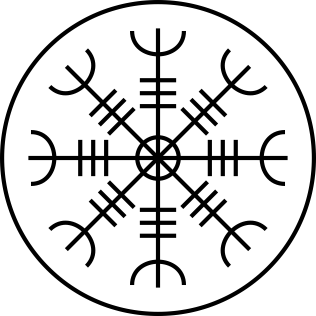
Source: Wikipedia, Oegishjalmr
In principle, we may recognize the nine worlds within this symbol (the semicircles and the circle), just as Ägir is regarded as father of the nine waves. Midgard lies at its centre, and the three crossbars between the worlds recall the light- and rainbow-bridge with its three colours. In this respect, it is a symbol of the unity of all worlds, open in every direction and reuniting within wholeness. Consciousness of this wholeness, within which nothing can be lost, naturally also grants a certain invincibility in life’s struggle. Thus, we can readily imagine Sigurd later transforming this helmet in this holistic sense, perhaps even using it as a cloak of invisibility.
Yet here, this helmet still belongs to Fafnir as the ego-dragon, and he uses it accordingly:
18. Fafnir: Poison I spewed while lying upon my father’s mighty inheritance.
19. Sigurd: Oh shining serpent, you made a mighty hissing and acquired a hard spirit (intellect). All the greater grow anger and hatred among the sons of men who wear this helmet.
Here, Fafnir begins to contemplate his nature, recognizing how he sought to defend his paternal inheritance’s golden treasure with the poison of demarcation and separation. Naturally, this self-contemplation is important for the ego-dragon to be defeated.
Sigurd confirms this contemplation and describes the serpent of separation: although a shining being of light, through its hostile poison it became a hardened intellect possessing form. Thus, the ‘protective battle-helmet of life-form’ reinforces the conception of being a separate entity. The stronger this identification becomes through attachment, the more anger and hatred grow within life. For whoever wishes to protect and assert their own form at any cost naturally fears loss and feels threatened by all other forms.
20. Fafnir: I counsel you, Sigurd: accept this counsel and ride home from here! The ringing gold, the glowing-red treasure, and these rings will kill you.
21. Sigurd: Your counsel is given, yet I shall ride to the gold lying upon the heath. But you, Fafnir, lie in your death-throes until Hel has you!
Thus, in dying, Fafnir gives wise counsel whose depth he probably does not yet recognize himself, though perhaps he senses it. Indeed, intellect and body are fundamentally there for riding home again: home to the divine origin toward which Heimdall also calls us. For the way out is also the way in. Yet naturally, we must take the golden treasure with us.
What kind of gold is this? Gold is an ancient and powerful symbol. On the one hand, it is a bright, shining, precious, and enduring raw material valued according to purity and weight. On the other, it can be shaped into desired works of art, appearing not merely beautiful and shining, but also durable and long-lasting. Later, it became ringing coins, dear money, which we believe can fulfil all our wishes. Desire for it presumably also drove Fafnir to wish to possess and defend it with glowing-red passion. That means killing and rendering ineffective anyone wishing to take it from the ego.
Accordingly, in many ancient myths, fairy tales, and legends, we find gold as a symbol of general desire, but also as a symbol of the pure, enduring, and true that every spirit fundamentally seeks. Hence, we like to interpret gold’s essence as truth.
From this perspective, too, Fafnir is right, for truth can naturally kill and render ineffective every illusion, above all the ego-illusion of demarcation and separation, like Fafnir himself, who can see only a mortal ego-being even in Sigurd. Hence, we ordinarily fear truth and would rather repress it and conceal it behind various forms.
Sigurd accepts Fafnir’s counsel, yet turns it against the counsellor himself, saying that he will take over the golden treasure. Fafnir, by contrast, must enter Hel as the clinging ego and remain there as long as his spiritual attachment to an outward form of truth persists, which he wishes to possess and hold fast in separation.
This symbolism becomes clearer if we imagine truth as pure, formless consciousness capable of assuming every form. In this respect, it can fulfil all wishes and is fundamentally the gold desired by all beings. Yet if this consciousness identifies with a particular form and clings to it, it enters a dead end, experienced as death, a dark cave, hell, or Hel when that form passes away. At some point, however, it must turn back within this dead end and rediscover formless consciousness, the divine and wholeness. For this homecoming from the illusion of form, it must naturally find and take with it the gold of truth. Indeed, it must itself be the gold of truth, for separation and demarcation can no longer exist within wholeness.
The intellect now again plays the decisive role, possessing both the ability to distinguish and separate and the ability to connect and unite through recognizing relationships. Thus, it can follow the path into illusion’s dead end, but also back out again.
22. Fafnir: Regin betrayed me. He will betray you, too, bringing death to us both. I believe Fafnir will lose his life, for your power has now grown stronger.
Here, we may reflect upon the role of the Regin-intellect as the ‘Mighty in Knowledge’. Regin was driven out into the world by his brother Fafnir because Fafnir wished to possess the golden treasure entirely alone. For this, he had killed his father and would also have been prepared to kill his brother. Hence, Regin joined with Sigurd, won him as a friend, trained him, and even forged his sword of wisdom to kill Fafnir. And Fafnir presumably rightly suspects that Regin ultimately also wishes to betray and kill Sigurd to possess the paternal treasure. He thereby threatens to take Fafnir’s place and himself become an ego-dragon seeking to defend the golden treasure with separation’s poison.
This means that the intellect itself need not yet be an ego. It can even become the ego’s enemy and train a Sigurd, whom we may regard as holistic reason in the sense of an Einherji. And this happens because the intellect itself cannot defeat the ego. Why not? It can impart knowledge, forge weapons, and show the path to the dragon. Yet as the discriminating intellect, it remains part of the ego-system, which is, in practice, its brother. Thus, it stands between reason and ego, like Regin between Otter and Fafnir.
Regin had gone away when Sigurd killed Fafnir. He returned as Sigurd wiped the blood from the sword.
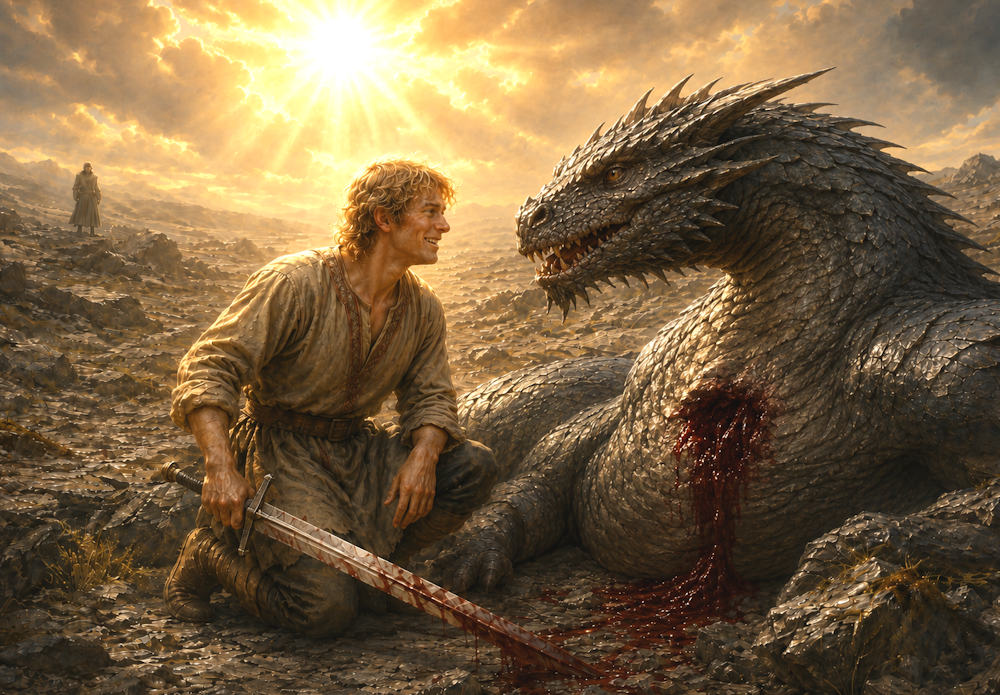
Thus, the intellect, too, was absent when reason defeated the ego. For only holistic reason can overcome the separating ego within the light of pure consciousness. Yet the intellect returned as reason cleansed its sword of wisdom of the blood-guilt of the deadly deed the intellect had desired. And now it begins to act again:
23. Regin said: Hail to you now, Sigurd! Now you have won the victory and felled Fafnir. Of the men walking upon earth, I call you the most fearless ever born.
24. Sigurd: Uncertain it is, when we all come together, the victory-gods’ sons, who was born the most fearless. Many are brave who have never reddened their sword in another’s heart’s blood.
How can the intellect most easily kill holistic reason, exalting itself above it and ruling again itself? By making it proud, so that it identifies with its deed and thereby falls from wholeness into demarcation. Thus, a new ego can grow again.
Yet Sigurd does not allow himself to be made into a born lone warrior, not even through praise, but sees himself among the eternal victory-gods’ sons as an Einherji within the divine host of unity. Thus, he does not fall into the trap of egoistic identification with a particular victory. For Sigurd does not attain victory as a personal deed: he is victory itself, which knows no losing.
25. Regin: Glad you are now, Sigurd, rejoicing in victory as you wipe Gram (‘Wrath’) upon the grass. My brother you have killed, yet I, too, have contributed my share.
26. Sigurd: You counselled me to ride here across the holy mountains. The shining dragon would still have ruled over treasure and life had you not doubted (and thereby challenged) my courageous spirit.
Now the intellect begins to assert its share in the victory, justifying its claim to the golden treasure. Sigurd at least admits that the intellect brought reason out of its ‘holy, whole world’ into the ‘Rubble-Heath’ of egoic physicality to defeat the ego-dragon there. The trick was to doubt reason’s power and demand practical confirmation. This also makes sense, for without doubt the intellect would be nothing other than holistic reason.
The name Gram for Sigurd’s sword, actually meaning ‘Wrath’ or ‘Anger’, is noteworthy here. For it was forged by the fierce anger of the discriminating intellect, which also gave it its name. In holistic reason’s hand, however, it transforms into the sword of wisdom: into ‘healing, divine wrath’, as it were, whose point, symbolizing unity, could pierce the ego-dragon’s heart.
Sigurd wipes the blood-guilt of this deed upon the grass of growing beings upon physicality’s ‘Rubble-Heath’, as though within creation’s living river. Where else? For creation exists to resolve those problems arising through separation. Wholeness itself remains pure, and holistic reason with it.
Then Regin went to Fafnir and cut out his heart with the sword called Ridill (‘Riding, Moving’). Afterwards, he drank the blood from the wound.
Here, the intellect also demonstrates its claim to victory in practice, seeking to appropriate Fafnir’s heart and blood. His sword’s name, Ridill, is difficult to interpret and might recall the intellect’s capacity to move, embody itself, and become creative within creation. And ‘cutting out’ recalls the discriminating intellect, working more with the sword-edge of separation than with the point of unity.
In the Skaldic Book §40, Regin’s sword is called ‘Refill’, which may be interpreted as ‘Wall-Hanging’ or ‘Woven Fabric’. This, too, symbolically suits the intellect, which can weave individual pieces of information into conceptual patterns with which it then adorns the walls surrounding it. Yet scribal errors may also have crept in.
The heart may be regarded symbolically as the body’s soul, and blood as its life-force. Naturally, nature’s holistic soul is also present within the ego-dragon’s heart, for wholeness is present everywhere. The problem lies in ‘cutting out’ the heart and drinking ‘blood from the wound’. Through this, Regin evidently attempts to appropriate Fafnir’s essence and life-force, so as also to command the golden treasure.
Sigurd, too, is to help with this, presumably a further trick to kill holistic reason and make it an instrument of egoistic separation and demarcation:
27. Regin: Sit now, Sigurd! I shall go to sleep, and you hold Fafnir’s heart to the fire! After this draught of blood, I wish to savour the heart as well.
‘Holding to the fire’ might mean making the raw ego-heart palatable and digestible. In the Old Norse text, this heart is even described as ‘eiskǫld’, recalling an ice-cold heart, devoid of compassion and mercilessly prepared to do anything to defend its supposed property. This is now to be made palatable. In other words, reason is to ensure that being a powerful, greedy ego is not really so terrible and painful for the intellect.
Does this sound familiar? We have long been able to observe humanity’s attempts to misuse reason, which should actually distinguish us from animals, drawing it down to this level as the servant of bodily desires. The path toward this is suggested here as ‘going to sleep’, the loss of pure consciousness’s far-sighted mindfulness within life. This also happened to Otter at the beginning, when he forgot the wholeness and divinity surrounding him and shortsightedly saw only his bodily nourishment. Indeed, in this way, holistic divine reason is lost within the human being.
28. Sigurd said: Away you went while I reddened my sharp sword in Fafnir. My power I set against the dragon’s strength while you lay in the heather.
29. Regin said: Long would you have left the old giant lying there upon the (Rubble-) Heath had you not used the sword I forged myself, your sharp sword.
Here, Sigurd rejects the intellect’s presumption in now claiming the victory for itself, although it was not even present during the actual struggle. And the intellect replies that without the sword it had forged for reason, reason could never have defeated the ego-dragon.
There is much to reflect upon here. Pure reason probably truly has no cause to change anything within this world. As holistic consciousness, it actually sees no separate ego at all. Nevertheless, it can help the intellect overcome the problem of separation if the intellect offers itself as a suitable instrument. This means that the intellect forges the sword of wisdom, and reason wields it toward victory. Thus, our intellect should serve reason, rather than the other way round.
30. Sigurd said: Spirit (reason) is better than the sword’s might when angry men fight. For I also see a brave man with a blunt sword winning enduring victory.
31. The brave fare better than the faint-hearted in the contest of battle. The cheerful fare better than the despondent in whatever they undertake.
Thus, Sigurd explains that, within the struggle of opposites, holistic reason is mightier than a sharply discriminating intellect in attaining enduring victory. And enduring victory does not mean having won once, but being victory itself, as Sigurd, too, is as the ‘Victory-Protector’. This requires courage, or fearlessness, which is actually found only within wholeness, or the divine, where nothing can be lost. There, too, the cheerfulness of pure light is at home: the serene joy of a pure consciousness that succeeds in everything because it is free to assume every form.
Sigurd took Fafnir’s heart and roasted it upon a spit. When he thought it cooked, and juice foamed from the heart, he touched it with a finger to test whether it was truly done. He burned himself and put his finger into his mouth. Yet when Fafnir’s heart’s blood touched his tongue, he understood the birds’ language. He heard what the tits were chirping among the branches.
Thus, reason now serves the intellect. Why should it not? It is free and has nothing to lose within wholeness. Yet in this service, making the raw ego-heart palatable, it tastes the heart’s blood itself through its action within the world. This blood carries the ego-intellect’s essence, yet already dying, pierced by the sword of wisdom and prepared by reason at the spiritual fire.
Here, the process we have already encountered in the gods’ stories is again suggested: the divine becomes human so that the human may become divine. Thus, divine reason now begins to understand nature’s language, just as Odin learned the secret meaning of nature’s outward signs in the Rune Song.
Regarding the tits (Old Norse ‘igða’, a feminine word for ‘small birds’), we might symbolically think of nature’s soul, like a seeress, Völva, or Wala, as the principle of causation, speaking forth from the Sea of Causes the effects seeking to unfold within the world. And what does nature’s soul speak? These are the voices of natural diversity speaking of spiritual unity:
32. One tit said: There sits Sigurd, stained with blood, roasting Fafnir’s heart at the fire. Wise would the giver of rings seem to me if he himself ate the shining muscle of life.
This might mean: There serves the eternally victorious one, stained by the ego’s essence, ennobling the ego-soul. Wise would the giver of wholeness be if he could himself eat, work out, and digest this ego-soul as life’s driving force, which fundamentally also consists only of the light of consciousness.
33. The second tit: There lies Regin, taking counsel with himself and wishing to betray the youth who trusts him. In anger he conceives wicked thoughts; the smith of harm wishes to avenge his brother.
Thus, trusting reason can now also read the discriminating intellect’s thoughts. In many legends, this intellect is symbolically described as a smith: a smith of concepts, separating what is holistically whole and healed in order to grasp it in separation and cling to it. In this direction, Regin is not upon the path to wholeness, to the ideal of the Einherjar, but wishes to become a selfish lone warrior like his brother Fafnir.
34. The third tit: Let him send the old chatterer from here to Hel, a head shorter! Then he alone can rule over all the gold, over the abundance that lay (hidden) beneath Fafnir.
This might mean: Preserve the head as the creative, acting essence of the intellect, but let conceptual identification depart to Hel as long as it wishes to cling to forms! Then holistic reason, with pure consciousness, can freely rule over truth within all forms, like Odin upon his throne of boundless far-sight.
35. The fourth tit: Wise would he seem to me if he could heed the great, friendly counsel of you sisters. Let him reflect and gladden Hugin (the ‘Thought’ flying to Odin). Where I see (a wolf’s two) ears, there I expect a wolf.
Wisdom listens to nature’s voices and recognizes what should happen within the greater whole to attain creation’s great goal. Then thoughts, too, rise toward the divine. For where outward signs are visible, the inward essence is also to be expected. This means that wherever separation is recognized, the ravenous wolf of transience already waits.
36. The fifth tit: The battle-tree (Sigurd) would not be as wise as I judged the commander of the host to be if he let one brother escape after taking the other’s life.
Once the ego of demarcation has been defeated, what does wisdom now do with the intellect of discrimination, the ‘smith of harm’?
37. The sixth tit: Without wisdom he would be if he still spared this enemy of humankind. There lies Regin, who has betrayed him. He presumably does not know how to protect himself against him.
Here is reason, and there the intellect. How can this separation be overcome so that wholeness is preserved?
38. The seventh tit: Let him make the frost-cold giant lose the rings, a head shorter. Then he is sole ruler of the treasure Fafnir possessed.
Preserve the intellect’s head and dissolve its rigid form, just as Thor fights the frost giants, who, with the rings of wholeness and regeneration, seek to appear as something whole within separation. Yet these rings truly serve a healing purpose only in reason’s possession.
39. Sigurd: Destiny is not so mighty that Regin should bring (and speak) my word of death. For both brothers shall soon depart from here to Hel!
Sigurd answers nature’s voices within the river of creation: the separating intellect can never kill holistic reason. Nor is that creation’s destiny. For only the intellect within demarcation and separation can imagine death as final annihilation. And this is the path the two brothers follow as the ‘ego-intellect’, not because Sigurd wills it, but because the ego-intellect has created this world for itself and must now experience it.
Here, it already becomes clear that the fundamental victory over the ego-dragon is only the beginning of a long process of overcoming demarcation and separation, extending within the greater whole until Ragnarök, when the wolf of transience and the Midgard Serpent are defeated throughout all creation. For ‘Ragnarök’ is the ‘destiny (rök) of the mighty in knowledge (regin)’, and thus above all the destiny of Fafnir and Regin as the ‘ego-intellect’, resolving this fundamental problem of demarcation and separation within the river of creation.
Thus, we can readily imagine how self-knowledge as reason’s victory is followed by lengthy self-realization, now described as the path of reason the human being may follow to become an Einherji.
Sigurd struck off Regin’s head, then ate Fafnir’s heart and drank the blood of both, Regin and Fafnir.
Naturally, this is not about killing people, or about something present not being allowed to exist. It concerns an exceedingly profound psychological transformation, which even then was difficult to describe in words. For as soon as we put it into words, the discriminating intellect already thrusts itself between them.
Presumably, holistic reason’s absorption into itself of the blood as the essence of the ‘ego-intellect’ is meant. In this way, reason turns the separating intellect back into a uniting intellect, and the demarcating ego into a holistic I. Here, the ideal of the Einherjar already reveals itself. Likewise, Sigurd also internalizes the heart as the ego-soul and principle of causation, whose effects must still be lived out, recognized, and dissolved. And this is what the long story of Sigurd that follows concerns.
At this point, we may also reflect that the ego’s nature of attachment and holding fast is not fundamentally wrong. The great question is simply: What does consciousness wish to hold fast? It would be reasonable to hold fast to the eternal and let go of the transient: to preserve the pure, formless gold and allow the gold’s forms to flow freely. Surely this would be simplest, requiring little action. Things become complicated, difficult, and laborious when one wishes to hold fast to the transient without recognizing the eternal at all…
The symbolism of ‘beheading’ recalls the mystical story of ‘Mimir’s Head’. It concerns Hönir and Mimir, who, after the Vanir War between spirit and nature, were handed over by Aesir-spirit to Vanir-nature: Hönir as king and Mimir as counsellor. We could also interpret this pair as reason and intellect. And the story tells how reason without intellect could neither judge nor rule within nature. There, too, Mimir was beheaded, presumably so that he could no longer run away and lose himself within physicality. The head was sent back to Odin, to the holistic divine spirit, who preserved it and restored it to life.
Regin’s beheading may be understood similarly: his attachment to physicality is struck away, while the head, as the intellect’s creative, acting essence, remains preserved and returns to the service of holistic reason.
Yet let us now see how Sigurd’s story continues:
Then Sigurd heard the tits speaking:
40. Bind up the red rings, Sigurd! It is not kingly to fear many things. A maiden I know, the fairest of all, adorned with gold, if you could win her.
Here, too, manifold nature’s voice speaks again of the rings’ spiritual unity, within which nothing need be feared. The ‘red’ may recall love, capable of reconnecting and uniting everything separate. Now the maiden, too, enters the youth’s life: spirit’s great love for nature’s soul, described in many dragon-slayer legends as the fundamental motivation for this struggle. For only true love can truly defeat the ego-dragon and the ego-intellect. Hatred does not lead to the goal here, for the ego lives upon it and only grows stronger. Sigurd already showed this love toward Regin, whom he served, and then toward nature’s voices, which he followed. And now love’s path continues:
41. Green paths lead to Gjuki (the ‘Gifted and Giving One’). Destiny shows the leader of men the way ahead. There the noble king has raised a daughter whom you, Sigurd, should win with a bridal gift.
Now this love leads him farther along life’s green path to Gjuki’s daughter. The bridal gift will presumably come from the golden treasure, probably one of the ‘red rings’. We shall later encounter this daughter as Gudrun, as the ‘God-Rune’ and nature’s holistic divine mystery.
When you know your true Self,
the mystery is yours.
(Hui-Neng, Zen master)
This true love is also unconditional love for destiny: pure trust in the decisions of the gods at the Well of Destiny, who possess the necessary far-sight. It is the generous acceptance of every circumstance we encounter in life. This is not blind submission, but trust in God and in life’s green path toward further self-realization. Accordingly, this path of divine love now leads first to the Valkyrie Sigrdrifa (‘Victory-Driver’), who chooses Sigurd as an Einherji after his victory over the ego-intellect:
42. A hall stands upon high Hindarfjall (‘Mountain of the Hinds’), entirely surrounded by fire. Wise men created it from Ogn’s (‘Terrible Battle’s’) undarkened radiance (gold).
43. I know that upon the mountain a battle-being (a Valkyrie) sleeps, and around her plays the linden’s destruction. Yggr (Odin) pricked her with the sleep-thorn. For the flax-Gefn (‘Giver of Destiny’s Thread’) felled a different hero from the one he desired.
44. Young man, you can see beneath the helmet the maiden who rode from battle upon Vingskornir (the horse ‘Earth-Plougher’?). Yet Sigrdrifa’s (the ‘Victory-Driver’s’) sleep cannot be broken against the Norns’ decree of destiny, oh kinsman of the Skjöldungs (‘Shieldlings’ as ‘Protectors’).
We have already spoken more fully of the Valkyries as ‘Choosers of the Fallen’ and Odin’s servants in Valhalla in the section ‘Valkyries’. Symbolically, we may see in them the outward circumstances and conditions of life’s struggle. Depending upon how warriors respond to these, they are either chosen for Valhalla as Einherjar or follow the path to Hel as selfish lone warriors.
Thus, a Valkyrie now also awaits Sigurd as a human being fighting heroically, unfolding destiny’s outward circumstances upon the Einherji’s path. She waits upon a mountain summit in a hall, which may be regarded as a space of consciousness, behind a fire-wall. We have already encountered the fire-wall several times as a symbolic spiritual barrier for fateful causes awaiting a particular spirit in order to unfold and work out their effects.
This also includes a story of Sigrdrifa, who had not yet chosen the right man in battle, so that Odin put her to sleep until the right one came: Sigurd. Accordingly, the names Sigrdrifa and Sigurd were surely also chosen as ‘Victory-Driver’ and ‘Victory-Protector’. This story is told more fully in the following ‘Lay of Sigrdrifa’. There, we would also like to examine more closely the many symbols within the last three verses.
Mentioned only here is the Valkyrie’s horse named Vingskornir. The name can be interpreted as ‘Earth-Plougher’, recalling the Valkyrie’s bodily nature, which, like a farmer with his plough, ensures that only what should grow does grow. Accordingly, Sigrdrifa, too, lies like a seed within the earth, awaiting Sigurd’s spiritual sun so that she may unfold according to destiny.
Yet first, Sigurd now takes over the dragon’s golden treasure:
Sigurd rode along Fafnir’s trail to his dwelling and found it open. The doors and doorposts were iron, as were all the house’s beams, yet it was dug deep into the earth. There Sigurd found a great deal of gold and filled two chests with it. From there, he also took the Aegis-Helmet (‘Helmet of Life-Form’), the golden coat of mail, the sword Hrotti (‘Violence’), and many precious things, loading them upon Grani (his ‘horse’). Yet the horse would not move until Sigurd mounted its back.
(Fáfnismál, based on Arnulf Krause, Edward Pettit, and the Old Norse source)
Thus, reason now follows the ego’s trail back to its root, to a ‘dwelling’ likewise imaginable as a space of consciousness, bounded by iron concepts and dug deep into physicality’s earthly matter. There, Sigurd finds and takes over the paternal inheritance that Fafnir had selfishly seized and sought to hold fast within demarcation. This includes the gold of truth, once received by the father from the gods, but also this gold’s outward forms as helmet, coat of mail, sword, and further useful things. Sigurd now loads these upon his horse, symbolizing his physicality, while he himself is the spirit enlivening and moving it.
In this transfer of golden things from egoic separation into holistic reason, we may also imagine a spiritual purification. The helmet protecting the head recalls the intellect; the coat of mail as breast-armour recalls physicality; and through reason, the sword of violence transforms into a sword of wisdom. What the ego previously ruled and concealed can now once again serve wholeness openly and freely.
This applies above all to the gold Sigurd places within two chests and loads upon his horse. The two chests recall the bodily world of opposites, which fundamentally are not so opposed at all, since they all contain the same gold of truth: pure information and pure consciousness. Upon the right and left of physicality’s horse, they ensure a certain balance during movement. Thus, physicality does indeed carry duality, yet within it truth continues to act as unity and wholeness.
We may regard this dragon fight of Sigurd as a central story around which manifold further stories unfold: on the one hand, the earlier history of Regin and Sigurd; on the other, the continuation of Sigurd’s path within the human world. From a spiritual perspective, this victory over the ego-intellect of demarcation and separation may also be interpreted as the culmination of ‘self-knowledge’. For who are we without ego? The subsequent story would then be the lengthy path of ‘self-realization’, allowing accumulated karma to work itself out, much as the gods’ stories also describe upon the path toward Ragnarök.
Comparison with the Nibelung Legend
We have thus encountered a dragon fight sharing many similarities with Siegfried’s dragon fight in the Nibelung legend, yet also showing certain differences. Regin and Mimer play similar roles as smiths of the intellect. Mimer here recalls the creative Mimir-intellect. Siegfried’s development, too, may be regarded as a path toward holistic reason. To this end, he defeated the ego-dragon and also killed the smith Mimer, who initially served as his teacher but then sought to make himself master over Siegfried. Through bathing in the dragon’s blood, Siegfried became invulnerable, which may also be interpreted as spiritual recognition of the imperishable essence revealed through the ego’s death. For through the ‘linden leaf’ that fell upon his shoulder while bathing, his body remained mortal.
Siegfried wins the golden treasure only later from the two brothers Schilbung and Nibelung, who, like Fafnir and Regin, quarrelled over their paternal inheritance. This then becomes the ‘Nibelung Treasure’, the ‘Golden Treasure of the Mist-Beings’. Yet Siegfried does not take personal possession of it, leaving it within the nature of the Nibelung realm, where the dwarves, led by Alberich, continue to guard it. He also defeats Alberich in battle, winning from him the cloak of invisibility. We have already compared this with the Aegis-Helmet, for both confer a certain power over bodily appearance. Similarly, the golden coat of mail won by Sigurd recalls Siegfried’s bodily invulnerability. And the sword Hrotti from the treasure recalls Balmung, the sword Siegfried received from the Nibelung Treasure.
Thus, from a spiritual perspective, both traditions reveal the same fundamental idea: the ego-dragon is overcome, and a human being of reason is gained.

