
| Content | Next | About |
Cosmology and Ragnarök
We have now come a long way on our spiritual journey through the wondrous world of Old Norse mysticism. Slowly, we are approaching Ragnarök, the great showdown with a happy ending and a happy beginning. To this end, we would like to examine more closely the cosmological conceptions described in the Edda and explore how people of that time imagined the world, both great and small. Today, we work with formulae and scientific models that require lengthy study and are also difficult to get out of our heads again. Evidently, people then preferred familiar symbols from everyday life, applying the principles they could observe and experience on a small scale to the greater whole. We would like to begin with the Lay of Vafthrudnir.
The Lay of Vafthrudnir
1. Odin: Counsel me now, Frigg (Odin’s wife), for I am drawn to journey forth and visit Vafthrudnir (the ‘Mighty Entangler’). Great is my thirst for knowledge, to compare myself in ancient (original) knowledge with the all-wise giant.
2. Frigg: At home I would keep the Father of Hosts, within the gods’ court, for I know no giant as strong as Vafthrudnir.
3. Odin: Much have I travelled, much have I attempted, much have I tested the counsellors (the mighty in knowledge). Now I wish to know the nature of Vafthrudnir’s dwelling.
This song again makes clear that our conceptions of the world consist above all of knowledge. Even if we believe in solid matter, we should occasionally recall the biblical saying: ‘In the beginning was the Word.’ Or modern physicists such as Anton Zeilinger: ‘Information is the primordial substance of the universe—reality and information are the same.’ Or Hans-Peter Dürr: ‘Matter is congealed spirit that can no longer think of anything.’ Or Konstantin Wecker, who sings in memory of Hans-Peter Dürr: ‘You may grasp it, yet you cannot comprehend it. For what you see is only frozen light.’ Thus, we ultimately return to the light of consciousness and our knowledge as the foundation of everything in the world.
Hence, even Odin now speaks of his ‘great thirst for knowledge’. How can a holistic god thirst for knowledge? Is he not all-knowing? Indeed, he surely is. And Odin in particular is always conscious that this entire creation is drawn by the Mimir-intellect from his own eye, while he watches with his other eye. Yet there are also many creatures, such as ourselves, who do not yet recognize themselves as a whole within creation and live in separation. For them, Odin embodies the thirst for knowledge, which also appears symbolically as an eagle capable of rising from the World Tree. For them, he hung upon the World Tree for nine long nights to learn runic magic. And for them, he travels through the world, challenging them in the battle of knowledge, so that they may find holistic wisdom and ultimately recognize themselves again within the whole. Indeed, this is the wondrous ‘power of knowledge’: to bring forth vast worlds full of creatures, yet also to dissolve them again and recognize the truth behind everything.
Thus, the mountain and frost giants, too, consist of knowledge that has hardened and embodied itself as the conceptual mind: a rigid and frozen light of consciousness. And just as Thor fights them with his hammer to keep creation alive, Odin now struggles in his own way against rigid concepts and opinions. Here, we may see the path of action on the one hand and the path of insight on the other, ultimately becoming one again. Hence, there is also a similar song about Thor and the dwarf All-Wise.
Yet Frigg, Odin’s wife, in whom we may recognize the soul of creation, was initially unenthusiastic. Why? Well, when a god struggles with a creature, there is naturally always the danger that the creature within us will triumph, and that our conception of and belief in a deity will be lost. How many people have been introduced to divine knowledge? Yet their intellect refused, hardened in opposition, and the harm exceeded the benefit. Hence, Frigg now also asks that the intellect prove useful and that Odin remain whole and unharmed:
4. Frigg: Journey safely and return safely! May healing attend you upon your paths! May your intellect serve you, Father of Humankind, when you exchange words with the giant.
5. Then Odin journeyed forth to test this all-wise giant’s eloquence. He came to the hall owned by Imr’s (‘Ember, Strife’s’) father. At once, Ygg (Odin) entered.
6. Odin: Hail to you, Vafthrudnir (‘Mighty Entangler’)! Now I have come into the hall to see you yourself. Above all, I wish to know whether you are clever and all-wise, giant.
7. Vafthrudnir: What man is this who addresses me within my hall? Never shall you leave our halls unless you are the cleverer one.
8. Odin: Gagnrad (‘Counter-Counsellor, Victory-Counsellor’) is my name. Now I have come into your hall thirsty from my journey. Long have I travelled, in need of invitation and your welcome, giant.
9. Vafthrudnir: Why, then, do you speak from the forehall, Gagnrad? Come to a place within the hall! There it will be revealed who knows more: the guest or the old thul (speaker).
Wonderful! The All-Father comes not as a tyrannical ruler but appears humbly as a guest, a ‘visitor’ who, after a long journey through the river of creation, needs invitation and welcome. Thus, Odin now enters the hall of consciousness that Vafthrudnir, as the ‘Mighty Entangler’, has built through the creative power of his intellect. How did this happen? Such an intellect can recognize manifold connections between conceptual thoughts. Thus, it can weave itself a great net in which it also entangles itself, creating a personal identity. This is Me! And ultimately, the concepts virtually harden into stones with which it can even build itself an apparently solid body-castle that it then wishes to defend. Made, as it were, of ‘frozen light’ or ‘water of life’, hence the expression ‘frost and mountain giants’.
The holistic god approaches him cautiously, speaking ‘first from the forehall’, thus more from the outward world. As usual, he assumes a name and form that seem useful under the given circumstances. How else could the intellect recognize a holistic god who is himself formless and unites everything within himself? Vafthrudnir thus grows curious and asks who this man is. Indeed, he positively challenges him—calls him in. Yet the visitor naturally remains cautious, so as not to ‘come crashing through the door’ at once and cause more harm than good:
10. Odin: A man without possessions who comes to a rich man should speak usefully or remain silent. Great talkativeness, I believe, leads to ill when one comes to a cold-ribbed one (a frost-giant intellect).
11. Vafthrudnir: Then tell me, Gagnrad, since you wish to test your skill from the forehall: What is the name of the horse that passes over humankind each day?
12. Odin: Skinfaxi (‘Light-Horse, Shining-Mane’) is the name of the horse that passes over humankind in the radiant day. To the Hreidgoths (‘Riding Goths’, or humans), it seems the best of horses, and the horse’s mane shines always.
13. Vafthrudnir: Tell me, Gagnrad, since you wish to test your skill from the forehall: What is the name of the steed that draws night from the East over the glorious counsellors (the mighty in knowledge)?
14. Odin: Hrimfaxi (‘Dark-Horse, Frost-Mane’) is the name of the steed that passes over the glorious counsellors each night. Every morning it sheds drops of foam, and from them comes the dew in the valleys.
Why does God come from outside? Meister Eckhart also writes on this: For herein lies a great evil: that the human being places God at a distance. For whether a person walks far away or near, God never goes far away; he remains constantly near. And if he cannot remain within, he withdraws no farther than just outside the door. (Meister Eckhart, Talks of Instruction)
Thus, the inquisitive intellect first begins to ask about the phenomena of the outward world that it sees within the play of opposites. The most wondrous opposition is probably that between day and night, light and darkness, appearing and disappearing, for our world exists between them. And just as the frost-giant intellect asks for conceptual names, Odin answers with symbolic names, already making clear that this concerns the intellectual world of ‘Gylfi’s Delusion’, the ‘Delusion of the Foaming Wave’. There, we are told that Night was a dark giant’s daughter and that Day was born to her. The two horses of day and night then recall the embodiments of sun and moon, while their chariots might be seen as the blue daytime sky and the starry sky at night. This is presumably how Vafthrudnir imagines his world, and Odin initially seems to confirm this conception to gain his trust.
Yet ‘Gylfi’s Delusion’ also emphasizes the gods’ role: Day’s father was an Ase as the divine dawn, and the All-Father gave day and night their horses and chariots. Similarly ambiguous are the counsellors in the text. In the Edda, the Old Norse word ‘regin’ usually refers to the gods. Here, however, it evidently means all beings possessing the power to shape creation through their knowledge and living within the world of day and night.
This is presumably also why Odin mentions the dew in the valleys. To people of that time, the morning dew at night’s end must surely have been a great wonder: where these drops of water, and even frost, suddenly came from, only to disappear again beneath the sun. Here, too, we may recognize a magical runic mystery, inviting reflection on the spiritual principles mirrored within it.
15. Vafthrudnir: Tell me, Gagnrad, since you wish to test your skill from the forehall: What is the name of the river that divides the land between the giants’ sons and the gods?
16. Odin: Ifing (‘Wave-River, Yew-River’?) is the name of the river that divides the land between the giants’ sons and the gods. Freely it shall flow for all time, and never shall there be ice upon the river.
17. Vafthrudnir: Tell me, Gagnrad, since you wish to test your skill from the forehall: What is the name of the field where the battle between Surt (the fire giant Surtur) and the gentle (merciful) gods takes place?
18. Odin: Vigrid (‘Battle-Wave, Battle-Rider’) is the name of the field where the battle between Surt and the gentle gods takes place. A hundred miles it measures in every direction. This is the field appointed to them.
19. Vafthrudnir: Clever you are, guest; come to the giant’s bench! Let us converse together upon the seat! Let us wager our heads upon our cleverness within the hall, guest.
Thus, Vafthrudnir’s conceptual mind continues to ask about opposites, entangling itself within them. What is this river dividing the world between the sons of the spiritual gods and bodily giants? The ‘Yew-River’ recalls the Tree of Life and the river of life with its two banks of spirit and nature. It will always flow, even if in waves. For the gods, as holistic beings on both sides of the river, ensure that it never becomes entirely rigid. Odin’s son Vali also symbolizes this as the god of the life-principle, who remains unmarried and even survives Ragnarök.
Yet the bodily giant naturally sees an end to his life. Thus, he now also asks about Ragnarök’s field, where the gods meet their end. Odin gives this field a mystical name suggesting rather a being that rides upon the battle of opposites, presumably meaning the worldly intellect. Its size, too, is probably symbolic, the hundred suggesting the 100% of wholeness. This means that the field is everywhere: in all worlds, throughout the intellect’s entire creation.
From these answers, the giant evidently senses that he is not speaking with an ordinary guest. Thus, he invites him into his hall, presumably even to the high seat, or throne, at his side. Yet naturally only a king can sit there. Thus, the wager now concerns the head, or intellect: the giants’ general question of ‘dominance’. Who has power over whom or what? Does spirit rule the body? Or the body spirit? And just as the giant previously questioned the god in the outward world, the god now questions the giant from within. Here, we can readily imagine how, in a person’s mature years, questions suddenly arise that challenge their familiar world of conceptions:
20. Odin: Tell me this first, if your intellect is worth anything and you know it, Vafthrudnir: Whence originally came the earth and the heavens above, wise giant?
21. Vafthrudnir: From Ymir’s flesh (the ‘Hermaphrodite’, the ‘Ice-Giant of the Frozen Universe’) the earth was created, and from his bones the mountains; the heavens from the ice-cold giant’s skull, but the sea from his blood.
22. Odin: Tell me this second, if your intellect is worth anything and you know it, Vafthrudnir: Whence came the moon, to pass over humankind, and the sun as well?
23. Vafthrudnir: Mundilfari (the ‘Time-Moved One’) is the name of the father of the moon and also of the sun. They shall circle the heavens each day, allowing humans to reckon the years.
24. Odin: Tell me this third, since you are called clever and you know it, Vafthrudnir: Whence came the day that passes over the people, and night with the new moon?
25. Vafthrudnir: Delling (‘Dawn’) is the name of Dagr’s (Day’s) father, while Nott (Night) was born to Nörfi (the ‘Dark Giant’). The glorious counsellors (the mighty in knowledge) created full moon and new moon, allowing humans to reckon the years.
26. Odin: Tell me this fourth, since you are called wise and you know it, Vafthrudnir: Whence originally came winter and warm summer to the wise counsellors?
27. Vafthrudnir: Vindsval (the ‘Wind-Cold One’) is the name of Winter’s father, but Svasud (the ‘Gentle One’) of Summer’s.
Thus, Odin now begins to question the bodily giant’s intellectual world. First, he asks about the origin of outward creation. Naturally, the giant again sees a bodily giant from whom everything arose. So it is also told in ‘Gylfi’s Delusion’. Yet there we also read: ‘He (God and the All-Father) created heaven, earth, and air, together with everything belonging to them.’ Here, the intellect’s wondrous quality reveals itself: it can view everything from different perspectives. Is creation spiritual, then, or bodily?
Similarly, Odin then asks about the origin of sun and moon, day and night, summer and winter within worldly opposites’ play. Here, too, ‘Gylfi’s Delusion’ can be understood as saying that everything descends from Ymir, yet also from Mimir out of Odin’s eye. Thus, for example, it says of the sun: ‘The gods had created it to illuminate the world, from the sparks that flew out of Muspelheim.’
28. Odin: Tell me this fifth, since you are called wise and you know it, Vafthrudnir: Who was the oldest of the Aesir, or of Ymir’s kin, in ancient days?
29. Vafthrudnir: Countless years before the earth was created, Bergelmir (‘Mountain-Crier’) was born. Thrudgelmir (‘Power-Crier’) was his father, Aurgelmir (‘Mud-Crier’) his grandfather.
30. Odin: Tell me this sixth, since you are called clever and you know it, Vafthrudnir: Whence originally came Aurgelmir among the giants’ sons, O wise giant?
31. Vafthrudnir: From Elivagar, drops of poison splashed and grew until a giant (Aurgelmir, or Ymir) arose from them. All our families arose together there; hence, they are always deeply terrible.
Thus, Odin cautiously pursues the questioning ever further toward the origin of Everything, which also contains the question of truth: of what was before anything came to be. Yet the giant’s intellect clings stubbornly to bodily creation, where it can imagine something tangible. In ‘Gylfi’s Delusion’, Elivagar is described as a river of rivers that moves away from its origin and increasingly freezes and becomes rigid, thus becoming the frost giant Ymir, whom the frost giants also call Aurgelmir, the ‘Thawing Ymir’. The poison, or harm, would be separation from the origin, and thus from life, also giving rise to terrible suffering. The ending Gelmir can be interpreted as ‘crying, roaring, or clamouring’, which initially seems ill-suited to a rigid frost giant. Presumably, it means the inner potential of mighty knowledge, naturally striving eventually to thaw again and express itself, or work out its effects. Some scholars also interpret Gelmir as ‘Barley’, recalling the karmic seed that seeks to grow and work out its effects.
Thus, our modern science also knows how much power and force are contained within matter, allowing the most terrible atomic bombs to be made from it. This, too, was a ‘loud cry’ passing through our world.
32. Odin: Tell me this seventh, since you are called clever and you know it, Vafthrudnir: How did the bold giant beget children when he had no love-play with a giantess?
33. Vafthrudnir: Beneath the frost giant’s arm, they say, a girl and boy grew together. Then one foot, with the wise giant’s other foot, begot a six-headed son.
34. Odin: Tell me this eighth, since you are called wise and you know it, Vafthrudnir: What do you remember first, and what is the oldest thing you know? Surely you are all-wise, giant.
35. Vafthrudnir: Countless years before the earth was created, Bergelmir was born. This I remember first: that this clever giant was laid upon a ship (or a mill-casing).
If a body, as Ymir, is the origin, whence then come man and woman? Here, the giant’s intellect imagines a separation like that of Adam and Eve. Symbolically, we might think of the World Tree with its right and left halves as spirit and nature. Its two feet would then be the Wells of Destiny and Birth, between which a six-headed son is begotten and born within the Well of Creation. This would have to be Thrudgelmir as the son of Aurgelmir, or Ymir: a living, and therefore powerful, Gelmir, as it were. The six heads recall the five senses together with thought. Yet in him, too, we might symbolically recognize the living World Tree: the upper six worlds as his heads, Muspelheim and Niflheim as his arms, his body as Jötunheim’s trunk, and his feet, or roots, upon which he stands, as the two Wells of Destiny and Birth. From this arose Bergelmir, the materially living creation from which the earth also arose, floating like a ship upon the Sea of Life, or Sea of Causes. As for the mill-casing, we might also think of the mill Grotti, or of Thor’s hammer as the Crusher, keeping creation alive.
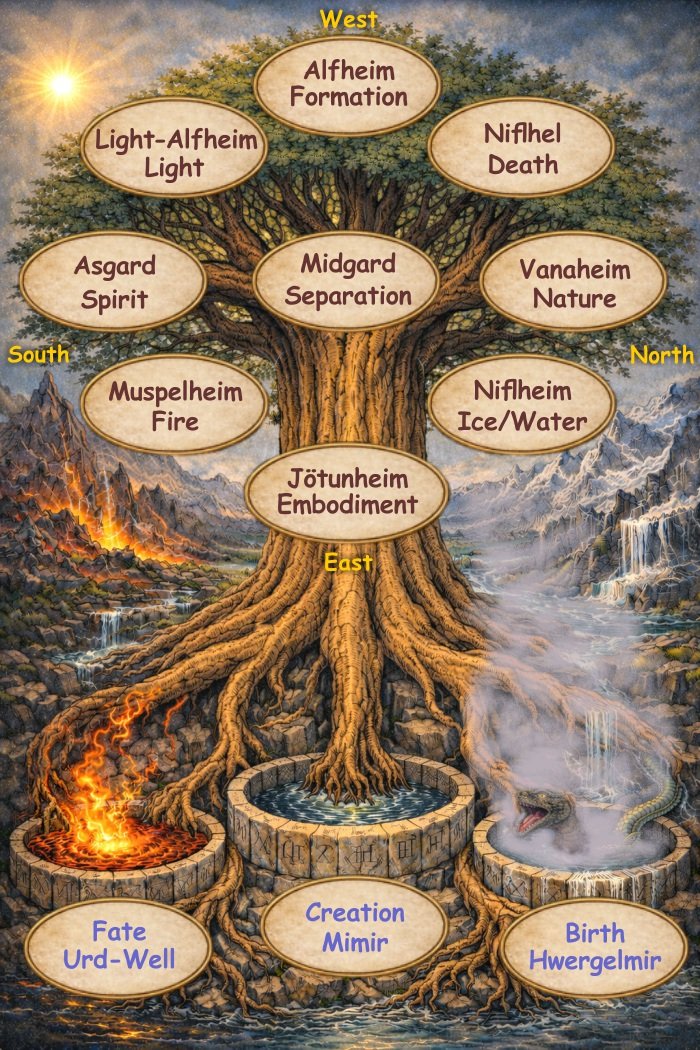
Yet the bodily giant’s intellect cannot remember farther back. Thus, with his ninth question, Odin cautiously begins to ask about something invisible:
36. Odin: Tell me this ninth, since you are called clever and you know it, Vafthrudnir: Whence comes the wind, to blow over the water? Yet never is it itself seen.
37. Vafthrudnir: Hräsvelg (‘Corpse-Devourer’) is the name of the one sitting at the (northern) edge of heaven, a giant in an eagle’s guise. From his wings, they say, the wind passes over all beings.
Here, too, the giant answers with another conception from ‘Gylfi’s Delusion’: a giant in an eagle’s guise. Presumably, this signifies desire, also manifested as the thirst for knowledge, stirring the wind of spirit as it attempts to rise from the limited world back into wholeness. This is indeed the great goal, yet it remains impossible for a bodily separate being that sees only bodily creation. Hence, Odin cautiously continues his questioning about the gods’ origin:
38. Odin: Tell me this tenth, since you know the gods’ entire destiny, Vafthrudnir: Whence came Njördr among the sons of the Aesir? Temples and altars he has in great number, yet he was not born among the Aesir.
39. Vafthrudnir: In Vanaheim, wise counsellors (the mighty in knowledge) created him and gave him as a hostage to the gods. At the world’s end, he will return home to the wise Vanir.
Here, Odin alludes to the great war between the Aesir and Vanir as spirit and nature at creation’s beginning. No decision could be reached, and both sides agreed upon peace and recognized one another as holistic gods. To this end, ‘hostages’ were symbolically exchanged, and the Vanir Njördr became an Ase. Yet here, too, the giant cannot imagine that both sides share the same divine nature. He insists upon his distinction, so that at the world’s end Njördr becomes a Vanir again. Hence, Odin now asks about life’s course:
40. Odin: Tell me this eleventh, where the men practise battle in the courtyard each day: What do the Einherjar do with the Father of Hosts until the counsellors perish?
41. Vafthrudnir: All the Einherjar strike (fell) one another each day in Odin’s court. They choose the fallen and ride home from battle. Then they sit together all the more reconciled.
42. Odin: Tell me this twelfth, since you know the gods’ entire destiny, Vafthrudnir: What is the certain truth of the mysteries of the giants and all the gods, all-clever giant?
43. Vafthrudnir: Of the mysteries of the giants and all the gods, I can tell the certain truth, for I have visited every world. Through nine worlds I travelled down to Niflhel, where beings die in Hel (the dark cave, or hell).
The Einherjar are a typical example of life’s regeneration. Thus, ‘Gylfi’s Delusion’ tells how they fight one another each day in Odin’s court, the All-Father’s creation, and all fall. This means there are no victors, which is ingenious, for neither are there any losers or any loss of life. Thus, they choose themselves as the fallen for life, to sit together afterwards still more reconciled. The bodily giant’s intellect does speak of this as he heard it in ‘Gylfi’s Delusion’, yet evidently cannot understand it.
For when Odin enquires further, he speaks of death as the end of life in Niflhel, the ninth world. Indeed, this is presumably how every bodily being thinks who lives as a lone warrior rather than within the divine host of unity. It believes that the most certain thing in life is death, for everything born must die again, and everything arising must pass away again. Hence, Odin asks ever more insistently about the origin of Everything. What is it that always remains and never passes away?
Thus, a circle of twelve questions closes, followed by six further essential questions leading toward the climax, all beginning with the refrain from verse 3, with which Odin set out upon his ‘visit’:
44. Odin: Much have I travelled, much have I attempted, much have I tested the counsellors (the mighty in knowledge). Which beings live when the infamous Fimbulwinter (the ‘Great Winter’ at Ragnarök) has passed over the beings?
45. Vafthrudnir: Lif and Lifthrasir (‘Life and the Urge to Live’), for they will hide within Hoddmimir’s (‘Hoard-Mimir’s’) wood. Morning dew they have for food, and from them the generations arise again.
Here, too, the giant repeats the words of ‘Gylfi’s Delusion’: how life as feminine and masculine, or nature and spirit, survives even Ragnarök. This happens within a spiritual forest of conceptions that then becomes Mimir’s Well again, the Sea of Causes. Yet the intellect then divides this Mimir’s Well of Creation again into Urd’s Well of Destiny for spiritual creation and Hvergelmir’s Well of Birth for bodily creation. In the latter, we again find a ‘Cauldron’-Gelmir, the ‘cry or clamour’ of embodiment, or of the ‘Barley’ that is then ground within the world’s mill into ‘Frodi’s Peace’, or brewed into ‘Ägir’s Beer’.
Within this Mimir’s Well, ‘Lif and Lifthrasir’ survive as living beings of nature and spirit. They feed upon divine morning dew, the water of eternal life, which condenses and crystallizes again through night’s influence. From it, the generations of all beings arise anew. Yet has the giant also understood this meaning profoundly? Thus, a question follows to test his understanding:
46. Odin: Much have I travelled, much have I attempted, much have I tested the counsellors. Whence does the sun return to the clear heavens after the Fenrir Wolf has swallowed her?
47. Vafthrudnir: Elf-Gleam (the sun) bears a daughter before Fenrir seizes her. She shall ride her mother’s paths when the counsellors die.
Depth is evidently still lacking, for Vafthrudnir can again imagine the bodily sun only within a bodily creation, rather than a spiritual one, as ‘Gylfi’s Delusion’ also says: ‘The gods had created it to illuminate the world, from the sparks that flew out of Muspelheim.’
48. Odin: Much have I travelled, much have I attempted, much have I tested the counsellors. Who are the maidens (virgins) who travel over the sea, journeying with wise intent?
49. Vafthrudnir: Three mighty streams fall from Mögthrasir’s (the ‘Urge for Sons’) maidens over the farmstead (of creation). They alone are the world’s guardian spirits, although they grew up among the giants.
Presumably, the three Norns of destiny are meant here: Urd, Skuld, and Verdandi as general destiny, personal guilt, and personal merit, coming from the Sea of Causes and determining creation. They are thus three aspects of nature’s pure soul as the principle of causation, while their father strives for sons as spiritual effects.
Thus, Odin now asked directly about Urd’s Well of spiritual creation. Yet Vafthrudnir’s intellect assigned even these powers of destiny protecting creation to the bodily race of giants. This is naturally not fundamentally wrong, yet brings him no closer to deeper understanding.
50. Odin: Much have I travelled, much have I attempted, much have I tested the counsellors. Which Aesir rule over the gods’ inheritance when Surt’s flame dies out (and the fire giant Surtur has burned everything at Ragnarök)?
51. Vafthrudnir: Vidar and Vali (Odin’s sons ‘Stillness’ and ‘Life’) rule the gods’ sanctuary after Surt’s flame has died out. And Modi and Magni (Thor’s sons ‘Courage’ and ‘Might’) will wield Mjölnir, continuing Vignir’s (Thor’s) struggle.
52. Odin: Much have I travelled, much have I attempted, much have I tested the counsellors. What becomes of Odin at life’s end, when the counsellors (the mighty in knowledge) perish?
53. Vafthrudnir: The (Fenris-) wolf will swallow the All-Father. Vidar (the god of silence) will avenge this. The hostile jaws he will tear apart in battle against the (Fenris-) wolf.
Indeed, it is a long journey for our intellect to penetrate to the origin. Yet it is the great path, and creation’s All-Father persistently asks about it again and again. What remains when all creation burns and every formation dissolves? Here, too, the intellect-giant again relies upon ‘Gylfi’s Delusion’. There, we are told how creation’s fundamental principles survive even Ragnarök. Most difficult to understand is probably Vidar, the ‘god of silence and silent warrior within the forest’ of conceptions, as he is called in the Skaldic Book. The proverb says: ‘Silence is golden, speech is silver.’ Thus, Vidar comes closest to the gold of truth: formless consciousness, capable of assuming any form and thus the enduring foundation of everything, the celebrated ‘Philosopher’s Stone’. Hence, ultimately every form of Odin, and the All-Father’s entire creation, must also be swallowed by the wolf of transience. For everything arising must pass away again. Only one can overcome this wolf, and this is again Vidar: silent, formless consciousness itself, Odin’s eye. He can tear the wolf’s jaws so far apart that a vast space of consciousness opens again for a new creation. Powerful symbolism!
Thus, Odin now asks about himself:
54. Odin: Much have I travelled, much have I attempted, much have I tested the counsellors. What did Odin himself say into his son’s ear before mounting the funeral pyre?
55. Vafthrudnir: No being knows what you said into your son’s ear in ancient days. With a mouth doomed to death I spoke my ancient knowledge, even of Ragnarök. With Odin I have now tested my eloquence. You will always be the wisest.
(Vafþrúðnismál, based on Arnulf Krause, Karl Simrock, and Edward Pettit)
Thus, the Lay of Vafthrudnir ends as abruptly as a Zen koan, with a breakthrough of intuition. There is much to reflect upon here. The usual interpretation holds that this is the funeral pyre of Odin’s son Baldr, the god of brightness, killed with Loki’s weapon by his own brother Hödur, the god of darkness. This story, too, is told in ‘Gylfi’s Delusion’. Yet it does not say whether Odin whispered anything into his son’s ear upon the funeral pyre. It says only that he placed the golden ring Draupnir into the fire as well, the ring of renewal and regeneration, which Baldr then sent back from Hel’s realm of the dead with his brother Hermodr as ‘Messenger’. Indeed, within this profound symbolism we may recognize life’s nature. Yet Odin himself?
We suspect that Odin’s own funeral pyre is meant here: how, at Ragnarök, he burns as the All-Father together with all creation in Surtur’s fire. He then whispers his final message into his son Vidar’s ear as a legacy and the beginning of a new creation—at the origin of primordial days, as it were. Yet what can one whisper into the ear of a god of stillness so that no one hears it? Here, we might reflect upon Odin’s own true nature: silent and formless consciousness, expressing itself everywhere within creation so that beings may recognize themselves within it. This thus concerns the celebrated self-realization. As the final verse so beautifully says: the mouth is doomed to death, yet neither the speaker nor the listener is. Throughout creation, knowledge, or consciousness, speaks with itself: one of Odin’s eyes with the other, as divine consciousness and self-consciousness. Whatever we wish to call it, for we cannot grasp it. Even ‘Gylfi’s Delusion’ tells of this divine consciousness. And with this insight, Vafthrudnir, the ‘Mighty Entangler’, disappears as the bodily intellect together with his own knowledge. The Lay of Vafthrudnir has ended, yet truth remains.
Wonderful! Who am I? Indeed, human beings can experience such things. Even C. G. Jung, the famous psychiatrist and founder of modern analytical psychology, writes in his ‘Memories’:
I had once before dreamed about the problem of the relationship between the Self and the ego. In that earlier dream, I was travelling on foot. I walked along a small road through a hilly landscape; the sun was shining, and I had a broad view all around. Then I came to a small wayside chapel. The door stood ajar, and I entered. To my astonishment, there was neither an image of the Virgin Mary nor a crucifix upon the altar, but only an arrangement of magnificent flowers. Then, however, I saw a yogi seated on the floor before the altar, facing me—in the lotus posture and in deep meditation. Looking more closely, I recognized that he had my face. I was profoundly startled and awoke with the thought: Ah, so this is the one meditating me. He has a dream, and I am that dream. I knew that when he awoke, I would no longer exist.
(C. G. Jung, Memories, p. 326)
In this ‘awakening’, we may recognize the goal of all creation: the goal of the thirst for knowledge, of the intellect, of wisdom, and also the goal of ‘Gylfi’s Delusion’. And having spoken of it so much in fragments, we would now like to examine this Edda text more closely once again as a whole.

